Ether Way, You're In
In 1887, two American physicists named Michelson and Morley ran what became the most famous failed experiment in the history of science.
They were trying to detect "luminiferous ether," the invisible medium scientists had believed for centuries carried light waves through the universe.
They found nothing. Ether didn't exist. The null result helped lay the groundwork for Einstein's theory of special relativity, and the concept was buried for good.
Fast forward to 2013: a 19-year-old Russian-Canadian programmer named Vitalik Buterin was scrolling through a Wikipedia list of science fiction terms looking for a name for his new blockchain.
He landed on "Ethereum" because it contained the word "ether," and he liked the idea of his network being the invisible, imperceptible medium that everything else ran on. A dead scientific theory, resurrected as the world's second-largest cryptocurrency.
And now Wall Street is trying to own a piece of it without touching it.
That last part is where ETHA comes in. The iShares Ethereum Trust ETF is BlackRock's answer to investors who want Ether exposure without the crypto wallet, the seed phrase, and the existential dread of accidentally sending $50,000 to the wrong address on an irreversible blockchain.
Launched in June 2024, it now holds $6.86 billion in net assets, custodied entirely through Coinbase Prime, the institutional arm of Coinbase Global (COIN).
One custodian, one exchange, for the entirety of the second-largest cryptocurrency ETF on the market.
ETHA is a Delaware Statutory Trust that holds physical Ether as its sole asset. When you buy shares, you own a fractional claim on that Ether.
You cannot use it to transact on a blockchain or deploy decentralized applications the way direct ETH-USD ownership would allow.
The tradeoff is regulatory compliance, brokerage account accessibility, and no seed phrase to lose.
The expense ratio is 0.25%, shares are created and redeemed in batches of 40,000 by authorized participants, and there's no leverage or derivatives involved.
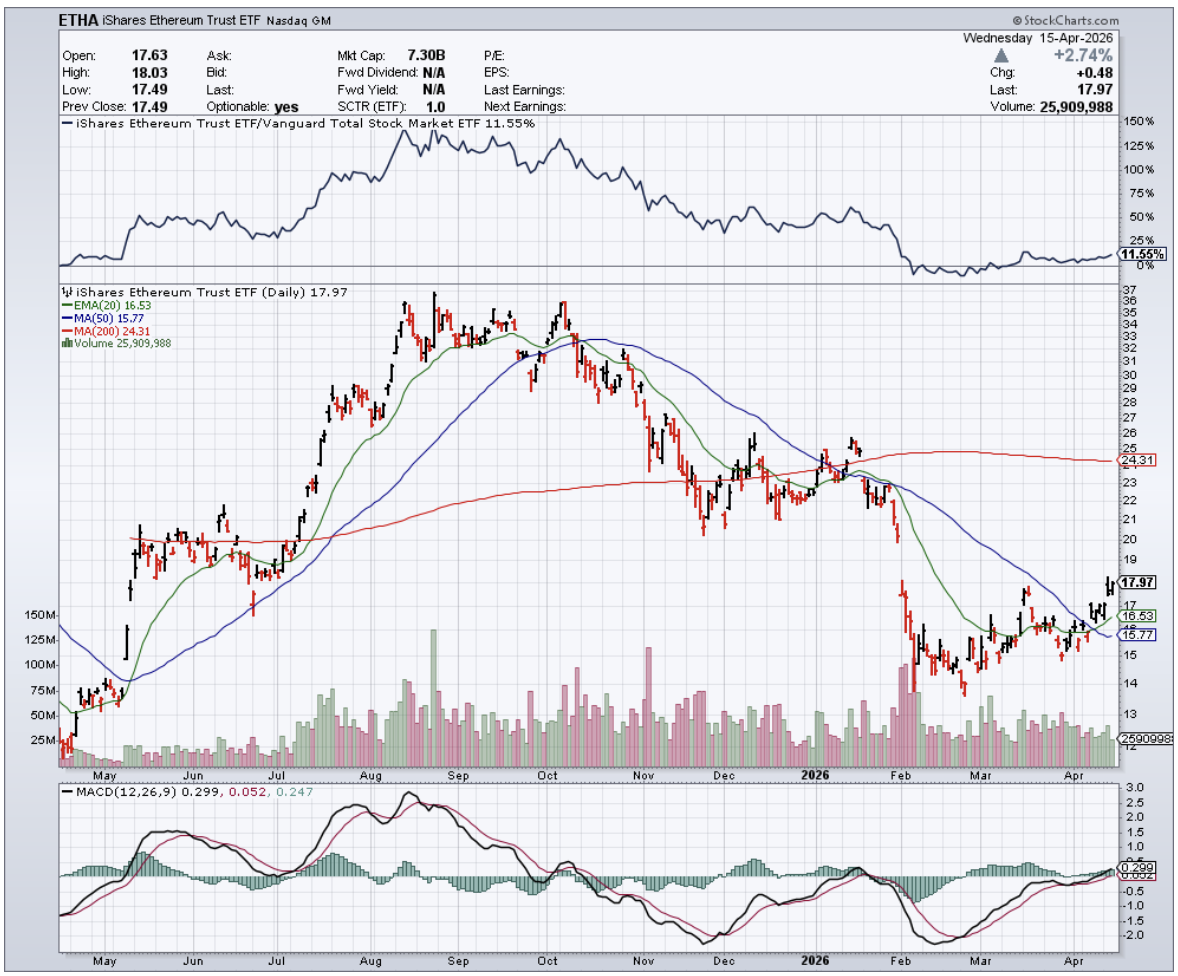
Now the part that matters for active investors. Since inception, ETHA has returned 49.17% against ETH-USD's 33.52%. That gap looks like alpha. It isn't.
ETHA has been trading at a premium to its NAV, currently 0.33% as of mid-April, driven by institutional demand ahead of the "Glamsterdam Hard Fork," a technical upgrade to the Ethereum network slated for the first half of 2026 aimed at improving throughput and efficiency. That premium ran as high as 0.60% earlier this year before news of potential delays trimmed it back.
When Ether drops and recovers, institutional short-sellers who hedged via ETHA rush to cover, creating a squeeze that further inflates the ETF's price relative to spot.
Historically, ETHA has traded at a discount more often than at a premium; 130 discount days versus 117 premium days in 2025 alone.
Worth knowing alongside ETHA is its newer sibling, ETHB, the iShares Staked Ethereum Trust ETF launched two months ago.
Where ETHA simply tracks Ether's price, ETHB employs a staking strategy to generate yield and is designed to pay distributions, though none have started yet.
Think of it loosely as the difference between holding a stock outright and lending it out for income.
For those who want passive income layered on top of Ether exposure, ETHB is the more interesting instrument.
There's also the trading hours gap. Ether runs 24/7. NASDAQ doesn't.
If Ether surges over a weekend and holds, ETHA gaps up at Monday's open. If it surges and fades before the bell, ETHA's chart looks like nothing happened.
These distortions make short-window performance comparisons between the two almost meaningless.
The annualized volatility is 73%, conservative by crypto standards, given Ether's standing as the second-largest cryptocurrency by market cap.
The Glamsterdam upgrade is the near-term catalyst.
If it executes on schedule, the institutional demand inflating that NAV premium has room to build further. If delays keep accumulating, expect ETHA to revert toward raw ETH-USD performance.
Either way, Ether's investment case ultimately rests on the health of the Ethereum network itself; the same invisible infrastructure Buterin named after a substance that never existed.
The medieval scientists were wrong about ether. Buterin's version, at least, has a market cap.