• support@madhedgefundtrader.com
  • Member Login
Mad Hedge Fund Trader
  • Home
  • About
  • Store
  • Luncheons
  • Testimonials
  • Contact Us
  • Click to open the search input field Click to open the search input field Search
  • Menu Menu
Mad Hedge Fund Trader

Global Pension Funds Next in Line

Bitcoin Letter

Once it rains, it pours.

South Korea’s public pension ecosystem has long been viewed as conservative, but that perception has been steadily eroding. One of the country’s largest institutional pools of capital, the Korean Teachers’ Credit Union (KTCU), has explored digital asset exposure as part of its broader effort to improve long term returns.

The fund considered gaining Bitcoin exposure through exchange-traded funds in early 2022, a move that would have been unthinkable for most public pensions just a few years earlier.

I am not going to touch on whether there is a moral high ground when it comes to investing employee retirement assets. The reality is that the fixed-income instruments pension funds traditionally rely on have struggled to deliver adequate returns in a prolonged low-yield environment.

The definition of insanity is repeating the same approach when it no longer works.

Faced with a shrinking menu of viable options, institutional allocators have been forced to expand their definition of alternative assets, and crypto has increasingly entered that conversation.

Pension fund managers have performance targets like everyone else and are ultimately judged on results.

This shift does not represent the old status quo for retirement capital, but it does reflect a broader change in how alternative investments are evaluated.

KTCU’s exploration of Bitcoin-linked exchange-traded products included funds associated with South Korean asset manager Mirae Asset Global Investments, which launched Bitcoin futures-based ETFs through its Canadian subsidiary Horizons ETFs in 2021.

Today, KTCU oversees more than $45 billion in assets under management, with a substantial portion allocated to alternative investments alongside domestic and international equities.

The mere consideration of crypto and blockchain exposure by pension funds has opened a new chapter in the digital asset market, one where the most conservative capital pools in the world no longer dismiss the asset class outright.

What once seemed bizarre has become increasingly rational when viewed through the lens of portfolio construction and risk management.

Despite lingering concerns about volatility, crypto has established itself as one of the most actively traded and institutionally monitored asset classes globally.

Regulatory clarity has improved over time, particularly following the approval of spot Bitcoin exchange-traded funds in major markets, including the United States, which significantly lowered the barrier to entry for large institutional investors in Bitcoin.

Traditional stewards of retirement capital have begun voting with their currency, and this trend has extended beyond Korea into other parts of Asia.

Family offices were early adopters of crypto funds, but pension plans and endowments have since followed, accelerating the professionalization of the digital asset ecosystem.

The market has grown more sophisticated and more institutional, driven by post pandemic monetary policy, inflation concerns, and the search for assets that behave differently from traditional markets.

Being risk-averse no longer automatically means avoiding cryptocurrency. Increasingly, it means understanding it.

Several high-profile pension-related moves have underscored this evolution.

The Houston Firefighters’ Relief and Retirement Fund confirmed allocations to Bitcoin and Ethereum, marking one of the earliest United States public pension entries into digital assets.

Canada’s Ontario Teachers’ Pension Plan Board participated in a major funding round for crypto exchange FTX. That investment was later written down following FTX’s collapse, reinforcing the importance of counterparty risk management rather than reversing institutional interest in digital assets more broadly.

This growing channel of institutional capital has reshaped the crypto market structure, providing deeper liquidity and a more resilient base of long-term participants.

With more buyers able to access the market through regulated products, crypto has moved further into the financial mainstream, even as volatility remains a defining feature of the asset class.


https://www.madhedgefundtrader.com/wp-content/uploads/2021/10/the-K.png 562 936 Mad Hedge Fund Trader https://madhedgefundtrader.com/wp-content/uploads/2019/05/cropped-mad-hedge-logo-transparent-192x192_f9578834168ba24df3eb53916a12c882.png Mad Hedge Fund Trader2026-01-15 13:00:292026-01-21 13:20:36Global Pension Funds Next in Line
Mad Hedge Fund Trader

Are Altcoins Relevant?

Bitcoin Letter

As some of you may have figured out, there are other cryptocurrencies out there besides Bitcoin (BTC).

In fact, there are thousands of different cryptocurrencies out there.

Generated, in part, by the transformational narrative of BTC, many have tried to replicate the success of Bitcoin in terms of percentage gain of the underlying asset.

These other peer-to-peer digital currencies have emerged over the last decade and are all chasing BTC.

First, let me get it out of the way by saying that BTC has extraordinarily benefited from its first-mover advantage and the subsequent snowballing network effect.

Altcoins, not even one, have replicated these super boosters.

These digital currencies, better known as altcoins, are mainly designed to overcome the structural and technical limitations of BTC while supporting a diverse set of real-world use cases.

Why should investors keep tabs on altcoins?

Per the date of this writing, BTC has reached market capitalizations well over one trillion dollars at cycle peaks, and altcoins have represented a comparable share of total crypto market capitalization across cycles.

Commanding a substantial portion of the crypto market is enough to warrant attention.

Since altcoins are such a large part of the market, every crypto investor should understand how they work.

In fact, the way you might profit from crypto is not in BTC itself, but in the diverse set of other assets in the space.

It’s true that many missed the BTC boat. Make sure you don’t miss the next boat.

Owing to the growth of the decentralized finance ecosystem, the increased use of smart contracts, and the introduction of environmentally friendly consensus mechanisms, altcoins expanded their market capitalization rapidly between 2020 and 2021, followed by consolidation and shakeouts in subsequent years.

Altcoin popularity signaled the growing breadth of high-quality crypto assets entering the industry.

Many blockchain companies and projects issue their own cryptocurrency tokens, making them the primary utility token for users to interact with their network.

Since there are hundreds of projects and decentralized finance opportunities available, such as staking and yield farming, together with an open market to choose from, it has proven increasingly difficult to determine the most promising projects.

One major variable that must be baked into the pie is that altcoins tend to offer higher risk and higher reward as a cryptocurrency investment.

Although Bitcoin is volatile, it remains the market leader and has already gained substantial value and name recognition, so investors looking for extra juice gravitate toward lower-priced, nascent coins with more upside.

Altcoins have more room to grow, but they also carry higher idiosyncratic and survivorship risk. Therefore, I can’t advise readers to pour their entire net worth into altcoins.

A wonky altcoin has repeatedly gone to zero across cycles, and there is no way to recover fiat capital once that happens.

Readers looking for altcoin exposure should only allocate a small portion of their portfolio into this space, and I would still emphasize using reputable platforms such as Robinhood or Coinbase.

Altcoins are often more experimental. Since they came out after Bitcoin, they have attempted to improve on its technology. In terms of transaction speeds and costs, many altcoins are superior to Bitcoin in narrow technical dimensions, though often at the expense of decentralization or security.

Should you consider investing in altcoins?

The proverbial low-hanging fruit in BTC was harvested earlier, although Bitcoin remains the benchmark asset in the space.

Another serious challenge with altcoins is how to pick the right one in a crowded setup, which is where we come in.

We continue to navigate through altcoins and give readers the best chance to succeed.

Like real estate, many altcoins are priced relative to the value proposition they offer when compared to a high-five figure or six-figure BTC, which is essentially seen as the best house in the best neighborhood and therefore priced the highest.

The altcoin that performs best in the short run is often the worst house in the best neighborhood, while the greatest long-term potential tends to come from the best house in a rapidly gentrifying neighborhood.

Altcoins and their underlying prices have behaved in a similar fashion to real estate prices, which is why Ethereum and some others have cycled between periods of apparent undervaluation and excess when measured against BTC.

In short, the rising tide lifting all boats has applied unevenly across digital assets over multiple cycles. Bitcoin itself moved through a full market cycle after 2021, but the broader crypto asset class survived, matured, and validated its existence through repeated stress tests.


https://madhedgefundtrader.com/wp-content/uploads/2019/05/cropped-mad-hedge-logo-transparent-192x192_f9578834168ba24df3eb53916a12c882.png 0 0 Mad Hedge Fund Trader https://madhedgefundtrader.com/wp-content/uploads/2019/05/cropped-mad-hedge-logo-transparent-192x192_f9578834168ba24df3eb53916a12c882.png Mad Hedge Fund Trader2026-01-13 13:04:192026-01-28 10:49:58Are Altcoins Relevant?
Mad Hedge Fund Trader

Understanding the Fog of War

Bitcoin Letter

One might postulate that the price of Bitcoin and Chinese housing have no relevant correlation with each other.

Think again!

Granted, Chinese citizens aren’t denominating their mortgages in Bitcoin to snap up their ritzy Shanghai townhouses overlooking the Bund.

I don’t mean that.

But Bitcoin is an asset just like stocks, bonds, and commodities, and is exposed to one-off events that shake out the financial system.

What’s brewing in the Middle Kingdom?

China’s biggest property builder, Evergrande, has since collapsed into one of the largest restructurings in global property history.

Add it up, Chinese bank deposits are estimated at over $45 trillion, more than 2x the US.

Would any Chinese financial crisis lead to an epic flight to fiat alternatives?

Does nobody recognize that this is a planned liquidity drain of the property market in China by the CCP?

All escape "exits" have already been shut. You can't even buy paper gold in China either. Forget Bitcoin!

So I don’t believe that the potential disorderly selling of Chinese flats or the bust of a major property developer would end up boosting the price of Bitcoin because the Chinese government has made it abundantly clear that Bitcoin remains a hard prohibition for its citizens, with enforcement expanded through 2024.

If there is a 20% dip in Chinese property prices, the Chinese would believe that’s a once-in-a-century buy-the-dip type of event, which ultimately became a multi-year decline exceeding 30% in many tier-2 and tier-3 cities.

That doesn’t mean that some won’t try to sell on the down low and get their money out of China through hell or high water.

Some certainly will. China made it clear they didn’t want their citizens investing in overseas assets. I know of the odd millionaire spinning out a random credit card to put a down payment on a house in Vancouver.

What this does scream is policy error big time, an overtightening that could result in a hard landing that is ruinous for global growth.

That would be the worst-case scenario, and I would put that at 10%, which in hindsight proved directionally correct, though slower and more structural than abrupt.

Why is this company systemically important?

Evergrande was once China’s darling real estate developer. Now, it has defaulted, been restructured, and effectively dismantled.

It was founded in 1997 by Xu Jiayin. It has completed around 1,300 commercial, residential, and infrastructure projects, and at its peak, employed over 200,000 people directly, with millions indirectly exposed.

The company’s success came because it was aligned perfectly with the parabolic boom in real estate that has been driven by the last two decades of staggering Chinese growth, growth for a country that is unparalleled in all of modern human history.

The tragedy in all this is that over 1.6 million Chinese put deposits down on homes that hadn’t been built, and this was more often than not their entire life savings.

Most likely, it is they who held the bag, many of whom faced long delays, partial recoveries, or state-mediated completions.

Better them than me.

For a soft landing to happen, the Chinese government has selectively intervened while still allowing developers to fail.

Even though I categorize this as a quasi-gray swan, opposed to a solid black swan, it is highly likely that it did not spill over into the broader global market, and when large bitcoin dips occurred, bitcoin buyers were ultimately gifted lower prices to enter.

These opportunities were few and far between in that cycle, and I can guarantee that MicroStrategy CEO Michael Saylor went on to repeatedly execute additional bitcoin purchases, often financed with corporate paper.

Limiting the fallout proved more complex than initially assumed, with piecemeal liquidity support and moral-hazard constraints shaping policy responses, plugging holes before they became unpluggable, not unlike our own debt ceiling mess.

The larger issue remains to ponder. Was this the tip of the iceberg?

The silence and lack of major actions from policymakers made everyone nervous at the time, but most likely, they were managing it quietly through state banks and local governments.

The response was largely driven by the People’s Bank of China, which initiated targeted liquidity operations that became a multi-year pattern rather than a single rescue event.

Evergrande was ultimately confirmed to have over $300 billion in liabilities, more than any other property developer in the world. At its peak, it was a beast in China’s high-yield dollar bond market.

A lackluster response to an already expensive market proved costly, with real estate still estimated to account for roughly 35 to 40% of household assets in China despite price declines. At the time, home sales by value showed their sharpest drop since the onset of the coronavirus.

Isolating Evergrande became a point of emphasis for the Chinese Communist Party, using the firm as a scapegoat for sky-high property prices.

They were the fall guy.

This was more of a political show than anything else, a show of power, letting the world know that this economic pain was nothing to even bat an eyelid about.

Bitcoin, perceived as a riskier asset along the risk curve, was not immune from sell-offs, and risk-off sentiment contributed to episodic drawdowns during the 2021 to 2022 cycle.

I had faith in the Chinese government’s authority to contain systemic fallout, and while $40,000 proved only a temporary reference point for Bitcoin, the asset ultimately moved through a full cycle drawdown before reaching new highs in subsequent years.

Short-term relief rallies did occur as headlines improved, though always within a broader macro tightening cycle.

This episode should be understood as part of a standard risk reset, where a 5% equity drawdown translated into roughly double that in crypto volatility.

Booking some of those gaudy profits earlier in the cycle to lower cost basis while deploying capital at lower levels ultimately proved to be the correct play.


https://madhedgefundtrader.com/wp-content/uploads/2019/05/cropped-mad-hedge-logo-transparent-192x192_f9578834168ba24df3eb53916a12c882.png 0 0 Mad Hedge Fund Trader https://madhedgefundtrader.com/wp-content/uploads/2019/05/cropped-mad-hedge-logo-transparent-192x192_f9578834168ba24df3eb53916a12c882.png Mad Hedge Fund Trader2026-01-13 13:02:222026-01-21 13:22:37Understanding the Fog of War
Mad Hedge Fund Trader

The Appeal of Ethereum

Bitcoin Letter

I’ll take you on a short journey on the next best thing after Bitcoin in crypto land.

Ethereum, or ETH.

It’s most likely the most profitable opportunity from the established crypto assets today.

ETH is the second-largest cryptocurrency by valuation, coming in at over $400 billion.

I know many of the readers out there have a hard time wrapping their heads around Bitcoin, and I will vouch that ETH could be the real catch up trade if the initial breakout phase in Bitcoin was missed.

Let’s take a look at what’s driving Ethereum’s price action.

Why is Ethereum on the rise?

ETH was launched in 2015, and it’s famous for being the first cryptocurrency with a programmable blockchain.

While other cryptocurrencies were using blockchain technology to record transactions, ETH offered a blockchain that developers could use.

Through ETH, developers can create decentralized apps, or dApps.

These dApps are a fundamental part of some of the biggest current trends in cryptocurrency. They are used for decentralized finance, or DeFi, which are platforms that provide financial services without a middleman, such as a bank. They are also used with non fungible tokens, or NFTs, which are digital assets that people buy and sell as collectibles.

Offering a robust platform to build other apps on it is one of the biggest differences between bitcoin and ETH and also why ETH could have more upside to the price in the long term.

As of last count, about 60% of dApps are built on ETH, reflecting increased competition from alternative layer one networks.

Fortunately, ETH benefits from the first mover advantage in this respect and continues to attract high quality developers to work on dApps.

The development of dApps has created an ecosystem that far exceeds anything bitcoin can produce at the base layer.

Another critical reason for higher prices in ETH is that the asset has gone through a series of structural upgrades.

The Ethereum network’s long planned transition to a scalable, proof of stake consensus model was completed in September 2022.

This transition, commonly referred to as Ethereum 2.0, fundamentally changed how the network operates.

Major upgrade milestones did produce classic buy the rumor sell the news price action, with strong rallies into events followed by periods of volatility afterward.

These upgrades made ETH significantly more environmentally friendly and improved security, while scalability has increasingly been achieved through layer two rollups rather than the base layer itself.

More specifically, Ethereum’s upgrades fulfilled its original vision of becoming an efficient, global scale, general purpose transaction platform while retaining crypto economic security and decentralization.

Should you buy Ethereum right now?

I believe ETH could outperform Bitcoin on a relative use basis over time, even though Bitcoin remains dominant as a monetary asset.

Why?

Its co originator, Vitalik Buterin, is an Elon Musk type figure in the crypto community, capable of moving mountains and pulling off technical breakthroughs time and time again.

He is the individual who built ETH from scratch.

Second, ETH remains the cryptocurrency of choice for creating dApps.

Ethereum’s transition to proof of stake proved to be a major improvement, allowing it to support far greater transaction volumes through scaling layers while reducing energy usage by more than 99%.

It is relevant in terms of volume and market capitalization, meaning there is a minimal chance this is a fly-by-night phenomenon.

After Bitcoin, ETH has remained the most popular asset for institutional allocation, particularly through ETFs, custody products, and staking-enabled investment vehicles.

Access to ETH is also top-notch and available for purchase at most cryptocurrency exchanges. It is easy to buy compared to many irrelevant coins.

ETH prices have continued to trade through macro uncertainty driven by global rate cycles, regulatory shifts, and alternating risk-on and risk-off regimes.

Historically, ETH has been volatile, reflecting its dual role as both a technology platform and a financial asset.

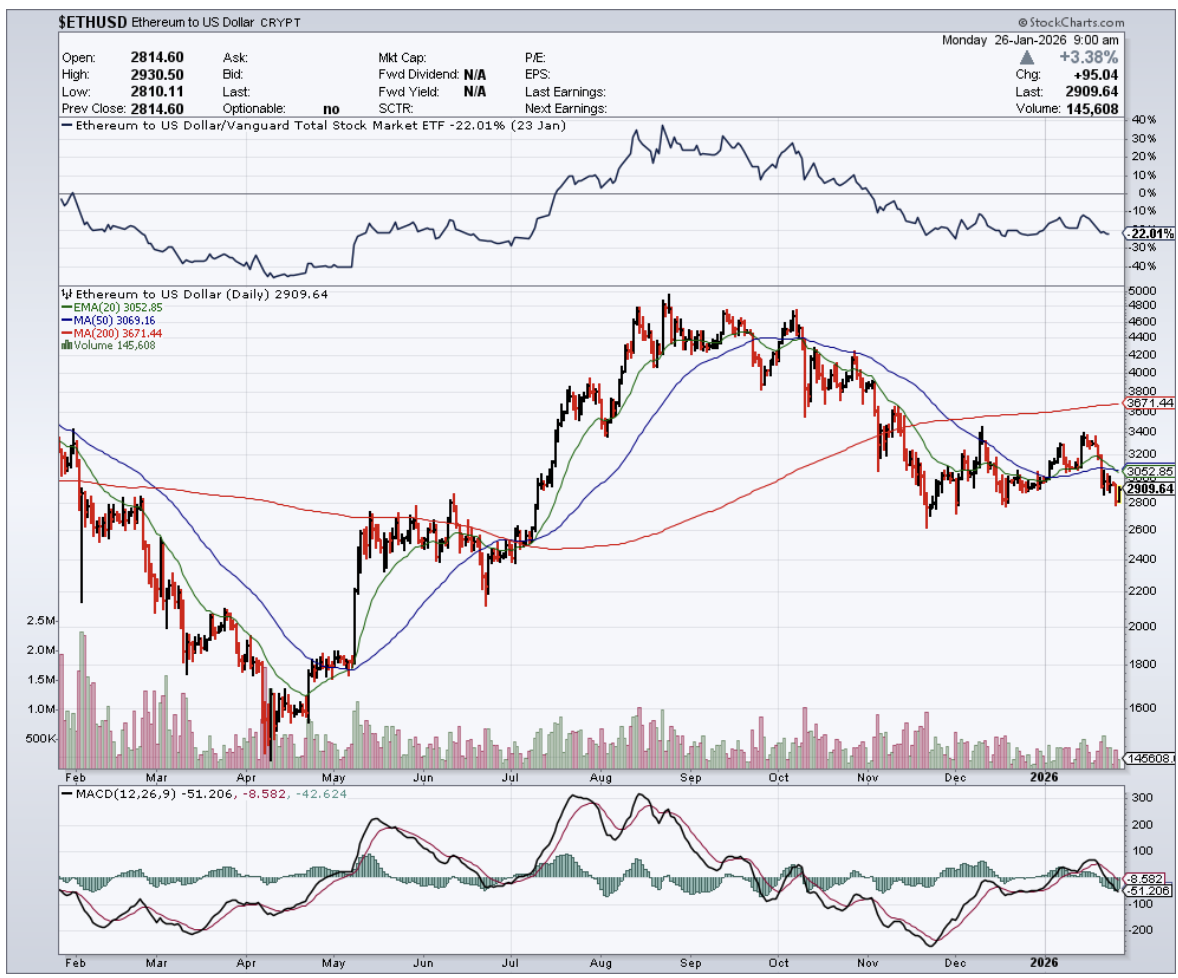
It has recently traded around $3,000, and ETH continues to position itself as core infrastructure for the digital asset economy.

Ultimately, while near term price targets are always speculative, ETH has already traded well beyond prior cycle highs, and future upside will likely be driven less by hype and more by adoption, fee generation, and real economic usage.


https://madhedgefundtrader.com/wp-content/uploads/2019/05/cropped-mad-hedge-logo-transparent-192x192_f9578834168ba24df3eb53916a12c882.png 0 0 Mad Hedge Fund Trader https://madhedgefundtrader.com/wp-content/uploads/2019/05/cropped-mad-hedge-logo-transparent-192x192_f9578834168ba24df3eb53916a12c882.png Mad Hedge Fund Trader2026-01-13 13:00:092026-01-21 13:21:10The Appeal of Ethereum
Mad Hedge Fund Trader

October 27, 2022

Bitcoin Letter

Mad Hedge Bitcoin Letter
October 27, 2022
Fiat Lux

Featured Trade:

(SILVER LININGS)
(BTC), (GOOGL), (GENZ)

https://madhedgefundtrader.com/wp-content/uploads/2019/05/cropped-mad-hedge-logo-transparent-192x192_f9578834168ba24df3eb53916a12c882.png 0 0 Mad Hedge Fund Trader https://madhedgefundtrader.com/wp-content/uploads/2019/05/cropped-mad-hedge-logo-transparent-192x192_f9578834168ba24df3eb53916a12c882.png Mad Hedge Fund Trader2022-10-27 16:04:182022-10-27 17:09:42October 27, 2022
Mad Hedge Fund Trader

Silver Linings

Bitcoin Letter

With all the Dr. Dooms out there, and you know there are plenty, it might seem like a broken record.

Crypto’s been kicked around, mocked, and left for dead so many times, you’d think it owed Wall Street money. With all the criticism hurled its way lately, you'd be forgiven for thinking it has no future. But I wouldn't bet on that.

The road ahead for crypto is lined with silver linings. Not obvious to the casual observer, perhaps, but impossible for any sharp-eyed investor to ignore. 

Let’s talk Google or Alphabet, if you want to be formal about it. Their latest earnings didn’t mention crypto by name, but the subtext was loud and clear. The advertising landscape is shifting. Payments are evolving. And guess who's still lingering in the machinery? Crypto.

In 2025 alone, the blockchain-in-media and advertising market clocked in at a cool $2.68 billion. That’s not chump change. It’s proof that crypto-related ad spend hasn’t vanished but simply changed costumes. The industry didn’t disappear. Instead, it adapted.

So when a behemoth like Google starts missing its growth targets, part of that slowdown reflects a deeper truth: money is moving differently now. And crypto, along with its Web3 cousins, is very much a part of that evolution.

Meanwhile, financial firms are still splashing ad dollars across every media channel that can spell ROI. And while not every banner screams Bitcoin, the underlying infrastructure - wallets, exchanges, DeFi platforms - is still feeding the ecosystem. Big media still wants those clicks, and crypto still delivers the eyeballs.

But forget ad dollars for a second. The more important asset is the audience.

Let’s not kid ourselves. Plenty of retail traders got torched during the last cycle. Some won’t touch crypto again if you paid them in Ethereum. Despite that, the appetite among younger investors is as strong as ever.

Case in point: Gemini’s 2024–2025 survey showed over 51% of Gen Z respondents worldwide have owned, or still own, some form of crypto. In the U.S., that number held steady. 

Meanwhile, a separate US investment trends report found that 48% of Gen Z investors are using crypto exchanges. That’s more than those using traditional financial advisors.

This shouldn’t come as a surprise though. After years of arbitrary lockdowns and enough inflation to make your grocery bill look like a car payment, younger generations are rethinking everything. They find traditional retirement plans suspicious. They think the US financial system is rigged. These folks have gone from skeptical to cynical.

And who can blame them? The stock market got clobbered in 2022, and it hasn’t exactly been a parade since. Bonds didn’t offer much comfort either. This might be yet another year where both stocks and bonds disappoint - a double whammy that laughs in the face of your grandpa’s 60/40 portfolio.

Ah, yes, the sacred 60/40 split. Sixty percent in stocks, forty in bonds. Supposed to give you growth with a safety net. Well, in today’s market, that safety net has more holes than ever.

It’s time for a reset.

Wealth-building isn’t what it used to be. When both stocks and bonds are sagging - and when the Fed spent years flooding the economy with Monopoly money - there are no free lunches left. 

Many upper-middle-class families thought they were cruising toward retirement on autopilot. Instead, they’ve been shoved back into the workforce, legs flailing, as everyday costs spike anywhere from 8% to 50%, depending on your zip code.

Now, some people are still parroting the old “crypto is on life support” line. That was maybe true two years ago. Today? Please. Forget survival. In 2025, crypto was on the offensive.

Bitcoin cracked the $100,000 barrier in November. Not on some fantasy of a future Fed pivot, but on the back of actual, real-deal monetary easing that started in late 2023. 

We’re no longer guessing about the pivot. It happened. Now the conversation is about stability, and crypto has shown it can handle that just fine.

The idea that Bitcoin rises or falls based purely on Jerome Powell’s caffeine intake is dated. This market has grown up. With spot Bitcoin ETFs, regulated U.S. exchanges, and serious institutional muscle, crypto now has more than just a pulse. It has infrastructure, credibility, and momentum.

That said, the biggest threat to crypto remains the same as always: the people in it. The panic sellers. The hype chasers. The ones who buy the top and sell the bottom. The space could use fewer influencers and more investors.

Meanwhile, the harsh reality is sinking in across America: more families are scrambling to patch together some kind of retirement. And whether you’re 28 or 68, dismissing crypto might not be the smartest move. 

According to the 2025 Modern Wealth Survey by Charles Schwab, 41% of Americans now consider crypto a good investment. And 65% of those already in the space say they’re planning to add more.

Here’s the bottom line. If you believe, as I do, that crypto has matured - from a speculative gamble to a legitimate, evolving asset class - then turning your back on it could be the biggest mistake of all.

Position sizing matters. Discipline matters. But the opportunity? Still very much alive.

https://madhedgefundtrader.com/wp-content/uploads/2019/05/cropped-mad-hedge-logo-transparent-192x192_f9578834168ba24df3eb53916a12c882.png 0 0 Mad Hedge Fund Trader https://madhedgefundtrader.com/wp-content/uploads/2019/05/cropped-mad-hedge-logo-transparent-192x192_f9578834168ba24df3eb53916a12c882.png Mad Hedge Fund Trader2022-10-27 16:02:152025-11-14 08:21:23Silver Linings
Mad Hedge Fund Trader

October 25, 2022

Bitcoin Letter

Mad Hedge Bitcoin Letter
October 25, 2022
Fiat Lux

Featured Trade:

(SAVING CRYPTO)
(BTC), (KPMG)

https://madhedgefundtrader.com/wp-content/uploads/2019/05/cropped-mad-hedge-logo-transparent-192x192_f9578834168ba24df3eb53916a12c882.png 0 0 Mad Hedge Fund Trader https://madhedgefundtrader.com/wp-content/uploads/2019/05/cropped-mad-hedge-logo-transparent-192x192_f9578834168ba24df3eb53916a12c882.png Mad Hedge Fund Trader2022-10-25 15:04:102022-10-25 16:03:39October 25, 2022
Mad Hedge Fund Trader

Saving Crypto

Bitcoin Letter

One can’t help but be appalled to see the former driver of global growth China turn radically inward, preferring a deeply authoritarian economic model.

What they had in the Hu Jin­tao years between 2002 to 2012 was legendary and might not ever happen again.

Friends of mine who have managed to flee China all mention how it was easier to leave before 2020.

Good luck now navigating Chinese lockdowns.

Authorities have made it impossible to leave and they track everything including a digital yuan now.

China and its backward economy have a lot of problems, and the more problems that add up nudge the people to a crypto solution.

I am not saying that every Chinese person will invest in crypto, but for the wealthy ones that usually immigrate to Singapore or Hong Kong, the data backs up my thesis.

KPMG accounting firm has indicated a colossal interest in the crypto market from the wealthy elite of Singapore and Hong Kong. 

In fact, a 2022-survey by KPMG found that 58 % of the 30 family-offices and high-net-worth individuals (AUM US$10 m–500 m) across Singapore/HK were already invested in digital assets and a further 34 % intended to allocate funds to bitcoin, stable-coins, ether, as well as DeFi opportunities.

Of those 58 % who already invested:

  • 100 % held bitcoin,
  • 87 % held ether,
  • 60 % bought NFTs/metaverse tokens,
  • 47 % held DeFi tokens.

Beyond that, most already invested only allocated less than 5 % of their portfolio to the digital-asset class (reflecting caution around regulation/valuation).

But since 2022, things have evolved:

  • In 2025, the global fintech invest­ment in H1 reached US$44.7 billion across 2,216 deals.
  • In Singapore, fintech (including cryptocurrency/digital assets) pulled in around US$1.04 billion in H1 2025.
  • Meanwhile in China, the stance toward cryptocurrencies remains very hostile: crypto ownership, trading and DeFi operations in mainland China are being criminalised and enforcement has stepped up markedly in 2025.
  • And the digital yuan (e-CNY) is being actively deployed: for example, by end Sept 2025, cumulative e-CNY transactions hit RMB 14.2 trillion (~US$2 trillion) and 225 million personal wallets were in circulation.

So: The good news is that there is a pathway that links rich Chinese to the future of crypto, but it’s largely contingent on whether crypto can get its act together or not.

China is ramping up its control over money supply by advancing the digital yuan that they can track and regulate with fine control.

This is really 1984 in its purest form.

As the crypto winter continues, there are indeed some silver linings.

However, crypto needs to be careful that it doesn’t turn into just another centralized version of what the Chinese are running away from.

Decentralization is hard to pull off in the long term as the government will want its cut.

Rome wasn’t built in one day.

https://madhedgefundtrader.com/wp-content/uploads/2019/05/cropped-mad-hedge-logo-transparent-192x192_f9578834168ba24df3eb53916a12c882.png 0 0 Mad Hedge Fund Trader https://madhedgefundtrader.com/wp-content/uploads/2019/05/cropped-mad-hedge-logo-transparent-192x192_f9578834168ba24df3eb53916a12c882.png Mad Hedge Fund Trader2022-10-25 15:02:082025-11-17 00:43:42Saving Crypto
Mad Hedge Fund Trader

Quote of the Day - October 25, 2022

Bitcoin Letter

“The biggest risk is not taking any risk.” – Said Co-Founder and CEO of Facebook Mark Zuckerberg


https://www.madhedgefundtrader.com/wp-content/uploads/2019/03/elon-musk.png 304 397 Mad Hedge Fund Trader https://madhedgefundtrader.com/wp-content/uploads/2019/05/cropped-mad-hedge-logo-transparent-192x192_f9578834168ba24df3eb53916a12c882.png Mad Hedge Fund Trader2022-10-25 15:00:062022-10-25 16:03:16Quote of the Day - October 25, 2022
Mad Hedge Fund Trader

October 20, 2022

Bitcoin Letter

Mad Hedge Bitcoin Letter
October 20, 2022
Fiat Lux

Featured Trade:

(LOOKING TO MAKE A DIFFERENCE)
(BTC), (NFT)

https://madhedgefundtrader.com/wp-content/uploads/2019/05/cropped-mad-hedge-logo-transparent-192x192_f9578834168ba24df3eb53916a12c882.png 0 0 Mad Hedge Fund Trader https://madhedgefundtrader.com/wp-content/uploads/2019/05/cropped-mad-hedge-logo-transparent-192x192_f9578834168ba24df3eb53916a12c882.png Mad Hedge Fund Trader2022-10-20 15:04:132022-10-20 15:51:21October 20, 2022
Page 2 of 35‹1234›»

Legal Disclaimer

There is a very high degree of risk involved in trading. Past results are not indicative of future returns. MadHedgeFundTrader.com and all individuals affiliated with this site assume no responsibilities for your trading and investment results. The indicators, strategies, columns, articles and all other features are for educational purposes only and should not be construed as investment advice. Information for futures trading observations are obtained from sources believed to be reliable, but we do not warrant its completeness or accuracy, or warrant any results from the use of the information. Your use of the trading observations is entirely at your own risk and it is your sole responsibility to evaluate the accuracy, completeness and usefulness of the information. You must assess the risk of any trade with your broker and make your own independent decisions regarding any securities mentioned herein. Affiliates of MadHedgeFundTrader.com may have a position or effect transactions in the securities described herein (or options thereon) and/or otherwise employ trading strategies that may be consistent or inconsistent with the provided strategies.

Copyright © 2026. Mad Hedge Fund Trader. All Rights Reserved. support@madhedgefundtrader.com
Scroll to top