Mad Hedge Biotech and Healthcare Letter
December 26, 2023
Fiat Lux
Featured Trade:
(A MARATHON, NOT A SPRINT)
(AMGN), (ABBV), (DNA), (PFE), (RHHBY), (GILD), (NVO)

Mad Hedge Biotech and Healthcare Letter
December 26, 2023
Fiat Lux
Featured Trade:
(A MARATHON, NOT A SPRINT)
(AMGN), (ABBV), (DNA), (PFE), (RHHBY), (GILD), (NVO)
Navigating the stock market, where fortunes are made and lost faster than a New York minute, can be as exhilarating as it is nerve-wracking.
And when you're hunting for that quick win, that short-term stock buy that'll make your year, you realize you're playing a game where even the big guns like Warren Buffett don't always have the magic crystal ball.
But let's pivot a bit. What about when you're not sweating under a cash crunch — when you can afford to play the long game?
That's when you shift your sights to those long-term compounders, the kind that churn out robust returns on capital like a well-oiled machine. Here, initial valuations play second fiddle to the long-term prospects.
This is where Amgen (AMGN) struts onto the stage. It's not just any old player in the biotechnology and healthcare arena; it's a front-runner with a knack for keeping its coffers brimming and its profitability soaring.
In terms of therapeutic innovation, Amgen is a leader in the fields of oncology, inflammation, neurology, and pulmonary diseases. Their biosimilar practice is also on the rise, churning out replicas of blockbuster drugs like AbbVie’s (ABBV) Humira and Genentech’s (DNA) Herceptin.
Essentially, investing in Amgen is like finding a gold mine in your backyard – and then realizing there's oil under there, too.
Now, let's talk numbers because that's where the rubber meets the road. Amgen's moat-worthy drug franchises make it as solid as a rock for those seeking stability in their cash flows, especially when economic clouds are gathering.
And in the healthcare segment, it's akin to building your house on a rock – it withstands economic storms.
Amgen is known for its industry-leading profitability, flashing its A+ grade like a badge of honor. Their 11% return on total capital and a jaw-dropping 134% return on equity? That's not just good; it's like winning the financial Olympics.
Over the last decade, Amgen's total return of 218% didn't just outdo the S&P 500; it left peers like Pfizer (PFE), Roche (RHHBY), and Gilead (GILD) in the dust. Sure, AbbVie is still ahead, but that's mostly thanks to their Humira magic.
Fast forward to the present, and Amgen's showing no signs of slowing down.
Their total revenue shot up by 4% YoY to $6.9 billion in the third quarter, courtesy of a surge in volumes across their star products. We're talking double-digit growth in BLINCYTO, EVENITY, Repatha, and Nplate. This is like watching a relay race where every runner is Usain Bolt.
Peeking into the future, Amgen's pipeline is a treasure trove of potential.
The company has six first-in-class oncology assets and three FDA Breakthrough Therapy designations. Mirroring Novo Nordisk's (NVO) success with Ozempic, Amgen’s wrapped up Phase 2 studies for their obesity contender, Maridebart cafraglutide.
But here's where it gets even more interesting. Amgen's leap into multi-specific drugs, particularly with tumor treatment AMG 193, is like stepping into a sci-fi novel – it's groundbreaking, it's futuristic, and it just might revolutionize drug delivery.
Let's not forget the FDA's priority review of tarlatamab for small-cell lung cancer. This isn't just good news; it's a potential game-changer, a sign that Amgen might just be first across the finish line in this high-stakes race.
Of course, the recent acquisition of Horizon Therapeutics adds another feather to Amgen's cap, expanding its rare disease portfolio. The incoming drugs from this deal, including Tavneos, Tepezza, KRYSTEXXA, and UPLIZNA, are in the early stages of their lifecycle, making them ripe for growth.
However, every silver lining has a cloud. The integration of Horizon Therapeutics carries its own set of risks, and Amgen's legacy drugs like Enbrel and Otezla face the ticking clock of declining sales.
We also can’t gloss over the elephant in the room – Amgen's ballooning long-term debt, expected to hit a whopping $65 billion by year-end. The recent downgrade of Amgen's credit rating to BBB is like a cautious tap on the shoulder, a reminder to tread carefully.
But don't let that dampen your spirits. Amgen's 3.3% dividend yield is as solid as it comes, with management showing a vote of confidence with a 5.6% raise for the upcoming Q1 2024 payout.
The company's history of rewarding shareholders through share buybacks – a 19% reduction in share count over five years is nothing to scoff at either.
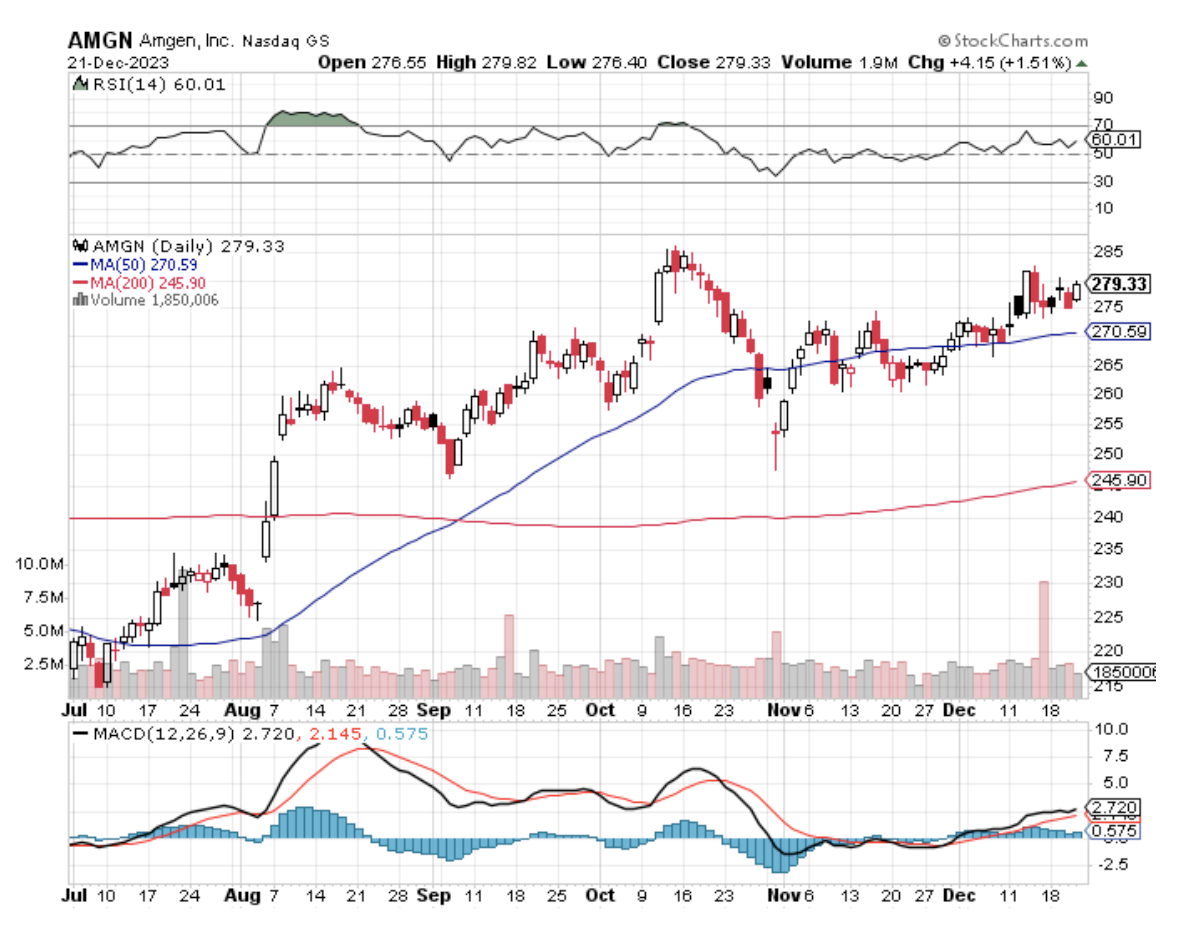
So, where does that leave Amgen's valuation? At a current price of $275 and a forward PE of 14.8, it's not exactly a bargain basement, but it's far from sky-high. It's in that sweet spot where quality meets value.
For long-term investors who value stability and growth, consider adding Amgen to your portfolio playbook.
Mad Hedge Biotech and Healthcare Letter
December 21, 2023
Fiat Lux
Featured Trade:
(UNLEASHING THE UNDERDOGS)
(NVS), (LLY), (PNT), (RYZB), (MRK), (ABBV)
Grab your notebooks because class is in session, and today's topic is radiopharmaceuticals.
Yes, you heard it right - radiopharmaceuticals. It’s not your everyday cocktail party topic, but it's certainly the buzzword in the biotech investing world. And let me tell you, the numbers are sizzling.
Venture capital deals in this sector have shot up by an eye-watering 550% to $408 million this year. Back in 2017, this figure was a mere $63 million. Talk about going from zero to hero.
The global market for these radioactive wonders zoomed past $5.2 billion in 2022 and is now racing towards an estimated $13.67 billion by 2032. That's a CAGR of 10.2% for the statisticians among us.
So, what's cooking in the radiopharmaceutical kitchen? Well, a lot, apparently.
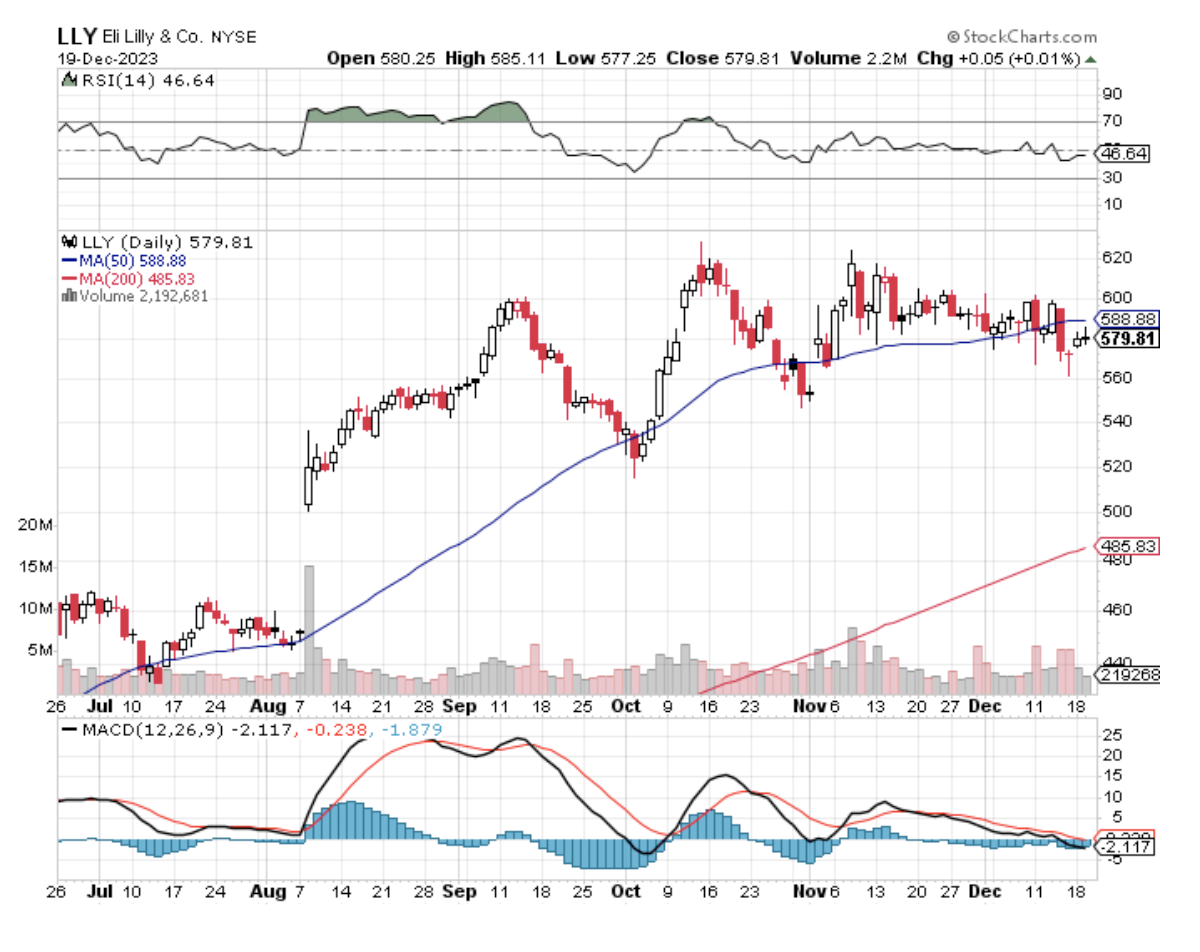
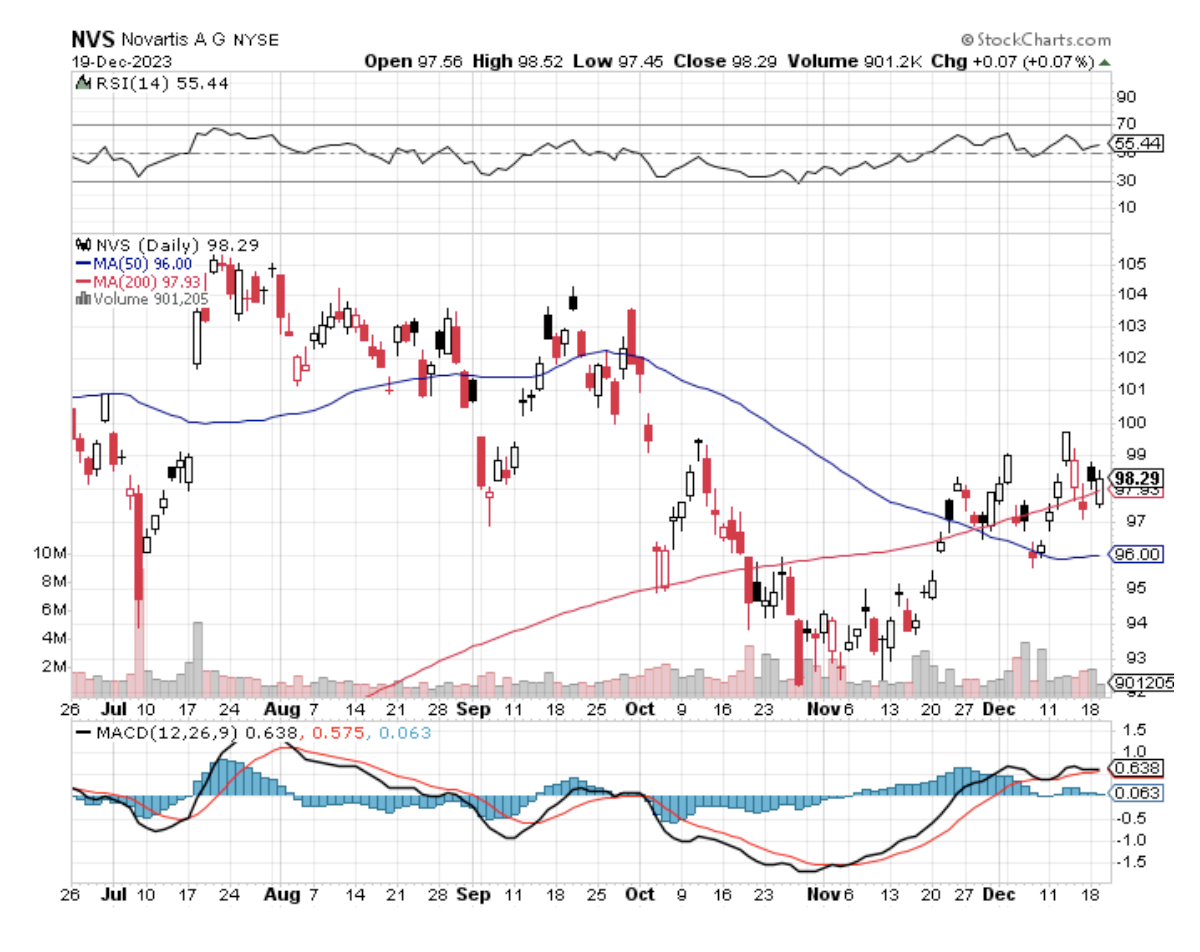
Leading the pack are the heavyweights – Novartis (NVS) and Eli Lilly (LLY). Novartis has thrown its hat into the ring, making radiopharmaceuticals a showstopper in its oncology lineup. With stars like Lutathera and Pluvicto, they're not just playing; they're here to dominate.
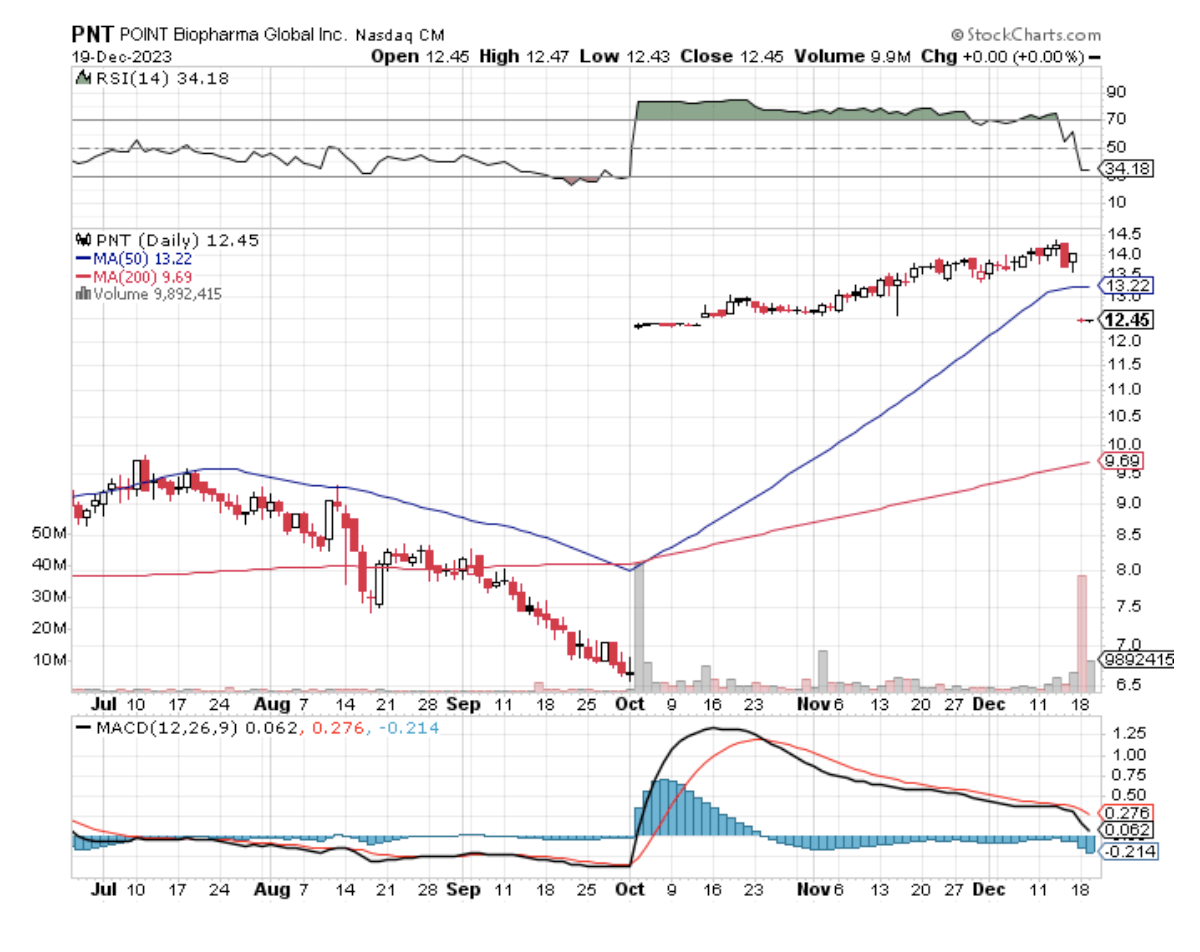
As for Eli Lilly, they're playing catch-up but with style. They laid down a cool $1.4 billion for Point Biopharma Global — a biotech gem focusing on radioligand therapies. Notably, Point investors are playing hardball, waiting for a Phase 3 reveal.
Meanwhile, Eli Lilly's also buddied up with Mariana Oncology and its $175 million Series B – these guys are eyeing small cell lung cancer with a glint in their eye.
So, what does this mean for the investor universe? Well, in a nutshell, it's party time. Early-stage companies, especially those with their lab coats on in discovery and preclinical stages, are like magnets to investors right now.
There’s POINT Biopharma, which hails from Indianapolis, that went public on Nasdaq as of July 1, 2021. Remember the ticker symbol “PNT”? That's them, and they currently have roughly $1.33 billion in market cap.
Another promising option is Mallinckrodt Pharmaceuticals. These folks are into everything from specialty pharmaceuticals to, you guessed it, radiopharmaceuticals—an American-Irish charm, if I may say so.
Abdera Therapeutics, a Canadian startup (eh!), is also in the running. This company is all about precision radiotherapeutics. They're eyeing small-cell lung cancer, and they've got the funds to back it up.
And then there’s ARTBIO, with an impressive $90 million Series A six months post-launch.
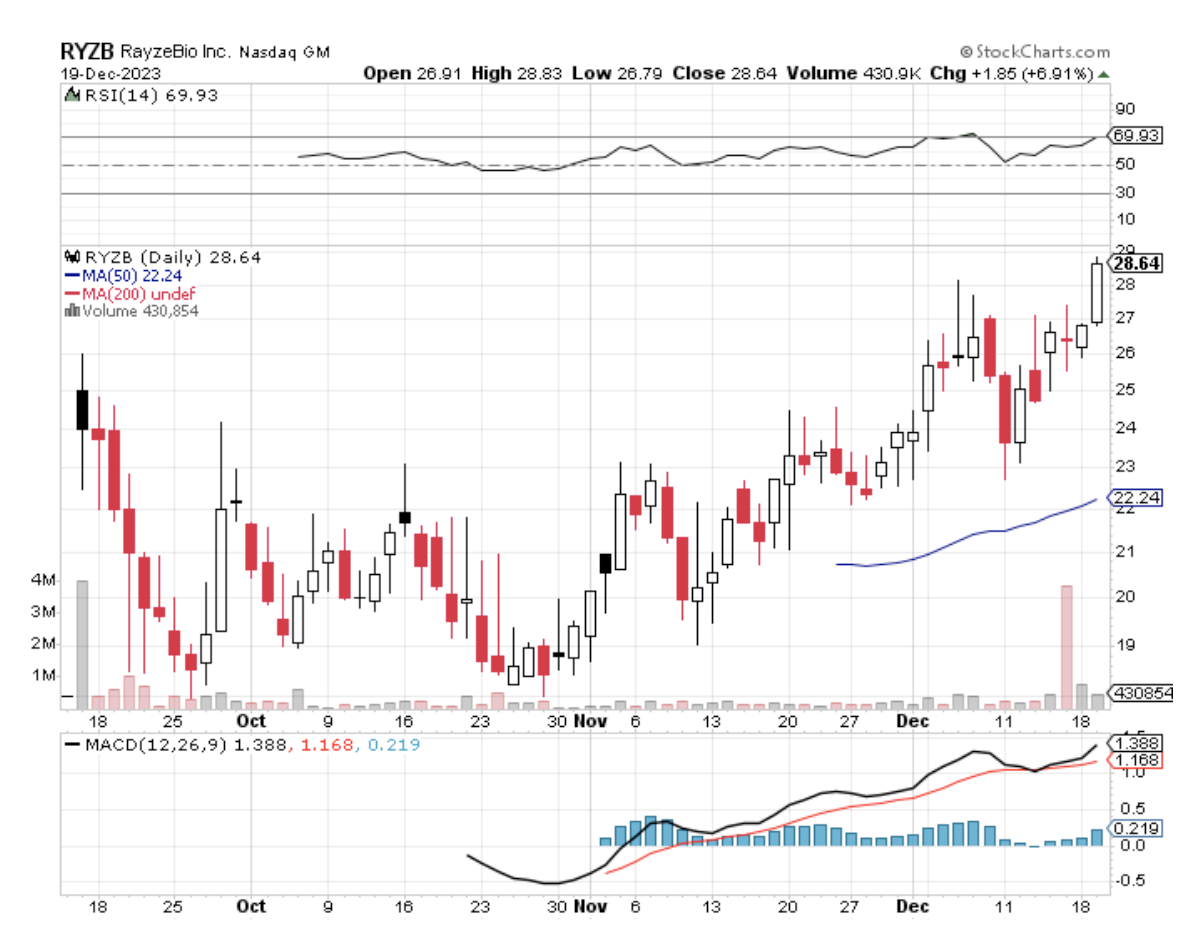
There’s also RayzeBio (RYZB), which is based in sunny California. They're not just turning heads; they're opening wallets. This company raised a whopping $160 million in Series D last year and then sprinted towards a dazzling $311 million IPO just last September.
Between 2018 and 2023, US-based radiopharmaceutical companies attracted a hefty $1.2 billion in venture financing. The peak? A cool $262 million in 2021. And guess what? Most of this dough was for preclinical and discovery shenanigans.
But let's not forget the hurdles, particularly the supply challenges and overwhelming demand. Yet, despite these hiccups, the sector remains hotter than a summer in the Sahara.
Prior to this, ADCs (Antibody Drug Conjugates) dominated the conversation.
We witnessed Merck (MRK) confidently investing $4 billion in Daiichi Sankyo for their ADC prospects. Lilly was busy forming a cozy partnership with Mablink Bioscience. And let's not forget AbbVie (ABBV), which generously splurged $10.1 billion on ImmunoGen's Elahere.
To this day, ADCs are still the talk of the town. But here's the thing: radiotherapeutics might be the underdog next to ADCs, but they're catching up. Fast.
This sector is bubbling with potential, simmering with innovation. For investors and pharma bigwigs, radiopharmaceuticals are more than just a fad. They're the future.
So, what's the takeaway? Radiotherapeutics might not be grabbing the spotlight like ADCs, but they’re like that quiet kid in class who ends up acing the test.
Mark my words. This is one space in oncology that's set to make some serious noise in the coming years.
Mad Hedge Biotech and Healthcare Letter
November 28, 2023
Fiat Lux
Featured Trade:
(A MILLIONAIRE MAKER IN THE MAKING)
(ABBV), (ABT)
In the high-stakes game of investment, where the dream is to turn a modest sum into a cool million, savvy players are constantly on the hunt for that one stock with the Midas touch.
Enter the scene: AbbVie (ABBV), a heavyweight in the healthcare arena, boasts a revenue growth of over $20 billion since 2019.
Let's cut through the noise and see if AbbVie is the golden goose for your portfolio, capable of outpacing the market and padding your account with those sought-after seven figures.
Since its spinoff from Abbott Labs (ABT) in 2013, AbbVie has been flexing its muscles in the dividend world.
I’m not talking about just keeping up with the Joneses here; AbbVie's dividend payout has skyrocketed by an impressive 270% through late 2023. This isn't just inheritance; it's multiplication.
Now, let's address the elephant in the room: Humira, AbbVie’s blockbuster drug, which is set to lose its patent shield in 2023.
This anti-inflammatory drug has been a cash cow for AbbVie, spanning a wide range of treatments from rheumatoid arthritis to Crohn's disease. But the party can't last forever. As the patent protection fades, so does a chunk of AbbVie’s revenue stream.
However, don't think AbbVie's been caught off guard. They've been prepping for this moment with Rinvoq and Skyrizi, two new immunology drugs poised to pick up the slack and maybe, just maybe, outshine their predecessor by 2027.
Dig into the latest quarter, and you'll find Rinvoq and Skyrizi raking in the cash with double-digit sales growth, eyeing to breach the $11 billion mark in annual revenue.
AbbVie's strategy? Cover all bases Humira did, and then some.
But that's not all in AbbVie's arsenal. With over 50 programs chugging along in development, the odds are in favor of a few big wins that could give the biopharma top and bottom lines a healthy boost.
Besides the promising Rinvoq and Skyrizi, AbbVie has other aces up its sleeve. Take bipolar disorder treatment Vraylar, with its potential to hit $4 billion in peak annual revenue, or acute migraine drug Ubrelvy, eyeing at least $1 billion.
While transition phases are tricky, especially since AbbVie's shift from Humira to the likes of Skyrizi and Rinvoq is no walk in the park, it's the other elements in play that add to AbbVie's potential.
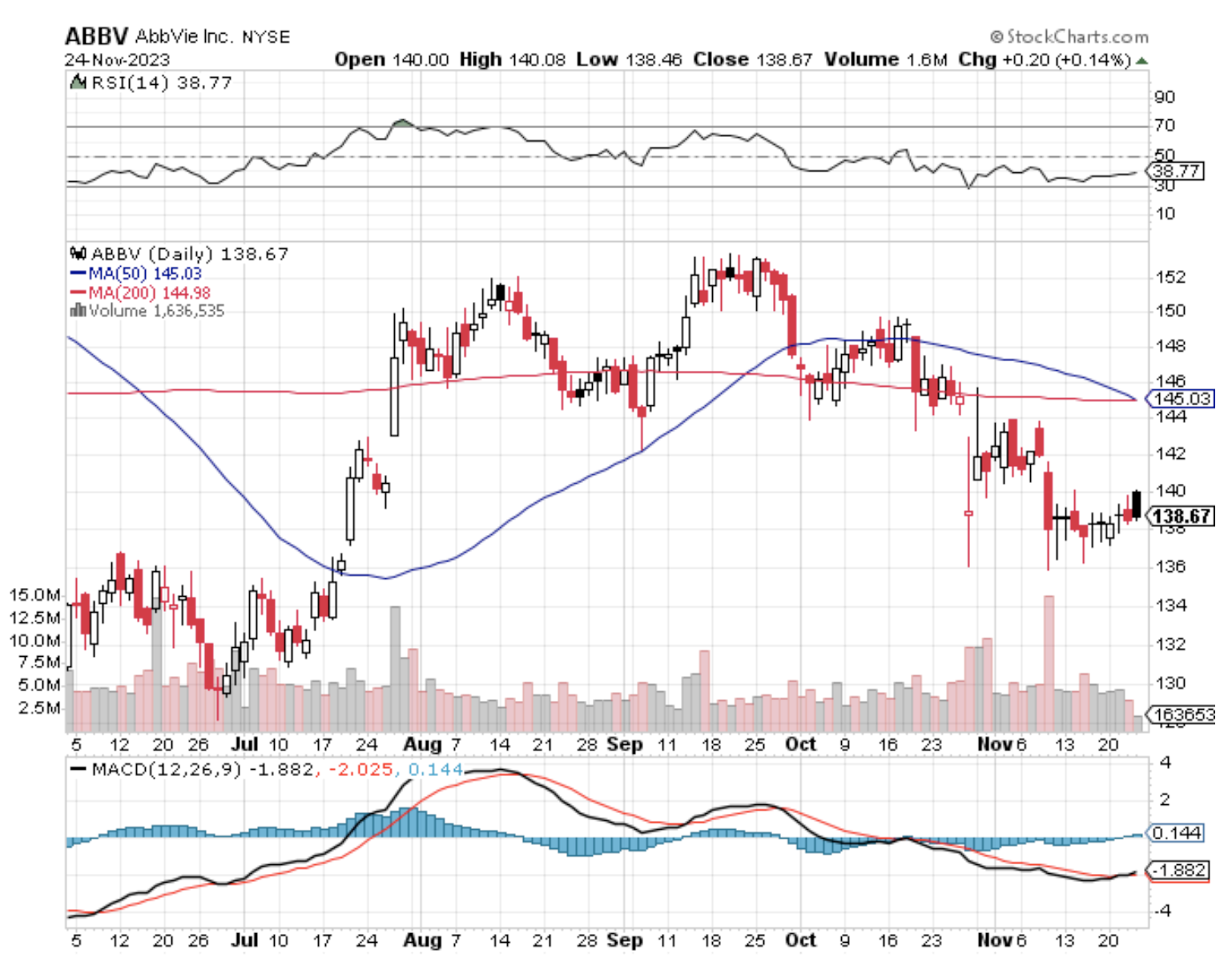
For instance, here's another factor that makes the company attractive for growth investors: AbbVie's stock is currently undervalued, trading at a mere 12 times its estimated future earnings, a bargain compared to the sector's average. This could be your ticket to get on board for the long haul, eyeing those hefty returns down the road.
Now, what about the financials? After all, a company's muscle is measured by its monetary might. Well, AbbVie's operating profit of $15.8 billion on $55.1 billion in revenue in the past 12 months is nothing to sneeze at.
Now, let's talk free cash flow (FCF) – aka the real indicator of financial fitness. AbbVie's sitting pretty with $24.7 billion in FCF over four quarters. That's not pocket change; it's a war chest, part of which is already earmarked for a generous 4.5% dividend yield.
So, is AbbVie the magic bean that grows into a million-dollar beanstalk? Let’s give it more context.
To morph a $30,000 investment into $1 million, AbbVie's market cap would need to balloon over 30 times its current size, a Herculean feat that translates to a market valuation of over $7.3 trillion.
It's a long shot but not beyond the realms of possibility, especially considering the long-run average return of the S&P 500.
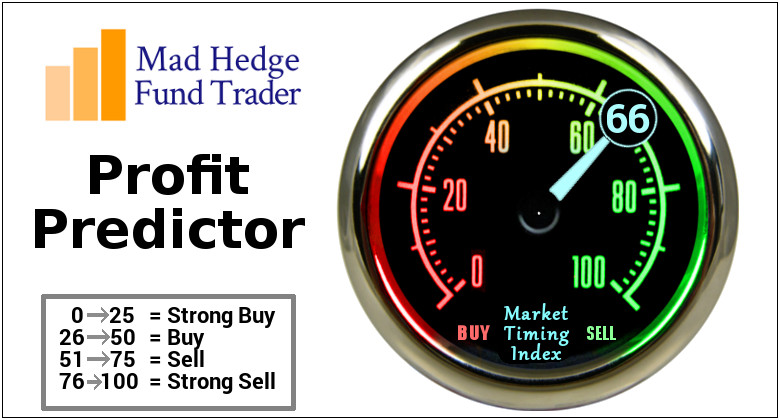
Overall, AbbVie is more than just a contender in the investment arena. With its solid track record, robust pipeline, and undervalued stock, it's a heavyweight with a puncher's chance of turning your investment into a million-dollar dream. I suggest you buy the dip.
Mad Hedge Biotech and Healthcare Letter
November 21, 2023
Fiat Lux
Featured Trade:
(A PRESCRIPTION FOR CAUTION)
(VTRS), (PFE), (JNJ), (LLY), (BMY), (TEVA), (ABBV), (CVS)
In the rollercoaster world of pharmaceutical stocks, 2023 has been like riding the Cyclone at Coney Island – thrilling for some, nauseating for others.
Take Pfizer (PFE), for instance. It’s seen its stock take a nosedive by 43.4%. That’s the kind of drop that makes you check if your wallet’s still there. Then there’s Johnson & Johnson (JNJ), trailing behind with a 16.4% decline. Not as dramatic, but still enough to make your stomach lurch.
Meanwhile, there’s Eli Lilly (LLY), playing the hero as it rockets up by an extraordinary 66.8%, thanks to its new weight-loss drugs. At this point, investors are practically throwing ticker-tape parades.
However, even with Eli Lilly’s star performance, the S&P 500 Pharmaceuticals index still shows a downturn of 2.3%.
Now, as we've seen earnings reports trickle in, a trend has started to stick out: positive results aren’t shielding drugmakers from a sell-off. Look at Pfizer and Bristol Myers Squibb (BMY), both hovering near their 52-week lows.
Still, investors are giving the biotechnology and healthcare stocks the side-eye for several reasons.
The new Medicare drug-price negotiation program is like a strict parent setting a curfew – it’s potentially restricting pricing power for certain medications. Plus, as interest rates climb, the allure of high dividend yields is diminishing faster than my motivation to hit the gym.
In this skeptical market, however, there are some optimistic investors who are digging through the bargain bin, hoping to strike gold.
Enter Viatris (VTRS), trading at just 3.3 times earnings and boasting a 5.1% dividend yield. It sounds promising, but only a few brave souls are recommending a buy.
Basically, this situation with Viatris is pretty much like finding a designer shirt at a discount store – sure, it’s cheap, but will it fall apart after two washes? Let’s take a closer look.
Viatris’s backstory is a bit of a soap opera. Born from the merger of Mylan and Pfizer's Upjohn unit, it carries the baggage of Mylan's EpiPen pricing scandal.
Since rebranding, Viatris has been trying to find its footing. Despite a shiny new business plan, which involves selling off assets for a potential $9 billion, investor confidence remains shaky at best.
Notably, its decision to exit the biosimilars market, where heavy hitters like Teva Pharmaceutical Industries (TEVA) and AbbVie (ABBV) play ball, has been seen as a bold move. Considering the potential of that market, it felt like leaving a high-stakes poker game just when the chips were starting to stack up. And with CVS Health (CVS) eyeing this lucrative space, Viatris might find itself wishing it had stayed at the table.
These past months, investors have been capturing this drama through a meme – comparing 'adjusted Ebitda' to 'free cash flow' with images of Jennifer Aniston and Iggy Pop. It’s a cheeky way of saying that Viatris’s financial projections might be wearing rose-colored glasses.
Looking ahead, Viatris is aiming for $2.3 billion in free cash flow next year, buoyed by recent sales. But the big question is: can it turn these assets into growth, or will it continue its high-wire act?
Reviewing its recent moves and their effects on the market, the Viatris saga has turned into a cautionary tale for investors in the pharma world – it’s a reminder that sometimes the threat of a nosedive is as real as the thrill of a skyrocket.
So, what’s the takeaway for those of us with skin in the game?
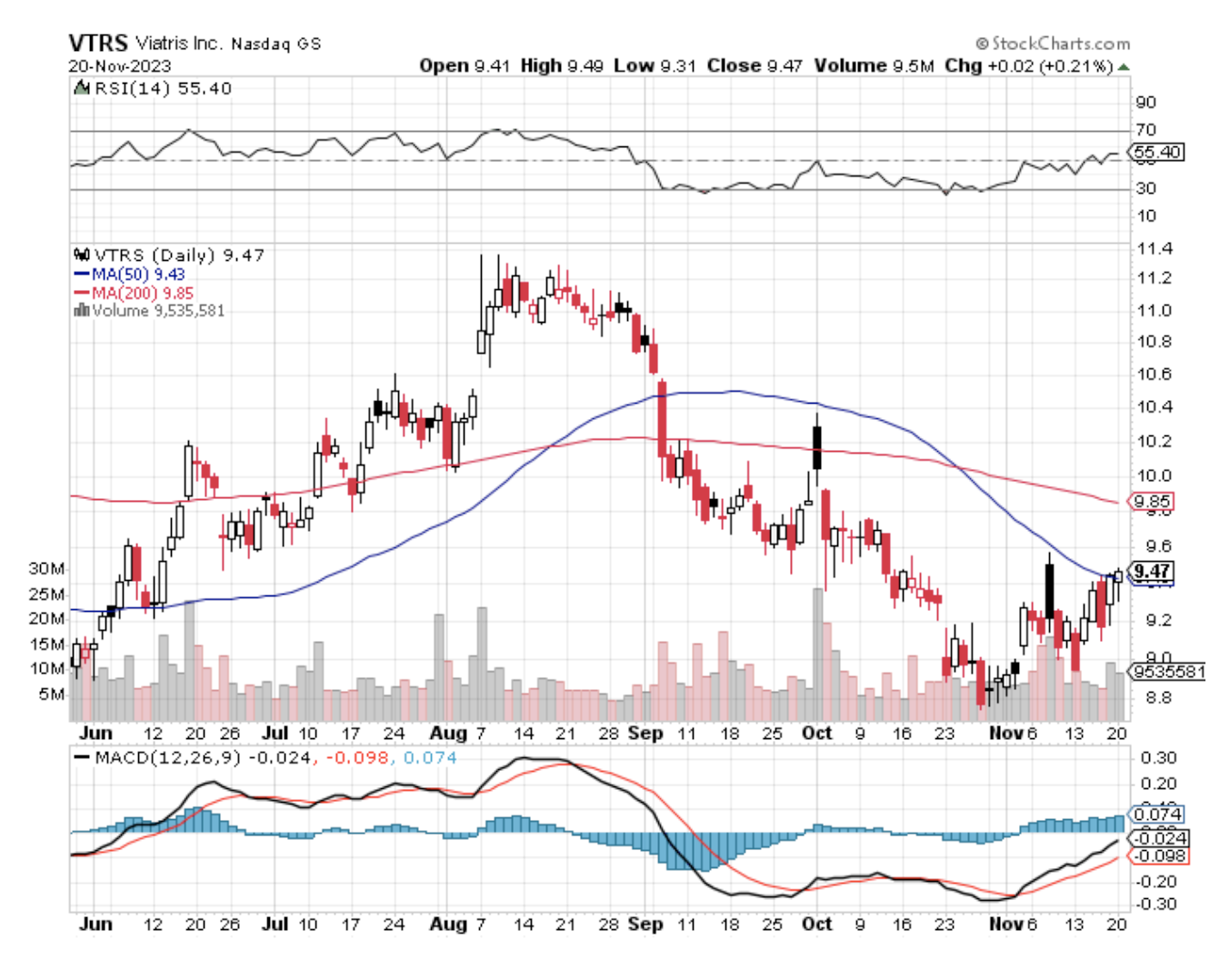
It seems wise to keep our eyes peeled and not jump on any bandwagons too hastily. Viatris, amidst its strategic transformations and market challenges, is worth watching with a careful eye. While its cash flow looks steady through 2027, thanks to planned asset sales, the long-term picture is as clear as mud.
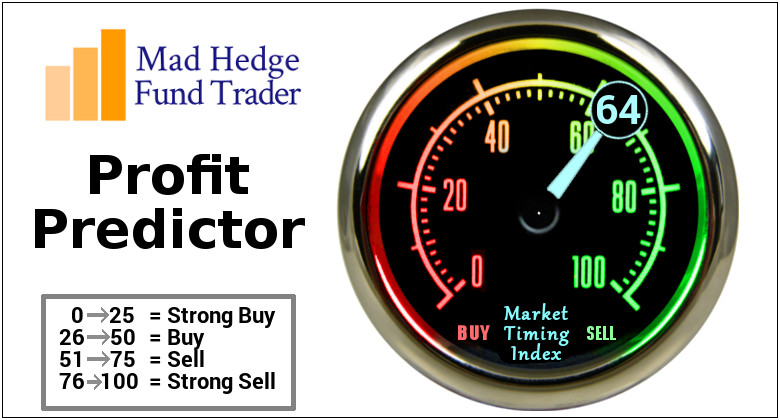
As we navigate the unpredictable waves of the pharmaceutical market this year, let’s remember – it’s not just about holding on for the ride. It’s about knowing when to get on, when to get off, and maybe, just maybe, when to enjoy the view from the sidelines with some popcorn in hand. I say hold off from buying Viatris shares at the moment.
Mad Hedge Biotech and Healthcare Letter
October 24, 2023
Fiat Lux
Featured Trade:
(INNOVATION OVER EXPIRATION)
(ABBV), (ALPMY), (PFE), (BAX)

In the current investment landscape, with the nearly 5% annualized yield from the 10-year U.S. Treasury bond casting a formidable shadow, making a case for investing in stocks might seem like an uphill battle. Especially so when one considers the sluggish performance of several stocks over the past two years, excluding those in niches like artificial intelligence and weight loss.
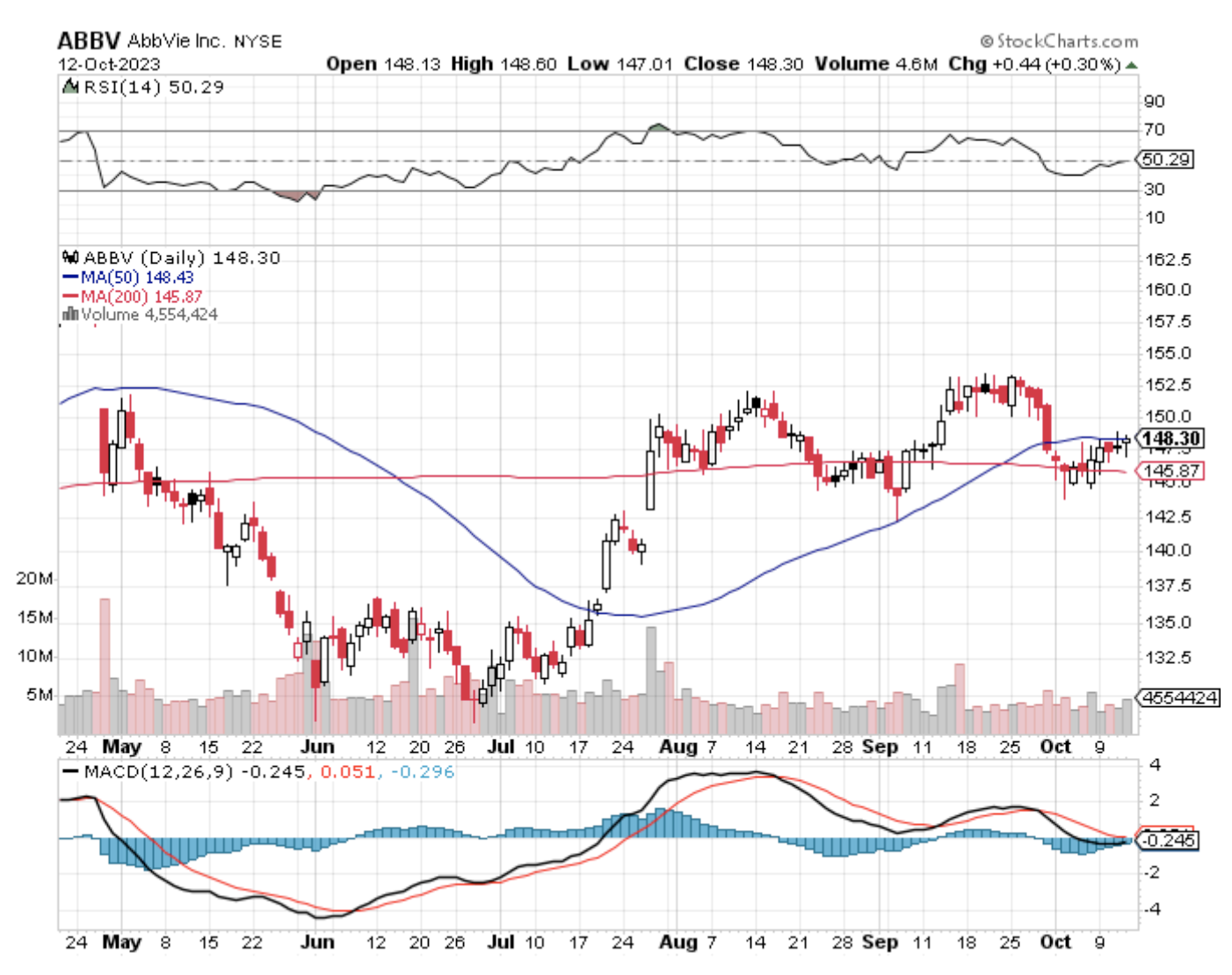
Yet, history teaches us a vital lesson: high-quality dividend stocks, especially in the biotech sector, tend to outpace most other asset classes in the long run. While the broader market has seen fluctuations and shifts towards safer options like CDs, dividend magnates in the biotech space, like AbbVie (ABBV), command attention for value and income investors.
Ever since its spin-off from Abbott Laboratories in 2013, AbbVie has carved a niche for itself. The sheer numbers are a testament to this: an eye-catching 270% growth in its dividend payouts over the last decade.
This performance positions it with a current yield of 3.99%, making it one of the most attractive propositions within the biopharma dividend landscape.
Further sweetening the pot is its moderate cash payout ratio of 42%, indicating a strong potential for more generous dividend increases in the foreseeable future.
Still, as with any investment, it's paramount to factor in the challenges ahead. AbbVie's journey with Humira, the anti-inflammatory drug, serves as a case in point.
Commanding a price tag of $50,000 annually, Humira wasn't just another drug in the market; it was a pharmaceutical marvel that earned the accolade of being the highest-grossing drug in history. But the winds of change are inevitable.
AbbVie's U.S. patent protection for Humira has expired, signaling an era where the company has to look beyond this blockbuster drug for its revenue streams.
The spotlight now is on Skyrizi and Rinvoq, AbbVie's next-gen immunology therapies. These drugs have shown commendable performance since their introduction to the market. However, the looming question is whether they can step into Humira's colossal shoes.
While some analysts remain skeptical about Skyrizi and Rinvoq matching up to Humira's performance benchmarks before 2030, AbbVie's internal projections are more bullish, eyeing a turnaround by 2025.
But amidst these contrasting forecasts, there's a silver lining that both skeptics and optimists agree upon: buoyed by its robust cash flows, AbbVie is expected to sustain, if not enhance, its dividends for at least the next decade.
Pivoting slightly and shining a light on its innovative pursuits, AbbVie unveiled promising results for Rinvoq in a mid-stage trial for vitiligo treatment.
For the uninitiated, vitiligo is a condition where individuals experience a loss of skin pigment, affecting varied parts of the body. The potential market for vitiligo treatments is substantial, with current valuations at $410.5 million, projected to burgeon to $625.8 million by 2031.
The increasing number of vitiligo cases globally plays a significant role in this growth trajectory. To put things in perspective, the Global Vitiligo Foundation in 2021 estimated that nearly 70 million people worldwide are affected by this condition, with a sizable fraction being children.
Navigating this emerging and competitive landscape is no small feat. Powerhouses like Astellas Pharma (ALPMY), Pfizer (PFE), and Baxter (BAX) are just a few of the giants that dot this arena. Every move by AbbVie, especially its endeavors with Rinvoq, is more than just corporate strategy; it's a tango in a fiercely competitive ballroom.
Now, coming full circle to the heart of the matter: What does this all mean for an investor with a keen eye on biotech dividends? AbbVie's journey is both a testament to its past prowess and an indicative nod to its future trajectory. While Humira's glory days might be seeing a horizon, the dawn of Skyrizi and Rinvoq offers a fresh chapter filled with both risks and rewards.
For those already holding AbbVie stocks, the prudent strategy might be a blend of patience and perseverance, enjoying the dividends while staying attuned to the market's pulse. Investments, after all, are as much about the art of patience as they are about the science of numbers. Today's challenges could well be the stepping stones to tomorrow's successes. I suggest you wait for a better entry point and buy the dip.