Mad Hedge Biotech and Healthcare Letter
March 23, 2023
Fiat Lux
Featured Trade:
(OLD BUT GOLD)
(HUM), (UNH)


Mad Hedge Biotech and Healthcare Letter
March 23, 2023
Fiat Lux
Featured Trade:
(OLD BUT GOLD)
(HUM), (UNH)
The entire point of investing is to place your hard-earned cash to work for you, hoping that one day you will no longer need to work just as hard. A growth investing strategy could deliver just that when executed correctly and offered sufficient time.
Choosing stocks that can survive and even thrive in just about any type of economic environment is typically a critical contributing aspect to the success of an investment strategy. While daunting, this step doesn’t need to be complicated. Investors simply need to focus on picking stocks under sectors of the economy that are vital.
Healthcare is one of the sectors that constantly perform well regardless of the turmoils happening across the globe. This is because patients depend on the goods and services this industry offers at all times.
Narrowing it down some more, the segment in the healthcare world that should be taken into consideration when selecting stocks is the health insurance sector.
The health insurance industry worldwide is projected to grow by 7.1% every year from an already whopping $1.7 trillion in 2022 to approximately $2.6 trillion by 2028.
For companies like Humana (HUM), focusing on older patients is a crucial strategy in dominating this sector.
To date, Humana has roughly 22.3 million members enrolled in its medical, vision, dental, and supplemental programs, ensuring that the company can sustain its operations and still have room to expand. This company has an impressive $64 billion market capitalization, ranking it as the fifth biggest health insurer in the world.
Humana’s pièce de rèsistance is Medicare Advantage. The plans provide seniors with sets of bundled benefits and charge a handful of out-of-pocket payments.
This segment generated around $73 billion in sales last 2022, with the insurance premium offerings comprising over 84% of the company’s revenue. The remaining 16% comes from its newly launched CenterWell platform, which offers pharmacy, home care, and primary care services to seniors. In terms of revenue, these figures put Humana in second place behind UnitedHealth Group (UNH).
Even considering the potential slowdown in adding new members, the sheer number of patients signing up for Medicare Advantage most likely won’t. At the moment, about 30 million of the total 60 million seniors in the United States alone subscribe to the plans, with the other 30 million anticipated to sign up eventually. On top of that, the number of senior patients is expected to keep climbing to reach 95 million by 2060.
Despite the incredible potential of this segment, Humana has more to offer than simply Medicare Advantage.
The health insurer is ramping its CenterWell venture by acquiring more physician practices. In 2022, the number of primary-care units handled by the company rose to 235 from the 206 centers recorded in 2021. Humana collaborates with them in searching for low-cost, reliable options for patients. This strategy is a win-win for both parties.
Although it’s still a tiny business compared to Humana’s Medicare Advantage system, the figures from the CenterWell segment look promising. In the fourth quarter of 2022, it reported $4.1 billion in sales with an operating margin of 6.4%. That’s beyond the health insurer’s anticipated margin for 2023, which was set at roughly 4.8%.
As CenterWell expands in terms of how much it contributes to Humana’s total, the company’s operating margin is predicted to grow to about 5.2% by 2026. This would indicate approximately 14% annual earnings per share growth through 2026.
Humana’s 0.6% dividend yield is a potential turnoff factor, which pales compared to the S&P 500’s 1.6%. Still, this isn’t necessarily bad if given the proper context. Over the past 10 years, Humana’s quarterly dividend paid per share has continuously tripled.
This is a promising indication, especially since the dividend payout ratio of Humana was only 12% in 2022. Hence, the company has nowhere else to go but up. This is because offering a conservative payout enables Humana to maximize its funds and focus on growing the business and strengthening its balance sheet. That’s clearly why the health insurer should have no problems delivering double-digit dividend boosts within the next few years.
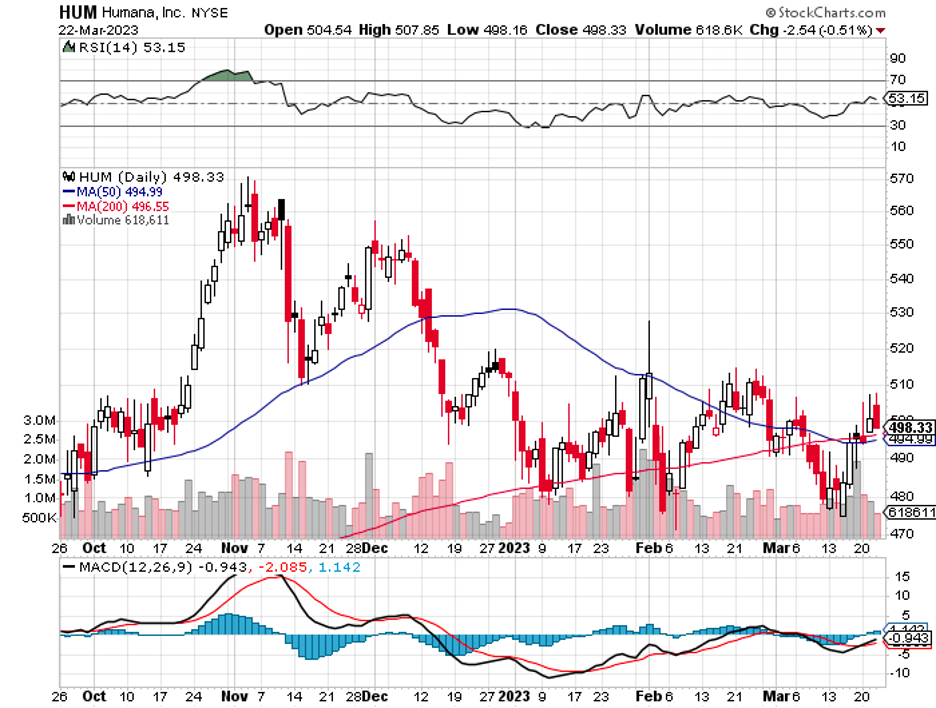
Overall, Humana is a demonstrably excellent company, but the stock remains underrated. I suggest you exploit the market’s disinterest in this profitable business and buy the dip.
Mad Hedge Biotech and Healthcare Letter
February 21, 2023
Fiat Lux
Featured Trade:
(AN UNFAILING STOCK FOR YOUR WATCHLIST)
(UNH)

After a grueling year, investors are desperate for high-quality stocks that can push their portfolios toward a robust recovery. Besides, the stock market is still expected to suffer from volatility because of skyrocketing interest rates and concerns over a possible recession.
This is why it’s critical to look for stocks with long-term potential regardless of the short-term uncertainties.
One of the stocks that fall under this category is UnitedHealth Group (UNH).
United is the second biggest health insurance plan provider in the United States. It handles over 45 million individuals domestically and more than 5 million customers across the globe. On top of these, United has over 100 million clients via its Optum Health subsidiary.
United shares have catapulted by 115% over the past 5 years and 748% in the last decade. This shows the company’s stability and solid leadership. After all, these incredible gains didn’t occur by accident.
The company has reported positive year-over-year growth in its bottom line in 19 out of 20 years, with the Great Recession in 2008 being the only exception.
The company provides an extensive range of services, including medical and commercial insurance, prescription, Medicare Part D plans, Medicare Advantage, Medicaid, and Medicare Supplement. Its sheer size and diverse portfolio easily set United apart from its counterparts in the sector. More importantly, the company is consistent in its performance and frequently surpasses its rivals in terms of profitability.
It also boasts of higher margins that consequently lead to better efficiency ratios like return on equity and return on assets. This indicates United’s superior way of handling its financial resources to ensure it delivers good returns for its shareholders.
These factors all result in a notably solid company that delivers stable cash flows throughout the different economic cycles. Admittedly, though, United will never become a transformative stock. Instead, it should be regarded as one of the most reliable dividend stocks in anyone’s portfolio.
Over the last 10 years, United’s shareholder distributions have regularly grown, with the stock offering a 1.3% dividend yield. While this is notably lower than the S&P 500’s current average yield at 1.7%, the company has been aggressive in boosting its payouts every quarter.
For context, its $1.65 per share payment in the current quarter is almost eight times the $0.2125 it paid its shareholders 10 years ago.
Remarkably, the company only took 7 years to triple its payout in 2015, which was at $0.50 per share.
All in all, these average out to a compound annual growth rate of 18.6%.
That’s an impressive rate of growth, and this performance could very well be sustained thanks to United’s strong earnings.
With the business showing no signs of slowing down anytime soon and the continuous expansion of its Medicare segment, United’s bottom line is projected to climb between 13% and 16% every year over the long term.
Currently, United trades at 23 times earnings, making it reasonably priced albeit a bit more costly than the S&P 500’s average of 20. Still, this type of growth and such a solid dividend make the healthcare stock worth a premium.
To date, United has a payout ratio of 29%, demonstrating that the company is capable of producing more than enough earnings to sustain and boost its dividends.
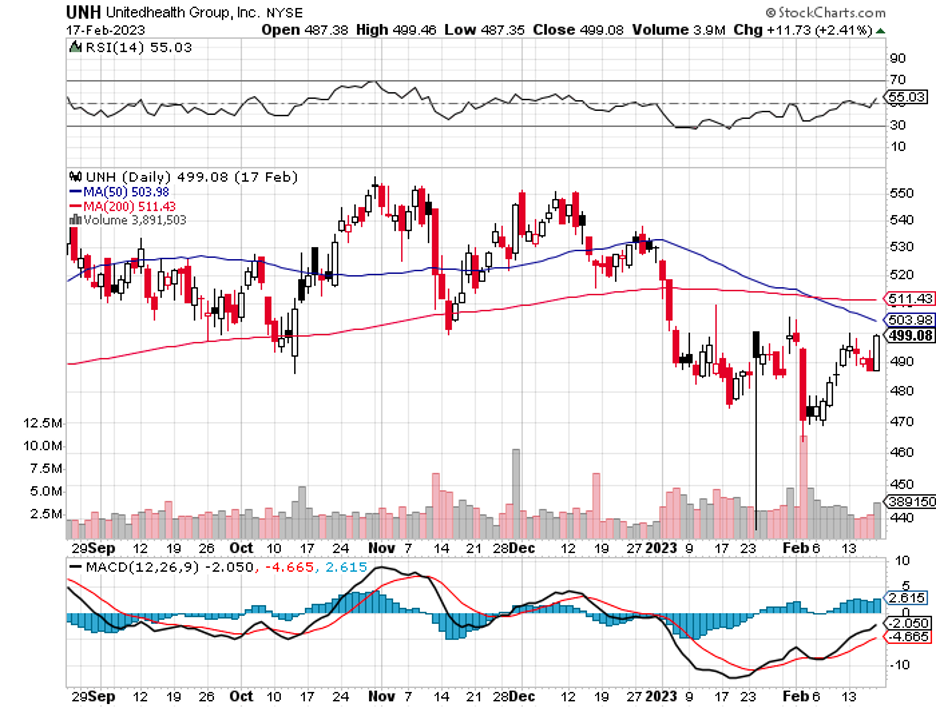
It also has a forward P/E ratio under 20, indicating that investors can buy United shares sans the risk brought by too much volatility. Hence, this is an excellent stock for income investors and retirees. I suggest you put it on your current watchlist and be ready to buy the dip.
Mad Hedge Biotech and Healthcare Letter
December 8, 2022
Fiat Lux
Featured Trade:
(THE MASTODON OF HEALTHCARE)
(UNH), (HUM), (CI), (ELV), (CVS)

Most earnings reports across all industries recently include the terms “inflationary pressures,” “short-term macroeconomic conditions,” “labor shortages,” and, of course, “supply chain issues” to justify why revenues are down or flat. The S&P 50 index has declined by over 20% to date, with signs of sliding further.
Clearly, the economy cannot be described as recession-proof. It typically follows a relatively predictable, albeit irregular, path commonly called the economic cycle. Needless to say, recessionary periods can be heartbreaking and brutal for the market and its investors.
However, some sectors are somewhat immune to the ups and downs of the economy. These industries provide investors with recession-proof stocks that can be held onto during these challenging periods. One of them is the healthcare industry.
Healthcare stocks, particularly high-quality businesses, tend to be viewed as recession-proof. Despite the economic turbulence, companies in this sector still enjoy relatively solid and steady demand. That’s not entirely shocking since people can’t exactly just cancel their healthcare needs.
No matter what’s happening in the world, when you’re unwell, you have no other option but to see a doctor and get medicine.
Within the healthcare sector, not all businesses are created equal. Some still felt the recession's nasty consequences, while others managed to thrive.
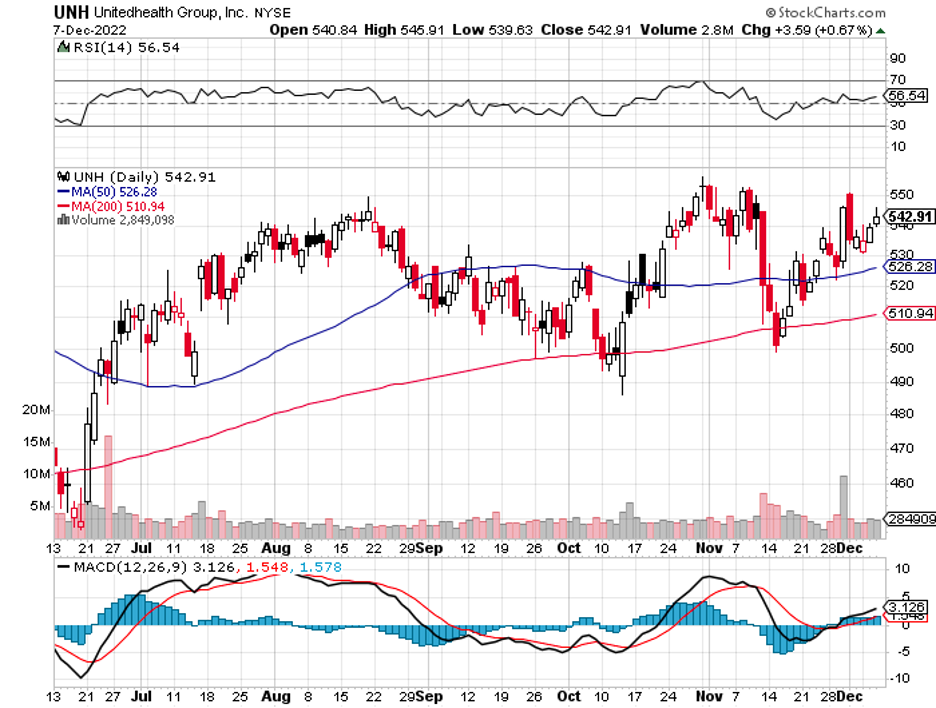
One name that continues to impress amid the economic turmoil is UnitedHealth Group (UNH).
Basically, UNH operates 2 main segments.
One is UnitedHealthcare, which offers a complete range of healthcare insurance. The other is Optum Health, which provides data-driven healthcare gathered from partner surgery centers. It also obtains information from OptumRx, UNH’s pharmacy management arm.
Both UnitedHealthcare and Optus Health delivered excellent results to date, boosting the company’s full-year guidance from $20.85 to $2105 in terms of EPS. In comparison, UNH recorded an annual EPS of $18.08 back in 2021.
In the first 9 months of 2022, UNH raked in $192.5 billion in revenue. This shows a 14% increase year over year. Meanwhile, its earnings per share climbed to $16.15 compared to the $13.82 it reported during the same period in 2021.
One of the key drivers for these results is the boost in the number of subscribers to UNH’s services, which rose by 850,000 in 2022. Apart from these, the company has an attractive dividend that keeps investors satisfied. For the 13th consecutive year, UNH has raised its dividend, announcing a quarterly boost of 14% to reach $1.65.
Keep in mind that the health insurance industry climbs higher each year, and COVID-19 has forced everyone to reconsider and review their perspectives towards healthcare.
On top of these, UNH’s long-term growth is supported by the inevitable: the continuous and increasingly expensive demands of an aging population. That is, the company has a massive addressable market that keeps on expanding year after year.
Looking at the trajectory of this industry, it is estimated that 73.5 million individuals will be enrolled in Medicare by 2027. This represents a 28.5% boost from the 57.2 million reported in 2017.
Due to the increasing demands in healthcare in the coming years, particularly among the aging population, spending in this segment is also anticipated to rise rapidly. In fact, healthcare spending is projected to hit $6 trillion annually by 2028.
Thus far, UNH is hailed as the leading company in healthcare. The company’s hegemony looks and feels incomparable, and none of its competitors appear to be strong enough to dethrone it. For context, the leading rivals of UNH in the US include Humana (HUM), Cigna (CI), Elevance (ELV), and CVS Health (CVS).
For these competitors to stand a chance at beating or at least competing with its on equal grounds, they would need to merge—a move they’ve all attempted in the past but were blocked by regulators.
Overall, UNH remains a solid choice, especially during these trying times. This company is a widely respected mastodon in the insurance market worldwide, showing off substantial growth in revenue and profit practically every year. Buy the dip.
Mad Hedge Biotech and Healthcare Letter
September 8, 2022
Fiat Lux
Featured Trade:
(WON’T GO DOWN WITHOUT A FIGHT)
(CVS), (SGFY), (AMZN), (HUM), (UNH)

Bigger is better. At least, that’s what CVS Health (CVS) seems to believe.
Recently, the big news in healthcare is CVS’ move to acquire Signify Health (SGFY) for $8 billion, pushing it even nearer to its goal of becoming an integrated healthcare provider.
The deal, anticipated to close by the first quarter of 2023, is an all-cash deal with CVS paying $30.50 per share.
While this deal isn’t exactly something new, Signify has been known to be a great innovator in the fast-moving space.
The critical factor in how Signify is different from other companies lies in its strategy, which leans more on a technology- and data-focused model that caters to the gig economy. Under its scheme, clinicians are likened to Uber drivers in terms of independence.
Meanwhile, CVS’ move to swoop in and buy Signify actually threw a wrench in the plans of another company hoping to dominate in the healthcare space: Amazon (AMZN).
Just a few weeks before this announcement, Amazon’s entry into the healthcare industry felt unstoppable. The e-commerce giant started its journey with the $3.9 billion purchase of One Medical (ONEM), a doctor’s office chain, with the goal of continuing its expansion through a deal with Signify.
The encroachment of the retail giant seemed like a massive issue for existing players in the healthcare industry, particularly CVS, which was said to have lost out in the bidding war for ONEM.
Needless to say, this makes CVS’ success in buying Signify an even sweeter victory.
More importantly, this decisive move from CVS makes it apparent that it won’t go down without a fight. That is, Amazon’s march into the healthcare industry will not be completely unopposed.
Basically, Signify sends clinicians to patients’ homes to help them assess their conditions. However, the company does not offer home health services at all.
CVS’ decision to pursue this deal makes it clear that the company is veering toward primary care delivery. Signify’s services can integrate almost seamlessly with the CVS Health ecosystem, with clinicians being afforded the opportunity to simply direct patients to other CVS products and services.
However, not all plans are perfect.
One red flag in this deal involves the major clients of Signify: Humana (HUM) and UnitedHealth (UNH).
Given that CVS is a competitor, they may be put off by the new arrangement and decide to pull out of their existing contracts. This is an understandable concern since one of the main attractions in availing of Signify’s services is its status as an independent entity. This ensures that it operates without any bias and allows equal participation among all payers.
While Signify execs claim that all stakeholders are “very supportive” of this deal, the effects of the plan remain to be seen.
Either way, home-based healthcare is emerging as a new and lucrative trend in the industry. Hence, more and more companies are expected to make similar decisions.
Earlier this month, Walgreens Boots Alliance (WBA) executed a similar move when it acquired a majority share of CareCentrix. Even UNH shelled out a premium when it bought LHC Group, a home-health provider, for $5.4 billion this spring.
Whether it’s caused by an aging population battling mobility issues or healthier patients who realized the price of convenience during the pandemic, it’s undeniable that the demand for home-based healthcare is growing.
Obviously, companies like CVS are capitalizing on that trend.
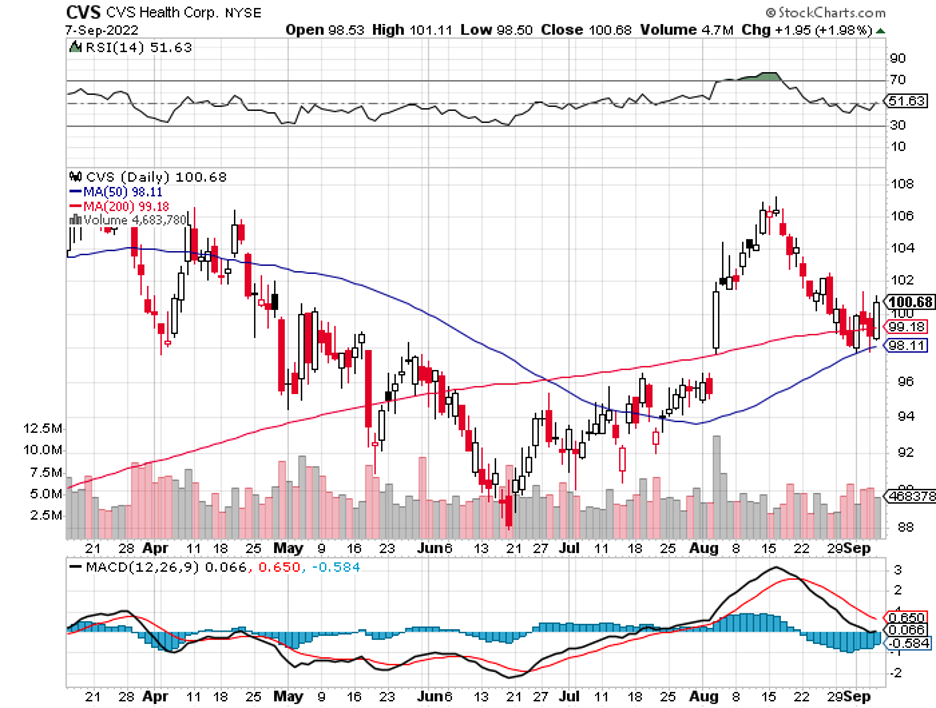
So far, CVS’ strategy to develop a one-stop-shop for healthcare looks to be on track. The fact that it’s managing to build out a full-scale integrated model while practically doubling its stock price in the last three years makes it an excellent stock to own for the long haul.
If the company continues this trajectory and expansion into primary care, then CVS could quickly become one of the biggest healthcare stocks globally.
Mad Hedge Biotech and Healthcare Letter
July 26, 2022
Fiat Lux
Featured Trade:
(ANOTHER TECH AND HEALTHCARE CROSSOVER)
(ONEM), (AMZN), (TDOC), (AMWL), (GOOGL), (AAPL), (MSFT), (CVS), (WBA), (UNH)

The battle for telemedicine dominance might have just ended before it even began.
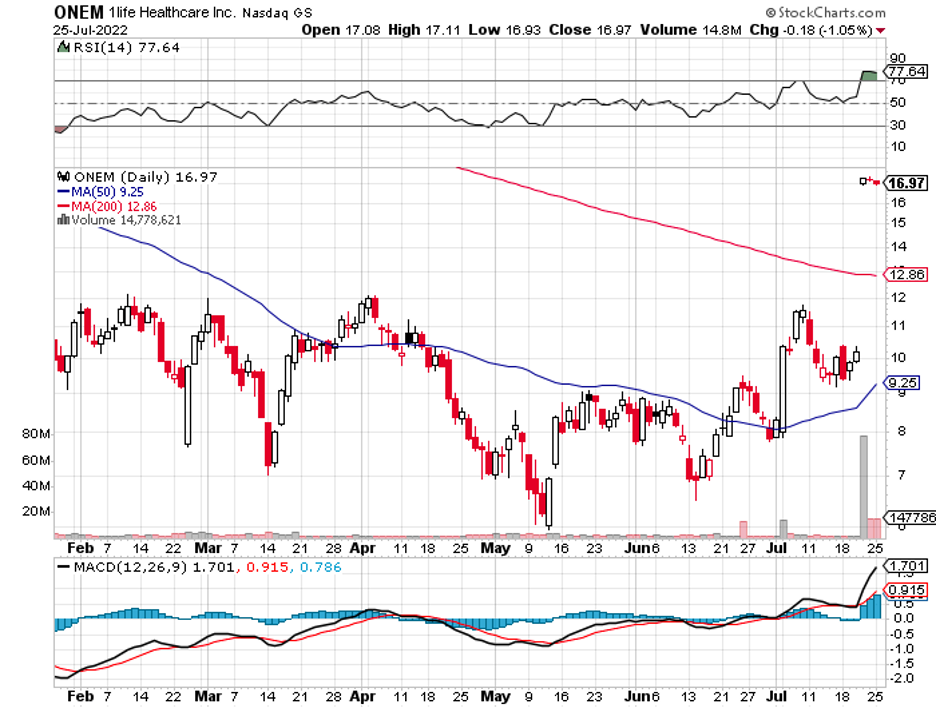
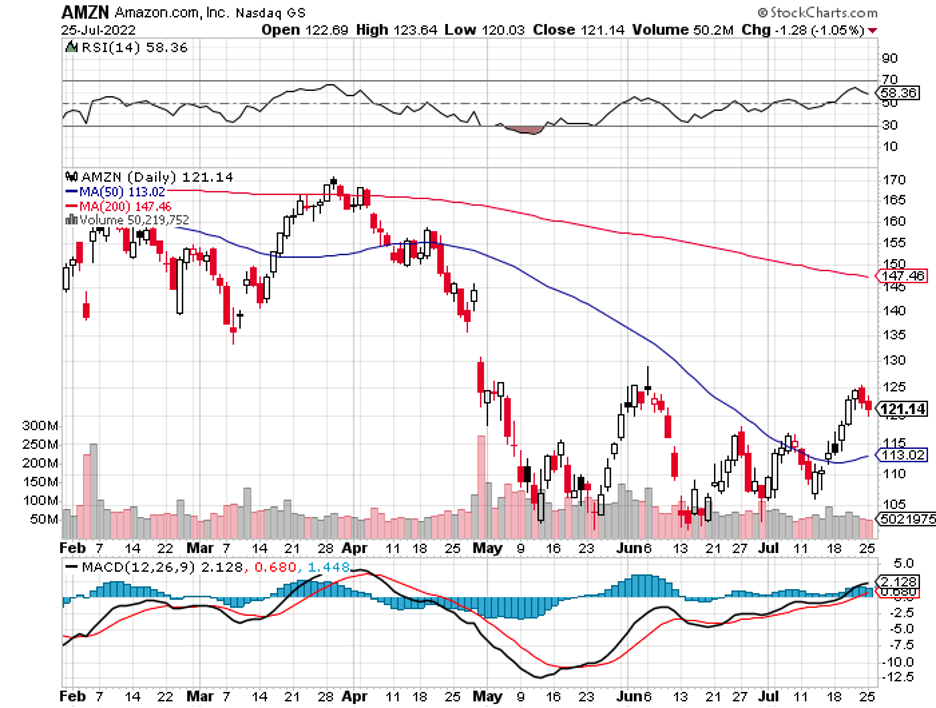
Amazon (AMZN) just announced its all-cash plan to acquire One Medical (ONEM) for $3.9 billion, paying $18 per share.
To date, this will be Amazon’s biggest step toward the healthcare world.
With the entry of Amazon into this telehealth segment, companies like Teladoc (TDOC) and Amwell (AMWL) would need to work overtime to match the resources of the e-commerce giant.
However, Amazon’s move isn’t exactly novel considering that other FAANG companies like Google (GOOGL), Apple (AAPL), and Microsoft (MSFT) have already acquired healthcare companies.
What this move simply indicates is that Amazon has finally turned serious in its bid for a bigger piece of the healthcare market.
This isn’t even the first time Amazon decided to go beyond its retail business. It has a pretty diverse portfolio including Amazon Web Services, a cloud infrastructure service, and even Whole Foods.
However, the decision to aggressively pursue the $800 billion healthcare industry might just be what Amazon needs to really move the needle.
In 2018, Amazon shelled out roughly $1 billion to buy an online pharmacy called PillPack which led to the launch of virtual Amazon Care clinics.
On that same year, the e-commerce company also pursued a joint venture, dubbed Haven, with Berkshire Hathaway and JPMorgan Chase. Unfortunately, that plan didn’t pan out and was eventually shut down.
Buying One Medical at a premium of 77%, Amazon beat other interested bidders including CVS (CVS), Walgreens (WBA), and UnitedHealth (UNH).
It’s still unclear what Amazon plans with One Medical. The e-commerce giant might add it to its Amazon Care brand or let it operate independently.
One Medical is a membership-based platform, which is backed by the Carlyle Group (CG) and managed under 1Life Healthcare.
Like most telehealth companies, it offers virtual healthcare services like virtual visits. What makes it different is that it also provides in-person checkups in accredited medical offices within the US.
One Medical’s app enables clients to schedule appointments, talk with their healthcare provider, and ask for prescriptions.
A key selling point is that the company guarantees that all the appointments start on time. Another notable feature is that users can gift a yearlong subscription to someone for $199.
Like Teladoc and Amwell, the company isn’t profitable yet. This case isn’t shocking for a relatively new field.
However, One Medical’s strategy has led to impressive revenue and membership growth.
The company’s revenue has consistently increased since its 2020 IPO. In 2021, its membership count climbed by 34% to reach 736,000.
In the first quarter of 2022, One Medical’s membership grew again by 28% and revenue jumped 109% to record over $254 million. So far, more than 8,000 companies provide One Medical services to their staff.
For 2022, One Medical projects its revenue to be between $831 million and $853 million.
Admittedly, these figures seem inconsequential when you compare them to the other sectors of Amazon’s business. For example, Amazon Web Services raked in $18.4 billion in sales in the first quarter of 2022.
Actually, One Medical’s revenue and membership growth might even look small and unimpressive compared to Teladoc, which recorded $565 million in the first quarter and has more than 54 million members in the US alone.
Undoubtedly, the healthcare market offers a mouthwatering opportunity for the likes of Amazon. It’s a lucrative industry, one of the handful that can truly make a difference in an already thriving business. Moreover, it has been highly profitable over the years.
Nonetheless, the acquisition of One Medical isn’t a foolproof plan for Amazon’s dominance in healthcare. So far, the e-commerce giant’s track record has been mixed. That doesn’t mean that the deal is a bad move. In fact, it indicates Amazon’s seriousness in making a play for the healthcare market.
Either way, the clear winner would be One Medical. Since the announcement, the stock has risen 70%.
Moreover, even if Amazon falls victim to politicization or anti-trust issues involving the deal, One Medical still has a number of suitors lined up.
Basically, it’s a win-win for this emerging telehealth company.