• support@madhedgefundtrader.com
  • Member Login
Mad Hedge Fund Trader
  • Home
  • About
  • Store
  • Luncheons
  • Testimonials
  • Contact Us
  • Click to open the search input field Click to open the search input field Search
  • Menu Menu
Mad Hedge Fund Trader

AbbVie’s Big Coronavirus Play

Biotech Letter

Two major issues are in the root of the panic caused by every new infectious disease.

The first is because of the uncontrollable spread of the virus, affecting thousands of people in a short span of time. This consequently pushes the public to question the capacity of their government to provide the proper healthcare to every patient, causing further confusion, alarm, and eventually, economic upheaval.

The second is the overpowering uncertainty that looms over not only the people directly affected by the disease but also the rest of the world as we feel like sitting ducks, wondering who the virus will infect next.

Both effects have become apparent with the news of a new coronavirus, known as 2019-nCoV, which originated in Wuhan, China.

The public’s reaction has come so close to mass hysteria, especially since the virus has already taken over 400 lives and infected more than 20,000 people worldwide.

The speed by which the disease is spreading is also alarming. The 2019-nCoV getting transmitted from one person to another almost as fast as the highly transmissible flu, which was not the case for its slower-moving cousins Severe Acute Respiratory Syndrome (SARS) and Middle East Respiratory Syndrome (MERS).

In response to this alarming situation, the Chinese government along with the medical community has turned to unconventional means to find a cure — and giant biotechnology company AbbVie (ABBV) is at the forefront of these efforts today.

One measure taken by the health experts is using AbbVie’s off-label HIV drug, called Kaletra (aka Aluvia), to treat 2019-nCoV patients.

Kaletra has two components valuable in battling the coronavirus: lopinavir and ritonavir. Both have the capacity to block HIV viral replication.

The twice-a-day Kaletra regimen comprises taking the HIV drug and undergoing infusions of interferon, a protein that triggers the immune system.

Although the AbbVie drug has yet to be officially declared as an approved cure for the 2019-nCoV, more and more health experts in China are already using it.

The belief on this treatment’s efficacy stemmed from the statement of the head at Peking University First Hospital, who shared that he contracted 2019-nCoV but cured himself by taking Kaletra.

This Chinese doctor is currently part of the national team of experts sent by the Chinese government to tend to those in Wuhan. Aside from him, Shanghai authorities disclosed that they have already adopted the HIV treatment in handling their own patients.

However, this isn’t the first time that Kaletra was deployed as a treatment against a coronavirus.

In 2004, Kaletra was used to cure the patients of SARS-CoV. This is promising since SARS, which is also caused by a coronavirus, bears a close resemblance to the 2019-nCoV. Experts tested the drug to help treat MERS patients as well.

A roadblock for the Kaletra cure is the scarcity of the drug in China.

A lot of health professionals disclosed that they have been struggling to get their hands on the AbbVie off-patent product. In response, AbbVie donated approximately $1.5 million worth of Kaletra to help contain the 2019-nCoV.

Other biotechnology behemoths have followed AbbVie’s lead of donating funds to help with the research in China. The list includes Roche Holding (RHHBY) and Gilead Sciences (GILD).

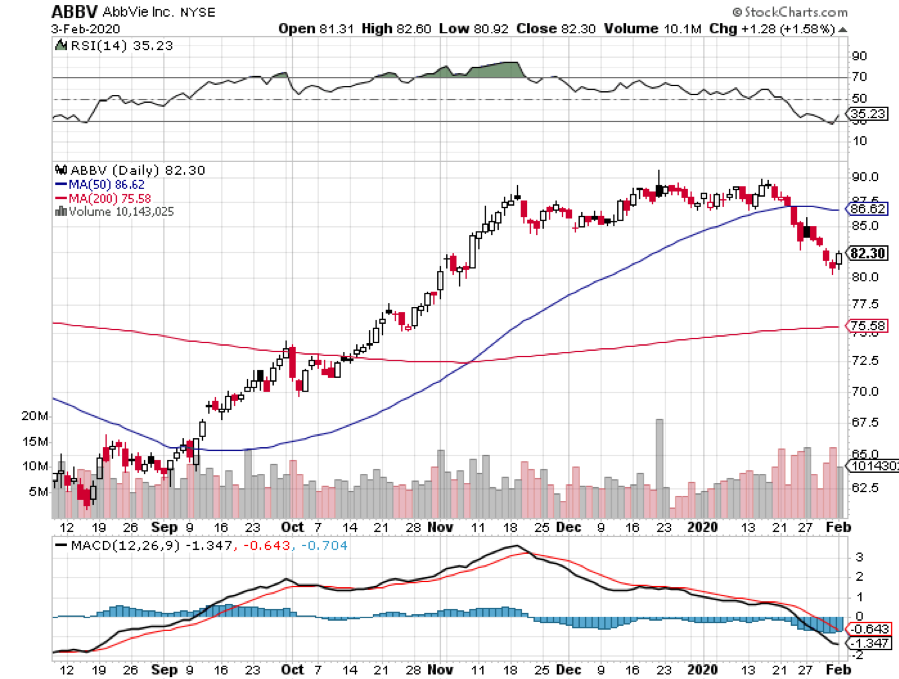
Meanwhile, this piece of promising news is not lost in the market. In fact, AbbVie shares pushed higher the moment Kaletra’s efficacy against the 2019-nCoV was revealed.

Apart from that, this development has reminded investors of AbbVie’s promising growth lately.

Unfortunately, most of the company’s growth came from acquisitions — a path where AbbVie has an abysmal track record. More often than not, investors fear that the company overpays in deals that fail to reap the promised rewards.

Case in point: AbbVie’s hefty $63 billion acquisition of Botox maker Allergan, which is due to be finalized early 2020.

In moving to acquire a company that only has one consistent blockbuster product, experts believe that AbbVie might have pulled the trigger too soon without considering other options.

While this high-profile agreement has been such a hot topic in the investing community, I think it’s a good move towards diversifying AbbVie’s sales and injecting additional growth.

Remember, AbbVie is in desperate need for a new outlet in light of the dwindling Humira sales. Adding a high-selling and established industry leader like Botox to the mix would make AbbVie more diversified than ever, making it safer.

More importantly, AbbVie ensured that the $63 billion acquisition doesn’t run the company to the ground — and its precautionary measures showed.

The company has been consistent in its net income, reporting over $5 billion annually in the past three years. It also raked in $12.8 billion in free cash flow in 2018, proving that AbbVie is well-positioned to acquire more companies and be more creative in looking for growth targets.

Hence, I view this biotechnology stock as an underrated buy that would appeal to bargain hunters willing to hang onto it for the years to come.
https://madhedgefundtrader.com/wp-content/uploads/2019/05/cropped-mad-hedge-logo-transparent-192x192_f9578834168ba24df3eb53916a12c882.png 0 0 Mad Hedge Fund Trader https://madhedgefundtrader.com/wp-content/uploads/2019/05/cropped-mad-hedge-logo-transparent-192x192_f9578834168ba24df3eb53916a12c882.png Mad Hedge Fund Trader2020-02-04 09:34:422020-02-04 09:53:53AbbVie’s Big Coronavirus Play
Mad Hedge Fund Trader

January 23, 2020

Biotech Letter

Mad Hedge Biotech & Healthcare Letter
January 23, 2020
Fiat Lux

Featured Trade:

(BIOGEN’S BIG ALZHEIMER’S BET),
(BIIB), (BMY), (PFE), (IONS), (MYL)

https://madhedgefundtrader.com/wp-content/uploads/2019/05/cropped-mad-hedge-logo-transparent-192x192_f9578834168ba24df3eb53916a12c882.png 0 0 Mad Hedge Fund Trader https://madhedgefundtrader.com/wp-content/uploads/2019/05/cropped-mad-hedge-logo-transparent-192x192_f9578834168ba24df3eb53916a12c882.png Mad Hedge Fund Trader2020-01-23 04:02:402020-01-23 10:57:08January 23, 2020
Mad Hedge Fund Trader

Biogen’s Big Alzheimer’s Bet

Biotech Letter

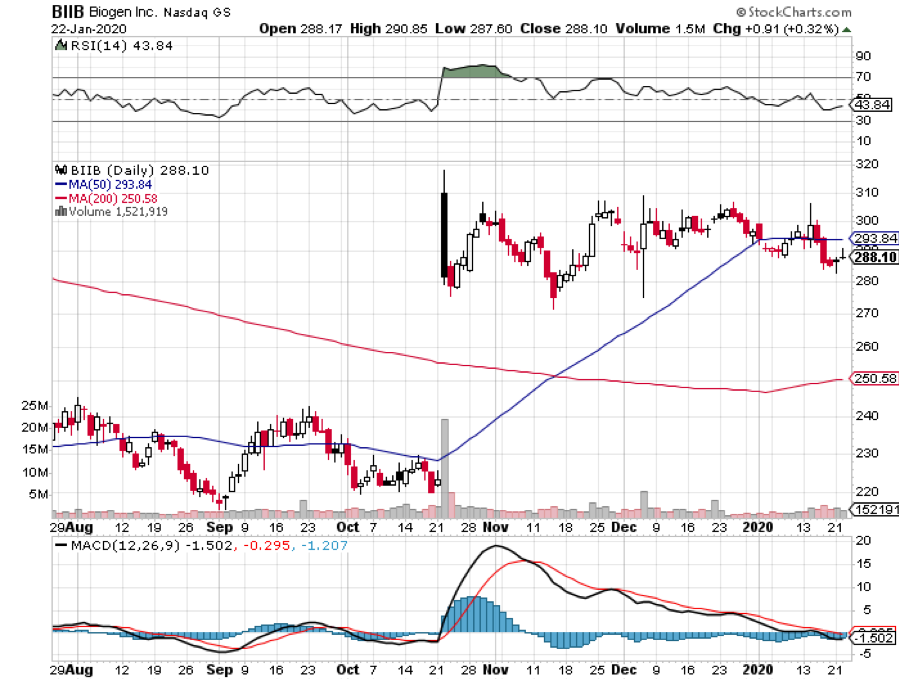
Biotech giant Biogen (BIIB) failed to impress in 2019. Surprisingly, the company is sticking to its strategy this 2020.

Despite the majority of biotech companies posting market-beating gains last year, Biogen’s shares suffered a 1.4% loss to their value. Taking a look at its performance, there are three obvious reasons why Biogen stock lost ground in 2019.

For one, its revenue generation, particularly for the multiple sclerosis portfolio, flatlined last year. Another reason is the company’s move not to acquire another company the way Bristol-Myers Squibb (BMY) took over Celgene.

Biogen’s decision to not make any major acquisition in 2019 was deemed as an inability to achieve significant business development milestones, thereby failing to positively influence the company’s near-term outlook.  

The third reason is Biogen’s decision to halt trials for its widely anticipated Alzheimer’s drug candidate, Aducanumab, in March 2019.

With so much invested in the development of this product, the investing community expected Biogen to completely drop the project altogether.

However, it seems that Biogen has found a way to resolve the issues it initially encountered in the Aducanumab study.

In October 2019, the company announced its plan to resurrect all its Aducanumab-related efforts. To show its commitment to the plan, Biogen kicked off 2020 with a massive purchase from Pfizer (PFE).

Since Biogen aims to apply for regulatory approval by early 2020, the company has been aggressively pursuing avenues to ensure that its Alzheimer’s drug candidate will get the green light as soon as possible.

One of its efforts is its $700 million deal to buy Pfizer’s castoff drug, PF-05251749.

The Pfizer drug was created to treat Irregular Sleep-Wake Rhythm Disorder suffered by Alzheimer’s and Parkinson’s disease patients. This condition, also known as Sundowning, affects 20% of those afflicted by these neurological diseases.

According to the terms of the deal, Biogen will shell out $75 million upfront to gain the rights to the Pfizer drug.

The company will also pay an additional $635 million in the form of milestone payments. Pfizer will receive tiered royalties as well.

On top of this $700 million deal with Pfizer, Biogen also added another $45 million to fund its Alzheimer’s research with Ionis Pharmaceuticals (IONS). Apart from these, the two companies have been working on ION859, which is a possible treatment for Parkinson’s disease.

As if all of these are not enough to show Biogen’s dedication to finding the cure for Alzheimer’s disease, the company has a similar drug in its pipeline: BAN2401. This new drug, which uses a similar approach to Aducanumab, is actually already in its late-stage testing phase.

However, Biogen’s deal with Pfizer is not the first of its kind.

Prior to this, the company paid a whopping $300 million upfront to Bristol-Myers Squibb to own the rights to neurological drug Gosuranemab. Unfortunately, that study failed to deliver the desired results.

Even though Biogen has yet to actually file for regulatory approval for Aducanumab, the company is already preparing for the treatment’s launch this year. This is a rather confident move especially in light of the niggling doubts on the drug’s approval.

Apart from working on Aducanumab, Biogen has been testing for a higher dosage for spinal muscular atrophy medication Spinranza. This is done as a precautionary measure against Novartis’ (NVS) blockbuster gene therapy Zolgensma.

Its exclusive rights on Tecfidera, which has been challenged by Mylan (MYL), is also anticipated to hold until 2028. This means Biogen can still expect to reign supreme in this niche, hanging on to its blockbuster drug that raked in $4.3 billion in 2018 alone and $2.15 billion in the first half of 2019.

In addition to Alzheimer’s and Parkinson’s disease, Biogen is active in searching for treatments for Lou Gehrig’s disease along with stroke and choroideremia as well.

Biogen has also set in motion its plan to venture into rare eye diseases via its $800 million acquisition of Nighstar Therapeutics back in June 2019.

Notably, though, Biogen has been steering away from any major acquisition in 2020.

This strategy could be a stroke of genius if the company’s bet on Aducanumab pays off.


https://www.madhedgefundtrader.com/wp-content/uploads/2020/01/biogen.png 312 899 Mad Hedge Fund Trader https://madhedgefundtrader.com/wp-content/uploads/2019/05/cropped-mad-hedge-logo-transparent-192x192_f9578834168ba24df3eb53916a12c882.png Mad Hedge Fund Trader2020-01-23 04:00:362020-01-23 10:57:00Biogen’s Big Alzheimer’s Bet
Mad Hedge Fund Trader

January 21, 2020

Biotech Letter

Mad Hedge Biotech & Healthcare Letter
January 21, 2020
Fiat Lux

Featured Trade:

(WHY THERE’S ANOTHER DOUBLE IN CRISPR THERAPEUTICS)
(CRSP), (BLUE), (EDIT), (NVS), (GILD)

https://www.madhedgefundtrader.com/wp-content/uploads/2020/01/biotech.png 337 506 Mad Hedge Fund Trader https://madhedgefundtrader.com/wp-content/uploads/2019/05/cropped-mad-hedge-logo-transparent-192x192_f9578834168ba24df3eb53916a12c882.png Mad Hedge Fund Trader2020-01-21 11:02:492020-01-21 11:15:51January 21, 2020
Mad Hedge Fund Trader

Why There’s Another Double in CRISPR Therapeutics

Biotech Letter

Biotech investors, take note: 2019 was a great year for the industry, but the best is yet to come.

In the final three months of 2019, the biotech sector grew by 32% -- notably outpacing the pharmaceutical industry, which only recorded a 9.5% gain.

However, the biotechnology sector is estimated to grow substantially in 2020, and reach over $775 billion in revenue by 2024 as more and more treatments for previously incurable diseases get discovered.

Looking at all the progress in the biotechnology space, this could even be the year we’d finally discover the cure to many life-threatening and debilitating conditions like cancer and Alzheimer’s disease.

With all these technological advancements, two revolutionary tools have been overhauling the entire biotechnology and healthcare industry from the ground up: precision medicine and CRISPR. Actually, the impressive growth of the biotechnology industry has been largely attributed to the excitement generated by the gene-editing sector.

While the majority of companies concentrating on the human genome are still in the research phase, the growth of this industry is undeniable. 

Here’s tangible proof.

Just 20 years ago, reading all the DNA of a single person cost approximately $3 billion. Now, this price is down to only $1,000. In the future, this number will go even lower at $100. There are now gigantic factories in China sequencing DNA for companies like Ancestry.com and 23andMe.

This is just one example of how the biotechnology industry has grown by leaps and bounds. It’s also the reason behind the surge of CRISPR shares.

In effect, the specialists in this niche, including Crispr Therapeutics (CRSP), Bluebird Bio (BLUE), and Editas Medicine (EDIT), are amplifying their efforts in 2020.

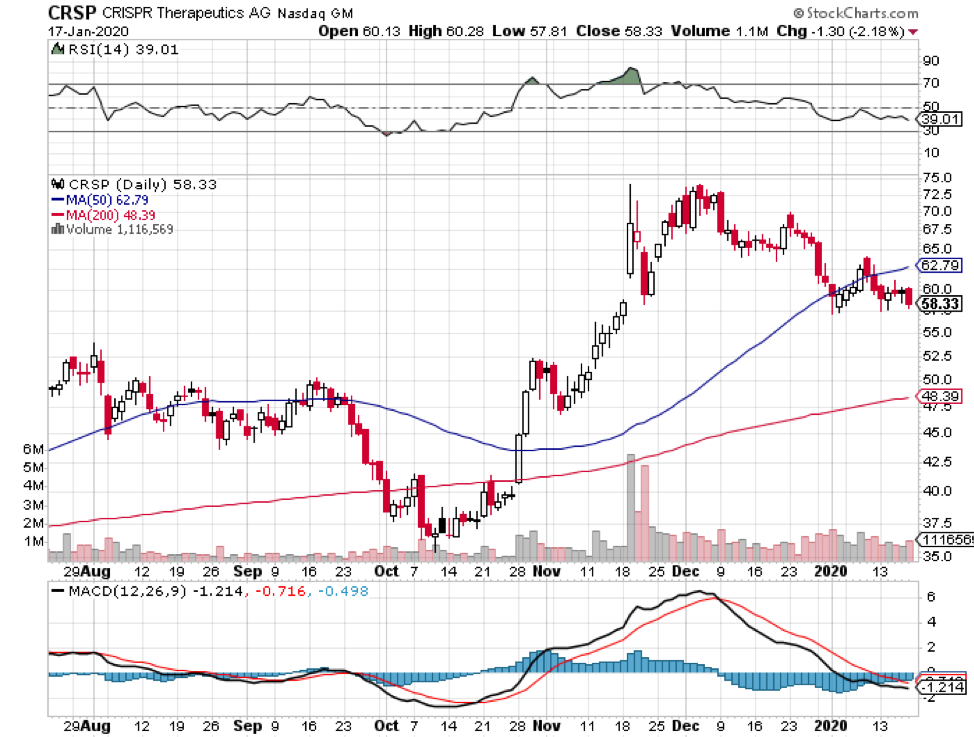
Among the specialist companies, CRISPR Therapeutics is considered as one of the frontrunners -- if not the top stock. This is because compared to its rivals, which are still in preclinical phases of development, CRISPR Therapeutics’ already has two drugs going through Phase 1 trials: CTX001 and CTX110.

The promising results of the company’s research resulted in a 113% rise in shares last year, with the bulk of the surge starting in October. In fact, CRISPR Therapeutics’ performance had been so impressive that its market cap reached $3.4 billion.

CTX001 is created to target patients suffering from genetic blood disorders, specifically sickle-cell disease and transfusion-dependent beta-thalassemia.

Meanwhile, CTX110 is a CAR-T treatment. The process involves the extraction of immune cells from the patient. These are then retrained and later re-introduced to the human body.

CRISPR Therapeutics’ CAR-T treatment is anticipated to be offered at a cheaper price compared to the other CAR-T therapies.

Both Novartis (NVS) and Gilead Sciences (GILD) are pursuing the same treatment. However, the cost of the therapy from the latter two is expected to reach as much as $475,000 for every patient annually.

Apart from CTX001 and CTX110, CRISPR Therapeutics has two more immunology candidates, currently dubbed CTX120 and CTX130.

If both phase trials succeed, these will bring massive home runs for CRISPR Therapeutics, especially since the cancer immunology market is expected to reach $127 billion by 2026. Over the next 10 years, this niche is estimated to reach $25 trillion in sales.

Among the gene-editing treatments under development today, CRISPR is projected to grow tenfold in the number of applications and potentially curing 89% of disease-causing genetic variations by 2026.

Taking this pace into consideration, the valuation for this market is expected to grow from $551 million in 2017 to reach roughly $3.1 billion by 2023 and $6 billion by 2025.

Meanwhile, precision medicine as a whole is estimated to show a significant jump from $48.6 billion in 2018 to $84.6 billion by 2024. In 2028, this market is expected to rake in $216 billion.

Hence, further success with CTX001 and CTX110 along with additional treatments in the drug pipeline would all but guarantee that Crispr Therapeutics could beat the market again in 2020.


https://madhedgefundtrader.com/wp-content/uploads/2019/05/cropped-mad-hedge-logo-transparent-192x192_f9578834168ba24df3eb53916a12c882.png 0 0 Mad Hedge Fund Trader https://madhedgefundtrader.com/wp-content/uploads/2019/05/cropped-mad-hedge-logo-transparent-192x192_f9578834168ba24df3eb53916a12c882.png Mad Hedge Fund Trader2020-01-21 11:00:472020-01-21 11:15:27Why There’s Another Double in CRISPR Therapeutics
Mad Hedge Fund Trader

January 16, 2020

Biotech Letter

Mad Hedge Biotech & Healthcare Letter
January 16, 2020
Fiat Lux

Featured Trade:

(THE FUTURE OF PRECISION MEDICINE),
(ILMN), (PACB), (RHHBY), (TMO), (QGEN)

https://madhedgefundtrader.com/wp-content/uploads/2019/05/cropped-mad-hedge-logo-transparent-192x192_f9578834168ba24df3eb53916a12c882.png 0 0 Mad Hedge Fund Trader https://madhedgefundtrader.com/wp-content/uploads/2019/05/cropped-mad-hedge-logo-transparent-192x192_f9578834168ba24df3eb53916a12c882.png Mad Hedge Fund Trader2020-01-16 13:02:112020-01-16 13:54:49January 16, 2020
Mad Hedge Fund Trader

The Future of Precision Medicine

Biotech Letter

Hyper-personalized treatments, otherwise known as precision medicine, have been hailed as one the hallmarks of the healthcare revolution in the past decade.

Although a lot of people don’t see the need for such personalized treatments, a 2017 study by Boston medicine professor Jason Vassy indicated otherwise.

In his paper, titled “Annals of Internal Medicine,” Vassy discussed how his team performed whole-genome sequencing to 100 perfectly healthy adults.

To give you a better picture of how big this project was, whole-genome sequencing involves the analysis of the entire body’s DNA -- yes, all 3 billion pairs of letters found in every individual’s body.

So, you can imagine how tedious and complicated Vassy’s process was and why a lot of people found that to be incredibly pointless, especially since the adults in the study are all “healthy.” More importantly, the naysayers believed that this process would only bring unnecessary panic and anxiety to the subjects.

However, the results shocked them as 20% of the people tested positive for rare, life-threatening conditions that required immediate medical attention.

This prompted more experts to delve deeper into gathering genetic data sets in an effort to bolster the preventive power of genomics. This movement was supported by the National Institutes of Health in 2018 via their “All of Us” project, investing $27 million.

Meanwhile, a Harvard geneticist named George Church founded a similar organization called Nebula Genomics.

Basically, the idea behind precision medicine is very simple: Understanding how your genome works means knowing exactly how to “optimize” your body.

That means health professionals will be able to determine the perfect diet, perfect exercise routine, and of course, the perfect drugs for every patient. You’ll even learn the diseases your body is most susceptible to and how to prevent those.

At the moment, the biotechnology world only has a handful of companies focusing on precision medicine.

One of the leading biotechnology companies in this field is Illumina (ILMN), which focuses on DNA sequencing.

Utilizing its advanced machines, Illumina has been designing treatments to target specific cells in the human body -- and its efforts have been rewarded in recent years.

So far, Illumina stock has been up by 5,791% since its initial public offering back in 2000.

At the moment, Illumina practically controls approximately 80% of the next-generation sequencing space geared towards human genome analysis.

The key to its success is the company’s move to zero in on short-read data sequencing, which has been known as the cheapest, quickest, and most accurate service available in the market.

Since Illumina is one of the top movers in this field, it has easily become the top dog with a long waiting list of clients willing to pay tons of cash for the biotechnology firm’s machines.

While the machines definitely cost a lot upon purchase, Illumina actually earns more from the follow-up revenues generated from all the instances that a biotechnology or research laboratory uses the company’s technology to sequence a genome.

In 2019, Illumina earned $390 million in instrument revenue and $1.73 billion in consumables profit in the first three quarters alone.

Unfortunately, one of Illumina’s efforts to broaden its hold of the market failed.

The company opened 2020 to bad news as regulatory pressures pushed Illumina to shut down its plan to acquire its rival, Pacific Biosciences (PACB), for $1.2 billion.

While no particular reason was officially given by the reviewing bodies, reports indicate that the merger had been delayed due to fears of creating a monopoly.

Nonetheless, many consider this an odd excuse considering that Illumina’s supposed “monopoly” would actually compete directly with Roche (RHHBY).

For comparison, Roche’s market capitalization is $275 billion while Illumina is at $49 billion. In terms of revenue, Illumina earns $3.5 billion annually while Roche rakes in $56.8 billion.

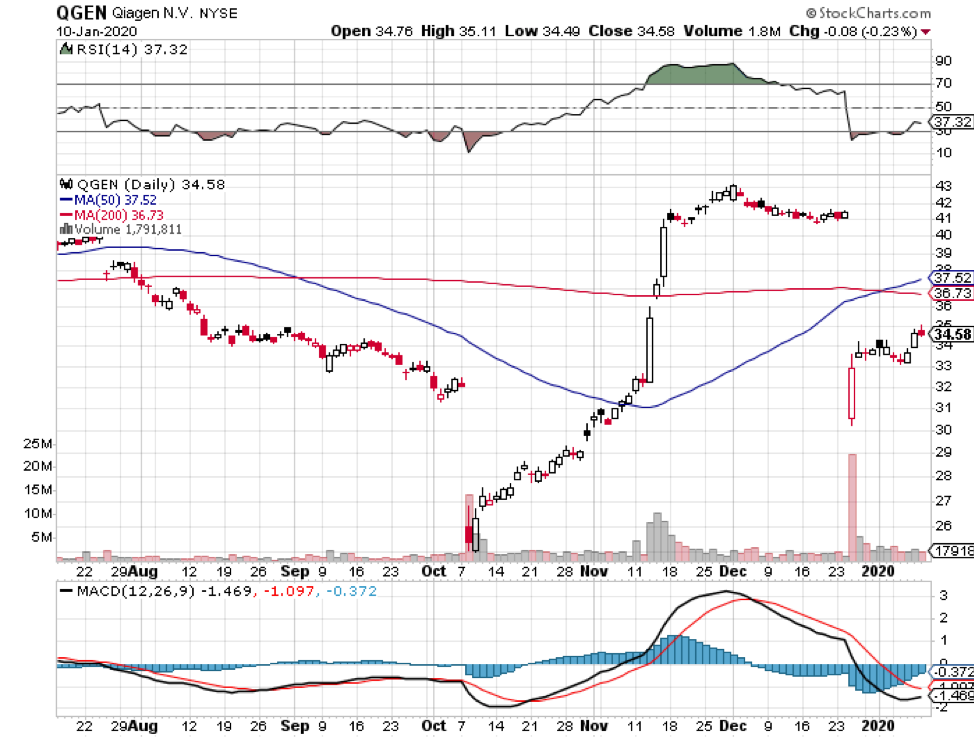
Nevertheless, Illumina has decided to shrug off the rejection and move on to another potentially lucrative deal -- a 15-year partnership with another up and coming next-generation sequencing company: Qiagen (QGEN).

Initially thought to be a surefire acquisition candidate by Thermo Fisher Scientific (TMO) to the tune of $8 billion, Qiagen opted to reject the offer.

Instead, the smaller biotechnology firm has decided to focus on expanding its product portfolio. In the next five years, Qiagen estimates an earnings growth rate of roughly 9.1%. 

Between Qiagen and Illumina, the former focuses more on individually customized treatments or “N-of-1 medicine.”

This has become even more pronounced following Qiagen’s acquisition of N-of-One, which raised $12.4 million in funding at the time, in January 2019.

N-of-One provides precision cancer care services. It offers clinical solutions like molecular interpretation to doctors and other healthcare professionals.

Apart from its partnership with Illumina, Qiagen also collaborates closely with NeoGenomics for cancer genetic testing services and DiaSorin for automated TB testing.

We’re in an era of remarkably personalized medical care.

With more and more genetic data made available for analysis, the rare diseases that boggled the minds of the healthcare industry are gradually becoming a thing of the past.

Now, we have access to tools that help with preventive measures to save us from the rare conditions that plagued our predecessors. If you really stop to think about it, targeted medicine just might be the key to immortality -- or at least to a significantly less disease-laden life. 

If you’re looking to invest in Illumina or Qiagen stock (or both), the best thing to do is to take advantage of the next price drop.


https://www.madhedgefundtrader.com/wp-content/uploads/2020/01/illumina.png 393 393 Mad Hedge Fund Trader https://madhedgefundtrader.com/wp-content/uploads/2019/05/cropped-mad-hedge-logo-transparent-192x192_f9578834168ba24df3eb53916a12c882.png Mad Hedge Fund Trader2020-01-16 13:00:252020-01-16 13:55:10The Future of Precision Medicine
DougD

January 14, 2020

Biotech Letter

Mad Hedge Biotech & Healthcare Letter
January 14, 2020
Fiat Lux

Featured Trade:

(CALIFORNIA JUMPS INTO THE DRUG BUSINESS)
(MYL), (TEVA), (RHHBY)

https://madhedgefundtrader.com/wp-content/uploads/2019/05/cropped-mad-hedge-logo-transparent-192x192_f9578834168ba24df3eb53916a12c882.png 0 0 DougD https://madhedgefundtrader.com/wp-content/uploads/2019/05/cropped-mad-hedge-logo-transparent-192x192_f9578834168ba24df3eb53916a12c882.png DougD2020-01-14 11:02:412020-01-14 11:38:30January 14, 2020
DougD

California Jumps Into the Drug Business

Biotech Letter

The bio-pharmaceutical industry, including the biotechnology sector, is in for another shock. 

Taking a page off Elizabeth Warren’s book, California Governor Gavin Newson announced his plan to create the first-ever state-run prescription drug label in the country. 

This move would be an ideal way to leverage the size and power of the California population in terms of negotiating advantageous pricing with generic drug manufacturers. 

Wielding California’s massive purchasing power courtesy of the 40 million residents, almost 33% of which are enrolled in Medicaid or Medicare, Newsom believes that the government can get generic drugs for substantially lower prices from the manufacturers.  This idea is part of Newsom’s broader vision to lower the healthcare costs in California.

In effect, the Golden State is stepping in where the federal government has failed to act. Washington should have used their massive purchasing power as a cudgel to lower prices decades ago. We’ve seen a half-century of talk, but no action.

Research from the Kaiser Family Foundation shows that 6 out of 10 Americans take a prescription, with 79% of them complaining about the unreasonable costs of these drugs. 

As a result of these prohibitive prices, 3 in 10 Americans no longer take their prescribed medications adding hugely to the nation’s health care bill.  

Even governments find it challenging to keep up with the costs of healthcare, with California’s Medicaid program for the less fortunate, otherwise known as Medi-Cal, reached over $100 billion annually in state and federal spending alone.

Inevitably, the skyrocketing prices pushed people to look at generic medications as more reasonable alternatives to brand name medications. 

However, Newsom’s announcement wasn’t met with an overwhelmingly positive response from the generics sector either. 

In fact, the Association for Accessible Medicines, the advocacy organization for generic drug manufacturers, only sent out a polite message regarding Newson’s announcement. 

The group said that they "look forward to working with California to help expand access to safe, affordable and effective generic and biosimilar medicines, but let's make our decisions and policies based on the best data and science available." You couldn’t get any more anodyne.

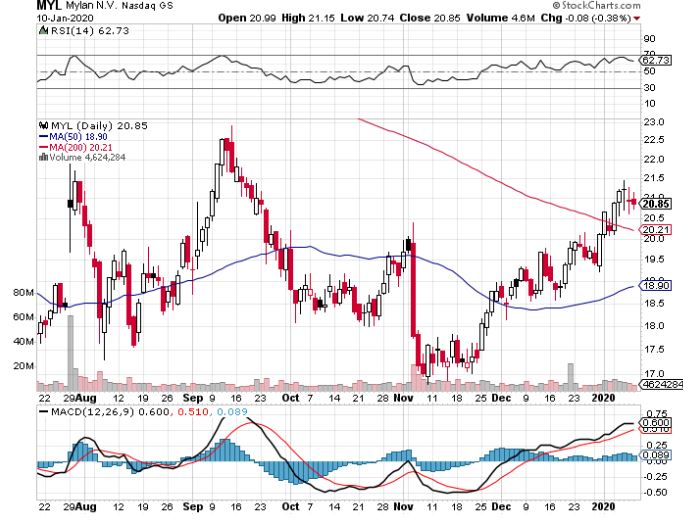
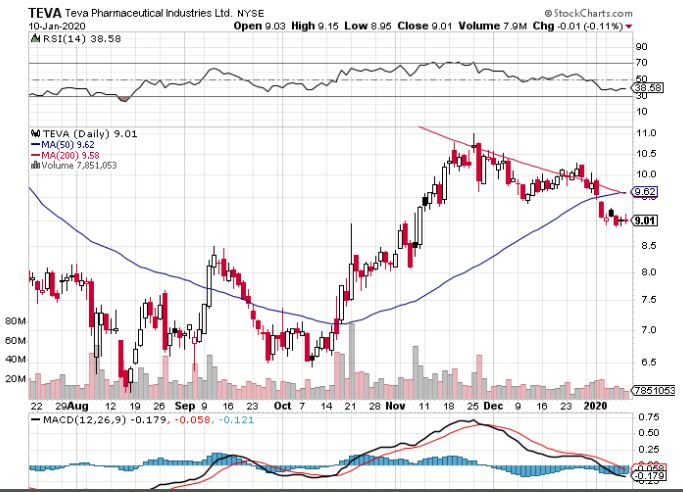
Despite their lukewarm response to this plan, two major players in the generic pharmaceutical industry have already been identified as the front runners for this shift to generics movement: Mylan (MYL) and Teva Pharmaceutical Industries (TEVA).

To say that 2019 was an awful one for Mylan is an understatement. The generic drugmaker faced a slew of issues including declining sales in their North American market, endless legal battles, and even exclusivity loss for its top-selling impotence treatment Tadalafil (Cialis). 

However, Mylan moved to turn things around in July 2019 when it entered a merger agreement with Pfizer’s (PFE) generic unit Upjohn. The two companies will turn into one entity, called Viatris, and will be launched by mid-2020.

According to the terms of this deal, Viatris will be handling the off-patent but lucrative branded drugs of Pfizer such as cholesterol treatment Lipitor, pain medication Celebrex, and erectile dysfunction and the blue erectile dysfunction drug Viagra. 

This agreement aims to inject more money into Mylan’s research and development team for them to create more complex generics and biosimilars. 

At the same time, the new company will already have a “ready-made” tried and tested drug portfolio courtesy of Pfizer’s off-patent previous blockbusters. 

Apart from the Pfizer’s lineup, Mylan also has a number of key products to contribute to Viatris. 

One is a biosimilar of Roche’s (RHHBY) blockbuster breast cancer drug Herceptin (it added four years to the life of my first wife). The launches of promising products, like biosimilar versions of Teva’s multiple sclerosis injection Copaxone and GlaxoSmithKline’s (GSK) asthma medication Advair, are also positive indicators of growth. 

With these decisions, Mylan is expected to have a brighter 2020. 

Another generic drug maker that’s expected to make a comeback in 2020 is Teva. 

In 2019, everything that could possibly go wrong went wrong for this company. As a refresher, here’s what it had to endure: executive leadership turnover, bribery allegations, generic competition for its top-selling drug Copaxone, and of course, the opioid lawsuits from 44 states. 

Needless to say, Teva’s profit estimates tumbled and its dividend was shelved. Worst, its debt load has been a huge warning sign that repelled investors left and right.

However, Teva has managed to turn things around.

The opioid lawsuits are reaching a reasonable settlement and the company now has a stronger leadership team. More importantly, it has been successful in cutting down its expenditures. If things go smoothly, Teva is expected to save $3 billion in yearly expenses to improve its profit margins in 2020. 

On top of these, Teva has regained its footing in the generic drug market via the steady climb in terms of sales of its newer branded treatments, Ajovy and Austedo.

All in all, the stage is set for Teva to make its comeback and patient investors should expect to be richer in 2020.

Since both generic drug makers churned out less than stellar numbers in 2019, the stocks are likely undervalued at the moment. Hence, it’s important to take advantage of this and buy before these regain momentum and the prices skyrocket once again.  


https://www.madhedgefundtrader.com/wp-content/uploads/2020/01/bio3-01142020.jpg 237 582 DougD https://madhedgefundtrader.com/wp-content/uploads/2019/05/cropped-mad-hedge-logo-transparent-192x192_f9578834168ba24df3eb53916a12c882.png DougD2020-01-14 11:00:352020-01-14 11:40:47California Jumps Into the Drug Business
Mad Hedge Fund Trader

January 9, 2020

Biotech Letter

Mad Hedge Biotech & Healthcare Letter
January 9, 2020
Fiat Lux

Featured Trade:

(THE 2020 DARK HORSES OF BIOTECH)
(AMRN), (THOR), (SAN), (NBSE), (OHRP),
 (MRNA), (MRK), (AZN), (VRTX), (RGLS), (ARWR)

https://madhedgefundtrader.com/wp-content/uploads/2019/05/cropped-mad-hedge-logo-transparent-192x192_f9578834168ba24df3eb53916a12c882.png 0 0 Mad Hedge Fund Trader https://madhedgefundtrader.com/wp-content/uploads/2019/05/cropped-mad-hedge-logo-transparent-192x192_f9578834168ba24df3eb53916a12c882.png Mad Hedge Fund Trader2020-01-09 14:02:362020-01-09 13:48:49January 9, 2020
Page 109 of 115«‹107108109110111›»

Legal Disclaimer

There is a very high degree of risk involved in trading. Past results are not indicative of future returns. MadHedgeFundTrader.com and all individuals affiliated with this site assume no responsibilities for your trading and investment results. The indicators, strategies, columns, articles and all other features are for educational purposes only and should not be construed as investment advice. Information for futures trading observations are obtained from sources believed to be reliable, but we do not warrant its completeness or accuracy, or warrant any results from the use of the information. Your use of the trading observations is entirely at your own risk and it is your sole responsibility to evaluate the accuracy, completeness and usefulness of the information. You must assess the risk of any trade with your broker and make your own independent decisions regarding any securities mentioned herein. Affiliates of MadHedgeFundTrader.com may have a position or effect transactions in the securities described herein (or options thereon) and/or otherwise employ trading strategies that may be consistent or inconsistent with the provided strategies.

Copyright © 2026. Mad Hedge Fund Trader. All Rights Reserved. support@madhedgefundtrader.com
Scroll to top