• support@madhedgefundtrader.com
  • Member Login
Mad Hedge Fund Trader
  • Home
  • About
  • Store
  • Luncheons
  • Testimonials
  • Contact Us
  • Click to open the search input field Click to open the search input field Search
  • Menu Menu
Mad Hedge Fund Trader

Unpacking a Pharmaceutical Powerhouse

Biotech Letter

Engaging in the pursuit of income through investing might not be the most riveting way to build wealth. Still, the story can unfold with remarkable profit when dividends remain consistent and occasionally serve as a side of growth.

Take a look at the captivating tale of Merck (MRK) shareholders. Picture this: a $5,000 investment made just five years ago that has now blossomed into $9,700 with dividends reinvested. An investment that beats the S&P 500 index's transformation of the same amount into $8,600 during that same stretch. Intrigued? You should be.

Now, let's dive deeper into this pharmaceutical marvel, a proud member of the Dow Jones Industrial Average.

Few players in the pharmaceutical landscape embrace innovation quite like Merck, an arena where it generously dispensed $13.5 billion on research and development in 2022.

That's a whopping 23% of its impressive $59.3 billion in total revenue for that year.

From the game-changing oncology drug Keytruda to the vital human papillomavirus vaccine Gardasil, Merck's pharmaceutical arsenal boasts seven products, each teetering on the brink of exceeding $1 billion in sales by 2023.

Emerging from its New Jersey hub, Merck's total sales displayed a modest 3% growth year-over-year, totaling $15 billion in Q2.

But factor in the robust U.S. dollar's foreign exchange influence, and you'll discover a currency-neutral surge of 7% for that quarter. A deep dive into these numbers would reveal an increase in sales in five out of seven of Merck's blockbuster products.

The spectrum of growth ranged from a modest 1% for its ProQuad/M-M-R II/Varivax vaccine franchise to a meteoric 53% for Gardasil.

Even the 30% and 23% YoY sales dips in diabetes medicines Januvia and Janumet couldn’t dim the sparkle, as generic competition in Europe and U.S. pricing challenges were handily offset.

The plot thickens with Merck's Q2 non-GAAP net loss per share of $2.06. Unravel this figure, and you’ll find that, excluding the $4.02 per share acquisition charge for Prometheus Biosciences, adjusted diluted EPS actually rose 4.8% YoY to $1.96.

Notably, the acquisition of Prometheus, a spotlight on immune-mediated disease treatments, fortifies Merck's immunology pipeline, adding the promising PRA-023 drug candidate for ulcerative colitis and Crohn's disease.

Merck's R&D treasure trove is far from empty.

With over 100 projects in phase 2 or phase 3 clinical trials, gems like the pulmonary arterial hypertension drug candidate sotatercept stand out, projected to reach annual peak sales of $3 billion to $4 billion.

Moreover, Merck's adjusted diluted EPS is projected to rise 9.4% annually for the next half-decade, outpacing the industry's 8.5% consensus.

Merck's 2.8% yield isn't just numbers on a page; it's a tantalizing promise, especially when juxtaposed against the S&P 500 index's 1.5% yield. And the intrigue deepens when you learn that Merck's quarterly dividend per share soared 52% higher in a mere five-year span.

Expect the threads of mid- to high-single-digit annual dividend growth to weave into the future, enabled by a strategic dividend payout ratio of just 41% for 2023, excluding the Prometheus acquisition charge. After all, the company has shown excellent strategies in terms of capitalization on growth opportunities and further fortification of the balance sheet.

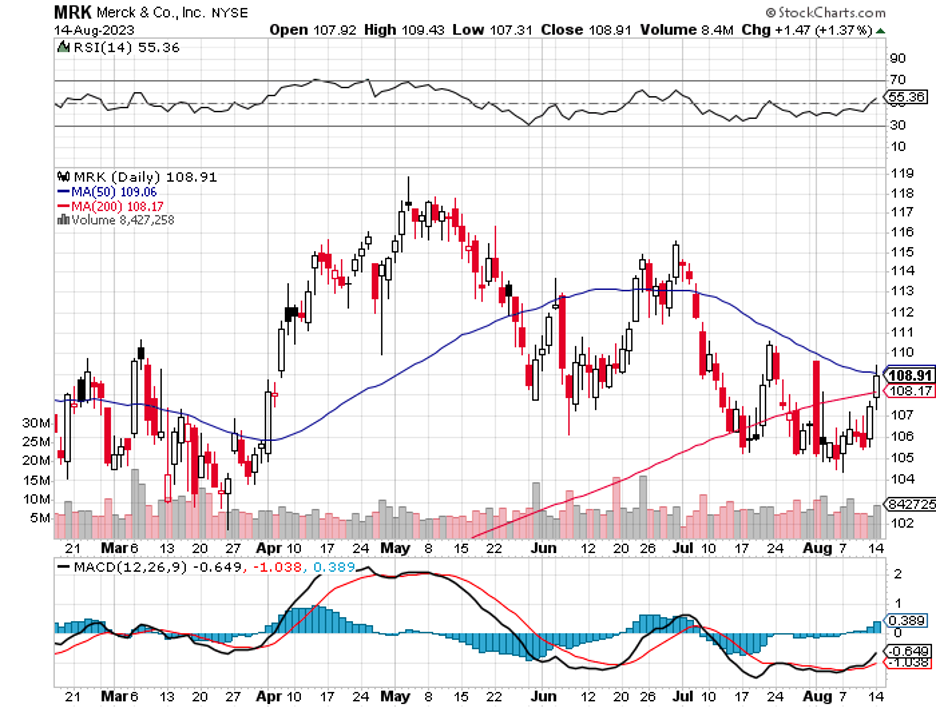
With shares surging 21% higher in the past 12 months, Merck's momentum isn't just business—it's also in the stock. And yet, there's still more to be uncovered for income investors.

Consider Merck's forward P/E ratio of 12.4, a figure that ducks below the drug manufacturer industry average of 13.3. These numbers sketch a compelling picture where above-average growth potential meets below-average valuation. Analysts pencil in an average 12-month share price target of $125—a striking 19% upside from the current $105 share price.

In the grand tapestry of investment opportunities, Merck's stock elegantly stitches together an engaging and profitable narrative, making it an alluring buy for income investors at this juncture. It's not just a chapter in the book of investment—it's a whole saga waiting to be read.
 

pharmaceutical

https://madhedgefundtrader.com/wp-content/uploads/2019/05/cropped-mad-hedge-logo-transparent-192x192_f9578834168ba24df3eb53916a12c882.png 0 0 Mad Hedge Fund Trader https://madhedgefundtrader.com/wp-content/uploads/2019/05/cropped-mad-hedge-logo-transparent-192x192_f9578834168ba24df3eb53916a12c882.png Mad Hedge Fund Trader2023-08-15 16:00:122023-08-27 19:10:49Unpacking a Pharmaceutical Powerhouse
Mad Hedge Fund Trader

August 10, 2023

Biotech Letter

Mad Hedge Biotech and Healthcare Letter
August 10, 2023
Fiat Lux

Featured Trade:

(INVESTING IN A KING)
(ABBV), (JNJ), (LLY)

https://madhedgefundtrader.com/wp-content/uploads/2019/05/cropped-mad-hedge-logo-transparent-192x192_f9578834168ba24df3eb53916a12c882.png 0 0 Mad Hedge Fund Trader https://madhedgefundtrader.com/wp-content/uploads/2019/05/cropped-mad-hedge-logo-transparent-192x192_f9578834168ba24df3eb53916a12c882.png Mad Hedge Fund Trader2023-08-10 15:02:402023-08-10 15:27:23August 10, 2023
Mad Hedge Fund Trader

Investing In A King

Biotech Letter

The Dividend Aristocrats Club is a badge of honor for those S&P 500 stocks that have managed to increase their dividends for at least 25 consecutive years. But let's take a closer look because there's an even more exclusive club worth our attention.

Introducing the Dividend Kings, the unsung heroes of the dividend world. No need to be part of the S&P 500; these select few must achieve at least 50 consecutive years of dividend growth. That's a feat as impressive as running an investment marathon and crossing the finish line with energy to spare!

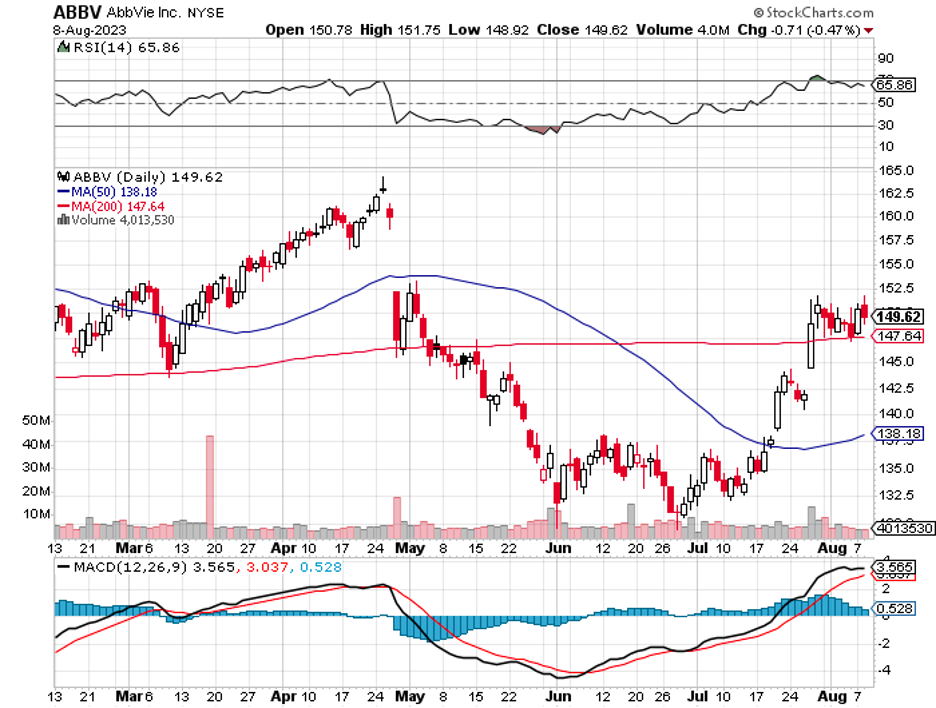
Among them? AbbVie (ABBV), is a name synonymous with financial resilience. Let's explore why this Dividend King is attracting the attention of savvy income investors.

AbbVie, with 51 years of dividend growth, has a strong financial footprint. It is the fifth-largest pharmaceutical company worldwide, with a market capitalization of $260 billion. It ranks just behind industry giants such as Johnson & Johnson (JNJ) and Eli Lilly (LLY). Its pharmaceutical line-up serves over 62 million patients annually, combating conditions like cancer and migraines.

Now, let's not overlook some recent financial trends. AbbVie recorded $13.9 billion in net revenue during the second quarter, a 4.9% drop from last year, but the net revenue only fell by 4.2% when considering currency fluctuations. A stumble? Perhaps. A fall? Not quite. This Dividend King may have more to reveal.

However, it is essential to remain grounded in reality. After all, even giants face their day of reckoning.

AbbVie's Humira, a drug that generated $200 billion over the last 10 years, lost its exclusive patent in January 2023. Biosimilar competition led Humira's total revenue to shrink by 25.2% in the second quarter.

The company’s non-GAAP diluted earnings per share (EPS) dipped by 13.6% year over year to $2.91 for the second quarter. The company's non-GAAP net margin contracted by nearly 390 basis points year over year.

Clearly, the era of Humira's dominance as the top-selling medication in history is slowly coming to an end, paving the way for a future where its sales will be reduced. A tough pill to swallow, no doubt, but it's not all gloom at AbbVie's camp.

In 2022, Humira's global sales peaked at $21.2 billion. The emergence of biosimilar versions like Amjevita from Amgen has seen global Humira sales slide to $16 billion in the second quarter. However, AbbVie is managing the decline with rapidly increasing sales from newly launched drugs.

Promising medicines such as Skyrizi, Rinvoq, Botox Therapeutic, Vraylar, and Venclexta continue to offset the withering Humira sales, with solid growth prospects in other areas and a pipeline full of potential.

These new drugs appear ready to replace the shrinking Humira revenue. With other growth drivers like Epkinly and Vraylar, AbbVie looks well-positioned for the long term.

Additionally, with a strong $23.5 billion free cash flow over the past 12 months and needing just 43% of that amount to meet its dividend commitments, the company's 4% yield remains appealing to income investors.

The decline of Humira's sales is significant but hardly a death knell for AbbVie. The company has shown resilience and adaptability, balancing both growth and income potential.

While the potential risk of a recession could disrupt these trends, AbbVie's 50-plus-year record of increased dividends suggests historical resilience.

With moderate annual dividend growth likely, and a strong foundation for future development, AbbVie represents a compelling buy for investors. The figures and financials paint a picture of opportunity; now it's time to consider whether AbbVie fits into your investment portfolio.

Remember, the crown of a Dividend King is not easily earned, and AbbVie's financial performance showcases a royal opportunity worth exploring.


abbvie dividend

https://madhedgefundtrader.com/wp-content/uploads/2019/05/cropped-mad-hedge-logo-transparent-192x192_f9578834168ba24df3eb53916a12c882.png 0 0 Mad Hedge Fund Trader https://madhedgefundtrader.com/wp-content/uploads/2019/05/cropped-mad-hedge-logo-transparent-192x192_f9578834168ba24df3eb53916a12c882.png Mad Hedge Fund Trader2023-08-10 15:00:482023-08-24 20:46:38Investing In A King
Mad Hedge Fund Trader

August 8, 2023

Biotech Letter

Mad Hedge Biotech and Healthcare Letter
August 8, 2023
Fiat Lux

Featured Trade:

(A DISCOUNTED PHOENIX SET TO RISE)
(BMY), (JNJ), (GSK), (MRK)

https://madhedgefundtrader.com/wp-content/uploads/2019/05/cropped-mad-hedge-logo-transparent-192x192_f9578834168ba24df3eb53916a12c882.png 0 0 Mad Hedge Fund Trader https://madhedgefundtrader.com/wp-content/uploads/2019/05/cropped-mad-hedge-logo-transparent-192x192_f9578834168ba24df3eb53916a12c882.png Mad Hedge Fund Trader2023-08-08 15:02:072023-08-08 20:29:50August 8, 2023
Mad Hedge Fund Trader

A Discounted Phoenix Set to Rise

Biotech Letter

The rollercoaster ride that is the equity market never fails to excite, surprise, and occasionally bemuse us. There's an erratic heartbeat in how it functions - illogical at times, downright whimsical at others. The upshot? Sometimes, great companies find themselves in the bargain bin of Wall Street – perfect for investors who love a good discount.

This is where Bristol Myers Squibb (BMY) comes in.

In the rear-view mirror of the past year, Bristol Myers Squibb hasn't exactly been the star of the stock market show. Its financial pulse has been somewhat weak, with lethargic revenue growth and, at times, flatlining completely. A big part of this has been the loss of patent exclusivity on a once superstar medication last year, causing its top line to struggle.

Flash forward to BMY dropping its Q2 2023 financial report, and the question is whether the company met the Street's expectations. Well, not exactly.

Let's dive into the numbers. The Q2 2023 revenue was a hefty $11.23 billion, albeit a 0.97% dip from the previous quarter and a 5.6% drop year-over-year. Non-GAAP net earnings clocked in at $3.7 billion or $1.75 per share, a quarter less than my earlier prediction.

The culprit? A steeper decline in Revlimid's sales than expected. The blockbuster sales were $1,468 million, a sizable 41.3% YoY drop, thanks to generics flooding the market and lower net selling prices in Europe.

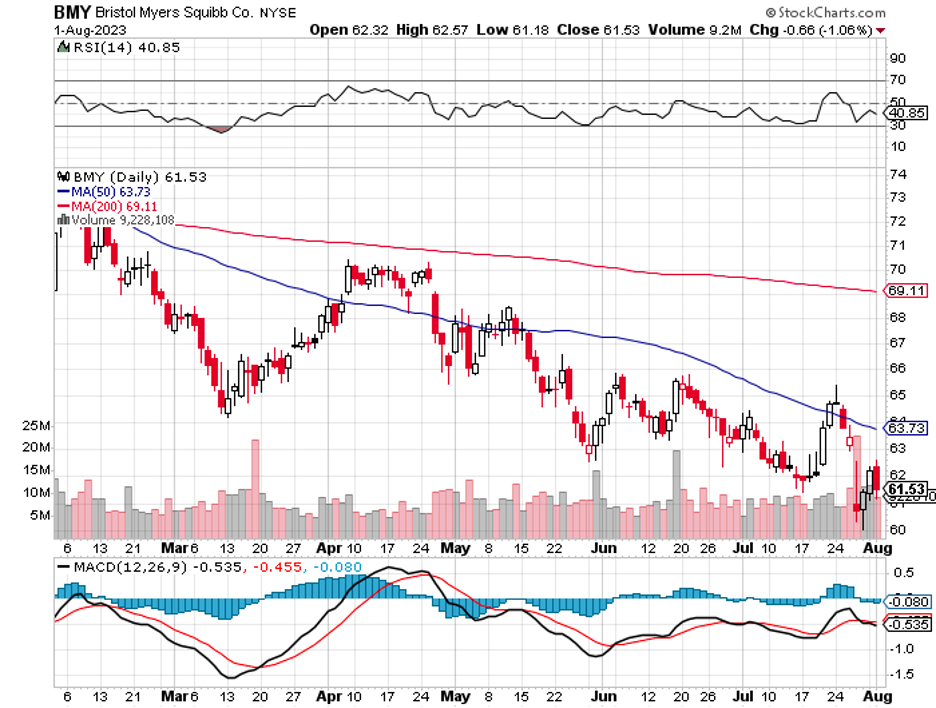
Cue the traders and investors giving a thumbs down to the financials, sending the stock price spiraling down by 4.2% in just two days.

Over half a year, BMY's share price shrank by a whopping 16%, even with a bunch of positive clinical trial results and a flurry of medicine approvals.

Meanwhile, the bigwigs of the global cardiovascular and oncology drug market, Johnson & Johnson (JNJ), GSK (GSK), and Merck (MRK), have been doing a victory lap.

Still, there’s a silver lining here.

Bristol Myers is currently strutting around with a forward price-to-earnings (P/E) ratio of just 8. If you stack that against the pharmaceutical industry's average of 15.3, our friend Bristol Myers looks appealing. This is especially true when you consider the company is far from down for the count and has quite a few tricks up its sleeve to stage a solid comeback.

Projected revenue for Bristol-Myers Squibb for Q3 2023 lands somewhere in the ballpark of $10.8 billion to $11.92 billion, which, sure, marks a 4.5% dip from Q2 expectations. But hold onto your hats because Bristol-Myers Squibb's revenue is projected to comfortably clear the bar and pull in a cool $11.35 billion.

The heroes of this victory? Groundbreaking drugs like Yervoy and Opdualag have become hotter than a two-dollar pistol in the medical world.

We're talking about a Q2 2023 sales total of $154 million for Opdualag alone, up a jaw-dropping 165.6% from Q2 2022. And let's not forget this medical marvel only debuted in March 2022 and has been selling like hotcakes thanks to its performance in clinical trials.

What's more, Bristol Myers Squibb has been as busy as a bee, adding nine innovative medicines to its repertoire over the last three years. These new kids on the block are set to step up to the plate and replace older, soon-to-be patent-less drugs. They're also expected to drive sales growth into the stratosphere for the foreseeable future.

Bristol Myers Squibb is expected to report continuous growth, thanks to its proven clinical trials and potential to expand its labels. The company is already rolling up its sleeves to test the safety and efficacy of Camzyos for conditions like non-obstructive hypertrophic cardiomyopathy and heart failure with preserved ejection fraction (HFpEF).

As we look towards the horizon of 2025, Bristol Myers forecasts an impressive revenue of $10 billion to $13 billion from its freshest batch of products. Considering it pulled in $2 billion last year from these drugs, that's not too shabby. But don't think it’s resting on its laurels. The company is already testing over 50 clinical compounds across a smorgasbord of trials.

Let's also pay attention to Bristol Myers' attractive dividend profile.

The company currently offers a yield of 3.5%, dwarfing the S&P 500's average of 1.5%. Plus, it has bumped its payouts by 43% over the last five years.

With a cash payout ratio of around 42%, there's much room for this trend to continue into the foreseeable future.

Despite recent stumbles on the revenue and stock value front, BMY is no slouch. Its unyielding character and unwavering commitment to ploughing funds into fresh offerings signal a robust comeback on the horizon.

So, in the immortal words of an old Wall Street sage, it’s time to "Buy low, sell high,” and BMY is looking like quite a bargain right now.


bristol myers squibb

https://madhedgefundtrader.com/wp-content/uploads/2019/05/cropped-mad-hedge-logo-transparent-192x192_f9578834168ba24df3eb53916a12c882.png 0 0 Mad Hedge Fund Trader https://madhedgefundtrader.com/wp-content/uploads/2019/05/cropped-mad-hedge-logo-transparent-192x192_f9578834168ba24df3eb53916a12c882.png Mad Hedge Fund Trader2023-08-08 15:00:052023-08-22 18:05:30A Discounted Phoenix Set to Rise
Mad Hedge Fund Trader

August 3, 2023

Biotech Letter

Mad Hedge Biotech and Healthcare Letter
August 3, 2023
Fiat Lux

Featured Trade:

(A FUTURE-PROOF INVESTMENT)
(UNH), (CI), (HUM), (CNC)

https://madhedgefundtrader.com/wp-content/uploads/2019/05/cropped-mad-hedge-logo-transparent-192x192_f9578834168ba24df3eb53916a12c882.png 0 0 Mad Hedge Fund Trader https://madhedgefundtrader.com/wp-content/uploads/2019/05/cropped-mad-hedge-logo-transparent-192x192_f9578834168ba24df3eb53916a12c882.png Mad Hedge Fund Trader2023-08-03 08:02:392023-08-03 08:20:22August 3, 2023
Mad Hedge Fund Trader

A Future-Proof Investment

Biotech Letter

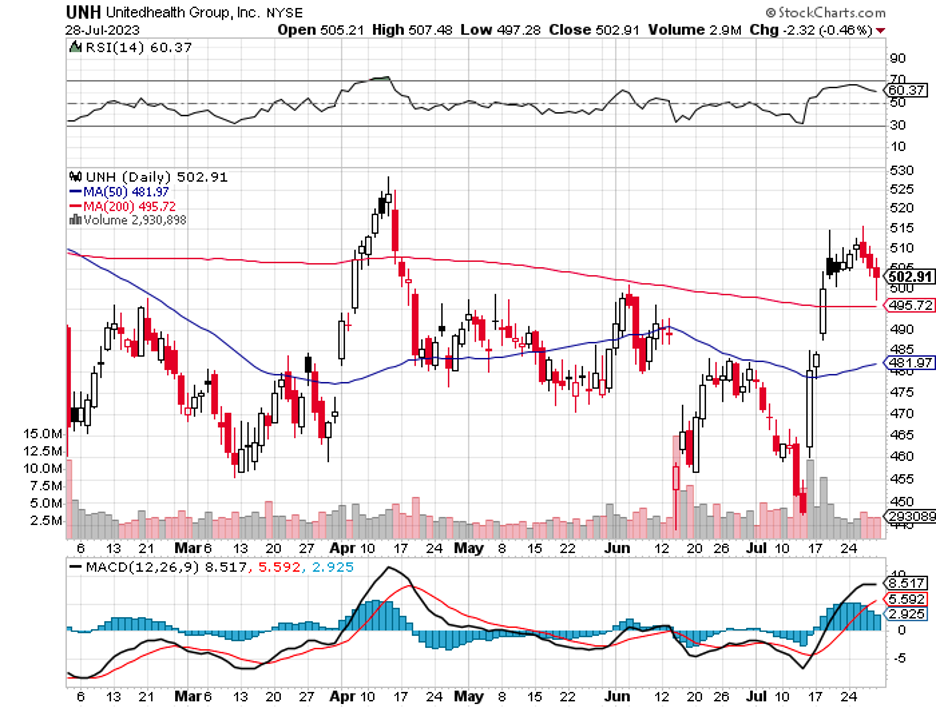
With a staggering market cap of $472 billion and a network reaching scores of policyholders, UnitedHealth Group (UNH) is an undisputed titan in the health insurance industry.

To put this into perspective, its competitors such as Cigna (CI), Humana (HUM), and Centene (CNC) have market caps of $86.42 billion, $56.64 billion, and $36.32 billion, respectively.

However, the past year witnessed a slight dip in UnitedHealth’s share price by 2%, which noticeably lags the broader market's return of 17%.

This raises a question: Is UnitedHealth’s investment appeal dwindling, or is it merely in a brief pause?

One can't discuss the health insurance sector without addressing the brewing storm of growth in its forecast. This sector is expected to welcome a turbocharged surge fuelled by an escalating burden of maladies and an expanding aging population worldwide.

The global landscape is witnessing a steep rise in various chronic afflictions - from cardiovascular and respiratory conditions to neurological disorders, cancer, musculoskeletal diseases, and diabetes. With the world population growing savvier about the financial cushioning health insurance provides, we're staring at a potential boom in this sector.

Take a gander at the numbers: The global health insurance industry was valued at a hefty USD 2.17 trillion in 2022.

Fast forward to 2032, and we're talking about a market swelling to an eye-watering USD 4.37 trillion. And with a projected CAGR of 7.3% from 2023 to 2032, we can safely say the health insurance express isn't slowing down anytime soon.

With this backdrop, let's dive into the compelling aspects of investing in UnitedHealth.

First, let's delve into the favorable aspects of investing in UnitedHealth. The core rationale is simple: healthcare is perennial. As long as human beings exist, healthcare will always be needed.

In the United States, individuals or their employers inevitably need to secure health insurance on a monthly basis. The constant evolution and improvement of healthcare services create a fertile ground for potentially substantial earnings in both the insurance and healthcare delivery sectors.

UnitedHealth, a veritable powerhouse, operates two key divisions - one specializing in health insurance and prescription coverage, and the other focused on healthcare provision. This dual-pronged approach has the potential to create sustained shareholder value.

Finding a flaw in this favorable proposition is challenging, particularly when examining the figures.

The company amassed an impressive $93 billion in revenue in the second quarter of 2023 alone, making it one of the world's largest corporations. It outperformed analysts' predictions of $91 billion, and the earnings per share of $6.14 surpassed Wall Street estimates of $5.99.

Although the company's medical care ratio did increase from 81.5% to 83.2% as expected, this was offset by a robust revenue growth that outpaced the rise in medical and operational costs.

UnitedHealth provides insurance to over 51 million individuals, with an addition of over a million new policyholders in 2023. UnitedHealth's scale allows it to keep costs low, forming a formidable entry barrier for new market contenders.

Moreover, its quarterly revenue experienced a notable 63% increase over the past five years, hinting at significant growth potential. This suggests that UnitedHealth's future growth prospects remain robust.

Straight from the company itself, UnitedHealth anticipates growing its earnings per share (EPS) between 13% and 16% annually. Moreover, the company has shown consistent dividend growth, with an annual increase of 10% since 2010.

This indicates a company that excels in operating its business model over time, suggesting potential stability and growth in both share price and dividends.

One key strategy of UnitedHealth is its diverse portfolio, developed over the years through strategic acquisitions like home health company LHC Group and analytics firm Change Healthcare. This diversity has allowed the company to maintain a growth rate exceeding 10% over the last five years.

UnitedHealth's most significant growth driver remains its premiums, but the company also saw an additional $2 billion in revenue from services and $1.2 billion from product sales last quarter.

Although it faces potential increases in medical costs, the company's diversified portfolio helps it maintain strong profit growth, with adjusted earnings per share rising 10% to $6.14 year-on-year.

Despite the overall positive outlook, it's worth noting that UnitedHealth's shares have decreased by about 4% this year. While the stock is trading at 23 times trailing earnings, slightly below the healthcare industry average of 25, the company's consistent growth could justify a higher valuation.

Overall, UnitedHealth remains a promising investment in the long run despite some short-term volatility, as it offers a blend of stability and growth. It may well be a stock worth considering for those looking for a long-term hold in the healthcare sector. I suggest you buy the dip.


unitedhealth

https://madhedgefundtrader.com/wp-content/uploads/2019/05/cropped-mad-hedge-logo-transparent-192x192_f9578834168ba24df3eb53916a12c882.png 0 0 Mad Hedge Fund Trader https://madhedgefundtrader.com/wp-content/uploads/2019/05/cropped-mad-hedge-logo-transparent-192x192_f9578834168ba24df3eb53916a12c882.png Mad Hedge Fund Trader2023-08-03 08:00:342023-08-21 17:45:02A Future-Proof Investment
Mad Hedge Fund Trader

August 1, 2023

Biotech Letter

Mad Hedge Biotech and Healthcare Letter
August 1, 2023
Fiat Lux

Featured Trade:

(CHASING THE TRILLION-DOLLAR DREAM)
(LLY), (NVO), (AMGN), (PFE)

https://madhedgefundtrader.com/wp-content/uploads/2019/05/cropped-mad-hedge-logo-transparent-192x192_f9578834168ba24df3eb53916a12c882.png 0 0 Mad Hedge Fund Trader https://madhedgefundtrader.com/wp-content/uploads/2019/05/cropped-mad-hedge-logo-transparent-192x192_f9578834168ba24df3eb53916a12c882.png Mad Hedge Fund Trader2023-08-01 08:32:262023-08-01 08:34:16August 1, 2023
Mad Hedge Fund Trader

Chasing the Trillion-Dollar Dream

Biotech Letter

Mark my words. The healthcare sector is on the cusp of a seismic shift. By 2033, I expect to see the dawn of a trillion-dollar enterprise. Now, you might think I've lost my marbles, but hear me out.

The prime contender for this prestigious title? Eli Lilly (LLY).

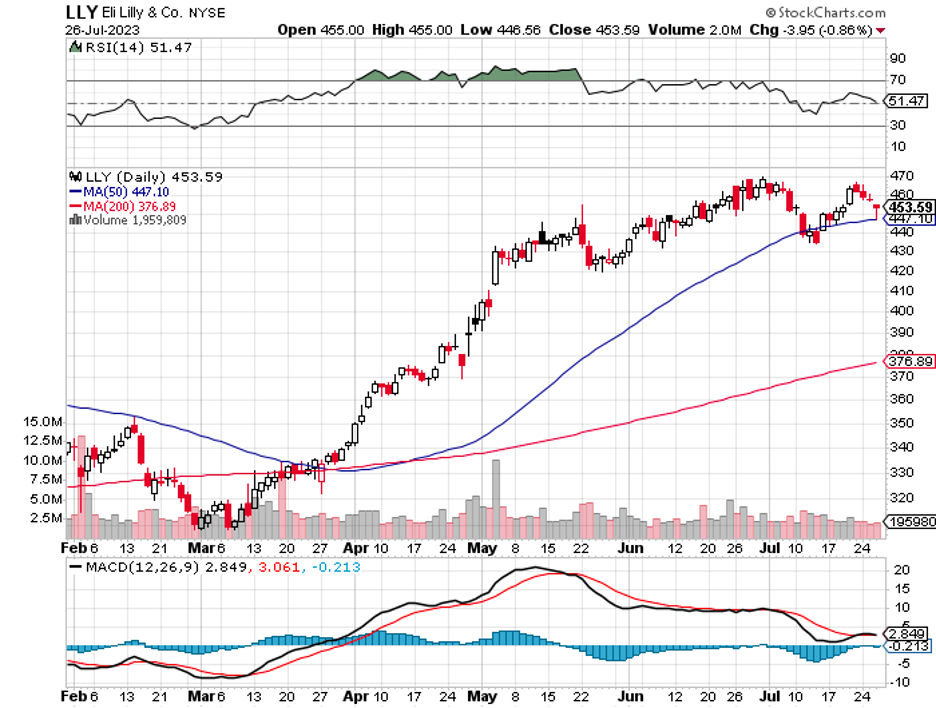
Now, Lilly is comfortably lounging at a market cap of $425 billion, a massive figure, yes, but still less than half of our $1 trillion target. Lilly's stock would need to scale up by a staggering 135% to breach the trillion-dollar threshold.

Daunting, right?

But if you break it down to an annual growth rate over a 10-year span, we're looking at a relatively modest compound rate of around 8.9%. With Lilly's recent track record and brimming product pipeline, this growth trajectory doesn't seem so far-fetched.

A closer look at Lilly's pharmaceutical lineup reveals a host of innovative treatments. Lilly's recent contributions to diabetes care - Mounjaro, Jardiance, and Trulicity - represent significant strides.

Adding to the fray are Taltz, a cutting-edge psoriasis solution, and Verzenio, a life-saving breast cancer drug. A peek into Lilly's late-stage pipeline reveals potential blockbusters in the making, like lebrikizumab for atopic dermatitis, mirikizumab for immunology, and donanemab for the relentless battle against Alzheimer's.

Then, there's the $1.9 billion acquisition of Versanis Bio, positioning Lilly at the precipice of the weight-loss market.

Lilly stands out with its robust line-up in the race for weight loss solutions. Mounjaro, initially a diabetes drug, has demonstrated potential as a weight-loss aid in clinical trials, with participants on the highest dosage shedding up to 22.5% of their body weight over 72 weeks.

Yet, the sector is intensely competitive, with giants such as Novo Nordisk (NVO), Amgen (AMGN), and Pfizer (PFE) on the battlefield. While Lilly's recent acquisitions present strong prospects, forecasting revenue growth over the next decade remains an intricate puzzle.

Notably, weight-loss solutions form a crucial part of Lilly's growth plan and could contribute more than 60% of the company's annual revenue by the mid-2030s.

Meanwhile, Lilly is developing potential breakthroughs in Alzheimer's treatment, with donanemab showing promise in clinical trials. This treatment has a mechanism that targets amyloid plaque, often found in the brains of Alzheimer's patients.

If approved, sales could reach a projected $3.9 billion by 2027.

Despite these promising avenues, caution is warranted. Lilly's stock is trading at 51.75 times its forward-looking earnings estimates. While the prospects for Alzheimer's and weight management treatments show promise, their success is far from guaranteed.

Historically successful drugs like Humalog and Alimta have seen their sales decline by 25% and 83%, respectively, as they lose exclusivity and face competition from lower-cost alternatives.

A company's value is often tied to its latest blockbuster in the pharmaceutical sector. Patent protection typically lasts 25 years from the date of discovery, with about half this time spent on testing. This leaves a limited window for profitability.

Investing in Lilly or any other pharma stock based on earnings expectations over 50 times isn’t always a guaranteed win. The firm’s upcoming offerings could indeed be significant earners, but they must offset foreseeable losses from other areas.

For instance, Trulicity, Lilly's top-selling treatment, generated nearly $2 billion in sales during the first quarter of 2023. However, Trulicity's revenue may be cannibalized by Lilly's own Mounjaro, with looming patent expirations set to intensify the pressure from 2027.

With robust profit margins exceeding 20%, the ascent of Eli Lilly to a trillion-dollar valuation is not only a bold prediction but also a captivating journey to monitor.

While this forecast appears to be grounded in solid reasoning and well-articulated facts, the reality of this industry is inherently marked by uncertainty and continuous change. Without the caveat of patent expiration, Lilly would be an unequivocal strong buy.

But given this reality, investors might be wiser to monitor Lilly first, rather than rush into a commitment. I suggest patiently waiting and buying the dip.


lilly

https://madhedgefundtrader.com/wp-content/uploads/2019/05/cropped-mad-hedge-logo-transparent-192x192_f9578834168ba24df3eb53916a12c882.png 0 0 Mad Hedge Fund Trader https://madhedgefundtrader.com/wp-content/uploads/2019/05/cropped-mad-hedge-logo-transparent-192x192_f9578834168ba24df3eb53916a12c882.png Mad Hedge Fund Trader2023-08-01 08:30:232023-08-18 00:25:35Chasing the Trillion-Dollar Dream
Mad Hedge Fund Trader

July 27, 2023

Biotech Letter

Mad Hedge Biotech and Healthcare Letter
July 27, 2023
Fiat Lux

Featured Trade:

(INVESTING IN NECESSITIES)
(KVUE), (JNJ), (HLN), (GSK), (KO)

https://madhedgefundtrader.com/wp-content/uploads/2019/05/cropped-mad-hedge-logo-transparent-192x192_f9578834168ba24df3eb53916a12c882.png 0 0 Mad Hedge Fund Trader https://madhedgefundtrader.com/wp-content/uploads/2019/05/cropped-mad-hedge-logo-transparent-192x192_f9578834168ba24df3eb53916a12c882.png Mad Hedge Fund Trader2023-07-27 10:02:562023-07-26 10:55:51July 27, 2023
Page 37 of 115«‹3536373839›»

Legal Disclaimer

There is a very high degree of risk involved in trading. Past results are not indicative of future returns. MadHedgeFundTrader.com and all individuals affiliated with this site assume no responsibilities for your trading and investment results. The indicators, strategies, columns, articles and all other features are for educational purposes only and should not be construed as investment advice. Information for futures trading observations are obtained from sources believed to be reliable, but we do not warrant its completeness or accuracy, or warrant any results from the use of the information. Your use of the trading observations is entirely at your own risk and it is your sole responsibility to evaluate the accuracy, completeness and usefulness of the information. You must assess the risk of any trade with your broker and make your own independent decisions regarding any securities mentioned herein. Affiliates of MadHedgeFundTrader.com may have a position or effect transactions in the securities described herein (or options thereon) and/or otherwise employ trading strategies that may be consistent or inconsistent with the provided strategies.

Copyright © 2026. Mad Hedge Fund Trader. All Rights Reserved. support@madhedgefundtrader.com
Scroll to top