• support@madhedgefundtrader.com
  • Member Login
Mad Hedge Fund Trader
  • Home
  • About
  • Store
  • Luncheons
  • Testimonials
  • Contact Us
  • Click to open the search input field Click to open the search input field Search
  • Menu Menu
Mad Hedge Fund Trader

Investing in Necessities

Biotech Letter

Everyone knows that Warren Buffett was schooled by the one and only Benjamin Graham. His game was easy-peasy early on — he hunted for dirt-cheap companies in relation to their assets, snagged them, and played the waiting game until the market woke up and realized their true worth. This was the good old 'cigar butt' investing.

It took Charlie Munger, Buffett's partner-in-crime, to shake things up. Munger nudged Buffett to eye high-quality companies with a thick competitive buffer that could weather long stretches of time.

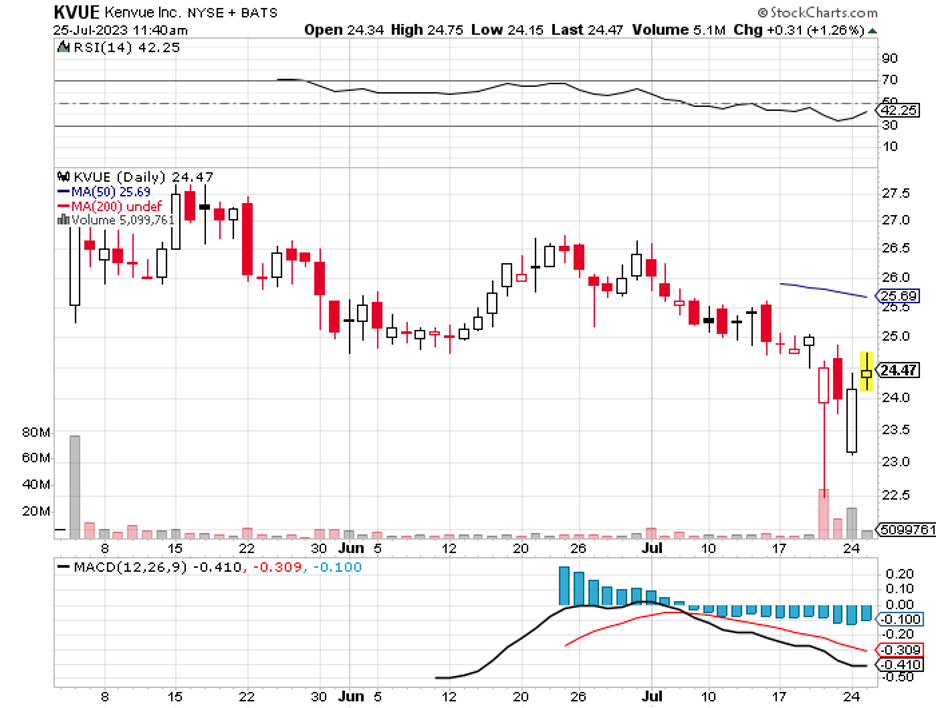
Now with Johnson & Johnson's (JNJ) recent spinoff of Kenvue (KVUE), it seems the investment gods have dished up just the kind of opportunity Munger and Buffett would drool over.

JNJ is rolling out a red carpet, enticing its investors to trade their shares for most of its stake in Kenvue, the consumer division it made public in May.

If you're invested in JNJ, consider looking into this proposition. We're talking about a potential $35 billion transaction. Actually, JNJ is practically dangling a carrot, offering its holders $107 in Kenvue stock for every $100 in JNJ stock, capped, of course.

Basically, the JNJ deal lets holders swap all, some, or zip of their shares for Kenvue. It's a limited-time offer, expiring on August 18, with the price nailed down between August 14 to 16.

Interestingly, the Big Pharma company opted to play the game of 'voluntary exchange offer,' or 'split-off' in Wall Street jargon. A bit more elusive than your garden-variety spinoff, but trust me, it has its charm.

Why, you ask? This method tends to tighten the share count, beefing up the earnings per share.

And here's the sweetener: split-offs usually come with perks. The parent company tends to sprinkle a little discount magic for investors who decide to trade their old shares for the shiny new spinoff ones.

So, what could investors expect from Kenvue?

When it comes to its financial muscle, Kenvue's flexing a robust $20 billion in equity. The balance sheet displays a formidable $35 billion in assets squaring off against a $15 billion debt.

The first quarter has set the pace, projecting an annual revenue run rate of a cool $15.2 billion, and the operating cash flow isn't too shabby either, clocking in at $3.2 billion.

Kenvue's market valuation stands around 18 times its forecasted earnings for 2023, yielding a sweet 3.4%. That's a smidge more than J&J's yield of 2.8%.

Sure, Kenvue may not be sprinting in the high-growth lane — with earnings growth likely to pace in the mid-single digits post-2023 — but it holds a rock-solid portfolio of consumer health brands we've all grown to trust. Bonus? It trades at a discount compared to its closest peer, Haleon (HLN), GlaxoSmithKline’s (GSK) spinoff company.

Kenvue boasts a roster of brand-name products that people can't live without, and this constant demand spells nothing but growth. This spinoff is the proud holder of household names like Tylenol, Listerine, and Band-Aid.

In essence, Kenvue comes off as a Warren Buffett-type business that's up for grabs at a seemingly bargain price.

Consider for a moment why Buffett is so cozy with his long-standing stake in Coca-Cola (KO). Coke quenches the world's thirst with its myriad beverages, winning over brand loyalty and securing repeat purchases like it's a walk in the park.

My investment angle on Kenvue draws a parallel here, with a twist: Kenvue's products are absolute necessities, not just something you treat yourself to. That fact alone makes it even more appealing to me.

The company also disclosed a promising earnings range of $1.26 to $1.31 per share, with sales growth itching to hit a respectable 5%. The cherry on top? They're starting a quarterly dividend at 20 cents a share.

Now, you might be wary of growth prospects stagnating – let's face it, there's a limit to how many Band-Aids and Tylenol a household will need, right?

But here's where the plot thickens: the fine folks over at healthcare firm IQVIA (IQV) made quite the compelling argument that the over-the-counter drug market is expected to grow by a hearty 6.1% until 2025.

With a product lineup that's nothing short of a hit with consumers, a sturdy financial standing, and a rosy outlook for growth in the market it caters to, Kenvue is shaping up to be quite the catch for investors.

Of course, there are possible risks, such as a looming recession prompting even the most brand-loyal customers to opt for generic alternatives or management falling short on growth plans. That said, these potential drawbacks are dwarfed by the massive upsides of investing in Kenvue.

I think it's about time you give Kenvue some serious thought.
 

https://madhedgefundtrader.com/wp-content/uploads/2019/05/cropped-mad-hedge-logo-transparent-192x192_f9578834168ba24df3eb53916a12c882.png 0 0 Mad Hedge Fund Trader https://madhedgefundtrader.com/wp-content/uploads/2019/05/cropped-mad-hedge-logo-transparent-192x192_f9578834168ba24df3eb53916a12c882.png Mad Hedge Fund Trader2023-07-27 10:00:532023-07-31 15:35:14Investing in Necessities
Mad Hedge Fund Trader

July 25, 2023

Biotech Letter

Mad Hedge Biotech and Healthcare Letter
July 25, 2023
Fiat Lux

Featured Trade:

(THE NEXT INVESTMENT DARLING)
(VRTX), (CRSP)

https://madhedgefundtrader.com/wp-content/uploads/2019/05/cropped-mad-hedge-logo-transparent-192x192_f9578834168ba24df3eb53916a12c882.png 0 0 Mad Hedge Fund Trader https://madhedgefundtrader.com/wp-content/uploads/2019/05/cropped-mad-hedge-logo-transparent-192x192_f9578834168ba24df3eb53916a12c882.png Mad Hedge Fund Trader2023-07-25 17:02:322023-07-25 17:54:01July 25, 2023
Mad Hedge Fund Trader

The Next Investment Darling

Biotech Letter

The pandemic stage lit a blazing spotlight on healthcare and biotech warriors like never before. Some biotech heroes, taking on the gauntlet of grave or lethal ailments, are still setting the market ablaze.

You see, the world's population isn't getting any younger, and diseases aren’t going away. These elements strap an ironclad defense around the healthcare sector - come hell or high water in the economy, the drumbeat of demand won't miss a beat.

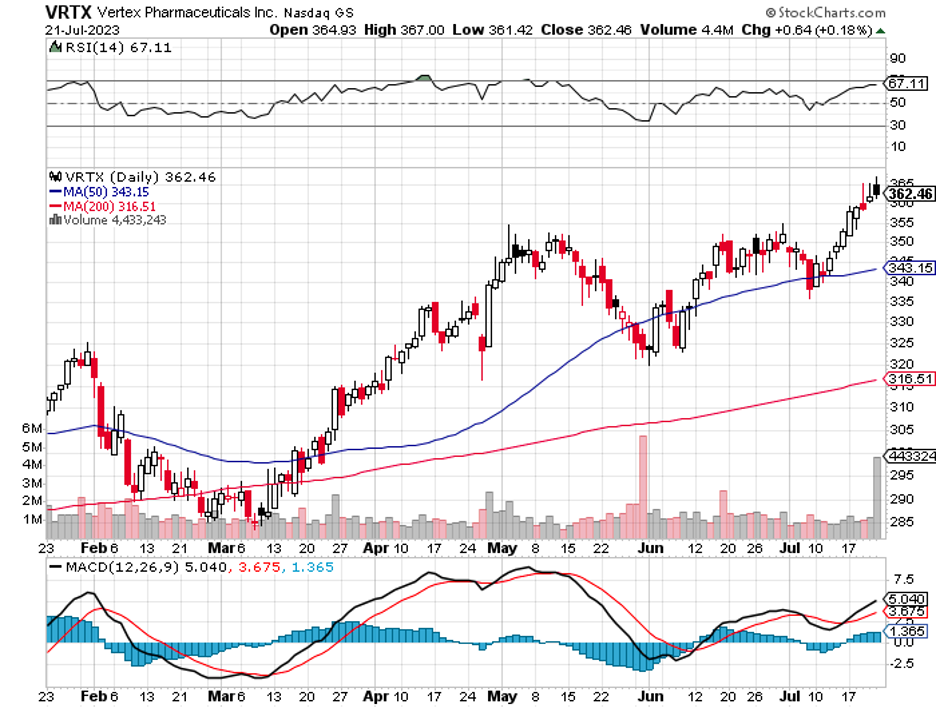
One name in the biotechnology and healthcare sector that’s snubbing the bear market's growl with its groundbreaking panaceas is Vertex Pharmaceuticals (VRTX).

Widely considered an underdog in the sector, Vertex has been an overachiever for the past decade, running circles around the market. But guess what? The San Diego champ is also primed to repeat that glorious run over the next ten years.

Vertex has carved out its healthcare niche, nurturing a blossoming franchise in the world of cystic fibrosis treatments. The company's yearly sales are closing in on the dizzying heights of $10 billion.

While other Big Pharma names are staring down the barrel of a patent cliff later this decade, Vertex has shown that it’s playing the long game. Their cystic-fibrosis arsenal is locked and loaded till the mid-2030s at least, and they've got a robust pipeline of drugs chugging along nicely.

Specifically, its blockbuster drug Trikafta won't face the treacherous patent cliff until 2037. With its history of turning the complex task of developing CF therapies into child's play, Vertex has lorded over this territory for over a decade. Adding more feathers to its cap, Vertex is poised to bag fresh non-CF approvals, a move that will spice up its offerings and rev up its growth engine.

Not one to rest on its laurels, Vertex, along with Crispr Therapeutics (CRSP), is on the brink of clinching approval for a gene-editing treatment for red blood cell disorders such as sickle cell disease. The stage is set at this point, and the companies are patiently awaiting the green signal for exa-cel from Uncle Sam and our European friends across the pond.

Exa-cel, the brainchild of Vertex and CRISPR Therapeutics, is a game-changer in gene-editing therapy for rare blood diseases. But this ain't a one-trick pony. Vertex has more rabbits in the hat.

The company's brewing up a storm, geared towards hitting a home run by launching five new products within the next five years. Ambitious? You bet.

As Vertex's cystic fibrosis (CF) business continues to stride forward and the pipeline remains robust, a steady uptick in revenue and earnings is on the cards. The company stands tall, ready to deliver market-beating performances for some time to come.

Sure, the stock is inching closer to its 52-week zenith, but make no mistake - it's still a good catch, even at this high watermark.

Moreover, Vertex is far from being the wallflower at the party. The stock has leaped a whopping 25% this year, outpacing the respectable 18% gain of the S&P 500. The drug giant is the belle of the ball, sporting a market cap north of $90 billion.

Taking a cue from its CF monopoly, Vertex will kick things up a notch, potentially establishing a monopoly in the world of pain relief. The company should get its moment in the spotlight by year's end when clinical trial results for its ground-breaking non-narcotic drug for pain roll out.

Operating under the code-name VX-548, this trailblazer from Vertex intercepts pain signals in the peripheral nerves, outside the central nervous system. The modus operandi is somewhat akin to the topical drug lidocaine, but with a twist.

While lidocaine takes a toll on the heart when ingested, VX-548 sidesteps this issue, making it safe to pop as a pill. Plus, as it doesn't monkey around with the brain, it avoids the slippery slope of opioid addiction. Now, that's what I call a win-win.

Naysayers may voice doubts about the willingness of insurance companies to foot the bill for Vertex's high-priced, newfangled pain drug instead of sticking to the generic opioids or other neurological drugs usually prescribed.

But I don’t buy into the skepticism. There’s a huge possibility that the insurers will. The reason? The mounting political and public relations pressure will essentially force these organizations to back a non-opioid contender, given it can duke it out toe-to-toe in terms of effectiveness.

Given the market for this, VX-548 stands to amass a revenue jackpot of a whopping $5 billion by 2032.

Sure, the healthcare sector isn't going the way of the dodo anytime soon. But rest on your laurels, and you'll be yesterday's news. It's a dog-eat-dog world out there, and if healthcare companies don't stay ahead of the curve, they risk being left in the dust.

This is where Vertex shines as a leader and innovator in its corner of the healthcare world. Keep an eye on this stock. It has the potential to deliver some handsome returns over the next decade.


vertex healthcare

https://madhedgefundtrader.com/wp-content/uploads/2019/05/cropped-mad-hedge-logo-transparent-192x192_f9578834168ba24df3eb53916a12c882.png 0 0 Mad Hedge Fund Trader https://madhedgefundtrader.com/wp-content/uploads/2019/05/cropped-mad-hedge-logo-transparent-192x192_f9578834168ba24df3eb53916a12c882.png Mad Hedge Fund Trader2023-07-25 17:00:282023-07-31 21:00:47The Next Investment Darling
Mad Hedge Fund Trader

July 20, 2023

Biotech Letter

Mad Hedge Biotech and Healthcare Letter
July 20, 2023
Fiat Lux

Featured Trade:

(INNOVATION GENIUS OR INVESTORS’ QUAGMIRE?)
(TDOC), (MSFT)

https://madhedgefundtrader.com/wp-content/uploads/2019/05/cropped-mad-hedge-logo-transparent-192x192_f9578834168ba24df3eb53916a12c882.png 0 0 Mad Hedge Fund Trader https://madhedgefundtrader.com/wp-content/uploads/2019/05/cropped-mad-hedge-logo-transparent-192x192_f9578834168ba24df3eb53916a12c882.png Mad Hedge Fund Trader2023-07-20 14:02:282023-07-20 15:42:32July 20, 2023
Mad Hedge Fund Trader

Innovation Genius or Investors' Quagmire?

Biotech Letter

Let's rewind to the inception of Teladoc (TDOC).

In the early 2000s, online medical appointments were as futuristic as a scene out of The Jetsons. Fast forward to today, and Teladoc's business model - a digital clinic where you see the doctor from your laptop - is as commonplace as ordering a latte from your phone.

In theory, it's a genius innovation - cut down the rigmarole of office visits, boost doctor efficiency, and slash overhead costs associated with physical appointments.

Unfortunately, the real world has been a tough nut to crack for Teladoc, with investors getting cold feet over the past few years.

Still, when the risk-averse tide returned in 2023 and investors started making a beeline for stocks that had taken a beating in 2022, Teladoc shareholders were also banking on a swift recovery from the lows.

Indeed, with a market shift towards greener pastures, the stock got a nearly 60% leg-up from its historical lows by early February. It looked like buyers were of the view that, despite some managerial slip-ups, the leader of the telehealth market seemed underpriced given its double-digit growth rates. The expectations also seemed tempered.

Then came another slap of reality with the quarterly reports.

Despite respectable Q4 figures, the outlook was nothing short of a letdown. After a 2022 slump in the telehealth market and Teladoc's 18% growth, one might have hoped for a more robust expansion within a burgeoning industry.

Instead, investors got a projection of lukewarm average increase of just 8.4%, GAAP profitability seemed like a distant dream, and even an EBITDA growth of 22% couldn't make the numbers shine.

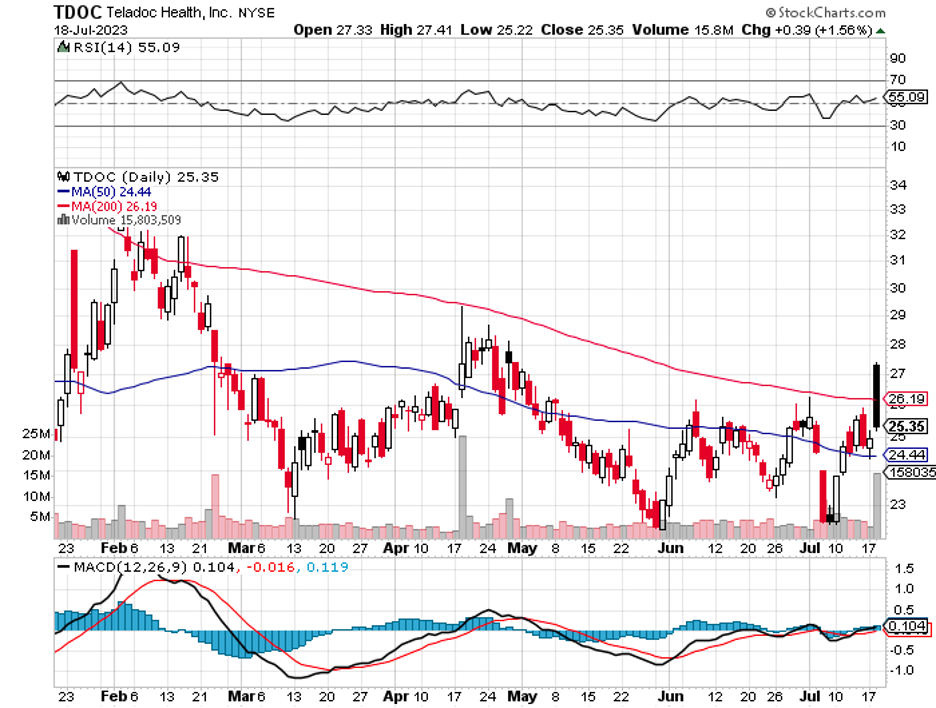
The backlash was predictable. After Q1 numbers, the stock rallied before it stumbled again, nearing its all-time lows - even amidst a risk-on climate.

Diminishing growth, elusive profitability, mounting competition – Is this Teladoc's swan song, or can it claw back its glory?

Recent updates show that it seems like Teladoc is leaning on Microsoft (MSFT) for a lifeline.

The company declared an expanded alliance with Microsoft, aiming to harness the latter's state-of-the-art artificial intelligence (AI) technology. This uplifting news is a much-needed antidote for the digital health provider, whose recent journey had more in common with a bear market trudge than a bull run sprint.

The idea is for the telehealth company to basically plug in the Azure OpenAI Service, along with other Microsoft products, directly into its homegrown Teladoc Solo virtual care platform.

The endgame? Cut the red tape for overworked healthcare professionals by automating the grind of clinical documentation – applicable to virtual check-ups and in-person consultations.

That's not all. Teladoc is additionally introducing the "Nuance Dragon Ambient eXperience," or DAX, a sophisticated tool that effortlessly transforms patient-practitioner dialogues into comprehensive, specialty-specific clinical notes, all while sticking to the letter of documentation standards.

As expected, the stock enjoyed an initial sugar rush as investors toasted to the company's pivot towards AI.

For me, though, I have a more measured take on the announcement. While I recognize the positive thrust of the move, I can’t completely agree that this alliance is a game-changer. Let me share some of the reasons behind my reluctance.

In the first part of 2023, Teladoc reported a top-line revenue of $629 million, while carrying a net loss of $69 million. On the surface, the balance between the top and bottom lines seems skewed.

However, taking a step back, Teladoc took a considerable hit last year with a sizeable goodwill impairment charge. But spring 2023 brings a new twist, with an $8.1 million expense for restructuring.

Based on the 10-Q filing, these costs were tied to "kissing goodbye to excess leased office spaces." We might assume this is a one-off, and quite frankly, it's a move I admire for a company currently in the red.

But let’s flip the script a bit and talk about operating expenses.

While the company managed to cut back on Sales and Technology and Development, they seemed to have thrown caution to the wind, with General and Administrative costs up by 9% and Advertising and Marketing expenses skyrocketing by 32%.

I’m not talking about an occasional splurge here. The 2022 report shows a 50% annual increase in Advertising and Marketing costs. This figure is critical, as it gives us a peek into the company's customer acquisition costs. More money spent on marketing translates to longer customer retention needed to turn a profit.

To provide you with a sense, for every dollar Teladoc made in Q1 2023, 28 cents went to marketing, a noticeable bump from 24 cents per dollar in Q1 2022.

Now, Teladoc hints at some seasonality in their operations, with the first and last quarters typically reflecting weaker operating income as the pace of new customer acquisitions and revenue growth lags behind marketing expenses. But let's not let this divert our attention from the discrepancy between revenue growth and marketing costs.

As an investor, you'd obviously want to know how well the company is retaining its customers with these rising acquisition costs.

Here's the deal: Teladoc's customer churn rate isn't increasing, but it's not dropping either. As for the customer retention rates, the company’s executives describe the figures as "stable."

Notably, the company already casts a wide net, claiming that "over 80 million individuals in the U.S. have access to one or more of our products and services." If that's true, Teladoc already has its hooks in nearly a quarter of the U.S. population.

So, the million-dollar question for investors: If Teladoc can't turn a profit with this massive reach, then when will it?

In the digital healthcare universe, Teladoc once promised to be a shooting star. Yet, amidst stalled growth, daunting losses, and controversial investments, it appears more like a black hole absorbing investor optimism.

The recent alliance with Microsoft injects a ray of hope, aiming to automate and optimize operations through AI. But the questions remain: Is this the life-saving maneuver that rights Teladoc's trajectory, or just a brief flash in the pan?

As investors, we're left to wonder, in the dance of innovation and investment, will Teladoc waltz or wobble? Only time will play the music.


teladoc investors

https://madhedgefundtrader.com/wp-content/uploads/2019/05/cropped-mad-hedge-logo-transparent-192x192_f9578834168ba24df3eb53916a12c882.png 0 0 Mad Hedge Fund Trader https://madhedgefundtrader.com/wp-content/uploads/2019/05/cropped-mad-hedge-logo-transparent-192x192_f9578834168ba24df3eb53916a12c882.png Mad Hedge Fund Trader2023-07-20 14:00:252023-07-31 23:09:50Innovation Genius or Investors' Quagmire?
Mad Hedge Fund Trader

July 18, 2023

Biotech Letter

Mad Hedge Biotech and Healthcare Letter
July 18, 2023
Fiat Lux

Featured Trade:

(BIG PHARMA, BIGGER OPPORTUNITIES)
(AMGN), (HZNP), (BMY), (GILD), (PFE)

https://madhedgefundtrader.com/wp-content/uploads/2019/05/cropped-mad-hedge-logo-transparent-192x192_f9578834168ba24df3eb53916a12c882.png 0 0 Mad Hedge Fund Trader https://madhedgefundtrader.com/wp-content/uploads/2019/05/cropped-mad-hedge-logo-transparent-192x192_f9578834168ba24df3eb53916a12c882.png Mad Hedge Fund Trader2023-07-18 15:02:462023-07-18 18:11:25July 18, 2023
Mad Hedge Fund Trader

Big Pharma, Bigger Opportunities

Biotech Letter

The irresistible charm of pharma companies often boils down to their potential pot of gold at the end of the rainbow: the groundbreaking drugs they're tirelessly laboring to introduce. But let's not be reckless.

As appetizing as these stocks may be, they carry a hefty price tag. Moreover, the road to drug development is fraught with unexpected potholes that can leave a nasty dent in the stock's value.

Alternatively, you could pivot to buying a cluster of the more affordable ones.

After all, embracing the tried-and-true philosophy of "a penny saved is a penny earned" can be a winning strategy across diverse sectors, and pharma stocks are no exception.

Here are some options you can explore.

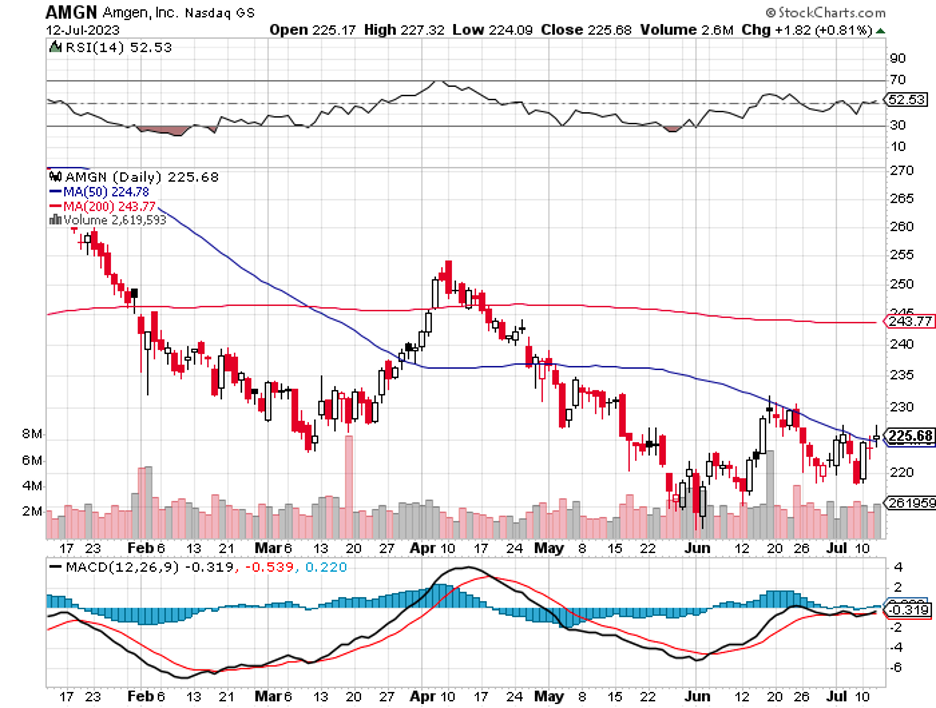
Hovering at $222, Amgen (AMGN) carries a price-to-earnings ratio slightly shy of 12. The firm is grappling with the challenge of a potential few-billion-dollar-a-year dip in sales for some of its drugs while making ambitious strides to enhance its annual revenue of $27 billion.

So far, the most notable beacon of hope for Amgen is its experimental obesity treatments, AMG133 and AMG786, positioned in a market that has the potential to skyrocket beyond a whopping $30 billion annually.

Meanwhile, in a bold move, Amgen has proposed a $27 billion acquisition of Horizon Therapeutics (HZNP).

This strategic takeover could directly bolster Amgen's earnings per share (EPS) by more than $5, significantly enhancing the firm's current annual EPS of $18.

Amgen remains resilient despite facing hurdles from the Federal Trade Commission, which has launched legal proceedings to halt the transaction. The company is not just fixated on Horizon; it has the bandwidth to explore other potential acquisitions or augment its stock buyback program.

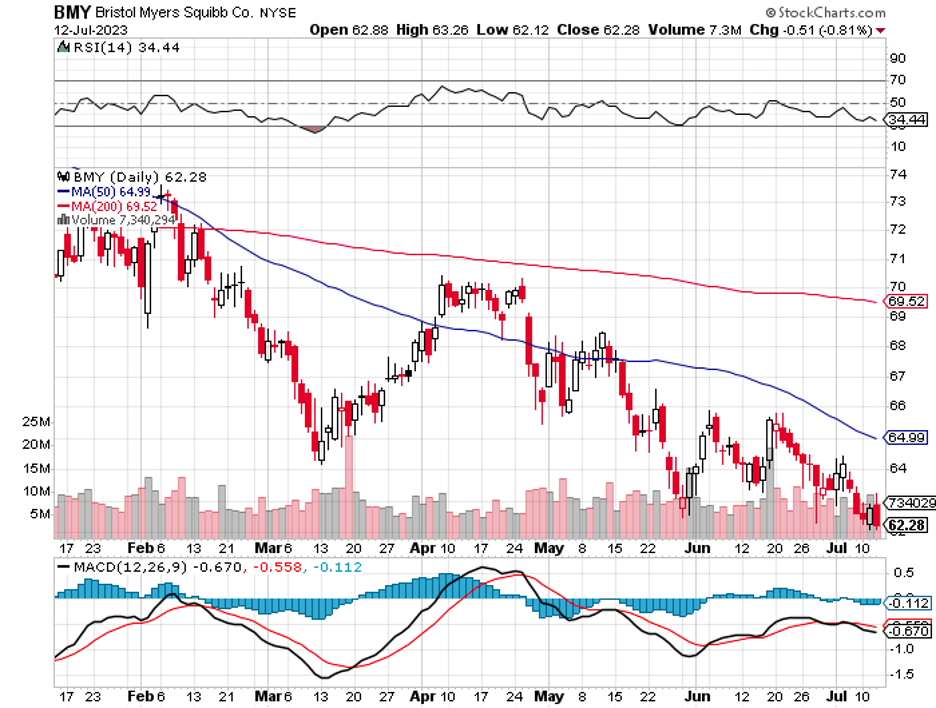
Another stock to consider is Bristol Myers Squibb (BMY). Priced at a humble $63, it’s trading at a modest valuation, barely touching eight times its earnings.

The market trembles at the potential stagnation—or worse, reduction—of its annual EPS, currently soaring just above $8. This anxiety is fuelled by the projected multi-billion dollar decline in sales for several drugs as the sands of time run out on their patents. These drugs, after all, form a substantial portion of this year's anticipated revenue of $46.6 billion.

However, it's not all gloom and doom. Bristol Myers Squibb has not one, not two, but a whopping eight new drugs jostling their way through clinical trials. One to keep an eye on is milvexian, a stroke prevention formula that shows immense promise.

These innovative concoctions could eventually inject a stunning $30 billion into the company's annual revenue stream, with the stock potentially reaching an ambitious price target of $85, projecting a handsome upside of 32%.

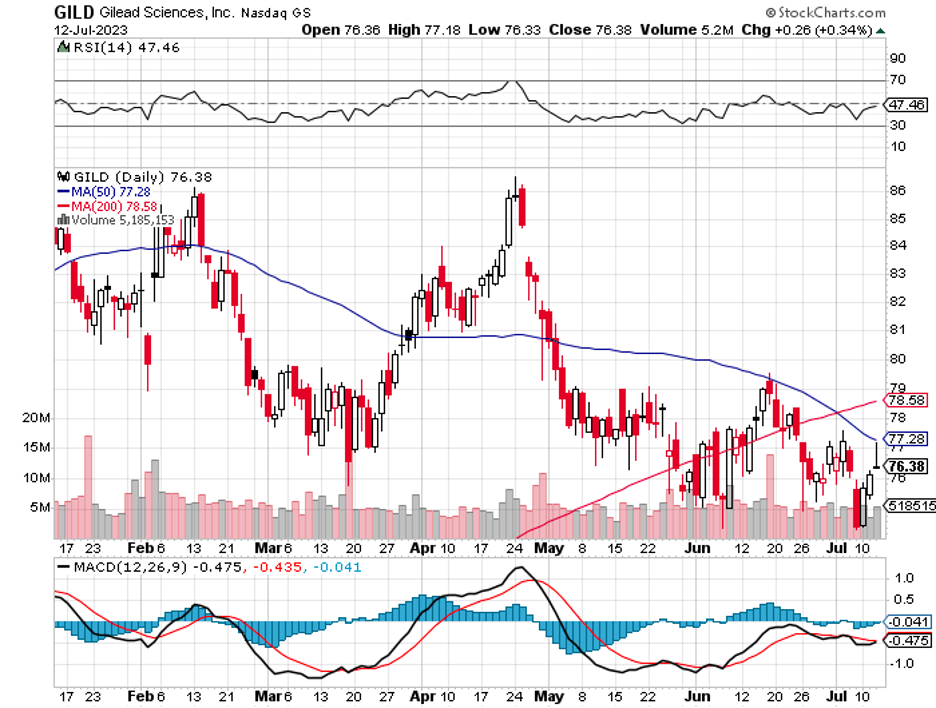
Gilead Sciences (GILD) is one more stock to take into consideration. Trading at an enticing 11 times earnings, it’s a steal at $76.

Yes, some of its products are on the downhill, but here's the game-changer: Trodelvy, an innovative cancer treatment.

Anticipated to triple revenues, this treatment’s sales is projected to surge from a humble $1 billion this year to a staggering $2.7 billion by 2028.

This suggests an upward trajectory for Gilead's sales, hurtling from just shy of $27 billion this year to well over $30 billion by 2028. The earnings per share (EPS) is poised to see an annual gain of about 6%, potentially reaching nearly $9 by then.

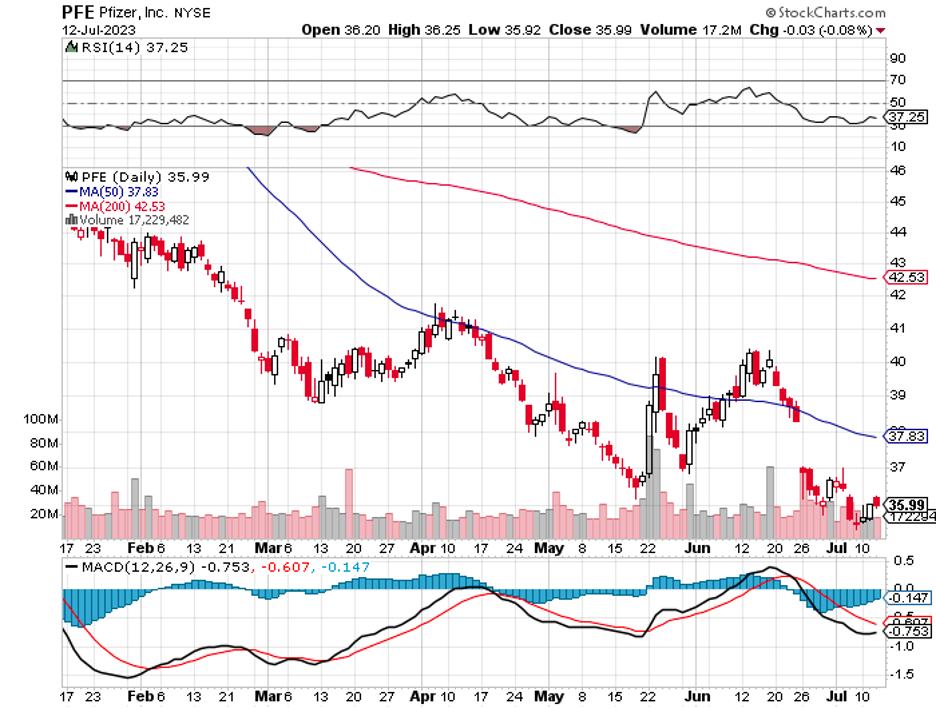
There’s also Pfizer (PFE), priced at a modest $36 and trading just shy of 11 times earnings.

As the dark cloud of Covid-19 gradually disperses, the pharmaceutical titan projects a significant contraction in its annual vaccine sales - halving it down to nearly $14 billion this year, contributing to the overall $67.8 billion income.

But don't be too hasty to dismiss Pfizer's prospects. Its innovation pipeline is teeming with promising solutions like its groundbreaking meningitis therapy. Moreover, it's poised to breathe fresh life into its vaccine division by fusing a flu and Covid vaccine.

Come 2026, the company anticipates its vaccines will arm over 130 million Americans, a notable surge from this year's 79 million recipients of the Covid vaccine alone.

You may find a less treacherous path by adopting a strategic approach of integrating more economically priced pharma stocks into your portfolio.

These stocks may grapple with dwindling sales from established drugs and the relentless onslaught of generic brands.

Nevertheless, they also harbor promising new entrants that, if successful, could spark a significant rally.

All things considered, the companies mentioned above are not mere “cheap” stocks but intriguing opportunities laced with robust potential. I suggest you take advantage of the dip.


big pharma


https://madhedgefundtrader.com/wp-content/uploads/2019/05/cropped-mad-hedge-logo-transparent-192x192_f9578834168ba24df3eb53916a12c882.png 0 0 Mad Hedge Fund Trader https://madhedgefundtrader.com/wp-content/uploads/2019/05/cropped-mad-hedge-logo-transparent-192x192_f9578834168ba24df3eb53916a12c882.png Mad Hedge Fund Trader2023-07-18 15:00:422023-08-01 15:01:51Big Pharma, Bigger Opportunities
Mad Hedge Fund Trader

July 13, 2023

Biotech Letter

Mad Hedge Biotech and Healthcare Letter
July 13, 2023
Fiat Lux

Featured Trade:

(A ROCKY ROAD TO REDEMPTION)
(BIIB), (ESALY)

https://madhedgefundtrader.com/wp-content/uploads/2019/05/cropped-mad-hedge-logo-transparent-192x192_f9578834168ba24df3eb53916a12c882.png 0 0 Mad Hedge Fund Trader https://madhedgefundtrader.com/wp-content/uploads/2019/05/cropped-mad-hedge-logo-transparent-192x192_f9578834168ba24df3eb53916a12c882.png Mad Hedge Fund Trader2023-07-13 16:02:402023-07-13 23:15:29July 13, 2023
Mad Hedge Fund Trader

A Rocky Road to Redemption

Biotech Letter

In an era marked by dynamic biotech developments, Biogen (BIIB) had once emerged as an industry powerhouse, the fruitful labor of its innovative multiple sclerosis drugs catapulting revenues into the stratosphere.

Unfortunately, time revealed a looming issue as the company's marquee products confronted diminishing exclusivity: stagnation.

Confronted by the precipice of change, Biogen made a strategic pivot toward the complex world of Alzheimer's disease. In partnership with the Japanese pharmaceutical giant Eisai (ESALY), they trailblazed the development of Leqembi, a game-changer that recently bagged the much-coveted traditional approval from the U.S. Food and Drug Administration (FDA).

The stamp of approval from federal authorities signifies a significant advancement towards broadening the drug's reach. Earlier in the year, the Centers for Medicare and Medicaid Services pledged to shoulder a considerable portion of the cost of Leqembi, contingent on the FDA's full authorization.

This commitment brings relief to aging American beneficiaries of Medicare, lightening the load of the drug's yearly $26,500 bill.

Armed with the FDA's endorsement and CMS agreeing to shoulder most of the expenses, there is anticipation that thousands, if not tens of thousands, of Alzheimer's patients across the US will be prescribed either lecanamab or donanemab in the imminent years.

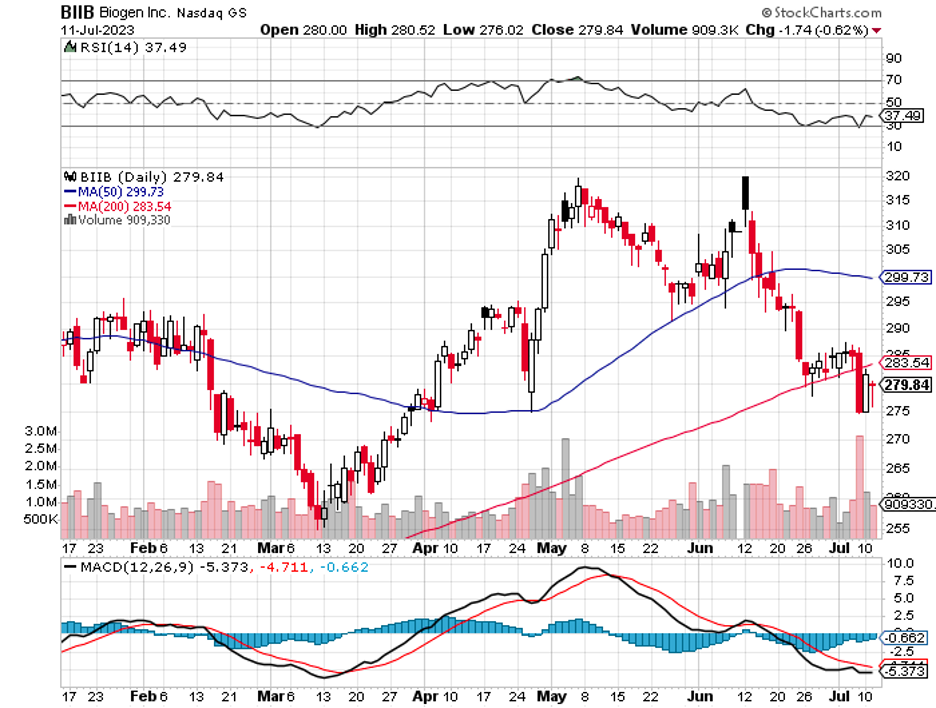
But a question remains: Will this approval be sufficient to invigorate BIIB, a stock that has languished in the doldrums for the past decade?

Leqembi has been projected to become a blockbuster in a few years, with its total sales expected to exceed $12 billion from 2023 to 2028. Although Biogen and Eisai will be splitting the profits, Leqembi's potential as a significant asset for Biogen cannot be overlooked.

The imperative to treat Alzheimer's disease is grave, considering the current 6 million Americans living with the condition, a figure which could potentially burgeon to 13 million by 2050.

Disturbingly, this affliction claims more elderly lives than breast and prostate cancer combined.

In relation to this, the worldwide Alzheimer's therapeutics market is estimated to record a compound annual growth rate of 16.2% stretching into 2030, when it is anticipated to hit a worth of around $15.6 billion.

Eisai had earlier projected that Leqembi's peak sales could rake in a lucrative $7.3 billion by 2030. Meanwhile, experts believe the figure would be closer to $13 billion.

So, why didn't Biogen's shares experience a bounce on the back of this news?

They actually dipped by 3.5% in the trading session, and overall, the stock has remained relatively stable this 2023.

The answer lies in what happened last autumn when Biogen saw a nearly 40% surge in a single day when it announced Leqembi's successful achievement of clinical trial objectives. Given the positive data, investors largely anticipated an approval, suggesting that this recent positive update was already baked into the stock price.

What then about the future revenues?

Considering that Biogen isn’t exactly launching an “everyday pill,” there might be issues to resolve first.

Before commencing the treatment, patients would require PET scans or lumbar punctures for a confirmed diagnosis. Following this, Leqembi is to be administered at infusion centers -- a process that could potentially face capacity issues. These factors imply that rolling out Leqembi and getting all potential patients on the treatment might be a gradual process.

Biogen also anticipates that this year, the costs associated with bringing Leqembi to the market will eclipse the revenue it generates. As such, this novel product poses a short-term challenge and will likely dampen growth in 2023.

Should you then put money in Biogen stocks?

Answering this query isn't straightforward as it hinges on your risk appetite. It's possible that hurdles such as infusion center inadequacies can be overcome -- Biogen's vast experience places them in a strong position to address these.

However, the crux of the matter revolves around whether the medical community and patients will embrace the treatment, a point of uncertainty and risk.

For the thrill-seeking investor who embraces unpredictability, Biogen could offer an appealing opportunity at the moment.

If their new drug, Leqembi, attains success, the long-term potential for the stock's rise is significant.

For the more reserved investor, though, waiting for clearer signs of acceptance from doctors and patients might be a safer play. As for me, I suggest waiting and buying the dip.


biogen leqembi

https://madhedgefundtrader.com/wp-content/uploads/2019/05/cropped-mad-hedge-logo-transparent-192x192_f9578834168ba24df3eb53916a12c882.png 0 0 Mad Hedge Fund Trader https://madhedgefundtrader.com/wp-content/uploads/2019/05/cropped-mad-hedge-logo-transparent-192x192_f9578834168ba24df3eb53916a12c882.png Mad Hedge Fund Trader2023-07-13 16:00:392023-08-01 14:11:44A Rocky Road to Redemption
Mad Hedge Fund Trader

July 11, 2023

Biotech Letter

Mad Hedge Biotech and Healthcare Letter
July 11, 2023
Fiat Lux

Featured Trade:

(A CALCULATED GAMBLE)
(PFE), (CRBU), (AAPL), (NTLA), (CRSP)

https://madhedgefundtrader.com/wp-content/uploads/2019/05/cropped-mad-hedge-logo-transparent-192x192_f9578834168ba24df3eb53916a12c882.png 0 0 Mad Hedge Fund Trader https://madhedgefundtrader.com/wp-content/uploads/2019/05/cropped-mad-hedge-logo-transparent-192x192_f9578834168ba24df3eb53916a12c882.png Mad Hedge Fund Trader2023-07-11 17:02:202023-07-11 17:36:38July 11, 2023
Page 38 of 115«‹3637383940›»

Legal Disclaimer

There is a very high degree of risk involved in trading. Past results are not indicative of future returns. MadHedgeFundTrader.com and all individuals affiliated with this site assume no responsibilities for your trading and investment results. The indicators, strategies, columns, articles and all other features are for educational purposes only and should not be construed as investment advice. Information for futures trading observations are obtained from sources believed to be reliable, but we do not warrant its completeness or accuracy, or warrant any results from the use of the information. Your use of the trading observations is entirely at your own risk and it is your sole responsibility to evaluate the accuracy, completeness and usefulness of the information. You must assess the risk of any trade with your broker and make your own independent decisions regarding any securities mentioned herein. Affiliates of MadHedgeFundTrader.com may have a position or effect transactions in the securities described herein (or options thereon) and/or otherwise employ trading strategies that may be consistent or inconsistent with the provided strategies.

Copyright © 2026. Mad Hedge Fund Trader. All Rights Reserved. support@madhedgefundtrader.com
Scroll to top