• support@madhedgefundtrader.com
  • Member Login
Mad Hedge Fund Trader
  • Home
  • About
  • Store
  • Luncheons
  • Testimonials
  • Contact Us
  • Click to open the search input field Click to open the search input field Search
  • Menu Menu
Mad Hedge Fund Trader

Bargain Deal For A Quality Stock

Biotech Letter

Uncertainty. That’s the prevalent sentiment in the investment community these days.

Investors have been hesitant to buy stocks because they believe the bear market isn’t over yet.

Moreover, investors are anxious over the possibility that the stocks will keep falling as issues like higher inflation continue to hound the market.

However, it’s critical to remember that although today’s situation is challenging, it’s only temporary. This means that businesses with solid track records and promising prospects still make excellent buys.

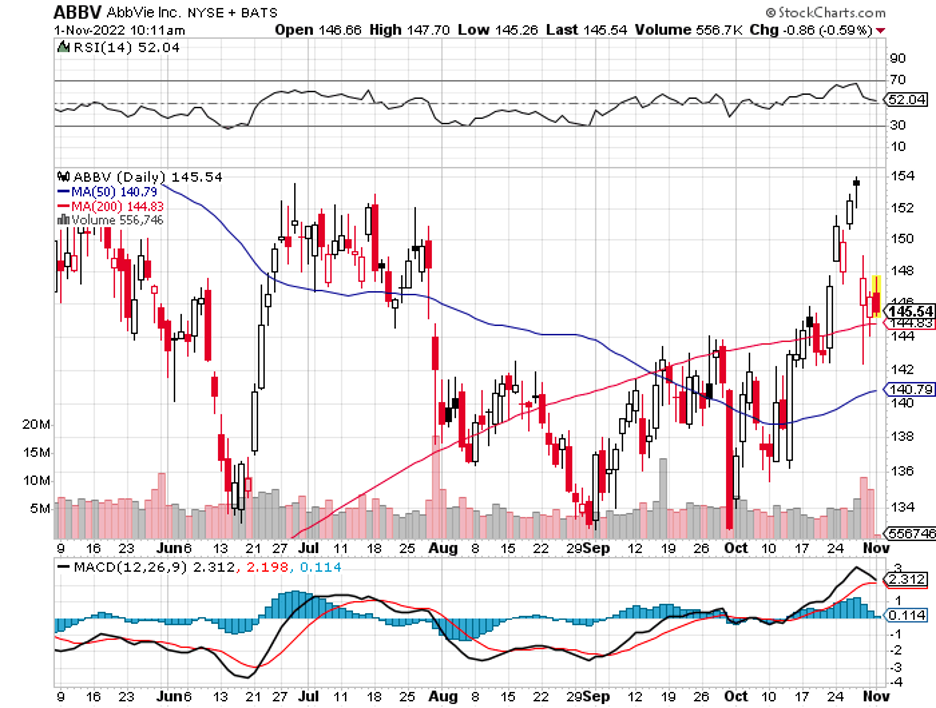
One of the companies outperforming the market this year but which has fallen out of investors’ favor recently, is AbbVie (ABBV).

AbbVie stock has been declining in value lately following an underwhelming third-quarter earnings report. On top of that, the looming patent expiration of its top-selling drug Humira remains a significant concern among investors.

While the Humira situation is clearly not good news for the company, the reality is that AbbVie has impressively preserved the medication’s exclusivity for almost a decade longer than initially expected. Plus, the company has been boosting Humira pricing every year to cope with the declining revenues in the EU, where it already lost patent protection in 2018.

Hence, it’s acceptable for Humira’s chapter in AbbVie’s story to end. After all, the drug has given the company so much. It has been primarily responsible for the more than 325% climb in the company’s share price since 2012 when AbbVie was spun out of Abbott Laboratories (ABT).

Nonetheless, Humira’s impending patent loss doesn’t mean that AbbVie will simply abandon its roots.

The company has since developed potential successors of Humira, namely, Skyrizi and Rinvoq.

So far, the two auto-immune drugs have delivered promising results and are on track to keep the company in tip-top shape in its post-Humira era.

These newer immunology drugs are showing impressive growth potential, with Rinvoq recording a 56% increase in revenue in the third quarter of 2022 and Skyrizi revenue soaring by 85%.

Both are also on track to beat Humira’s peak sales, with joint peak sales from Skyrizi and Rinvoq initially estimated to reach roughly $15 billion.

However, recent revenue reports show that the two could surpass the estimate and completely eclipse Humira’s more than $20 billion annual return.

Obviously, AbbVie would require more than its immunology segment if it plans to sustain a good top and bottom-line growth trajectory.

Other than the more than 10 neuroscience, hematology, immunology, and oncology candidates in its pipeline, which are projected to be ready for market launches in the three to five years, AbbVie has been diving into the aesthetics and eye care markets.

Its eye care program, specifically RGX-314, which is currently being developed in partnership with Regenxbio (RGNX), is an interesting wildcard. For context, the eye care segments for wet and dry advanced macular degeneration are roughly worth over $10 billion to $20 billion annually.

With its Humira chapter closing, AbbVie could be ushering in a new era where products from its Allergan acquisition take the lead.

For example, its Botox franchise consistently delivers impressive results. Even its Botox for migraine line has been recording double-digit revenue growth in the third quarter, indicating gains in AbbVie’s neuroscience segment.

As for the aesthetic indications of Botox, this particular portfolio could be a key driver in the company’s future growth.

Aside from Botox, AbbVie also gained access to the widely used dermal filler Juvederm. With the facial aesthetics industry pegged to experience a compound annual growth rate yearly at 14%, the market is estimated to hit $15.2 billion by 2028.

This trend of AbbVie dominating the market is likely to continue as the company is confident that competitors would be unable to develop biosimilars of Botox. That means its Botox line could keep adding to its top-line growth for an extended period.

Overall, AbbVie is a solid bet among the “Big 8” in the pharmaceutical world, which includes Johnson & Johnson (JNJ), Merck (MRK), Gilead Sciences (GILD), Amgen (AMGN), Eli Lilly (LLY), Bristol Myers Squibb (BMY), and Pfizer (PFE).

Moreover, this is an excellent time to hunt for deals as several quality stocks continue to decline, affected negatively partly by the momentum of the broader market. Among stocks to consider, AbbVie should be at the top of your list.
 

abbvie humira

https://madhedgefundtrader.com/wp-content/uploads/2019/05/cropped-mad-hedge-logo-transparent-192x192_f9578834168ba24df3eb53916a12c882.png 0 0 Mad Hedge Fund Trader https://madhedgefundtrader.com/wp-content/uploads/2019/05/cropped-mad-hedge-logo-transparent-192x192_f9578834168ba24df3eb53916a12c882.png Mad Hedge Fund Trader2022-11-01 11:00:162022-11-02 04:35:58Bargain Deal For A Quality Stock
Mad Hedge Fund Trader

October 27, 2022

Biotech Letter

Mad Hedge Biotech and Healthcare Letter
October 27, 2022
Fiat Lux

Featured Trade:

(A HIDDEN TREASURE IN THESE TURBULENT TIMES)
(BMY), (AMGN)

https://madhedgefundtrader.com/wp-content/uploads/2019/05/cropped-mad-hedge-logo-transparent-192x192_f9578834168ba24df3eb53916a12c882.png 0 0 Mad Hedge Fund Trader https://madhedgefundtrader.com/wp-content/uploads/2019/05/cropped-mad-hedge-logo-transparent-192x192_f9578834168ba24df3eb53916a12c882.png Mad Hedge Fund Trader2022-10-27 17:02:002022-10-27 17:23:22October 27, 2022
Mad Hedge Fund Trader

A Hidden Treasure In These Turbulent Times

Biotech Letter

Biotechnology and healthcare companies are not exactly the thrilling investments that tech stocks or other growth-centered businesses tend to be described as.

Nonetheless, one of the reasons I find this sector attractive is that the companies can offer steady growth in extensively diverse markets.

From biopharmaceutical treatments to household items, the products these businesses develop are the kinds people tend to need and use regularly constantly.

While the biotechnology and healthcare sector doesn’t always beat the general market, the combo of steady growth, resilient returns, and reliable dividends generally make it an incredibly attractive option for investors.

Among the companies in this segment, one of the names you can buy and hold in the long run is Bristol Myers Squibb (BMY).

BMY is hailed as the seventh-biggest biopharmaceutical company across the globe in terms of sales. In 2021, the business recorded $46.4 billion in total revenue, which was up by 9% from 2020.

More than half of BMY’s revenue last year was generated from sales of three of its best-selling treatments: multiple myeloma drug Revlimid, Eliquis, and cancer treatment Opdivo.

The full-year revenue for all three drugs jumped that year, with Revlimid climbing by 6% to reach $12.8 billion, blood thinning medication Eliquis rising by 17% to hit $10.8 billion, and Opdivo increasing by 8% to record $7.5 billion.

Despite the impressive performance of these top-selling products, BMY has been diversifying its portfolio to cover a vast lineup of candidates in the fields of immunology, hematology, and, of course, oncology.

The healthcare giant has also grown, in part, through acquisitions, and part of its 2021 revenue of $46 billion, which was twice more than its 2018 revenue of $23 billion, came from these efforts. Moreover, BMY has reported a free cash flow of roughly $13 billion for two consecutive years.

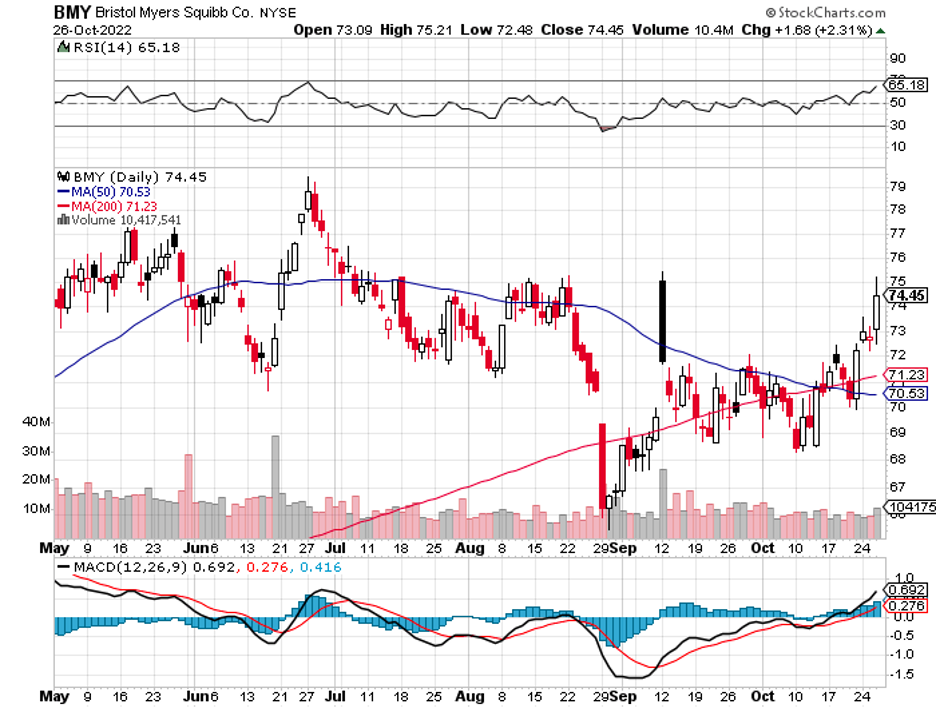
In 2022, BMY reported a lackluster third-quarter performance. While the company’s revenue slid by 3% to $11.2 billion, the stock still climbed 2.31%.

This could be attributed to the fact that BMY managed to beat expectations as analysts predicted a more significant drop due to foreign exchange impacts.

Aside from these, Revlimid has been dealing with increased competition worldwide in the past months. Specifically, this bone marrow cancer drug has been facing “generic erosion” thanks to the emergence of cheaper alternatives in the market.
Picking up the slack from Revlimid is Eliquis, which has become the company’s top performer in terms of revenue and projected growth. Sales for this drug rose by 10% in the third quarter to reach $2.66 billion.

Meanwhile, sales of BMY’s newly launched products jumped 61% to record $553 million.

Future growth is anticipated to be led by Sotyktu, an oral drug for moderate to severe plaque psoriasis that recently gained FDA approval.

In the US alone, roughly 7.5 million individuals suffer from psoriasis. This is a promising market for BMY, which has been aggressively searching for products to rejuvenate its portfolio.

Since it was only recently approved, Sotyktu’s contribution to BMY’s revenue has yet to be proven. However, the drug recorded better results than Amgen’s (AMGN) blockbuster drug Otezla, which raked in $2.25 billion in sales in 2021.

Given the released data, target market, and more promising results from Sotyktu, BMY’s drug is estimated to reach peak sales at $4.2 billion by 2028.

Overall, BMY is an excellent bet during these turbulent times. In the past 10 years, the company has generated total returns, including dividends, of 190%.

This isn’t far from the 223% returns recorded by the S&P 500. Moreover, if BMY sustains its recent performance, then it’s only a matter of time before it successfully shrinks that gap. I suggest that long-term investors buy the dip.


bmy

https://madhedgefundtrader.com/wp-content/uploads/2019/05/cropped-mad-hedge-logo-transparent-192x192_f9578834168ba24df3eb53916a12c882.png 0 0 Mad Hedge Fund Trader https://madhedgefundtrader.com/wp-content/uploads/2019/05/cropped-mad-hedge-logo-transparent-192x192_f9578834168ba24df3eb53916a12c882.png Mad Hedge Fund Trader2022-10-27 17:00:562022-11-30 14:27:06A Hidden Treasure In These Turbulent Times
Mad Hedge Fund Trader

October 25, 2022

Biotech Letter

Mad Hedge Biotech and Healthcare Letter
October 25, 2022
Fiat Lux

Featured Trade:

(A FAIL-SAFE HEALTHCARE STOCK)
(JNJ)

https://madhedgefundtrader.com/wp-content/uploads/2019/05/cropped-mad-hedge-logo-transparent-192x192_f9578834168ba24df3eb53916a12c882.png 0 0 Mad Hedge Fund Trader https://madhedgefundtrader.com/wp-content/uploads/2019/05/cropped-mad-hedge-logo-transparent-192x192_f9578834168ba24df3eb53916a12c882.png Mad Hedge Fund Trader2022-10-25 16:02:242022-10-25 17:14:30October 25, 2022
Mad Hedge Fund Trader

A Fail-Safe Healthcare Stock

Biotech Letter

What’s a clear indicator of a well-run business? It’s when customers across the globe can easily recognize your company’s brands.

It’s safe to state that practically everyone in the world knows at least one or two products in Johnson & Johnson’s (JNJ) portfolio.

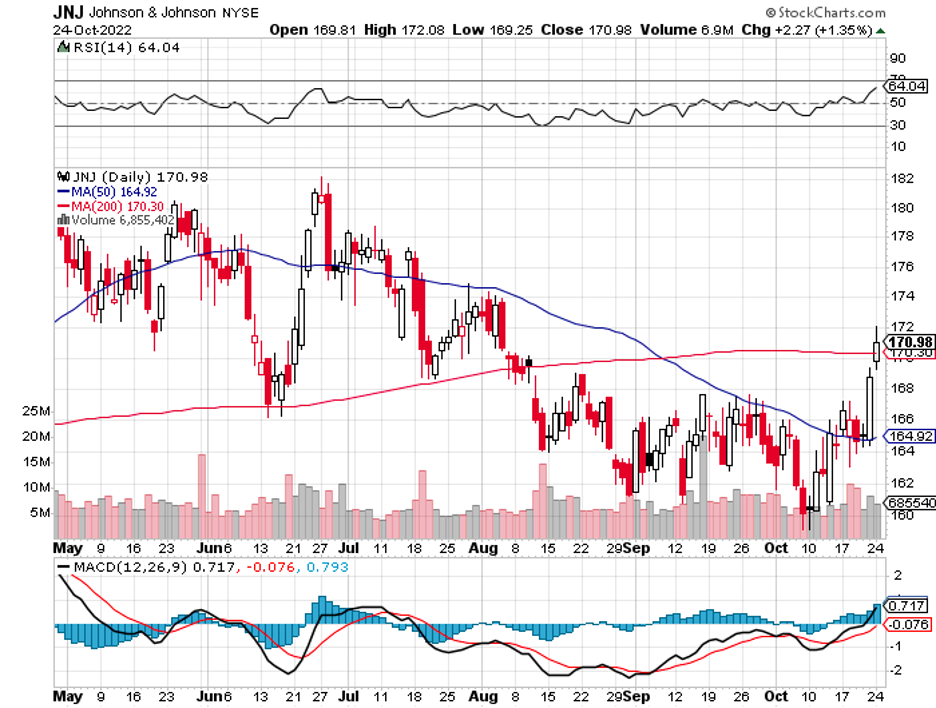
Since the pandemic started and until now, when things remain uncertain and economic headwinds continue to befall the market, JNJ has proven itself to be virtually recession-resistant.

In fact, based on its third-quarter earnings report, JNJ is one of the handful of companies receiving short-term boosts. Amid the issues over inflation and supply chains, this healthcare company reported $23.8 billion in revenue, rising by 1.9%, and earnings per share of $1.68, up by 22.6%.

In the past 10 years, JNJ has boosted its revenue annually except in 2015.

The biopharmaceutical giant is also diligent in making sure its investors are happy. It has shelled out $2 billion in 2022 alone on share buybacks, with an additional $3 billion scheduled.

It has also paid out $3 billion worth of dividends to investors, with the market-proclaimed Dividend King raising its payout for 60 consecutive years.

As in the previous quarters, JNJ’s pharmaceutical business division delivered the most substantial sales gains, while its consumer health division struggled to overcome foreign currency woes.

Minor tweaks to JNJ’s guidance offered some color to the earnings report. The company narrowed its sales growth estimates and lowered its range for full-year revenue to somewhere between $93 billion and $93.5 billion, primarily due to the strong dollar. Nevertheless, the company’s adjusted earnings guidance remains the same, with anticipated operational gains.

Meanwhile, its plan to spin off its consumer health segment in 2023 into a new company called Kenvue has shareholders hopeful for an increase in the value of JNJ stock soon.

The plan to spin off this segment has been in the works for quite some time and is anticipated to enable JNJ to become a more profitable company in the long run.

While brands like Listerine, Band-Aid, and Benadryl have high name recall, the company’s consumer health segment remains a slow growing and has become a burden. Actually, these well-known brands only account for roughly 15.6% of the company’s $47.4 billion recorded in the first 6 months of 2022.

The true catalyst in JNJ’s growth is and will continue to be its pharmaceutical division. This segment includes the mega-blockbuster immunology treatment Stelara and the oncology drug Darzalex, both of which rake in at least $5 billion in sales every year.

JNJ also has 11 more drugs and its COVID-19 vaccine in its portfolio, which are all on pace to add a minimum of $1 billion in sales for this year.

Looking at its current portfolio and pipeline, JNJ is projected to record a 4.1% annual earnings growth in the next 5 years. On top of these, JNJ has 99 drug indications queued for clinical development across various therapy areas like oncology and immunology. These should offer the company more than enough firepower to bolster its sales and earnings higher gradually.

Coupling this earnings growth with JNJ’s dividend payout ratio at a reasonably 44%, then I can confidently say that the company’s 60-year dividend growth streak is on track. It’s also safe to project 5% to 6% annual dividend growth in the short term.

One of the critical principles in investing is to ensure that you are diversifying your portfolio not only in terms of the companies but also the sectors you put your money into.

This measure can help protect your portfolio and its income from headwinds in a particular industry at any given time.

Throughout the years, healthcare has proven to be a must-own segment. After all, everyone will require access to the healthcare system, whether for a routine checkup, prescription, or surgical procedure.

Moreover, the part of the global population needing more focused and frequent medical care—people aged 65 and older—is projected to nearly triple from 2015 to 2050 to record 1.6 billion individuals.

Considering these factors and the stability offered by JNJ, it’s easy to see how this company can become a lucrative long-term investment for those looking to diversify their portfolio. I strongly suggest buying the dip.


jnj portfolio

https://madhedgefundtrader.com/wp-content/uploads/2019/05/cropped-mad-hedge-logo-transparent-192x192_f9578834168ba24df3eb53916a12c882.png 0 0 Mad Hedge Fund Trader https://madhedgefundtrader.com/wp-content/uploads/2019/05/cropped-mad-hedge-logo-transparent-192x192_f9578834168ba24df3eb53916a12c882.png Mad Hedge Fund Trader2022-10-25 16:00:212022-11-30 13:23:24A Fail-Safe Healthcare Stock
Mad Hedge Fund Trader

October 20, 2022

Biotech Letter

Mad Hedge Biotech and Healthcare Letter
October 20, 2022
Fiat Lux

Featured Trade:

(A CURE FOR A SICKENING MARKET)
(MRK), (OGN)

https://madhedgefundtrader.com/wp-content/uploads/2019/05/cropped-mad-hedge-logo-transparent-192x192_f9578834168ba24df3eb53916a12c882.png 0 0 Mad Hedge Fund Trader https://madhedgefundtrader.com/wp-content/uploads/2019/05/cropped-mad-hedge-logo-transparent-192x192_f9578834168ba24df3eb53916a12c882.png Mad Hedge Fund Trader2022-10-20 16:02:092022-10-20 17:29:49October 20, 2022
Mad Hedge Fund Trader

A Cure for a Sickening Market

Biotech Letter

In this sickening market, it makes sense that the biotechnology and healthcare industry is proving to be a great hedge.

This sector has managed to remain one of the handful to post gains in 2022 amidst the seemingly never-ending barrage of negative news caused by the bear market, economic and political turmoil, and even health crises.

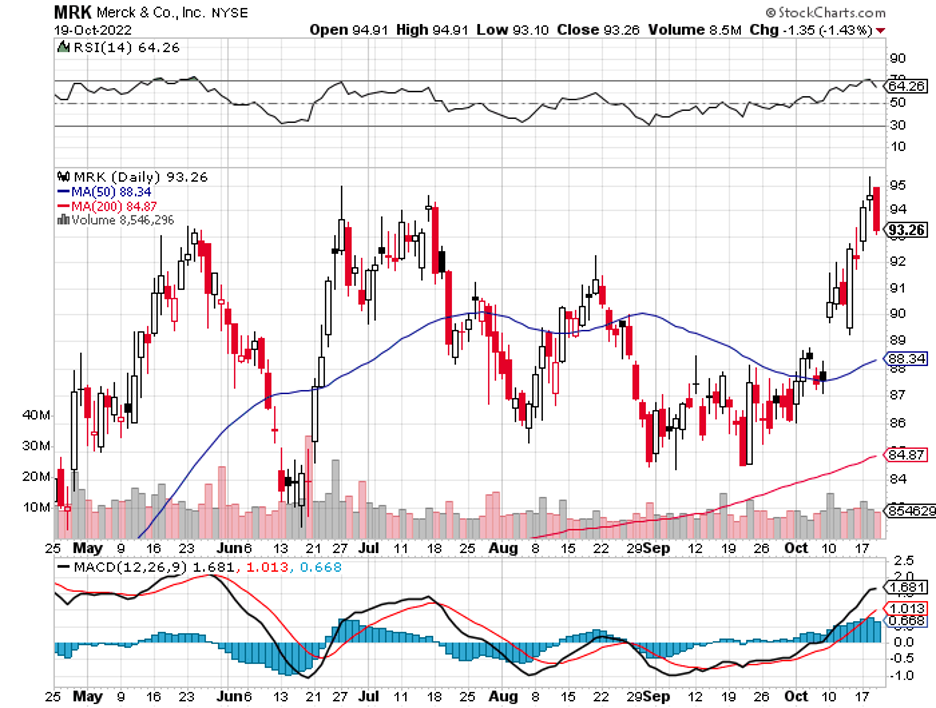
The criteria bring me to Merck (MRK), which has performed excellently this year.

Merck is a globally dominant biopharmaceutical company, standing the test of time, and having been in operation for more than 130 years.

It has consistently delivered stable results, showing off a 28% growth in sales in the second quarter of 2022. Among the names in its roster, the most profitable drug is cancer treatment Keytruda, which recorded a 30% year-over-year growth in sales during the same period.

Despite the already remarkable performance of Keytruda, this oncology medication has proven to be capable of targeting more than just lung cancer as it was recently given the green light for 6 additional indications.

In line with ensuring the company is not reliant on a single blockbuster drug, Merck has been aggressive in seeking potential high-selling candidates to add to its portfolio.

Recently, its $11.5 billion bet on Sotatercept, a heart medication, seems to have paid off as the company disclosed positive results from a Phase 3 trial focused on treating a condition called pulmonary arterial hypertension.

It was in 2021 when Merck bought Sotatercept as part of its agreement to acquire Accelerant Pharma. The goal was to find a drug to fill the anticipated revenue gap from the impending patent loss of Keytruda by 2030.

The strategy was high risk at that time because data on Sotatercept were limited on Phase 2 trial results. Nevertheless, Merck paid a significant sum to the company. That was reported as one of the biggest acquisitions of 2021.

Given the current data, the conservative estimate for Sotatercept sales is at $700 million annually. However, the established nature of the target market has some analysts pushing the forecast to potentially reach $4 billion by 2031.

However, unlike other biopharmaceutical companies that heavily depend on one or two blockbuster treatments, Merck has a strong lineup of high-margin products in the market.

Moreover, its pipeline candidates support its solid profitability and investment capital returns for several years. This becomes even more apparent with the spinoff of Organon (OGN) in 2021, where Merck retained a portfolio of drugs with strong patent protection.

It holds a moat-worthy portfolio of specialty treatments in various sectors, including oncology, immunology, cardiometabolic disease, rare diseases, and infections. It also has an extensive vaccine segment that targets HPV, pediatric conditions, shingles, and Hepatitis B.

In the past trailing 12 months, the company generated roughly $57 billion in revenue, with half coming from US sales and the rest internationally.

More importantly, Merck sports a notable 3.1% dividend yield that’s easily supported by a low 35% payout ratio. It reports a 9% five-year CAGR and has an impressive 11-year growth streak.

Throughout the years, Merck’s stock, underlying strategies, and growth model have demonstrated their resilience against macroeconomic headwinds, with the company’s core businesses firing on all cylinders.

It has one of the most solid balance sheets in the industry, which illustrates its financial flexibility to comfortably invest in promising R&D prospects and sustain its dividend at a solid pace.

Overall, Merck is an excellent choice for investors looking to deploy some capital but want to minimize exposure to volatility on top of the possibility of earning some extra dividend income.


merck

https://madhedgefundtrader.com/wp-content/uploads/2019/05/cropped-mad-hedge-logo-transparent-192x192_f9578834168ba24df3eb53916a12c882.png 0 0 Mad Hedge Fund Trader https://madhedgefundtrader.com/wp-content/uploads/2019/05/cropped-mad-hedge-logo-transparent-192x192_f9578834168ba24df3eb53916a12c882.png Mad Hedge Fund Trader2022-10-20 16:00:092022-11-02 03:45:43A Cure for a Sickening Market
Mad Hedge Fund Trader

October 18, 2022

Biotech Letter

Mad Hedge Biotech and Healthcare Letter
October 18, 2022
Fiat Lux

Featured Trade:

(JUST WHAT THE DOCTOR ORDERED)
(MRNA), (MRK), (PFE)

https://madhedgefundtrader.com/wp-content/uploads/2019/05/cropped-mad-hedge-logo-transparent-192x192_f9578834168ba24df3eb53916a12c882.png 0 0 Mad Hedge Fund Trader https://madhedgefundtrader.com/wp-content/uploads/2019/05/cropped-mad-hedge-logo-transparent-192x192_f9578834168ba24df3eb53916a12c882.png Mad Hedge Fund Trader2022-10-18 18:02:252022-10-18 21:02:20October 18, 2022
Mad Hedge Fund Trader

Just What The Doctor Ordered

Biotech Letter

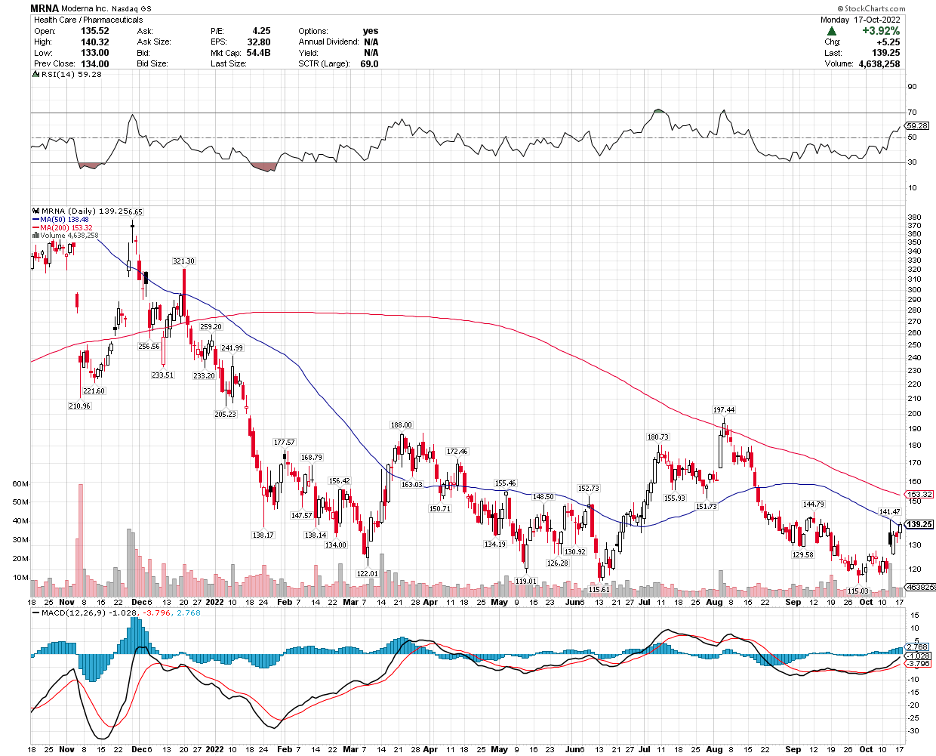
A newly announced collaboration extension with Merck (MRK) might just be what the doctor ordered for Moderna’s stock, which has been experiencing a decline in revenue since the public started resisting boosters.

Moderna stock rose 12% following the news that the FDA approved its collaboration deal with Merck as well as its COVID booster geared towards young kids.

Those positive updates most likely mark the end of a falling knives stage for the company, as it was coming off a 52-week low just days before the announcements.

The deal between Moderna and Merck involves a personalized cancer vaccine, which the two have been working on since 2016. The goal is to use Moderna’s technology as a combo treatment alongside Merck’s mega-blockbuster Keytruda.

The cancer vaccine, currently dubbed mRNA-4157, will be tailored for every patient. It generates a reaction according to the particular mutational signature of an individual’s tumor.

The collaboration is already in its Phase 2 trial for a high-risk melanoma vaccine.

The deal involves Merck shelling out $250 million in cash to exercise its option on this personalized cancer vaccine candidate. Had Moderna not earned copious amounts of cash over its COVID-19 vaccine over the past two years, this money would have seemed like a much bigger deal.

Nevertheless, the agreement is for a 50-50 sharing of costs and, eventually, potential profits. The results of Phase 2 should be disclosed to the public before December 2022.

Regarding how this affects Moderna’s pipeline, the collaboration demonstrates the versatility of the mRNA technology.

The other update that boosted the stock is the emergency use authorization granted to Moderna and fellow COVID-19 vaccine maker Pfizer (PFE), which allowed their boosters to be used on children.

As you know, Moderna markets and sells only a single product: SpikeVax. While this COVID vaccine is, apart from Pfizer’s Comirnaty, the most extensively used worldwide, pushing revenues to $18.5 billion in 2021, and is on track to hit roughly $21 billion in 2022, sales for SpikeVax are expected to decline now that the pandemic has been deemed “over.”

The company’s agreement to 70 million vaccine doses to the US government, on top of the option to purchase up to 230 million, which will be worth about $4.8 billion at $16 per dose, may very well be Moderna’s last to a government.

Currently, the biotech is looking into the private market, in which its vaccine may start costing up to $100.

Reviewing the demand and the current situation, my best estimate is that Moderna would earn roughly $7 billion annually from the private market for its COVID vaccine.

Nevertheless, Moderna’s vaccine has shown proof of concept. This would translate to more confidence in the company’s pipeline. Its expanded collaboration with Merck is a clear indicator of this sentiment.

In terms of the rest of its pipeline, Moderna has several candidates.

The most advanced so far are its Phase 3 programs for a flu vaccine, a respiratory syncytial virus vaccine (RSV), and a cytomegalovirus vaccine (CMV).

Considering the respiratory nature and the resounding success of its mRNA COVID vaccines, it’s reasonable to believe that the Phase 3 trials for these candidates would also be successful.

Hence, Moderna could be looking at substantial revenues once these vaccines enter the market.

While it can be argued that flu vaccines already exist, sometimes being the first to market is insufficient to keep a significant market share.

The current flu market is estimated to be worth $5 billion to $6 billion, and there are definitely a lot of competitors in the sector.

However, Moderna aims to develop a more efficacious vaccine. Needless to say, that could easily command a higher price tag and attract more customers.

Meanwhile, Moderna’s RSV vaccine—if approved—would not have any rivals. This is also another massive segment, with the market for the older adult population alone already worth $10 billion.

Both RSV and flu vaccines are anticipated to be released by late 2024 or early 2025.

When people hear Moderna, they immediately think COVID stock. Then, they immediately begin to wonder about the company’s future. Basically, Moderna has become a victim of its own success.

At the moment, the market is focused on Moderna’s potential revenue loss from its COVID vaccine. That sentiment is clearly weighing on the company’s price, making it undervalued. However, these very same fears make Moderna a steal considering the company’s long-term prospects well beyond its COVID program.

Long-term investors would see this as an opportunity to buy an innovative biotech for a bargain and reap the rewards when Moderna’s other candidates start to gain momentum.


moderna merck

https://madhedgefundtrader.com/wp-content/uploads/2019/05/cropped-mad-hedge-logo-transparent-192x192_f9578834168ba24df3eb53916a12c882.png 0 0 Mad Hedge Fund Trader https://madhedgefundtrader.com/wp-content/uploads/2019/05/cropped-mad-hedge-logo-transparent-192x192_f9578834168ba24df3eb53916a12c882.png Mad Hedge Fund Trader2022-10-18 18:00:222022-11-02 03:32:37Just What The Doctor Ordered
Mad Hedge Fund Trader

October 13, 2022

Biotech Letter

Mad Hedge Biotech and Healthcare Letter
October 13, 2022
Fiat Lux

Featured Trade:

(A SAFE BET IN A VOLATILE MARKET)
(AMGN), (NVO), (LLY)

https://madhedgefundtrader.com/wp-content/uploads/2019/05/cropped-mad-hedge-logo-transparent-192x192_f9578834168ba24df3eb53916a12c882.png 0 0 Mad Hedge Fund Trader https://madhedgefundtrader.com/wp-content/uploads/2019/05/cropped-mad-hedge-logo-transparent-192x192_f9578834168ba24df3eb53916a12c882.png Mad Hedge Fund Trader2022-10-13 19:02:202022-10-13 20:05:28October 13, 2022
Page 53 of 115«‹5152535455›»

Legal Disclaimer

There is a very high degree of risk involved in trading. Past results are not indicative of future returns. MadHedgeFundTrader.com and all individuals affiliated with this site assume no responsibilities for your trading and investment results. The indicators, strategies, columns, articles and all other features are for educational purposes only and should not be construed as investment advice. Information for futures trading observations are obtained from sources believed to be reliable, but we do not warrant its completeness or accuracy, or warrant any results from the use of the information. Your use of the trading observations is entirely at your own risk and it is your sole responsibility to evaluate the accuracy, completeness and usefulness of the information. You must assess the risk of any trade with your broker and make your own independent decisions regarding any securities mentioned herein. Affiliates of MadHedgeFundTrader.com may have a position or effect transactions in the securities described herein (or options thereon) and/or otherwise employ trading strategies that may be consistent or inconsistent with the provided strategies.

Copyright © 2026. Mad Hedge Fund Trader. All Rights Reserved. support@madhedgefundtrader.com
Scroll to top