

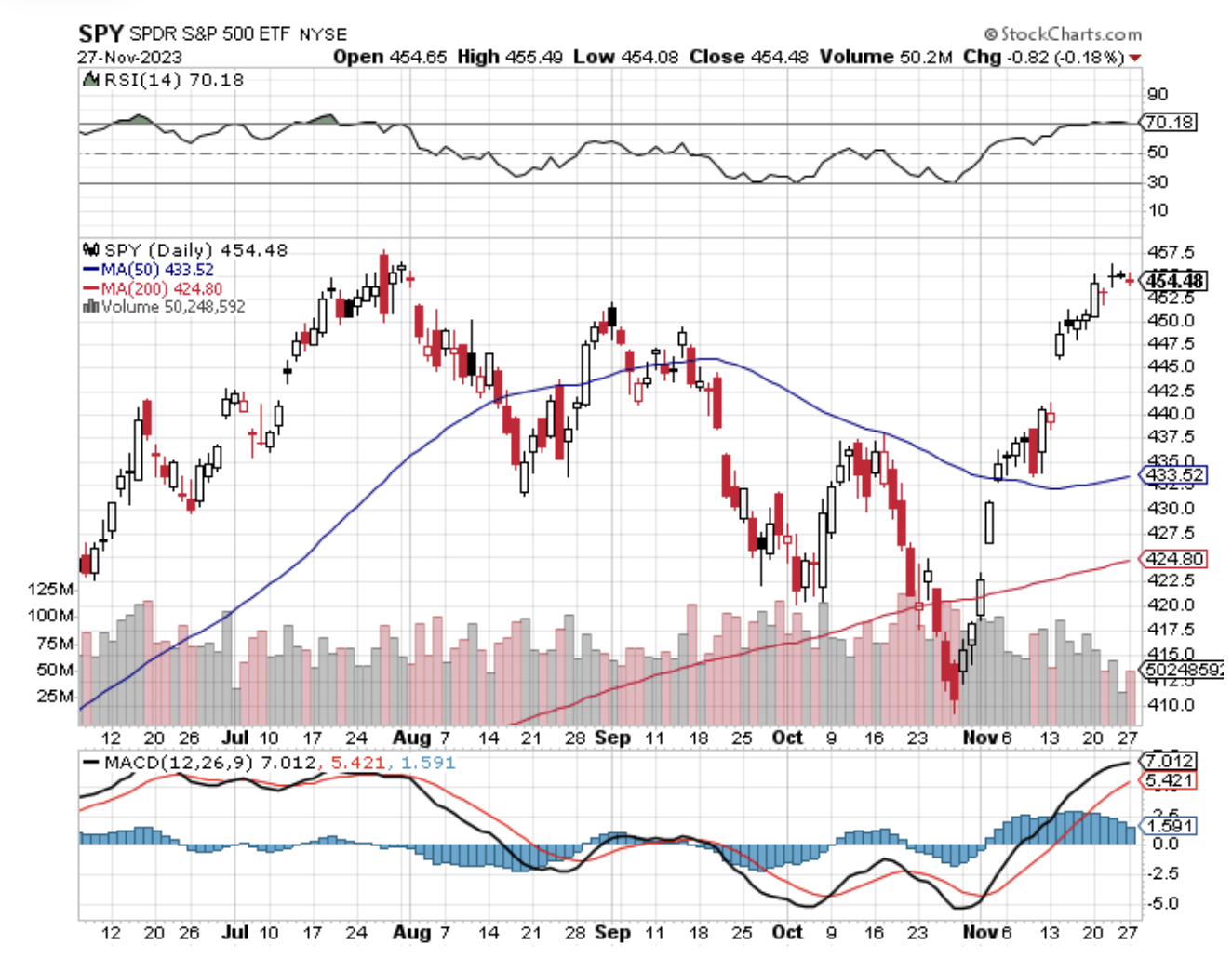
A Dow Average up 11 days in a row?
Yikes!
The last time I saw this, in 1987, Armageddon ensued. It hailed fire and brimstone, and dogs and cats lay together.
Excuse me for being nervous, but I am still hanging on to my 100% invested position.
And you know what is even scarier?
Almost all of the Dow gain since October 26 has been concentrated in a
a handful of technology stock, which I own.
That is the paramount question on the minds of every trader on Wall Street going into yearend.
And here is what is keeping everyone awake all night.
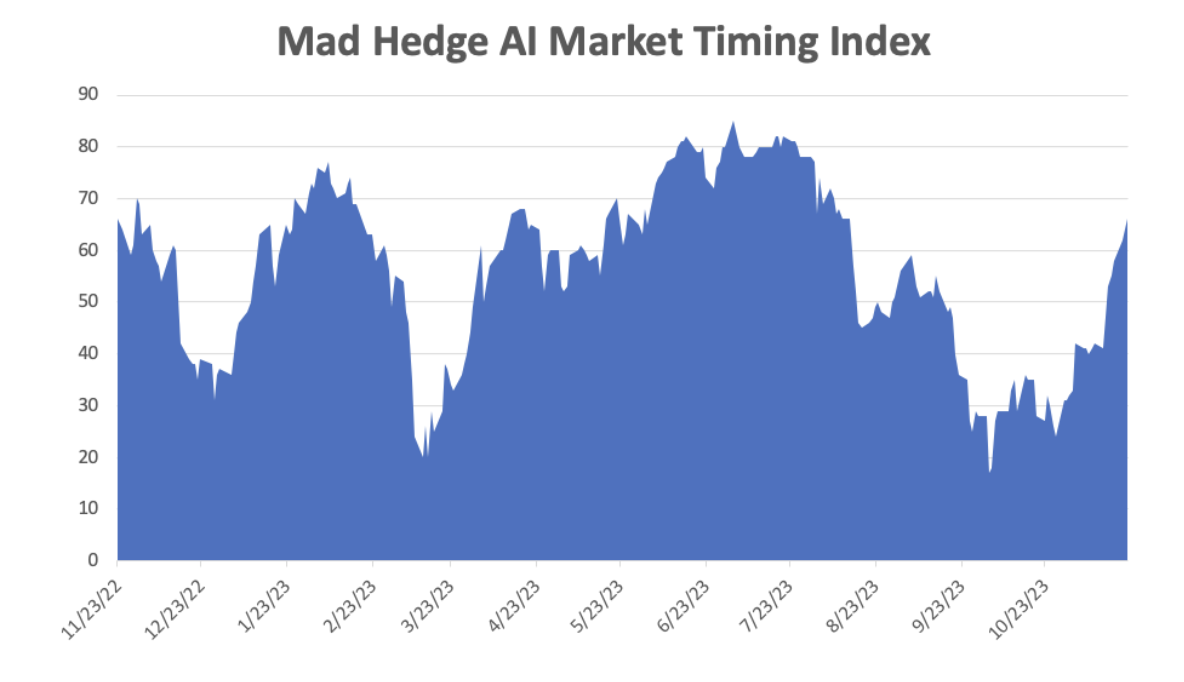
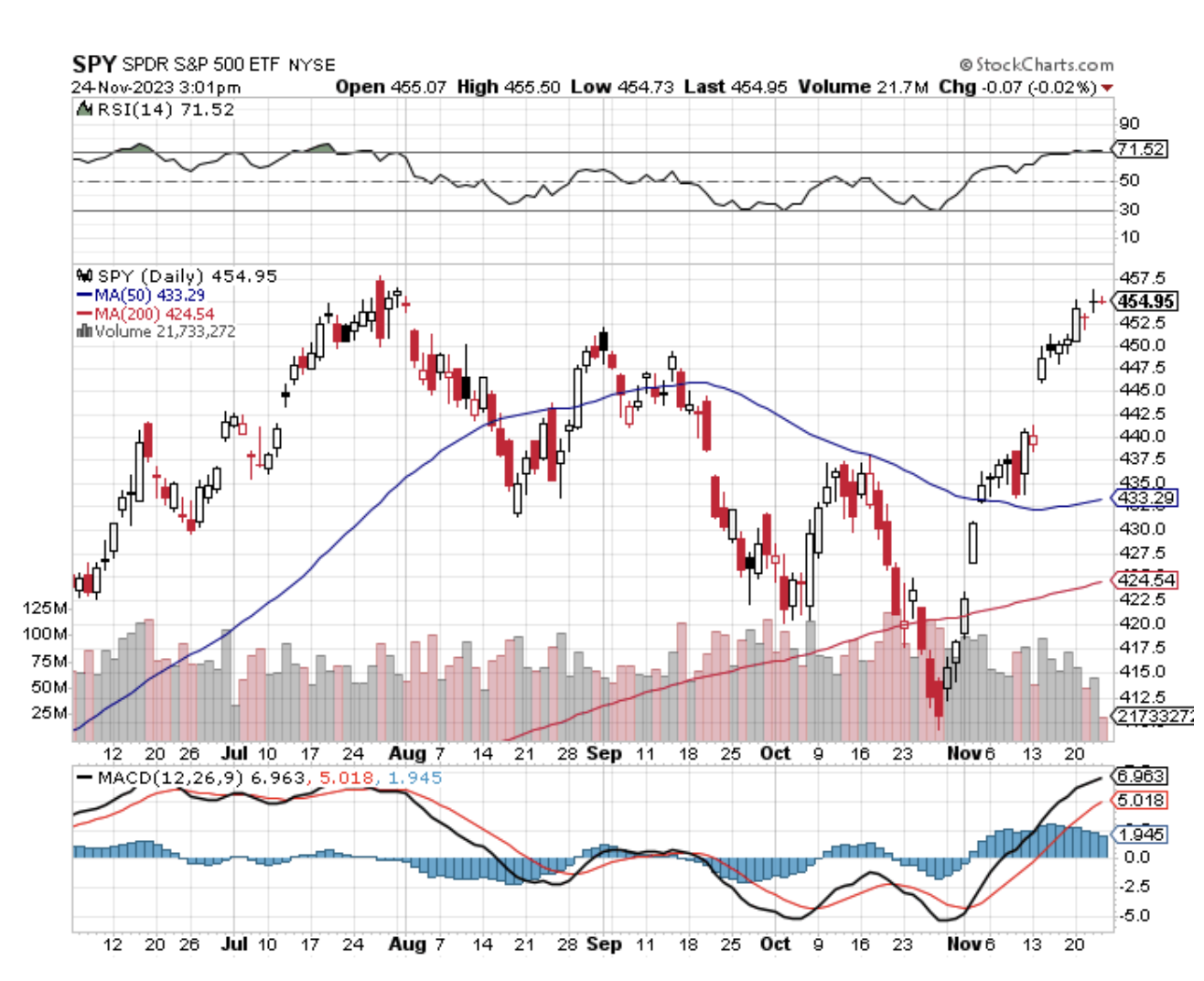
Will be closing out 2023 more overbought than at any time in history. NASDAQ has risen almost every day during November!
Markets are not just prices for perfection, but double, or even triple perfection.
If perfection doesn’t arrive, the consequences could be severe.
Any professional trader caught loading the boat here would be fired.
Better to buy on a dip or a momentum-driven upside breakout, than at an absolute apex.
It was all enough to bring my 2017 year-to-date performance to 15.74%, and my trailing one-year return to a positively meteoric 81.54%. November alone now stands at an eye-popping 15.37%.
It has been the best since, well….last year!
All is now on hold until December 10. That is when we get the CPI for November, which is likely to show another decline in inflation. The recent collapse in oil prices has yet to be priced in.
Global Market Comments
November 27, 2023
Fiat Lux
Featured Trade:
(MARKET OUTLOOK FOR THE WEEK AHEAD, or MELT UP),
(MSFT), (NLY), (BRK/B), (CCJ), (CRM), (GOOGL), (SNOW), (CAT), (XOM), (TLT)

If you think the market performance for the past month has been spectacular, you have seen nothing yet. We have two major positive catalysts that are about to hit stock prices.
On December 10, we will see a lower-than-expected Consumer Price Index, driving yet another stake through the heart of inflation. On December 13, we will also be greeted with a Federal Reserve decision to keep interest rates unchanged, as they will do over the next several meetings.
“Higher for shorter” is about to become the new market mantra.
That will give the market the shot in the arm it needs to reach my $4,800 yearend target, which was precisely the goal I laid out on January 1. Caution has been thrown to the wind and hedging downside risks has become a distant memory. One of the fastest market melt-ups in 100 years will do that. Complacency is the order of the day.
Equity-oriented mutual funds have seen $43 billion in inflows so far in November. Commodity Trading Funds, or CTA’s, have seen a breathtaking $60 billion piled into long equity strategies.
Hedge funds flipped from short to long and now have the most aggressively bullish positions in 22 years, mostly in big tech. All of this has taken the Volatility Index (VIX) down to a subterranean $12 handle. Bears are suddenly lonely….and afraid.
Yes, 55 years of practice makes this easy.
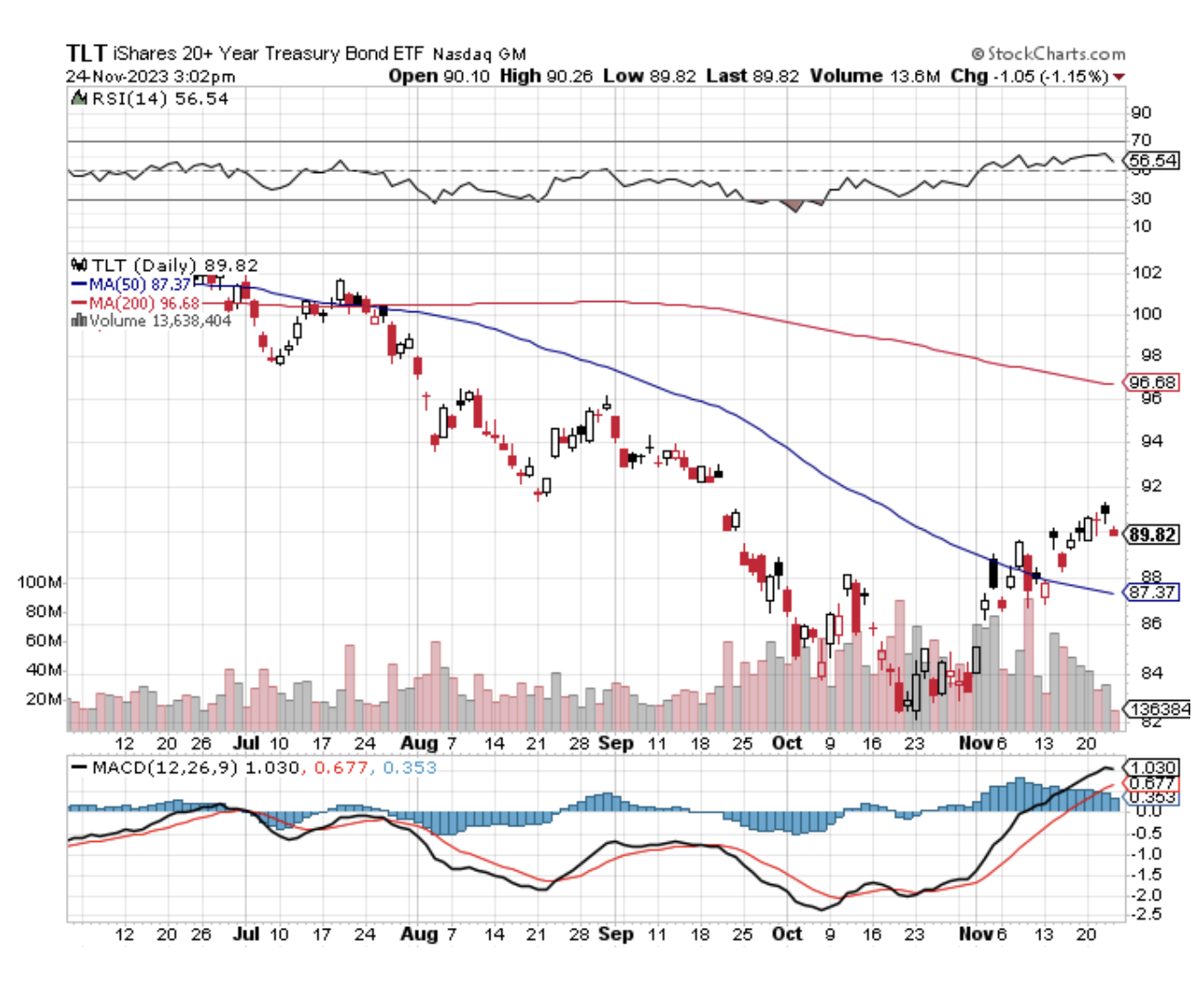
On October 28, it turns out that we reached a decade-high peak in bond investment when Treasuries were flirting with new highs in yields. With perfect rear-view mirror hindsight that’s when many investors cut stock holdings to the bone. They will spend the next several months desperately trying to get back in.
Oh yes, and Company buybacks are about to surge as companies race to pick up their own stocks before the yearend deadline. Apple is the top buyback stock followed by Alphabet (GOOGL) and Microsoft (MSFT). Heard these names before?
And while big tech is starting to look expensive, they are cheap when you factor in the trillions of dollars in profits that are headed their way over the next decade.
That’s what always happens.
What could pee on my victory parade? Ten-year US treasury bonds revisiting a 5.08% yield, crude oil popping back up to $100 a barrel, oil another new blacking swan alighting out of the blue, like a Chinese invasion of Taiwan, or Russia retaking the Baltic states. That’s all.
Avoid these and stocks will continue to rise, as will your retirement funds.
The Magnificent Seven will continue to lead, as will big financials, which are still at bargain-basement levels. Energy and commodities are already posting January sale prices, discounting a 2024 recession that isn’t going to happen. This is fertile LEAPS territory.
Weekly Jobless Claims Drop 24,000, to 209,000 in one of the sharpest declines this year. It makes last week’s jump look like an anomaly.
Consumer Inflation Expectations Rise, to 3.2%, a 12-year high. They are counting on a 4.5% in 2024. They are now looking at gasoline prices. There’s your mismatch. Any decline in inflation will be viewed as a shocker and drive share prices to new all-time highs.
US Gasoline Prices Hit Three-Year Low, on recession fears and replacement concerns by EVs. Energy stocks are tracing the downside tic for tic, pulling down all other commodities. Don’t buy this dip.
Pending Home Sales Plunge to 13-Year Low, down 4.1% in October, on a signed contracts basis. Sales were down 14.6% year over year. The median price of an existing home sold in October was $391,800, an increase of 3.4% from October 2022. These are the last poor sales numbers before the collapse in interest rates. At the end of October, there were 1.15 million homes for sale, down 5.7% from a year earlier. This is about half as many homes as were available for sale pre-Covid. At the current sales pace, that represents a 3.6-month supply. A six-month supply is considered a balanced market between buyer and seller.
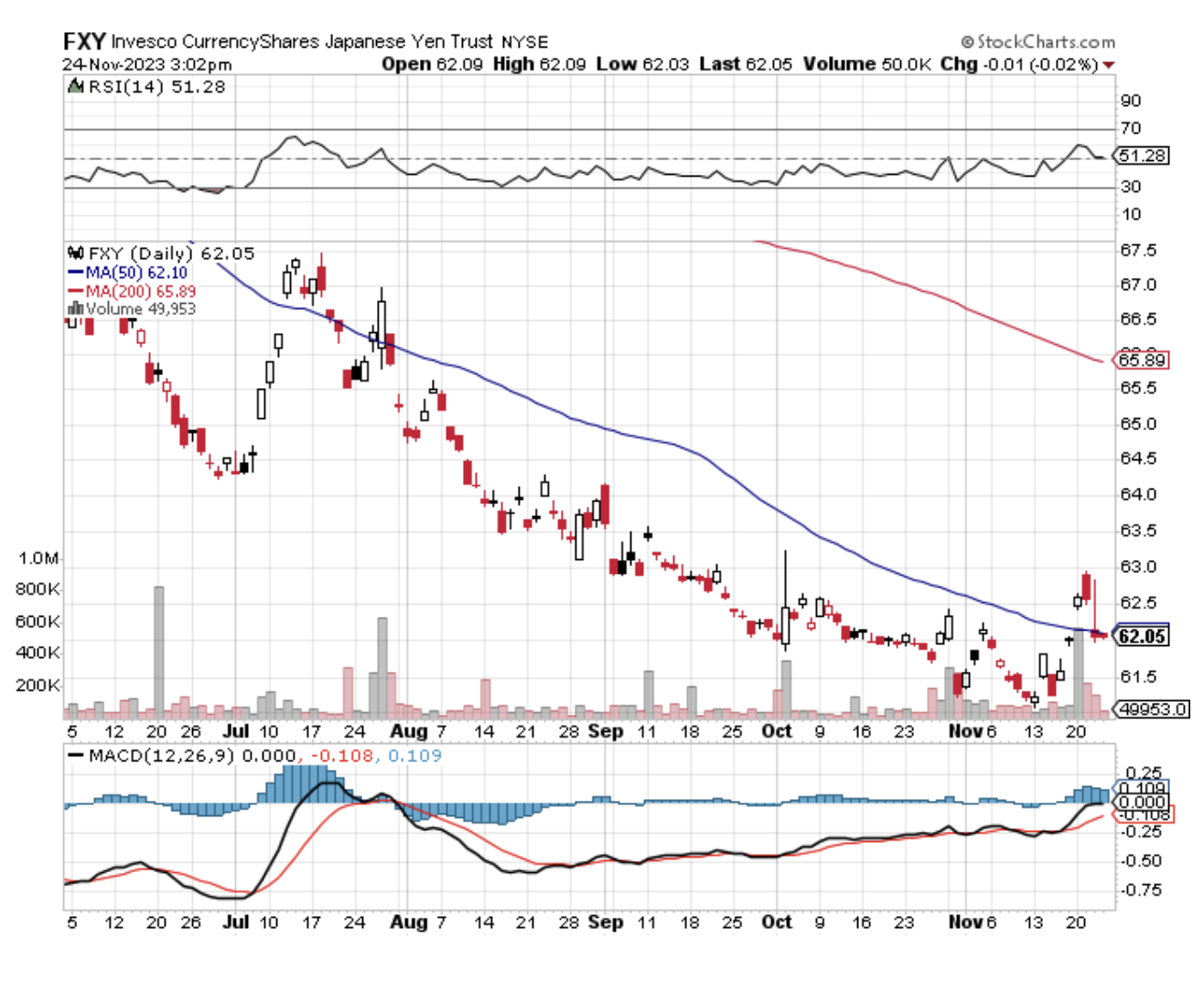
Monster Pay Hikes Will Lead to Strong Japanese Yen, with whiskey maker Suntory offering 7% pay hikes. The prospect of falling US interest rates adds fuel to the fire. Buy (FXY) on dips.
Starship Two Blows Up, two minutes or 92 miles after launch. The test fire of the 33-engine spacecraft was considered a success. The massive 397-foot tall, 30-foot-wide rocket, the largest ever built, is crucial for the NASA moon launch in 2025 and the SpaceX Mars trip further down the road.
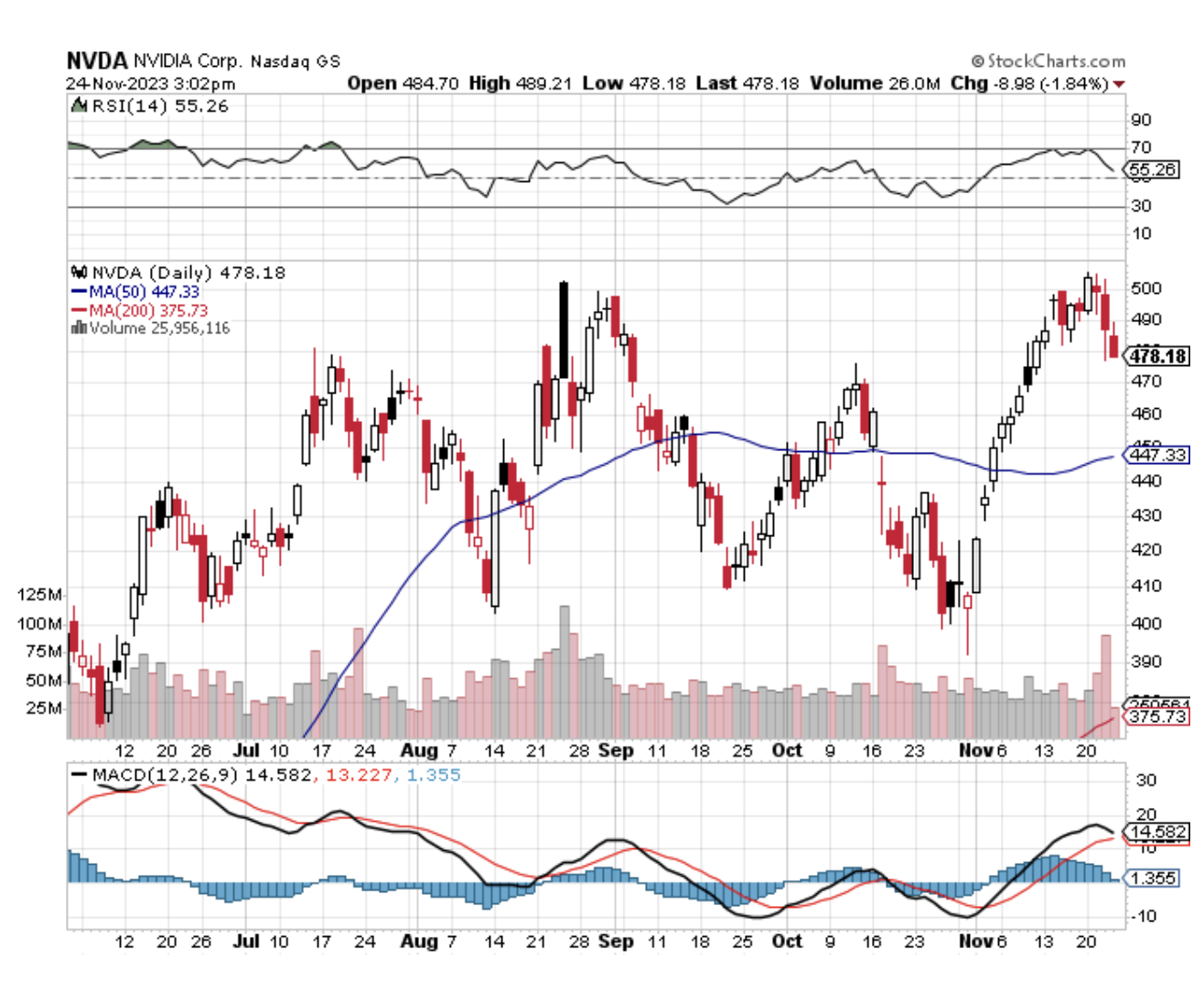
NVIDIA (NVDA) Beats, with a profit triple, but that stock sells off 6% on the news. It was a classic buy the rumor, sell the news move. Future earnings increases will not be as big. Keep "buy (NVDA) on dips" as a must-own.
Famed Short Seller Jim Chanos shut down after a massive short in Tesla shares blew up. His funds under management have plunged from $6 billion to $200 million since (TSLA) went public. Chanos had a few big wins, notably Enron in 2001. But he was also seen as a hedge against other long positions.
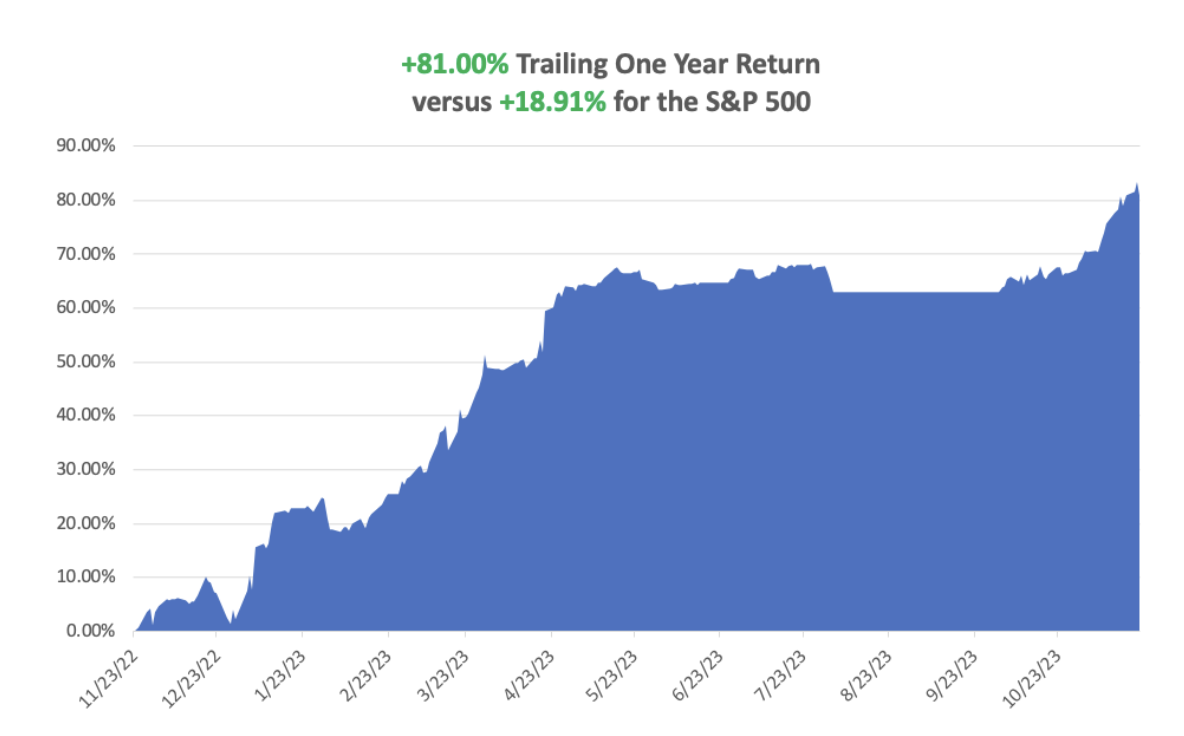
So far in November, we are up +12.62%. My 2023 year-to-date performance is still at an eye-popping +78.79%. The S&P 500 (SPY) is up +19.73% so far in 2023. My trailing one-year return reached +81.00% versus +18.91% for the S&P 500.
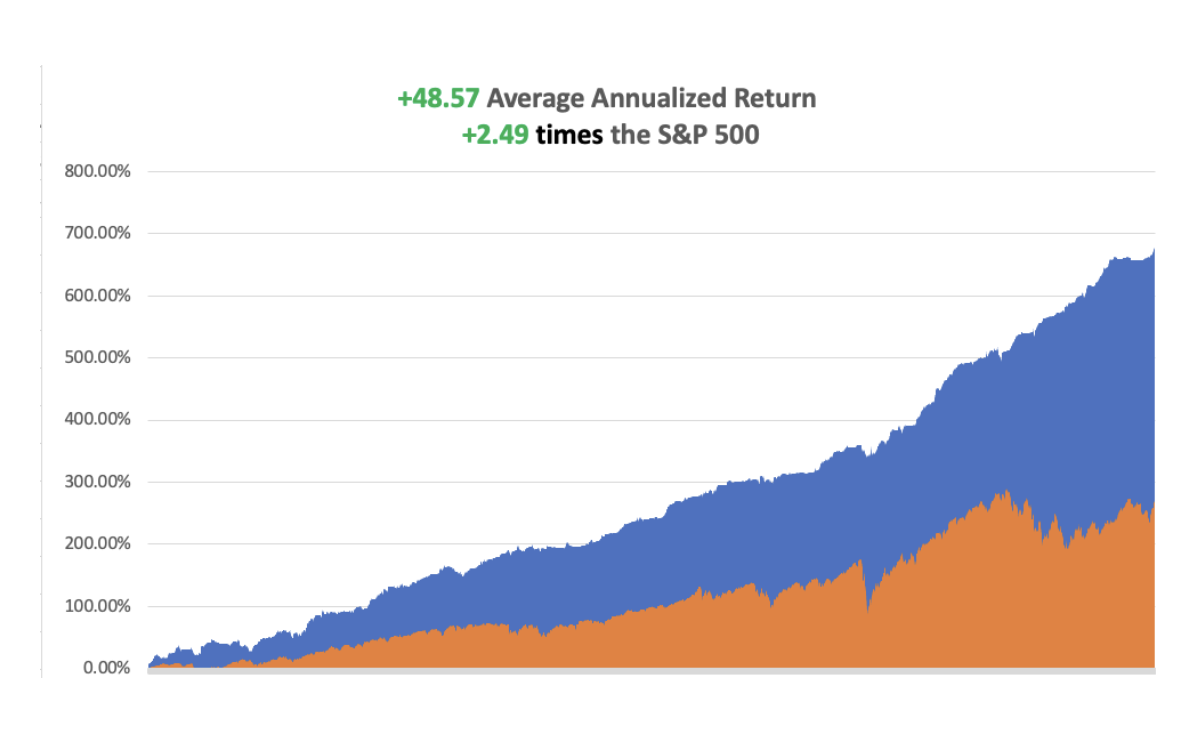
That brings my 15-year total return to +675.98%. My average annualized return has exploded to +48.57%, another new high, some 2.49 times the S&P 500 over the same period.
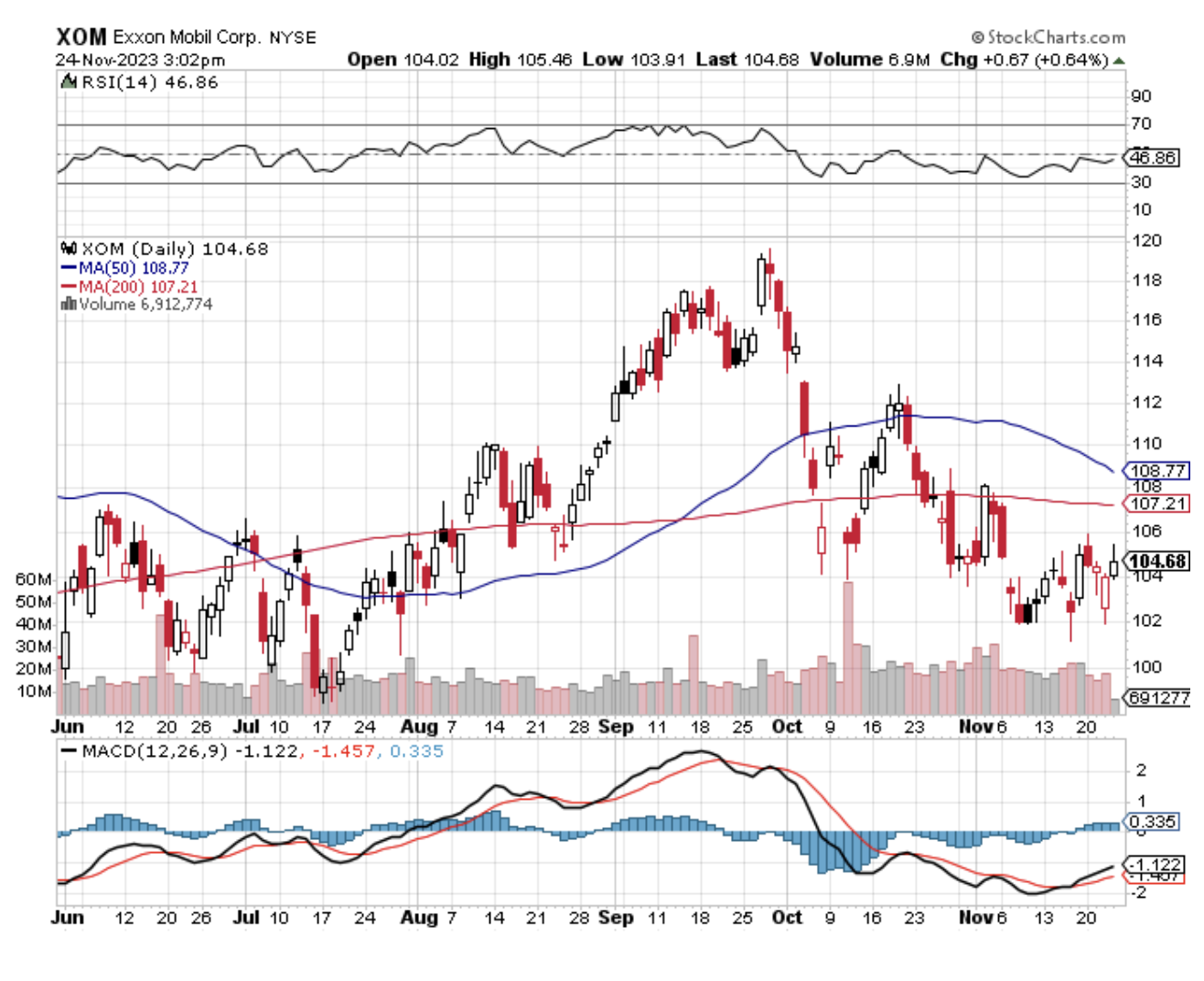
I am 100% fully invested, with longs in (MSFT), (NLY), (BRK/B), (CCJ), (CRM), (GOOGL), (SNOW), (CAT), and (XOM). I have one short in the (TLT).
Some 66 of my 61 trades this year have been profitable.
My Ten-Year View
When we come out the other side of the recession, we will be perfectly poised to launch into my new American Golden Age or the next Roaring Twenties. The economy decarbonizing and technology hyper-accelerating, creating enormous investment opportunities. The Dow Average will rise by 800% to 240,000 or more in the coming decade. The new America will be far more efficient and profitable than the old.
Dow 240,000 here we come!
On Monday, November 27, at 8:30 AM EST, the New Home Sales are out.
On Tuesday, November 28 at 2:30 PM, the S&P National Home Price Index is released.
On Wednesday, November 29 at 8:30 AM, the Q2 GDP Growth Rate is published.
On Thursday, November 30 at 8:30 AM, the Weekly Jobless Claims are announced.
On Friday, December 1 at 2:30 PM, the October ISM Manufacturing Index is published. At 2:00 PM the Baker Hughes Rig Count is printed.
As for me, When I landed in Tokyo in 1974, there were very few foreigners in the country. The WWII occupation forces had left, but the international business community had yet to arrive. You met a lot of guys who used to work for Douglas MacArthur.
There was only one way to stay more than 90 days on the standard tourist visa. That was to get another visa to study “Japanese culture.” There were only two choices: flower arranging or karate.
Since this was at the height of Bruce Lee’s career, I went for karate.
It was not an easy choice.
World War II was not that distant, and there were still hundreds of army veterans missing limbs begging for money under railroad overpasses. Some back then were still fighting on remote Pacific islands.
Many in the karate community believed that the art was a national secret and should never be taught to foreigners. So those who entered this tight-knit community paid the price and had the daylights beaten out of them. I was one of those.
To this day, I am missing five of my original teeth. There is nothing like taking a kick to the mouth and watching your front teeth fly across the dojo, skittering on the teak floor.
We trained three hours a day, five days a week. It involved punching a bloody hardwood makiwara at least 200 times. The beginners were paired with black belts who thoroughly worked us over. Then the entire class met up at a nearby public bath to soak in a piping hot ofuro. You always hurt.
During the dead of winter, we ran five miles around the Imperial Palace in our karate gi’s barefoot in freezing temperatures daily. Then we were hosed down with cold water and trained for three hours.
During this time, I was infused with the spirit of bushido, the thousand-year-old Japanese warrior code. I learned self-discipline, stamina, and concentration. In the end, karate is a form of meditation.
Knowing you’re indestructible and unassailable is not such a bad thing, especially when you’re traveling in some of the harsher parts of the world. When muggers in bad neighborhoods see me late at night, they cross the street to avoid me. I am not a guy to mess with. Utter fearlessness is a great asset to possess.
The highlight of the annual training schedule was the All-Japan Karate Championship held in the prestigious Budokan, headquarters of all Japanese martial arts near the ghostly Yasukuni Jinja, Japan’s National Cemetery. By my last year in Japan, I had my black belt, and my instructor, Higaona Sensei, urged me to enter.
Because I had such a long reach, incredibly, I made it to the finals. I was matched with a very tough-looking six-footer who was fighting for Japan’s national prestige, as no foreigner had ever won the contest.
I punched, he kicked, fist met foot, and foot won. My left wrist was broken. My opponent knew what happened and graciously let me fight on one hand for another minute to save face. Then he knocked me out on points.
The crowds roared.
It’s all part of a full life.
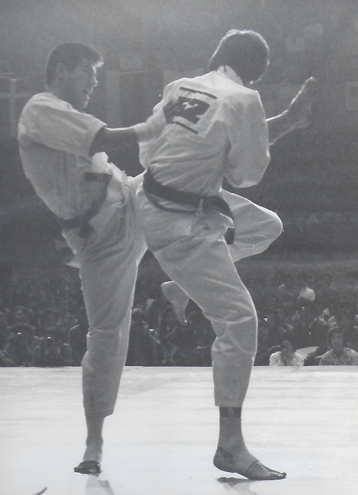
Losing the All-Japan National Karate Championship

1974 Higaona Sensei
Stay Healthy,
John Thomas
CEO & Publisher
The Diary of a Mad Hedge Fund Trader

“If we’re able to produce a general purpose robot that could observe you and learn how to do a task, that would supercharge the economy to a degree that would be insane….Working could become a choice,” said Elon Musk, founder of PayPal, Space X, Tesla, Solar City, The Boring Company, Neuralink, and owner of “X”, the former Twitter.

Global Market Comments
November 24, 2023
Fiat Lux
Featured Trade:
(MY UPDATED PERSONAL ECONOMIC INDICATOR),
(HMC), (NSANY), (GM), (F), (TSLA)
(HERE IS YOUR TOP PERFORMING INVESTMENT FOR THE NEXT FIVE YEARS),
(ITB), (PHM), (KBH), (DHI)
(TESTIMONIAL)

There is no limit to my desire to get an early and accurate read on the US economy, which at the end of the day is what dictates the future of all of our trades and investments.
I flew over one of my favorite leading economic indicators only last weekend at the controls of a vintage Cessna 172.
Honda (HMC) and Nissan (NSANY) import millions of cars each year through their Benicia, California facilities, where they are loaded onto thousands of rail cars for shipment to points inland as far as Chicago.
In 2009, when the US car market shrank to an annualized 8.5 million units, I flew over the site and it was choked with thousands of cars parked bumper to bumper, rusting in the blazing sun, bereft of buyers.
Then, “cash for clunkers” hit (remember that?).
The lots were emptied in a matter of weeks, with mile-long trains lumbering inland, only stopping to add extra engines to get over the High Sierras at Donner Pass.
The stock market took off like a rocket, with the auto companies leading.
I flew over the site last weekend, and guess what?
The lots are empty.
U.S. new vehicle sales, including retail and non-retail transactions, are estimated to reach 1,354,600 units in August, a 15.4% jump from a year earlier, according to the joint report by J.D. Power and GlobalData. Consumers are estimated to spend $47.8 billion on new vehicles, the highest on record for the month of August, and 10.5% higher than last year, the report said.
Japanese cars are suddenly selling so fast that vehicles are being sold even before they land on the dock.
It is all further evidence that my increasingly optimistic view on the US economy is correct, that multiple crises this year are fully discounted, and that the stock market is poised for new highs.
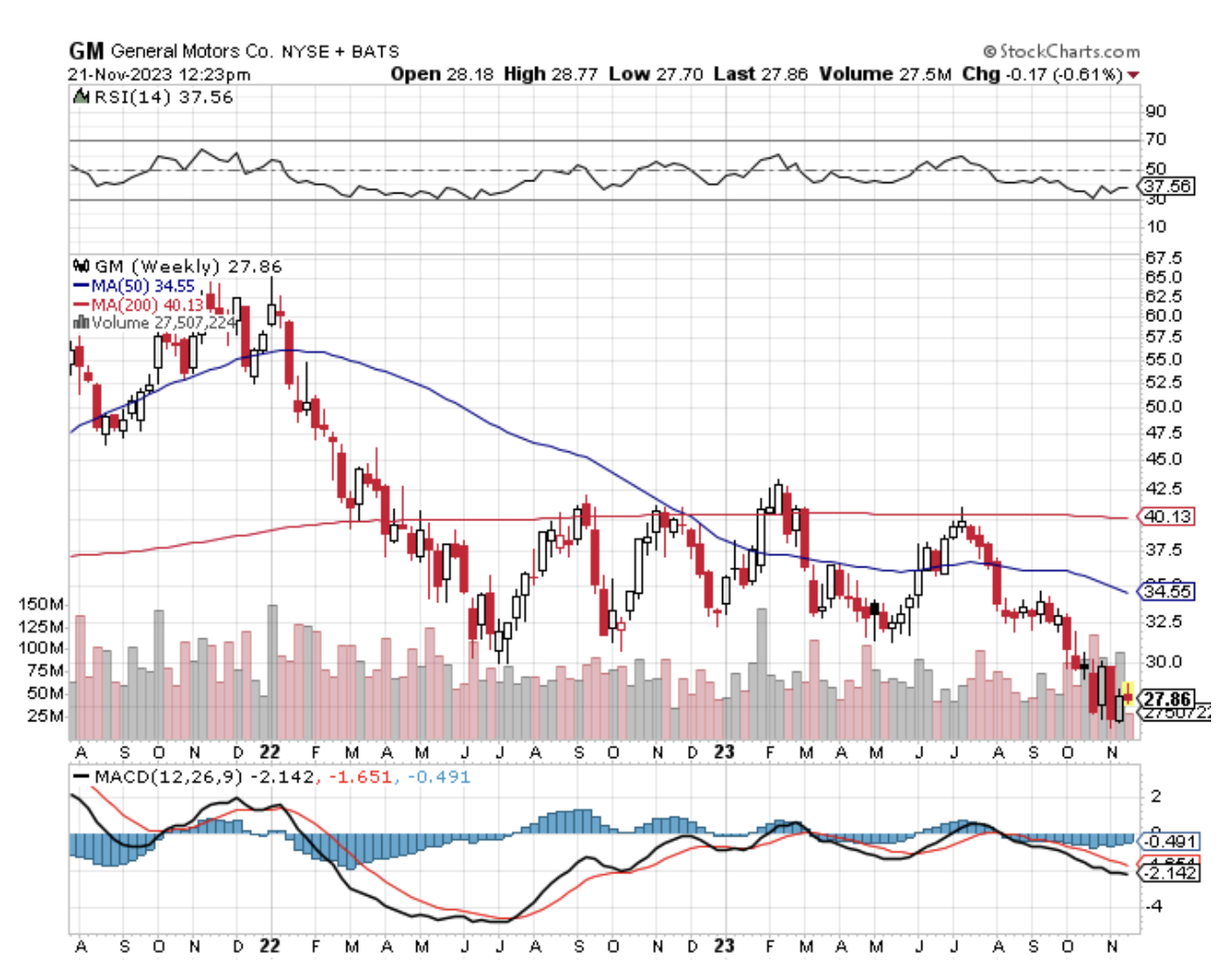
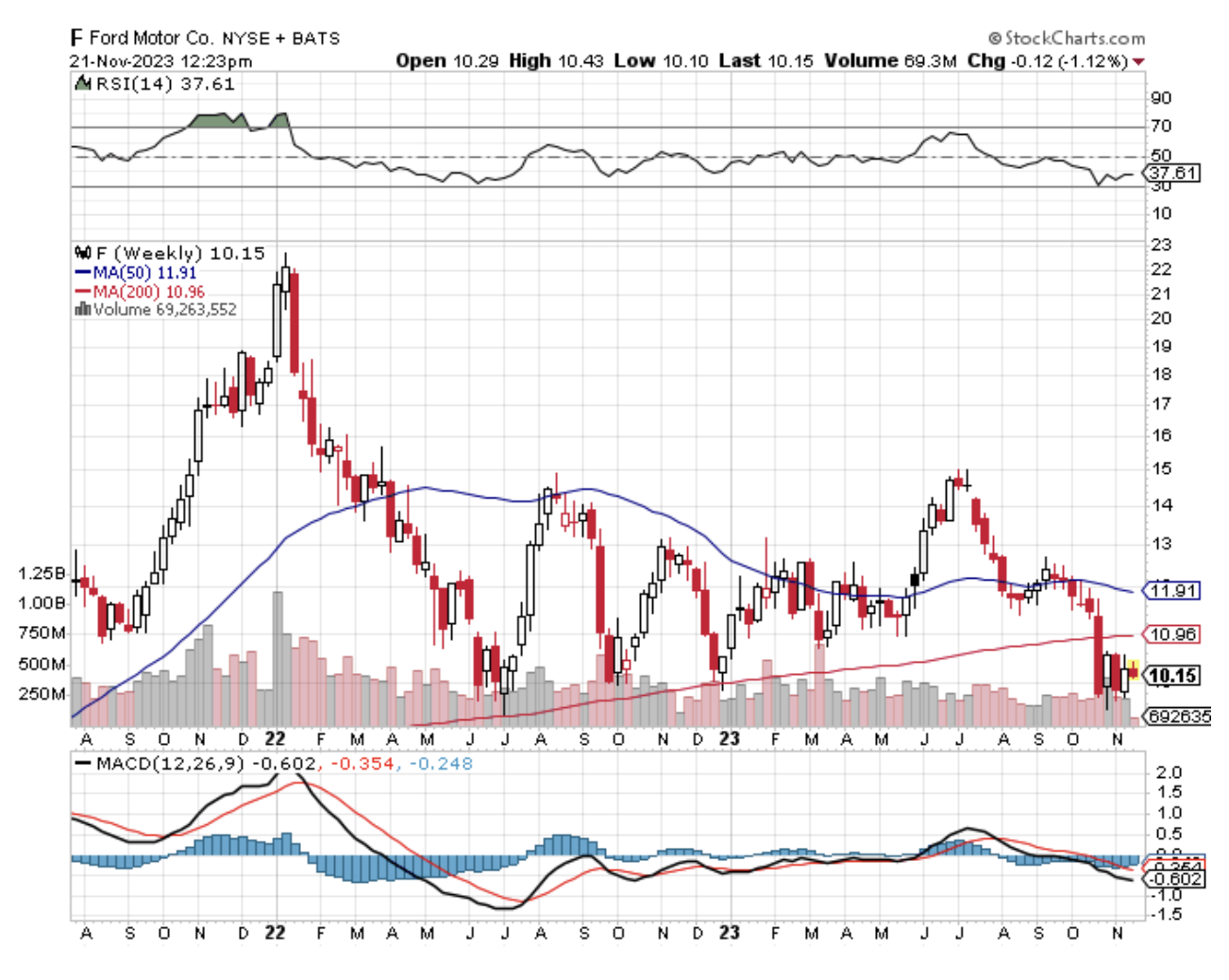
The conventional auto industry should lead to the upside, as it has already done, led by General Motors (GM) and Ford (F). But the move may not happen until the second half of 2024 when the market’s love affair with big tech stocks reaches the point of temporary exhaustion.
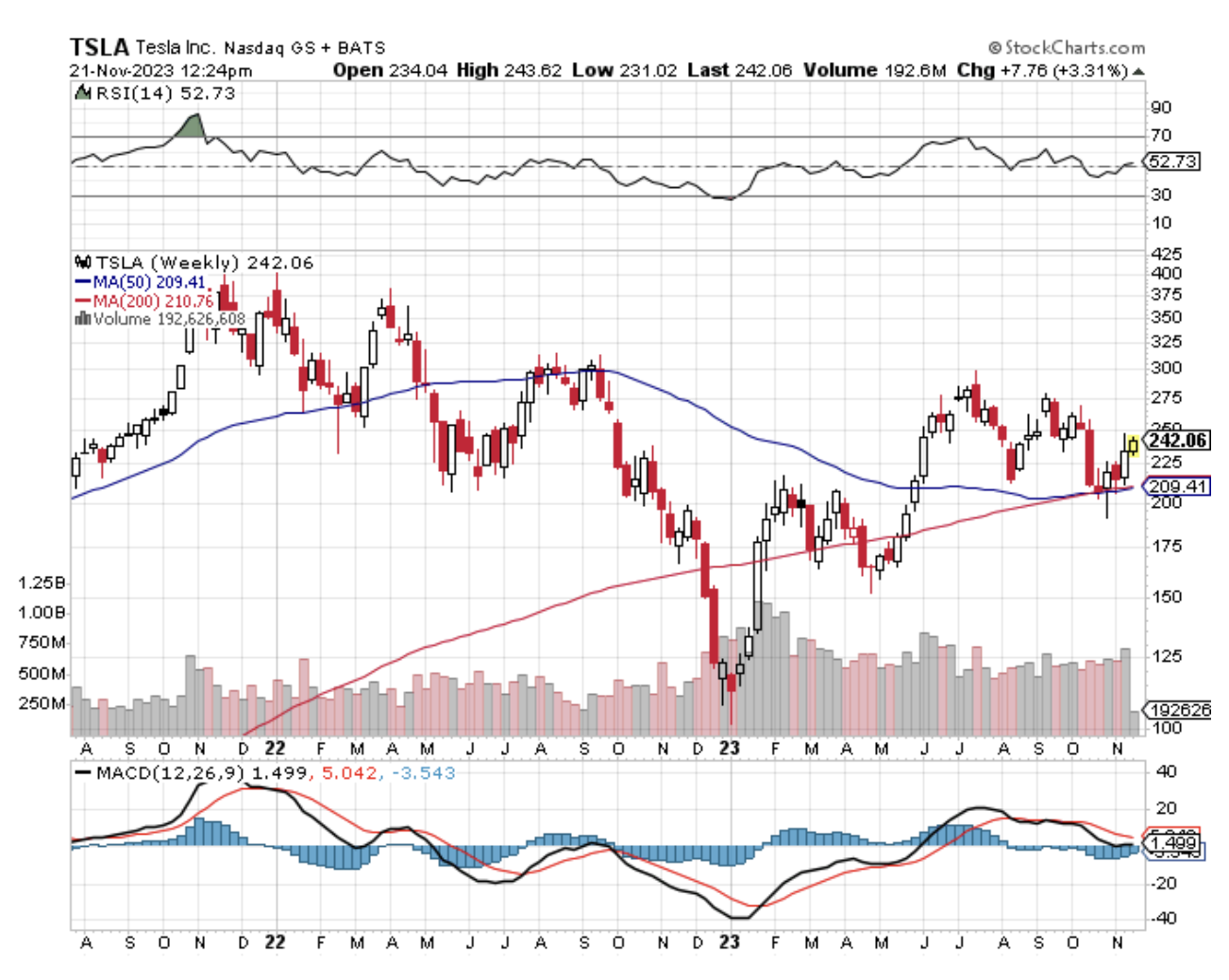
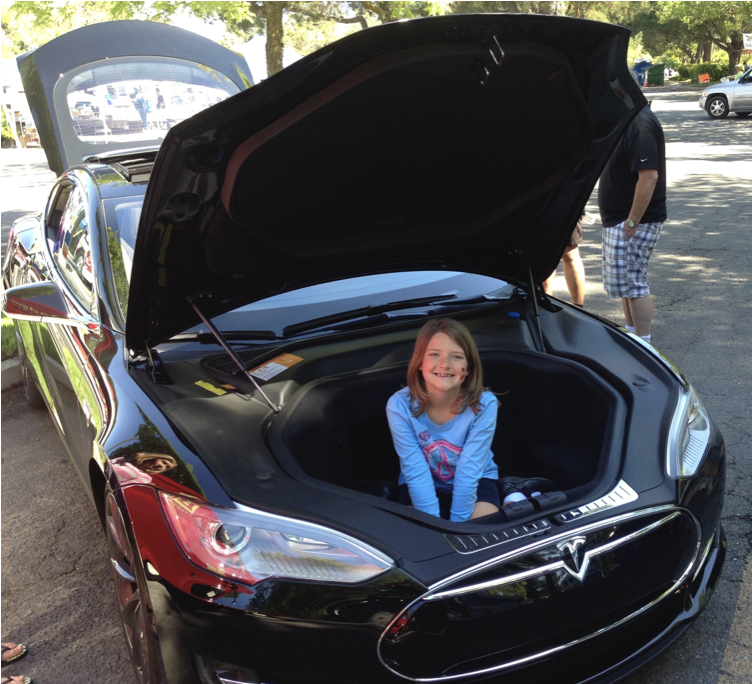
As for Tesla (TSLA), better to buy the car than the stock at these depressed prices. Once the EV price wars end, the stock should double again to new all-time highs.
This is a big deal because the auto industry directly and indirectly accounts for about 10% of the total US economy.
It is also the largest manufacturing employer, with the legacy Big Three accounting for 6 million jobs, 4.87% of the 124 million US total.
Not only do you have to include the big four automakers, but you also must include the vast number of parts suppliers, advertisers, and the national dealer networks.
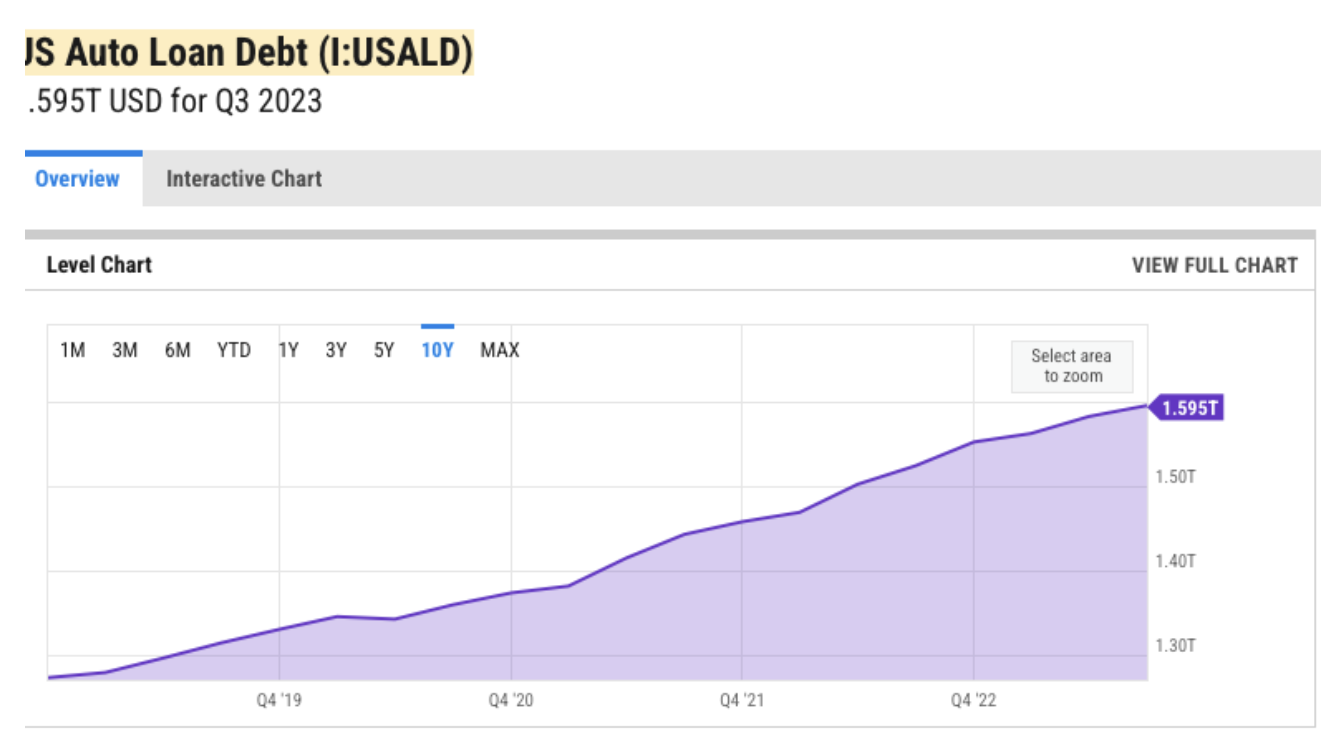
Since so many car purchases are financed with loans, it turns out that the industry is a great play on falling interest rates.
There are $1.6 trillion in subprime auto loans on lenders’ books now.
If you don’t believe me, check out the resale market price of your wheels at Kelly Blue Book (click here for the site)
You will see they have recently risen steadily in value.
It is all further evidence of the hard data/soft data conundrum, which I have written about extensively in the past.
Look no further than Consumer Sentiment, which has held up remarkably well for the past three consecutive months.
Sorry the photo below is a little crooked, but it's tough holding a camera in one hand and a plane's stick with the other, while flying through the never-ending turbulence of the San Francisco Bay’s Carquinez Straight.
Air traffic control at nearby Travis Air Force Base usually has a heart attack when I conduct my research in this way, with a few joyriding C-130s having more than one near miss in recent years.


Will gold be your best-performing asset for the next five years?
Is it high-growth technology stocks?
Energy stocks?
Or maybe biotech shares?
How about French collectible postage stamps or vintage racing cars?
Nope, you’re not even close. I’ll give you a hint: you’re probably sitting in it.
Yes, the best-performing investment you will own for the next five years will most likely be the home you live in.
Psshaww you may say. Perhaps even balderdash!
However, if you look at the crucial data that drives this long-ignored sector, my conclusions are unassailable.
You can count on your home to appreciate at a 3%-4% annual rate until well into the next decade, and more if you are fortunate enough to live on the red-hot West Coast.
Net out the copious tax breaks that come with home ownership, and your take home will be even higher than that.
For a start, the Federal Reserve’s imminent interest rate cuts are hugely pro-housing.
The conventional 30-year fixed home mortgage can now be had for a bargain of 7.40%%. They are on their way to 5.0%. And many finance their properties with the 5/1 ARM’s that I have been recommending which are currently going for only 6.60%.
Wait a few quarters and you’ll probably get a lower rate than you can get now.
That is, assuming you still have a job and haven’t been replaced yet by an algorithm.
The good news for those homeowners who rely on the floating rates of an adjustable-rate mortgage is that this is not a low-interest-rate decade coming, but a low-interest-rate century.
Another big housing positive is plunging fuel prices, which have cratered 35% in two months.
Cheap fuel means that consumers have more money in their pockets with which to qualify for loans, buy houses, and meet their mortgage payments.
Not only will this be a low-interest-rate century, but it will also be a low-energy cost century as well. If solar energy costs continue their dramatic rate of improvement, around 50% every four years, it will nearly be free by 2030.
Not only will free energy provide a big underpinning under home values, but it will also increase the value of suburban homes where commuting is a major factor.
It gets better.
You know that Millennial of yours who’s been living in your basement since he graduated from college?
Go downstairs and take a look. Chances are he probably moved out when you weren’t looking, turning his prodigious gaming skills into a high-paying coding job.
What’s more, he’s now dating a girl. You know, the one with the nose ring, the streak of purple hair, and tattoos up and down both arms.
That leads to family formation.
And you know what? The most important trend affecting the economy that no one knows about is that THE UNITED STATES IS ABOUT TO ENJOY ANOTHER BABY BOOM!
That’s why new household formations are likely to jump from the current 1.2 to 1.5 million a year in the coming decade.
However, only 1 million homes a year are being built, thanks to the halving of construction capacity in the aftermath of the Great Recession. Subtract from that 250,000 houses a year that get demolished.
Does anyone hear the words “short squeeze”?
That means 86 million Millennials will be chasing the homes of only 55 Gen Xers. Americans aren’t the only ones buying homes.
Are you convinced now? Are you ready to jump into the real estate boom and participate more than just through your residence?
Fortunately, there are several ways you can achieve this.
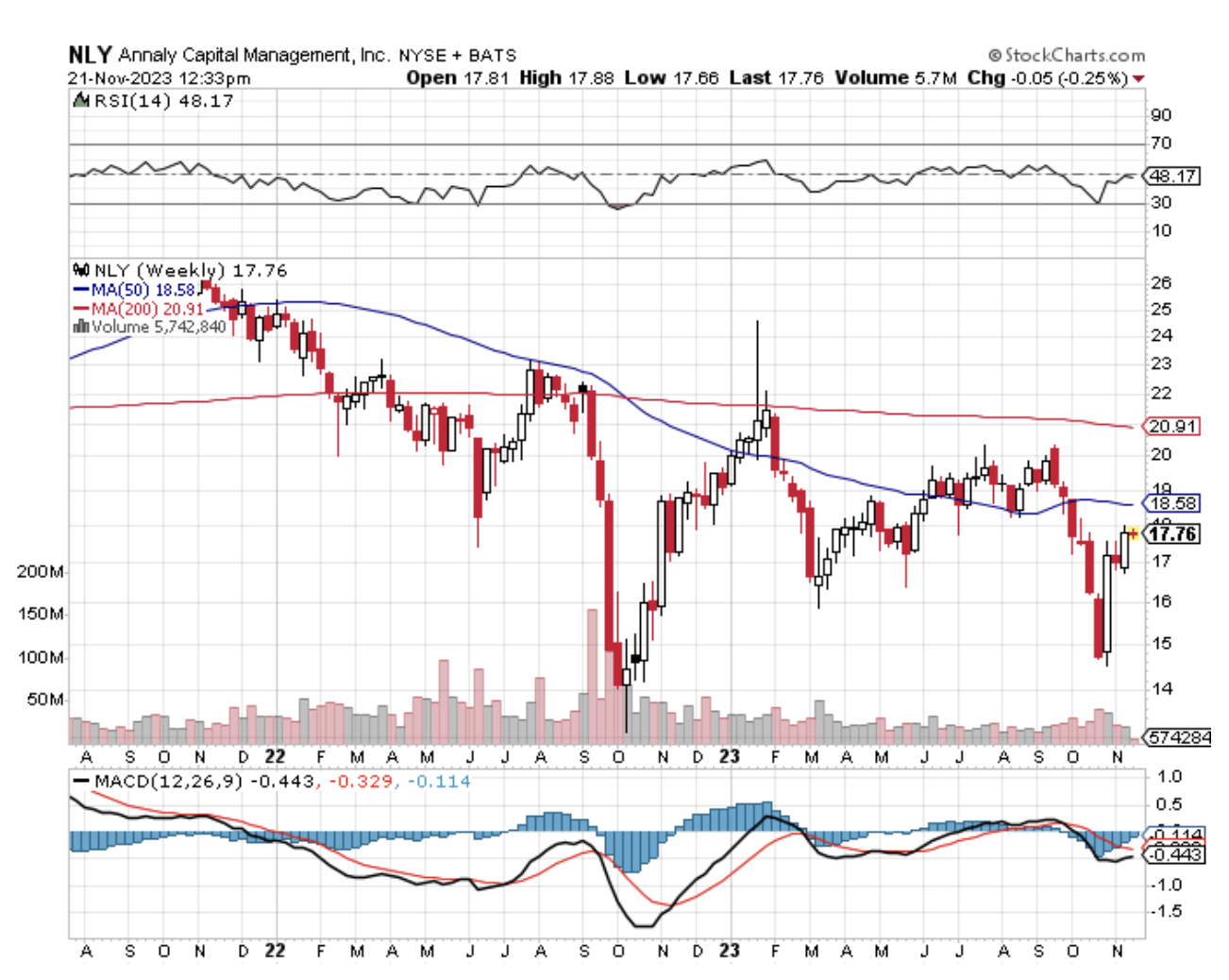
Residential Real Estate Investment Trusts (REITs), like Anally Capital Management (NLY), offer the opportunities of both a high yield and capital appreciation.
Better yet is that all of these trade at deep discounts to book values because of the wreckage caused by the recent interest rate spike.
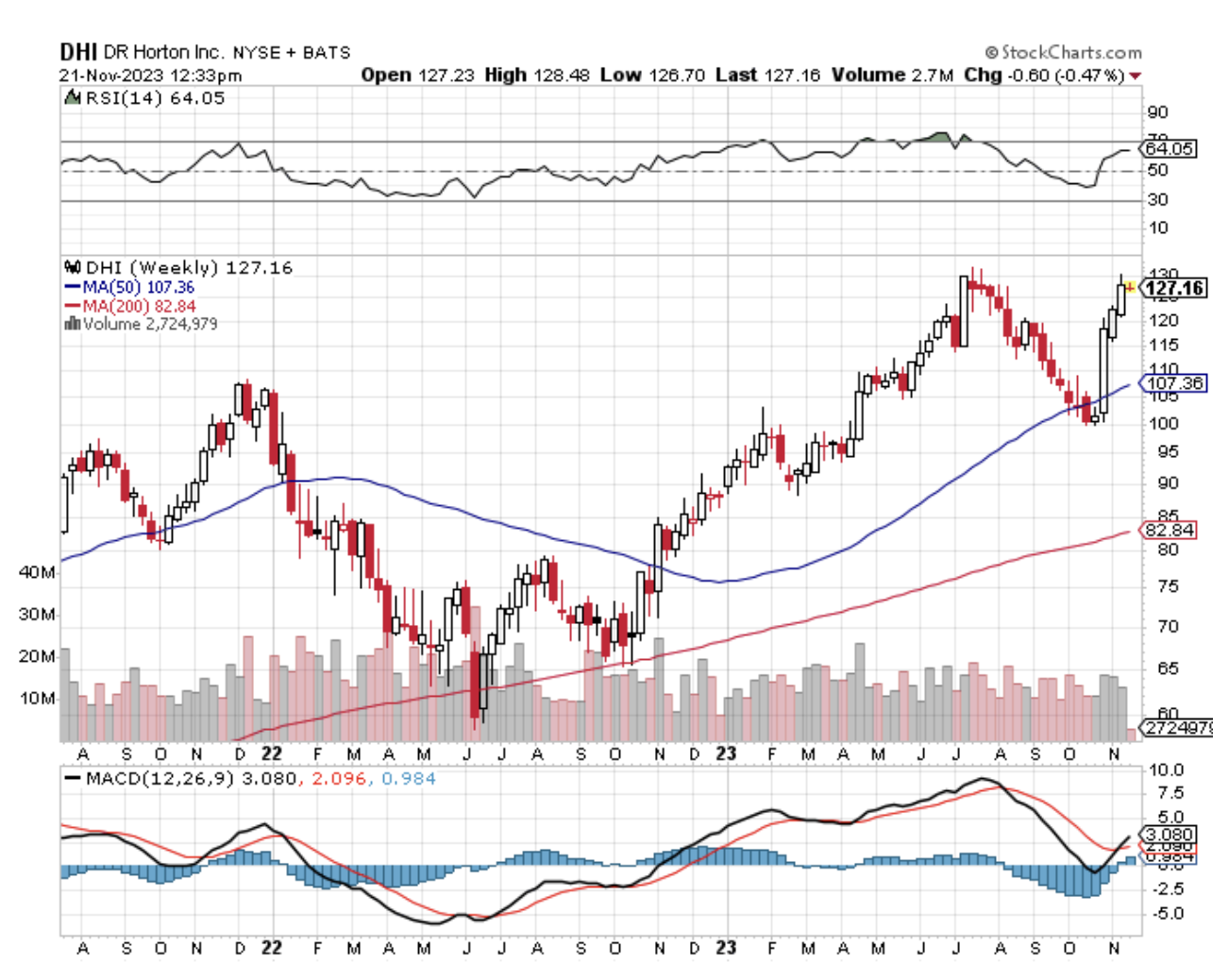
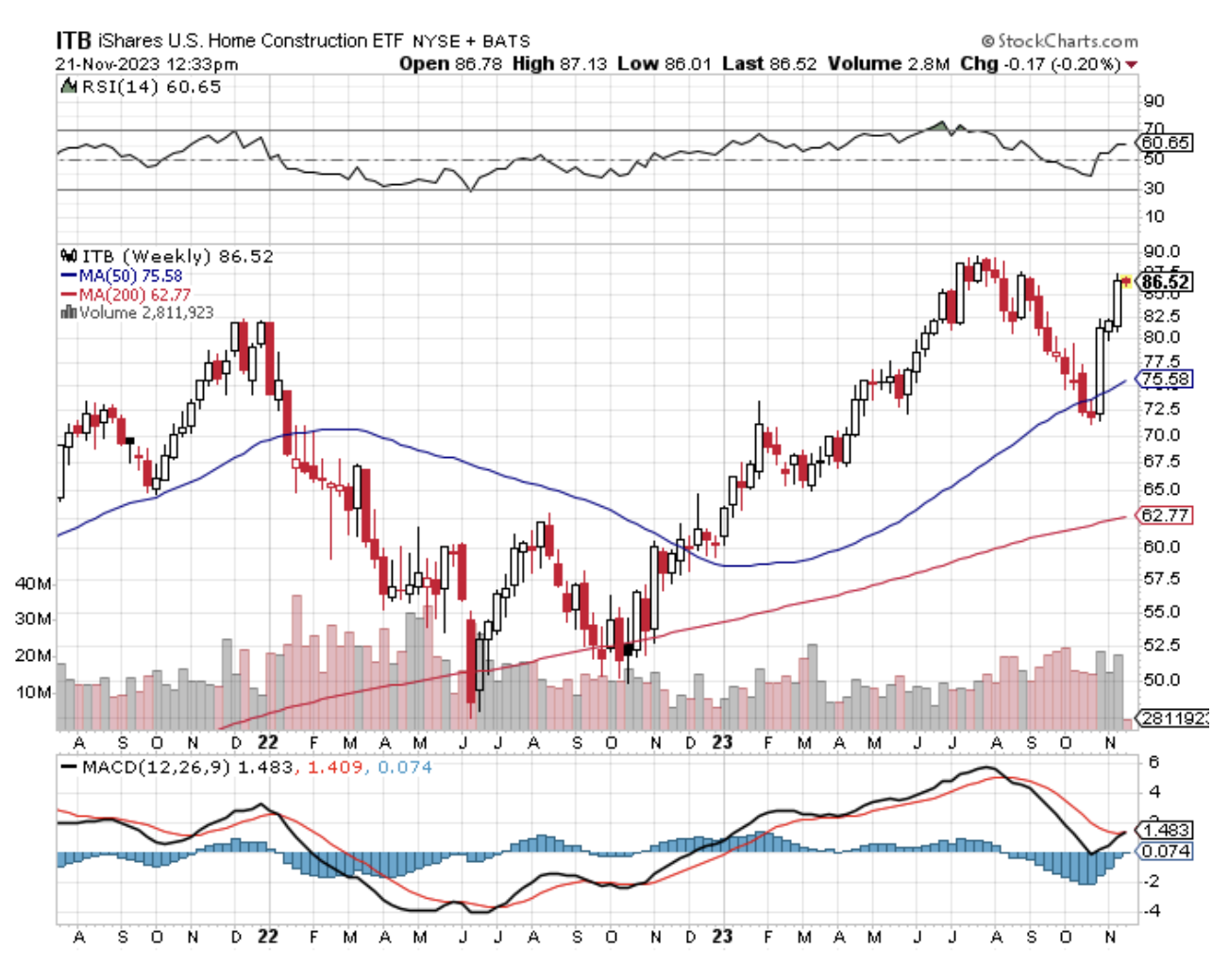
They include traditional new homebuilders, such as KB Homes (KBH), Pulte Homes (PHM), and DH Horton (DHI). Another option is to take a basket approach by picking up the iShares US Home Construction ETF (ITB).
See you at the next open house!

Dear John,
I want to thank you for the outstanding conference in Miami.
The hotel and food were first class along with the very informative presentations.
I felt that the information I learned will more than pay for the trip. Hope to see you in Incline Village.
Thanks
Rich
Detroit, Michigan


“Instead of buying low and selling high, you’re buying high and crossing your fingers,” said Bill Gross, former head of the bond giant PIMCO.

Global Market Comments
November 22, 2023
Fiat Lux
Featured Trade:
(TRADING THE KENNEDY ASSASSINATION)