


I used to do a lot of skydiving from 20,000 feet. There’s nothing like a freefall, feeling the wind rip at your jumpsuit as you plunge towards the earth at terminal velocity of 125 miles per hour. In the beginning, the ground looks very far away. Then it suddenly gets very close, very fast.
I used to do this during the 1960s with WWII surplus silk parachutes with a “double L” cut. You hit the ground like a ton of bricks. Sometimes, we’d swing back and forth from the wings of the airplane before letting go just to have fun and freak out the pilot who had no chute.
Over time, you develop a very accurate sense of how fast the ground is approaching and when to pull the ripcord. If you’re wrong, you die.
That’s how I felt when markets went into freefall last Monday. However, after a half-century of trading, I have a highly developed sense of where the bottom is.
So, I piled on the “bet the ranch” longs in technology stocks and shorts in the bond market right at the absolute bottom. And to make sure everyone to a man got in, shares swooshed down one final time when rumors spread that Trump was escalating the trade war with China once again.
By Wednesday morning, the Mad Hedge Fund Trader model portfolio had booked its largest two day gain since the inception of this letter 11 years ago, some 12%. By miracle of miracles, we ended up positive for October, virtually the only one to do so in the entire hedge fund industry.
I would like to think that 50 years of toil in the markets is finally starting to pay off for me. The truth is, the harder I work, the luckier I get.
Stocks lost $2 trillion in market value in October, off 6.9%. Other than that, how was the play, Mrs. Lincoln? Tech took the worst hit in a decade, with many favorites down 20%-30%.
I am raising as much cash as I can ahead of the Midterm Elections tomorrow. Democrats seizing the House of Representatives is priced into the market already.
If the Republicans end up keeping the House, you can count on at least a 1,000-point rally in the Dow Average in the next few days as the door is now open for more tax cuts, more deregulation, and more deficit spending.
If the Democrats end up taking both the Senate and the House you can look for a 1,000 point drop in the Dow. That would bring on a huge “flight to safety” bid in the bond market and yet another opportunity to sell short at great prices.
Either way, I want more dry powder with which to take advantage of any extreme moves that may take place. “Extreme” seems to be the order of the day.
By the way, we are so far in the money with our remaining positions that even with a 1,000 point drop we should still reap the maximum profit with the November 16 option expiration in only 9 trading days.
Not that it matters, but October Nonfarm Payroll Report came in at a red-hot 250,000. The headline Unemployment Rate remained at a two-decade low at 3.7%. The Broader U-6 “Discouraged worker” unemployment rate fell 0.1% to 7.4%.
For the first time in yonks, no sector lost jobs last month. HealthCare added 36,000 jobs, Manufacturing 32,000 jobs, and Leisure & Hospitality 42,000 jobs.
However, the real blockbuster was that Average Hourly Earnings exploded to a 3.1% YOY rate, the highest in ten years. Yes, ladies and gentlemen, this is what inflation looks like, up close and ugly.
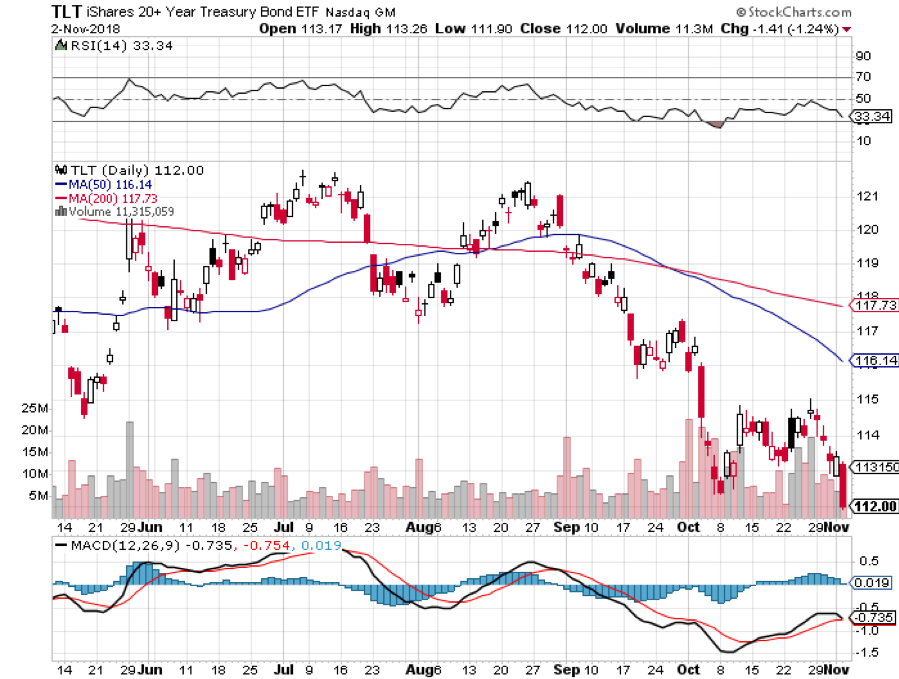
The number immediately knocked the wind out of the bond market taking it to a new low for the year. Yes, this is what double short positions in bonds are all about. I saw this coming a mile off.
The backdrop for the bond market is looking worse than ever. The budget deficit is about to break $1 trillion for the first time since the 2009 crash. Rising interest rates mean the government’s debt burden is about to grow by leaps and bounds, eventually becoming its largest expenditure.
The US Treasury is hitting the markets daily with massive new issuance, and the Chinese are dumping what US bonds they have to support the Yuan, now at a ten-year low. This is what Armageddon looks like in slow motion.
Last week was dominated by a China trade war that was on again, then off, then on one more time. The stock market ratcheted four-digit figures every time this happened.
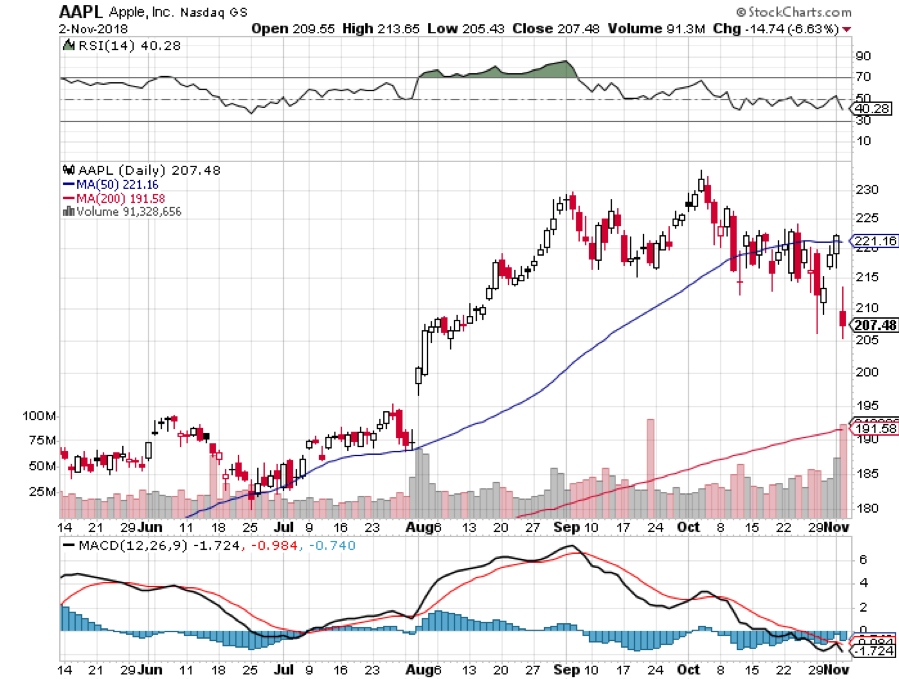
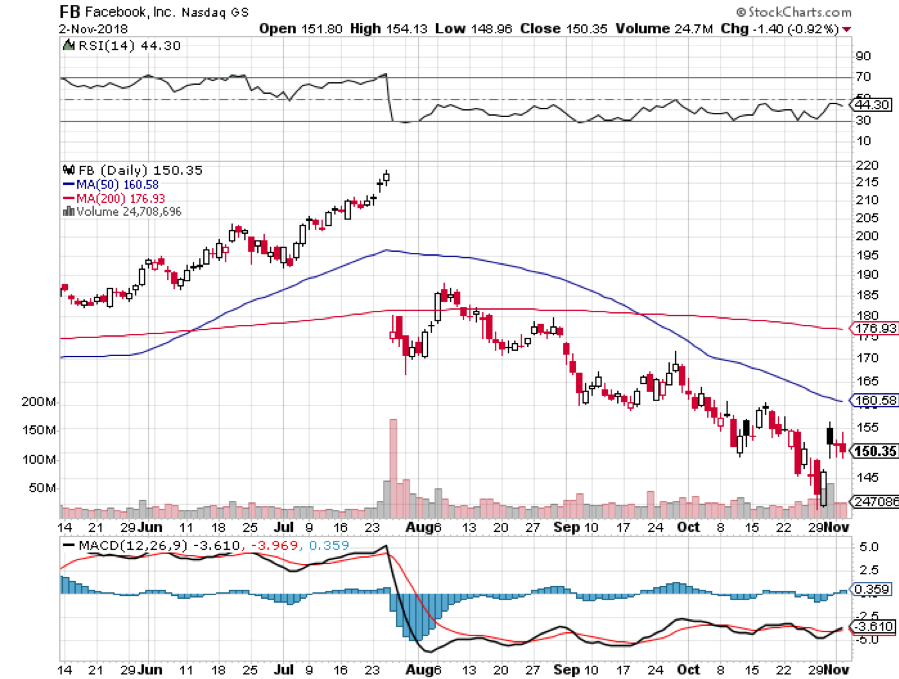
Apple (AAPL) announced record profits yet again but countered with cautious forward sales guidance. Social media pariah Facebook (FB) delivered an earnings report beyond all expectations popping the stock $10.
IBM took over Red Hat (RHT) for $33 billion, the third largest merger in history. It’s too little too late for Big Blue as the stock falls on the news. It all reeks of a “Hail Mary.”
General Electric (GE) cut its dividend from 12 cents a share to one cent after reporting a breathtaking $22.8 billion loss. The Feds have opened a criminal investigation into accounting practices. This may define the final bottom in the stock. Take another look at those long-term LEAPS.
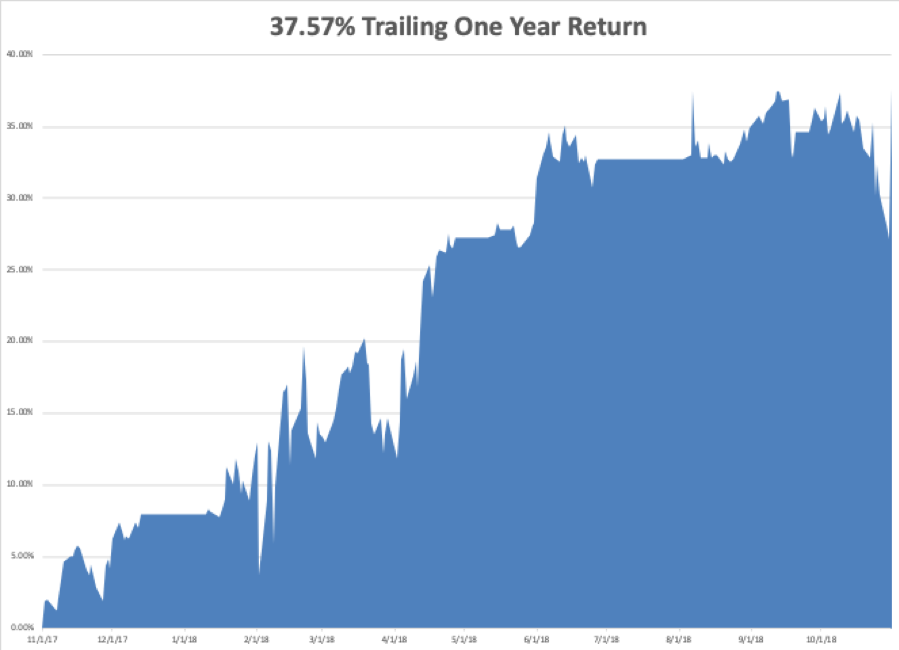
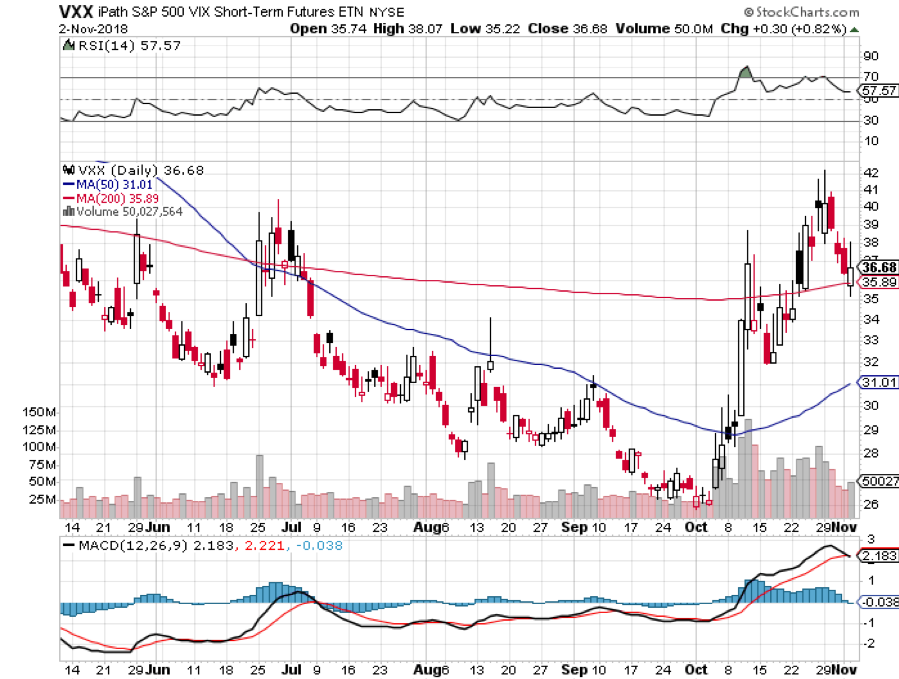
My year-to-date performance rocketed to a new all-time high of +33.17%, and my trailing one-year return stands at 37.57%. October finished at +1.24% and that includes an ill-fated -4.23% loss in the iPath S&P 500 VIX Short Term Futures ETN (VXX).
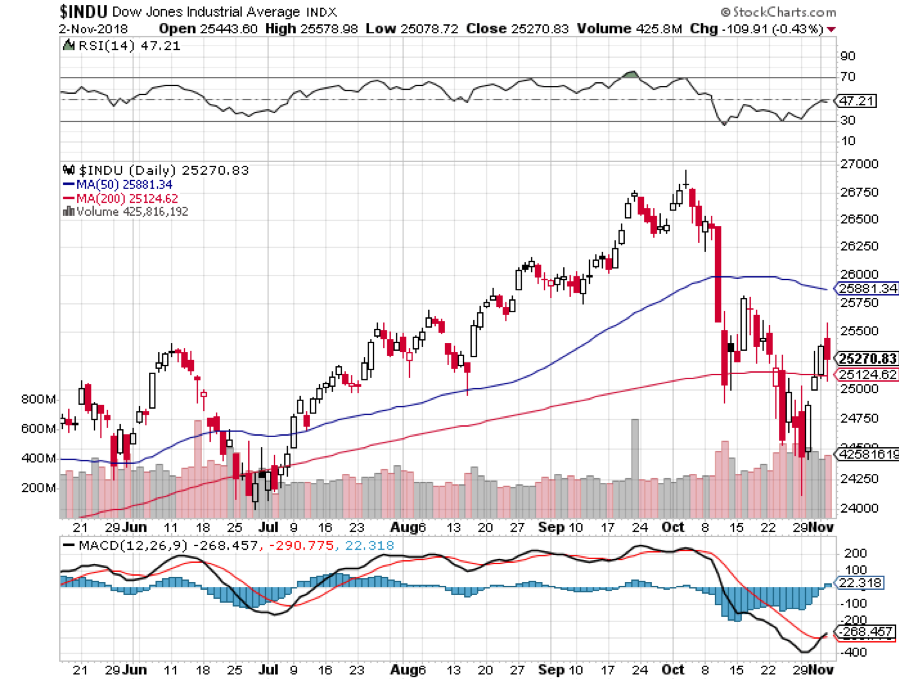
And this is against a Dow Average that is up a miniscule 1.9% so far in 2018. So far in November, we are up an eye-popping +3.54%.
Incredible as it may seem, the Mad Hedge Fund Trader has been up 18 consecutive months. That’s what you pay for and that’s what you’re getting. There’s nothing more fulfilling in life than making promises to friends, then delivering in spades.
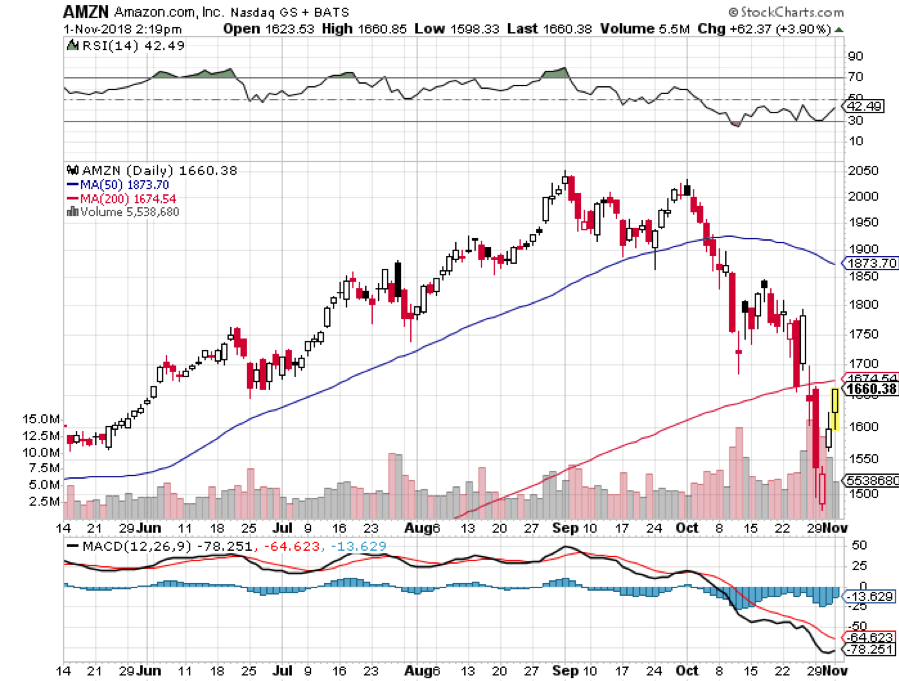
As the market collapses, I scaled into longs in Amazon (AMZN), the S&P 500 (SPY), the Russell 2000 (IWM), and Salesforce (CRM). I used the flight to safety bid in the bond market to double up my short position there, and am kicking myself for not going triple weight.
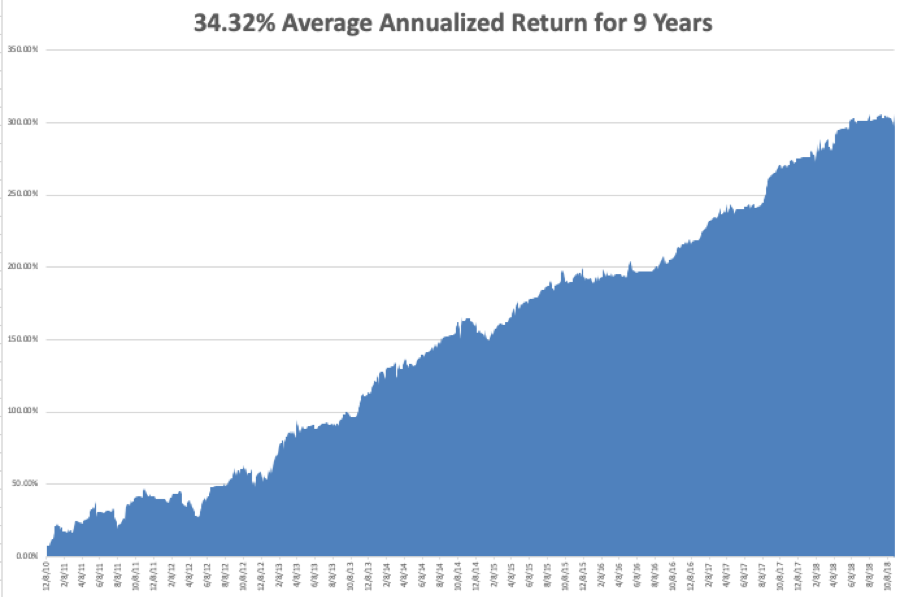
My nine-year return ballooned to 309.64%. The average annualized return stands at 34.72%.
All the BSDs are done reporting Q3 earnings and only a few tag ends are left to report. The carnage is over until we restart the cycle once again in February. In any case, economic data pales in comparison to the election in terms of market impact.
On Monday, November 5 at 10:00 AM, the ISM Manufacturing Index is out.
On Tuesday, November 6 is Election Day. Trading will be a subdued affair and the results will start coming out at 11:00 EST after the west coast polls close.
On Wednesday, October 24 we have the election aftermath to deal with. Up 1,000, down 1,000, or unchanged, who knows?
At 10:30 AM the Energy Information Administration announces oil inventory figures with its Petroleum Status Report.
Thursday, October 25 at 8:30, we get Weekly Jobless Claims. The Federal Open Market Committee meets to discuss interest rates but will take no action.
On Friday, October 26, at 8:30 AM, the October Producer Price Index is out, an important read on inflation.
The Baker-Hughes Rig Count follows at 1:00 PM.
As for me, I made a massive amount of money personally in the October crash. I am going to plop down $150,000 and buy a brand new Tesla Model X for myself. The ashtrays are full on the old one, and besides, there is a tiny nick in the windshield from driving up to Lake Tahoe. I hear the new one has new “Summon” technology that allows it to drive into a parking lot by itself and drive around until it finds an empty space, then back into it, all untouched by human hands.
Good luck and good trading.
John Thomas
CEO & Publisher
The Diary of a Mad Hedge Fund Trader

Knowing When You Hit the Ground is Crucial

My New Wheels

“If you put the federal government in charge of the Sahara Desert, in five years, there would be a shortage of sand,” said Nobel Prize-winning economist Milton Friedman.
Global Market Comments
November 2, 2018
Fiat Lux
Featured Trade:
(OCTOBER 31 BIWEEKLY STRATEGY WEBINAR Q&A),
(EDIT), (TMO), (OVAS), (GE), (GLD), (AMZN), (SQ), (VIX), (VXX), (GS), (MSFT), (PIN), (UUP), (XRT), (AMD), (TLT)

Below please find subscribers’ Q&A for the Mad Hedge Fund Trader October 31 Global Strategy Webinar with my guest and co-host Bill Davis of the Mad Day Trader.
As usual, every asset class long and short was covered. You are certainly an inquisitive lot, and keep those questions coming!
Q: I would like to keep CRISPR stocks as a one or two-year-old, or even longer if it is prudent. What do you think?
A: Yes, there is a CRISPR revolution going on in biotech—I’m extremely bullish on all these stocks, like Editas Medicine (EDIT), Thermo Fisher Scientific (TMO), and Ovascience Inc. (OVAS). If any of these individual companies don’t move forward with their own technology, they will get taken over. The principal asset of these companies is not the patents or the products, it’s the staff, and there is an extreme shortage in CRISPR specialists (and anybody who knows anything about monoclonal antibodies).
Q: Could you explain how to manage LEAPs? For example, the Gold (GLD) and the General Electric (GE) LEAPs. Sit and leave them or trade them short term?
A: You make a lot of money trading long-term LEAPs. Just because you own a year and a half LEAP doesn’t mean that you keep it for a year and a half. You sell it on the first big profit, and I happen to know that on both the Gold (GLD) and the (GE) LEAPs we sent out, people made a 50% profit in the first week. So, I told them: sell it, take the profit. The market always gives you another chance to get in and buy them cheap. You make the money on the turnover, on the volume—not hanging out trying to hit a home run.
Q: Why did you only close the Amazon (AMZN) November $1,550-$1,600 vertical bull call spread and not roll the strike prices down and out?
A: Well I actually did do the down and out strike roll out first, which is the super aggressive approach. By adding the November $1,350-$1,400 vertical bull call spread position on Monday at the market lows and doubling the size—we took a huge 30% position in Amazon and that position alone should bring in about $3600 in profits in two weeks, at expiration. And when I put on that second position I told myself that on the next big rally I would get out of the high-risk trouble making position, which was the November $1,550-$1,600 vertical bull call spread. So that’s how you trade your way out of a 30% drop in three weeks in one of the best tech stocks in the market.
Q: Is AT&T (T) no longer a good buy at these prices?
A: All of the telephone companies have legacy technology, meaning they are all dying. Basically, AT&T is about owning a bunch of rusting copper wire spread around the country. They haven’t been able to innovate new technologies fast enough to keep up with others who have. The only reason to own this is for the very high 6.56% dividend. That said, dividends can be cut. Look at General Electric which cut its dividend earlier this year. Whatever you make of the dividend can get lost in the principal.
Q: Do you think Square (SQ) is a good buy at this level?
A: Absolutely, it’s a screaming buy. It’s one of the favorite companies of the Mad Hedge Technology Letter and one of the preeminent disruptors of the banks. We think there’s another 400% gain in Square from here. It’s dominating FinTech now.
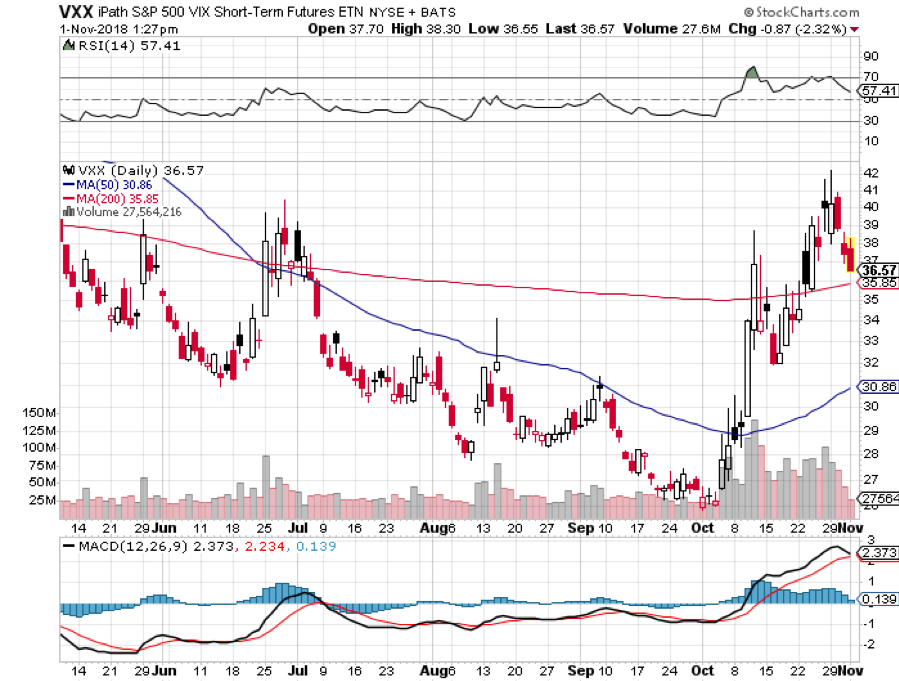
Q: When do you expect to close the short position in the iPath S&P 500 VIX Short-Term Futures ETN (VXX)?
A: If we can get the Volatility Index (VIX) down to $15, the (VXX) should crater. We’ll take a hit on the time decay and that’s why I say we may be able to sell it for 20 cents in the future when this happens. We’ll still take a 50% hit on the position, but half is better than none.
Q: What happened to Microsoft (MSFT) last week?
A: People sold their winners. They had a great earnings report and great long-term earnings prospects, but everyone in the world owned it. Buy the long-term LEAP on this one.
Q: If we want to double up on the iPath S&P 500 VIX Short-Term Futures ETN (VXX), how do you plan to do it?
A: Go out to further with your expiration date. When you go long the (VXX) you only buy the most distant expiration date. I would buy the February 15 expiration as soon as it becomes available.
Q: How do you see Goldman Sachs (GS) from here to the end of the year?
A: It may go up a little bit as we get some index money coming into play for year-end, but not much; I expect banks to continue to underperform. They are no longer a rising interest rate play. They are a destruction by FinTech play.
Q: Is it too soon for emerging markets in India (PIN)?
A: As long as the dollar (UUP) is strong, which is going to be at least another year, you want to avoid emerging markets like the plague. As long as the Federal Reserve keeps raising interest rates, increasing the yield differential with other currencies, the buck keeps going up.
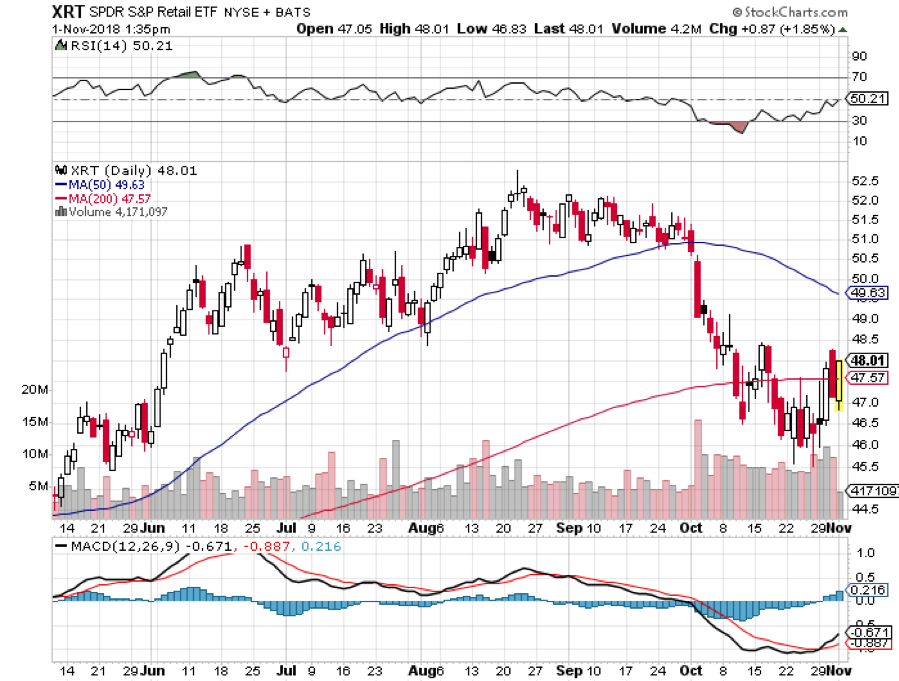
Q: What are your thoughts on retail ETFs like the SPDR S&P Retail ETF (XRT)?
A: You may get lucky and catch a rally on that but the medium term move for retail anything is down. They are all getting Amazoned.
Q: Is it better to increase long exposure the day before the election?
A: No, what we saw starting on Tuesday was the pre-election move. That said, I expect it to continue after the election and into yearend.
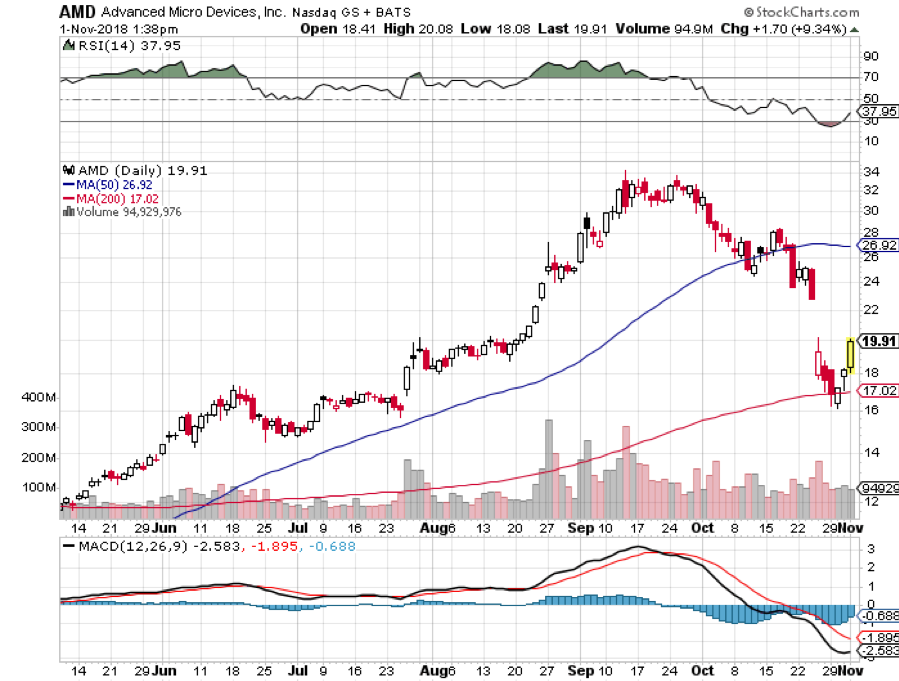
Q: Any opinions on Advanced Micro Devices (AMD)?
A: Yes, this is a great level. It was extremely overbought two months ago but has now dropped 50%. It is a great long-term LEAP candidate.
Q: What about the W bottom in the stock market that everyone thinks will happen?
A: I’m one of those people. So far, the bottom for the move in the S&P 500 is looking pretty convincing, but we will test the faith sometime in the next week I’m sure. We got close enough to the February $252 low to make this a very convincing move. It sets up range trading for the market for the next year.
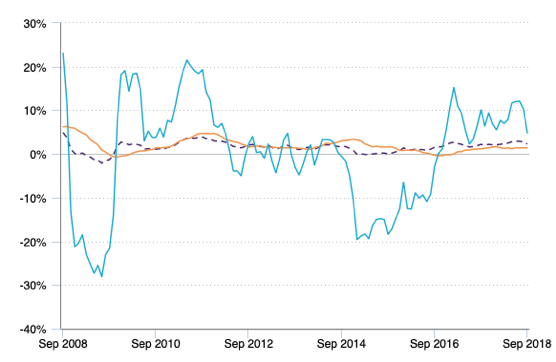
Q: How do you figure the inflation rate is 3.1%?
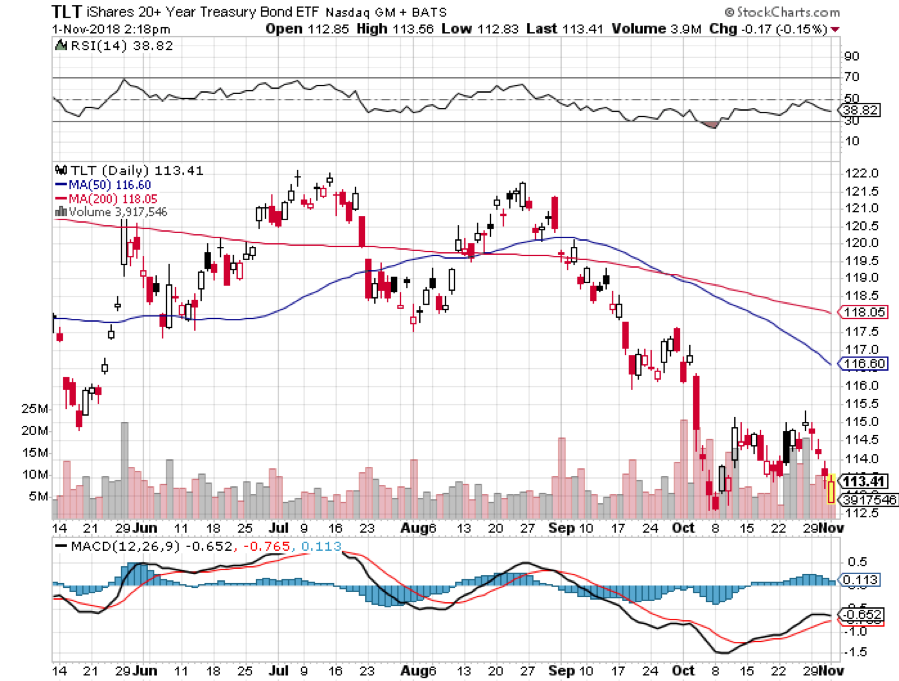
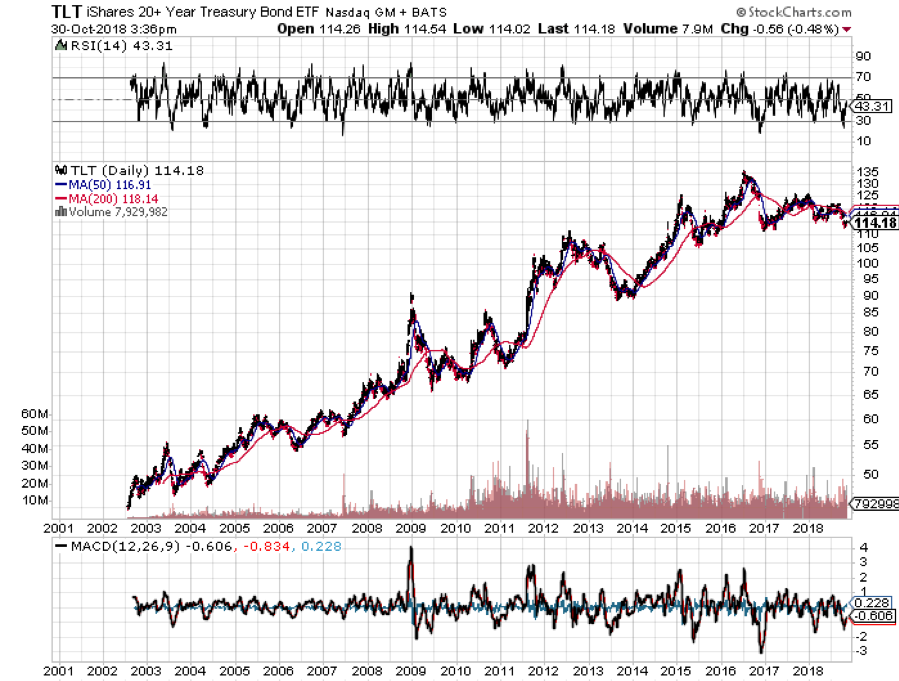
A: The year-on-year Consumer Price Index for September printed at 2.3%, and the most recent months have been running at an annualized 2.9% rate. Given that this data is months old we are probably seeing 3.1% on a monthly annualized basis now given all the anecdotal evidence of rising prices and wages that are out there. That is certainly what the bond market believes with its recent sharp selloff and why I will continue to be a fantastic short. Sell every United States US Treasury Bond Fund ETF (TLT) rally. Like hockey great Wayne Gretzky said, you have to aim not where the hockey puck is, but where it's going to be.
Q: Will rising interest rates kill the housing market?
A: It already has. A 5% 30-year mortgage rate shuts a lot of first time Millennial buyers out of the market. We are seeing real estate slowing all over the country. Los Angeles is getting the worst hit.
Q: How do you see the Christmas selling season going?
A: It’s going to be great, but this may be the last good one for a while. And Amazon is getting half the business.
Q: October was terrible. How do you see November playing out?
A: It could well be a mirror image of October to the upside. We are already $1,000 Dow points off the bottom. So far, so good. Throw fundamentals out the window and buy whatever has fallen the most….like Amazon.
Did I mention you should buy Amazon?
Good luck and good trading
John Thomas
CEO & Publisher
The Diary of a Mad Hedge Fund Trader
Ten Years of Consumer Price Index

Global Market Comments
November 1, 2018
Fiat Lux
Featured Trade:
(THE TERRIFYING CHART FORMATION THAT IS SETTING UP),
(SPY), (AMD), (MU), (AMZN), (NFLX),
(THE TECHNOLOGY NIGHTMARE COMING TO YOUR CITY)


The Mad Hedge Fund Trader is seeing its biggest one-day gains since the inception of our Trade Alert Service 11 years ago. By the time you read this, we will have picked up an astounding 11% profit for the entire portfolio in 24 hours.
However, this being Halloween, I don’t want to sound like I’m whistling by the graveyard. But what I am about to say will scare the daylights out of you.
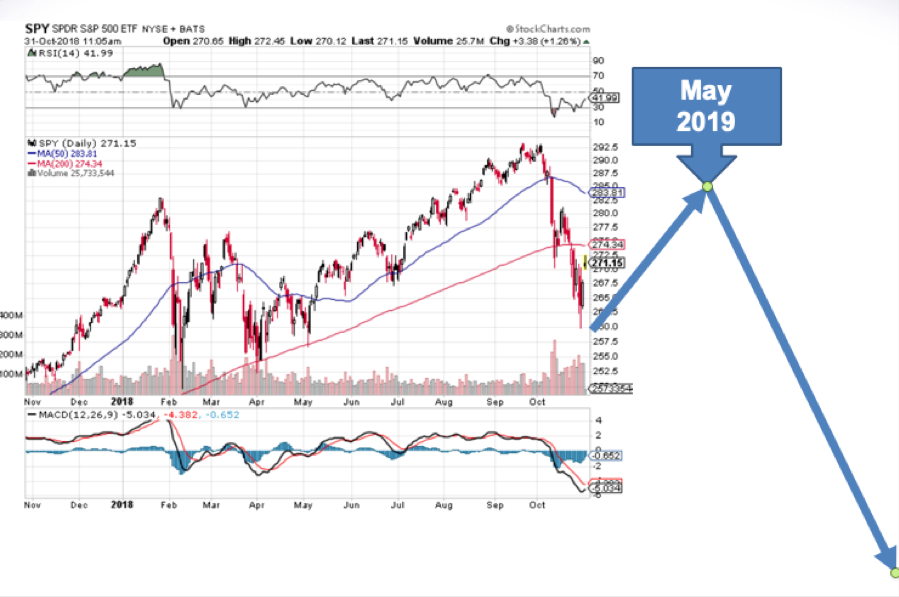
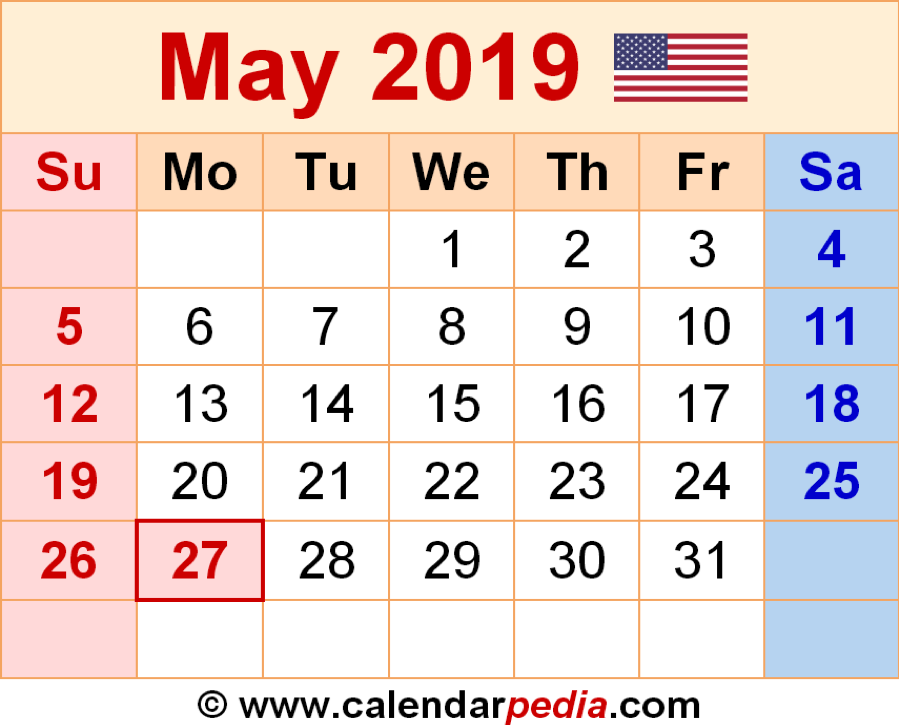
I hate to say I told you so but my prediction a year ago that the bull market would end on May 10, 2019 at 4:00 PM is starting to look pretty good.
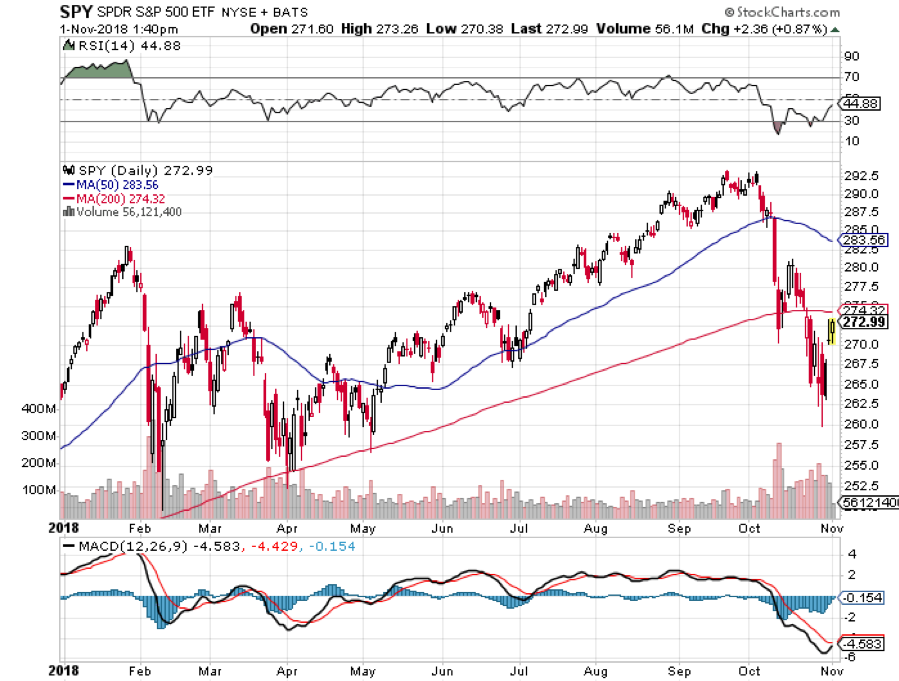
If I am right, the charts for the S&P 500 (SPY) are setting up a classic head and shoulders top. The left shoulder was created by the January 2018 rally to $282.
We just saw the head created at the beginning of October at $293. All that remains is to build the right shoulder back up to $282 by the spring. What will then follow is the crying.
This is not a matter of throwing a dart at a calendar or reciting a chant taught to me by a long-dead Yaqui Indian. It is a simple matter of math. Here’s how it goes:
*The Fed Raises funds rate 25 basis points per quarter for the next four quarters to 3.25%
*The Yields Curve Inverts, taking short rates higher than long rates now at 3.15%
*Bond yield spread trades increase massively going into the inversion as traders ramp up the size to make up for shrinking spreads.
*When the spread turns negative, they dump everything, creating an interest rate spike to 4% or 5%.
*Inverted yield curves last an average of 14 months or until February 2020 in this cycle when a recession begins.
*Stock markets peak on average seven months before recessions, and you arrive at Friday, May 10, 2019 at 4:00 PM EST as the date for the demise of the bull market. At that point, it will be ten years and two months old, the longest such move in history.
A lot of people asked why I sent out so few trade alerts during the summer and going into the fall.
In fact, the list of negatives has reached laughable proportions:
*Longest bull market in history
*In the face of rising interest rates
*In the face of rising oil prices
*Rising inflation
*Nothing else to buy
*Only bull market in the world
*Valuations approaching two-decade highs
*Overwhelmingly concentration in big cap tech
*Double top in the market on an Equal Weight S&P 500 chart
*Record retail inflows into ETFs
*Recession has already started in the auto industry
*Recession has already started in the housing industry
*Rotation to value defensive stocks underway
*Massive unicorn IPOs planned in 2019- $215 billion
*Slowing GDP Growth 4.2% to 3.5%
*Large amount of economic growth sucked forward from 2019 as businesses accelerate Chinese imports to beat the tariffs
*The same is going on in China to buy our exports
Should you throw up your hands, dump all your stocks, and hide out in cash?
Absolute not! In fact, the last six months of a bull market are often the most profitable. Many tech stocks like Micron Technology (MU) and Advanced Micro Devices (AMD) have dropped by half in recent months. That means they have to double to get back to their old highs.
Other big quality stocks such as Amazon (AMZN) and Netflix (NFLX) have plunged by 30% and only have to appreciate by 43% to hit highs. It is, in fact, the best entry point for large-cap tech stocks since 2015 with valuations at a three-year low.
If I am wrong, the trade war with China plunges us into recession and ends the bull market sooner. Almost all the “worry” items on the list above are getting worse by the day.
Save That Date!

Global Market Comments
October 31, 2018
Fiat Lux
Featured Trade:
(WHAT IS AMERICA’S TRUE NATIONAL DEBT?)
(TLT), (AMLP), (JNK), (MUB)
(TESTIMONIAL)

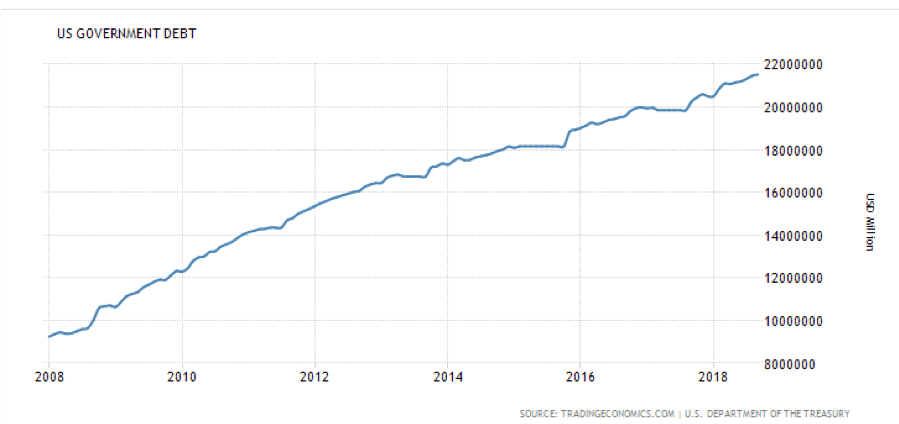
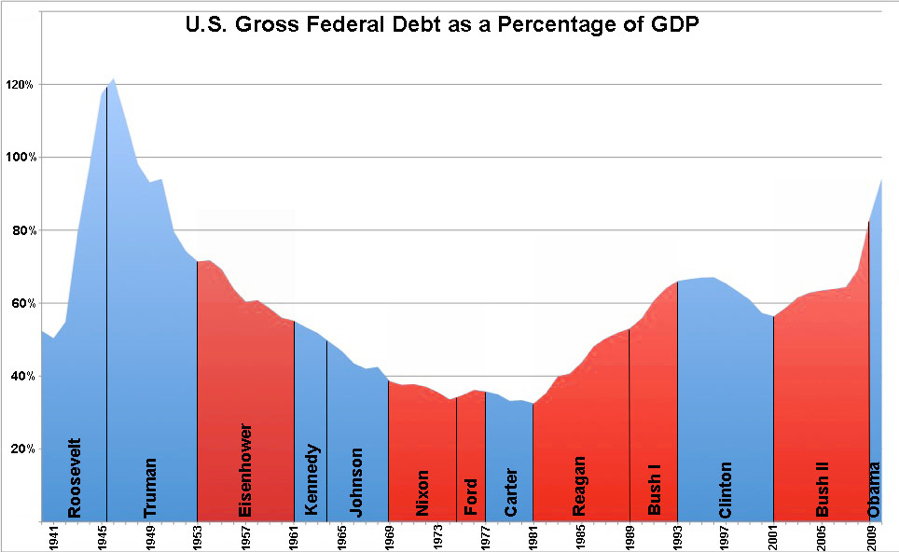
Not a day goes by without someone carping about the national debt to me which now stands at $21.6 trillion.
Since President Obama came into office on January 20, 2010, it skyrocketed.
Are we all going to hell in a handbasket? Eventually, yes.
While it is true that the national debt has increased by some $10 trillion over the past ten years, there is less than meets the eye.
Much less.
That includes the $4 trillion purchased by the Federal Reserve as part of its aggressive five-year monetary policy known as “quantitative easing”.
It also includes another $1 trillion of Treasury holdings by dozens of other federal agencies such as Fannie Mae, Freddie Mac, and Sallie Mae.
So, the net federal debt actually issued during Obama’s two terms is not $9 trillion, but $4 trillion.
That’s a big difference.
These numbers would make Obama one of the most fiscally conservative presidents in US history (see tables below).
And he pulled off this neat trick despite US tax revenues utterly collapsing in the aftermath of the Great Recession.
What the Treasury has in effect done is taken one dollar out of one pocket and put it in the other, 5 trillion times.
There has been no change in the nation’s true indebtedness or net worth as a result of these transactions.
In fact, these bonds were never even really issued. They only exist on a spreadsheet, on a server, on a mainframe, somewhere at 1500 Pennsylvania Avenue, NW, Washington DC.
And here is the real shocker.
The Treasury can cancel this debt at any time.
They can just decide to use one set of figures on the plus side of the balance sheet to offset an equal amount on the negative side, and poof, the debt is gone forever, and the national debt is suddenly only $16 trillion.
It wouldn’t even require an act of Congress. It could simply be carried out through a presidential order.
And we have seen a lot of those lately.
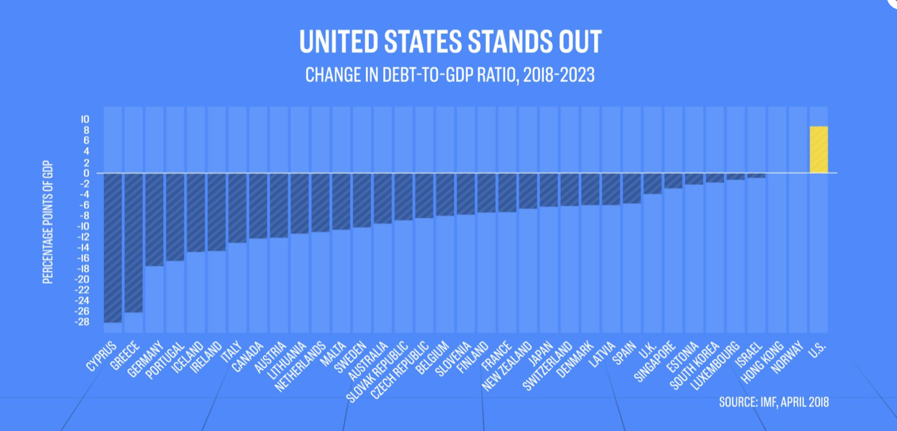
That would give America one of the lowest debt to GDP ratios in the industrialized world.
I actually recommended that the White House use this ploy to get around the last debt ceiling crisis.
All of this sounds nice in theory. But how would markets respond if this were the true state of affairs in the debt markets?
Ten-year US Treasury bond yields would stay stubbornly low around $3.10%.
Prices for marginal debt securities in emerging markets (ELD) would boom.
Am I ringing any bells here people? Do these sound like debt markets you know and love?
A half-century of trading has taught me to never argue with Mr. Market. He is always right.
By keeping its bonds, the Fed has a valuable tool to employ if it ever senses that real inflation is about to make a comeback without having to raise the overnight deposit rate.
It simply can raise bond market rates by selling some of its still considerable holdings.
“FED SELLS BOND HOARD.”
How do you think risk markets would take that headline? Not well, not well at all.
There are other reasons to keep the $5 trillion in phantom Treasury bonds around.
It assures that the secondary market maintains the breadth and depth to accommodate future large-scale borrowing demanded by another financial crisis, Great Recession, or war.
Yes, believe it or not, governments think like this.
I remember that these were the issues that were discussed the last time closing the bond market was considered.
That was at the end of the Clinton administration in 1999 when paying off the entire national debt was only a few years off.
But close down the bond market and fire the few hundred thousand people who work there, and it could take decades to restart.
This is what Japan learned in the 1960’s.
It took the Japanese nearly a half-century to build the bond infrastructure needed to accommodate their massive borrowings of today.
The Chinese are learning the same thing as they strive to construct modern debt markets from whole cloth. It is not an overnight job.
One of the most common questions I get from foreign governments, institutional investors, and wealthy individuals in my international travels is “What will come of America’s debt problem?”
The answer is easy. It will all go to debt heaven. It will disappear.
US government finances are now worsening at a pretty dramatic pace (see more charts and tables below).
The budget deficit has doubled from the Obama low of $450 billion to $900 billion in only two years. Debt has exceeded GDP for the first time since WWII. New government bond issuance is rocketing and will crush the market any day now.
However, there is a way out of the looming financial disaster.
A massive demographic tailwind kicks in during the 2020s as 85 million Millennials grow up to become big-time taxpayers.
In the meantime, the last of the benefit-hungry baby boomers finally die off, eliminating an enormous fiscal drag.
“Depends” and “Ensure” prices will crater.
The national debt should disappear by 2030, or 2035 at the latest. The same is true for the Social Security deficit. That’s when we next have to consider firing the entire bond market once more.
That is what happened to the gargantuan debt run up by the Great Depression, the Civil War, and the Revolutionary War.
Government debt always goes to debt Heaven either through repayment during the period of demographic expansion and economic strength, or via diminution of purchasing power caused by inflation.
That’s why we have governments to pull forward economic growth during the soft periods in order to even out economic growth and job creation over the very long term to accommodate population growth. Pulling forward growth during strong economies as the administration is now doing only ends in tears.
The French were the first to figure all this out in the 17th century. They were not the last.
History doesn’t repeat itself, but it certainly rhymes.

I just stumbled across your writing and I love it!
I have been reading it all weekend. The more I read, the more I have this weird sensation in my frontal cortex. I believe it used to be called "thinking" before the new world order arrived. Almost stimulating....like the stuff before decaf...
What a fresh perspective you provide! You challenge my preconceived notions from CNN, and that is scary.
Please keep up the good work.
Yours Truly,
Ron



“Every geopolitical crisis in the world is squarely pointed at the heart of Europe right now, be it terrorism, the collapse of Europe, or the currency crisis, and that means it’s focused on Chancellor Angela Merkel of Germany,” said my friend Ian Bremmer, of the political consulting firm, Eurasia Group.
