

Global Market Comments
December 24, 2013
Fiat Lux
Featured Trades:
(A CHRISTMAS STORY),
(THE U-HAUL INDICATOR)

It is the end of the school year at the University of California at Berkeley, and the unenviable task of moving my son, a senior, out of his hovel for the holidays fell to me.
When I arrived, I was stunned to find nothing less than a war zone. Both sides of every street were lined with mountains of trash, the unwanted flotsam and jetsam cast aside by departing students. Computer desk, stained mattresses, broken lava lamps, and an assortment of heavily worn Ikea furniture were there for the taking. Newly arriving students were sifting through the piles looking for that reusable gem. Diminutive Chinese teenagers were seen pushing massive suitcases on wheels down the sidewalk on their way back to Shanghai, Beijing, and Hong Kong. The university attempted to bring order to the chaos by strategically placing dumpsters on every block, but they were rapidly filled to overflowing.
It was all worth it because of the insight it gave me into one of my favorite, least known leading economic indicators. When I picked up the truck at U-HAUL, the lot was absolutely packed with returned vehicles, and there were more parked on both sides of the streets. The booking agent told me there is a massive influx of people moving into California from the Midwest and the Northwest, with the result that lots all over the San Francisco Bay Area are filled to capacity.
I love this company because in addition to providing a great service, they get the first indication of any changes to the migratory habits of Americans. The last time I saw this happen was after the dotcom bust, when thousands of tech savvy newly unemployed pulled up stakes in the foggy city and moved to Lake Tahoe to work in ?the cloud.? Bottom line: California is enjoying a resurgence of hiring and new economic growth. This is what the stock market is seeing that you and I can?t.

![lava lamps]() Want a Great Deal on a Used Lava Lamp?
Want a Great Deal on a Used Lava Lamp?

Global Market Comments
December 23, 2013
Fiat Lux
Featured Trade:
(THE ONE BRIGHT SPOT IN REAL ESTATE),
(A SHORT HISTORY OF HEDGE FUNDS),
(THE POPULATION BOMB ECHOES), (POT), (MOS), (AGU),
(THANK GOODNESS I DON?T LIVE IN SWEDEN), (EWD)
Potash Corp. of Saskatchewan, Inc. (POT)
The Mosaic Company (MOS)
Agrium Inc. (AGU)
iShares MSCI Sweden (EWD)
Global Market Comments
December 20, 2013
Fiat Lux
SPECIAL END OF YEAR ISSUE
Featured Trades:
(GO LONG CHRISTMAS CHEER AND HOT BUTTERED RUM),
(A SPECIAL NOTE ON EXERCISED OPTIONS)
Global Market Comments
December 19, 2013
Fiat Lux
Featured Trade:
(MAD HEDGE FUND TRADER PROFIT HITS 63%),
(SPY), (TLT), (FXY), (SFTBY), (AAPL), (XLF),
(I WAS WRONG?.BUT IT DIDN?T MATTER)
(A DIFFERENT VIEW OF THE US)
(THE STRUCTURAL BEAR CASE FOR TREASURY BONDS),
(TLT), (TBT)
SPDR S&P 500 (SPY)
iShares 20+ Year Treasury Bond (TLT)
CurrencyShares Japanese Yen Trust (FXY)
SoftBank Corp. (SFTBY)
Apple Inc. (AAPL)
Financial Select Sector SPDR (XLF)
ProShares UltraShort 20+ Year Treasury (TBT)
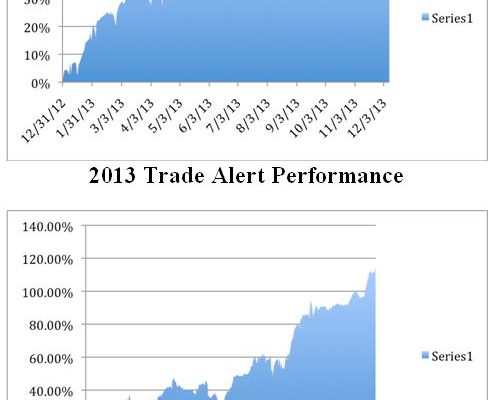
The performance of the Mad Hedge Fund Trader?s Trade Alert Service is still going ballistic, reaching the heady height of 63.08% for the year.
Including both open and closed trades, 24 out of the last 26 consecutive Trade Alerts have been profitable. The results so far in December are up a stunning +7.04.
The three-year return is an eye popping 118%, compared to a far more modest increase for the Dow Average during the same period of only 32%.
That brings my averaged annualized return up to 39.3%.
This has been the profit since my groundbreaking trade mentoring service was launched three years ago. It all is a matter of the harder I work, the luckier I get.
I held on to every risk on position during the two-week December correction, fully expecting the pause to become the springboard for a new run to all time highs by year-end. That is exactly what happened in the wake of the Federal Reserve?s decision to taper its quantitative easing program by only $10 billion a month, mere sofa change given the size of our bond market.
That sent off to the races my long positions in the Financials Select Sector SPDR (XLV), the S&P 500 (SPY), and Internet giant Softbank (SFTBY). I cashed in one of my three short positions in the Japanese yen (FXY), which broke to new multiyear lows. I kept my shorts in the Treasury bond market (TLT), which crashed. I?ll double up here on the next rally.
It looks like I still have room to take in a few more percentage points in profits before 2014. Japan should explode to the upside tonight, where I am maintaining a hefty 40% weighting in my model trading portfolio. My followers will spend New Years laughing all the way to the bank.
This is how the pros do it, and you can too, if you wish.
Carving out the 2013 trades alone, 77 out of 92 have made money, a success rate of 83%. It is a track record that most big hedge funds would kill for.
My esteemed colleague, Mad Day Trader Jim Parker, has also been coining it. Since April, his own performance numbers have just come back from the auditors, revealing that he is up a staggering 279%.
The coming winter promises to deliver a harvest of new trading opportunities. The big driver will be a global synchronized recovery that promises to drive markets into the stratosphere in 2014. The Trade Alerts should be coming hot and heavy. Please join me on the gravy train. You will never get a better chance than this to make money for your personal account.
Global Trading Dispatch, my highly innovative and successful trade-mentoring program, earned a net return for readers of 40.17% in 2011 and 14.87% in 2012. The service includes my Trade Alert Service and my daily newsletter, the Diary of a Mad Hedge Fund Trader. You also get a real-time trading portfolio, an enormous trading idea database, and live biweekly strategy webinars. Upgrade to?Mad Hedge Fund Trader PRO?and you will also receive Jim Parker?s?Mad Day Trader?service.
To subscribe, please go to my website at www.madhedgefundtrader.com, find the ?Global Trading Dispatch? box on the right, and click on the lime green ?SUBSCRIBE NOW? button.


Global Market Comments
December 18, 2013
Fiat Lux
Featured Trade:
(THE RECEPTION THAT THE STARS FELL UPON),
(NLR), (CCJ), (CORN), (WEAT), (SOYB), (DBA),
(OIL ISN?T WHAT IT USED TO BE), (USO),
(TAKING A BITE OUT OF STEALTH INFLATION), (SGG), (WEAT)
Market Vectors Uranium+Nuclear Enrgy ETF (NLR)
Cameco Corporation (CCJ)
Teucrium Corn (CORN)
Teucrium Wheat (WEAT)
Teucrium Soybean (SOYB)
PowerShares DB Agriculture (DBA)
United States Oil (USO)
iPath DJ-UBS Sugar TR Sub-Idx ETN (SGG)

Virtually every analyst has been puzzled by the seeming immunity of stock markets to high oil prices this year. In fact, stocks and crude have been tracking almost one to one on the upside. The charts below a friend at JP Morgan sent me go a long way towards explaining this apparent dichotomy.
The first shows the number of barrels of oil needed to generate a unit of GDP, which has been steady declining for 30 years. The second reveals the percentage of hourly earnings required to buy a gallon of gasoline in the US, which has been mostly flat for three decades, although it has recently started to spike upwards.
The bottom line is that conservation, the roll out of more fuel efficient vehicles and hybrids, and the growth of alternatives, are all having their desired effect. Developed countries are getting six times more GDP growth per unit of oil than in the past, while emerging economies are getting a fourfold improvement. The world is gradually weaning itself off of the oil economy. But the operative word here is 'gradually', and it will probably take another two decades before we can bid farewell to Texas tea, at least for transportation purposes.

![Horse Drawn Car]() But the Mileage is Great!
But the Mileage is Great!

Global Market Comments
December 17, 2013
Fiat Lux
Featured Trade:
(THE RISING DRUMBEAT FOR ALIBABA),
(SFTBY), (S), (TMUS), (T),
(RAMPANT WAGE INFLATION STRIKES CHINA), (FXI)
(CHECK OUT OBAMA?S LATEST STIMULUS PLAN),
(TESTIMONIAL)
SoftBank Corp. (SFTBY)
Sprint Corporation (S)
T-Mobile US, Inc. (TMUS)
AT&T, Inc. (T)
iShares China Large-Cap (FXI)

I rely on hundreds of 'moles' around the world whose job it is to watch a single, but important indicator for the world economy. One of them checks for me the want ads in the manufacturing mega city of Shenzhen, China, and what he told me last week was alarming.
Wage demands by Chinese workers have been skyrocketing this year. The biggest increases have been at the low end of the spectrum, where migrant workers from the provinces are earning up to 40% more than a year ago. Wage settlements of 20% or more for trained workers are common. One factory that gave staff only a 10% increase saw many of them fail to return after the recent Chinese lunar New Year.
Of course China's blistering 8% GDP growth is the cause, which has pushed inflation well beyond the government's 4% target. So the cost of living in the Middle Kingdom is rising dramatically. The problem has been particularly severe with imported commodities, such as in food. Hence, the increased demands.
This is important for the rest of us because low wages have been the cornerstone of the Chinese economic miracle. In just the last decade, average monthly Chinese wages have climbed from the bottom rung to the middle tier. That seriously erodes the country's cost advantage, which has gained it such enormous shares in foreign markets, like the US. Take away the country's price advantages, and demand will wither, slowing growth globally.
What will they be demanding next? Collective bargaining rights? In the meantime, keep checking those Craig's List entries for Shanghai.
Average Monthly Salary
$3,099 Yokohama, Japan
$1,220 Seoul, South Korea
$888 Taipei, Taiwan
$235 Shenzhen, China
$148 Jakarta, Indonesia
$100 Ho Chi Minh City, Vietnam
$47 Dhaka, Bangladesh
