

Featured Trades: (TIME TO SCOOP UP SOME (CAT)), (CAT)
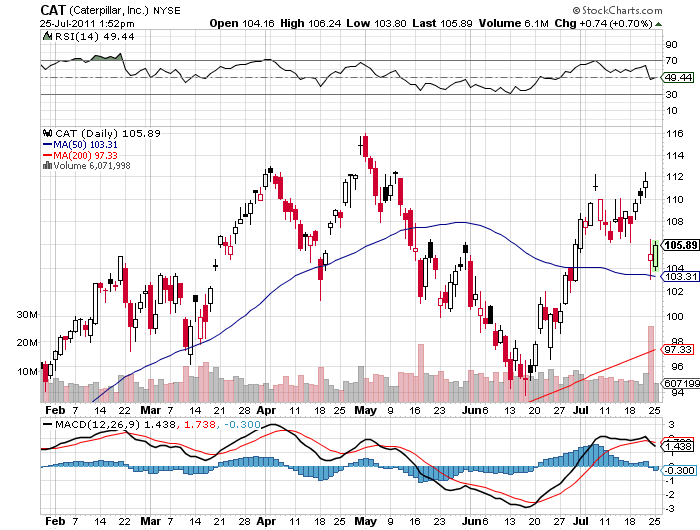
2) Time to Scoop Up Some (CAT). I love it when a world beating, best of breed company temporarily stumbles and gives me a great entry point for a new long position. That was certainly the case on Friday, when Caterpillar, the icon for manufacturing bulldozers and other heavy construction and mining equipment, released their Q2 earnings.
It was a good report. It raised its outlook for revenues by $2 billion to $55 billion, up big from $42 billion a year ago. Earnings soared by 44% YOY. It has a record backlog for new orders. CEO, Doug Oberhelman, expects profits for the company to rise through 2015.
But the dreaded words 'China slowing' were mentioned. Analysts' expectations had outrun reality, so traders trashed the stock, taking it down by 8%.
A closer inspection showed that all the company did was to cut its forecast of US GDP growth to my own, a lackluster 2.5% a year. It largest domestic clients, road and infrastructure builders and those involved in home construction, have seen business drop by half from the 2007 peak. With various stimulus programs running out, and state and local construction spending in free fall, business at home could drop by a further quarter to a third.
Caterpillar has in fact done a spectacular job boosting its international earnings to more than offset dreadful business at home. It's a good thing that Caterpillar occupies a sweet spot in the global economy. It does a massive amount of business with emerging markets, especially China, helping them build their own infrastructure from scratch.
It also is getting huge business around the world from producers of hard assets of every description, including iron ore, gold, silver, copper, uranium, nickel, zinc, and rare earths. The producers of these commodities, BHP Billiton, Rio Tinto, Xstrata, and Anglo American are all announcing record profits. It is a good rule of thumb in business that when your customer is coining it, you can too.
These all have great long term fundamentals. It recent acquisition of Bucyrus (BUCY), a major customer, will give it a leading position of the coal market, fast becoming one of America's largest exports.
-

Time to Scoop Up Some (CAT)
Featured Trades: (BRING BACK THE SMOKE FILLED ROOMS), (SPX), (TBT)
2) Bring Back the Smoke Filled Rooms. I write this from poolside at the historic Claremont Hotel in Berkeley, California. The weather couldn't be more perfect, and the local beauties, many coeds on summer break from the university, are strutting their wares, or the lack thereof. It is shocking what some people will tattoo on their bodies these days, and where they will do it. The blue sun umbrellas array themselves around the water like a postmodern impressionist painting.
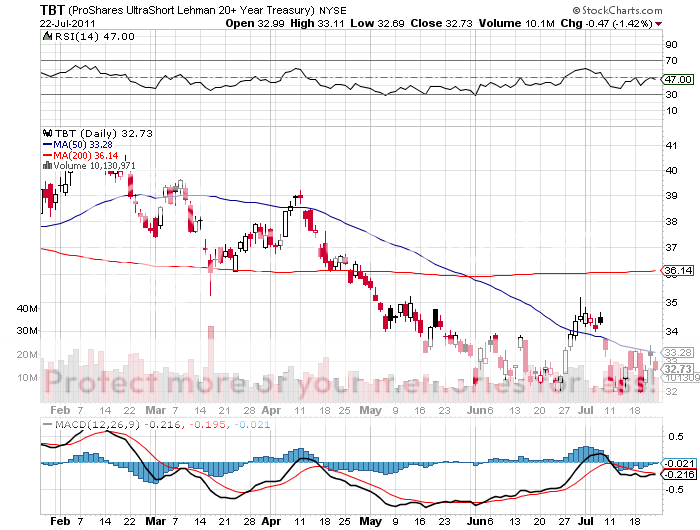
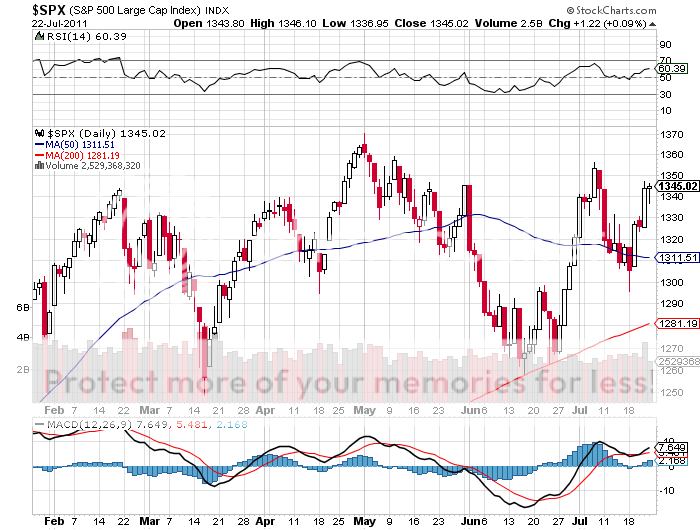
I am sending out the letter late today in the hope that I will get some insight into the debt ceiling negotiations before the markets open. So far, no joy. The (SPX) opened down 15 points in Asia, oil is tanking, Treasury bonds (TBT) are getting beat up on a prospective downgrade, and Uncle Buck is getting mugged. Fortunately, my long in equities is partially hedged by my short on the bonds. Is it possible that I have underestimated the stupidity of congress?
In days of old, when such impasses presented themselves, Speaker of the House, the rosy cheeked Tip O'Neil, would meet his counterpart in the Senate for a night of poker. Several bottles of Scotch later, a deal would get struck, and the two would be photographed together shaking hands the next morning, talking about the good of the country. The process moved on.
That doesn't happen anymore. Speaker John Boehner is new at the job, with a mere six months in the post, and he is learning through trial and error, mostly the latter. He is up against a world class constitutional law professor. I can't imagine Boehner playing cards with Harry Reid, Obama, or anyone.
Even if he does come to an agreement, it is unlikely that he can make it stick by getting his own party to follow him. Many of the new junior house members are from the Tea Party, whose understanding of economics, financial markets, and the law making process is shaky at best. In another six months they have to start campaigning again, going to their supporters and financial backers with a list of what they have achieved. Raising the debt ceiling is not on that list.
If Tip O'Neal faced recalcitrant members of his own party, he would threaten a cut off of all pork barrel projects in their district, banish them to the least popular committees, and kill any bill they brought to the floor. But at least if Tip cut a deal, you knew he could deliver the votes. Today, rebellious republicans won't even take a call from Boehner, who view him with almost as much hostility as they do Obama.
What we are seeing here is sausage making in public, in all its odiferous ugliness. It is negotiation out in the open, never a good idea, especially when both sides believe the other is doing so in bad faith.
All of this leads us to bemoan the passing of the Reagan republicans, who you could work with and get a few laughs along the way. It also means that the volatility that I promised you last week will be arriving by the boatload in coming days. I still believe a deal will get made in the coming nine days, so I will use the sharp dips to add selective risk exposure. Watch this space.
-
-
Featured Trades: (LOS ANGELES STRATEGY LUNCH REVIEW)
1) Los Angeles Strategy Luncheon Review. I am writing this letter at a table at Zeppy's Pizza Shack in Hermosa Beach, just across the street from Yer Cheat'n Heart Tattoo. The flotsam and jetsam of humanity are gliding past me on bicycles, roller blades, and skateboards, clad in tank tops and bikinis. A homeless man, clearly schizophrenic and having a heated conversation with himself, was sifting through a trash can, hunting for empty cans and bottles.
To get here, I had to negotiate the notorious Los Angeles freeway system, where traffic frequently backs up because of drivers found dead the wheel, the victims of daily road rage incidents. You never use your turn signal here. It only encourages people to speed up to take your space.
The freeways here are more a state of mind that a transportation system, and it brings out the full range of human emotion.? Drive the Pasadena Freeway and you are experiencing the full force of an action video game set in the 1930's. Make the turn from the 101 to the 110 and you are plunged into a hopeless maze where only the most aggressive and predatory rat escapes alive. But turn off from the 10 over the magnificent elliptical overpass to the 405 and you are soaring with the eagles.
The lunch at the Los Angeles Athletic Club was well attended, and professionally served, with many last minute sign ups. I guess those LA guys spend more time at the beach than I thought. There was much discussion about the longer term outlook for the financial markets, which I viewed with modestly positive for the rest of the year, but then turn hugely negative farther out. The remnants of QE2 will provide enough liquidity for the S&P 500 to claw its way up to 1,400 by year end. After that, the longer term structural problems facing the country will drag us back into another recession and trigger a second financial crisis. There will be no QE3.
The banks will become the major victims of the next melt down, as they have yet to amortize the losses of the last crash, and house prices are still falling. The only distinction is that there will be no TARP, no bail outs, and no stimulus package. A gridlocked congress offers no safety net. Then the chips really will fall where they may. Residential real estate may fall another 25% and then bump along the bottom for another decade.
At the moment, it looks like Obama can win another election, especially if the large numbers of minorities and young people return to the polls after going missing in action in 2010. Campaigning for his own job will make a huge difference. He should have a win in Libya in his back pocket, and his successful hit against Osama bin Laden has certainly reinforced his anti-terrorism credentials.
Demographic and immigration factors could deliver him up to 4 million new voters. The House is really up in the air. If the economy can continue to eke out a 2% growth rate for another year, he might just make it.
The spanner in the works will be unemployment. With every level of government cutting staff to staunch deficits, and with large companies keeping a death grip on their cash hoards, I don't expect any improvement here. The structural headwinds are so severe, that I doubt we can make it to the 7% handle for the jobless rate. The 25 million jobs we shipped to China are never coming back. There is nothing Obama or anyone else can do about this, no matter what they say.
I am planning a rather ambitious lunch schedule for the rest of the year, which I will post in my store in the next few weeks. I look forward to seeing the rest of you then.

-

Featured Trades: (TIME TO FLIP TO THE SHORT SIDE ON THE TREASURY BOND MARKET), (TBT)
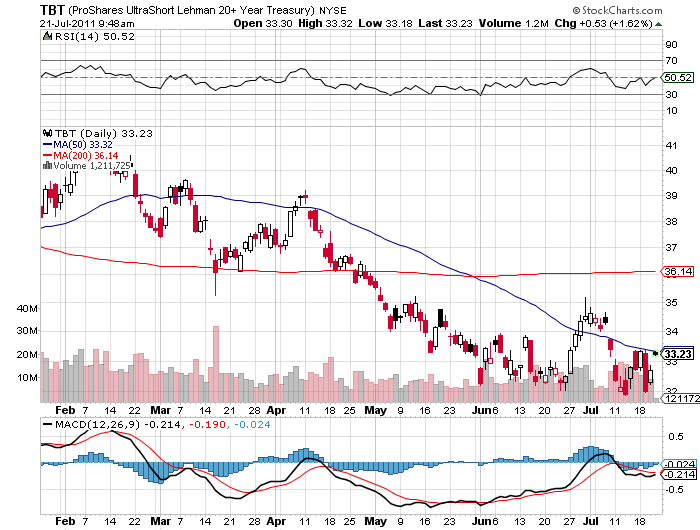
2) Time to Flip to the Short Side in the Treasury Bond Market. The first thing that I noticed this morning is that the long end of the bond market was getting absolutely creamed. 'RISK ON' has returned with a vengeance, at least for a few weeks.
If you assume that the real inflation rate is close to 3%, then most of the Treasury bond spectrum is paying negative interest rates, including two, five, and ten year paper. Only the 30 year is offering a small single digit real return. That is amazing, given the huge inflationary prospects that Ben Bernanke has created with his vast money printing exercise, on top of the huge price increases we have seen in food, commodities, energy, and metals this year. This makes Treasury bonds terrible investments, and great shorts.
Today's terrible price action puts a chink in the armor of the bull market in Treasuries which has now run for nearly five months. I have been milking this for all it has been worth, but it is now time to get more aggressive on the other side. It sets up a double top on the long bond charts. The flipside of that is a double bottom for the (TBT), the double short inverse ETF that profits when longer dated Treasury bond prices fall.
I will increase this position when I see another entry point, as I believe that falling bond prices will be one of the key developments running up to the year end. They don't ring a bell at the top, so it's now or never. This could be the banner trade for the rest of 2011.
-
Time to Flip to the Short Side in the Treasury Market
Featured Trades: (APPLE SURPRISES AGAIN)
1) Apple Surprises Again. Wow, and double wow! That's all I can say about Apple's (AAPL) ballistic earnings. Talk about firing on all cylinders and the turbocharger and the supercharger at the same time! Apple is now the world's second largest company and is boasting a positively mind boggling $76 billion in cash, one of the largest hoards in history.
While the 2,000 plus (AAPL) analyst community is scouring the horizon with potential technology takeover targets, let me propose one that most are ignoring: Apple itself. With these kinds of returns on capital, the wisest thing the company can do is buy back its own stock, providing additional returns to its already ecstatic shareholders. Buying anything else would be a step down in quality, profitability, and outlook.
Of course, the company is behaving as if the 2008 crash is coming back tomorrow, hence the huge insurance policy. This is erroneous. I happen to know that it is not coming until next year, or 2013 at the latest. They also have to brace themselves against the prospect that the brilliant Steve Jobs will go on to his greater rewards in the near future.
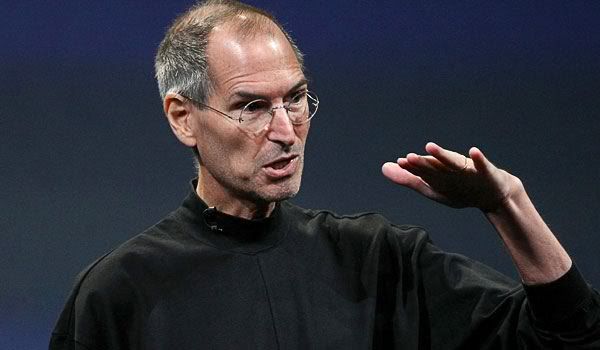
If the company does take my advice and start a serious buyback program, the stock will soar to $500 in a heartbeat. Then it will require only one more double to get to my long term target of $1,000 a share. I've never been one to pat myself of the back, but in this case I'll make an exception. Every time I put out this prediction, I get tons of abuse from other investors and 100 new subscriptions from happy and hardworking? apple employees. So here it is again in the next piece below, which I originally put out at $250 a share on June 3, 2010.
Hey Steve! I have another idea on how to use your cash mountain. Ever thought about getting into the newsletter business? My returns on capital are even better than yours. I'm only an hour away. Let's talk. Lunch at Stacks in Campbell, maybe? I'm sure they have something vegetarian there.

-

Featured Trades: (NEXT STOP FOR APPLE: $1,000)
2) Apple's Next Stop: $1,000. When I took a young, cocky, long haired, Levis wearing Steve Jobs around to meet Morgan Stanley's institutional investors to pitch an Apple share offering 28 years ago, I vowed never to buy anything from the man. He was such a great salesman, and possessed such a messianic devotion to his product, the risk of getting legged over had to be great.
This proved a good strategy for the next 18 years, when the company nearly went under three times, and the stock repeatedly plunged from its initial listing price of $22 down to $4. Disastrous products like the Apple Newton came and went, and then poor Steve got fired. Ouch!
Living in the San Francisco Bay Area, I was also creeped out by the fanatical cult following that Steve enjoys. Criticize an Apple product here, and you risk getting attacked, ostracized, deleted from address books, and chopped off Christmas card lists. There was also no end of abuse from my IPod and Imac addicted kids.
I have to confess now that my prior prejudices lead me to miss the boat on Apple for the last decade, when the stock soared from $4 to $275, eventually topping Microsoft (MSFT) with a $238 billion market capitalization last week. To see the company bring out a ground breaking, high end $499-$829 product like the IPad and sell 2 million units in a short two months during unstable economic conditions is nothing less than amazing.
The recent stock performance has also been miraculous, bouncing back from a flash crash low of $195 to challenge its old high in a matter of weeks, while the rest of techland lies in ruins. Forecasts for the global smart phone market are ratcheting up by the day on the back of surging demand from emerging markets. Sales could reach 250 million units annually by 2012, of which 17% currently is sold by Apple.
The company has become a monster cash flow generator, spewing out $12 billion over the last 12 months. It sits on a cash mountain of $23 billion, or $45/share. Apple now has the envious problem in that sales of several of its products are going hyperbolic at the same time. Some analysts have Apple's earnings skyrocketing from the current $12/share to $30 over the next two years, which at the current 22 multiple would take the share price up to $675.
If the company's multiple expands to its pre-crash average of 35 X, that would take the stock to a positively nose bleeding $1,073, giving it a 400% return over the next two years. I'm not saying that you should rush out and load up on stock today. But it might be worth taking a stake on the next wave of fear that strikes the market. Note to readers: (originally published June 3, 2010).

-
What a Long and Winding Road It's Been
Featured Trades: (TIME TO GET ON THE (SPX) ROLLER COASTER), (SPY), (SPX)
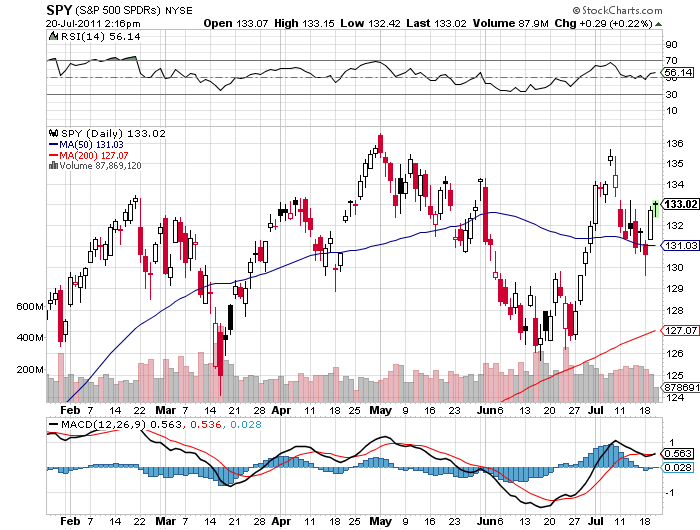
3) Time to Get on the (SPX) Roller Coaster. I think yesterday's reaction to a rumored settlement on the debt ceiling was a great 'tell' on the short term direction of the financial markets. The S&P 500 popped 20 points, bonds roared by two points, and it was off to the races for commodities. However, gold took a $30 hickey.
To some extent, I am making a political call here. I think that there is a 100% chance that we get an agreement on the debt ceiling by the August 2 deadline because the republicans have unwisely, and some would say recklessly, painted themselves into a corner.
The debt ceiling is the responsibility of the House of Representatives, and using it as a weapon to achieve political gains has never been done before. Reagan did it, Clinton did it, and Bush did it big time. If they fail to take action and the US defaults, all President Obama has to do is suspend payment of Social Security checks and correctly blame it on them.
That would assure a big win for the democrats next year and return to them control of both houses of congress. There is no way the republicans are willing to risk even a remote chance of this. So deal they must, and very soon.
A final agreement could create a short term love fest for equities and take the (SPX) up to the old high of 1,370, and possibly to a new yearly high of 1,400.
This is not exactly a low risk trade. I am not predicating the onset of a whole new bull market here, just a swing up to the upper end of a narrow, tedious, and boring range.
You can expect some volatility as the rumors continue that a deal is on, then off, then on again. But we know that the final answer is 'on', so if you get any big dips, you might want to double down.
-

Featured Trades: (INTEGRATING AMERICA'S POWER GRID)
2) Integrating America's Power Grid. Until now, America's power grid has been divided into three unconnected chunks, making transnational transmission impossible, leading to huge regional mispricing. While California and New York suffered from brown outs and sky high prices, electricity was given away virtually for free in Texas.
A group of power companies is now proposing to build the $1 billion Tres Amigas superstation in Clovis, New Mexico that would connect all three grids. The plant would use advanced superconducting technology that will send five gigawatts of power down cables cooled at 300 degrees below zero.
The facility would solve a major headache of alternative energy planners, and will no doubt accelerate development. It would allow the enormous wind farms on the drawing board in the Midwest to ship energy to the power hungry coasts. Ditto for the mega solar projects proposed in the Southwest deserts, and the big geothermal plants being built in Nevada.
With Obama sending tidal waves of government cash towards the sector, the timing couldn't be better. It is also great news for major alternative suppliers like First Solar (FSLR). Some of these projects might now actually make some sense.
Featured Trades: (THINK AGAIN BEFORE BUYING THAT VACATION HOME)
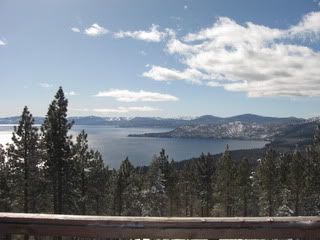
3)Think Again Before Buying That Vacation Home.If you're entertaining buying a vacation home any time soon, I'd think again. In my annual review of the residential real estate market in the High Sierra mountain hamlet of Incline Village, Nevada, and I am sad to report that antidepressant addiction among realtors there is still at epidemic proportions.
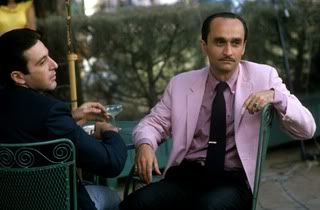
This is the town on the shores of sparkling Lake Tahoe that is the home to the Godfather III, former junk bond king Mike Milliken, the mythic arms dealer Adnan Khashoggi, and a high school with one of the worst drug problems in the state. Devoid by edict of the down market fast food chains that afflict most of America, Incline boasts two municipal golf courses, where at 6,300 feet, the air is so thin that your drive travels an extra 50 yards. If you want a Big Mac, you have to drive down the road to California, if the road isn't blocked by snow.
Incline is also a Mecca for libertarian millionaires drawn by the absence of a state income tax. Unfortunately, they also possessed the financial sophistication to buy trophy waterfront homes, extract cash-out refi's all the way up, invest the proceeds in the stock market, and lose it all in the subsequent crash.
The result has been a meltdown of Biblical proportions in the housing market. Of the 8,000 homes in the village, 400 are for sale at distressed prices and another 400 or more discouraged sellers hang over the market. Brokers report a brisk business in short sales, foreclosures, and sales on the Washoe County Court House steps at prices down 60%-70% from the 2006 peak.
Jumbo financing is now an extinct species, unless you're happy to pay a 200 basis point premium over conventional loans. So the high end market has ceased to exist. One fabulous property on tony Lakeshore Drive, with every imaginable upgrade (a heated driveway, beveled glass windows, an elevator, and a fireplace in the bathroom?), originally listed at $14 million and sold for $4 million. Only cold, hard cash talks here. But high net worth individuals hate tying up capital in an illiquid asset when more attractive options about. Precious metals coins are especially popular in the Silver State.
Some properties have been on the market so long that snow drifts have collapsed balconies, the local wildlife have moved in, and prospective buyers are scared away by offensive odors. Break-ins by black bears have become a serious problem, leaving basketball sized poops on the living room floor and finally answering the eternal question, 'Does a bear shit in the woods.' Abandoned homes see their pipes freeze and burst, causing irreparable damage. In Las Vegas, foreclosed homes can be easily spotted from the air by their dead lawns and green swimming pools. In Incline the 'tells' are the ten foot high mountains of frozen snow dumped there by snow plows. I guess all real estate markets really are local.
Owners used to be able to cover half their annual carrying costs by renting out their properties during Christmas and New Year's, and for a few weeks in the summer. Unfortunately, that market has collapsed also. There are not a lot of high rollers willing to fork out $10,000 a week for a vacation rental in a recession. An earlier start to the school year has wiped out a good part of the prime summer months.
The only consolation is that conditions are much worse in Las Vegas. The optimists concede that prices could stay down for another decade. The pessimists can already be found at the bottom of the lake with the Godfather's Fredo Corleone.
-
Featured Trades: (IS THE FAT LADY SINGING AGAIN FOR THE TREASURY MARKET?)
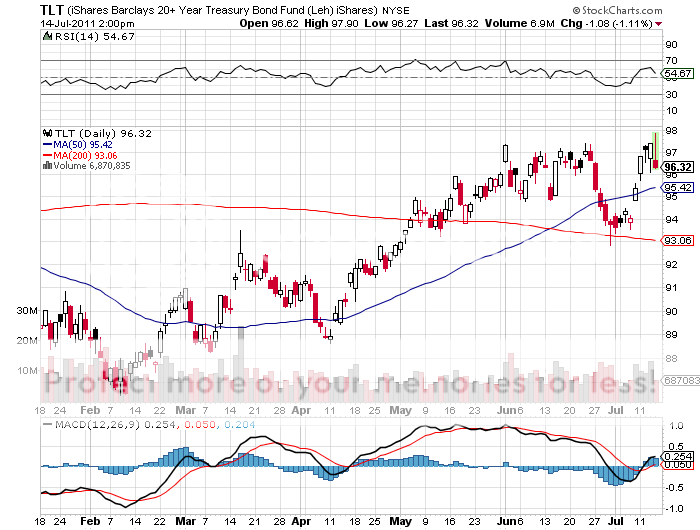
1) Is the Fat Lady About to Sing Again for the Treasury Bond Market? One of my best calls of the year was to pick the bottom of the Treasury bond market in February and pile readers into synthetic long positions by shorting puts in March. That handy little trade brought in a nice 4.51% profit for my model portfolio.
All good things must come to an end. Since my watershed call, the
Treasury bond market has rallied an awesome ten points. The long bond ETF (TLT) has soared from $87 to $98. My logic was that a flight to safety would send Treasury bond prices to the moon, and that we have gotten in spades. While the 'RISK OFF' trade started for the main indexes, gold, silver, and oil on April 29, it really started in February for copper, banks, and technology two and a half months earlier.
With QE2 now over, I think the party is about to end for the bond market. For the last eight months, the Federal Reserve has taken down virtually all of the Treasury's new issues. That amounts to $75 billion a month. That massive quantitate of new bond buying is over.
Private US and foreign central banks are not going to be able to make up the difference, no matter how many of their cars, textiles, electronics, toys, and finger traps that we buy. This big problem is that the bond market these days is very much like a Ponzi scheme. Unless there is a steady inflow of new suckers, the entire plan collapses like a house of cards.
So I am going to use this strength in the bond market to sell short some out of the money calls with September strikes. I'll be picking strike prices that equate to a ten year yield of 2.40%, last year's low in yields and high in prices. That allows room for a huge, multi decade double top in bond prices to unfold over the next three months and still allow me make money on this trade.
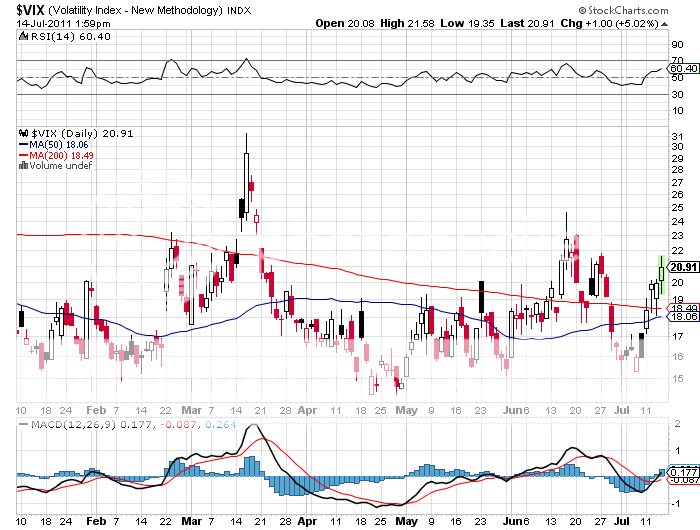
If I can see more confirmation of a double top in the bond markets, then I am going to have a reconciliation with an old flame, the (TBT), the 200% short play on the Treasury market. The only way I can lose money on this trade is for yields to blast through to new 30 year lows, driven by a true double dip recession and an utter collapse in the stock market. The volatility index for the stock market (VIX), stuck at a lowly 17% is telling us that is not going to happen, at least within the next two months, anyway.
-
-

Additional Pieces And Charts For Premium Subscribers