Global Market Comments
January 13, 2010
Featured Trades: (HYUNDAI), (KOREA), (WON), (EWY), (CYB), (REI)
1) I watched with both amazement and foreboding Japan's share of the US car market grow from 1% in the seventies to 40% in recent years. General Motors made excuses all the way up, as the Japanese ate an inexorably larger share of their lunch, until they went bankrupt. I see history about to repeat itself, but it's not American car makers' market share that is on the menu, but Japan's. South Korean auto makers Hyundai and KIA stunned industry experts when they, along with Japan's Subaru (Which is Japanese for the constellation Pleiades. Go figure), emerged as the only three auto firms to see sales increase in 2009. Hyundai's sales rose 8%, boosting its market share by 40%. The company got a lot of mileage when its elegant new $30,000 sports sedan, Genesis, was named 'Car of the Year,' becoming the first gasoline powered car to get an EPA rating over 30 mpg. New generations of the crossover SUV Tucson and midsize Sonata sedan promise to take the marque forward. The company will make its first foray into the hybrid space with a 'green' Sonata powered by a third generation lithium polymer battery pack. I rented a Hyundai a few weeks ago, and it took me back to my youth, reminding me of the Toyota Corolla I drove in Japan 25 years ago. You can buy Hyundai stock directly, which owns KIA, thanks to some financial indiscretions a few years ago. The hardier may also take a look at Samsumg, which is part owned by Renault, and Daewoo, which has a partial ownership by none other than GM. Consider it the same as buying Toyota in 1980, but with a lot more leverage, and a nice currency play on the side. For a broader view, look at the South Korean ETF (EWY), a country that seems to be doing everything right.

2) With much fanfare, China announced that it became the world's largest exporter last year, a humongous $130 billion in December shipments taking the annual figure up to a staggering $1.3 trillion. The Middle Kingdom also became the largest car market last year, and is set to surpass Japan to become number two in GDP this year. It remains to be seen whether there are buyers for all of these shoes, toys, clothes, furniture, and consumer electronics. The country's $586 billion stimulus package has proven so successful, about triple our package on a GDP basis, that the People's Bank of China has already started throttling back with the first two of, no doubt, many interest rate hikes to come. Ben Bernanke take note. This amazing performance makes a long Yuan position one of the great no brainer trades out there. Until now authorities have permitted a slow, controlled creep up in China's currency to the present 6.8270 to the dollar rate, or 14.6 cents. But with China's surpluses growing at a bat out of Hell rate, it's just a matter of time before that breaks. The fixed rate essentially lets the Federal Reserve set China's monetary policy, a central bank with a notorious reputation for inflating bubbles. It's the classic irresistible force meeting the immovable object scenario. Either China floats, or its domestic inflation will explode. When it does so, the Yuan will rocket, possibly by as much as 50%, as every hedge fund, their fraternity brothers, and their distant second cousins, dog pile in. In the meantime, noted short seller Jim Chanos is banging his drum about imminent economic collapse in China, claiming that it is manufacturing a mountain of goods that no one will buy, and that its real estate market is Dubai times 1,000. Right idea Jim, but wrong timing. I think you're early, way early. Sure there's a bubble in China, but these things can run far longer than you can possibly imagine. Having traded through the great Japanese stock market bubble of the eighties, I know. Better look at the Chinese Yuan ETF (CYB).
3) A year ago, I spent a shivering Saturday morning lined up for Recreational Equipment Inc.'s (REI) monthly members' only used equipment sale. Outdoor enthusiasts were joined by the newly jobless and homeless, who were hoping to pick up deeply discounted equipment so they could live out of their cars. They were not disappointed. I picked up a pair of Asolo heavy mountaineering boots, list price $280, with tax, for $5! I guess the size 13's don't fly out the door. It did not bode well for the economy when retailers were selling boots for the value of their laces. Since I hike about 1,000 miles a year on Sierra granite that eats up the thickest Vibram soles, I went back to the same sale last weekend for another pair. There were fewer homeless people this time, and more fitness fanatics. Identical boots were again on offer, this time for $27. I guess that says it all for the economy. We're off the bottom, but not off to the races yet. See you on the John Muir Trail.
'If you have been playing poker for a half an hour, and you don't know who the patsy is, it's you,' said Warren Buffet.
January 12, 2010
SPECIAL ETF ISSUE
Featured Trades: (ETF?s), (EEM), (EEG), (VWO),
(GLD), (SLV), (QQQQ), (XLK), (PPLT), (PALL)
1) Exchange traded funds (ETF?s) could soon replace traditional mutual funds as the primary investment vehicle for individuals because of the huge cost, tax, and liquidity advantages they offer. That?s the opinion of Tom Lydon, publisher of www.ETFTrends.com (click here) , a snappily designed site that I constantly refer to on all things related to this highly efficient trading instrument. Tom?s site offers updates on new ETF launches, research tools, and a free newsletter presenting a half dozen investment ideas a day. He finds ETF?s so attractive that he has converted his own management practice for high net worth individuals at www.globaltrend.com (click here) from one focused on mutual funds, to an ETF orientation. ETF?s enable rifle shots at specific, countries, industries, currencies and commodities on the cheap without having to wade through a morass of complicated settlement details. You can buy ETF?s on 50% margin, go short, and with the larger ones, like the S&P 500 (SPY), deal with only a penny spread, plus a token commission.

2) The ETF industry has exploded since the March bounce, and there are now 836 such instruments issued by 35 providers with a total market capitalization of $782 billion. Just last Friday, the first ETF?s for platinum (PPLT) and palladium (PALL) were launched. Some have grown so large they have become major influences on the market for their underlying commodities, as with the one for gold (GLD), which has $40 billion in assets, making it the world?s fifth largest holder of the yellow metal. The bigger ETF?s are now resorting to swaps to sidestep CFTC position limits on options and futures contracts. Since most of the current ETF?s mimic indexes, daily buying and selling is minimized, creating fewer taxable events for American investors. Low turnover also helps keep operating expenses down. These quasi index funds confined to narrow groups of stocks can offer better liquidity than any single security. Individual investors can?t put ETF?s into their 401k yet, but that is expected to change soon. More controversial are the leveraged ETF?s offering 200% and 300% long and short exposure, which because of their heavy cost of carry, can diverge substantially from their underlying markets. Better to use these only as short term trading vehicles. Other strategies generating debate are funds of funds holding ETF?s with much higher cost structures, and actively managed ETF?s, which cede their index qualities, for better or for worse. Hedge fund ETF?s can?t be far behind.
3) ETF?s are much more attractive than mutual fund competitors, with their notoriously bloated expenses and spendthrift marketing costs. You can?t miss those glitzy, overproduced, big budget ads on TV for a multitude of mutual fund families. You know, the ones with the senior couple holding hands walking down the beach into the sunset, the raging bulls, etc. You are the sucker who is paying for these. Sometimes I confuse them for Viagra commercials. I once did a comprehensive audit on a mutual fund, and a blacker hole you never saw. There were so many conflicts of interest it would have done Bernie Madoff proud. Any trainee assistant trader can tell you that more 90% of all mutual fund managers reliably underperform the indexes, some grotesquely so.?? Published performance is bogus, they show a huge survivor bias, not including the hundreds of mutual funds that close each year. And there?s always that surprise tax bill at the end of the year. If there was every an industry crying out for restructuring, consolidation, and price competition, and ultimately a whopping great downsizing, it is the US mutual fund industry. ETF?s may be the accelerant that ignited this epochal sea change, with the number of mutual funds recently having shrunk from 10,000 to 8,000. It?s still early days, with ETF?s only accounting for 5-6% of trading volume, even though they have been around for a decade.
4) ETF maven Tom Lydon?s favorite ETF?s include the ones for emerging markets (EEM), (VWO) and (EEG), gold (GLD), silver (SLV), and technology (QQQQ) and (XLK). No great surprise that these are the funds seeing the biggest investor cash inflows. They also happen to nicely mesh my own view of the world.?? I wish they had invented these things 40 years ago. It would have made my life so much easier. The potential performance of a Japanese small cap ETF bought in 1969, a gold ETF launched in 1971, or a Chinese technology ETF investment in 1978 would have been positively exponential. To listen to my complete interview with Tom Lydon, please go to the Hedge Fund Radio page at my website by clicking here.

January 11, 2010
Featured Trades: (NONFARM PAYROLL), (THE OPTIONS WHISPERER), (CHINA'S ONE CHILD POLICY)
1) President Obama could not have looked more morose in reacting to the news that the December nonfarm payroll showed a further loss of 85,000 jobs, taking the unemployment rate to 10%. It's really tough to put lipstick on this pig. Some 4.2 million have lost jobs on Obama's watch, and 7.2 million since the recession began in December, 2007. Total unemployment now stands at 15.3 million, and 25 million if you used the U6 figure that includes discouraged workers. Some 661,000 dropped out of the workforce, the duration of unemployment lengthened, and what real hiring did occur, was only among temporary workers, who gained 47,000 jobs. These are not exactly the sort of numbers that are going to send you shooting out of the blocks in the sprint towards the midterm elections. It is screamingly obvious now that while big business has stopped large scale layoffs, they are just plain not hiring. Perhaps they see the same thing as me, the deadening impact of a slowdown in government spending, or worse, a double dip recession, that would kill them if they started adding overhead now. They have also probably figured out that starving, bankrupt consumers don't buy much. Perversely, this means that productivity will keep soaring, as will corporate profits, which is how the stock market was able to hold its own today, despite the dismal figures. There is no doubt that the administration will take the message home that not only was the last Keynesian inspired stimulus package too small, another one is needed immediately. But you can bet the next one will be far more jobs focused than the last, which had more pork than a Chicago slaughterhouse. How about a new interstate system? That would be nice. Conservatives will be outraged, insisting that the only way to economic salvation is to put more money in consumers' pockets though tax cuts. This will certainly mean bigger deficits, followed by more borrowing, and then higher taxes. It also makes the Fed's public discussion about winding down quantitative easing a bit awkward. Expect zero interest rates to take on a new lease on life. To support the piece I wrote on January 7 claiming that job growth has been zero (click here for the story)for the last decade, check out the table below.
2) I am the options whisperer. They talk to me, and I listen. At the end of 2009, enormous selling of near money calls and buying of out-of-the-money puts meant that the sophisticated investors who do this stuff, like hedge funds, were expecting the market to fall. To drill down further, REIT's saw some of the most bearish bets, a sector that inhabits my own list of short selling candidates. Unfortunately, they generated such a large short interest, they created a self fulfilling prophecy for the opposite. That's what's delivering the daily rises in the indexes so far this year. The dynamic hedging these positions demand might be just enough to squeeze the last ten percent out of this move up. The average bull market is 17 months, and we are 10 months into this one. But if last year is any guide, history is worthless and will only get you in trouble. Retail participation in this rally has been absolutely zip, all their money pouring into bond funds instead. No one yet knows what the 'new' normal is. I'd hold back before piling on any shorts of real size. Just thought you'd like the heads up.
3) Thanks to China's 'one child only' adopted 30 years ago, and a cultural preference for children who grow up to become family safety nets, there are now 32 million more boys under the age of 20 than girls. Large scale interference with the natural male:female ratio has been tracked with some fascination by demographers for years, and is constantly generating unintended consequences. Until early in this century, starving rural mothers abandoned unwanted female newborns in the hills to be taken away by 'spirits.'.Today pregnant women resort to the modern day equivalent by getting ultrasounds and undergoing abortions when they learn they are carrying girls. Today millions of children are 'little emperors,' spoiled male-only children who have been raised to expect the world to revolve around them. The resulting shortage of women has led to an epidemic of 'bride kidnapping' in surrounding countries. Stealing of male children is widespread. The end result has been a barbell shaped demographic curve unlike that seen in any other country. The Beijing government says the program has succeeded in bringing the fertility rate from 3.0 down to 1.8, well below the 2.1 replacement rate. As a result, the Middle Kingdom's population today is only 1.2 billion instead of 1.6 billion. Political scientists have long speculated that an excess of young men would lead to more bellicose foreign policies by the Middle Kingdom. But so far the choice has been for commerce'?to the detriment of America's trade balance. Economists now wonder if the practice will also understate China's long term growth rate. Parents with boys tend to be bigger savers, so they can help sons with the initial big ticket items in life, like an education, homes, and even cars. The end game for this policy has to be the Japan disease; a huge population of senior citizens with insufficient numbers of young workers to support them. The markets won't ignore this.
'Direction comes from America, leadership comes from abroad,' said Jordan Kotick, a technical analyst with Barclays Capital.
January 8, 2010 Featured Trades: (GLOBAL GDP GROWTH),
(FXI), (IDX), (EWZ), (EWH), (EWY),
(SPAIN), (BILL FLECKENSTEIN), (TBT),
(GOLD), (WHEAT), (DIN), (JWN), (RIMM),
(HEDGE FUND RADIO)
1) If you want to know who is going to win the international investment sweepstakes, take a look at the table of 2010 consensus GDP Growth Estimates below. The ranking, prepared by the good folks at the Bespoke Investment Group, is very crowded at the top with countries I have been banging the table about for the last year. The odds on favorite is China (FXI), coming in at a breathtaking 9.4% forecast. The truly amazing thing is that China continues delivering blistering growth, while having the fourth largest GDP in the world ($4.3 trillion), after the EC ($18.4 trillion), the US ($14.4 trillion), and Japan ($4.9 trillion). That?s why it is my lead canary in the coal mine for the global risk appetite, which at the moment is expanding. Next comes Indonesia (IDX), an emerging market oil and LNG exporter, and one of the top performing stock markets last year, boasting a 5.55% forecast. Brazil (EWZ), the country that does everything right and will host the 2016 Olympics (look at the astronomical move China?s market delivered in the eight year run up to their Olympics), could bring in a 4.75% rate. Hong Kong (EWH) comes in at 4.45%, no doubt benefiting from proximity to the Middle Kingdom. South Korea (EWY) is expected to bring in a 3.95% growth rate. The US (SPX) growth forecast is at 2.6%, very close to my own. Skip Spain, which is enduring a subprime induced real estate meltdown that makes ours look like a walk in the park, and suffers the only negative GDP forecast for 2010. It is no revelation that you should be shoveling money into high growth countries, and passing on the also rans, like the US.

2) I have worshipped legendary hedge fund manager, Bill Fleckenstein, as the God that he is for decades. So I thought it was time to catch up with the noted bear to get his take on the New Year. The sky high expectations for 2010 now endemic will disappoint, with the year ending substantially lower than we are now.?? In a stroke of genius, Fleck, as he is know to his friends, closed his short only fund in March ahead of the coming onslaught of stimulus he saw. When the Dow popped above 10,000, Fleck took out his ?Dow 10,000? hat and symbolically placed it on top of the six foot tall stuffed grizzly he keeps in his office. The same idiots who sold the bottom in March are now buying the top, and some fantastic short selling opportunities are setting up. He is in no rush, though, as it is tough to short against zero interest rates. This could be the year when serious money is once again made on the short side. His favorite targets will be technology companies, where double ordering of components is now rampant, as Kool-Aid drinking managers rush to replenish depleted inventories. Research in Motion (RIMM) is a train wreck where he already has a big short position. Retailers like high end department stores with weak balance sheets, such as Nordstrom (JWN), are also in his cross hairs, as are restaurant chains like IHOP (DIN). ?Anything with a bad balance sheet will get clubbed,? said Bill, with the subtlety of a 20 pound sledge hammer. Big banks are one big fantasy in a world of make believe, but are really more of a macro call here. With the government changing the rules every day, he?ll stay away. Long Treasury bonds are a bubble waiting to burst, and the TBT is a home run staring you in the face. He can understand why the low end in residential real estate is holding up, since the government is offering a tax free bribe of $8,000 to all comers. But the high end is in serious trouble, and it is raining McMansions in tony neighborhoods.?? The nightmare won?t end until the banks foreclose on everything and then puke it all out, putting in the real bottom. This could be a long time off. He doesn?t see any way commercial real estate can avoid disaster. Commercial REITS are a screaming sell, which are falling off a cliff but haven?t felt any pain because they haven?t hit bottom yet. The current stock market bubble could continue for a few months, with Congress passing more stimulus projects to save their own skins in November. The bell will ring that the top is in when foreigners take away our printing presses by boycotting Treasury auctions, sending stocks bonds, and the buck into a simultaneous tailspin. That will be the time to get aggressive. What Fleck does like is gold and silver. To meet the big increase in demand, either production or prices have to go up, and he votes for the latter. Fleck congenitally despises all fiat currencies, but hold a gun to his head and he?ll tell you to buy the Canadian dollar (FCX), where a wealth of energy, metal, and food exports will enable the looney to outperform the others. Buy wheat. Traders were transfixed by last year?s huge American crop, when in reality, 40% of the wheat producing areas of the world are suffering prolonged droughts, and $8/bushel is not out of the question. Heavy autumn rains caused much of that to rot in the field, and now a horrific winter auguring for even higher prices.
For more on Fleck?s views, go to his insightful and informative blog called the ?Daily Rap? by clicking here , which is literally worth its weight in gold. You can also catch Fleck?s weekly view at MSN by clicking here . To listen to my interview with Fleck in its entirety, where he offers a wealth of trading tips and insights please go to Hedge Fund Radio by clicking here .
3) My guest on Hedge Fund Radio this week will be Tom Lydon, editor and publisher of ETF Trends, the go-to website for all things about the ?exchange traded fund,? or ETF industry. Tom is also president of Global Trends Investments, an investment advisory firm specializing in high-net worth individuals. Tom has been involved in money management for more than 25 years. He began his career with Fidelity Investments,?? and was a founding member of Charles Schwab?s Institutional Advisory Board. Tom is the author of two books, The ETF Trend Following Playbook, and iMoney: Profitable Exchange-Traded Fund Strategies for Every Investor. You can learn more about Tom by visiting his website http://www.etftrends.com/ . Hedge Fund Radio is broadcast every Saturday morning at 12:00 pm Eastern time, 11:00 am Central time, 9:00 am Pacific Coast Time, and 5:00 pm Greenwich Mean Time. For the online link to the live show, please go to www.bizradio.com or click here , click on ?Listen Live!?, and click on ?Houston 1110 AM KTEK.??? For archives of past Hedge Fund Radio shows, please go to my website by clicking here .
?Never short valuation
. I?ve got the scars on my back to prove it,? said Doug Kass of hedge fund Seabreeze Partners.

Global Market Comments
January 7, 2010
Featured Trades: (SPX), (DOW), (OBAMA),
(DBA), (GLD), (MOO), (PHO), (USO)
1) With all of the handwringing about the zero return on US equities for the last decade, I thought I'd better take a look at the long term charts. It's very clear that we have been trading in a gigantic sideways narrowing wedge for the last 16 years, defined by 14,000 on the upside and 6,000 on the downside. The clever investors out there, like hedge funds, have been selling every big rally and buying every dip, laughing all the way to the bank and leaving your average Joe pension fund beneficiary, 401k owner, and mutual fund investor holding the malodorous bag. What's more, I believe that this state of affairs is going to continue for another decade. You get what you deserve. This view is consistent with an economy that isn't inventing anything new, spends more than it borrows, and lets foreigners take the technological lead through sheer indolence and complacency. We aren't going to Twitter our way to prosperity. It also fits with 80 million baby boomers withdrawing wealth from the system, downsizing their homes, and plopping everything into the Treasury market. It didn't help that we had the worst presidential leadership in history. The stock market is telling us that the model where Bush provided the shining moral example and all the important stuff like defense and the economy, were delegated to others who knew better, like Cheney, Rumsfeld, and Paulson, clearly didn't work. All it got us was $6 trillion in new debt, a halving of most people's net worth, and the utter destruction of the financial system. This means that we are much closer to the end of this run in equities than the beginning. If you have any doubts, take a look at the data below from the Bespoke Investment Group showing that stocks are more expensive now than at any time in the last nine decades. Should one of the world's structurally more structurally impaired economies be commanding one of the highest PE multiples? I think not. This is why I have been using my electric cattle prod and my kangaroo skin bullwhip to herd investors into the hard stuff, like commodities (DBA), crude (USO), precious metals (GLD), food (MOO), and water (PHO).
2) While Obama relaxed in Hawaii, sipping Mai Tai's adorned with little pink umbrellas, hooking up with distant relatives, and watching Avatar, a potential nightmare is giving him sleepless nights. Let's say we spend our $2 trillion in stimulus and get a couple of quarters of decent growth. The 'V' is in. Then once the effects of record government spending wear off, we slip back into a deep recession, setting up a classic 'W.' Unemployment never does stop climbing, reaching 15% by year end, and 25% when you throw in discouraged job seekers, jobless college graduates, and those with expired unemployment benefits. This afflicted Franklin D. Roosevelt in the thirties. So Congress passes another $2 trillion reflationary budget. Everybody gets wonderful new mass transit upgrades, alternative energy infrastructure, smart grids, and bridges to nowhere. But with $4 trillion in extra spending packed into two years, inflation really takes off. The bond market collapses, as China and Japan boycott the Treasury auctions. The dollar tanks big time, gold breaks $2,300, and silver explodes to $50. Ben Bernanke has no choice but to engineer an interest rate spike to dampen inflationary fires and rescue the dollar, taking the Fed funds rate up to a Volkeresque 18%. The stock market crashes, taking the S&P well below the 666 low we saw in March. Housing, having never recovered, drops by half again, wiping out more bank equity, and forcing the Treasury to launch TARP II. The bad news accelerates into the 2012 election year. Obama is burned in effigy; Sarah Palin is elected president, and immediately sets to undoing all of his work. Republicans, reinvigorated by new leadership, and energized by a failing economy, retake both houses of congress. National health care is shut down as a wasteful socialist mistake, boondoggle subsidies for alternative energy are eliminated, and the savings are used to justify huge tax cuts for high income earners. We invade Iran, and crude hits $500. If you're over 50, and all of this sounds vaguely familiar, it's because we've been through it all before. Remember Jimmy Carter? Remember the 'misery index,' the unemployment rate plus the inflation rate, which hit 20, and catapulted Ronald Reagan into an eight year presidency? A replay is not exactly a low probability scenario. This is why junk bond yields are still stubbornly high at 12.5%, and credit default swaps live at lofty levels. It's also why the investing public is gun shy, favoring bonds over stocks by a ten to one margin. Are the equity markets pricing in these possibilities? Not a chance. The risk of economic Armageddon is still out there. Personally, I give it a 50:50 chance. Batten the hatches, and please pass the Xanax.
'I'm used to a market that trades off of hard data, not one that is blindfolded and walking across the interstate,' said David Bahoric, at Trade the News about the recent run up in the stock market.
January 6, 2010 Featured Trades: (HEDGE FUND REGULATION),
(CCJ), (NLR), (EWY), (BLONDES), (FXI), (EEM)
1) You?d think with the spectacular performance I was fortunate to bring in last year, I would have new investors pouring in over the transom, bombarding me with requests for offering documents, and asking for presentations to investment committees. The sad truth is that I?m pouring over my list of limited partners, trying to decide who to keep and who to dump. The diplomatic, patient ones who took me out to lunch at Gary Danko?s, invited me for a day on San Francisco Bay in their mega yachts, and went on extended vacations when the markets turned ugly, are in. The others who made law suit noises when I had one down month, sicced an army of due diligence consultants on me, and even hinted at withdrawals, are history. Keeping my life simple by limiting investors to a coterie of buddies who love me, come hell or high water, is a consideration. But my main concern is that the House is certain to pass legislation this year forcing hedge fund managers with more than $150 million in assets under management to register with the SEC. No, I?m not worried about a surprise visit from the federal agency, certain that my own accounts and reporting are accurate down to the last farthing. After all, SEC registration didn?t clip Bernie Madoff?s wings, or stop him from stealing $65 billion from clients, despite multiple canaries loudly singing that something was rotten in Denmark. For me, it?s just a cost issue, as the continuous filing and inspection requirements and legal fees can run into millions of dollars. Why bother? I?d much rather pass this savings on to my clients. And why become a witch, just as the Salem witch trials are starting? The harsh reality is that hedge fund managers are being scapegoated and demonized for the financial crisis, ignoring the fact that no hedge fund was bailed out, took any TARP money, or threatened any systemic risk. The funds that went under took a few wealthy limited partners down with the ship, as they so richly deserved when they didn?t understand the strategies, skipped the due diligence, and were simply trying to buy last year?s track record. If the government has to regulate, it would make much more sense to do so with the top one third of funds that control 95% of the industry assets and can afford it. But sense never seemed to be a prerequisite for legislation coming out of Washington.
2) Deal of the Week. I was blown away when I heard that Korea Electric Power won the contract to build four giant 1.4 megawatt electric power plants in the United Arab Emirates for $20.4 billion. The announcement was a thumb in the eye for the French, whose EPR 1600MW reactor was thought to be the hands down winner. No doubt some old fashioned incentives were in play, but the harsh reality is that the KEPCO bid was thought to undercut competitors by as much as 50%. My only regret about this deal is that I will no longer be able to fly my Cessna down a long uninterrupted stretch of the Emirates coast, a restricted area almost certainly about to pop up on?? my navigation chart. The deal speaks volumes about the direction the global economy is taking. In one fell swoop, South Korea leveraged its low labor cost to take a great leap up the international value chain, using what is basically a simply technology. What is a nuclear power plant, but a fancy way to boil water? It reveals some clever long term strategic thinking is going on in the Emirates, which is expected to run out of oil well before the other Gulf kingdoms. You can forget all the platitudes the Arabs were mouthing over environmental concerns. Why burn this valuable resource locally for nothing, when you can sell it to idiotic, short sighted Americans for $82/barrel? Worst of all, this is a high value added?? industry that America once owned,?? and just plain gave away, because of irrational environmental fears. Bottom line: South Korea takes a quantum leap ahead in the race for global competitiveness, while the US falls further to the back in the dust. Better take another look at my favorite nuclear plays, Cameco (CCJ), and the Market Vectors Nuclear Energy ETF (NLR). And while you?re at it, revisit the South Korea ETF (EWY). And those who don?t see this as a life or death contest for economic survival that we can no longer take for granted better get their heads out of the sand.
3) For an iconoclastic, myth shattering, eye opening view of the true competitive threat posed by Asia, read the piece in? Foreign Policy magazine by Minxin Pei, a scholar at the Carnegie Endowment for International Peace. Power is not shifting from West to East; Asia is just lifting itself off the mat, with per capita GDP only at $5,800, compared to $48,000 in the US. We are simply moving from a unipolar to a multipolar world. China is not going to dominate the world, or even Asia, where there is a long history of regional rivalries and wars. China can?t even control China, where recessions lead to revolutions, and 30% of the country, Tibet and the Uighurs, want to secede. All of Asia?s progress to date has been built on selling to the US market. Take us out, and they?re nowhere. With enormous resource, environmental, and demographic challenges constraining growth, Asia is not replacing the US anytime soon. There is no miracle form of Asian capitalism; impoverished, younger populations are simply forced to save more because there is no social safety net. Ever heard of a Chinese unemployment office? Nor are benevolent dictatorships the answer, with the despots in Burma, Cambodia, North Korea, and Laos thoroughly trashing their countries. The press often touts the 600,000 engineers that China graduates, joined by 350,000 in India. In fact, 90% of these are only educated to a trade school standard. Asia only has one world class school, the University of Tokyo. As much as we despise ourselves and wallow in our failures, Asians see us as a bright, shining example for the world. After all, it was our open trade policies and innovation that lifted them out of poverty and destitution. Walk the streets of China, as I have done for nearly four decades, and you feel this. To read the story in its entirety, click here . I think I?ll reread it next time I think about doubling up my FXI and EEM positions.
?If it bleeds, it leads. If it doesn?t bleed, get a knife,? said Michael Bloomberg, mayor of New York, and the founder of Bloomberg News.
< /div>
January 5, 2010 Featured Trades: (TOP TEN SURPRISES OF 2010),
(ZERO HEDGE), (HEDGE FUND RADIO),
(MANAGED FUTRES ACCOUNTS), (CTA?S)
1) My Top Ten Surprises of 2010
My friend and former Morgan Stanley colleague, Byron Wien, now at Blackstone Group (BX), initiated this concept? a few decades ago, which I always find a useful intellectual exercise. The goal is to list events which investors believe are nearly impossible, but which have a higher probability of occurring than they think. To a hedge fund manager, this generates a risk/reward imbalance, which always interests me, and can present great trading opportunities. Often you can see this in option pricing, with ?puts? on securities managers see as ?sure things? being tossed away for pennies. I liken them to Einstein?s ?thought experiments.? Here is my own list for 2010.
1) A dramatic decline in the unemployment rate enables the Democrats to increase the number of seats in the House and the Senate in the November midterm elections. Obama?s popularity soars.
2) A ?Goldilocks? economy of huge corporate profits with no inflation gives the stock market boom another year of life, taking the Dow to a new all time high of 15,000.
3) Strong economic growth cutting the government?s borrowing needs and continuing deflationary concerns keep interest rates on 30 year Treasuries and home mortgages near century lows.
4) Reviving American economic prospects and early Fed move to raise interest rates cause the dollar to soar to parity against the Euro. Differential growth and deficit spending rates then cause the European currency to fly apart. Deutschmarks, French francs, and lira make a comeback as member countries revert to their original constituent currencies. Talks of dollar reserve alternatives die out.
5) The surge in Afghanistan succeeds through a combination of drone attacks and intimate, on the ground, presence in the villages, and the war winds down to a dribble of sporadic suicide bombers. Osama bin Laden is captured in the mountains of Pakistan and put on trial in New York.
6) An American victory in the Middle East triggers the collapse of the fundamentalist regime in Iran. A new reformist government promptly shuts down its nuclear program and establishes diplomatic relations with the US. Obama signs a trade agreement that paves the way for US companies to make a killing rebuilding Iran?s aging energy infrastructure.
7) Continued low subsidized interest rates and renewed first time buyer tax credits at both the state and federal level trigger a buyers? panic in the real estate market. Banks start competing aggressively for market share.
8) The global commodity boom ends as China?s stimulus spending program runs out of money. Gold, silver, and platinum crash. Burgeoning stockpiles of everything, from copper to iron ore, sugar, and natural gas finally overwhelm real demand, and prices crater. Speculative demand vaporizes.
9) Huge new offshore discoveries, great strides in alternative energy, and enormous efficiency gains made possible by a smarter grid trigger a collapse in oil prices to $20/barrel. All exploration and development grinds to a halt, and several oil independents go under.
10) Tiger Woods admits to a sex addiction in a ?tell all? episode of Oprah, and goes on to win every major golf tournament. He refuses to take back the sponsors who baled on him last year, replacing AT & T and Gatorade with Viagra and Flomax.
2) I am pleased to announce my affiliation up with Zero Hedge, the top financial blog on the Internet, which boasts 300,000 visitors daily.?? The underground site posts out of consensus and iconoclastic analysis, and has begun putting up my work on their home page. You can visit their innovative and thought provoking site by clicking here at www.zerohedge.com . It is cleverly modeled on the Brad Pitt cult classic Fight Club, with contributing staff writing under noms de guerre taken from the film. Zero Hedge has broken several important news stories since they launched in March, like Goldman Sachs? prosecution of a hapless quantitative trader who tried to defect to Deutche Bank with proprietary software. To get the flavor for what they?re putting out, read their top story of the year on how to prepare for the hyperinflationary great depression, which drew in an astonishing 65,000 readers, by clicking here . The site has also launched its DARPA project, which is attempting to create an alternative research data base that will replace the inferior and conflicted products now offered by traditional brokerage houses and rating agencies. To find my own work there, just do a search for my handle ?madhedgefundtrader?. Of course you, the paying subscriber to the Diary of the Mad Hedge Fund Trader, will continue to get my research first, weeks, and even months before it appears publicly, in order to maintain your trading edge.
3) Managed futures accounts run by commodity trading advisors (CTA?s) are increasingly becoming an important investment alternative for both individuals and institutions, says Adam Rochlin, the head of MF Global?s alternative investment strategies business in New York. They give access to sophisticated strategies like global macro and high frequency trading to individuals and smaller institutions that can?t afford the astronomical cost of running their own high tech 24 hour global trading desks. They can also give you a convenient vehicle for pure commodity exposure, like in energy and the grains, without having to endure the management risk of indirect stock plays. The managed futures industry certainly delivered the goods in 2008, the year from Hell, when they brought in double digit returns, while every global stock index was crashing. The big new issue is transparency, which CTA?s deal with handily by executing trades in accounts still under the investor?s direct control, instead of asking for funds to be wired to a distant unknown custodian. As the futures markets never shut down throughout the financial crisis, liquidity was never a concern. You can learn more about managed futures accounts by contacting Adam directly at 212-319-1375, or by e-mailing him at alternativeinvestments@mfglobal.com . To hear the complete interview with Adam on Hedge Fund Radio this week, please visit my website by clicking here .
?Bull markets don?t die, they are killed by central bankers,? said JJ Burns of JJ Burns & Co., and investment advisor.

2010 Asset Allocation Review
January 4, 2010
The Thumbnail Portfolio
Equities-up, then down
Bonds-Corporates up, then down. Treasuries down, down, down
Currencies-dollar up, then down
Commodities-up, up, and way
Precious Metals-sideways, then up
Real estate-down to sideways
1) The Economy I am not of the 'V' or 'W' persuasion, but see a 'square root' shaped economic recovery, a 'V' followed by a long, modest rise. After a gut churning plunge in 2008 and early 2009, we are now seeing a bungee cord bounce back. GDP growth could see rollicking great 3%-4% annualized growth rates through Q1 2010. After that, you're going to need a triple shot espresso to stay awake, because growth will settle down to a more somnolencent 2% annualized rate. You can't have robust growth without credit or consumers, both of which are still missing in action in our last conflagration. It's anyone's guess how much toxic waste lies buried in bank balance sheets, so it's going to be a long time before the return to bidding for market share with free credit cards, low teaser rates, and liar loans, or their next generation iterations. The 'shadow banking system' proved to be just that, a shadow. There are still great swathes of the credit markets that have yet to make any recovery at all, like securitized home loans, auto loans, and credit card debt. Anything real estate related, commercial or residential, once a big part of GDP, will be dead weight. Another albatross around the economy's neck are thousands of states and municipalities that are sucking money out of the economy faster than the federal government can pump it in. Since we are not creating the new industries essential for real job growth, I believe the unemployment rate will stay stubbornly high?? at around 10%, much like Germany has seen for decades. The jobs that decamped for China or vaporized on the Internet are never coming back. With tens of millions wiped out, and most of the rest recovering from a halving of their net worth, don't hold your breath for a consumer spending boom. Sure, there were a few more in the stores this Christmas, but most of those were probably shoplifters. Frugality is here to stay. The economy is also going to have to kick its addiction to government stimulus spending, which has accounted for the bulk of the actual growth we have seen this year. If all of that were not bad enough, headwinds in the form of rising interest rates are certain to hit sometime in 2010, either to rescue a collapsing dollar, or because of a sheer volume of government borrowing, or both. What growth we will see in the global economy will be 80% an emerging markets story. As much as I'd like to shout from the roof tops that happy days are here again, I see nothing but storm clouds on my Doppler radar.
2) Equities (SPX), (EEM),(EWZ), (RSX), (PIN), (FXI), (EWY), (EWT), (IDX)
I'd rather get a poke in the eye with a sharp stick than buy equities right here. At a PE multiple of 20 times earnings, US equities (SPX) are at the top of a seven year valuation range. Emerging markets are even worse, with China sporting?? positively bubblicious multiples. There is no doubt that corporate managements panicked at the beginning of 2009 and chopped overheads at an unprecedented rate, leading to the eye popping 700,000 monthly nonfarm payroll losses we witnessed. With the economy snapping back faster than any of them expected, they accidently created the widest profit margins in history. Don't expect lightening to strike twice in the same place. Those margins can only shrink from here, either through the long delayed rehiring of workers that bumps up costs, or because of a double dip recession that slashes revenues. Equities are a lose-lose trade here, threatening more downside than upside. Barton Biggs taught me to always leave the last ten percent of a move for the next guy. Unfortunately, with interest rates at zero, some models value equities at infinity, and many traders seem hell bent on taking stocks there. So as expensive as equities are here, they may be about to surf a New Year tidal wave of liquidity to even greater heights, punishing those who short too soon severely.?? During their eighties stock market bubble, the Japanese loved to quote a favorite local expression: 'When the fools are dancing, the greater fools are watching.' The same may apply now to American equity investors. But this next boost could well be setting up one of the great shorting opportunities of the decade, which could start tomorrow, next week, next month, or by summer at the latest. If some bully is holding you by your ankles outside a high floor window, threatening to let go if you don't buy equities, only pick the emerging market variety (EEM). Think the BRIC's, Brazil (EWZ), Russia (RSX), India (PIN), and China (FXI), with South Korea (EWY), Taiwan (EWT), and Indonesia (IDX) thrown in for a more sophisticated flavor. But keep an itchy trigger finger on your mouse, because when the turn comes, there will be no place to hide. And beat the rush by booking that house in the Hamptons, the lakefront property at Tahoe, or the mega yacht in the Mediterranean, early.
3) Bonds (TBT), (JNK), (PHB), (HYG)
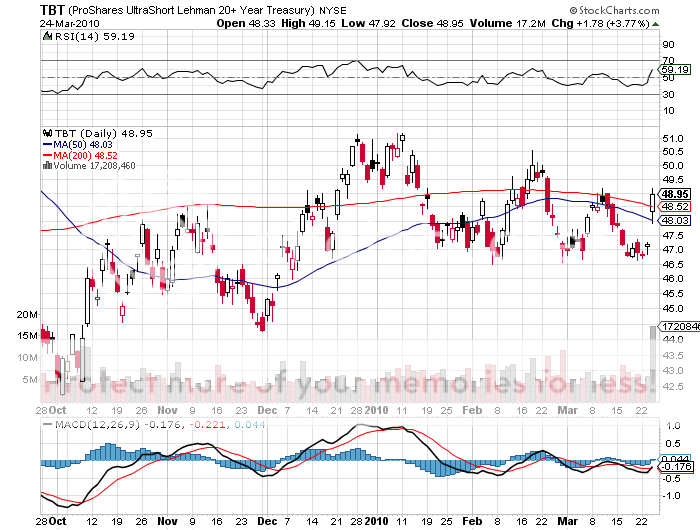
Shorting the world's most overvalued asset has got to be the big trade for 2010. I'm talking about 30 year US Treasury bonds. The relentless whirring of the printing presses is so loud that they keep me awake at night, even though, according to Mapquest, I live 2,804.08 miles away. What will be unique with this meltdown is that it will be the first collapse of a bond market in history in a deflationary environment. It is not inflationary fears that will execute the coup de grace for the long bond, it will be the sheer volume of issuance. The Feds have to sell nearly $2 trillion of debt to cover a massive budget deficit and to refund maturing paper, easily the largest amount in history. Pile on top of that billions more in offerings from states and municipalities bleeding white. By end 2010 total government debt will rocket to a staggering 350% of GDP. At some point, the world runs out of buyers, and the long bond yields will begin their inexorable climb from the current 4.6% to 5.5%, 6%, or higher.?? Even Moody's is talking about a ratings downgrade for the US debt, not that we should give that disgraced institution any credibility whatsoever. It's just a question of how many sticks it takes to break a camel's back. I am a worshipper of the TBT, a 200% leveraged bet that long bonds are going down. It has clawed its way back up from $43 to $51, and $60 looks like a chip shot for the first half. Longer term this ETF could hit $200. If interest rates double from the current levels, a virtual certainty, so does America's debt service, from the current 11% to 22% of the budget. That's when the sushi really hits the fan.
Corporate debt, which see interest rates moved more by credit quality considerations than the yield curve, will continue to trade like high yielding equities, as they did for most of 2009. After last year's cornucopia of bankruptcies, investors are also showing a preference for paying up for
securities more senior in the capital structure. That means you're going to have to employ an equity type strategy for this corner of the fixed income market. The global liquidity surge that free money is spawning will boost corporate bonds as much as equities, knocking yields down further. And with the world still in risk accumulation mode, that augers well for the riskiest corner of asset class ? junk bonds, whose default rates are not coming in anywhere near where they were predicted just a few months ago. Buy the junk ETF's like JNK, PHB, and the HYG here for a trade. Just don't forget to unload at the first sign of an equity market collapse.
4) Currencies (FXC), (FXA), (BNZ), (CYB)
Any trader will tell you to never bet against the trend, and the overwhelming direction for the US dollar for the last 230 years has been down. The only question is how far, how fast. Going short the currency of the world's largest borrower, running the greatest trade and current account deficits in history, with a diminishing long term growth rate is a no brainer. But once it became every hedge fund trader's free lunch, and positions became so lopsided against the buck, a reversal was inevitable. We seem to be solidly in one of those periodic corrections, which began a month ago, and could continue for several more months. The euro has its own particular problems, with the cost of a generous social safety net sending EC budget deficits careening. Just look at Greece, with a budget deficit of 12.7% of GDP against the 3% it promised on admission to the once exclusive club. Unwinding of 'hot' longs could easily take us into the $1.30's against the euro, and new momentum driven longs could take us to the $1.20's. Use this strength in the greenback to scale into core long positions in the currencies of countries that are major commodity exporters, boast rising trade and current account surpluses, and possess small consuming populations. I'm talking about the Canadian dollar (FXC), the Australian dollar (FXA), and the News Zealand dollar (BNZ), all of which will eventually hit parity with the dollar. Think of these as emerging markets where they speak English, best played through the local currencies. If you're looking for a risk controlled pairs trade, I vote for going long the Canadian dollar and short the Euro at ???1.40. For a sleeper, buy the Chinese Yuan ETF (CYB) for your back book.
5) Commodities (FCX), (VALE), (RIG), (JOY), (CCJ), (FSLR), (UNG), (USO), (MOO), (DBA), (MOS), (MON), (AGU), (POT), (PHO), (FIW)
This is my favorite asset class for the next decade, as investors increasingly catch on to the secular move out of paper assets into hard ones. Don't buy anything that can be manufactured with a printing press. Focus instead on assets that are in short supply, are enjoying an exponential growth in demand, and take five years to bring new supply online. The Malthusian argument on population growth also applies to commodities; hyperbolic demand inevitably overwhelms linear supply growth. Of course, we're already eight years into what is probably a 20 year secular bull market for commodities and these things are no longer as cheap as they once were. So you are going to have to allow these things to breathe. Ultimately this is a demographic play that cashes in on rising standards of living in the biggest and highest growth emerging markets. You can start with the traditional base commodities of copper and iron ore. The derivative equity plays here are Freeport McMoRan (FCX) and Companhia Vale do Rio Doce (VALE). Add the energies of oil, coal, uranium, and the equities Transocean (RIG), Joy Global (JOY), and Cameco (CCJ). Crude (USO) has in fact become the new global de facto currency (along with gold), and probably $30 of the current $78 price reflects monetary demand, on top of $48 worth of actual demand from consumers. That will help it spike over $100 sometime in 2010. Don't forget alternative energy, which will see stocks dragged up by the impending spike in energy prices. My favorite here is First Solar (FSLR). Skip natural gas (UNG), because the discovery of a new 100 year supply from fracting and horizontal drilling in shale formations is going to overhang this subsector for a long time. The food commodities are probably among the cheapest resources around, with corn, wheat, and soybeans coming off the back of bumper crops in 2009, and can be played through the futures or the ETF's (MOO) and (DBA), and the stocks Mosaic (MOS), Monsanto (MON), Potash (POT), and Agrium (AGU). Through an unconventional commodity play, the impending shortage of water will make the energy crisis look like a cake walk. You can participate in this most liquid of asset with the ETF's (PHO) and (FIW).
6) Precious Metals (GLD), (SLV), (PTM)
With gold's?? whopping great $150, 12% pull back from the all time high in the past month, I have been deluged by readers asking if this was the peak, if it was the final blow off top, and if gold is finished as an asset class. My answers are no, never, and not on your life. Obama has not suddenly become a paragon of fiscal restraint. Bernanke has not morphed into a tightwad overnight. When I pull a dollar bill out of my wallet, it's as limp as ever. If you forgot to buy gold at $35, $300, or $800, another entry point is setting up for those who, so far, have missed the gravy train. We could be seeing a replay of 2008-2009, where the yellow metal traded in a sideways range for many months before blasting through to a new all time high and quickly tacking on 25%. Start scaling in around $1,040. That's where the Reserve Bank of India started the recent love fest for the barbaric relic with its 200 ton purchase in November. If the institutional world devotes just 5% of their asset to a weighting in the yellow metal, and an emerging market central bank bidding war for gold reserves continues, it has to fly to at least $2,300, the inflation adjusted all time high, or higher. ETF players can look at the 1X (GLD) or the 2X leveraged gold (DGP). I would also be using the current bout of weakness to pick up the high beta, more volatile precious metal silver (SLV) and platinum (PTM), which have their own long term fundamentals working in their favor.
7) Real Estate (ESS)
The agony is going to continue in this world of hurt, and any allocation to either residential or commercial real estate is going to be dead money for the next decade. If you strip away the industry fig leaves, and ignore the paid apologists, the excesses in this sector are truly of Biblical proportions. 'Official,' shadow, and bank inventories, and another 1.5 million imminent option arm induced foreclosures, probably mean there is five years worth of supply out there. Fannie Mae is taking down 75% of the new mortgage in the secondary market, and the FHA is taking almost all of the rest, and there is no way the socialization of the mortgage market can continue indefinitely. The jumbo market has ceased to exist, and it is raining McMansions in tony neighborhoods everywhere. The demographic pressure of 80 million retiring and downsizing baby boomers easily add another five years. The commercial
sector is even worse, with valuations off 50%, some 5% of the industry's $1.8 trillion loan book in default, and cap rates soaring from 5% to 8-9%. The refinancing needs of this industry are gargantuan, and except for some triple 'A' paper taken down by the TALF, there is no bid other than from the vultures inhabiting the distressed world. And no one seems to be taking into consideration the fact that huge chunks of the office market are being permanently emptied out by the Internet, which is sending people home to work, transferring their jobs overseas, or vaporizing them altogether. If the liquidity induced surge in stock prices continues, I might even be enticed into shorting some of the big listed REITS, like Essex Properties (EES), which has nearly doubled from its lows, and is choking on its high prices California exposure. Only buy a home if your wife is nagging you about living in that cardboard box under the freeway overpass. But expect to put up your first born child as collateral, and bring in your entire extended family in as cosigners, if you want to get a bank loan.
Global Market Comments
December 24, 2009
Featured Trades:
(HEDGE FUND RADIO)
1) My guest on Hedge Fund Radio this week is David Gurwitz, the engaging and highly entertaining managing director of Charles Nenner Research, and a long time hedge fund industry veteran. Charles graduated from the famous Bronx High School of Science, and promptly tried out as a professional baseball player for the Montreal Expos. He struck out there, but did later play professional basketball in Europe. His financial career began in 1981 when he became an international tax expert for the big 8 accounting firm, Coopers & Lybrand. He spent another 20 years as a financial consultant and merchant banker. He went into the research business with the famed Dutch technical analyst, Charles Nenner in 2002. David is also an accomplished concert pianist and is about to launch his second commercial CD, making him a true renaissance man. Hedge Fund Radio is broadcast every Saturday morning at 12:00 pm Eastern time, 11:00 am Central time, 9:00 am Pacific Coast Time, and 5:00 pm Greenwich Mean Time. For the online link to the live show, please go to www.bizradio.com, or click here , click on ?Listen Live!?, and click on ?Houston 1110 AM KTEK.?? For archives of past Hedge Fund Radio shows, please go to my website by clicking here.
December 23, 2009
Featured Trades: (INTERVIEW WITH SANTA CLAUS)
1) OK guys. I get the message. Yesterday?s letter elicited no less than 100 out-of-office replies. So I?m going to take the hint and disappear for a few days. It?s two days until Christmas, and I haven?t even put my outside lights up yet. I?ll be doing my research with my little kids while watching the Princess and the Frog, and with my older kids while viewing Avatar.? The mandarin oranges are ripe and due for picking, the raccoons have broken a hole through the back fence, and there?s a load of firewood to chop and stack. I guess I?ll take my Lionel train set out, the same steel cast one I played with myself 50 years ago, and see if I can interest my girls. I hope you all enjoy your Christmas festivities, where ever you are in the world. At last count, this letter was being read in 100 countries. My next letter will be sent on December 28, and I?ll be putting out an annual asset allocation review on January 4. Until then, please enjoy the hard hitting, one on one, tell all interview with Santa Claus I conducted just yesterday.
2) I managed to catch up with my old friend, Santa Claus, the other day, before he took off on his global gift giving rounds. I have had a rocky relationship with old Saint Nick over the years, usually getting coal or potatoes in my stocking, as one who lives a feckless life might expect. But one year I found a Mercedes S600 V-12 under the tree! I ended up giving it away because I didn?t like the cup holders, but hey, it was a nice thought! Things are not good at the North Pole. The cost of the software upgrade needed to switch from children?s handwritten letters to email has been a killer. And what the hell is Twitter? The First National Bank of the North Pole won?t let him roll over his debt because snow appraisals aren?t coming in like they used to. Labor costs are rocketing. Elves used to work for a few pieces of candy cane a day, but no more. Now they want black snowmobiles with chrome wheels, big screen TV?s, and Blue Ray HD players. There are rumors of a strike over health care costs, which are bleeding him snow white. The Amalgamated Confederation of Elves must be the only union that gets Viagra with their benefits, besides the United Auto Workers. And now they want free mistletoe, to boot! He?s going to have to skip the unfortunate children of Afghanistan and Iraq again because Obama?s budget cuts won?t allow the US Air Force to provide needed fighter cover. The price of reindeer food is going through the roof, thanks to Chinese hoarding, and Donner and Blitzen are down with the swine flu. Rising costs, lower revenues, and an unruly workforce are not a good business model. Since the government forced that TARP money down his throat, the green eye shades from the Treasury have been camping out in accounting. To top it all, compliance is telling him he?s being investigated for backdated stock options in Santa Claus Inc. All this while the debate rages on over whether he even exists. Tell that to the SEC! Coming on top of all the shareholder carping about his ten figure compensation package, and unlimited use of the corporate sleigh, he needs this like a hole in his head! To be honest, he would have retired by now if he had not invested so much of his savings with Bernie Madoff. Sure, it?s a brave new world out there, but no one ever said being Santa Claus was easy.
?Gold does not have a heart, nor does it have a soul,? said Mama Odie, a 200 year old sorceress in the Disney film The Princess and the Frog