

November 9, 2009
Featured Trades:
(OCTOBER NONFARM PAYROLL),
(TRADE SCHOOL), (RESIDENTIAL REAL ESTATE)
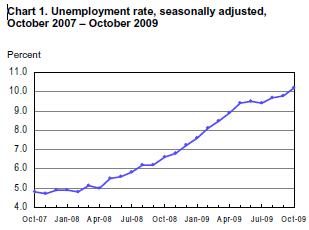
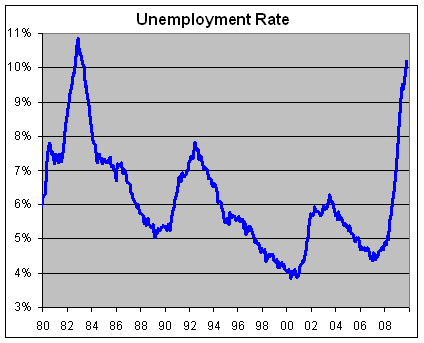
THERE'S A RECOVERY IN HERE SOMEWHERE, I JUST CAN'T FIND IT!

2) Every few weeks I get a warm and fuzzy feeling when I see my old house for sale in the Wall Street Journal. It was an 8,000 square foot two bedroom white elephant perched on a mountain peak, with panoramic 360 degree views of the San Francisco Bay Area. I picked it up for a song from the Sultan of Brunei in 1998, when crude crashed to $8/ barrel, and he was dumping properties to meet a cash flow crisis. The actor, Steve McQueen, had owned the property once, and the local teenagers used to park out front and make out, taking in the stunning view of the Golden Gate Bridge and shimmering city lights. The parties! Oh, the parties! But one day in 2005, my gardener, Jos??, mention that he had just obtained a $500,000 loan to buy a new place in which to house his seven kids, along with a home equity loan to cover the first year's mortgage payments. How would he make the next year's payments? The broker said the value of the house would go up, and he could then increase his home equity loan to cover that too. I knew I had to sell my home immediately, hitting the bid for a tidy $12 million, along with the rest of my real estate holdings. Regretfully, I had to let Jos?? go. I have been renting ever since. The last price I saw for my former 'Xanadu' was $7 million, or I could lease it for $19,500, which I know is 20% of its carrying cost. I'm not a person who normally wishes ill on people, but really, what were these buyers thinking? When people urge me to buy it back, I lie down and take a nap, and when I wake up, the feeling has refreshingly gone away. And to the pundits and prognosticators who tell me that we are about to launch into a 'V' recovery in residential real estate, just as the stock market has already done, I tell them I have this really neat bridge in Brooklyn that I'd like to sell them. And no, I won't be uttering the word 'rosebud' on my deathbed.

I am asked daily about my favorite financial books by the legions of subscribers who are using my blog to educate themselves about the markets. That is one of my goals. Below are my picks, which are entertaining, if not insightful. I have left out books about specific trading systems guaranteeing windfall profits, because they all eventually blow up. The good books on the current financial crisis have yet to be written. The best trading strategies will never be written about, but only whispered after work in poorly lit bars , the kind where your feet stick to the floor restrooms are foul. Successful traders are a notoriously secretive bunch who don't want copy cats hanging on to their coattails, spoiling their markets. When I do hear about these, I pass them on to you through my newsletter. Give yourself an edge as well as a decent education and foundation by reading the list below.
Security Analysis
by Benjamin Graham and David Dodd
The Bible of security analysis. If you are only going to read one book, make this it.
by Burton G. Malkiel
The history of risk analysis on Wall Street.
The Black Swan
by Nassim Nicholas Taleb
An iconoclastic, rock throwing, in your face rebuttal to convention risk analysis theory.
The Snowball: Warren Buffet and the Business of Life
by Alice Schroeder
The biography of the greatest investor of our time.
Extraordinary Popular Delusions and the Madness of Crowds
by Charles MacKay
The history of bubbles, from tulip mania, to the South Sea bubble, to the 1929 crash. Boy, does history ever repeat itself!
by John Kenneth Galbraith
A must read history about the big one. You'll be amazed by the parallels today.
Reminiscences of a Stock Market Operator
by Edwin Lefevre
Biography of one of the most famous speculators of the roaring twenties, who sadly committed suicide in a public bathroom in 1941. You won't believe what they did in the pre-SEC days.
The Strategic Bond Investor: Strategies and Tools to Unlock the Power of the Bond Market
by Tony Crescenzi
The bond side of the equation. You need to know where interest rates are going and how they will get there
Economics
by Paul Samuelson
What you missed by not going to the Harvard Business School. Your classic education about Keynesian economics that lets you ignore all that fluff in the broker reports. He got a Nobel Prize for this.
by Jim Rogers
The former George Soros partner tells you why you've been buying all that copper.
Crash Proof: How to Profit from the Coming Economic Collapse
by Peter Schiff
Nicely outlines the rationale for moving out of the dollar and into foreign stock mar
kets, gold, and silver, although he is a little extreme in his views of the future on the US.
Market Wizards: Interviews With Top Traders
by Jack D. Schwager
How the pros do it.
The Complete Guide to Investing in Commodity Trading and Futures: How to Earn High Rates of Return Safely
by Mary B. Holihan
The ABC's of commodity investing.
When Genius Failed: The Rise and Fall of Long Term Capital Management
by Roger Lowenstein
Why you're not shorting deep out of the money volatility in big size.
by Peter L. Bernstein
How ancient trade routes grew into the global financial system we all know and love.
Liars Poker: Rising through the Wreckage on Wall Street
by Michael Lewis
My friend's first book, what it is like to work at Goldman Sachs, except then it was Salomon Brothers. When it first came out many thought I had written this book with a nom du plume.
Beat the Dealer: A Winning Strategy for the Game of Twenty-One.
by Edwin O. Thorp
How to win at Black Jack by card counting. I put myself through college on this book, and so did Pimco's Bill Gross. Not so easy now. Every trader at Morgan Stanley was required to read this book. A nice introduction to probability analysis under stress.
The Money Game
by Adam Smith
How Wall Street Works. A peek into the Wall Street I grew up in during the sixties. How little has changed.
by Joel Greenblatt
The traditional value approach to picking stocks

QUOTE OF THE DAY
'It's amazing how the hawks got de-taloned going into the last meeting at the Fed,' said Yra Harris at Praxis Trading, about the agency's reluctance to raise interest rates for the foreseeable future.

MOST IDIOTIC QUOTE OF THE DAY
'Many economists think that rising unemployment benefits create rising unemployment,' said Larry Kudlow at CNBC. Most unemployed people I know would give their left arm to get a job. Maybe this is an insight into who Larry hangs out with.
Global Market Comments
November 6, 2009
SPECIAL DEMOGRAPHIC ISSUE
Featured Trades: (EEM), (VNM)
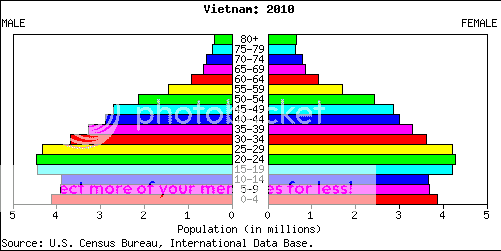
1) Desperate homeowners counting on a 'V' shaped recovery in residential real estate prices to bail them out better first take a close look at global demographic data, which tells us there will be no recovery at all. I have been using the US Census Bureau's population pyramids as long leading indicators of housing, economic, and financial market trends for the last four decades. They are easy to read, free, and available online at http://www.census.gov/. It turns out that population pyramids are something you can trade, buying the good ones and shorting the bad ones. These graphical tools told me in 1980 that I had to sell any real estate I owned by 2005, or face disaster. No doubt hedge fund master John Paulson was looking at the same data when he took out a massive short in subprime securities, earning himself a handy $4 billion bonus in 2007. To see what I am talking about, look at the population pyramid for Vietnam. This shows a high birth rate producing ever rising numbers of consumers to buy more products, generating a rising tide of corporate earnings, leading to outsized economic growth without the social service burden of an aged population. And what happened 40 years ago? The Vietnam War, where two million young people were killed who otherwise would have been enjoying their gold years now. This is where you want to own the stocks and currencies.
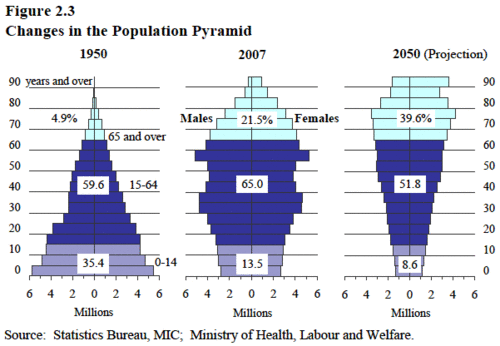
2) Now look at the world's worst population pyramid, that for Japan. These graphs show that a nearly perfect pyramid drove a miracle stock market during the fifties and sixties which I remember well, when Japan had your model high growth emerging market economy. That changed dramatically when the population started to age rapidly during the nineties. The 2007 graph is shouting at you not to go near the Land of the Rising Sun, and the 2050 projection tells you why. By then, a small young population of consumers with a very low birth rate will be supporting the backbreaking burden of a huge population of old age pensioners. Every two wage earners will be supporting one retiree. Think low GDP growth, huge government borrowing, deflation, and a terrible stock and housing markets. Dodge the bullet.
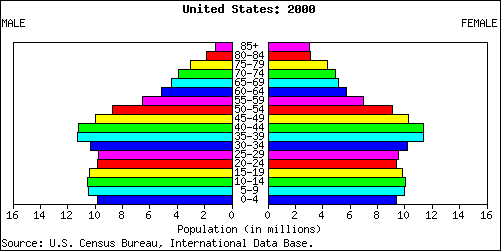
3) If demographics truly is destiny, then America's future sucks. Brace yourself. We are turning into Japan. As a silver tsunami of 80 million baby boomers retires, they will be followed by only 65 million from generation 'X'. The intractable problems that unhappy Japan is facing will soon arrive at our shores. Boomers, therefore, better not count on the next generation to buy them out of their homes at premium prices, especially if they are still living in the basement. They are looking at best at an 'L' shaped recovery, which means no recovery at all. The only thing that can possibly save us is a rising tide of immigration, bringing in more young workers. Oop's! The last administration did everything it could to shut out immigrants by building huge, multibillion dollar walls on our borders. What are the investment implications of all of this? Get your money out of America and Japan, and pour it into Vietnam, China, India, Brazil and Mongolia and other emerging markets with healthy population pyramids. You want the wind behind your investment sails, not in your face with hurricane category five violence. Use this dip to load the boat with the emerging market ETF (EEM).

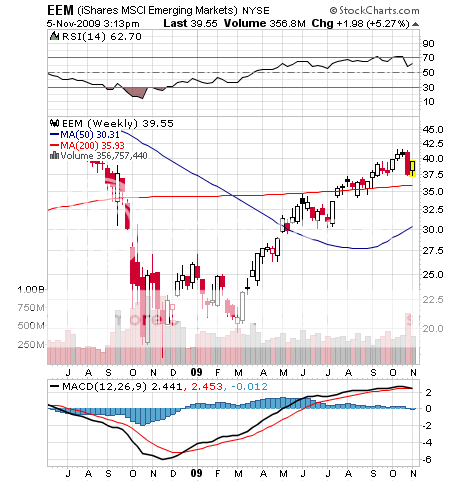
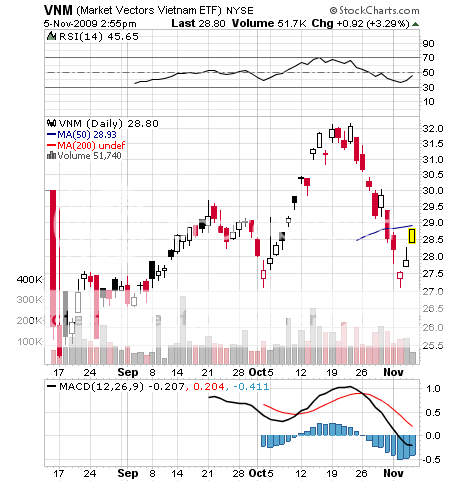
4) Now that we have figured out that Vietnam is a great place to invest, we welcome the news that the Van Eck group has launched its own Vietnam Index Fund (VNM). The venture will invest in companies that get 50% or more of their earnings from that country, with an anticipated 37% exposure in finance, and 19% in energy. This will get you easily tradable exposure in the country where China does its off shoring. Vietnam has been one of the top performing stock markets this year, at its peak rising by an amazing 110%.?? It was a real basket case last year, when zero growth and a 25% inflation rate took it down 78% from 1,160 to 250. This is definitely your E-ticket ride. Vietnam is a classic emerging market play with a turbocharger. It offers lower labor costs than China, a growing middle class, and has been the target of large scale foreign direct investment. General Electric (GE) recently built a wind turbine factory there. You always want to follow the big, smart money. Its new membership in the World Trade Organization is definitely going to be a help. Until now, the only way to get involved with this country was to go through the tedious process of opening a local currency brokerage account, or buy a region sub emerging market ETF. I still set off metal detectors and my scars itch at night when the weather is turning, thanks to my last encounter with the Vietnamese, so it is with some trepidation that I revisit this enigmatic country. Throw this one into the hopper of ten year long plays you only buy on big dips, and go there on vacation in the meantime. Their green shoots are real. But watch out for the old land mines.

If the Dow Jones Industrial Average rises by 4.5% a year for the next 90 years, the index will reach 525,000 by 2100, a 53 fold return.
Global Market Comments
November 5, 2009
Featured Trades: (FCX), (BIDU), (FXC), (USO),
(BERNIE MADOFF), (IAN BREMMER)

2) Ian Bremmer, President of the Eurasia Group, the world?s preeminent independent risk control consultant, passed through town to promote his latest book, The Fat Tail: The Power of Political Knowledge for Strategic Investing. The book details how money managers must become cognizant of, and deal with, foreign laws, regulation, government turnovers, civil unrest, expropriation, terrorism, and war, in order to survive in this increasingly complex and interconnected world. Globalization ground to a screeching halt during the financial crisis. Governments are now more important than multinationals in influencing our economic future, and a new form of ?state capitalism? is emerging. We are shifting from a unipolar to a nonpolar world. Iraq is morphing from war into a peace keeping operation, while Afghanistan is rapidly moving in the opposite direction. Geopolitical risks are rising. With crude at $80 a barrel there is no Iran premium currently in the market, and $20-$30 could price in very quickly. China and Brazil are the long term winners in the new set up, and the dollar is the big loser. The greatest risk to the US is its overdependence on borrowing from China. This is a must read book for any hedge fund manager struggling with his global risk exposure and looking for some great long term plays.

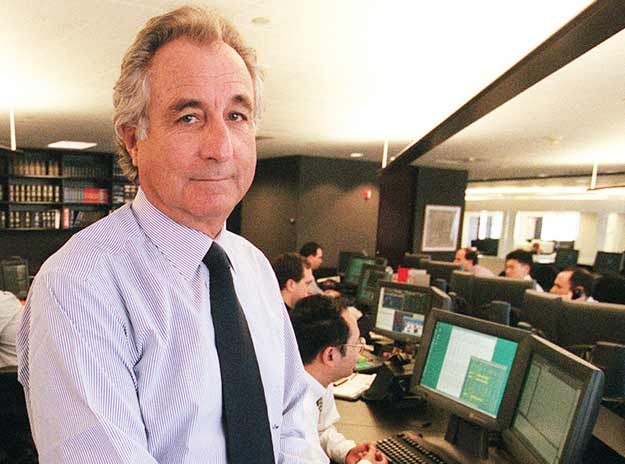
3) I spent a sad and depressing, but highly instructional evening with Dr. Stephen Greenspan, who had just lost most of his personal fortune with Bernie Madoff. The University of Connecticut psychology professor had poured the bulk of his savings into Sandra Mansky?s Tremont feeder fund; receiving convincing trade confirms and rock solid custody statements from the Bank of New York. This is a particularly bitter pill for Dr. Greenspan to take, because he is an internationally known authority on Ponzi schemes, and just published a book entitled Annals of Gullibility-Why We Get Duped and How to Avoid It. It is a veritable history of scams, starting with Eve?s subterfuge to get Adam to eat the apple, to the Trojan horse and the Pied Piper, up to more modern day cons in religion, politics, science, medicine, and yes, personal investments. Madoff?s genius was that the returns he fabricated were small, averaging only 11% a year, making them more believable. In the 1920?s, the original Ponzi promised his Boston area Italian immigrant customers a 50% return every 45 days. Madoff also feigned exclusivity, often turning potential investors down, leading them to become even more desirous of joining his club. For a deeper look into Greenspan?s fascinating, but expensively learned observations and analysis, go to his website at www.stephen-greenspan.com.

4) It?s been a busy year. Call me a celebrity groupie, but I never fail to garner valuable market insights from these meetings, which I happily pass on to you.? I am including below a list of interviews that I have conducted with important market movers this year. To access each interview, just type the name into my data base search function by clicking here .
Robert Reich-former Secretary of Labor-January 14
David Hale-CEO of David Hale Global Economics-February 13
Arnold Schwarzenegger-Governor of California-March 13
Jim Lehrer-National Public Radio anchor-April 8
Nancy Pelosi-Speaker of the House-April 16
Dr. Paul Ehrlich-Stanford University population expert-April 17
Dr. Robert Heller-former Governor of the Federal Reserve and CEO of VISA-April 30
Jack Welsh-for CEO of General Electric-May 12
Ian Bremmer? The Eurasia Group- May 15
Richard Haas-President of the Council of Foreign Relations-May 21
Ellen Tauscher-Undersecretary of State-May 29
Carl Pope-President of the Sierra Club-June 12
Christine Romer-Chairperson of the Council of Economic Advisors-June 9
Bill Gates, Sr.-Trustee of the Bill and Melinda Gates Foundation-June 19
George Schultz-former Secretary of Treasury, State, and White House chief of???? Staff-June 19
Janet Yellen-President of the San Francisco Fed-July 2
Neil MacFarquar-Cairo Bureau Chief for the New York Times-July 6
David Petraeus-Commander of the US Central Command-July 13
T. Boone Pickens-CEO of BP Capital Management-August 6
Steve Forbes-CEO of Forbes Magazine-September 1
John Garamendi-Congressman for the California 10th congressional district- September 23
David Wessel-Economics Editor for the Wall Street Journal-September 23
Bill Clinton-President of the United States-October 9
David O?Reilly-CEO of Chevron-October 12
Robert Mueller-Director o
f the FBI-October 12
Helen Thomas-White House Press Corp-October 15
Bill Fleckenstein-Hedge fund Manager-October 19
Barrack Obama-President of the United States-October 20
Zachary Karabell-President of River Twice Research-October 26
Leon Panetta-Director of the CIA-October 27
Malcolm Gladwell-Columnist for the New Yorker Magazine-November 2
QUOTE OF THE DAY
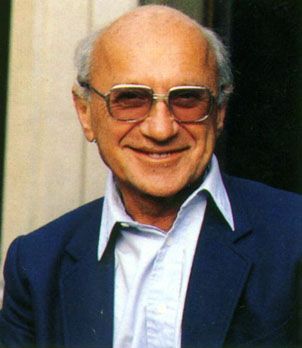
?The Fed only knows two speeds; too fast, and too slow,? said Nobel Prize winning economist Milton Friedman to me over lunch one day.
November 4, 2009
(UNP), (CSX), (KCSR), (OBAMA), (HEDGE FUNDS)
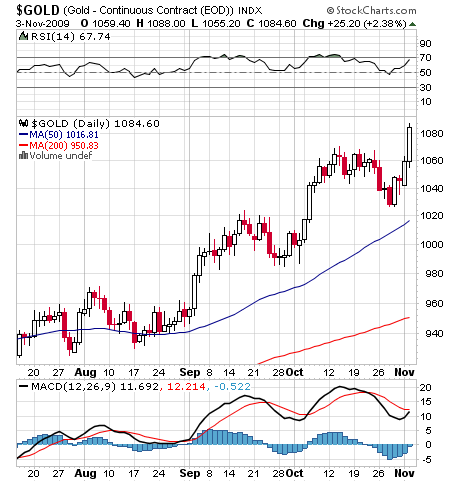
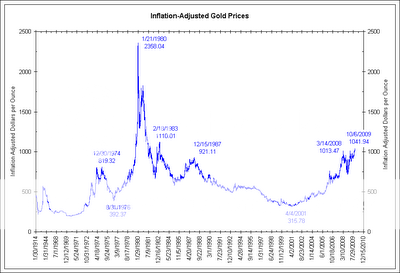
1) News broke this morning that, out of the blue, the Reserve Bank of India bought 200 metric tonnes of gold from the IMF for a handy $6.8 billion. The news set the gold market on fire, boosting the December futures $40 to an all time high of $1,088. It is the largest transaction in the barbaric relic since the Alaric's Visigoths sacked Rome in 410 AD. It has been public knowledge for some time that the IMF was looking to unload 403 tonnes of the yellow metal in order to fund lending to poor countries. Many traders say this threatening overhang is why gold failed to definitively break out to the upside this year, despite six attempts. The expectation was that China would take this hoard as part of a broader diversification away from the dollar. Bringing India into the fray, which had no prior history of stockpiling gold, is a whole new plate of basmati rice. Not only does this raise the prospect of a bidding war with China for more gold reserves, other cash rich emerging market central banks are likely to join the mosh pit as well, no doubt panicked by the ominously rising whirr of printing presses in the developed countries. My short term goal for gold was $1,200, but I now have to raise that to the $1,300 favored by some chartists in view of the new dynamics. If you want to see my long term target, take a look at the chart below, which has gold zeroing in on its inflation adjusted all time high of $2,358. For those who prefer holding the barbaric relic of the physical kind, visit the tightest spreads in town on American Eagles and bullion by clicking here at http://www.millenniummetals.net/ . And while you?re there, sign up for their free research product on precious metals.

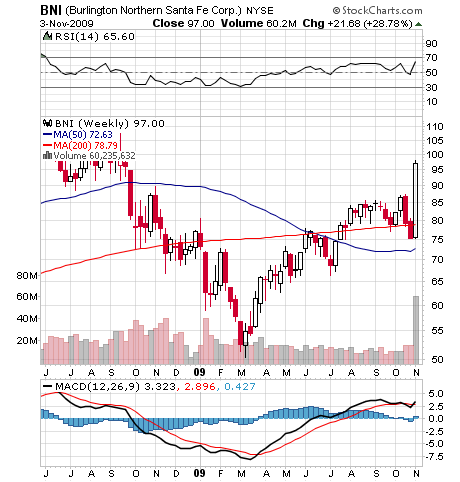
2) You've got to hand it to Warren Buffett, who never does anything half heartedly. The stunning news that his Berkshire Hathaway (BRK/A) is paying $44 billion for the 73.4% of Burlington Northern Sante Fe (BNI) he doesn't already own, a 30% premium, had punch drunk traders picking themselves off of the floor. The other rails rocketed, like Union Pacific (UNP), CSX (CSX), and Kansas City Southern (KCSR). The deal is the Oracle of Omaha's largest in his career, and took the BNI board all of 15 minutes to approve. For me this deal speaks volumes about the long term trends in the US economy as seen by its greatest investor. It screams Commodities! Commodities! Commodities! Rails can only prosper moving bulk freight from the heartland to ports on the three coasts, which foreigners are buying in ever larger quantities at ever higher prices. It also says the coal industry isn't going anywhere soon, as it accounts for 70% of all rail traffic, so you can kiss Cap & Trade goodbye. Buffet let loose of some fascinating statistics about the enormous productivity increases the industry has accomplished. In the last 25 years, it cut employment from 500,000 to 175,000, while increasing freight by 60% and reducing track by 40%, and now accounts for 40% of the total goods moved in the country. Railroads are the greenest transportation out there, a ton of freight requiring only a gallon of fuel to move 470 miles. When I was growing up, my big goal in life was to become a train engineer. Maybe it's time for me to revisit that aspiration. And I promise not to text while driving!

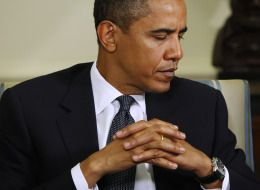
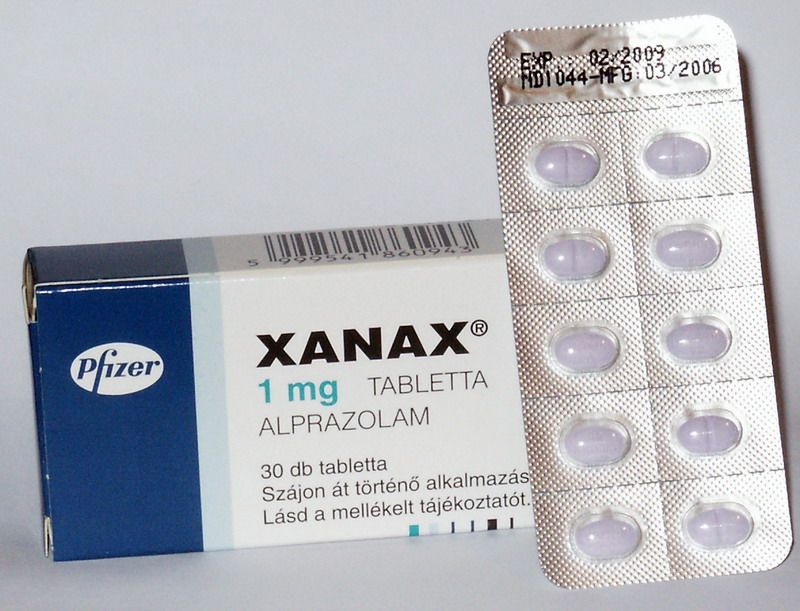
3) I know what keeps Obama awake at night. Let's say we spend our $2 trillion in stimulus and get a couple of quarters of weak growth. Then once the effects of the stimulus wear off, we slip back into a deep recession, setting up a classic 'W.' Unemployment never does stop climbing. This happened to Roosevelt in the thirties. So congress passes another $2 trillion reflationary budget. Everybody gets wonderful new mass transit upgrades, alternative energy infrastructure, and bridges to nowhere. But with $4 trillion in spending packed into two years, inflation really takes off. The bond market collapses, the dollar tanks big time, gold goes ballistic to $5,000, and silver explodes to $50. Ben Bernanke has no choice but to engineer an interest rate spike, taking the Fed funds rate up to a Volkeresque 18%. Housing, having never recovered, drops by half again. This all happens in the 2012 election year. Obama is burned in effigy, a Mormon is elected president, and the Republicans, reinvigorated by new leadership, retake both houses of congress. We invade Iran. Crude hits $500. This is not exactly a low probability scenario. Remember Jimmy Carter? This is why junk bond yields are still stubbornly high at 12.5%, and credit default swaps live at lofty levels. Are the equity markets pricing in this possibility? No chance. The risk of Armageddon is still out there. Personally, I give it a one in three chance. Pass the Xanax.
4) The hedge fund industry is still emerging from the ashes of 2008, but will inevitably grab a larger share of the investing public's assets. Low interest rates and hero status made it way too easy for inexperienced, untested, and sometimes unscrupulous managers to raise new funds that charged management fees as high as 3%, with a 50% performance bonus. Behind every 'liar loan' was a bond manager happy to soak it up through securitized Fannie Mae (FNM), Freddie Mac (FRE), or bank debt, shorting Treasuries against them, and then leveraging the 40 basis point spread 50 times to generate a highly marketable 20% annual gross return. Never mind the risks. It was easy money, as long as there were lots of liars- which mortgage brokers herded in by droves, and as long as spreads narrowed-which they did for most of the 21st century. By the beginning of 2008, assets under management soared to $2 trillion. The melt down that followed wiped out large numbers of funds, and raised gates for the survivors, making investors wonder if they would ever get their money back. Total assets plunged to $1 trillion in the blink of an eye through a combination of redemptions and market losses. The new era that is emerging will be populated with humbled and chastened managers offering more disclosure, lower fees, no gates, and thanks to Madoff, oodles of third party oversight. Their portfolios will have less leverage, be invested in more liquid securities, and bring in lower returns. But the new generation will also offer investors battle tested strategies that survived the 100 year flood. Bridgewater, with $37 billion in assets, is now the largest hedge fund, followed by JP Morgan with $36 billion, Pauls
on & Co. at $27 billion, DE Shaw showing $26 billion, and Soros still at a hefty $24 billion. Long track records and a Gucci cachet will assure that these will prosper. Fees will settle down to the 1%/20% range. For the rest of us this means more capital bunching up in the most successful trades, as we have already seen this year in financials, China, oil, copper, and the multitude of short dollar plays. It is also going to be much harder to get new fund launches off the ground.

'I just basically believe that this country will prosper, and have more people moving more goods in 10, 20, and 30 years from now, and the rails should benefit,' said Warren Buffet, explaining why he is taking over Burlington Northern. What guts! Only Buffet would, at the age of 79, make a 30 year bet. Most men his age don't even buy green bananas.
Global Market Comments
November 3, 2009
SPECIAL ?END OF JAPAN? ISSUE
Featured Trades: (NIKKEI), (YEN), (JGB),
(ATLANTIS JAPAN GROWTH FUND), (LSE-AJG)
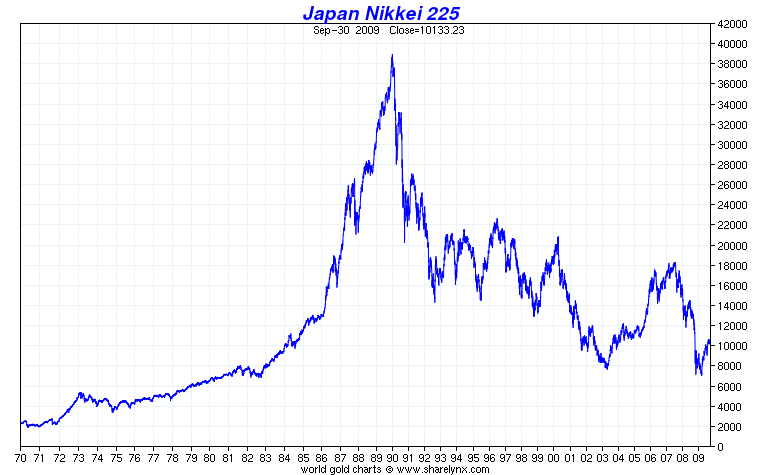
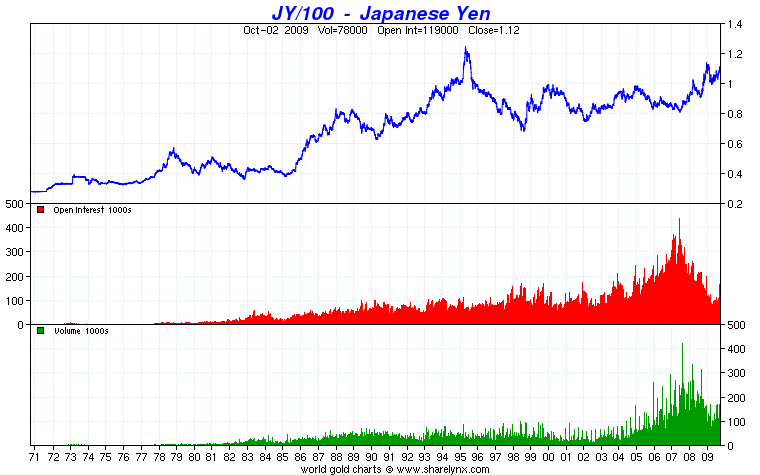
1)? Having spent a decade living in Japan sharing shoe box sized apartments, living on fish heads, rice, and instant ramen, I am something of an authority on that enchanting country. I spent the seventies toiling away learning Japanese, shuffling hundreds of flash cards whenever I rode the train or subways. My friends said I was crazy when I learned obscure, seemingly useless terms like hitokabu rieki (earnings per share) and genka shokyaku (depreciation). I even made the ultimate sacrifice to improve my fluency, taking a Japanese girlfriend, who later became a wife and mother. As with most bilingual families, discussions at the family dinner table were a mash up of Japanese and English, leaving visitors in the dark, as they only caught half the conversation.? Alas, my wife passed away too soon, and when my kids grew they complained how rotten my accent was, unaware that I had first learned it from the only free language school around, the bar girls and yakuza who attached themselves to stray foreigners. During the eighties, Japanese suddenly became the world?s most valuable language, as the stock market soared from ?6,000 to ?39,000, and PE multiples ballooned from 10 to 100, landing me a job at Morgan Stanley. A friend who delivered sandwiches for a living was even able to land a job at a special bracket firm because he had a reasonable fluency in this impossible to learn, 5,000 year old language. But languages rise and fall, as do civilizations, and I?m afraid that my language skills are getting downgraded to the relevance of Vulgar Latin. That?s what happened to our army of Vietnamese speakers, who could only land jobs in welfare offices after we pulled out our troops there, and Farsi speakers who ended up running Seven Elevens after the fall of the Shah. Japan is making new history in the demographic world, as they aren?t making Japanese anymore. There are now three workers supporting each retiree, and that is expected to drop to an impossible 2:1 over the next decade. That means no more money for expansive infrastructure projects, social services, and even debt service. More research on this last point to follow.

2) As much as I want to find a trade in Japan and therefore have an excuse to go there again, my searches have recently come up empty. With America maintaining its lead in innovation and the creation of new business models, and China taking over the world?s low end manufacturing, it is hard to see a future for Japan. Can a country of 127 million live only off of the high end manufacturing of luxury cars, video games, and electronics? The country is increasingly looking like a ?has been? emerging market. During my career, I watched GDP growth rates fall from a white hot 10% in the sixties, to 4% in the seventies and eighties, to 1% in the nineties and the early 21st century. Are we flat lining at 0% in the teens? That leaves fertile ground only for stock pickers who are willing to do the local spade work to find one hit wonders like Toyota and Fast Retail. That is a job best left to country specialists, like my old friend, 40 year veteran Ed Merner, who runs the Atlantis Japan Growth Fund (LSE-AJG) traded in London, which has shot up a sizzling 80% in six months.
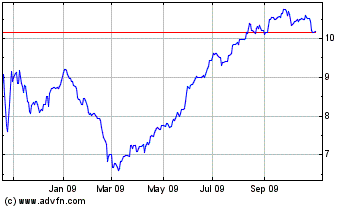

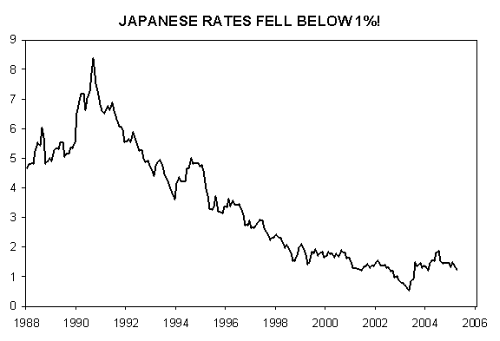
3) The collapse of the Japanese government bond market has long been the holy grail of the international hedge fund community. Unfortunately, it has remained just that for nearly 20 years, much talked about, unattainable, and some would say imaginary. During the early eighties, I took the entire pension fund of the Foreign Correspondents? Club of Japan out of US dollar bonds and put it into JGB?s, then yielding 10%, earning the eternal gratitude of the staff there. Even today, I am showered with free drinks and lunches when I visit Tokyo. After the 1990 stock market crash, JGB?s rocketed on a flight to safety bid, the ten year eventually reaching an unimaginable yield of only 0.46%. During this decade, we have largely traded in a 1.20% to 1.90% range. Every wave of government stimulus spending brought hopes of an imminent collapse in bond prices. But the country?s gun shy institutional investors weren?t buying it, and the end result was soaring national debt, a still stagnant economy, and 1,000 bridges to nowhere, some of them truly gigantic. Hedge fund guru, Julian Robertson, annually wrote a nine figure check to the JGB market anticipating a rate spike which never appeared. However, the day of reckoning for the JGB market may at last be coming. The savings rate has dropped from 20% during my time there, to a spendthrift 3%, because real falling standards of living leave a lot less money for the piggy bank. The national debt has rocketed to 200% of GDP, and 100% when you net out government agencies buying their own securities. Japan has the world?s worst demographic outlook. Now that the country is entering its third lost decade, unfunded pension fund liabilities are exploding. I?m not saying this is going to happen tomorrow. But when the break does come, you can expect the big hedge funds to dog pile in. And if JGB?s do go down the crapper, can the yen be far behind?
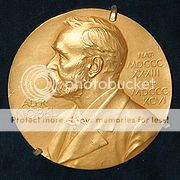
?It?s better to speak than to shoot,? said Thorbjorn Jagland, chairman of the Oslo based Nobel committee, in explaining why Obama was awarded the Peace Prize.
October 30, 2009
Featured Trades: (SPX), (TBT), (FISKER AUTOMOTIVE), (TAR SANDS)
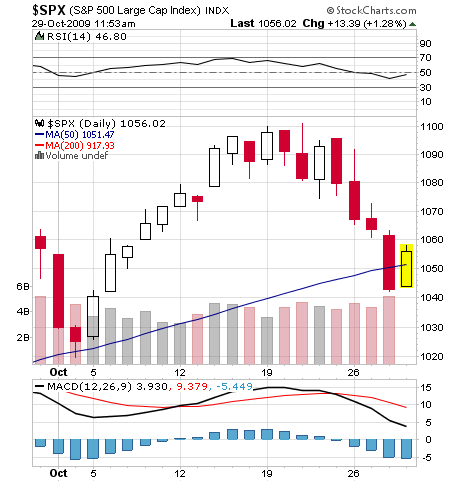
1) Those of you who heeded my GLOBAL RISK ALERT on October 13 (click here for report ) missed the top of the market by six trading days and 10 S&P points. I?m sorry; I?ll ring the bell more precisely next time, with a more accurate date and time. Since then, technical sell recommendations have been breaking out like acne at a junior year prom dance. You are all now out of your positions, or love them so much that you are willing to carry them through another crash. At the risk of hubris, even PIMCO?s Bill Gross has jumped on the bandwagon, although I doubt he needs my help ascertaining the direction of stocks and bonds. The way everything turned tail and ran at exactly the same time was a complete vindication of my theory that a tsunami of liquidity was raising all boats, completely unjustified by the underlying fundamentals. Long time readers of this letter know the only short I have advocated this year was in long dated Treasury bonds through the TBT. But the better than expected Q3 GDP of 3.5%, obviously fueled by temporary government programs like ?cash for clunkers? and the first time homebuyers tax credit,? may be presenting one of those pristine, ?sell on the news? moments. Will this data finally give us our long awaited double top? Fading rallies in stocks is looking more enticing by the day.
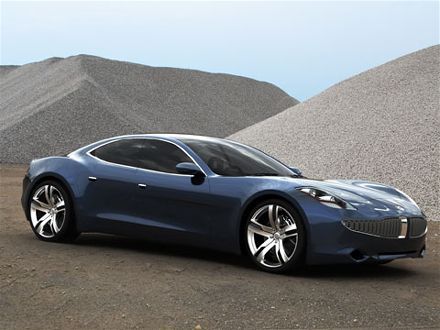
2) I can?t imagine a finer example? of? ?creative destruction? than Fisker Automotive?s takeover of a General Motors plant in Boxwood, Delaware that once built unwanted Pontiacs and minivans, but closed in July. The startup car maker will use a $528 million US government loan to build 100,000 plug-in hybrid electric cars a year that will sell for under $40,000. The firm?s Danish entrepreneur founder, Henrik Fisker, describes the new car as a ?green BMW.? The firm plans to export at least half its production. The Irvine, California based company is already building a high end electric sports sedan in Finland called the ?Karma? for $87,500. Joseph Schumpeter?s spirit must be smiling.
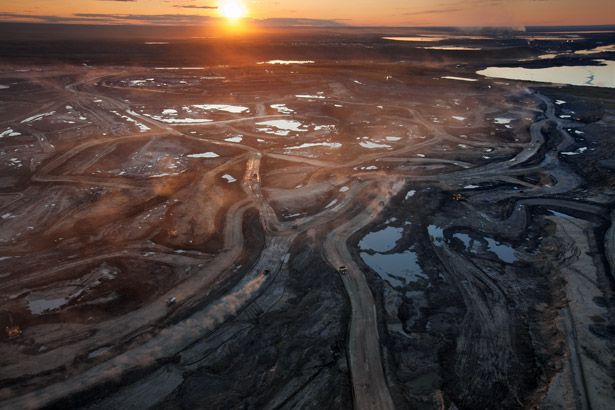
3) Anyone who has any illusions about the Canadian tar sands business should take a look at the March issue of National Geographic (click here), not normally a prime source of financial and economic news for me. I?m not a fanatic, sandal wearing, organic bean sprout eating environmentalist, but just looking at the glossy, eye opening pictures tells you that is this an eco disaster of Biblical proportions. A $50 billion investment by several firms over the last decade is now producing 750,000 barrels/day, and another $100 billion was headed north before prices crashed last year. You have to cut down a whole forest, remove two tons of peat, then another two tons of sand, and burn 100 barrels of oil equivalent to heat rivers of water to steam, just to produce a single miserable barrel of oil. This gives you the world?s highest production cost, thought to be $80-$100/barrel. There are now 50 square miles of sludge ponds in Northern Alberta leaching a witch?s brew of poisons into the water supply, which has caused the local cancer rate to explode tenfold. We?re not just talking about a few sick geese here. Canada is the largest foreign supplier of oil to the US, accounting for 19% of our total, and half of that is coming from tar sands. One can only assume that the whole industry was built as a hedge against some Third World War, Armageddon type total cut off of all foreign crude supplies that would drive prices to $500/barrel, making all of this hugely profitable someday. Maybe the owners think they can get away with this because it is in the middle of nowhere. An army of lawyers hitting these projects with a tidal wave of litigation think otherwise. After looking at these pictures and analyzing the numbers, you have to ask if it is really worth it, just so I can drive my Hummer to Wal-Mart.
QUOTE OF THE DAY
?Nobody in our industry was immune. Everybody has done a few deals which in hindsight we wish we hadn?t done. But you live and learn,? said David Rubenstein, Managing Director of the $86 billion private equity firm, the Carlyle Group

Global Market Comments
October 29, 2009
Featured Trades: (GOLD), (DOW), (BRAZIL), (EWZ)
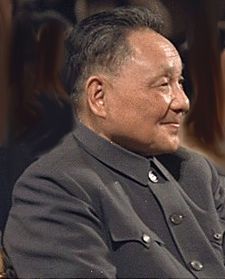
1) A few years ago, I went to a charity fund raiser at San Francisco's priciest jewelry store, Shreve & Co., where the well heeled men bid for dinner with the local high society beauties, dripping in diamonds and Channel No. 5. Well fueled with champagne, I jumped into a spirited bidding war over one of the Bay Area's premier hotties, who shall remain nameless. Suffice to say, she has a sports stadium named after her. The bids soared to $6,000, $7,000, $8,000. After all, it was for a good cause. But when it hit $10,000, I suddenly developed lockjaw. Later, the sheepish winner with a severe case of buyer's remorse came to me and offered his date back to me for $9,000.?? I said 'no thanks.' $8,000, $7,000, $6,000? I passed. The current altitude of the stock market reminds me of that evening. I have just had one of the best years of my career, and have cashed out of most of my positions so I can greedily await payment of my year end performance bonus. If you rode gold from $800 to $1,050, oil from $35 to $80, and the FXI from $20 to $40, why sweat trying to eke out a few more basis points, especially when the risk/reward ratio sucks so badly, as it does now? I realize that many of you are not hedge fund managers, and that running a prop desk, mutual fund, 401k, pension fund, or day trading account has its own demands. But let me quote what my favorite Chinese general, Deng Xiaoping, once told me: 'There is a time to fish, and a time to hang your nets out to dry.' At least then I'll have plenty of dry powder for when the window of opportunity reopens for business. One of the headaches in writing a letter like this is that while I publish 1,500 words a day for 250 days a year, generating about half the length of War and Peace annually, you really need to tinker with your portfolio on only a dozen or so of those days. So while I'm mending my nets, I'll be building new lists of trades for you to strap on when the sun, moon, and stars align once again. And no, I never did find out what happened to that date.
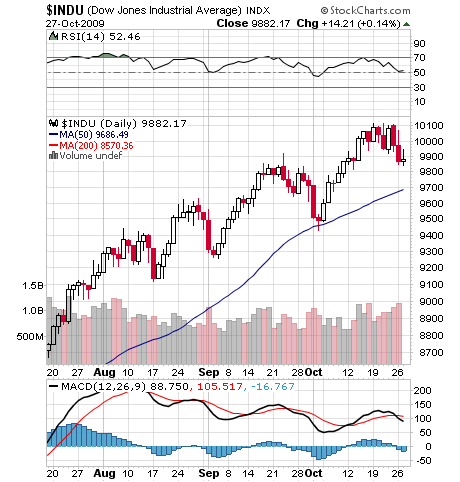
2) With the media going gaga over the imagined economic recovery, it's time to take another look at Ben Bernanke's exit strategy, or the lack of one. There is no doubt that a large part of our current financial stability is owed to massive Fed support of?? the entire spectrum of the debt markets and the forced recapitalization of the banks. If Ben vacates too soon, we'll descend back into the depths of Hell. If he hangs around too long, he'll be doling out massive dollops of hyperinflation. It's like having an annoying dinner party guest who you can't ditch because you need him to pay the bill. Fed watchers say the dilemma is as challenging as threading a needle in the dark while wearing pruning gloves. There are also the two 800 pound gorillas swept under the carpet named Fannie Mae and Freddie Mac, which are still major sources of home loans for the catatonic housing market. I'm glad it's his headache and not mine.

3) I've got to comment on Brazil's (EWZ) idiotic move last week to impose a 2% tax on real stock and bond purchases to scare off foreign investors. It's like firing off an emergency flare in the night and saying 'Come and get me.' If any portfolio manager was living in a cave for the past ten years and somehow missed the attractions of investing in an emerging market that exports food and energy, has an appreciating currency, and an almost perfect demographic profile, they can see it now, clear as day. This lunacy reminds me of Malaysia prime minster Mohamad Mahathir's rantings and ravings about George Soros's selling of his country's markets during the Asian financial crisis, when in fact, George was buying. I sympathize with Brazil's dilemma, similar to those of the Swiss during the eighties and nineties, when the whole world wanted to buy their currency, forcing the government in Berne to drive interest rates to zero, pushing domestic prices through the roof. But this is the price of economic success. Everyone wishes they had Brazil's problems. Better to just let things be.

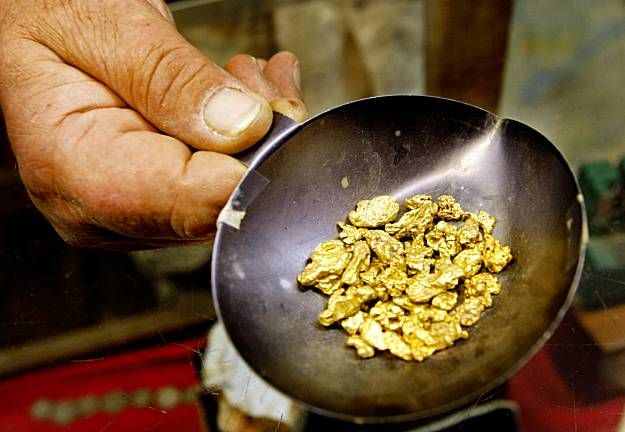
4) The gold rush is back on in California. On my way back from Lake Tahoe last weekend I saw that every bend of the American river was dotted with hopeful miners, looking to make a windfall fortune. Weekend hobbyists were there panning away from the banks, while the hardcore pros stood in hip waders balancing portable pumps on truck inner tubes, pouring sand into sluice boxes. A sharp eyed veteran can take in $2,000 worth of gold dust a day. The new 2009'ers were driven by a record price of gold at $1,066 and the attendant headlines, but also by unemployment, and recent heavy rains that flushes new quantities of the yellow metal out of the Sierras. They were no doubt inspired by the chance discovery of an 8.7 ounce nugget in May near Bakersfield, worth an impressive $9,200. Local folklore says that The Sierra's have given up only 20% of their gold, and the remaining 80% is still up there awaiting discovery. Out of work construction workers are taking their heavy equipment up to the mountains and using it to reopen mines that have been abandoned since the 19th century. The US Bureau of Land Management says that mining permits in the Golden State this year have shot up from 15,606 to 23,974. Unfortunately, the big money here is being made by the sellers of supplies and services to the new miners, much as Levi Strauss and Wells Fargo did in the original 1849 gold rush. Gee, do you think Wall Street is familiar with this concept?

'We get 150,000 job applications a year, and more when a James Bond movie comes out,' said Leon Panetta, Director of the CIA.

Global Market Comments
October 28, 2009
Featured Trades: (ROACH MOTELS) (FCX), (COPPER), (DOLLAR), (ALTERNATE RESERVE CURRENCY), (LONDON OLYMPICS)
1) This is how you trade this market. Buy the dips on any pull back in any asset, keep a tight stop loss, and run like Hell if it get?s triggered. No doubling up or leaning in. There is only one problem with this strategy. This is how the entire rest of the world is trading! So after the first couple of mouse clicks to the downside, the markets will seize up, as they did last year.?? Anyone with a position larger than the change under your living room sofa cushions won?t be able to get out. Portfolio managers will helplessly watch as their positions get marked down with no trade. The world has been borrowing dollars at zero and buying anything and everything, and the time to pay the piper is fast approaching.?? Dr. Nouriel Roubini, the Turkish economics professor at New York University whose recent negativity has brought him guru like status, made some interesting points yesterday. The Fed is keeping rates low to hasten a recovery before the next election, but Wall Street is jumping on the gravy train and avariciously coining it, creating a new bubble worse than the last one. When the inevitable synchronous global crash happens, it will make last year?s affair look like a walk in the park. There will be no place to hide. If we learned anything last year, it?s that the global capital markets have become Roach Motels. You can check in, but you can?t check out.
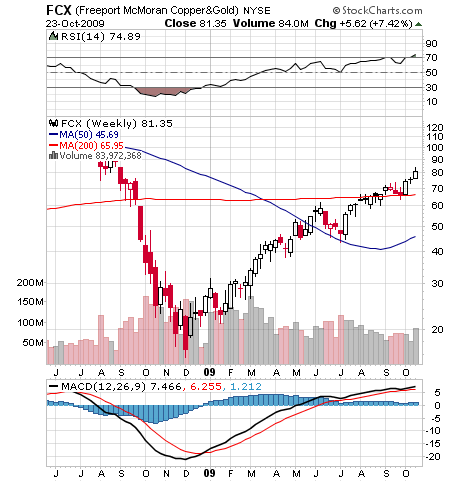
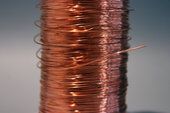
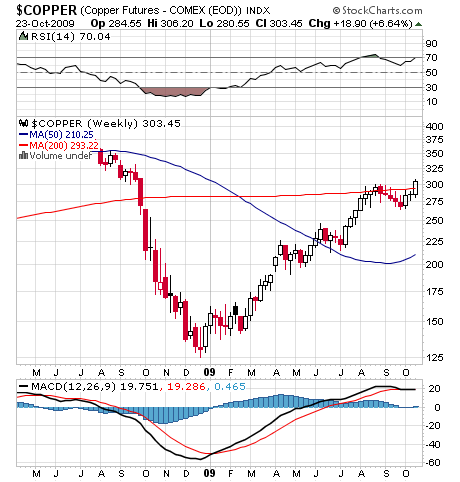
2)Last February, I told you I would kill myself if you didn?t buy the world?s largest copper producer, Freeport McMoRan (FCX) (click here for the call). OK, I exaggerate. I said I would throw myself in front of a train. Who knows, I might have survived the train. Since you all followed my advice, you are all now as rich as Croesus, as the stock has since gone parabolic, from $15 to $85, up 560%. Providing the rocket fuel for this move was copper?s leap from $1.25 to $3.00.?? CEO Richard Adkerson is the kind of burly, no nonsense kind of guy you might expect to find in an afterhours bar near one of the many open pits the company works around the world. Although Q3 revenues fell from $4.6 billion to $4.1 billion YOY, FCX has reinstated its dividend, and is clearly back in the catbird seat. China is importing record amounts of copper both for stockpiling and consumption by it explosively growing auto, consumer, infrastructure, and power industries. Record gold prices, which FCX also mines, are giving a further boost. Projects mothballed last year are back on track, and idle equipment is going back to work. When I was at Morgan Stanley during the eighties, any association with the red metal was considered career death, as it was in the grips of a 20 year bear market, trading as low as 60 cents. The guy who covered our big client in the sector was nice enough, but people avoided his table in the company cafeteria in the GM building like he had AIDS. I have to pinch myself when I see copper?s performance today. I wonder where that guy is now?
3) Will people pleeease stop incessantly nattering about the possibility of China dropping the dollar as a reserve currency? What else are they going to use? Monopoly money? Taiwanese dollars? Collectable postage stamps? At $2.3 trillion and rising fast, the Middle Kingdom?s reserves are so enormous that no other currency in the world could accommodate the switch, and no other security offers the necessary depth and liquidity but US Treasuries. China only needs to breathe on any other market for it to skyrocket, we have seen in the relatively Lilliputian commodity markets this year. And really, how likely is it that China embarks on radical new monetary policies that suddenly halves the earnings of it?s exporters, as well as its 30 year hoard of accumulated savings? The demise of the dollar has been predicted more often than the ditching of Microsoft?s Windows as the global PC operating system, and is just as likely.?? Hate the greenback as much as you like, but there just isn?t any other alternative. I have been hearing these arguments ever since the US went off the gold standard in 1971. First there was a perennial Arab threat to price crude in a basket of currencies. Gee, they never seem to complain when the buck is going up. Then there was the speculated emergence of the ?Yen Block?, in the eighties, back when Japan was dominating international trade and the yen was bumping up against ??80 to the dollar. Remember the book ?Japan as Number One? What a laugh. Then we got all that European whining after the launch of the euro, when the weak dollar was every trader?s free lunch. Let?s face it, Europeans hate using someone else?s currency as the primary reserve instrument. Before the dollar, sterling was the de facto reserve currency, and was equally despised. So rather than waste time discussing this issue anymore, let?s talk about something more important, like who is going to win the World Series this year. I?m wearing my Yankees hat.

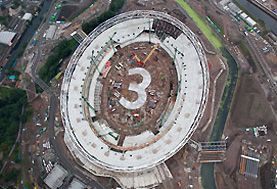
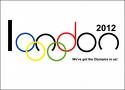
4) With the British economy mired in a vicious recession, many are wondering if hosting the 2012 London Olympics was such a great idea. The original plan was to convert the one square mile, Lower Lea Valley site into a new suburb, and sell the condos to hungry buyers at high prices. Market conditions today couldn?t be more hostile. Runaway cost overruns have pushed the budget from $2.8 billion to a back breaking $9.3 billion. The East London neighborhood is so bad that ?when you take the tube out there, life expectancy declines with every stop,? said one staffer. A profusion of undiscovered WWII bombs, a stone age cemetery, and a toxic waste dump have also caused delays. When I lived in England I flew over this area weekly to skirt the Eastern edge of the London air traffic control zone, and I will be charitable in calling this place an industrial wasteland. The last time the British attempted a major project like this, the 2000 Millennium Park, multibillion dollar losses resulted. But who can forget that great film Chariots of Fire? Maybe it?s worth it for the Brits after all?
?We cannot continue to run trillion dollar deficits and remain a powerful nation,? said Leon Panetta, Director of the CIA
October 27, 2009
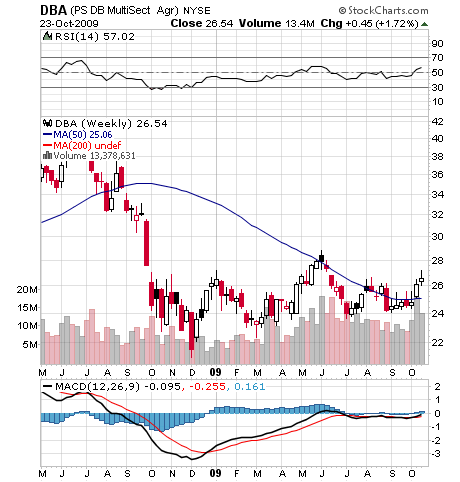
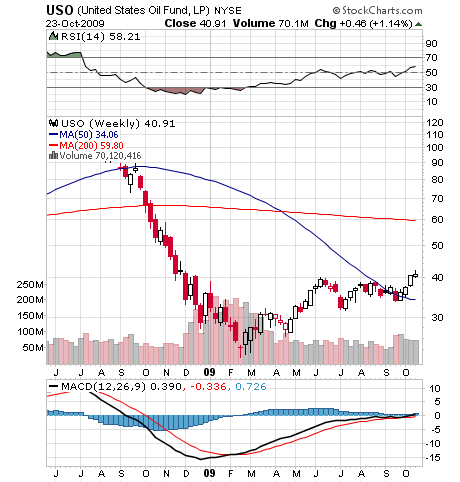
Featured Trades: (CIA), (TBT), (DBA), (FCX), (USO), (TM), (CVX), (XTO), (RSX), (GOOG), (BIDU)

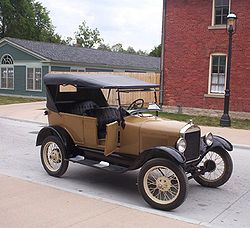
2) That unappreciated source of great investment ideas, National Geographic magazine, has a short piece on the infrastructure that will be needed to support the coming electric car boom in its November issue (click here for the full story at http://ngm.nationalgeographic.com/). Dozens of different plug-in hybrid and?? electric cars are about to hit the market, most of which run out of juice in 40 miles, needing a vast recharging network which doesn?t yet exist. If the main fuse on my house blows whenever my daughter uses her hairdryer, how am I supposed to top up my plug-in Toyota Prius, which will need an eight hour charge? California always lives perilously close to brown outs. What happens when you throw a million electric cars into the mix? The answer will be unique to each family, depending on their own personal transportation needs. Those driving cars from Better Place in the San Francisco area from next year will simply drive though a car wash type facility, where a new battery is swapped while the driver is sipping a fresh latte. Home ?smart meters? will take advantage of variable electricity pricing that will charge cars only at night when power is cheaper. The 240 volt outlet that you already have to run your dryer or hot tub will halve the charging time. Gas stations along major interstates will soon start offering hefty 480 volt ?quick charge? plugs where a recharge can be had in as little as 20 minutes. Alternative energy naysayers rightly complain that electric car enthusiasts are blind to these complex realities. But in 1908 you had to go to a drug store to buy a one gallon tin of gasoline to power your model T, yet 17 years later there were 25,000 gas stations across the US, and that?s when most had to be built using a horse and wagon.
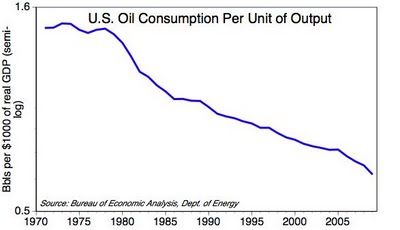
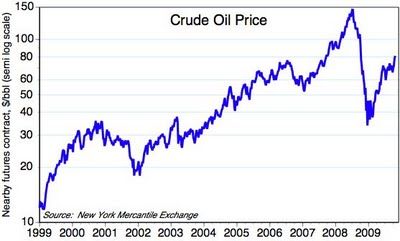
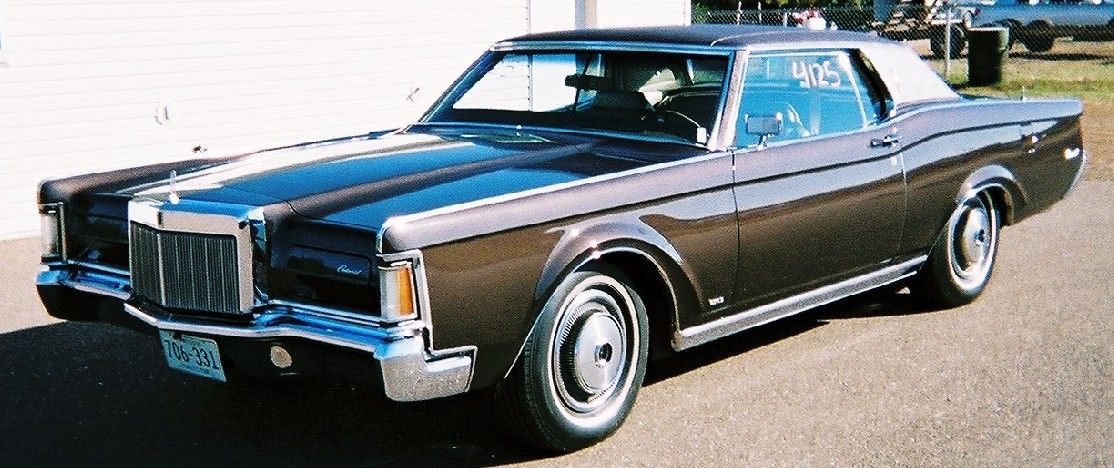
3)If you think oil is expensive here at $80, look again. The Department Energy chart below of US oil consumption per unit of output shows that, in fact, we are at a 40 year low in the price of crude. In other words, it takes half as much oil to produce a unit of GDP than it did in the late sixties, when 12 miles per gallon was considered reasonable, and only Lincoln Continentals got abused because they consumed a gluttonous six miles per gallon. This is the why current lofty prices are having a negligeable effect on a reviving economy. The other chart shows the price of oil in inflation adjusted terms. Again, we are at the high end of the range, but nowhere near the top. What?s the lesson in all of this? If the price of oil is not hurting now, then it will move a lot higher to where it does hurt big time. When the US gets back on track, and the emerging markets return to firing on all 12 cylinders, triple digit oil is a gimme, and new highs will easily be attainable. Then you can expect the current perfect correlation between rising stock and crude prices to shatter. Make sure you maintain exposure to the oil patch, either through majors like Chevron (CVX) (click here ), oil service companies like XTO Energy (XTO) (click here ), the Russian market ETF (RSX) (click here), or just the plain vanilla Oil Trust ETF (USO). If noting else, these names will help immunize your portfolio against the certainty of higher fuel prices. If you are wondering where the ?W? recession might come from, this is it.
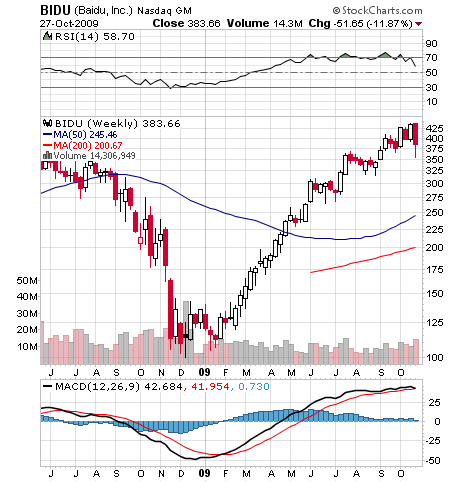
4) If you think Google (GOOG) has a great future (click here for my recent update), then you?ll love Baidu (BIDU), which is Google on Viagra. With economic growth for China exploding a sizzling 8.9% in the recent quarter, it can mean only one thing for the Chinese Internet provider. The business for banner ads is booming, and with that comes expanding margins as economies of scale kick in. I have been pounding the table, trying to get readers to buy Baidu since December, when it bounced off $100 (click here for my recommendation). Since then the stock has rocketed to $438. It is not exactly cheap here, but what multiple do you put on a hyper growing company in the world?s hottest economy? If you do play, I would suggest a limited risk vehicle in case someone soon stuffs some smelling salts up the noses of the global equity markets. Outright call options are too expensive for this bad boy, so cut your cost with a 1:1 call spread involving a long near money call against a short out of the money call. Use the surprise 20% pullback today to become a Baiduphile.

QUOTE OF THE DAY
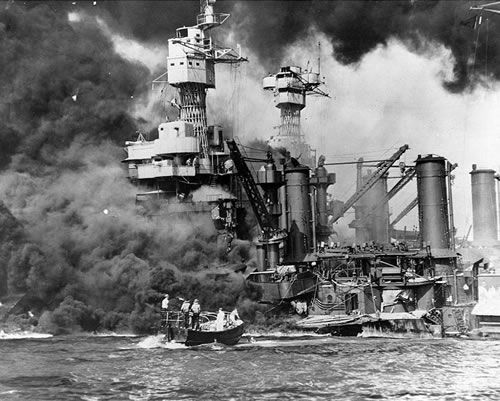
?The next Pearl Harbor will be a cyber attack,? Said Leon Panetta, Director o the CIA.
Global Market Comments
October 26, 2009
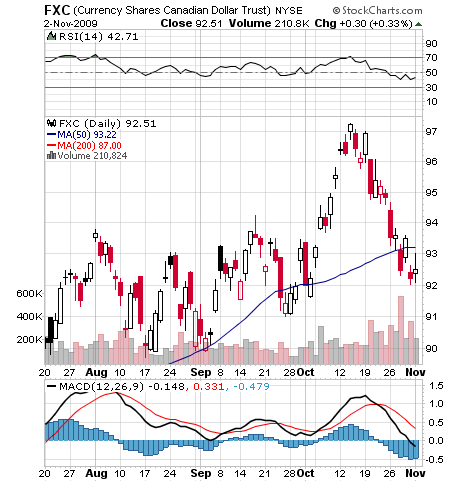
Featured Trades: (CANADIAN DOLLAR), (FXC),
(AUSTRALIAN DOLLAR), (FXA), (NEW ZEALND DOLLAR),
(BNZ), (RSX), (OIL), (ZACHARY KARABELL)
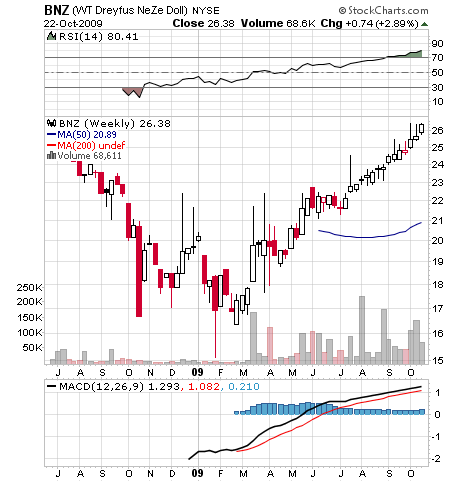
1) It?s all about the dollar, which I have despised all year like the red headed stepchild it has become (click here for my initial recommendation). The assured onslaught of federal debt issuance headed our way will be the overriding investment consideration for traders and portfolio managers for the next decade. That will knock the stuffing out of the greenback against every currency except the Zimbabwean dollar, and even that will rally when you get a long overdue regime change. As the new currencies of barrels of crude oil, 100 pound ingots of copper, or rail cars of iron ore won?t fit into your wallets or purses, foreign currencies offer a great dollar alternative. There was once an argument that foreigners piled into these currencies to capture a huge yield pickup, but even that advantage is now gone, with almost everything now yielding nothing. The soggy buck also explains a lot of what is going on in our stock market, with companies earning most of their revenues from increasingly wealthy foreigners, like those in technology, energy, and commodities. As I write this, I am looking at new one year highs for my favorite picks of the former British crown colony currencies of the Canadian dollar (FXC), up 28% YTD, Australian dollars (FXA) up 49% , and New Zealand dollars (BNZ), up 80%? dollars. Their bounteous natural resources, Anglo-Saxon contract law, a semi common language, and vibrant ports make them the safe bet of choice. Sure, they are all overheated and way overdue for a short term pull back. But over the long haul, you can count on the loony to hit parity, to be eagerly followed by the Aussie dollar, and then the kiwi. And once again, I am including a gratuitous photo of my favorite Canadian, Pamela Anderson to pique your interest.

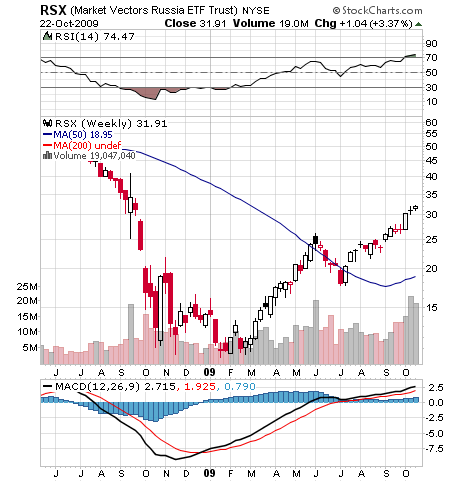
2) Last January I was extremely positive about building long equity exposure in Russia, one of the two BRICKS that is a big energy exporter (click here for the call ). I predicted that the Market Vectors Russia ETF (RSX) would deliver double the upside of the S&P 500 in the imminent bull market. Well I lied. It actually tripled, while the Dow eked out a measly 70%. It even would have worked as a market neutral pairs trade, long Russia, short the US. This was an oil play on steroids, and with crude then trading in the $30s, how hard of a call was that? A recovery in the ruble also gave you a nice hockey stick effect in the dollar traded ETF. The bounce in the Russian currency stopped the country?s reserve outflow dead in its tracks, and enabled the Russian Central Bank to start slashing interest rates from the nosebleed territory of 13%. There is plenty of room for further cuts. But Russia is not out of the woods yet. Some 30% of the $780 billion in corporate debt is due for rollover this year, and the unemployment rate is at 9.5% and climbing. It also doesn?t help that they lock up oligarchs on bogus tax charges, and will expropriate foreign assets at the drop of a hat, as they did from Shell and British Petroleum. But none of my investors told me I could only do business with nice people who gave me a warm and fuzzy feeling. A rising oil price atone for all sins, as any Middle Eastern sheik can attest. You might want to take a shower after you write the trade ticket, buy hey; sometimes you just have to follow the money. Just watch out for the volatility.
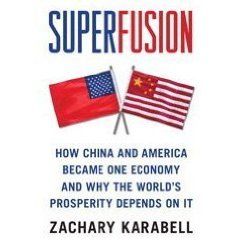
3) Zachary Karabell, president of River Twice Research, is one of the few original thinkers out there who also has a sense of humor. So there?s more than one? Zach has brought his considerable talents to bear on the current state of the Chinese-American relationship in a new book, Superfusion: How China and American became One Economy and Why the World?s Prosperity Depends On It.? International trade has fused the two countries into a single economic unit that accounts for a quarter of the world?s population and a third of its GDP, despite wildly different cultures, much like the loose confederation that makes up the European Community. The Middle Kingdom now has reserves of $2.3 trillion, which is overwhelmingly invested in the US. Where else can it go? That enabled them to step up and play an important role in the bail out of the US financial system this year. But it is an imbalanced agglomeration, with Americans over consuming and under saving and the Chinese doing the reverse. This has to stop, lest the symbiotic relationship tears itself apart. The tit for tat, storm in a tea cup, where the US imposed punitive import duties on Chinese tires and the they retaliated with a ban on American chicken feet (yes, they eat them, yuk!), is a recent example. The reality is that old, boring industries that once might have fought tooth and nail for protection are now migrating to China en masse and finding new life. Bet you didn?t know that General Motors sells more cars in China than in the US, some 1.6 million this year? Don?t hold your breath waiting for China to float the Yuan, as it is one of the few tools that give the Mandarins in Beijing direct control of a huge, disparate economy. Chinese military spending is so parsimonious that it won?t remotely comprise a threat to the US. What little they have is directed at potential regional aggressors, like Japan, India, and Russia. The greatest risk to the existing relationship is that Chinese growth continues so rapid, that it pits them against the world in resource bidding wars, which could get ugly. With crude at $82 and copper at $3, has that already started? The book is well worth a read for some excellent ?out of the box? analysis. Does anyone have any good recipes for chicken feet?

QUOTE OF THE DAY
?Looking at dreadful air pollution outside, we see an environmental disaster and the Chinese see progress,? said Zachary Karabell, president of River Twice Research.
