Mad Hedge Technology Alerts!
The dominant music streaming platform Spotify is trying harder these days.
When I say trying harder, I mean trying harder to become profitable because after almost a generation of when burning cash was ok, investors suddenly demand a business that doesn’t run a minus every year.
Zero rates have had an oversized effect on the balance of business in 2023 and 2024.
Failure isn’t rewarded with gaudy executive compensation and more vested shares.
Belt tightening by cutting staff and streamlining operations is the paradigm we are finding ourselves in.
Spotify was the prototypical loss maker in tech that was given a pass because it grew users fast.
Now that interest rates are high, tech companies are penalized by going to the debt markets too much and the effect is magnified if a company needs a high amount of debt.
Logically, SPOT has made diversifying revenue a top bullet point in their strategic future and that is exactly what they are doing.
SPOT has also discovered it can generate additional money from the most diehard music fans. Currently, all listeners pay the same rate for access to a musician’s catalog. But there are fans willing to pay far more to support an artist they love, as evidenced by the rising price of concert tickets, merchandise, and even vinyl for Korean artists.
SPOT plans to raise the price of its popular audio service in several key markets for the second time in a year, a crucial step toward reaching long-term profitability.
The streaming giant will increase prices by about $1 to $2 a month in five markets by the end of April, including the UK, Australia, and Pakistan, according to people familiar with the matter.
It will raise prices in the US, its largest territory, later this year, said the people, who asked not to be identified discussing confidential plans.
The higher prices will help cover the cost of audiobooks, a popular service introduced late last year.
Spotify offers customers up to 15 hours of audiobook listening a month as part of their paid plan. While the company pays publishers for books, it has so far only collected additional revenue from listeners who exceed the limit.
Spotify paid record labels, artists, and others more than $9 billion last year – from $13.2 billion in revenue.
Last year, SPOT posted its best year of user growth ever, with 113 million new sign-ups to its free and paid services.
Spotify had 602 million users at the end of 2023, including 236 million paying customers.
The success of the price increase has given management confidence to seek even more. Under the new pricing, individual plans will go up by about $1 a month, while family plans and so-called duo plans for couples will rise by $2.
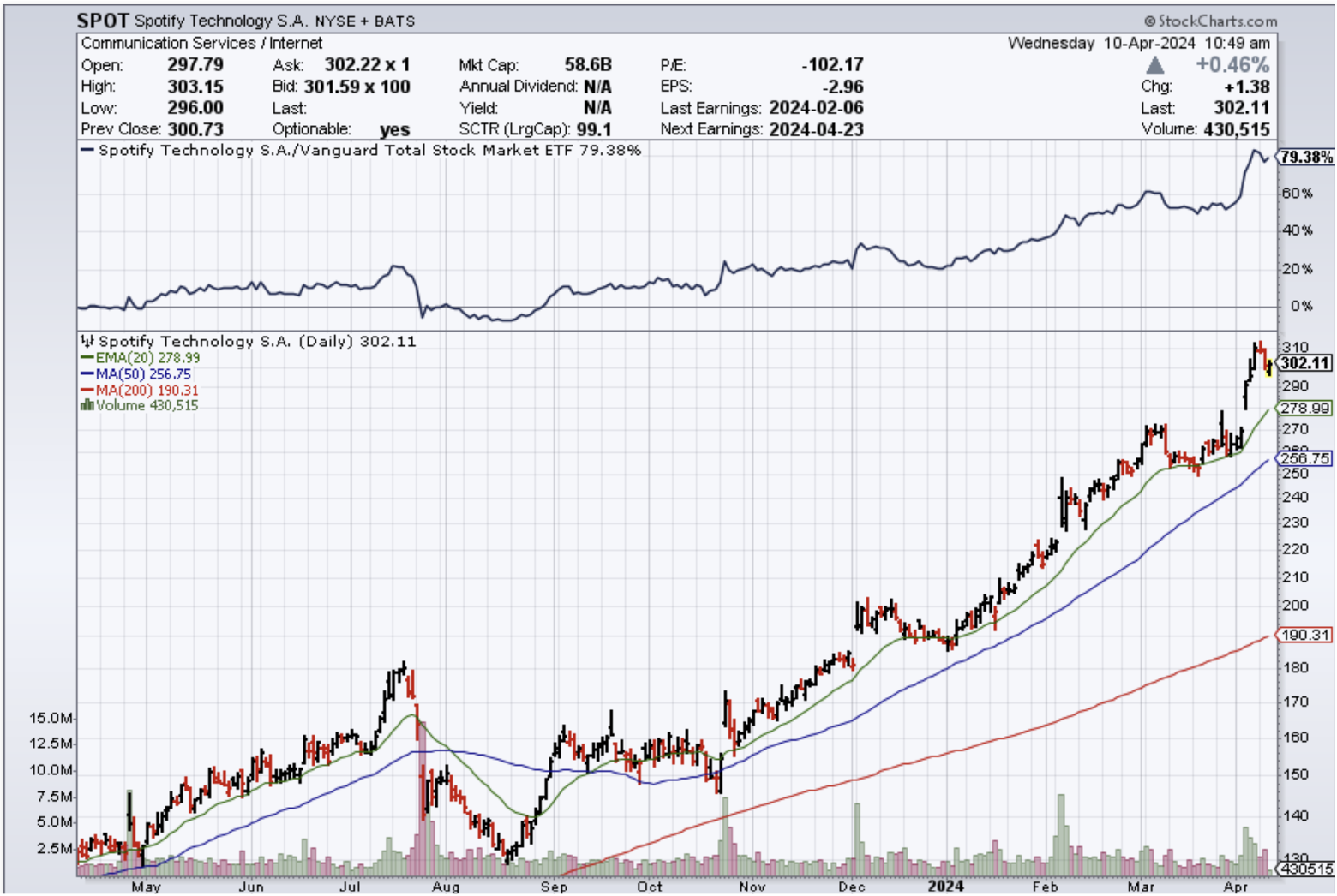
In the last 365 days, the stock has catapulted from $134 to over $300 per share.
The stock is absolutely resonating with investors and moves by management have been aggressive to branch out from the music royalty business.
Buy SPOT on the dip.
Mad Hedge Technology Letter
April 8, 2024
Fiat Lux
Featured Trade:
(BRANCHING OUT)
(INTC), (MSFT)

Intel (INTC) is an intriguing chip company that has been around for a long time but has seldom been at the vanguard of the tech movement.
Until now…
Remember the US government is pouring dollars at the tune of billions upon billions into the domestic semiconductor industry to maintain a competitive advantage that is quickly being challenged by China.
Intel could solidify itself as a real tech player if it can figure out the foundry business which has been largely ineffective as of late.
Even if the foundry business is a big-time loss maker right now, Intel is laying the groundwork to become a strategically important company to the US government and US tech industry in 5 years.
Government dollars are usually viewed as a more stable stream of revenue.
It’s true that Intel is better known for designing its own chips, but that type of barrier to entry isn’t as high as foundry production.
Many chip companies aren’t interested in the production of what they design, because of the capital-intensive nature of the process.
It’s easier to outsource designs and just collect the product after.
Intel shares fell 4% last Tuesday after the company revealed long-awaited financials for its semiconductor manufacturing business or foundry business.
Intel said its foundry business recorded an operating loss of $7 billion in 2023 on sales of $18.9 billion. That’s a wider loss than the $5.2 billion Intel reported in its foundry business in 2022 on $27.5 billion in sales.
It has been pitching investors to double down on an external foundry business to make chips for other companies.
In theory, it sounds promising.
Intel’s role as one of the only U.S. companies doing cutting-edge semiconductor manufacturing on American soil was a big reason it secured nearly $20 billion in CHIPS and Science Act funding last month.
Its management said that it expected its foundry’s losses to peak in 2024 and eventually break even “midway” between this quarter and the end of 2030.
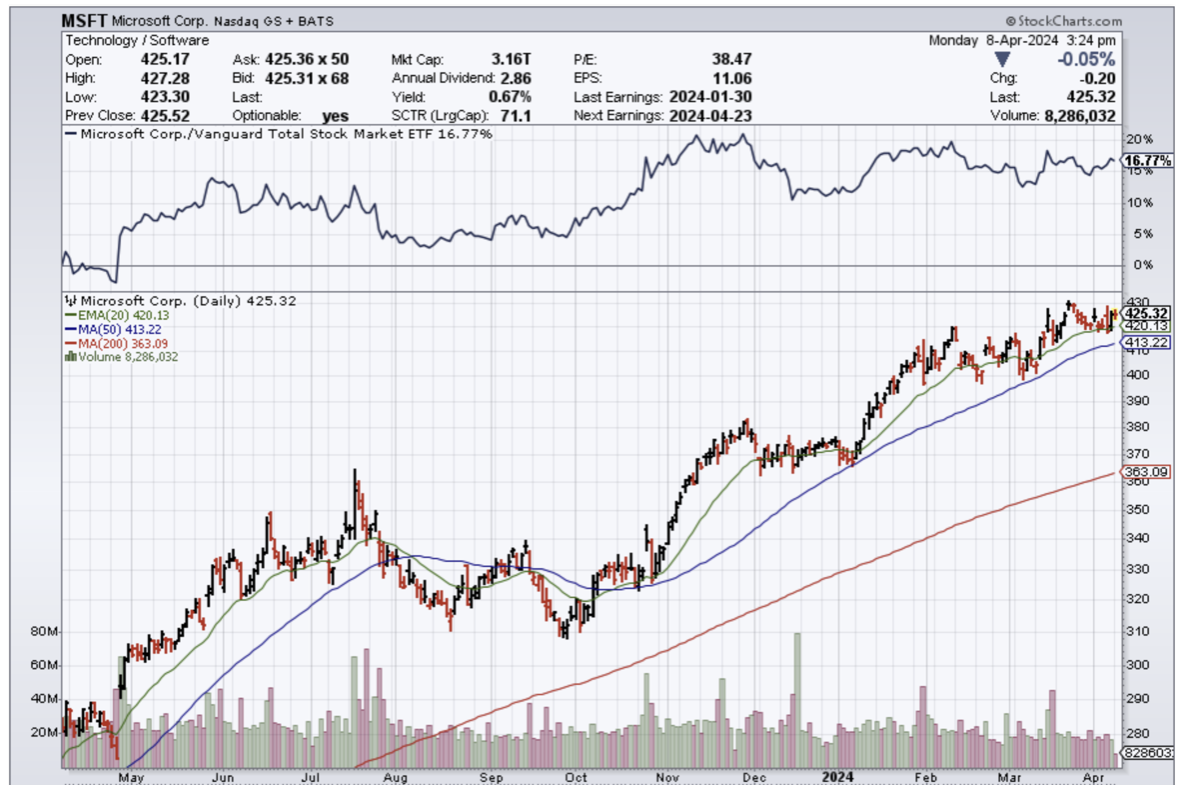
The company previously said that Microsoft (MSFT) would use its foundry services and that it has $15 billion of revenue for the foundry already booked.
The foundry business at Intel will ostensibly drive larger revenue momentum each approaching year to 2030.
Granted, it doesn’t take one day for chip production to come online, but the contract signed with Microsoft is a positive signal that will likely lead to other behemoths inking deals.
Intel even admitted that the lack of profitability in the foundry business from the past was correctable through better focus and execution.
I do believe Intel morphing into a multi-dimensional chip company is highly supportive of a higher share price only if they can get a handle on expense control.
Many times companies go too big with the government subsidies and need even more subsidies to dig themselves out of a hole.
I don’t believe that will be the case with Intel’s foundry business and installing a concrete plan has gone a long way to soothe investor fear.
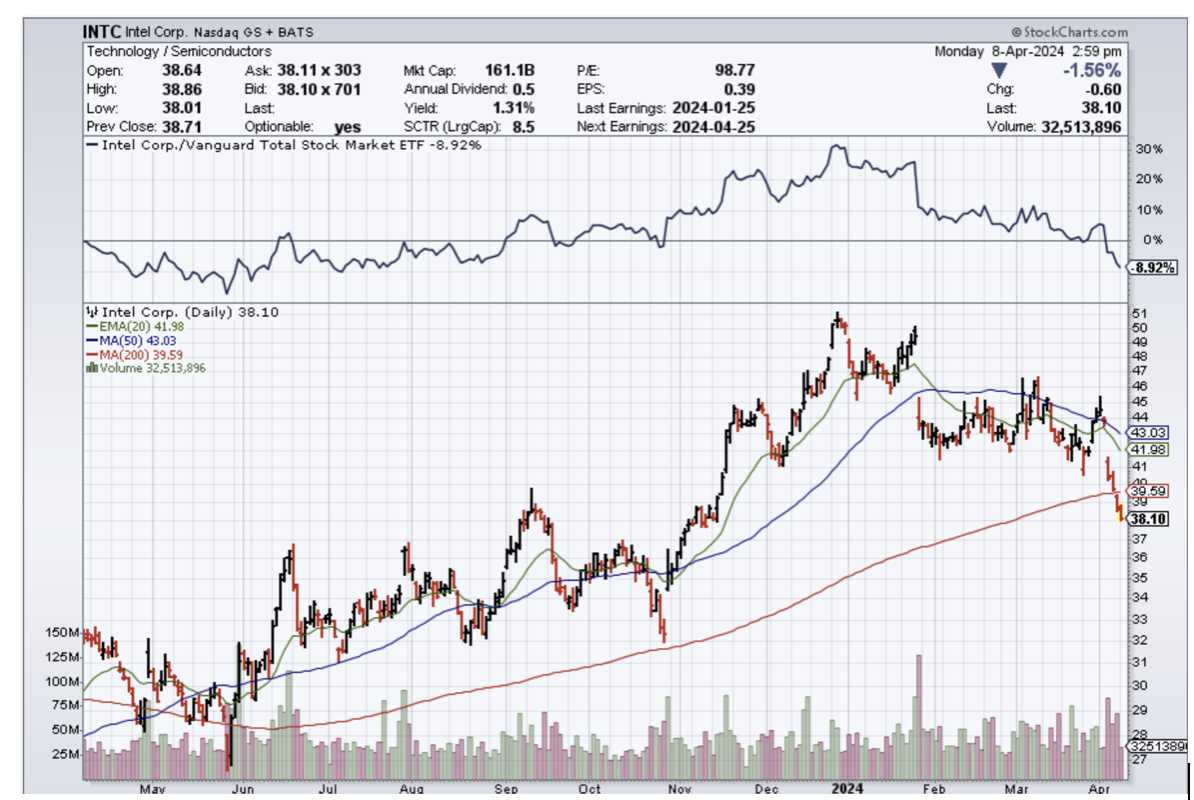
The stock was crushed in 2020 and hit a nadir of $25 per share in 2023.
Intel shares then reversed and doubled to around $50 per share.
They have now settled in the high $30 range and I do believe any dips should be bought and held long-term.