
Mad Hedge Technology Alerts!
Apple didn’t release a new iPad model in 2023 which speaks volumes to the short-term trajectory of the tech firm that Steve Jobs built.
The current CEO Tim Cook is still living off of Jobs’ past creativity.
I believe the new Apple VR headset named the Vision Pro is still a speculative product that won’t result in any meaningful revenue for at least the next few years if at all.
Part of the blame for Apple’s underperformance stems from the poor macro environment for pure multinational corporations as deglobalization accelerates.
Apple also took their lineup of smartwatches off the display cases minutes before last Christmas signaling a continued malaise for big tech companies that are finding it rough to move the needle along.
Many behemoth tech companies are feeling the pressure to squeeze that incremental revenue out of the consumer and Apple is no different from a company like Tesla which is under attack from Chinese EV maker BYD.
Competition is real and it’s only getting worse.
The proverbial low-hanging fruit has been plucked dry.
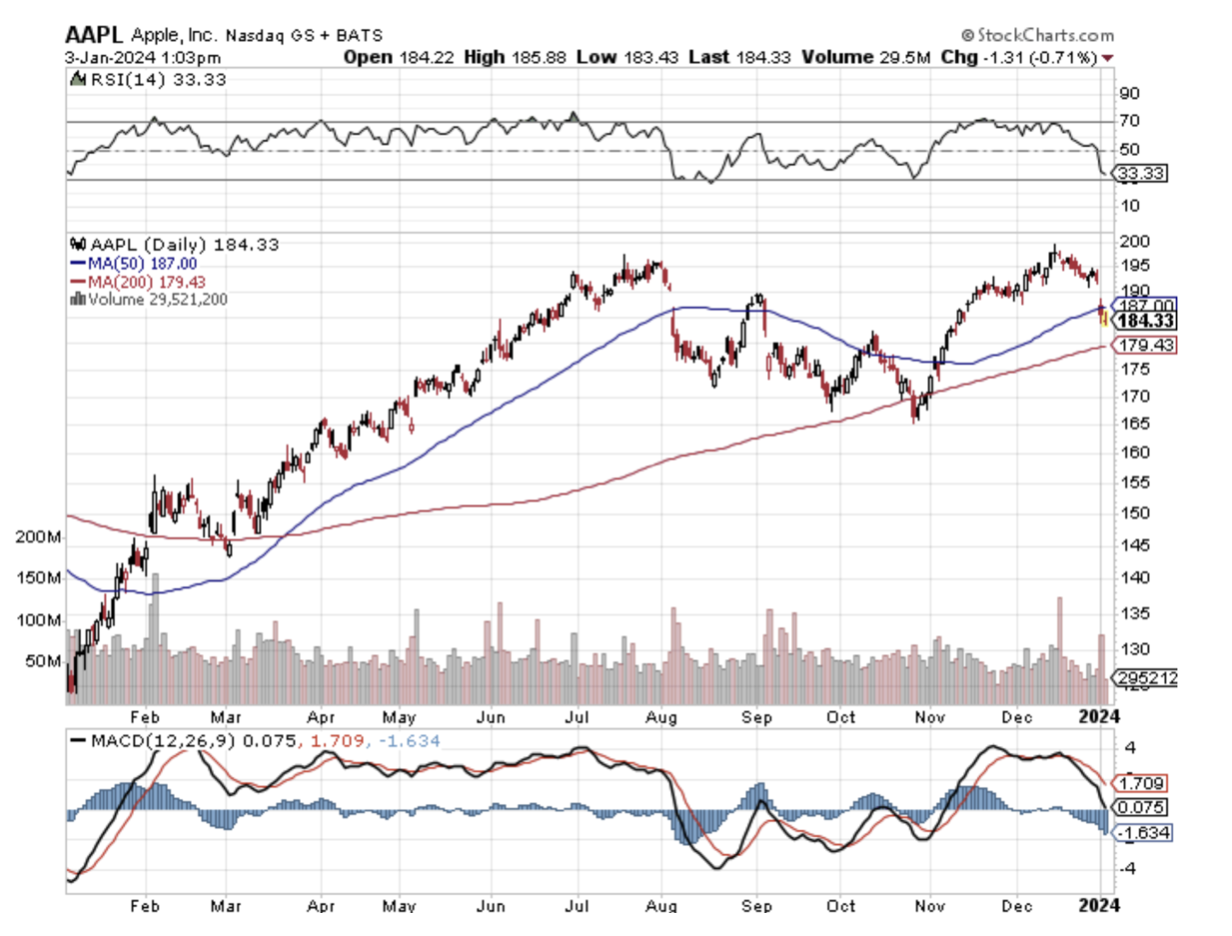
Luckily, the lack of expansion didn’t mean that Apple’s stock went down in 2023.
It was very much the opposite with Apple marauded over 40% higher because of the ultra-lucrative tailwind of the “Fed pivot.”
More minutely, Apple managed to underperform other big tech which is where the blips in the operating and creative spheres start to show up.
In 2023, which ended in September, Apple’s iPad revenue dropped 3.4% to $28.3 billion. On a unit basis, iPad sales were even worse, falling 15%.
Even for Apple’s new products, like Mac computers, consumers showed less desire for devices with minor upgrades. Sales of Mac PCs and laptops fell nearly 27% to $10.2 billion in fiscal 2023. Unit sales declined 11%.
In order to return to revenue growth and support its $3 trillion market cap, Apple needs to strike it rich with some new products and global demand for smartphones and laptops to recover.
Despite less-than-stellar performance, Apple is no slouch. The company recorded $383 billion in total revenue in 2023 and earned nearly $97 billion in net income.
Last November, Apple CFO Luca Maestri said the company’s December quarter will experience no growth compared with last year. He warned that Macs, Wearables, and iPads would see a sales drop.
Much of this weakness will eventually drop shares lower, but it is highly likely that a dip will be a garden variety.
Yesterday’s downgrade was a little surprising, but I do believe analysts are prone to issue a downgrade as a reversion to the mean play.
Many might argue that Apple doesn’t deserve as high of a stock price, because its recent near-term ceiling is relatively sagging compared to the past.
That said, its $2.85 billion market cap isn’t too shabby and just a shallow pullback will allow bulls to coalesce around another optimal entry point.
A drawdown will certainly result in a rip-your-face-up move.
Betting against Apple has traditionally been the worst strategy of modern stock trading.
Bears will smartly take profits and run for the hills to get out of the way of the next wave of buy orders.
Wait for the dip to buy Apple.
Mad Hedge Technology Letter
December 27, 2023
Fiat Lux
Featured Trade:
(BUYER BEWARE)
(TIKTOK)


Sometimes the best way to become successful at investing in technology stocks is to avoid the black swan or the big disaster.
I hate to say it but investment risk has never been higher.
One question that keeps getting rehashed that I thought I might take time to address is the rise of the TikTok influencer-adviser.
According to a brief Google search, TikTok, known in China as Douyin, is a video-sharing social networking service owned by Chinese company ByteDance.
The social media platform is used to make a variety of short-form videos, from genres like dance, comedy, and education, that have a duration from three seconds to one minute.
Unfortunately, for serious retail investors lately, content has migrated into high-stakes themes like financial education and financial advising giving rise to content that is produced by video creators to get a piece of the financial industry.
Naturally, this has brought down the quality of the financial content on the internet to historic lows simply because most of the content is marginal at best.
These promulgators often preach about their status as “trading gurus” and often leverage the hype of digital currencies to claim they are fully invested in “crypto assets” and urge anyone reading to become one of their new “cult followers.”
They are also usually paid to market a “bulletproof” financial app or certain crypto asset to avid followers without properly disclosing that they are being paid for the advertisement.
This behavior is being encouraged by the TikTok algorithms which order this type of misleading content at the top of searches simply because it gets more hits being a click-bait type of content.
The more outlandish the videos become, gloating about get-rich-quick schemes and 1,000% daily returns, the higher up in the search queries they usually populate when filtered through TikTok algorithms.
These accounts are known as financial “influencers” and post 100s of such videos every month featuring fraudulent success or minimizing the difficulty of profiting through trading and a mix or mash of everything in between.
Even some proclaim to have unlocked the holy grail of trading and “guarantee” 100% returns or your money back.
Another speaking point they like to touch on is how video watchers can “also” afford wealthy lifestyles without having to work, at least in the traditional way.
To dumb down the travails of investing and trading to something easier than pouring a glass of water is a lie.
Many of these novice investors are duped into paying for exorbitant services that are nothing more than promotional buzz offering hyped-up marketing language as specific trading advice.
Unfortunately, US regulators have turned a blind eye to what is happening on this nefarious Chinese platform, and imitators are spawned daily and are certainly incentivized to do so.
While I must admit that regulating this type of behavior on TikTok is incredibly messy, to leave this unchecked will result in massive fraud for the little guy that I try to help.
The justification for ignoring these TikTok “influencers” is that there is even worse cybercrime taking place out there and the content these influencers are peddling is straddling the gray areas of the law.
But it’s not enough, and readers need to understand the heightened risks of diving feet-first into these TikTok polar vortexes where you just get whipped around unknowingly.
Pre-emptively protecting your portfolio by avoiding these TikTok trading gurus is the order of the day.
As we enter 2024, taking tabs on the fallout has been epic.
The TikTok crypto marketers were largely being sponsored by the crypto exchange FTX.
They were peddling FTX’s own digital currency that was made out of thin air.
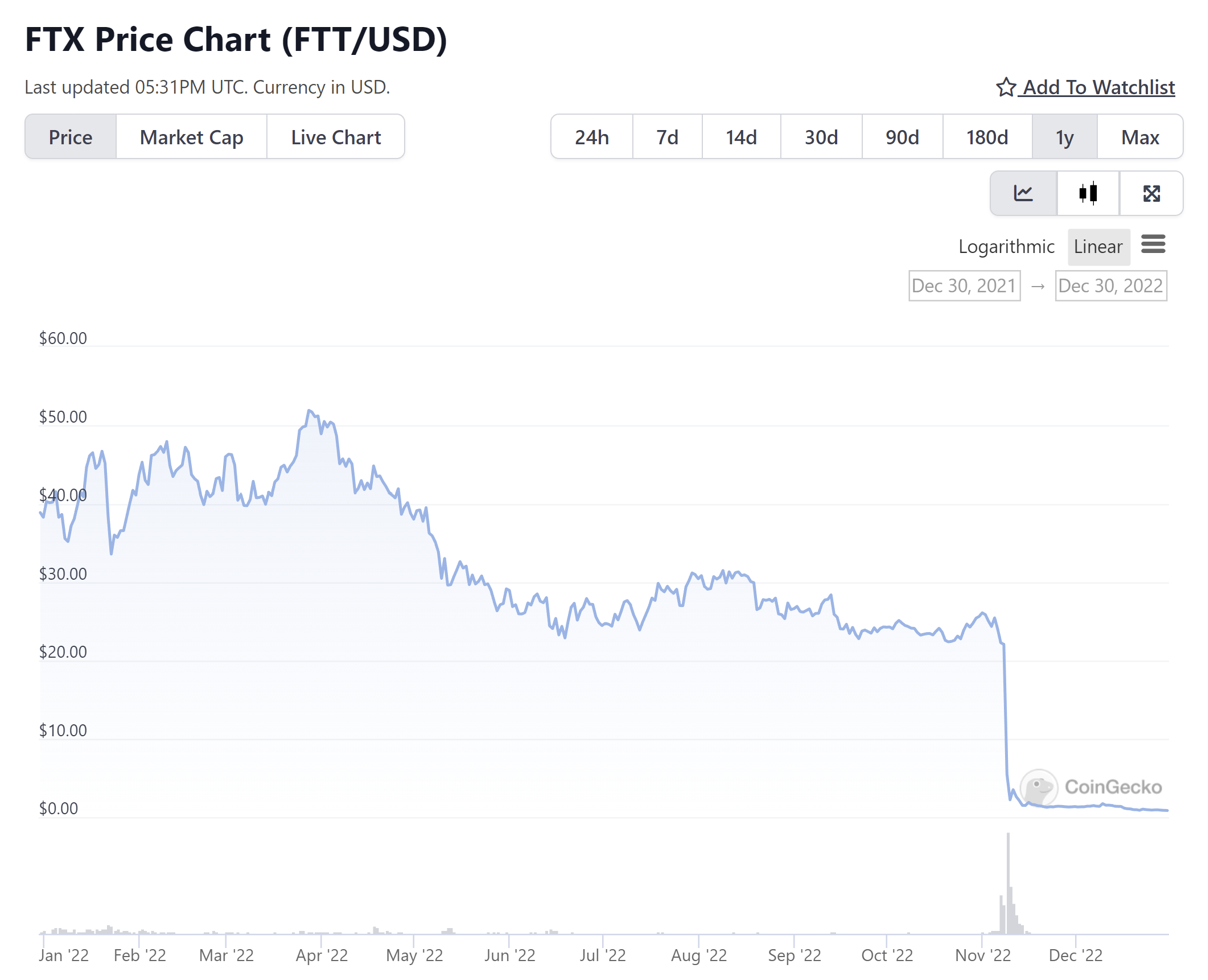
Anyone trading in this FTX in-house digital coin known as FTT lost most of their money as the CEO of FTX Sam Bankman-Fried was extradited back to the United States and found guilty in court.
FTX’s FTT coin went from $40 at the beginning of 2022 to 80 cents on December 30, 2022, highlighting the dangers of listening to fake crypto “trading gurus” on TikTok pushing FTT coin like there is no tomorrow.
Stay vigilant and happy trading and remember, there is no free lunch in trading.
It’s hard work earning your crust of bread.
BUYER BEWARE