Mad Hedge Technology Alerts!
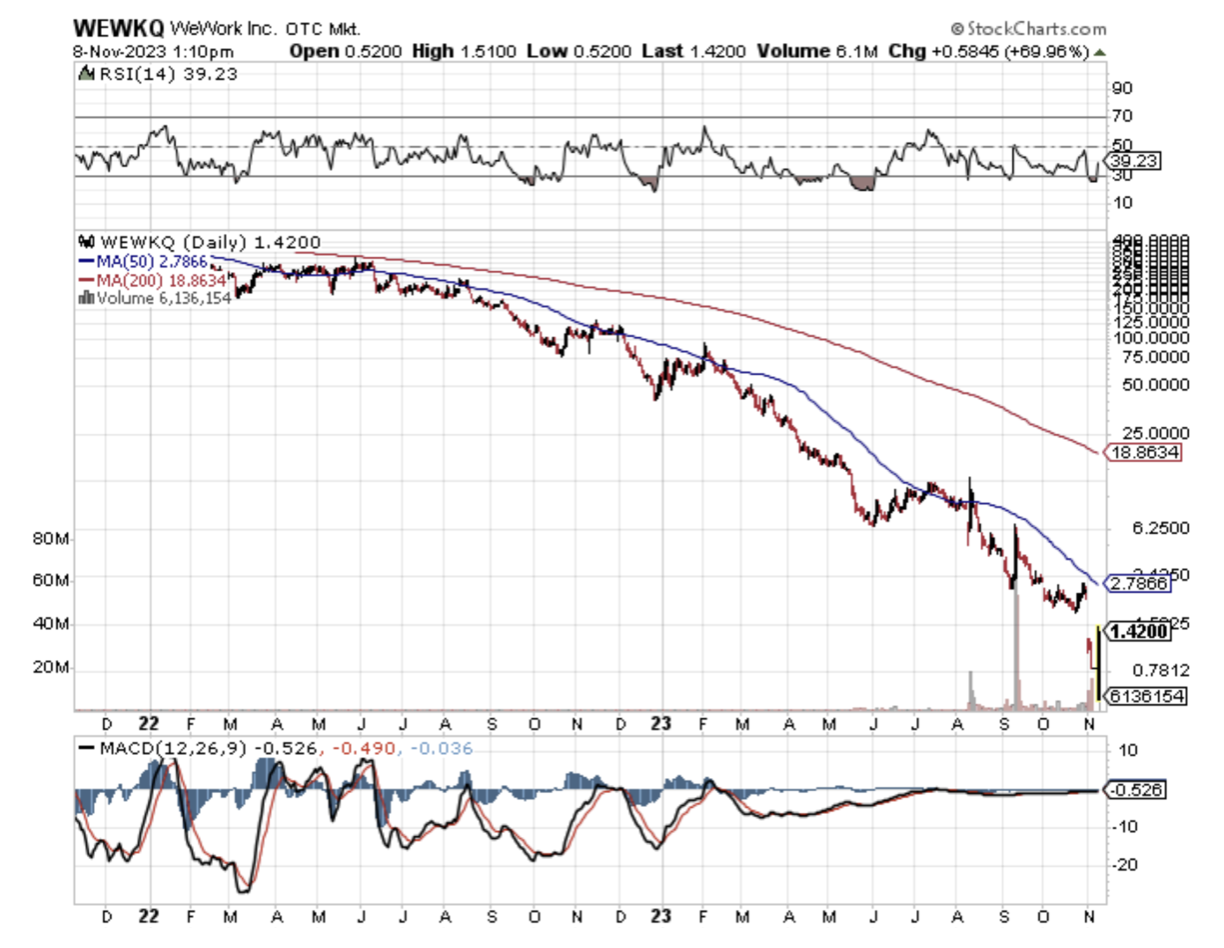
Taking out long-term leases and turning around to rent short-term i.e. Airbnb style for corporate offices ended with a thud as office sharing tech company WeWork filed for bankruptcy.
The idea never made sense and felt more like a gimmick.
Surprisingly, this bankruptcy didn’t happen much earlier as the “work from home” pivot during 2020-2022 made this business model go from bad to worse.
It’s safe to say that we are far passed the peak “sharing economy” and investors are licking their wounds on this one.
WeWork filed for bankruptcy, capping a dramatic period that saw the once high-flying startup navigate a failed initial public offering, forced government lockdowns, a blank-check merger, and a stubborn avoidance of return-to-office trends.
The company at its 2019 peak commanded a $47 billion valuation with the likes of SoftBank losing more than $14 billion on just this one investment.
The firm’s death spiral arguably started in 2019. In a matter of months, the company went from planning an IPO to firing thousands and procuring a multi-billion-dollar bailout.
WeWork was almost a scam from the beginning with its main business mission explained as to “elevate the world’s consciousness.”
The former CEO of WeWork Adam Neuman operated the business almost as a cult.
The company eventually went public in 2021 through a special purpose acquisition company, two years after its initially planned IPO. But that didn’t stop WeWork from hemorrhaging cash.
While WeWork reached a sweeping debt restructuring deal in early 2023, it quickly signaled desperation soon after.
High-interest rates are starting to knock out the low-quality business ideas that never should have gotten off the ground in the first place.
These developments are a godsend for the tech economy that needs a complete flushing out of the bad ideas that were fueled by 0% interest rates.
Cheap money attracts larger-than-life ideas and personalities that can’t really back up the chutzpah.
Raising the bar for quality in tech has also caused the unintended consequence of raising the top tech companies or magnificent seven even higher up than before.
This trend can easily be seen in the EV sector where incumbent Tesla is putting their foot on the scruff of smaller EV company’s necks that simply can’t keep up with the higher material costs and headache of developing a global manufacturing presence amid deglobalization.
In simple terms, it is substantially harder to build an above-average tech company, or any tech company for that matter in 2023.
The former is an issue with the lofty competition that wields powerful balance sheets and the latter is an issue with draconian funding terms.
Waving goodbye to lemons like WeWork is only healthy for the tech sector in the long term and shortly we should see other junk-status companies be thrown by the wayside as well.
Cryptocurrency mogul Sam Bankman Fried’s fall from grace with a guilty verdict of fraud is another signal that the tech’s excesses are quickly normalizing.
We are in the middle of setting ourselves up for the new bull market in technology stocks which will be kicked into gear if interest rates sniff out the next recession.
Mad Hedge Technology Letter
November 6, 2023
Fiat Lux
Featured Trade:
(HIGHER FOR LONGER IS NOT OFF THE TABLE)
(BIG TECH), (QQQ), (AAPL), (GOOGL), (META), (TSLA)

Tech (QQQ) earnings turned out to produce some positive performances.
Dominant companies can produce dominant earnings even in troubled times.
So what is the problem?
The sales outlook underwhelmed as the American consumer and business keep getting stretched to the limit.
I believe that traders shouldn’t expect a quick turnaround of sales projections for 2024 unless there are some material structural improvements in the business and consumer environment.
No savior is coming for 2024.
All signs point to more uncertainty and not less and rightly so as high inflation has only been replaced by a decrease in the rate of inflation.
Things are still expensive and that means less opportunity for tech to build a growth story.
Apple, Alphabet, Meta, and Tesla all gave investors reason to rub smiles off faces.
From Apple’s unimpressive holiday outlook to Alphabet’s tepid cloud computing sales results, a recurring theme for the group was weakness.
Meta warned that the year ahead is looking less predictable, while Tesla raised concerns that demand for electric cars is starting to weaken.
Despite Tesla's missing earnings, the group is poised to surpass the 36% increase estimates called for before earnings season began.
The tech sector in the S&P 500 still carries a nearly 36% premium to the index on a forward price-to-earnings basis, per data compiled by Bloomberg Intelligence.
There’s a lot of AI hype, but not every company is market-ready.
Everything can change in a heartbeat if there is economic or geopolitical upheaval, which would directly impact stocks.
The market is still pricing in no spreading of military activity as it looks through it as a self-contained area.
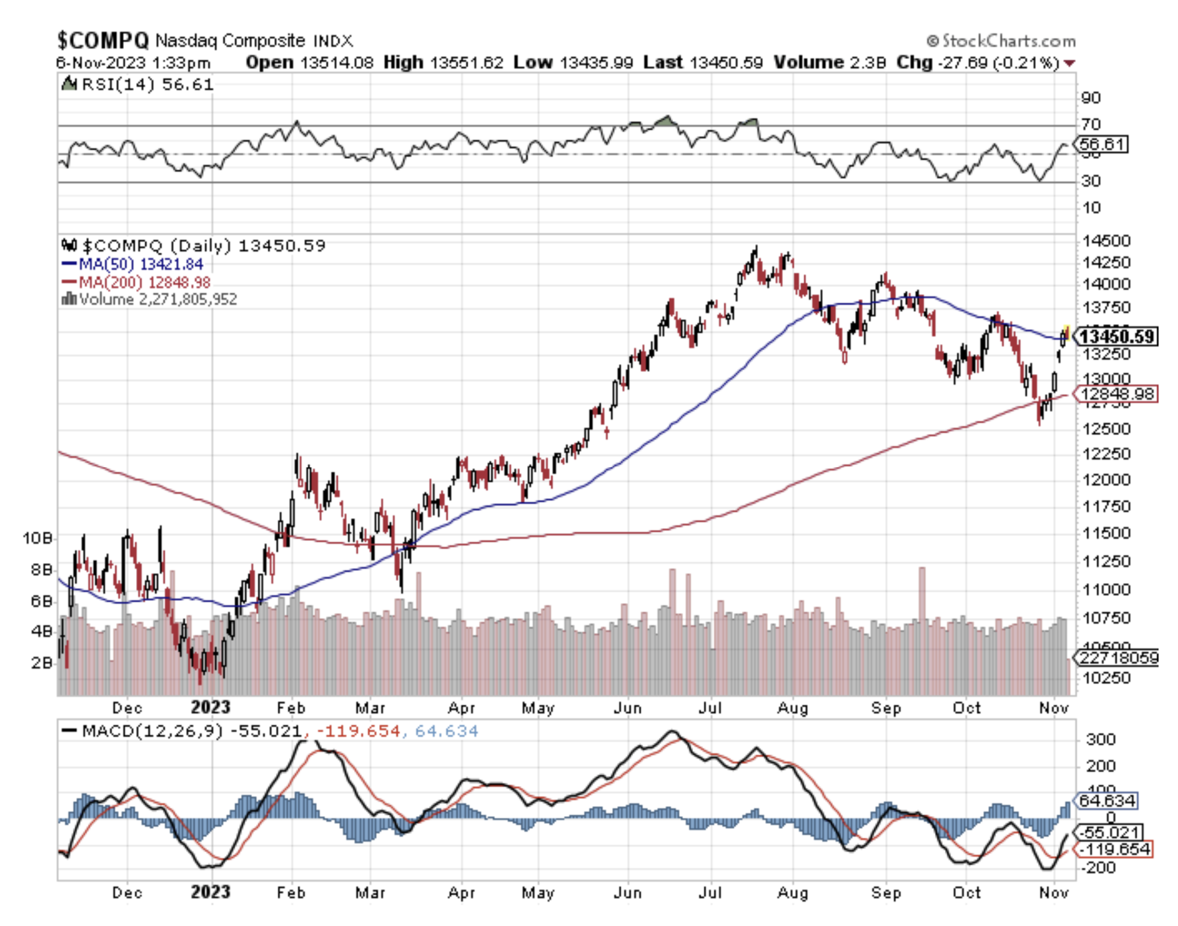
Therefore, the pendulum has swung the completely opposite direction as the U.S. 10-year treasury yield has dropped from 5% to 4.6%.
The strength in treasuries could be short-lived, because several have told me that traders are jumping back into the short-term trade which would signal higher for longer.
The Fed Futures show that the first 25 basis rate is forecasted for May 2024 with 2 more consecutive .25% rate cuts following the first.
The American consumer just might have enough juice for one more splurge that would then push back rate cuts from May to somewhere closer to July or August.
Therefore, it’s easy for me to see how this 6.5% surge has a little longer follow through only to soon clash with a “higher for longer” narrative.
The true tailwind for tech stocks here is that much of the bad news has been priced in and any violent surge in treasury yields seems like a low probability for the last 7 weeks of the year, unless another global conflict breaks out.
Seasonal buying could mean that November is more positive than negative for tech stocks and any big draw down should be bought in a quality tech name. December could be a harder slog for tech.