Mad Hedge Technology Alerts!
Sometimes the best way to become successful at investing in technology stocks is to avoid the black swan or the big disaster.
I hate to say it but investment risk has never been higher.
One question that keeps getting rehashed that I thought I might take time to address is the rise of the TikTok influencer-adviser.
According to a brief Google search, TikTok, known in China as Douyin, is a video-sharing social networking service owned by Chinese company ByteDance.
The social media platform is used to make a variety of short-form videos, from genres like dance, comedy, and education, that have a duration from three seconds to one minute.
Unfortunately, for serious retail investors lately, content has migrated into high-stakes themes like financial education and financial advising giving rise to content that is produced by video creators to get a piece of the financial industry.
Naturally, this has brought down the quality of the financial content on the internet to historic lows simply because most of the content is marginal at best.
These promulgators often preach about their status as “trading gurus” and often leverage the hype of digital currencies to claim they are fully invested in “crypto assets” and urge anyone reading to become one of their new “cult followers.”
They are also usually paid to market a “bulletproof” financial app or certain crypto asset to avid followers without properly disclosing that they are being paid for the advertisement.
This behavior is being encouraged by the TikTok algorithms which order this type of misleading content at the top of searches simply because it gets more hits being a click-bait type of content.
The more outlandish the videos become, gloating about get-rich-quick schemes and 1,000% daily returns, the higher up in the search queries they usually populate when filtered through TikTok algorithms.
These accounts are known as financial “influencers” and post 100s of such videos every month featuring fraudulent success or minimizing the difficulty of profiting through trading and a mix or mash of everything in between.
Even some proclaim to have unlocked the holy grail of trading and “guarantee” 100% returns or your money back.
Another speaking point they like to touch on is how video watchers can “also” afford wealthy lifestyles without having to work, at least in the traditional way.
To dumb down the travails of investing and trading to something easier than pouring a glass of water is a lie.
Many of these novice investors are duped into paying for exorbitant services that are nothing more than promotional buzz offering hyped-up marketing language as specific trading advice.
Unfortunately, US regulators have turned a blind eye to what is happening on this nefarious Chinese platform, and imitators are spawned daily and are certainly incentivized to do so.
While I must admit that regulating this type of behavior on TikTok is incredibly messy, to leave this unchecked will result in massive fraud for the little guy that I try to help.
The justification for ignoring these TikTok “influencers” is because there is even worse cybercrime taking place out there and the content these influencers are peddling is straddling the gray areas of the law.
But it’s not enough, and readers need to understand the heightened risks of diving feet first into these TikTok polar vortexes where you just get whipped around unknowingly.
Pre-emptively protect your portfolio by avoiding these TikTok trading gurus is the order of the day.
As we enter 2023, taking tabs of the fallout has been epic.
The TikTok crypto marketers were largely being sponsored by crypto exchange FTX.
They were peddling FTX’s own digital currency that was made out of thin air.
Anyone trading in this FTX in-house digital coin known as FTT lost most of their money as the CEO of FTX Sam Bankman-Fried was extradited back to the United States from the Bahamas for illegally using billions of dollars in customer deposits.
FTX’s FTT coin went from $40 at the beginning of 2022 to 80 cents on December 30, 2022 highlighting the dangers of listening to fake crypto “trading gurus” on TikTok pushing FTT coin like there is no tomorrow.
Stay vigilant and happy trading and remember, there is no free lunch in trading.
It’s hard work earning your crust of bread.
BUYER BEWARE
Mad Hedge Technology Letter
December 28, 2022
Fiat Lux
Featured Trade:
(STICHED UP BY ITS OWN POOR DECISIONS)
(SFIX), (AMZN)
I don’t get Stich Fix (SFIX).
It’s not that they shouldn’t be a company - I’ve seen worse ideas cut up on the drawing board - but I don’t see how they will ever become successful.
They probably should have invested in Bitcoin before it blew up to $65,000 because that was the last savior before tech companies realized they couldn’t just roll over debt anymore.
SFX’s lack of competitive advantage is worrisome, and they haven’t done enough to differentiate themselves amongst competition.
For a company fighting for relevancy, they have made some boneheaded mistakes.
They recent hired a new CEO Elizabeth Spaulding with no apparel experience - she was only a consultant with Bain and has never run a company in her life.
For one, customers don’t receive a great sales price on the clothes. Unless keeping the entire box (5 items), they won't get a discount. They also won't find any coupons online for Stitch Fix.
For many tech companies that preach the freemium model, Stich Fix is asking customers to pay a premium for clothing upfront without proof of a brand premium, and I believe that is turning off a lot of potential customers.
A tech company with decelerating revenue for 6 straight quarters is a red flag.
If you are a bargain bin fanatic, the sight of SFIX’s service will turn you off.
Stitch Fix claims the average price of items is around $70, but that the items can cost anywhere between $20 and $400.
You can set price ranges for each category, but that doesn't mean your stylist will always follow those instructions.
Pigeonholing oneself as a luxury service but hoping to scale broadly and fast like a tech company is counterproductive.
Many Americans simply won’t pay up to $500 for a 5-piece set of clothing no matter who is styling it.
This sounds like a service for a computer programmer in San Francisco with a $200,000 annual salary--which isn’t a bad thing, but it will fail to scale.
Just as important, there is quite robust competition that undercuts SFIX such as Amazon (AMZN) Prime Wardrobe.
Amazon Prime Wardrobe is an exclusive program just for Prime members. This service gives users the chance to have chosen clothing items shipped to their home for them to try on before buying. The difference here is that the user selects the item which, for me at least, makes sense instead of SFIX blindly shipping clothes that aren’t ok’d. I just don’t think a “stylist” can get it right more than half the time. You only pay for what you keep and you have 7 days to make up your mind.
The biggest head scratcher is the $20 SFIX styling fee if you don't keep anything.
Seriously, what is that about?
If you hate their expert stylish decisions, you get blamed for it and pay $20 for nothing! Shouldn’t it be SFIX paying the user $20 for failed style sense?
And this is without even mentioning the pain of resending the clothes!
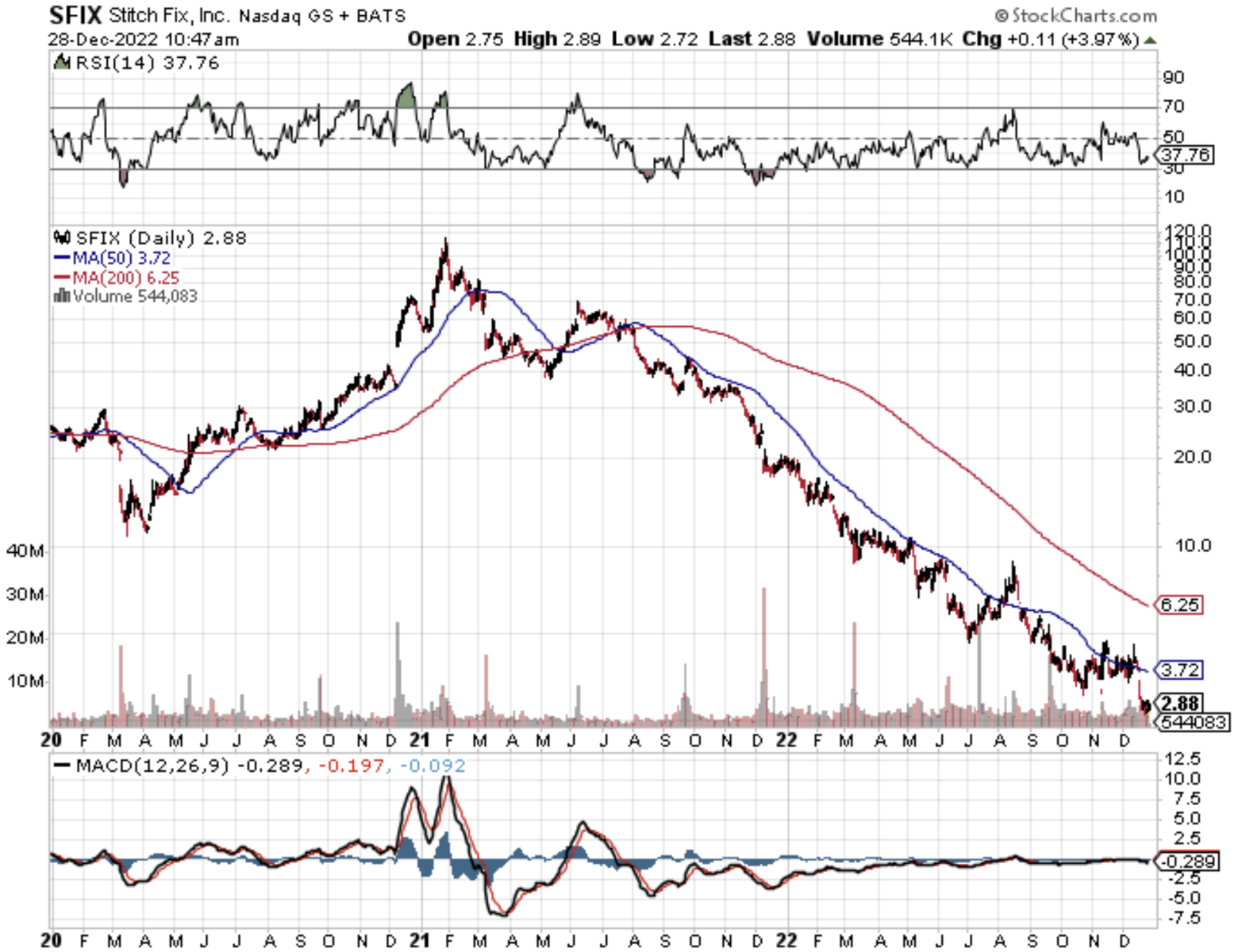
The inferior business model explains why the stock has gone from $120 fifteen months ago to under $3 per share today.
Don’t bet on a reversion to the mean trade as well, there are so many better stocks out there.