Mad Hedge Technology Alerts!
CEO of Uber (UBER) Dara Khosrowshahi earns 200X the salary of the median Uber employee and for that large sum of money, he lost the company $5.9 billion in just the first quarter.
The company is a perennial cash burner, and they haven’t shown us how they will fix this problem.
The company can dish out as many “positive outlooks” as it wants, but rest assured, they usually just move the goalposts and put some lipstick on a pig to dress up even more astronomical losses coming down the pipeline.
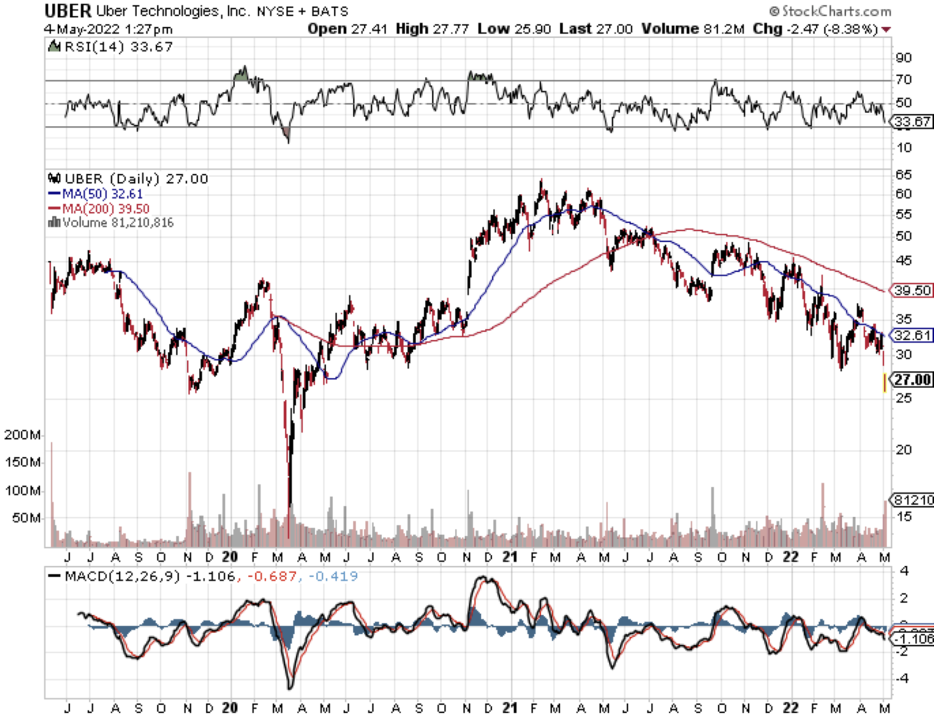
Uber’s management obviously did a bad job messaging their “positive outlook” as the share price opened up down 11% in today’s trading.
The time has come to pay the bill for this company and it’s not pretty.
They didn’t come anywhere close to becoming profitable during generational low-interest rates, and now, their prospects look bleak as we barrel towards a world with vastly higher borrowing costs.
Sure, the revenue doubled, but drivers aren’t making any money with such high gas prices and Uber has had to shell out more for labor and that’s not coming down any time soon.
In fact, if there was one tech company that would perform awful in high inflationary conditions, this is the company.
Not only that, but Uber’s service now is also just way too expensive, take a ride, and they charge consumers way more than its worth.
Unless it's 2 in the morning and there is no means back home, consumers won’t rush to order an Uber unless it’s an emergency.
I expect a shortage of drivers to continue as working for Uber as a driver is really bottom-of-the-barrel type of stuff and why do it during a time where labor rights are on the rise?
Remember they had to present a ballot for voters to get them classified as subcontractors and spent $200 million on it.
Investors must have pondered if this $200 million would have been better invested in the actual business instead of ripping off their own employees.
The intensifying competition for labor is also revealing the different ways in which ride-hailing giants are tackling the issue. Uber said it has been making tweaks to the driver app, like unlocking the ability to see upfront fares before accepting a ride, improving maps, and removing bugs.
Uber management touts Uber Eats as the savior of its business but then this company should be valued as a food delivery company with a lower multiple.
Uber eats is still losing money with no end in sight and one must conclude that it appears as if this “tech” firm has no chance of ever becoming profitable based on this current business model.
I fully expect Uber eats to burn more cash as food inflation goes from bad to awful which will mean demand destruction of its customers.
These customers can easily substitute Uber eats services by ordering supermarket delivery and throwing a frozen pizza in the oven.
Uber eats service is a luxury, not a necessity as many Americans cut back on spending because of major economic policy mistakes by the US Central Bank and the current White House administration.
It’s not a shocker to fin
d out that in the 3 years of Uber’s stock being public, shares have gone down 35% since the IPO in dreamy financial conditions with unlimited investment appetite for inferior tech companies.
The stock currently trades at $26 per share, and I would say this stock would be a good short-term trade at around $17.
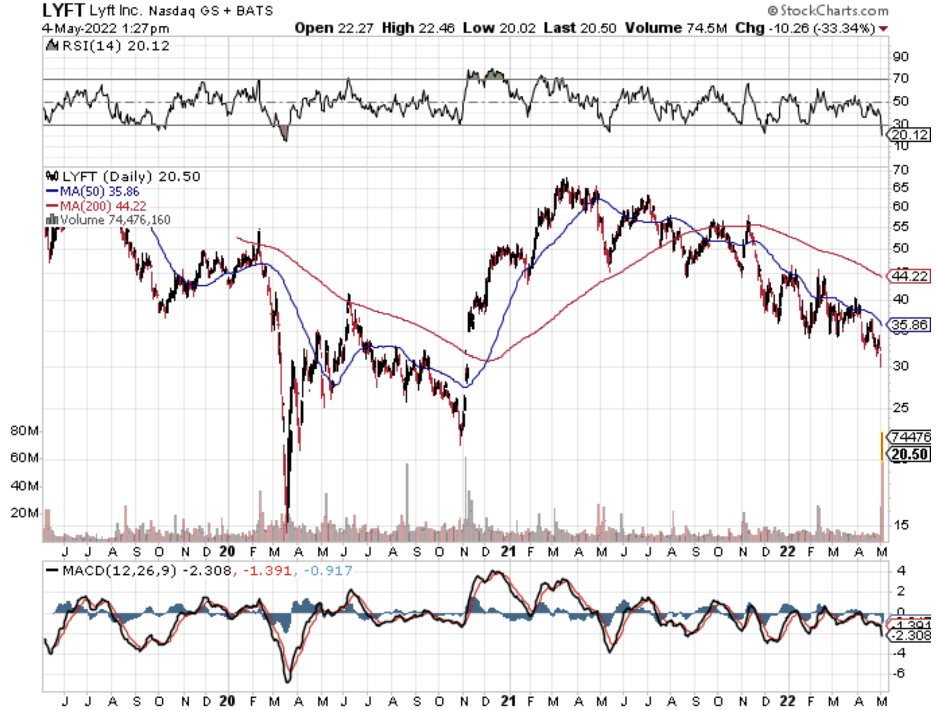
Lastly, Uber’s way of saying they are a good tech company is by describing themselves as “not Lyft” and that right there is a massive smokescreen.
Mad Hedge Technology Letter
May 2, 2022
Fiat Lux
Featured Trade:
(ANOTHER TECH SUPPLY SHOCK)
(SOXX)

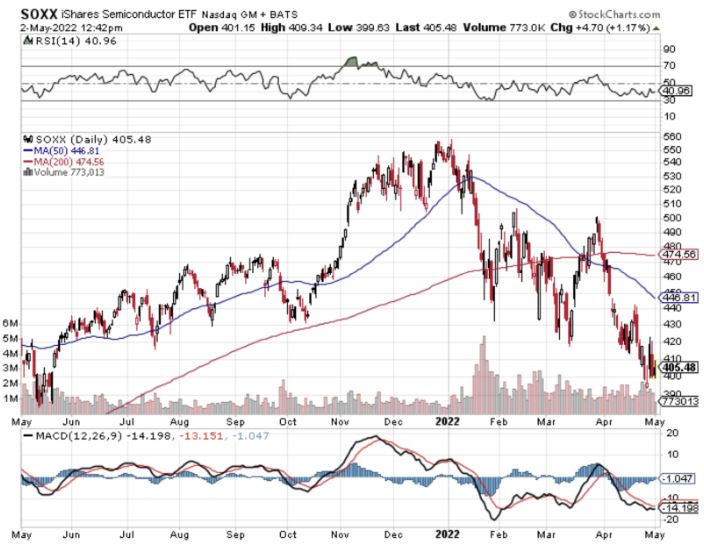
Some concerning developments will reveal the dire straights of the semiconductor industry (SOXX) right now.
What I am about to tell you effectively puts semiconductor chips in the doghouse with no end in sight and it’s not a surprise that semiconductor stocks have swan dived the past half-year.
They are quite infamous for the boom-bust cycle, but the new developments have put that thesis on steroids as the ensuing bust seems to be picking up momentum by the second.
What we have is supply-side shock.
The global semiconductor industry is being impacted by a neon shortage.
Neon is a gas that is crucial for making chips. It is used in the lithography step, which involves lasers carving into silicon to develop semiconductors.
Ukrainian neon is a byproduct of Russian steel manufacturing.
Critical Ukrainian companies, Ingas and Cryoin, have halted production unable to operate in this foggy environment of military conflict.
Ukraine is a significant supplier of neon and Ingas and Cryoin accounting for over 60% of the world’s total neon output.
Prices of neon have spiked by up to 500% from December because of the health situation.
In China, prices have also gone up by 400% as well and this can be expected when supply chains are disrupted such as the 600% in the run-up to Russia's 2014 annexation of Crimea from Ukraine.
Ingas produces neon gas out of Mariupol and exports around the world.
This city has more or less been destroyed with 99% of buildings reduced to rubble.
Before the military confrontation, Ingas produced 15,000 to 20,000 cubic meters of neon per month for customers in Taiwan, Korea, China, the United States, and Germany, with about 75% going to the chip industry.
Cryoin, which is based in the southern Ukrainian port city of Odessa, says they have three months of inventory if the factory is damaged.
Right now the factory production has been suspended because the company cannot access additional raw materials for purifying neon.
The government of Taiwan noted that Taiwanese firms had made advanced preparations and have reserve stocks of neon for the near term.
China is also a significant producer of neon gas, but prices there have been gapping up because of arbitrary lockdowns lately.
Clearly, there is a paradigm shift towards a brave new world where supply chains in far-flung territories governed by dictators won’t be able to deliver the “just-in-time” globalized module of manufacturing.
This proves the situation is highly likely to deteriorate than ameliorate and at some point if chip companies don’t suck it up and decide to bite the bullet, generations of products could be shelved because of a lack of materials.
Manufacturing of the entire chip manufacturing process must go back to a domestic operation simply because there will be no way to procure the particular inputs to create the end product.
This will destroy the supply for everything from electronics to other products that need chips causing another leg up in inflation.
What does this mean for the chip companies?
The small chip companies who usually rely on one or two big contracts are about to get massacred.
Missing deadlines is a death knell for small companies as they preside over paltry reserves and cannot endure this type of headwind in the manufacturing process.
At a broader level, expect the boom-bust cycles to show deeper busts with a more delayed snapback along with lower margins.
If that is the bottom line, a major de-risking of semiconductor stocks must happen to reflect this new reality.
Sure, there is a chance that inflation moderates in the next year, but it will still be higher than what chip companies have been used to for the past 30 years.
Chip stocks are in the penalty box until they can work out supply-side issues.