Mad Hedge Technology Alerts!

2022 could be the year that Lucid Motors (LCID) put a dent in the universe as one of the many EV upstarts hoping to eventually challenge Tesla (TSLA) one day on top of their lofty perch.
Realistically, many EV companies never get to the point of delivering cars, like fraudulent company Nikola (NKLA), but Lucid has started to roll out new cars to US customers.
Things move fast in the EV industry and Lucid has announced they are planning to start shipping cars in Europe sometime this year.
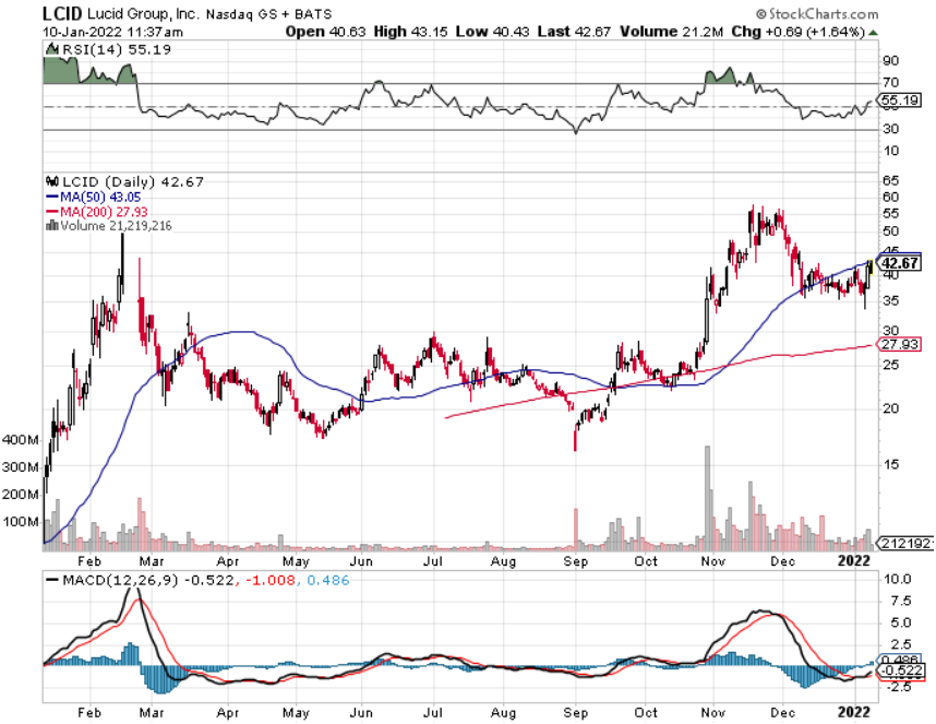
The stock exploded to the upside on the announcement.
Conceptually, the idea that Lucid is expanding fast, creating and looking to take advantage of the total addressable market in Europe only signals to investors they are doing all the right things in all the right places.
I believe there is loads of momentum in EV cars today, and their trajectory this year is impressive as we are seeing it in our news feeds.
I am not just talking about Tesla, but the mainstreaming of the product will help the next in line to build something competitive to Tesla and Tesla blazing an early trail has helped really legitimize the industry.
Sure, at the micro level, there are still teething pains with EVs, like waiting an hour for your Tesla X to charge at a supercharger.
The science behind it still needs to catch up to the point where someone can just get behind a wheel and drive coast to coast without crunching the logistics designed for the trip.
Germany will probably be the most important European market for Lucid, being a car-first society while the citizens harness high purchasing power.
Lucid also wants an expansive taste of Europe by expanding all over and that means places like Sweden and Switzerland.
The company is currently building its only model, the Air sedan, at its Arizona plant, yet the volume of cars is kept from the public view.
The firm pumped out a few hundred cars in 2021 but wants to ramp up to 20,000 by the end of 2022.
The vehicles it has delivered so far don’t have a full variety of active safety aids online, but they will be enabled via an over-the-air updated by the end of January.
Just like Tesla, Lucid will probably try to push its direct sales model in Europe as well. The manufacturer has already announced plans to set up nine Lucid Studios in the United States and major European cities are in the mix as well.
Lucid CEO Peter Rawlinson has already stated that the company also plans to roll out in the Middle East in 2022, with China following in 2023 so there’s a lot in the pipeline here, but it could be biting off more than they can chew.
If the “EV trade” catches fire this year which is certainly in the realm of possibilities, I see the stock doubling from $42 to over $80 per share.
Let’s not forget that the used car market is so hot that it costs almost as much as buying a new car.
Energy is higher across the board, so why not slap on some solar panels on the roof and drive an EV for free instead of indulging in expensive fossil fuels?
The Saudi Arabia's Public Investment Fund has previously stated that they will not be selling any of their Lucid Motors shares until beyond 2030, which is why they are planning to sell these EVs in the Middle East.
When the PIF gave Lucid Motors an investment of $1 billion in 2018, that deal was contingent on Lucid Motors building a plant in Saudi Arabia.
Lucid is projecting themselves to be a leader in solar, and by 2026 they estimate that they will make over $22 billion a year from their Renewable Energy division.
This EV company has a solid foundation, and if the cars stack up nicely against the Teslas of the world, then they really have the potential to uplift the stock price in 2022.
Reviews of its car have been generally good, with highlights like world-class efficiency, miraculous packaging, and amazing performance and comfort.
This could be the dark horse of EV’s in 2022 and I am looking out for a splashier Lucid EV model in the years ahead. I am bullish on Lucid Motors.

Mad Hedge Technology Letter
January 7, 2022
Fiat Lux
Featured Trade:
(THE DEATH OF VISA AND MASTERCARD)
(MA), (V), (SQ), (PYPL), (AFTPY), (AFRM), (AMZN)

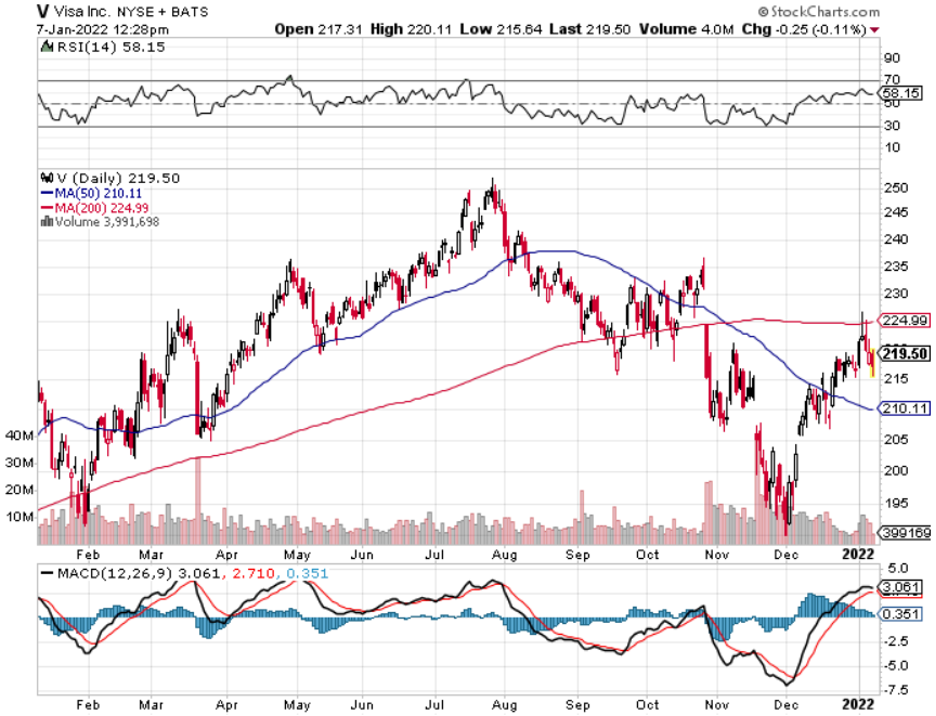
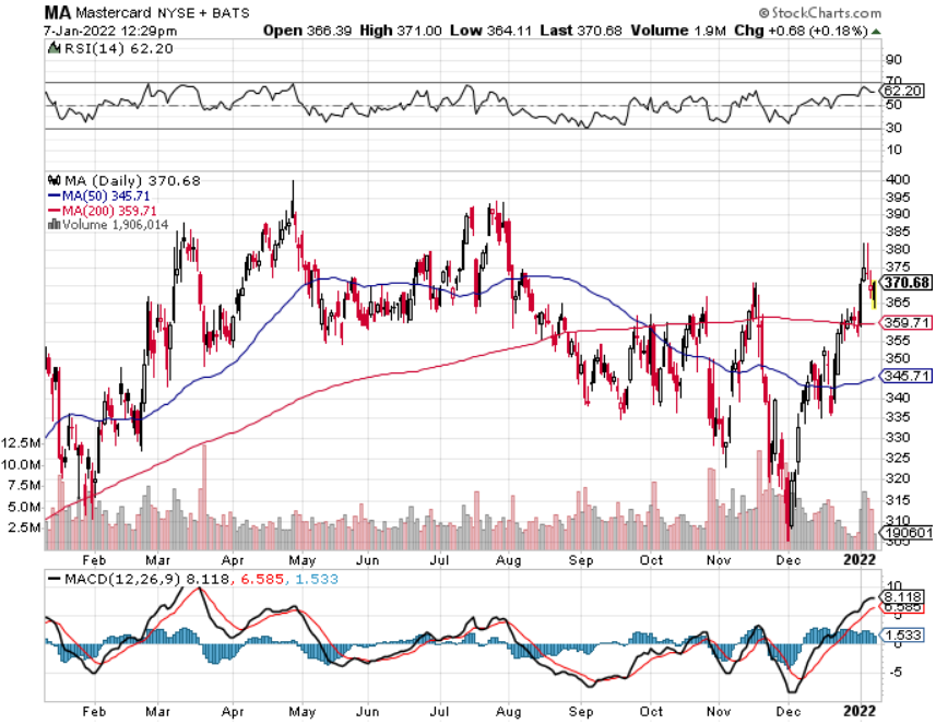
Visa and Mastercard’s card networks are a relic of the past, not in terms of reach or footprint, but the technology of it.
This will cost their stock price and we are already seeing it play out in the market.
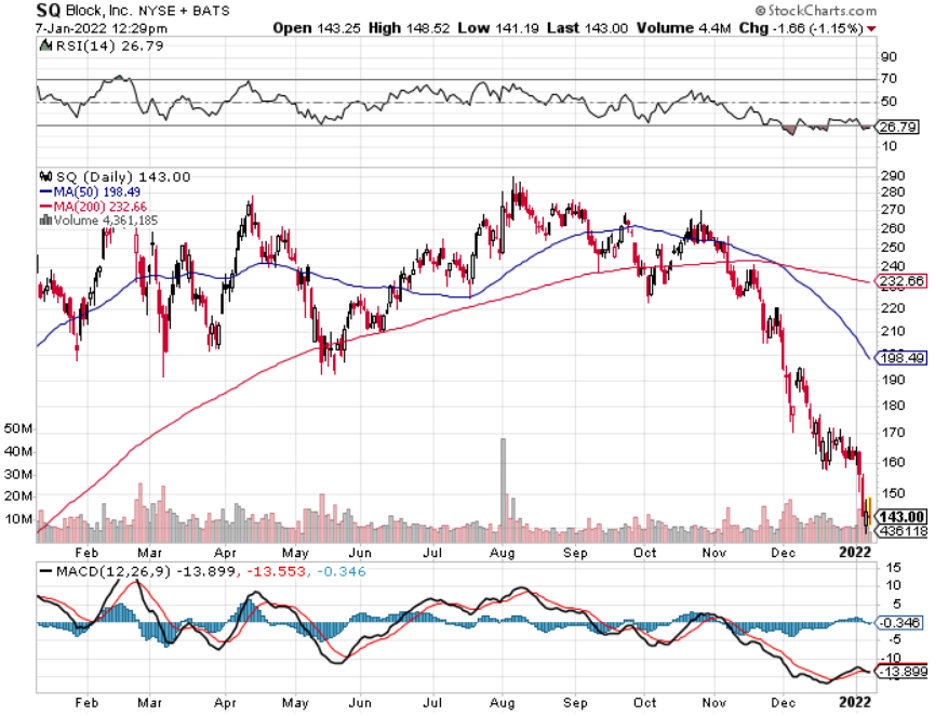
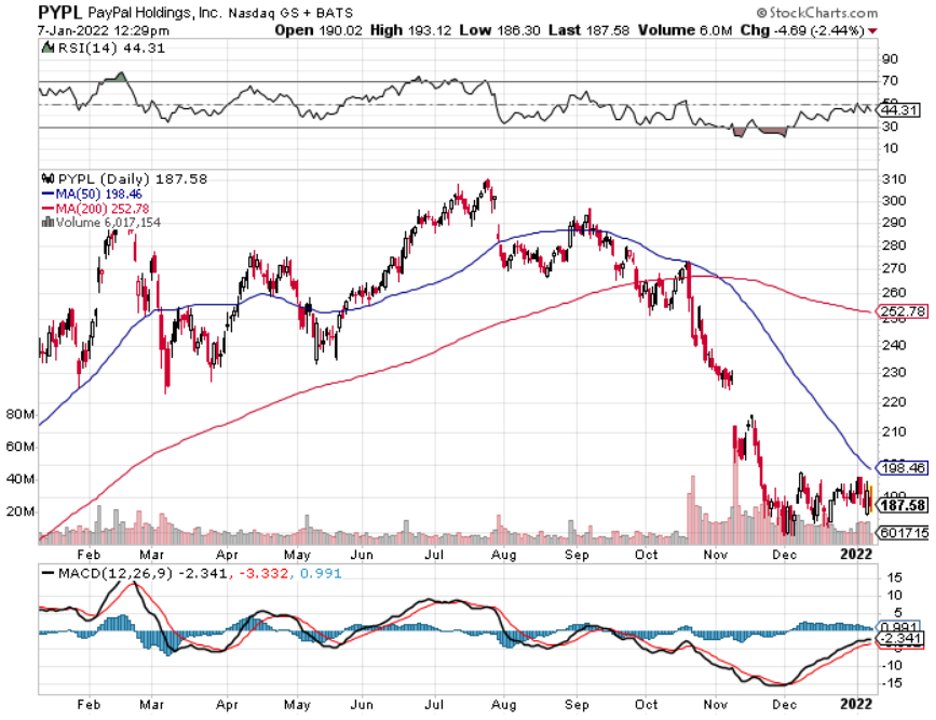
The canary in the coal mine was fintech players Square (SQ) and PayPal (PYPL) whose share prices were pummeled at the back end of last year.
PYPL is down 40% from its 2021 peak and SQ experienced a similar 42% drop.
This fierce competition and the crowded marketplace have investors paying less of a premium than ever before.
In a tightening rate environment, it’s clear the wolves are out for more flesh and the contagion will spread to those further up the food chain.
Fintech business models aren’t as robust or foundational as the bulwarks of MA and V, but questions must be asked if small businesses aren’t willing to pay an extra 2% on sales for outdated technology.
The fintech space has moved a long way in a short amount of time causing investors to be concerned about secular growth sustainability.
Among them are concerns that consumers are shifting to debit, away from higher-margin credit cards.
Consumers are also using more alternative payment methods that may bypass the card networks, including “buy now pay later” services offered by companies like Klarna, Afterpay (AFTPY), and Affirm (AFRM).
Visa has also come under pressure from a recent announcement by Amazon.com (AMZN) that next year it will stop accepting Visa-branded credit cards issued in the United Kingdom and this could be the beginning of a narrowing of Visas’ moat that could trigger a domino effect in other rich western countries.
The bulls would say that the stocks could undergo a reversal if the Omicron variant is not as bad as initially thought creating a tsunami of consumer spending massaging the bottom line for Visa and Mastercard.
But it’s looking more like V and MA are the victims of tightening travel restrictions around the globe and elevated positive cases that are immobilizing consumers.
The big card networks rely heavily on revenues related to cross-border travel as consumers and businesses use their cards for airfare, Airbnb’s, and Ubers, as well as duty-free gifts in foreign countries.
Multiples may need to come down if the Omicron variant puts the shackles on travel as countries reimpose bans or quarantine rules.
Investors had been counting on a recovery in cross-border travel to boost revenues for the card networks. This is definitely a kick in the nuts after initially seeing momentum as countries in general trended to loosening restrictions.
International transactions brought in $1.9 billion, or 21%, of Visa’s $8.9 billion in revenues for the 2021 fourth quarter.
The segment is highly profitable due to steep transaction and foreign-exchange fees. Cross-border margins come in around 69%, contributing significantly to Visa’s overall earnings per share.
The Christmas season has been confronted by a bevy of new restrictions as many places consider other measures to curb the spread of the Omicron variant.
Ultimately, even if MA and V can get positive reinforcement from increased short-term travel which seems unlikely, alternative business models are breathing down their neck as the technology of money has advanced.
The “buy now, pay later” phenomenon, although risky, is a rapid gut punch to the incumbents.
Then consider there is speculative technology like Bitcoin out there that bypasses these dinosaur networks altogether.
I believe 2022 is the year that MA and V get exposed as a luxury in a frugal world where small businesses can’t afford to give away 2% of revenue.
There’s too much money being invested into the technology of money for small businesses to reach for MA and V’s network.
Even open banking and digital networks can really dent the traditional payment networks.
Basically, I believe these companies have hit the high-water mark, and the likes of Zelle and Venmo will start to put pressure on these high fees.
Places like China don’t even use them by bypassing them through digital wallets like Wechat pay and Alipay.
Pie shrinkage and revenue decelerate — I believe this is one of the seminal trends we will see in fintech in 2022.