Mad Hedge Technology Alerts!
Several external events have prompted Silicon Valley giants to unveil a predecessor to what effectively could become a de facto social credit system by the end of this decade.
I would argue that it is already here, and we are just blind to it.
Take short-term housing agent Airbnb (ABNB) and their business model.
Try searching for a specific listing in any city with a certain date, number of guests.
If you ask other friends and family around the world to input the same data into the same listing, prices will vary greatly.
This is intentionally done because pricing depends on the profile of a certain customer.
If it is $80 per night for me, it could be $100 for the next person.
Why?
Airbnb has an embedded algorithm that conjures up a de facto social credit score, applies it to the situation, and bam — you get your price.
Through my rough research, I have found that males tend to get charged less and especially males wielding a financial profile from a rich country.
I honestly am not sure what data Airbnb is privy to, whether it is only based on a customer’s prior internal Airbnb history, or if it is pieced together from other “sources.”
I am not sure, but if they somehow have access to alternative sources to understand their client better, they might already know that this 47-year-old John Doe booking a 3-night stay in Chicago, Illinois earns $300,000 per year, 1 out of his 5 credit cards is American Express among others, he reported $300,000 of Bitcoin profits in 2020 to the IRS and he owns 3 mansions in Miami, Florida.
It would almost be safe to say that this John Doe would get a better daily rate on the same Airbnb listing than if a 19-year-old student from Albania with no credit card, no assets, and no income tried to book the same listing.
Of course, this also goes for a hardworking single mother trying to take her kids on vacation. So, in the end wealthy men get benefited by a system with discounts that other customers could probably use. But, I guess that's just business in corporate America.
This is just the beginning of the race to pad a soft social credit system so tech companies and others can charge different prices to different people, or maybe not sell some customers services at all.
Relying on an indirect boost from D.C., corporate America will attempt to force the most profound changes our society has seen during the internet era.
Last week, PayPal (PYPL) announced they would start to crack down on users that did not use their platform responsibly.
This group could potentially lose access to PayPal’s services.
PayPal says the collected information will be shared with other financial firms and politicians.
Facebook (FB) is adopting similar practices, recently introducing messages that ask users to snitch on their potentially “extremist” friends.
At the same time, Facebook and Microsoft are working with several other web giants and the United Nations on a database to block potential extremist content.
Some banking platforms already have announced a ban on certain legal purchases, such as firearms.
The growth of such restrictions will accelerate to every part of the business world.
The potential scope of the soft social credit system under construction is enormous and the data exchange practices could have all tech companies swapping customer info in some type of private network that is only accessible to them.
A creation of a “Digital Dollar” would put the tools in place to make sure customer data and flow of money are followed to the very kilobyte.
Working in conjunction with major tech companies, citizens convicted of a crime could lose their ability to transact any business as well.
On a business level, this is great for all the big Silicon Valley companies involved because they would be more efficient at deploying the business intelligence at hand to make money.
I won’t go through the Rolodex of tech companies that are in the data business, but anything involving the cloud and anything in the cloud making great margins, will go gangbusters if this is allowed to happen, which it's looking like it will.
Imagine how conversion rates at Facebook, Google (GOOGL), and Amazon (AMZN) will skyrocket because they already know how to sell stuff to the end guy.
Imagine how Airbnb could ban guests before they even had a chance to destroy somebody’s residence or give generous rates to big spenders that would encourage even more big spending.
This is essentially the dream of Silicon Valley, not for only ad tech like Roku, The Trade Desk, Snapchat, and so on, but the software companies too.
Accurate and voluminous data means better decisions and a super-charged business model.


"Software is like Lego. You can make anything with it, but it may not be appropriate." - CEO of IMC Worldwide Stuart Sherman

Inflation is everywhere — at your grocer, coffee shop and the bad news is — it’s likely to stay transitory for quite a while as it transits into even higher prices.
This isn’t the Mad Hedge Agricultural Letter so I will stay in my lane — this letter is about one of the building blocks of technology and specifically Electric Vehicles (EVs) — Lithium Batteries.
Lithium-ion batteries are the most popular type of batteries used in electric cars.
This kind of battery may sound familiar — these batteries are also used in most portable electronics, including cell phones and computers. Lithium-ion batteries have a high power-to-weight ratio, high energy efficiency and good high-temperature performance.
In practice, this means that the batteries hold a lot of energy for their weight, which is vital for electric cars — less weight means the car can travel further on a single charge.
The cost of Lithium-ion batteries is critical to EVs because it comprises about 50% of the total cost of producing an EV.
So what’s the deal with Lithium-ion batteries?
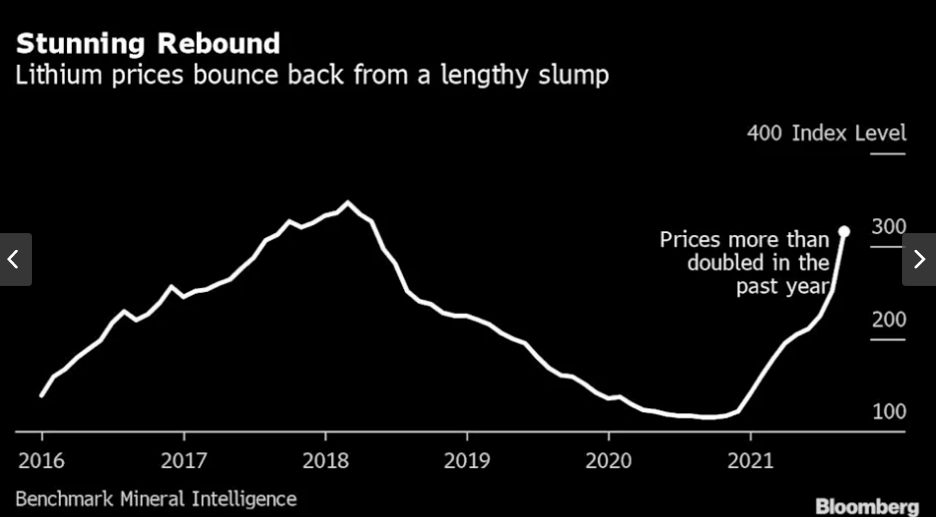
Prices have more than doubled in the past year because demand for the materials used in electric cars and renewable-energy storage has gone bonkers.
Miners cannot issue the supply to satisfy the current demand.
Instead of getting more into the weeds — I will tell you that your new Tesla (TSLA) you’re about to buy will become more expensive, so start budgeting wisely!
Increased costs will be passed onto electric vehicle (EV) manufacturers and not necessarily battery cell manufacturers, thereby potentially leading to a cost increase in EVs in the near future.
The price inflation from lithium is actually derailing a decades-long trend of a fall in lithium-ion battery prices.
Then coupled with a persisting semiconductor shortage (impacting microchip availability) — supply shortages could lead to EV demand destruction as EVs simply fail to come to market in significant quantities or do so at higher prices in limited availability.
Demand destruction is highly likely to accelerate if new lithium projects do not come to market relatively quickly, or miners might simply choose to collude together to keep prices high.
On the supply side, it’s just not guaranteed that miners can keep their costs of exploration, mining, engineering, and executing as low as they did before.
Hiring the proper talent to execute a new mine is facing headwinds like many other businesses in terms of spiking salary costs and lack of engineering talent.
For the EV industry, price points are a sore point because many consumers are on the fence about whether to buy an EV or not.
Simply put, if EVs are too expensive, consumers will just go with a gas guzzler because that’s what they know and they don’t need to deal with waiting hours at a charging station to charge their EV with a gas station across the street.
It’s true that the quality of EVs from Tesla to Mercedes has improved leaps and bounds in the past few years so the quality issue is a non-issue today.
To have a circular and sustainable bull market, EV uptake would need to surpass 50%. Until then, it’s a war of price points.
There’s also a strong possibility that not enough lithium can be mined, and this will keep EV prices high.
Battery makers are also facing higher prices for other key inputs like cobalt and copper.
Instead of doing risky things like short Tesla, which is a dangerous strategy, I would buy a lithium ETF.
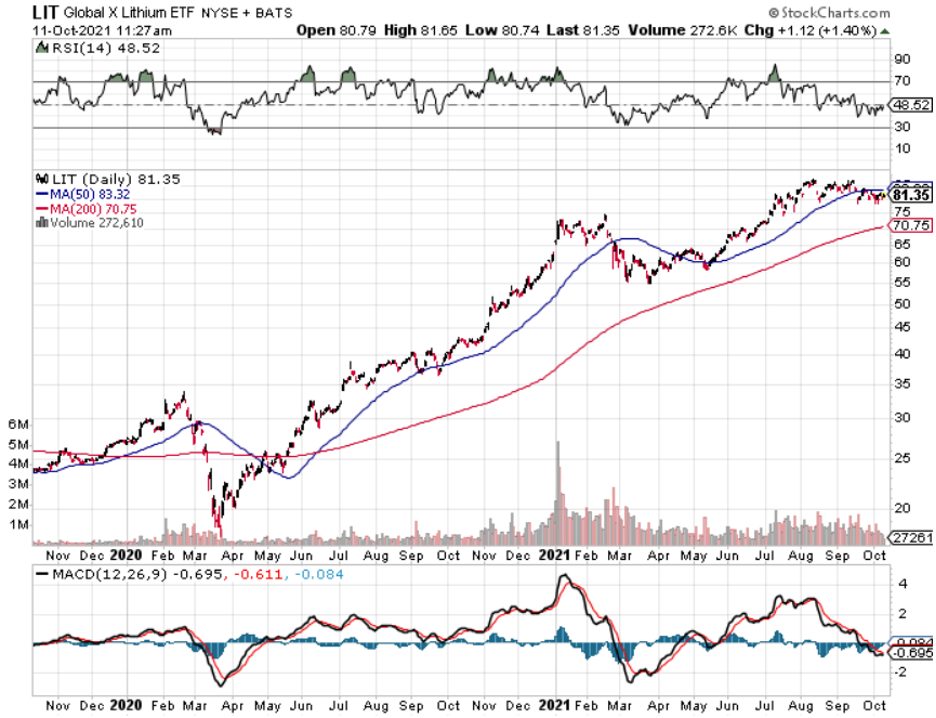
The one I recommend is Global X Lithium & Battery Tech ETF (LIT).
The stock is up over 300% in the last 2 years and if this lithium inflation narrative persists, which I highly believe it will, then any substantial drawdowns should be bought.