Mad Hedge Technology Alerts!

“Never trust a computer you can't throw out a window.” – Co-Founder of Apple Steve Wozniak
Mad Hedge Technology Letter
February 11, 2019
Fiat Lux
Featured Trade:
(HOW FORTNITE IS TAKING OVER THE GAMING WORLD),
(TTWO), (EA), (ATVI), (NFLX), (FORTNITE)

One idyllic content company reshaping the content landscape as we know it is Epic Games who is the producer of the video game phenomenon Fortnite.
Not only is Epic Games rapidly altering the video game industry by itself, it is also starting to take a bite out of Netflix’s subscriber growth momentum.
The company was established by Tim Sweeney as Potomac Computer Systems in 1991, originally founded in his parents' house in Potomac, Maryland.
The most fascinating nugget of information that came out of Netflix’s most recent earnings call was not that Netflix has already corralled 10% of television screen time in America, but the reason why this percentage is lower abroad is because of Fortnite taking away Netflix’s mojo.
Netflix (NFLX) has lately been asked to measure their content lead to the likes of Hulu, HBO, and the potential Disney streaming product about to hit the market.
But they explicitly confessed they were more worried about Fortnite and the revolution it is spawning.
The key takeaway is that Netflix is not only competing with fellow online content streamers, but video games are more of a threat to them than ever as they compete for the cord cutters and the elusive “cord nevers”.
Cord nevers are consumers who are digital natives who bypassed traditional media channels altogether.
Echoing the stickiness that Netflix has with its younger demographics, the company has targeted mobile screen time as a core driver usurping around 8% of American mobile phone screen time.
And if you thought Netflix was trying to sort out its own Fortnite problem, then how do you think the traditional American video game cohort felt about their own Fortnite problem?
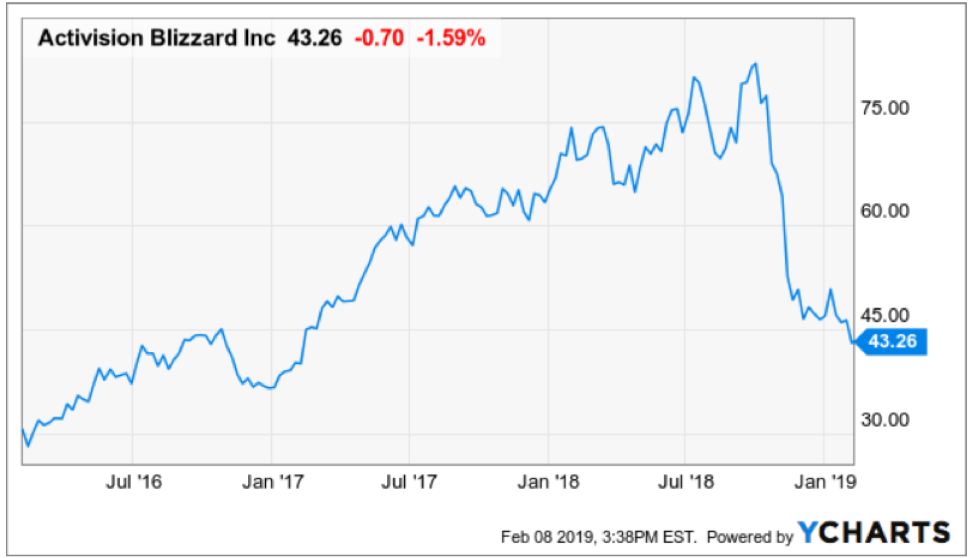
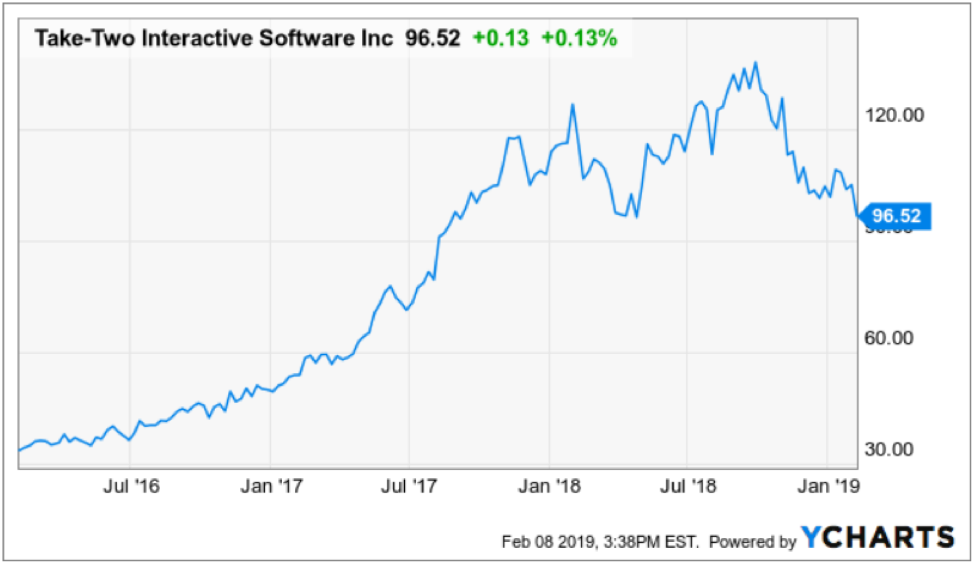
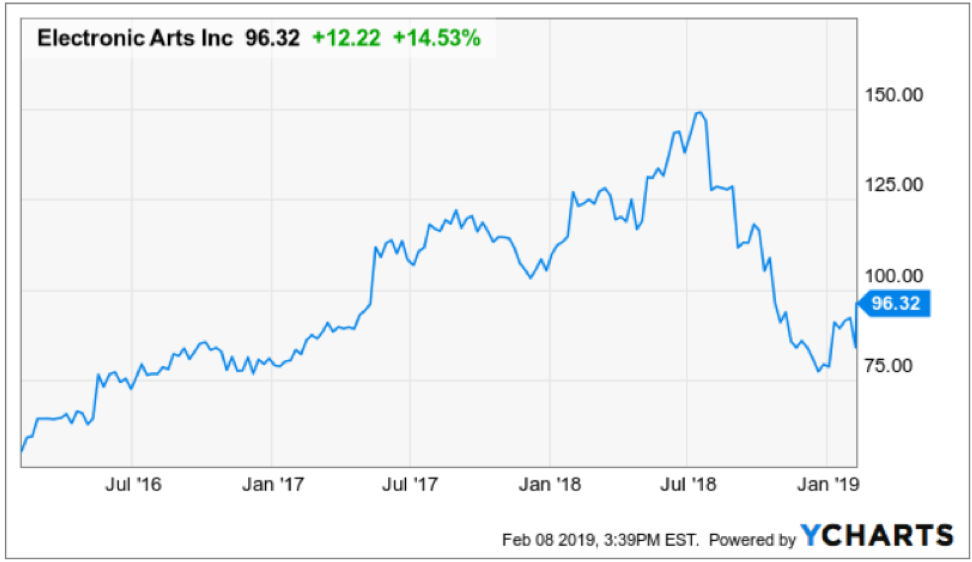
The traditional trio of EA Sports (EA), Activision (ATVI), and Take Two Interactive (TTWO) have been shredded to bits by Fortnite.
Late last year, I gave readers a steer clear synopsis of this company and the latest dead cat bounce in EA and Take Two Interactive should be chances to cut your losses instead of putting more money to work in these names.
Yes, the momentum in Fortnite is that palpable that you stay away from any name that this phenomenon affects.
Activision had no dead cat bounce being the weakest of the three and the stock has gone awry almost halving from $83 to $43 today.
EA’s earnings report was a disaster with their lead title, Battlefield V, doing 1 million fewer sales than the 7.3 million management expected.
During the same holiday season, Take Two Interactive issued a follow-up to a classic that was better than EA’s holiday flagship game called Red Dead Redemption 2 and Activision rolled out another iteration of Call of Duty: Black Ops 4.
Even between the three, the competition was fierce, then throw Fortnite into the mix and comps are getting killed with huge earnings misses penalizing the share prices of this once-vaunted trio.
With the explosion of content in the past several years, consumers are absorbing more content than ever.
Most of this avalanche of content is consumed on mobile phones or televisions, but the behavior varies when you look closer at the different demographics.
Cord cutters total in the low 20 million and are growing 30% annually.
Cord nevers amount to about 30 million growing at 66%.
This all amounts to Americans spending about 12 hours accessing content every day running up to the barrier of natural limits.
That might give consumers some allocated time to sleep, eat, and work, but not much else. We are robotically reliant on content providers to deliver us our fill of daily content.
When automotive technology comes online, it could potentially eke out an incremental 1-2 hours that Americans can stare at their content while being chauffeured around.
How is Fortnite doing financially?
Fortnite earned $2.5 billion in 2018 from a mix of in-game items and passes.
A seasonal Battle Pass is $10, and over 30% of American gamers have purchased this product.
Unlike traditional video gamers who are tied to certain consoles, Fortnite is available on seven platforms: PlayStation 4, Nintendo Switch, Xbox One, PC, Mac, iOS, and Android.
In a time of $60 video games, this new freemium model must shake the foundations of the video gaming establishment.
The rise of freemium games could eradicate the console completely.
A $200-300 console seems expensive if games are free on your $100 Android phone.
The worst side-effect of Fortnite for the traditional video game producers is not Fortnite itself.
It’s the fact that this new model has opened up a new can of worms proving this freemium model with no consoles is the key to unlocking gaming audiences with a 24-hour battle royale, free to play, on-demand, in-game currency, season pass model that was thought to be a hopeful wish by industry analysts.
Then the next question is when will the next Fortnite-esque freemium go viral and can these legacy gaming companies alter their model to accommodate this new business model?
Indeed, management must be freaking out. They thought they had a monopoly on the gaming industry but the nimbler and forward-thinking firm has won-out.
Even the most subscribed YouTuber PewDiePie from Sweden is using Fortnite to keep him in the lead for most YouTube subscribers as Indian music YouTube channel T-Series has caught up with his subscriber count that currently totals 84.3 million.
PewDiePie’s lead was cut down to 20,000 and decided to leverage playing Fortnite squad matches to boost his subs.
The upload got over seven million views in a day backing up my thesis that Fortnite has become the hottest media content asset for cord cutters and cord nevers around the world.
As for the video game stocks, don’t touch them until Fortnite trails off.
And if another freemium game comes to the fore that they aren’t on, run for the hills.