Mad Hedge Technology Alerts!

If you've been living under a rock the past few years, the cloud phenomenon hasn't passed you by and you still have time to cash in.
You want to hitch your wagon to cloud-based investments in any way, shape or form.
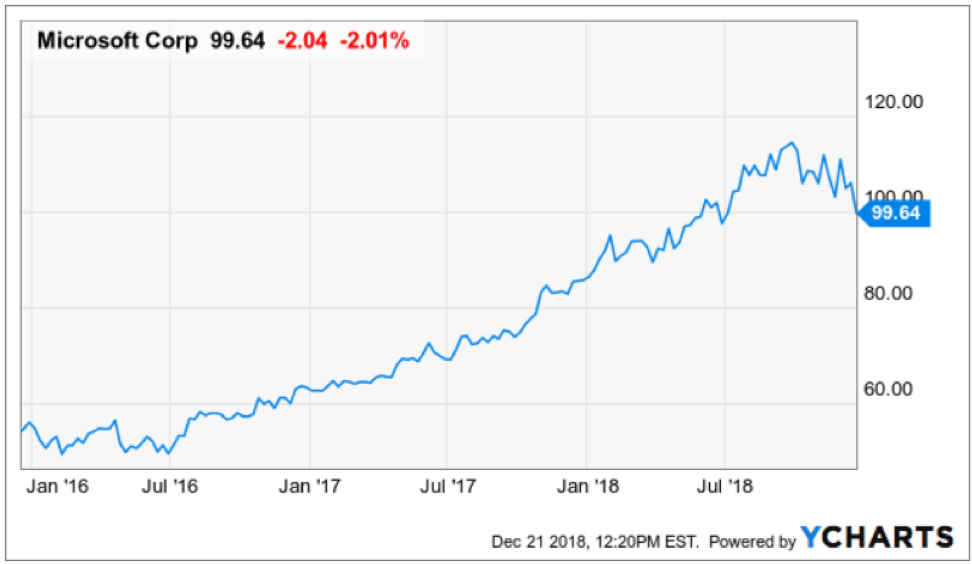
Microsoft's (MSFT) pivot to its Azure enterprise business has sent its stock skyward, and it is poised to rake in more than $100 billion in cloud revenue over the next 10 years.
Microsoft's share of the cloud market rose from 10% to 13% and is catching up to Amazon Web Services (AWS).
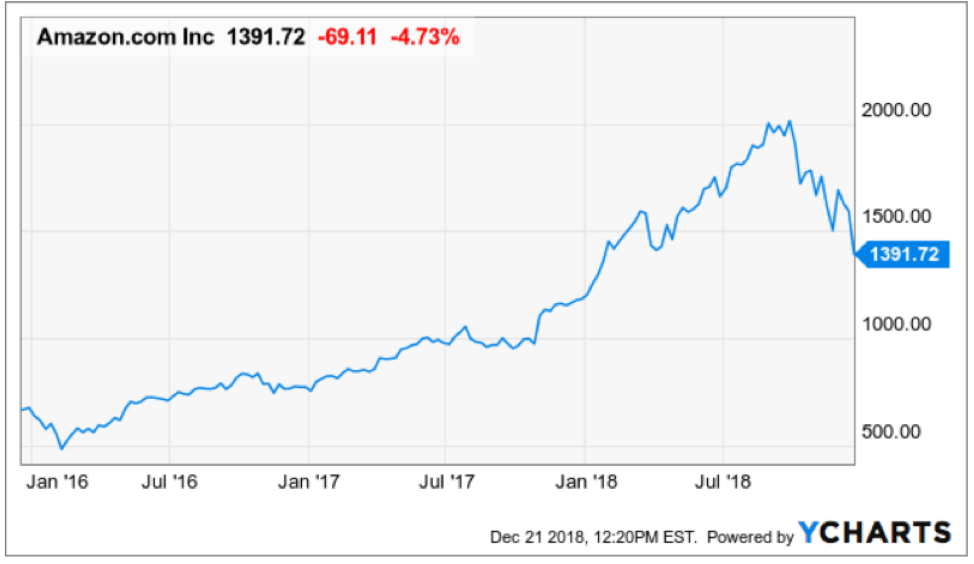
Amazon leads the cloud industry it created and the 49% growth in cloud sales from 42% in Q3 2017 is a welcome sign that Amazon is not tripping up.
It still maintains more than 30% of the cloud market. Microsoft would need to gain a lot of ground to even come close to this jewel of a business.
Amazon (AMZN) relies on AWS to underpin the rest of its businesses and that is why AWS contributes 73% to Amazon's total operating income.
Total revenue for just the AWS division is an annual $5.5 billion business and would operate as a healthy stand-alone tech company if need be.
Cloud revenue is even starting to account for a noticeable share of Apple's (AAPL) earnings, which has previously bet the ranch on hardware products.
The future is about the cloud.
These days, the average investor probably hears about the cloud a dozen times a day. If you work in Silicon Valley you can triple that figure.
So, before we get deep into the weeds with this letter on cloud services, cloud fundamentals, cloud plays, and cloud Trade Alerts, let's get into the basics of what the cloud actually is.
Think of this as a cloud primer.
It's important to understand the cloud, both its strengths and limitations. Giant companies that have it figured out, such as Salesforce (CRM) and Zscaler (ZS), are some of the fastest growing companies in the world.
Understand the cloud and you will readily identify its bottlenecks and bulges that can lead to extreme investment opportunities. And that's where I come in.
Cloud storage refers to the online space where you can store data. It resides across multiple remote servers housed inside massive data centers all over the country, some as large as football fields, often in rural areas where land, labor, and electricity are cheap.
They are built using virtualization technology, which means that storage space spans across many different servers and multiple locations. If this sounds crazy, remember that the original Department of Defense packet-switching design was intended to make the system atomic bomb proof.
As a user, you can access any single server at any one time anywhere in the world. These servers are owned, maintained and operated by giant third-party companies such as Amazon, Microsoft, and Alphabet (GOOGL), which may or may not charge a fee for using them.
The most important features of cloud storage are:
1) It is a service provided by an external provider.
2) All data is stored outside your computer residing inside an in-house network.
3) A simple Internet connection will allow you to access your data at any time from anywhere.
4) Because of all these features, sharing data with others is vastly easier, and you can even work with multiple people online at the same time, making it the perfect, collaborative vehicle for our globalized world.
Once you start using the cloud to store a company's data, the benefits are many.
- No Maintenance
Many companies, regardless of their size, prefer to store data inside in-house servers and data centers.
However, these require constant 24-hour-a-day maintenance, so the company has to employ a large in-house IT staff to manage them - a costly proposition.
Thanks to cloud storage, businesses can save costs on maintenance since their servers are now the headache of third-party providers.
Instead, they can focus resources on the core aspects of their business where they can add the most value, without worrying about managing IT staff of prima donnas.
- Greater Flexibility
Today's employees want to have a better work/life balance and this goal can be best achieved by letting them telecommute. Increasingly, workers are bending their jobs to fit their lifestyles, and that is certainly the case here at Mad Hedge Fund Trader.
How else can I send off a Trade Alert while hanging from the face of a Swiss Alp?
Cloud storage services, such as Google Drive, offer exactly this kind of flexibility for employees. According to a recent survey, 79% of respondents already work outside of their office some of the time, while another 60% would switch jobs if offered this flexibility.
With data stored online, it's easy for employees to log into a cloud portal, work on the data they need to, and then log off when they're done. This way a single project can be worked on by a global team, the work handed off from time zone to time zone until it's done.
It also makes them work more efficiently, saving money for penny-pinching entrepreneurs.
- Better Collaboration and Communication
In today's business environment, it's common practice for employees to collaborate and communicate with co-workers located around the world.
For example, they may have to work on the same client proposal together or provide feedback on training documents. Cloud-based tools from DocuSign, Dropbox, and Google Drive make collaboration and document management a piece of cake.
These products, which all offer free entry-level versions, allow users to access the latest versions of any document so they can stay on top of real-time changes which can help businesses to better manage workflow, regardless of geographical location.
- Data Protection
Another important reason to move to the cloud is for better protection of your data, especially in the event of a natural disaster. Hurricane Sandy wreaked havoc on local data centers in New York City, forcing many websites to shut down their operations for days.
The cloud simply routes traffic around problem areas as if, yes, they have just been destroyed by a nuclear attack.
It's best to move data to the cloud, to avoid such disruptions because there your data will be stored in multiple locations.
This redundancy makes it so that even if one area is affected, your operations don't have to capitulate, and data remains accessible no matter what happens. It's a system called deduplication.
- Lower Overhead
The cloud can save businesses a lot of money.
By outsourcing data storage to cloud providers, businesses save on capital and maintenance costs, money that in turn can be used to expand the business. Setting up an in-house data center requires tens of thousands of dollars in investment, and that's not to mention the maintenance costs it carries.
Plus, considering the security, reduced lag, up-time and controlled environments that providers such as Amazon's AWS have, creating an in-house data center seems about as contemporary as a buggy whip, a corset, or a Model T.

Mad Hedge Technology Letter
December 20, 2018
Fiat Lux
Featured Trade:
(MICRON TECHNOLOGY BOMBS AGAIN)
(MU), (FDX), (UPS), (AAPL), (QRVO), (SWKS), (NXPI), (CRUS), (LITE),


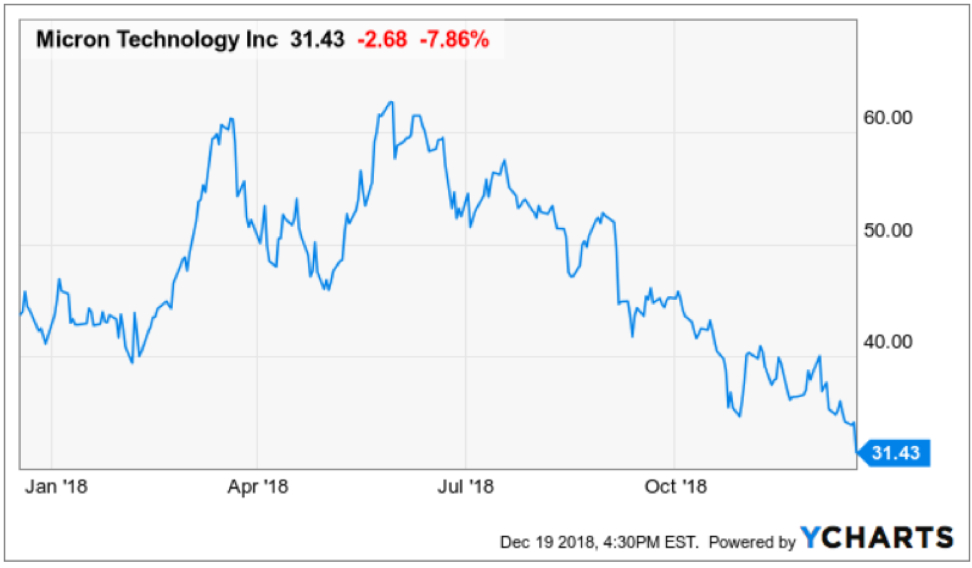
If there was ever a canary in the coal mine, we got one with chipmaker Micron (MU) delivering weak earnings results missing on the top line but squeaking through a one-cent beat on the bottom line.
Love them or hate them, chip companies are susceptible to the boom-bust cycle that is a hallmark of the chip industry.
The beginning of the bust stage of the cycle is upon us with management detailing an “inventory adjustment” that put a damper on revenue.
Micron followed that up by reducing capex for next year and it will take 2-3 quarters to work off this bloated inventory channel.
The perpetrator to the inventory backlog is the smartphone industry.
President and CEO of Micron Sanjay Mehrotra particularly noted “high-end smartphones” as the malefactor tugging down the demand.
This is another damming testament to the prospects of Apple’s (AAPL) suppliers Quorvo (QRVO), Skyworks Solutions (SWKS), NXP Semiconductors (NXPI), Cirrus Logic (CRUS), and Lumentum Holdings (LITE) who can’t catch a break.
The last six months have fired a barrage of poison-tipped arrows at their core business and these stocks are squarely in the no-fly zone until Apple and the trade war can conjure up some good news.
To say these shares are oversold is an understatement, but we are in an extreme trading environment with volatility shooting up the wazoo.
Further reducing the glimmer, Chinese tariffs took up a worrying amount of the conference call dialogue. Investors found out that tariffs pinged half a percent of gross margins.
I have been outright bearish the chip industry from the middle part of the year and Micron is heavily reliant on China for about half of its revenues which is a death sentence in December 2018.
As the China risks have spiked after each head fake détente, so have the execution risks to chip companies with an overly reliant manufacturing process in China.
Not only has the execution risk ratcheted up, but the regulatory risk through costly tariffs is now eroding Micron’s margins.
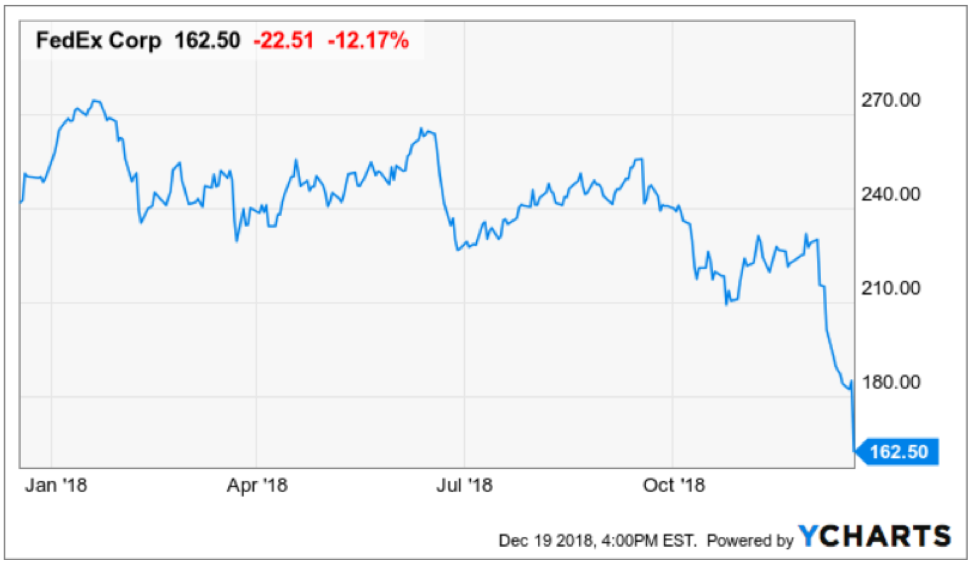
If you thought that was a downer, then FedEx (FDX) made sure the nail was in the coffin by its ghastly earnings report.
The stock sold off hard confirming fears that global growth is decelerating.
Management did not mince their words about the state of the world and investors usually listen because FedEx is a reliable yardstick of the bigger global economy.
CEO of FedEx Fred Smith offered an olive branch painting a picture of a “solid” US economy, but the conundrum is that the US economy and any other country don't exist in a vacuum and that has been highly evident in Britain who is engaging in economic suicide by disengaging from the globalized world.
Smith cited Europe as a stumbling block and blamed the bulk of weak guidance on “bad political choices”, a thinly veiled dig at the poor level of governance carried out around the world lately.
I might chime in that it is quite strange when political parties and sovereign nations adopt the game of chicken as the leading political strategy applying it to everything and anything.
The side effects to business have been startling with management unable to assuage investor sentiment and business plans shredded apart because of impulsive policy moves.
Politicians aren’t grasping fully that stock market moves are inherently tied to the news cycle and the overwhelming volume of bad news that shouldn’t be as bad as it should be, has a multiplier effect on the stock market algos that go haywire.
It truly is the world of the algos and humans are living in their world and not the other way around.
The most important takeaway from FedEx is what they didn’t say.
Early development of the de-facto Amazon Airlines has already cost FedEx up to 3% of total volume growth.
And this is just the beginning.
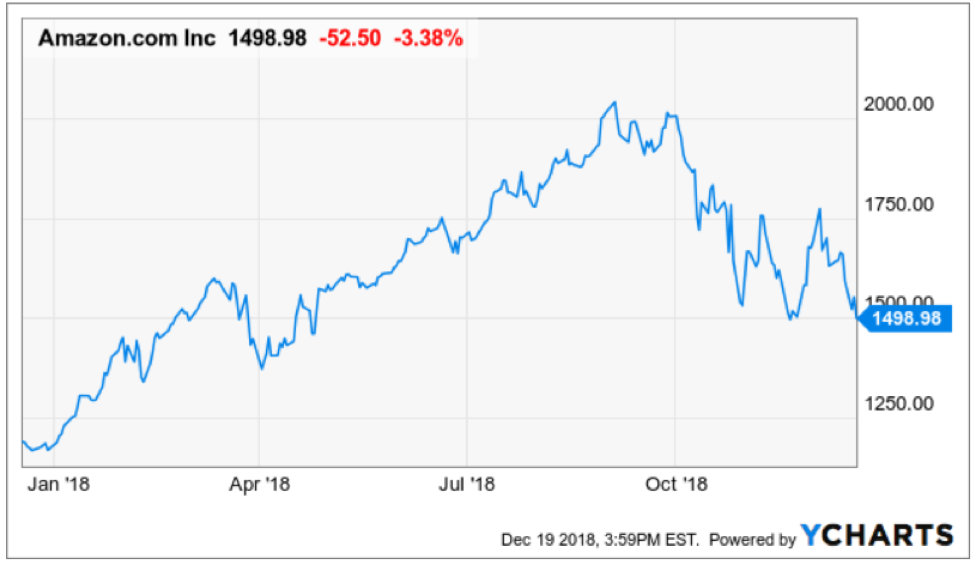
Amazon is still feeling around for the rocks at the bottom while it tries to cross the river.
Once it masters logistics, expect a radical swivel towards the integration of their own airline into the bulk of Amazon.com’s package deliveries.
And when FedEx’s management claims that the market has gotten it wrong about the Amazon threat, that means the market is completely correct.
The market is always right.
Amazon’s master plan is to vertically integrate every last process down to the last mile, the doorbell, and now the microwave as Amazon has rolled out a myriad of smart home products.
FedEx management has to be blind to understand this won’t damage future sales.
It is materially false if FedEx thinks Amazon is not competing with them, and the sad part of this is there is not much FedEx can do about it.
The shipping giant cut its 2019 earnings forecast between $15.50 and $16.60 per share — from $17.20 to $17.80 a share.
FedEx’s goal of eclipsing $1.5 billion in operating income by fiscal 2020 has been shelved disappointing investors. FedEx cratered 12% on a day that saw the Fed do its best body slam imitation on the market.
The first phase of the logistics swivel is taking delivery of 40 planes and constructing a hub that will be able to operate 100 planes, then it will do as Amazon does with everything – scale it to the hills.
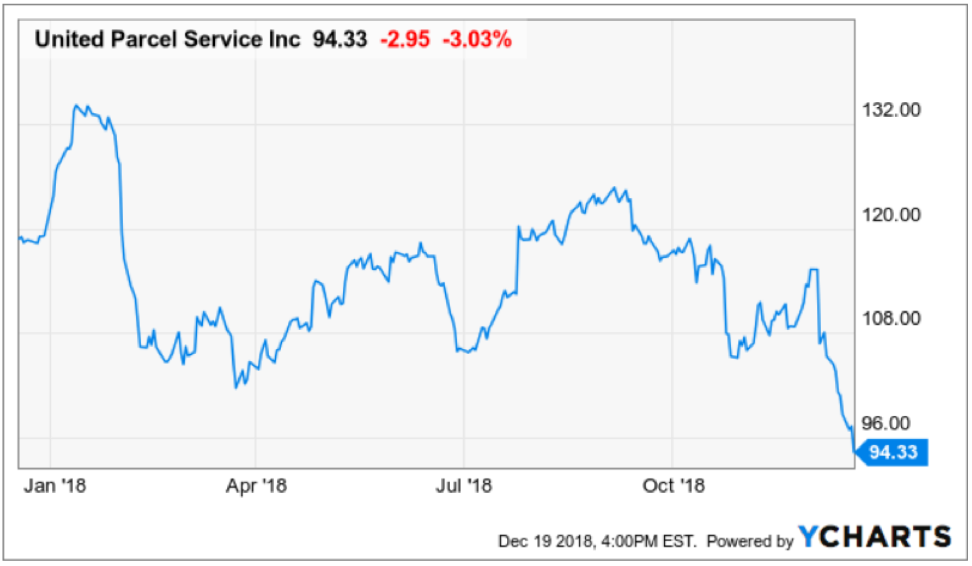
FedEx and UPS have a few years to figure out how to counteract this existential crisis and not decades.
Technology moves that fast now in this interconnected world.
Domestic volume comprises 17% of revenues at UPS and 19% at FedEx, management won’t be able to hide this problem under the carpet as the drag becomes highly visible like a sore thumb.
Analysts expect Amazon Air to offer more than slim savings to its business model saving between $2 to $4 per package next year.
The annual savings add up from $1 billion to $2 billion or 3% to 6% of its global shipping costs.
It is spot-on to admit that over the last few years, the explosion of packages during the holiday shopping season has put higher levels of stress on the U.S. Postal Service, UPS (UPS), and FedEx.
Even though overloaded with business, all three carriers have posted record levels of on-time deliveries and they appear to be handling the surge in volume.
But there will come a moment in time when an inflection point will give Amazon the keys to the car.
They will suddenly stop offering their e-commerce packages to these three carriers and business will drop off a cliff for them.
That is the future these three are confronted with and there is nothing they can do unless they build their own Amazon.com which is a pie in the sky dream at this point.
Amazon is out to prove they can execute the logistic part of their business cheaper and faster than anyone else because of the superior management and mountain of data they can act on.
I believe it will happen.
Part of stretching themselves with a new army of minions in Washington D.C., New York, and Nashville is partly about fulfilling the job of comprehensively and vertically integrating their e-commerce platform.
It will take a horde of workers to make this happen.
If the prophecy from FedEx management comes true and the global economy indeed softens next year, the stock will bear the brunt of the downside momentum and UPS too.
Stay away from the trio of deliverers. There are healthier fishes in the sea.
And as for the chip sector and Apple, wait on the sidelines for some good news.