• support@madhedgefundtrader.com
  • Member Login
Mad Hedge Fund Trader
  • Home
  • About
  • Store
  • Luncheons
  • Testimonials
  • Contact Us
  • Click to open the search input field Click to open the search input field Search
  • Menu Menu

Mad Hedge Technology Alerts! 

Back to Mad Hedge Technology Portal

Google’s Breakfast of Rotten Eggs

Tech Letter

In a recent interview Google CEO Sundar Pichai admitted he is “not a morning person” and maybe that was his argument for skipping out on the grilling that his contemporaries Facebook (FB) COO Sheryl Sandberg and CEO of Twitter (TWTR) Jack Dorsey received in front of Congress.

Or maybe Pichai managed to down a rotten egg that morning when eating his favorite staple breakfast “omelet with toast," because his decision to abort his date with Congress was a shocking error of judgment for a CEO that has had a flair for controversy lately.

With the whole world watching, the empty chair with a simple name tag with Google plastered over it represents the arrogance and excesses of Silicon Valley all mixed into one incongruous mixture.

This rookie move will open a can of worms for the company made famous by its search algorithm that dominates the developed world.

Google will have a target on its back going forward while creating a massive public relations backlash for a company that must fiercely defend its ad-laden profit engine going forward.

Instead of taking it on the chin like Facebook and Twitter, Google has voluntarily veered into a sticky situation, and all to avoid a few stomach wrenching questions from Congress.

How did this all happen?

In the beginning of June, Google decided to scrap its relationship with the U.S. Department of Defense.

Project Maven, as it was known, provided Google’s artificial intelligence (A.I.) technology to systematically analyze drone footage for the U.S. government.

Pichai chose to avoid renewing the contract, and Google Cloud CEO Diane Greene agreed it was a black eye for the company that applied its own technology to conspire against damaging human life.

Throwing fat on the fire, Pichai followed up by dismantling Project Maven and giving the thumbs up for code-name Dragonfly. This was a secret project aimed at the mainland Chinese market and rolling out a censored version of Google’s search engine by altering its construction of unique search algorithms for a mainland Chinese audience.

This incensed the higher-ups on Capitol Hill, as this move was largely viewed as pandering toward the Chinese communist government for monetary purposes at an uber-sensitive time between the two powerhouse nations, which remain mired in a tumultuous trade war.

The timing couldn’t be worse for Pichai.

Dragonfly is already in beta mode and could be rolled out in the near future. However, I see it as dead on arrival, because there is no hope that Google can penetrate the fortress that is the Chinese business world.

Naturally, Google employees were dismayed and shocked by these startling revelations.

Pichai’s conspicuous no-show was in part driven by the potential wrath he would have faced by these recent reckless decisions that seemed to put the American government’s interests below the Chinese communist government.

The circus was there for everyone to see.

Sheryl Sandberg put on her bravest face.

It was obvious she had rehearsed every word to the utmost precision while Dorsey vehemently guarded his brainchild with honesty and zeal.

The testimonies made social media look perceivably criminal with a congressman even hinting the reason they aren’t allowed to do business in China was mainly a business model issue, and more specifically a legal issue.

Another congressman from West Virginia suggested Facebook’s Instagram was the source of the opioid epidemic ripping apart his state.

The only thing getting ripped apart during the intense grilling was Sheryl Sandberg’s well-practiced smile.

Dorsey and Sandberg were visibly uncomfortable with the line of questioning and rightly so.

Google would have looked worse if it showed up. But it managed to look 10 times worse than that by stonewalling the government’s invitation.

In a recent Pew Survey, data revealed 44% of youth between 18 to 29 last year deleted Facebook on their mobile phones.

Facebook is already a legacy platform in the throes of disruption cannibalized by its own asset - Instagram.

Instagram will be the sole survivor of Facebook by taking out Facebook itself, and that is bearish for overall business.

And that is if social media can hang on that long before it’s taken down by the hawks circling above in Washington.

When Facebook’s Cambridge Analytica scandal broke, the government was at sixes and sevens at attempting to figure out what on earth was going on behind the smoke and mirrors of the big data theatrics.

CEO Mark Zuckerberg was let off the hook with questions he wriggled out of, and Facebook shares powered on unabated.

This time it’s different.

Regulation is an imminent threat to social media revenues and could hurt earnings this quarter.

Investors need to migrate to higher tide, meaning Amazon (AMZN) and Microsoft (MSFT), because the waves still aren’t yet reaching those levels.

Amazon and Microsoft need to send a thank you note to Alphabet for screwing the pooch.

The administration has felt it convenient to barrage Silicon Valley to solidify the Republican base, and this tactic has resonated with the administration’s diehards.

A smorgasbord of FANG-bashing was the recipe to this madness. But now sights will be zoned in on dismantling Google, and Microsoft and Amazon will benefit from avoiding nasty, gut-churning headlines that turn up in the form of Twitter blitzkrieg.

Yes, Sheryl Sandberg, Facebook was “too slow” to react to foreign interference in the elections. But it is more accurate to characterize the battle social media faces against outside nefarious forces as impossible.

It is impossible for these social media platforms to police themselves while policing the whole world.

The incessant whack-a-mole scenario is the best-case outcome for the self-policing prospects of social media.

Once social media algorithms figure out how to stopgap one method of circumvention, the bad actors will move on to a more advanced way to manipulate the algorithmic police.

What does this mean for social media?

Costs are going up and will seep into profit margins.

Highlighting the upward trend of rising expenses for social media platforms is the daily cost of keeping CEO Mark Zuckerberg safe.

And remember, he lives in Palo Alto, California, one of the safest places on planet earth with a medium household income of $137,000.

In 2017, Facebook divvied up $7.3 million for Zuckerberg’s security detail and costs associated to it.

In 2018, shareholders approved a $10 million security package to keep Facebook’s head honcho safe. This underscored the ballooning risk of leading this controversial technology forum littered with conflict of interests, and on the verge of potentially perverting western democracy.

By the end of 2018, Facebook will increase its security division from 10,000 employees to 20,000.

And that is just the beginning.

Facebook’s security division is the fastest-growing division of fresh hires at Facebook.

Before Facebook and Twitter can ring in the profits, they face an exorbitant war against foreign “bot armies” intent on muddying the free flow of accurate information on domestic shores that target individuals deemed unaligned to the foreign actor’s interests.

There will be collateral damage and lots of it.

This does not sound like an easy road to profits, and it is not.

As midterm elections creep closer and closer, Facebook and Twitter must confront elevated headline risk, and any trading day could see shares wacked with a 10% haircut.

Following the government question-and-answer period, Twitter and Facebook will be designing a new resistance to stymie villainous foreign infiltration.

Ultimately, spending the bulk of employees’ work days realigning their business models to protect democracy, instead of creating new growth drivers, is not bullish for the stock price.

It is hard to breed much confidence in social media stock’s long-term narrative after listening to Dorsey and Sandberg speak.

They kept touching on needing help from government intelligence sources to aid them in catching the miscreants.

It makes sense to gradually nationalize social media platforms to unite the disconnect between social media’s war against foreign forces and the intelligence communities war against them.

It is clear hackers are exploiting the dislocation in cohesiveness between the cracks in social media and government intelligence.

But if that ever happens, it would be the end of Facebook and Twitter as we know it, as normal users would be averse to providing free content on a government-enabled platform as well as a strong blow to democracy itself.

It all makes sense now why Dorsey and Sandberg gave the answers they gave.

Their answers were akin to a faint plea for help while appearing contrite, hoping to persuade Congress to give them more time to figure it out.

This thinly veiled attempt to elongate the profit-making process and find a solution for a problem with no solution could end badly for these two companies.

Migrate to higher quality tech names in the short-term.

The resilient American economy powers on with the heavy lifting done by Silicon Valley albeit it with fewer lifters.

If social media stocks can get through the midterm elections unscathed, there is a trade on the table for these beleaguered companies rounding out a tumultuous year.

But getting to that point will be volatile, as this group of stocks have a rocky road ahead of them for the rest of the year.


I’m Not A Morning Person


________________________________________________________________________________________________

Quote of the Day

“I'm not a regular smoker of weed. Almost never,” – said CEO of Tesla Elon Musk on The Joe Rogan Experience podcast.


https://www.madhedgefundtrader.com/wp-content/uploads/2018/09/Google-image-1.jpg 420 387 MHFTR https://madhedgefundtrader.com/wp-content/uploads/2019/05/cropped-mad-hedge-logo-transparent-192x192_f9578834168ba24df3eb53916a12c882.png MHFTR2018-09-10 01:05:172018-09-07 18:49:04Google’s Breakfast of Rotten Eggs

September 6, 2018

Tech Letter

Mad Hedge Technology Letter
September 6, 2018
Fiat Lux


Featured Trade:
(THE SMART PLAYS IN FINTECH),
(SQ), (PYPL), (JPM), (COF), (WFC), (BAC),
(MGI), (GRUB), (BABA), (NFLX)

https://madhedgefundtrader.com/wp-content/uploads/2019/05/cropped-mad-hedge-logo-transparent-192x192_f9578834168ba24df3eb53916a12c882.png 0 0 MHFTR https://madhedgefundtrader.com/wp-content/uploads/2019/05/cropped-mad-hedge-logo-transparent-192x192_f9578834168ba24df3eb53916a12c882.png MHFTR2018-09-06 01:06:152018-09-05 20:01:04September 6, 2018

The Smart Plays in Fintech

Tech Letter

Fintech is all the rage now, and it’s time for investors to grab a piece of the action.

The tech sectors’ stellar performance in 2018 is a little taste of things to come as every industry forcibly pushes toward software and artificial intelligence to enhance products and services.

Bull markets don’t die of old age and some of these tech stalwarts are truly defying gravity.

The fintech sector is no exception.

Square (SQ) led by tech visionary Jack Dorsey has been a favorite of the Mad Hedge Technology Letter practically from the newsletter’s inception.

But another company has caught my eye that most of you already know about – PayPal (PYPL).

PayPal, a digital payments company, has extraordinary core drivers and a splendid growth trajectory.

Its arsenal of services includes digital wallets, money transfers, P2P payments, and credit cards.

It also has Venmo.

Venmo, a digital payment app, is the strongest growth lever in PayPal’s umbrella of assets right now, and was the first meaningful digital payment app in America.

It was established by Andrew Kortina and Iqram Magdon-Ismail, who were roommates at the University of Pennsylvania, and the company was bought out by PayPal for $800 million in 2014, marking a new chapter in PayPal’s evolution.

Funny enough, Venmo’s original use was to buy mp3 formatted songs via email in 2009.

Venmo is wildly popular with tech savvy millennials. A brief survey conducted illustrates how fashionable Venmo is by recording higher user statistics than Apple Pay.

The app is commonly used for ordering pizza through Uber Eats or Grubhub (GRUB), or even shelling out for monthly rent.

If you want to stir up your imagination even more, Venmo has a prominent social feed where users can view other Venmo users’ purchases.

Financial models suggest Venmo could contribute $300 million to the PayPal top line in 2021. If Venmo executes perfectly, revenue could surpass the $1 billion mark in 2021, with much higher operating margins than PayPal’s core products.

Even though management declines to speak specifically about Venmo, the dialogue in the earnings call usually provides some color into what is going on underneath the hood.

Xoom, a digital remittance distributor app with offices in San Francisco and Guatemala City owned by PayPal, along with Venmo grew payment volume by 50% YOY, surging to $33 billion annually.

Of that $33 billion in volume, $19 billion was contributed by Venmo and Xoom chipped in with $14 billion.

More than 60,000 new merchants joined PayPal’s array of platforms, adding up to more than 19.5 million total merchants.

All in all, PayPal locked in $3.86 billion of sales last quarter, which was a 23% YOY jump in revenue, at a time where widespread acceptance of fintech platforms is brisk.

PayPal raised its end-of-year forecast and rewarded shareholders with authorization of a $10 billion buyback.

Upward margin expansion, expanding market share, multiple revenue stream, and untapped pricing power is the recipe to PayPal’s meteoric rise.

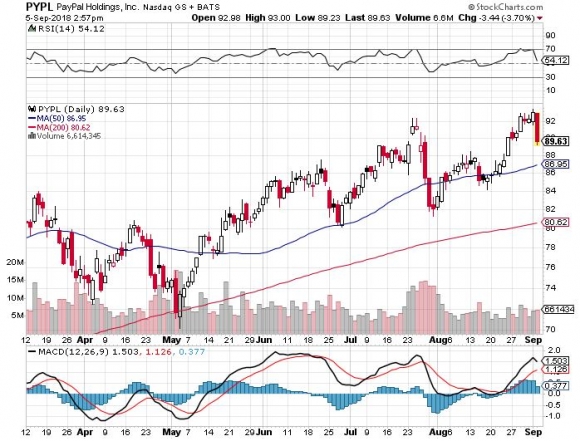
PayPal’s share price has climbed higher from a base of $73 at the beginning of the year to an all-time high of more than $90.

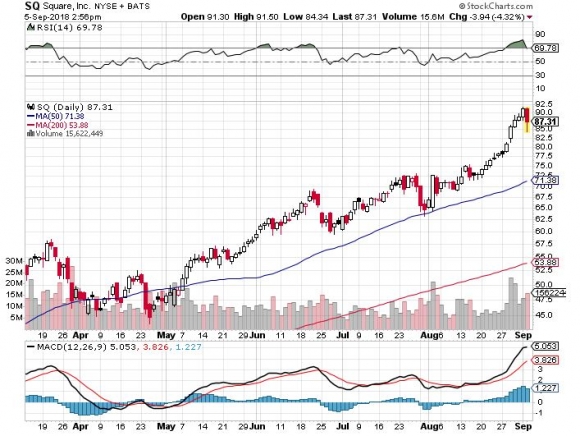
Offering more proof fintech is alive and kicking is Jack Dorsey’s Square’s dizzying rise of more than 200% YOY in its share price.

The company is exceeding all revenue growth expectations and is poised to ramp up subscription revenue.

As with the Venmo app, Square’s Cash app has unrealized potential and will be one of the outperforming profit drivers going forward.

Square hopes to be the one-stop-shop for all types of digital payment needs including consumer finance, equity purchases, possibly international transfers, and cryptocurrency.

All of this is happening amid a robust secular story that could have seen traditional banks swept into the dustbin of history.

Rewind a few years ago, perusing the data about the movement to digital payments must have frightened the living daylights out of the executives from major Wall Street mainstays.

Digital wallets assertive migration into mainstream money payment services could have detached traditional banks’ core businesses.

Slogging your way to a physical bank to put in a wire transfer was not appealing.

Archaic methods of business are painful to see, and traditional banks were still operating this way as of 2015.

Time is money and technology has crashed the traditional waiting time to almost zero.

The way these tech companies operate is simple.

They compete to hire a hoard of advanced computer developers or shortcut the process using the time-honored tradition of poaching the competition’s best talent.

Then snatch market share at all costs and grow like crazy.

Banks badly needed introducing some functions to their array of services such as linking with third-party payment APIs to facilitate online payments and enabling cross-platform digital payments.

Other functions such as establishing modern peer-to-peer payment systems or adopting QR code technology that are wildly popular in East Asia could enhance optionality as well.

These are several instruments they could have amalgamated into their arsenal of fintech technology that could have freshened up these dinosaur institutions.

Harmonizing banking tasks with mobile functionality was fast coming and would be the standard.

Anyone not on board would sink like the Titanic.

Ultimately, banking institutions needed to up their game and acquire one of these digital wallet processors or watch from the sidelines.

They chose the former when a consortium called Early Warning Services (EWS) jointly created by behemoth American banks, including JPMorgan Chase & Co. (JPM), Capital One (COF), Bank of America (BAC), and Wells Fargo (WFC) to “prevent fraud and reduce detection risk” made a game-changing decision.

(EWS) acquired digital payment app Zelle in 2016, and this was its aggressive response to Square Cash and PayPal’s Venmo.

Results have been nothing short of breathtaking.

Leveraging the embedded base of existing banking relationships, Zelle took off like a scalded chimp and never looked back.

In a blink of an eye, Zelle had already signed up more than 30 banks and over 100 financial institutions to its platform.

Banks couldn’t bear being left out of the fintech party.

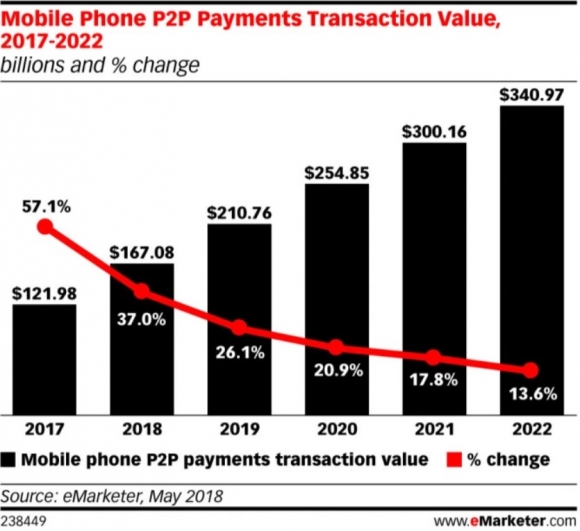
With hearty conviction, Zelle is signing up users at a pace of 100,000 per day, and the volume of payments in 2017 eclipsed $75 billion.

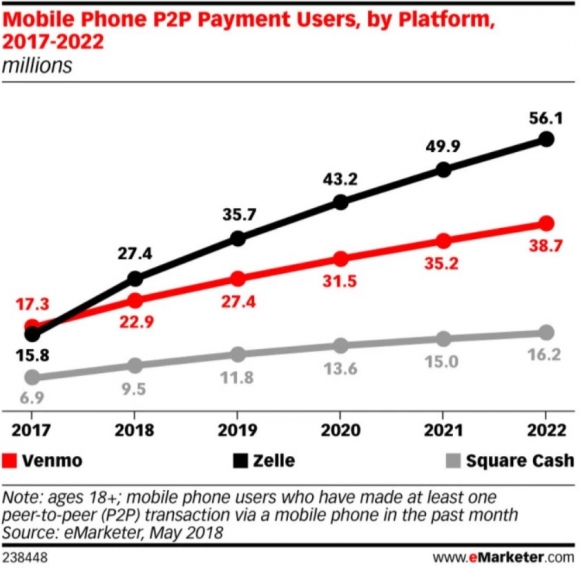
Zelle projects to expand more than 73% in 2018, integrating 27.4 million new accounts in the U.S., head and shoulders above Venmo’s 22.9 million and Square Cash due to add 9.5 million more users.

Make no bones about it, Zelle was in prime position to convert existing relationships into digital converts. The banks that do not have an interest in Zelle have an uphill climb to stay relevant.

The United States is rather late to this secular growth story. That being said, already 57% of Americans have used a mobile wallet at least once in their lives.

Innovative ideas bring supporters galore and even more adoptees.

That is why the strong pivot into technological enhanced ideas bear unlimited fruit.

Using a mobile platform to just open an app then send funds within a split second with minimal costs is appealing for the Netflix (NFLX) crazed generation that can hardly get off the couch.

Ironically, it’s those in the emerging parts of the world leading this fintech revolution by skipping the traditional banking experience completely and downloading digital wallet apps on their mobile devices.

It’s entirely realistic that some fresh-faced youth have never been present at a physical banking branch before in India or China.

Download an app and your fiscal life commences. Period.

The volume of funds passing through the arteries of Chinese digital wallet apps surpassed $15 trillion in 2017.

And by 2021, 79.3% of the Chinese population are projected to use digital wallets as their main source of splurging Chinese yuan.

America lags a country mile behind China, but the Chinese progress has offered American tech companies a crystal-clear blueprint to springboard digital payment initiatives.

Chinese state banks are already starting to become marginalized, and the Wall Street banks are not immune to the same fate.

Devoid of a digital strategy will be a death knell to certain banking institutions.

Compare the pace of adoption and some must question why American adoption is tardy to a fault.

Highlighting the lackadaisical pace of American fintech integration was Alibaba’s (BABA) smash-and-grab attempt at MoneyGram International Inc. (MGI), as it sought to gain a foothold into the American fintech market.

The attempt was rebuffed by the federal government.

The nascent state of the digital payment world in America must alarm Silicon Valley experts. And the run-up in Square and PayPal includes calculated bets that these two standouts will leapfrog into the future with guns blazing along with Zelle.

The parabolic nature of Square’s mystifying gap up means that a moderate pullback is warranted to put capital to work in this name.

Investors should wait for a timely entry point into PayPal as well.

These two stocks have overextended themselves.

As the fintech pie extrapolates, there will be multiple victors, and these victors are already taking shape in the form of Zelle, PayPal, and Square.


________________________________________________________________________________________________

Quote of the Day

“In the not-too-distant future, commerce is just going to be commerce. It won't be online commerce or offline commerce. It's just going to be commerce. And that will happen because of the phone,” – said CEO of PayPal Dan Schulman.

 

https://www.madhedgefundtrader.com/wp-content/uploads/2018/09/mobile-phone-p2p-payments-transaction-image-4-e1536176894297.jpg 531 580 MHFTR https://madhedgefundtrader.com/wp-content/uploads/2019/05/cropped-mad-hedge-logo-transparent-192x192_f9578834168ba24df3eb53916a12c882.png MHFTR2018-09-06 01:05:212018-09-05 20:00:17The Smart Plays in Fintech
Page 943 of 1036«‹941942943944945›»

Legal Disclaimer

There is a very high degree of risk involved in trading. Past results are not indicative of future returns. MadHedgeFundTrader.com and all individuals affiliated with this site assume no responsibilities for your trading and investment results. The indicators, strategies, columns, articles and all other features are for educational purposes only and should not be construed as investment advice. Information for futures trading observations are obtained from sources believed to be reliable, but we do not warrant its completeness or accuracy, or warrant any results from the use of the information. Your use of the trading observations is entirely at your own risk and it is your sole responsibility to evaluate the accuracy, completeness and usefulness of the information. You must assess the risk of any trade with your broker and make your own independent decisions regarding any securities mentioned herein. Affiliates of MadHedgeFundTrader.com may have a position or effect transactions in the securities described herein (or options thereon) and/or otherwise employ trading strategies that may be consistent or inconsistent with the provided strategies.

Copyright © 2026. Mad Hedge Fund Trader. All Rights Reserved. support@madhedgefundtrader.com
Scroll to top