Mad Hedge Technology Alerts!
The technology-laced film Ready Player One gives viewers a snapshot into the future where technology, income inequality, and society have run their course, and the year 2045 looks vastly different from the world of 2018.
Set in a semi-dystopian backdrop, the movie offers us a deeper insight into how certain technology trends will permeate into everyday life.
The first and most obvious future trend is the copious use of avatars.
Avatars will become the new normal. The first place that humans will find them is through the use of social media and entertainment, as children eventually becoming a part of us like our social media profiles today.
The Mad Hedge Technology Letter has incessantly hammered home about the phenomenon of gaming, and this will incorporate virtual reality allowing gamers access to a new digital world.
This was the on show in the film where the likes of protagonist Wade Watts, played by Tye Sheridan spent most of his life playing in the virtual world of Oasis using his character Parzival.
This could be your child in the future.
Wade Watts character is the new cool for Generation Z, as they are largely unconcerned about underage drinking and partying like the generations before them.
Gaming and hanging out on their preferred social media platforms are the new cool.
The companies dictating the current video game industry will have the first crack at it to realize profits and develop new businesses such as Microsoft (MSFT), Nvidia (NVDA), Advanced Micro Devices (AMD), Electronic Arts Inc. (EA), Take-Two Interactive Software, Inc. (TTWO), and Activision Blizzard, Inc. (ATVI).
Children just aren’t going outside like they used to and per most studies, they are addicted to the smartphone you bought them at age 10.
Most studies have found that once a child becomes hooked on technology, it is hard to reverse the habit, as once they enter into adult life and start their career, they become even more reliant on the technologies that got them to that point in the first place.
If your kid is already staring at tech devices three to four hours per day now for activities other than school work, expect that to grow to a minimum of six to seven hours per day once he hits puberty and smartphone time limits begin to fade away.
This all means that VR and gaming could be the handsome winner in all this, and the use of social media platforms will reap the benefits as well.
Generation Z just surpassed Millennials in terms of population comprising 25% of the American populace.
Neither of these generations have grown up with VR in their daily lives because the technology wasn’t advanced enough to really make a dent in their lives.
More than 75% of Generation Z has access to a smartphone, and they can truly be called the first generation of digital natives.
Avatars will push deeper into everyday life because the facial tracking technology has advanced by leaps and bounds.
Instead of cartoon-like avatars, lifelike avatars have replaced the less refined versions. It will be a tough time going forward distinguishing what is real and what is fake.
If you think fake news is a problem now, imagine how fake it will become in the future.
This could devastate the news industry as news organizations run the risk of melting down at any point, or just being completely taken over by tech companies and their algorithms, which is already happening now with Alphabet (GOOGL).
The future looks bleak for all newspaper assets, and the ones with the most advanced digital strategies will survive.
Newspapers only have so much time they can hang on with digital ad revenue, the reason they are still in business.
Viewers don’t want to see ads – period. And at some point, they will be disrupted as well.
Swashbuckling youth already have downloaded ad-blockers to completely remove ads from their lives, and refuse to open any website that forces them to white list a website.
There are children in Generation Z who might never have seen an ad before because their digital native capability allows them to navigate around ads with adept skill.
Or the easy solution for many Millennials is just watch Netflix because the platform is ad-less. The aversion to ads is so strong that traditional media giants such as Fox are experimenting with six-second ads because that is all a viewer can tolerate these days.
The traditional media giants were forced to adopt this new format after Alphabet’s YouTube rolled out micro-ads.
Popular browser Mozilla announced it will block all tracking scripts by default beginning in 2019, thwarting unregulated data collection and relentless ad pop-ups.
The reason why digital ads will have an existential crisis is because companies will be able to monetize the pure data, forcing companies with huge digital ad businesses such as Facebook (FB) to battle with the new competition that only wants your data and not hawk ads.
This is already happening in the e-brokerage space with disruptors such as Robinhood, which charges no commission and is more interested in collecting data and getting by with interest payment revenue.
Let’s face it, digital ads are not a high-quality business even though they are a high-margin business. As tech moves forward, the quality of tech will rise eliminating all low-grade tech that is still profiting in 2018.
On the business side of things, automation is replacing humans faster than humans realize, and the replacement will be an avatar representing the face of a company.
For lower-end services, an avatar chosen by the customer will populate to often give better service than a human can provide.
If this type of service is scaled, it would offer a massive cut in costs for American corporations saving on employee costs.
It will have the same effect that self-checkout kiosks have at supermarkets, wiping out another position at the low-end.
The front-end avatar that will service you is all possible because of the rapid advancement of artificial intelligence.
Every possible situation will be programmed in the software and executed briskly.
If customers desire the human touch, they will have to pay up.
Human interaction will command a premium price because human interaction cannot be automated.
The financial industry has a huge target on its back, and swaths of financial advisors could be sacked in favor of avatars with the functional software behind it to produce profits.
In fact, many financial advisors are instructed to refrain from recommendations now and urged to collect input to enter into a proprietary algorithm that will decide the customers’ portfolio.
Big banks have enjoyed their time in the sun, but technology will disrupt them in the near future. This is why you have seen huge run-ups in innovative fintech companies such as Square (SQ) and PayPal (PYPL).
Many forms of outside entertainment are on the chopping block, as well as indoor entertainment such as Hollywood.
Hollywood A-list actors command hefty premiums to contract their services, and that could all crumble if younger audiences prefer avatar-based films with the human roles performed by unknowns.
Johnny Depp earns more than $50 million for one movie, and these insane amounts could deflate rapidly if human participation in films becomes marginalized.
Ready Player One was a test case for how much technology could be infused into a movie, and the audience easily absorbed it.
I could argue that audiences could argue even more in this VR format.
The movie had a budget of $175 million, and returned $582 million at the box office.
The resounding success will encourage more directors to inject technology into their movies, and they will have to, if they hope to tempt younger audiences to the movie theater.
Going to the movie theater is another activity that has struggled to cope against the rise of Netflix and technology.
Theaters have been forced to improve the overall experience of watching a film with prime seating, comfortable seats, and other extras that never existed.
Every industry is going through the same headache of competing with technological disruption.
Stagnation is akin to surrendering in 2018.
And it wasn’t just a fringe director creating Ready Player One, it was visionary director Steven Spielberg, one of the most famous movie directors to ever exist.
This will pave the way for other lesser-known movie directors relying on technology to pump out the profits.
They wouldn’t be the first people or the first industry to go down this road either.
The Avatars Used In Ready Player One
________________________________________________________________________________________________
Quote of the Day
“The worst thing a kid can say about homework is that it is too hard. The worst thing a kid can say about a game is it's too easy,” – said American media scholar Henry Jenkins III.
Mad Hedge Technology Letter
August 30, 2018
Fiat Lux
Featured Trade:
(ON TRUMP’S TECHNOLOGY ATTACK),
(AMZN), (GOOGL), (FB), (AMD), (TWTR)

First Amazon (AMZN), now Alphabet.
In a strategic move to fortify his base ahead of critical midterm elections, the President of the United States Donald J. Trump has denounced tech behemoth Alphabet (GOOGL) describing search results using his name as “rigged.”
If Trump loses the midterm elections, it could open a can of worms and threaten his position.
It is no surprise that he plans to invest 40 days traveling around America campaigning for Republicans in November.
This is a big deal.
Silicon Valley has been a frequent bashing target for the White House.
The data privacy fiasco of 2018 has offered ample ammunition to pretty much anyone who wants to rain on big tech’s parade.
Big tech has experienced a wave of bad press shifting public opinion against them ruining future guidance for social media companies such as Facebook (FB).
How does the administration’s attack against Alphabet affect its stock price going forward?
It won’t even blink.
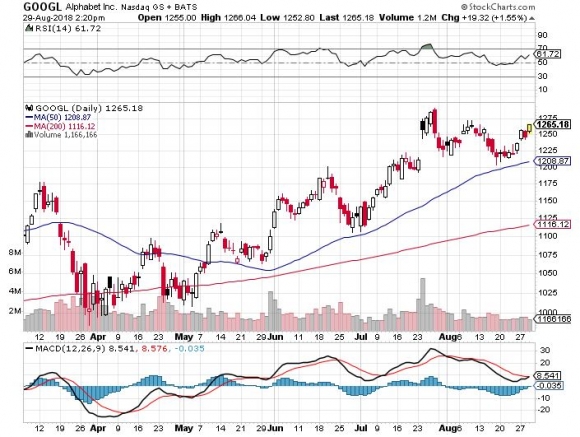
Alphabet’s stock barely budged after the President used his Twitter (TWTR) feed to sound off against the famous digital search engine company.
The stock closed down 0.83% on the day.
We have seen this story again and again with the administration lashing out at certain sectors or individuals, only for the stock market to shrug off any resemblance of weakness and power higher to new all-time highs.
Resiliency would be the best way to characterize this market.
Ironically, Trump found time yesterday to tweet that the Nasdaq had just surpassed 8,000 for the first time, showing off the tech strength underpinning the nine-year bull market.
The FANGs are front and center the stars of the show. Grumbling about a prominent member of this cohort will do nothing to stop the profit engines that tech companies have constructed.
Stellar corporate earnings are the secret sauce in this recipe and investors would be crazy to veer away from that.
Investors have no reason to panic because the tech narrative will not go away anytime soon, and the market knows that.
Political turbulence has been baked into the pie, and it would be eerie if the airwaves went silent.
Investors have largely avoided pinpointing non-economic issues and focused on the economy and its robust 4% growth rate.
It helps that the unemployment rate has fallen to 3.9%, and the full labor market is a net positive, even though inflation and wage growth has yet to contribute as much as initially hoped.
Of course, politics play a substantial role in influencing the stock market. But looking back at the past crisis, the stock market reacted the same as it will now and go much higher.
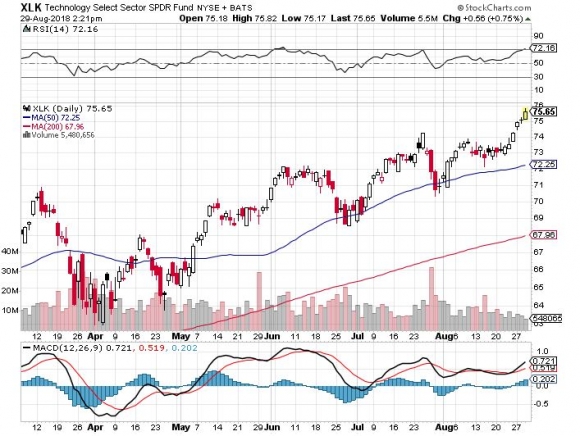
The market is still very much a tech story, and last week’s price action confirmed this.
The Mad Hedge Technology Letter is still net negative on chip stocks, but the two chip stocks that circumvent my negative calls are companies I recommended recently and that have seen a breathtaking leg up.
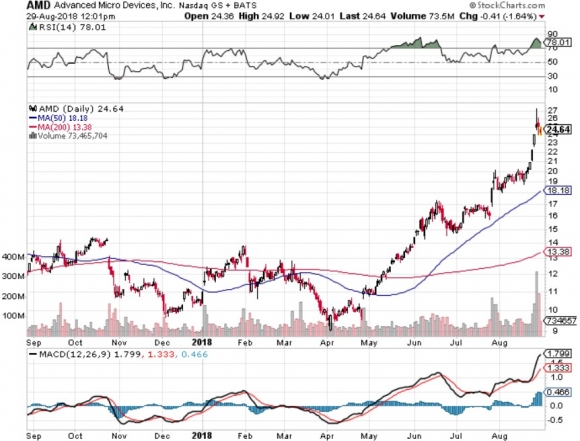
Not all chip companies are made equal and Advanced Micro Devices, Inc. (AMD) proved that by spiking 35% so far in August, 23% in the past week, and more than 140% this year.
The hockey stick move has seen (AMD) short sellers singed to a tune of $3 billion in 2018.
Chip stocks were supposed to get crushed by the weight of the trade war. However, these two stalwarts prove that if you are in the right names, you’ll avoid the carnage, which has beset many smaller chip companies that have the bulk of revenue tied to China.
Tech companies have bought back more than $1 trillion of their own stock since the beginning of 2009 because they have the money to do so.
Silicon Valley companies continue to purchase back their own stocks at a furious pace, putting a floor under many cash cow tech firms to the benefit of share prices.
Whether you want to believe or not, the market is metamorphizing into an all-tech story as every sector migrates to the cloud and the heavy use of big data.
Industrial giants are turning into industrial IoT companies.
Turn over any stone and you would be hard pressed to not find some sort of tech in new products.
Silicon Valley is on the cusp of rolling out its self-autonomous driving technology for commercial operations with Alphabet’s subsidiary Waymo.
If that wasn’t a good reason to buy Alphabet, then let’s review the other positive levers in their portfolio.
Alphabet is one member of a two-man team dominating digital advertising revenues with Facebook.
Global media spend is expanding at 13% YOY as the migration to mobile sees no end.
Google has the best search engine in the world. There are no competitors even close to supplanting its holy grail search engine business, unless you consider bing.com a worthy competitor, which it isn’t.
Data is the new oil, and Alphabet is able to douse itself in data because of the gobs it possesses.
This is the reason Google knows everything about most people in the world outside of China.
Alphabet will be able to leverage this enormous treasure trove of big data and monetize it using artificial intelligence technology.
Add it all up and Alphabet is massively profitable and positioned on the vanguard of every future groundbreaking technology in the world.
Picking on the big boys won’t do much, and the stock price will power on unabated for the foreseeable future.
As the midterm elections draw closer, Trump could also double down on his foreign exploits attempting to consolidate political capital.
That means virulently attacking China’s trade policy, which could go into overdrive as they could give him the source of expansive buffer for which he is looking.
However, it is a double-edge sword as many constituents in red states could be the recipient of higher costs that elevated tariffs would bring.
At the bare minimum, Trump has cast a light on China’s unfair trading policies that has tapped an uneasy nerve for many other countries quietly agreeing with the American president.
This could create a whack-a-mole scenario as China could experience growing problems with numerous undeveloped countries felt wronged, and these headaches could take on different forms such as the Forest City project in Malaysia.
Back in the equity world, the smaller chip companies are baring the brunt of the administration’s scathing rhetoric toward China, but the economy, stock market, and consumer health will hum along as if nothing happened.
The damage is limited, giving Trump sufficient leeway to speak out about side issues as the vital midterm elections roll around.
The bull market is not close to dying and there is still room to run.
________________________________________________________________________________________________
Quote of the Day
“Technology itself is neither good nor bad. People are good or bad,” – said former CEO of InfoSpace, Inc. and cofounder of Moon Express Naveen Jain.