
Mad Hedge Technology Alerts!
No one does it better than Nvidia (NVDA).
Fetch a measuring stick from the cupboard, gauge the levels of innovation around Silicon Valley, and Nvidia's name floats straight to the top of the list.
Nvidia has it all and more.
Not many firms can brandish one of the best CEOs in all of tech.
Nvidia CEO Jensen Huang is a true visionary.
When he hops on earnings calls, investors and analysts rejoice about the breadth of innovation percolating through the corridors in Santa Clara, CA.
Nvidia was able to increase quarterly revenue by an eye-popping 61% YOY. And this company is one of the quintessential growth companies in tech.
Huang is one of the few CEOs confident enough to talk all the way through the earnings call like he is talking about the back of his hand.
Most CEOs delegate to the CFO after a carefully choreographed introductory statement.
He knows everything about the company and is not afraid to go into detail.
The past few weeks have been hell for chip companies.
The cascade of downgrades undercut momentum with chip shares prices falling across the board.
Every nonsensical downgrade has proved unjustified with chip earnings displaying the robust potency that only FANGs can replicate.
Delve into Nvidia's latest performance and two parts of the business have gone into overdrive.
Gaming has burst to the forefront providing a sturdy pillar to Nvidia's income stream.
Fortunately, crypto mining and e-gamers are dual drivers fueling a rapidly expanding market.
In Q1, crypto miners and e-gamers faced a hysterical "scarcity" of high grade GPU hardware.
To make matters worse, Apple and Samsung are using the same memory as graphic cards.
These two global giants front ran other companies agreeing pricier per unit contracts to guarantee sufficient supply for their product lineup.
This led to a huge famine or feast environment to secure the necessary components.
Huang has ensured investors that Nvidia is moving mountains to meet demand and he hopes prices will "normalize" in the upcoming quarter.
Advanced Micro Devices (AMD) is the other player producing GPU chips that is experiencing a demand overload.
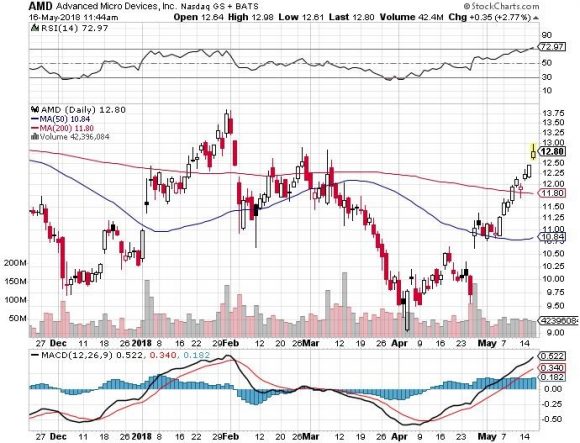
On the last sell-off, AMD dropped as low as 9.50 and was the perfect entry point into a great company led by Lisa Su, PhD.
AMD continued to bounce off the $9 handle and is trading at $13 after an outstanding earnings report.
Huang also caveated his hopes of chip prices normalizing by saying the "pent-up demand" could get worse because of the unbelievable gaming options in the market, such as blowout title Fortnite and popular online game Player Unknown's Battlegrounds that have sold more than 40 million copies throughout various platforms.
Nvidia has caught the innovation bug with new products coming off the conveyer belt sooner than expected.
Nvidia has announced NVIDIA RTX, the "holy grail" of graphic performance that will offer gamers Hollywood cinematic production quality lighting, reflections, and shadows.
This product has been in the works for the past 10 years and has gamers and miners drooling over this new technology called ray tracing.
Revenue from crypto miners is not a part of Nvidia's core mission, and the stronger than expected numbers are just the beginning.
If bitcoin takes another stab at $20,000, GPU demand will go through the roof.
As the price of cryptocurrencies rise, the profit-making opportunities to mine are greatly enhanced.
Another division running on all cylinders showing no sign of slowing down is the data center segment.
Initially, this industry was tabbed by Nvidia as a $30 billion opportunity by 2020.
They were completely wrong.
Nvidia moved the goal posts and announced at a recent investors day that it believes data center revenue will be a $50 billion market by 2023.
Data center revenue spiked 71% YOY to $701 million highlighting the innovation leadership Nvidia enjoys.
The data center incorporates Nvidia's Volta architecture and adoption has been broad-based.
Volta offers 500% more deep learning power than its previous edition Pascal.
The stamp of approval is evident with every major cloud player embracing the Volta technology.
At some points during the earnings call, it appeared to be a commercial for data center, gaming and crypto because of the strength of these two segments.
Huang did talk about other businesses such as autonomous driving buttering up its place in Nvidia's lineup.
Autonomous driving will be a $60 billion opportunity by 2035, according to conservative estimates.
Nvidia's DRIVE Constellation continues to be the bread-and-butter platform for automotive companies.
The platform allows car companies to use virtual reality (V.R.) to carry out driving trials.
Two servers have been built to aid in development.
The first server allows simulation in the form of a pseudo video game, and the other server is used to process the simulated data.
In whole, autonomous driving lagged gaming and data center with 4% growth YOY.
This should not alarm investors because Nvidia is in it for the long run.
The software system and infotainment in the first generation of commercial autonomous vehicles will have plenty of Nvidia chips hovering around under the hood.
At some point, every vehicle in the world will require autonomous technology. As Nvidia stays ahead of the innovation curve, buyers will gravitate toward its products.
The architecture of Nvidia chips allows car companies to advance their autonomous vehicle technology.
Nvidia is partnering with other industry leaders such as Tesla and Mercedes Benz, just to name a few.
Going forward developers will harness the power of artificial intelligence (A.I.) to build new software programs for the car.
The new car software will be part and parcel with voice recognition that has quickly come to the forefront of tech development.
Creating a whole autonomous vehicle system to just drag and drop into its business could lead to Nvidia's products becoming the industry standard.
Technical superiority eventually wins out.
Nvidia has diversified into every cutting-edge trend in technology.
Huang understands that to keep buyers salivating over its products, they must be the highest quality.
The reason Alphabet (GOOGL) or Apple partner and synergize with Nvidia so well is because it makes the best of the best and they cannot copy their products.
This is why ZTE, one of the biggest tech companies in China, practically went out of business after Donald Trump cut of its pipeline of critical American components.
Chinese companies have been attempting to buy American chip companies for years because the quality of chips is significantly superior.
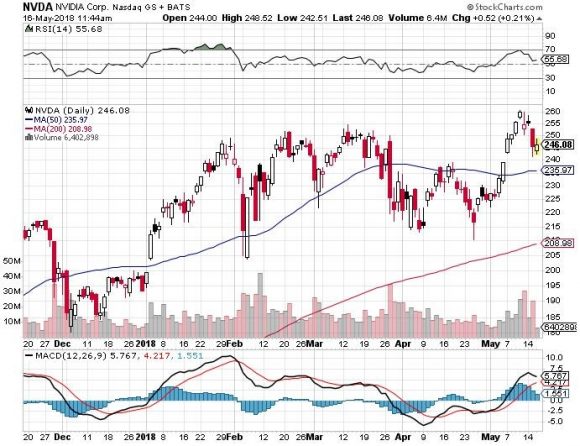
Amid a backdrop of a trade war, Nvidia shares have been trading choppily from a strong support level of $200.
It is only a matter of time before Nvidia explodes through the $250 resistance level and climbs higher.
To watch a video demonstration on Nvidia's new RTX ray tracing technology click here.
_________________________________________________________________________________________________
Quote of the Day
"The United States must possess unquestioned capacity to launch crippling counter-cyberattacks. This is the warfare of the future ... America's dominance in this arena must be unquestioned and today, it's totally questioned." - said President of the United States Donald J. Trump.

Mad Hedge Technology Letter
May 16, 2018
Fiat Lux
Featured Trade:
(WHAT'S UP AT FACEBOOK?)
(FB), (NFLX), (GOOGL), (AMZN), (GS), (AAPL), (IBM)

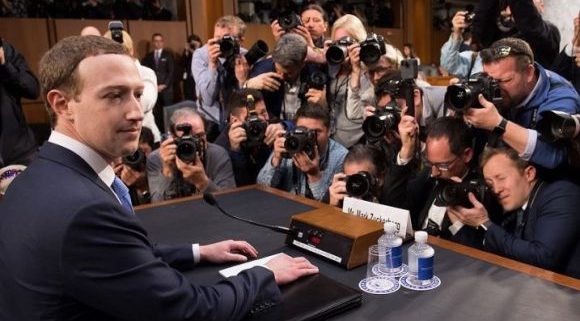
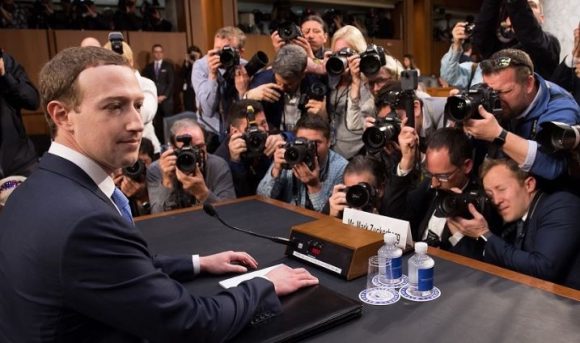
Capitol Hill unleashed a healthy dose of criticism on Facebook (FB) CEO Mark Zuckerberg and he has mobilized the forces to avoid a repeat shellacking.
Zuckerberg's response has been to reshuffle his cabinet at the Menlo Park, CA, headquarters, and a few tell-tale signs offer a unique glimpse into Facebook's future.
Basically, something needed to change at Facebook.
The company single-handedly took the blame for the entire sector and was not the only company with a liberal stance on personal data.
Zuckerberg would like to eschew public humiliation and avoid being a sitting duck.
The episode in Washington highlights the need for Facebook to decouple itself from ad revenue, which makes up the lion's share of revenue at the firm and find other levers to pull.
Down the road, Facebook's ad business could get crimped by regulators, and a lack of fallback options haunts Facebook investors in their sleep.
Consequently, a whole slew of high-level management rotation is underway at Facebook.
It is the biggest shake-up in the history of Facebook.
The road map starts with one of Zuckerberg's best friends and protege Chris Cox who will manage the new "family of apps" segment.
This collection of projects he will preside over include WhatsApp, Messenger, Instagram, and the Facebook Core App.
The step up in responsibility is warranted for Chris Cox who was credited with creating the Facebook news feed after joining the company in 2005 after ditching his Stanford graduate degree program at the time.
The executive reshuffle coincided with WhatsApp co-founder Jan Koum, one of Silicon Valley's biggest advocates for data privacy, who quit his post as a show of disapproval to Facebook's business model.
Mark Zuckerberg wants to aggressively monetize the WhatsApp messenger service that was acquired for $19 billion in 2014.
Zuckerberg's blueprint involves using the WhatsApp phone numbers as a vehicle to monetize through offering different products.
Facebook would then collect the data from its 1 billion usership and WhatsApp would become Facebook's new advertisement clearing house.
WhatsApp's leadership vehemently refused this U-turn and Koum decided he would rather leave then see his baby ruined.
Facebook consistently refrained in the past from passing WhatsApp to the data mining scientists and was able to prevent full-scale implementations of advertisements onto its platform.
Currently, there are no ads on WhatsApp's interface, and users could be in store for a massive transformation in look and feel.
Facebook investors have been clamoring for Zuckerberg to start the process of making WhatsApp into a material revenue stream.
Time is of the essence as the big data police creep in from the shadows.
Putting Zuckerberg's top guy on the job embarks Facebook down a new path of hyper accelerated profit-making.
Well, that is the goal.
Compounding Facebook's pivot to other businesses is commissioning a new blockchain tech team.
Blockchain technology, the technology that helped unearth bitcoin, has seen a recent slew of endorsements from financial heavy hitters such as Goldman Sachs (GS), which acknowledged the formation of a new business brokering in bitcoin futures.
A year ago, no reputable organization would touch blockchain with a 10-foot pole.
The utilization of blockchain technology would allow trackability and provide more security.
That would help Facebook to understand the provenance of unique problems allowing staff to nip problems in the bud before they snowball.
Blockchain tech fits nicely within the constraints of the model and would enhance the existing Facebook product.
Let's not forget that Facebook has a mountain of cash to fix any problem that crops up.
It is not one of these early stage seed companies burning through heaps of cash waiting for "scalability" down the road.
Facebook is here and now, and it has the money to show for it.
The pillars of blockchain revolve around cryptography. Blockchain would effectively allow individuals to possess more power over their identity decentralizing the stranglehold from Menlo Park.
Thus, Facebook must invest deeply into blockchain to counter the fear that this technology can marginalize the core business.
This epitomizes the tendency for large-cap tech to become preemptive.
None of the powerful FANGs want to miss the next big shift in technology, and the cash hoard allows them to have skin in the game in each revolutionary trend.
The tide has changed at Facebook from the early years where growing the user base was paramount.
Now that user base has matured into a 2.2 billion marketplace.
Facebook's strategy has shifted to extracting more revenue per user and management closely follows this metric.
Mike Schroepfer, the CTO of Facebook, was tabbed as the man leading the charge for Artificial Intelligence (A.I.), Augmented Reality (A.R.), and Virtual Reality (V.R.) technology.
Facebook was able to poach Jerome Pesenti from IBM (IBM), where he was a critical cog in the development of IBM's Watson, to run the Facebook A.I. team. A.I. is routinely implemented into Facebook's core products to enhance performance.
Promoting Chris Cox as the next in line and giving him control over all the powerful products effectively pushes ad tech down the pecking order.
Javier Olivan is the new man at Facebook tasked for managing ads, analytics, and integrity, growth and product management.
Moving forward, the ad division will be laced with a certain level of security to avoid a repeat of Cambridge Analytica.
Zuckerberg must know that there are other Cambridge Analytica's hidden somewhere in the system; another incident would knock down the stock 5% to 10%.
Facebook could look vastly different in a few years if some of these profit drivers prove successful. It only needs one to work.
Disrupt or be disrupted.
At this point, the big tech companies are considering anywhere or anyone to capture accelerated growth. The FANGs are spilling over to other companies' turf.
Crossover is everywhere and this is just the beginning.
Expect Amazon's (AMZN) ad division to grow from the already $2 billion per quarter, gradually challenging the duopoly of Facebook and Alphabet in the digital ad revenue industry.
It is yet to be seen if the new revamp of management will produce better results.
This move could backfire as the management carousel excluded any fresh blood from taking part.
Effectively, Zuckerberg rotated his best friends into different parts of the business without demoting anyone.
Solidifying his close-knit circle of trust is no doubt a defensive reaction to being hounded the past few months, leaving his existing circle as the few people on which he can still count.
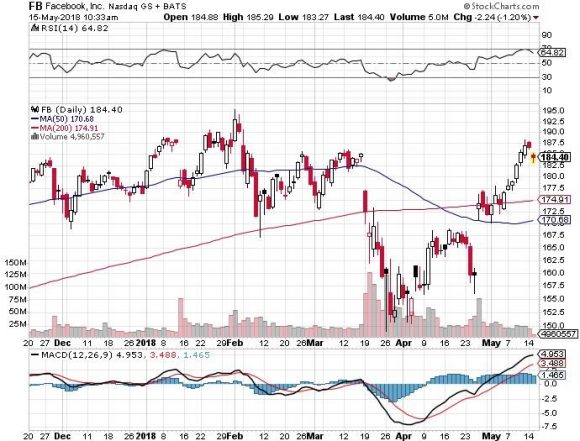
Facebook's stock remains healthy and the brouhaha stoked by the data leak gave investors a timely entry point.
I pounded on the table calling the bluff, begging readers to get into Facebook.
The long-term Facebook story is intact but the stock is overbought short-term.
Investors should not sleep on Facebook as it is a profit machine printing money like Apple (AAPL) and the executive revamp is a bullish development for Facebook.
My bet is that Chris Cox goes for the low hanging fruit monetizing WhatsApp, inciting the next leg up in Facebook shares later in the year.
_________________________________________________________________________________________________
Quote of the Day
"Simply put: We don't build services to make money; we make money to build better services." - said Facebook CEO Mark Zuckerberg