?We?ve seen the S&P 500 drop 50% twice in the last decade. That is the new normal?, said Richard Kang of Emerging Global Advisors.


?We?ve seen the S&P 500 drop 50% twice in the last decade. That is the new normal?, said Richard Kang of Emerging Global Advisors.
While the Diary of a Mad Hedge Fund Trader focuses on investment over a one week to six-month time frame, Mad Day Trader, provided by Jim Parker, will exploit money-making opportunities over a brief ten minute to three day window. It is ideally suited for day traders, but can also be used by long-term investors to improve market timing for entry and exit points. Read more
While the Diary of a Mad Hedge Fund Trader focuses on investment over a one week to six-month time frame, Mad Day Trader, provided by Jim Parker, will exploit money-making opportunities over a brief ten minute to three day window. It is ideally suited for day traders, but can also be used by long-term investors to improve market timing for entry and exit points. Read more
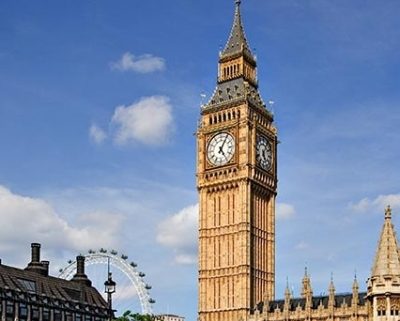
Come join me for lunch for the Mad Hedge Fund Trader?s Global Strategy Update, which I will be conducting in London on Monday, July 8, 2013. A three-course lunch will be followed by a PowerPoint presentation and an extended question and answer period.
I?ll be giving you my up to date view on stocks, bonds, currencies commodities, precious metals, and real estate. And to keep you in suspense, I?ll be throwing a few surprises out there too. Enough charts, tables, graphs, and statistics will be thrown at you to keep your ears ringing for a week. Tickets are available for $249.
I?ll be arriving an hour early and leaving late in case anyone wants to have a one on one discussion, or just sit around and chew the fat about the financial markets.
The lunch will be held at a private club on St. James Street, the details of which will be emailed to you with your purchase confirmation.
I look forward to meeting you, and thank you for supporting my research. To purchase tickets for the luncheons, please go to my online store.

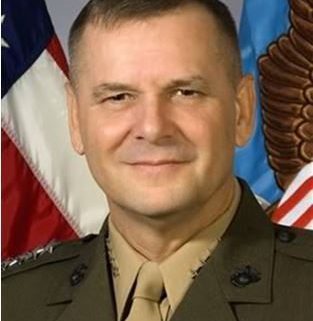
I have always considered the US military to have one of the world?s greatest research organizations. The frustrating thing is that their ?clients? only consist of the President and a handful of three and four star generals. So I thought that I would review my notes from a dinner I had with General James E. Cartwright, the former Vice Chairman of the Joint Chiefs of Staff, and known as ?Hoss? to his close subordinates.
Meeting the tip of the spear in person was fascinating. The four star Marine pilot was the second highest ranking officer in the US armed forces, and showed up in his drab green alpha suit, his naval aviator wings matching my own, and spit and polished shoes. As he spoke, I was ticking off the stock, ETF, and futures plays that would best capitalize on the long term trends he was outlining.
The cycle of warfare is now driven by Moore?s Law more than anything else (XLK), (CSCO), and (GOOG). Peer nation states, like Russia, are no longer the main concern. Budgeting for military expenditures is a challenge in the midst of the worst economic environment since the Great Depression.
Historically, inertia has limited changes in defense budgets to 5%-10% a year, but in 2010 defense secretary Robert Gates pulled off 30% realignment, thanks to a major management shakeup. We can only afford to spend on winning current conflicts, not potential future wars. No more exercises in the Fulda Gap.
The war on terrorism will continue for at least 4-8 more years. Afghanistan is a long haul that will depend more on cooperation from neighboring Iran and Pakistan. ?We?re not going to be able to kill our way or buy our way to success in Afghanistan,? said the general. However, the 30,000-man surge there brought a dramatic improvement on the ground situation.
Iran is a big concern, and the strategy there is to interfere with outside suppliers of nuclear technology in order to stretch out their weapons development until a regime change cancels the whole program.
Water (PHO), (CGW) is going to become a big defense issue, as the countries running out the fastest, like Pakistan and the Sahel, happen to be the least politically stable.
Cyber warfare is another weak point, as excellent protection of .mil sites cannot legally be extended to .gov and .com sites. We may have to lose a few private institutions in an attack to get congress to change the law and accept the legal concept of ?voluntarism.? General Cartwright said ?Anyone in business will tell you that they?re losing intellectual capital on a daily basis.?
The START negotiations have become complicated by the fact that for demographic reasons, Russia (RSX) will never be able to field a million man army again, so they need more tactical nukes to defend against the Chinese (FXI). The Russians are trying to cut the cost of defending against the US, so they can spend more on defense against a far larger force from China.
I left the dinner with dozens of more ideas percolating through my mind, which I will write about in future letters.


Dilbert cartoonist Scott Adams argues that you should invest in companies you hate because only the most unprincipled and rapacious firms make the greatest profits.
Moral bankruptcy is a great leading indicator of success, and the best ones can get you to balance your wallet on the end of your nose and bark like a seal, as you buy products that you utterly despise. Companies with the work ethic of a serial killer, like British Petroleum (BP) come to mind, but you can also add other firms to the list, like Goldman Sachs (GS), Citicorp (C), Pfizer (PFE), and Altria (MO).
Adams initially started investing in companies he loved, like Enron, WorldCom, and Webvan, and absolutely lost his shirt. Adams? advice to BP is not to waste money on artificially sincere ad campaigns apologizing, but get us to hate them more. Bring on more dead bird pictures!
Who is Adams about to hate next? Apple (AAPL), because he irrationally craves their products, resents their emotional control over his entire family, can?t get ITunes to work, and is appalled by those aloof black turtlenecks that Steve Jobs used to wear.

?Free choice is not relevant in financial markets because there are too many players. A stock with a million holders is much more predictable than one with five,? said Charles Nenner, of Charles Nenner Research in Amsterdam.

While the Diary of a Mad Hedge Fund Trader focuses on investment over a one week to six-month time frame, Mad Day Trader, provided by Jim Parker, will exploit money-making opportunities over a brief ten minute to three day window. It is ideally suited for day traders, but can also be used by long-term investors to improve market timing for entry and exit points. Read more
While the Diary of a Mad Hedge Fund Trader focuses on investment over a one week to six-month time frame, Mad Day Trader, provided by Jim Parker, will exploit money-making opportunities over a brief ten minute to three day window. It is ideally suited for day traders, but can also be used by long-term investors to improve market timing for entry and exit points. Read more
Global Market Comments
July 3, 2013
Fiat Lux
Featured Trade:
(JULY 12 AMSTERDAM STRATEGY LUNCHEON),
(IRAN SHOULD FOLD ITS NUCLEAR PROGRAM, OR ELSE),
(PETER F. DRUCKER ON MANAGEMENT)