
Mad Hedge Biotech and Healthcare Letter
April 11, 2023
Fiat Lux
Featured Trade:
(NOT NOW, BUT SOON)
(JNJ), (NVO), (LLY), (AMGN), (GILD), (ABBV), (BMY)

Mad Hedge Biotech and Healthcare Letter
April 11, 2023
Fiat Lux
Featured Trade:
(NOT NOW, BUT SOON)
(JNJ), (NVO), (LLY), (AMGN), (GILD), (ABBV), (BMY)
During times of market turbulence, many investors may find themselves hesitant to participate due to the uncertainty and risks involved. However, one potential strategy to weather the storm could be to seek out dividend stocks.
By investing in these types of equities, individuals can find a sense of stability and security, as they often offer a reliable source of income regardless of market fluctuations. In short, dividend stocks can serve as a safe harbor amid a choppy investment climate.
If you're looking for a healthcare stock with some serious street cred, check out Johnson & Johnson (JNJ).
Before delving into the company, knowing that JNJ’s stock price isn't exactly bargain-bin material is crucial. Still, it's not the most expensive pharmaceutical company out there, either. Novo Nordisk (NVO) and Eli Lilly (LLY) are commanding higher valuations, while JNJ’s peers like Amgen (AMGN), Gilead Sciences (GILD), AbbVie (ABBV), and Bristol-Myers Squibb (BMY) are trading at a lower price-to-free-cash-flow ratio.
Let's not forget that JNJ isn't just a one-trick pony in the pharmaceutical game.
With around 30% of its revenue from medical devices, we can't compare it apples-to-apples with other pharma companies. Peers in the medical devices sector typically trade at higher valuation multiples, so it's essential to keep that in mind when evaluating JNJ's price-to-free-cash-flow ratio.
Moreover, this mega-brand dominates both the pharmaceutical and consumer goods scenes. With fingers in many pies - pharma, med tech, and consumer goods - JNJ has made quite the name for itself.
Despite being a seasoned player, Johnson & Johnson (JNJ) still has some spring in its step; come year-end, the company will be shaking things up with a spin-off of its consumer segment into a new entity, Kenvue.
JNJ’s upcoming spin-off is about sharpening its focus on what matters - its pharma business. And for good reason - this is where the big bucks are made.
The healthcare giant’s immunology and cancer drugs are outperforming the rest of the pack, with two key players, Stelara and Tremfya, delivering some serious sales growth last year. Together, they raked in a cool $12.3 billion, proving that sometimes, less really is more.
JNJ’s pharma segment is crushing it. Darzalex, the multiple myeloma med, racked up an impressive $8 billion in sales, a 32% boost from the previous year. Meanwhile, prostate cancer drug Erleada wasn't far behind, with a 45.7% increase in sales to $1.9 billion.
All in all, JNJ's pharma segment hauled in a massive $52.5 billion in revenue in 2022. Not too shabby.
Looking deeper into its performance in fiscal 2022, JNJ reported a slight increase of 1.2% YoY in sales, reaching $94.9 billion, but currency effects had a negative impact. However, adjusted earnings per share increased by 3.6% YoY, with operational growth at 9.2%.
The "Consumer Health" segment reported a 0.5% decline in revenue, but adjusted operating growth was 3.6%.
The "Pharmaceuticals" segment, responsible for more than half of revenue, increased sales by 1.7% YoY to $52.6 billion, with operational growth at 6.7%.
The "MedTech" segment increased revenue by 1.4% YoY to $27.4 billion, with operational growth at 6.2%.
For fiscal 2023, Johnson & Johnson is expecting revenue growth of 4.5% to 5.5% and adjusted earnings per share growth of 3% to 5%.
Despite the positive reports, JNJ investors are still anxious about the future primarily because of the impending patent expirations of existing products. Unfortunately, the company is heading towards a patent cliff, as it faces the challenge of replacing revenue from products with expiring patents.
Stelara generated $9.7 billion in revenue in fiscal 2022 and will lose patent protection in 2023. Simponi, which generated $2.2 billion in revenue in fiscal 2022 and will lose patent protection in 2024, are two of the biggest concerns.
These two products account for 12.5% of the company's total revenue and 22.5% of the pharmaceutical segment revenue. Replacing these sales will not be an easy feat.
Additionally, in 2027, JNJ will lose patent protection for two other vital drugs - Xarelto and Imbruvica, which generated $2.5 billion and $3.8 billion in revenue in fiscal 2022.
To resolve these concerns, JNJ is putting its money where its mouth is regarding innovation. The company invested a whopping $14.6 billion in R&D in 2022 alone, and it looks like it's paying off. With plenty of promising drugs in the pipeline, JNJ is poised to continue its growth trajectory in the coming years.
When it comes to dividends, JNJ is royalty. With a 60-year track record of annual dividend increases, JNJ company has earned the coveted title of Dividend King.
JNJ boasts a healthy payout ratio of 41% and a juicy dividend yield of 2.8%, well above the S&P 500's average yield of 1.7%. The company's steady cash flow quickly covers these payouts, making it a solid choice for investors seeking reliable income.
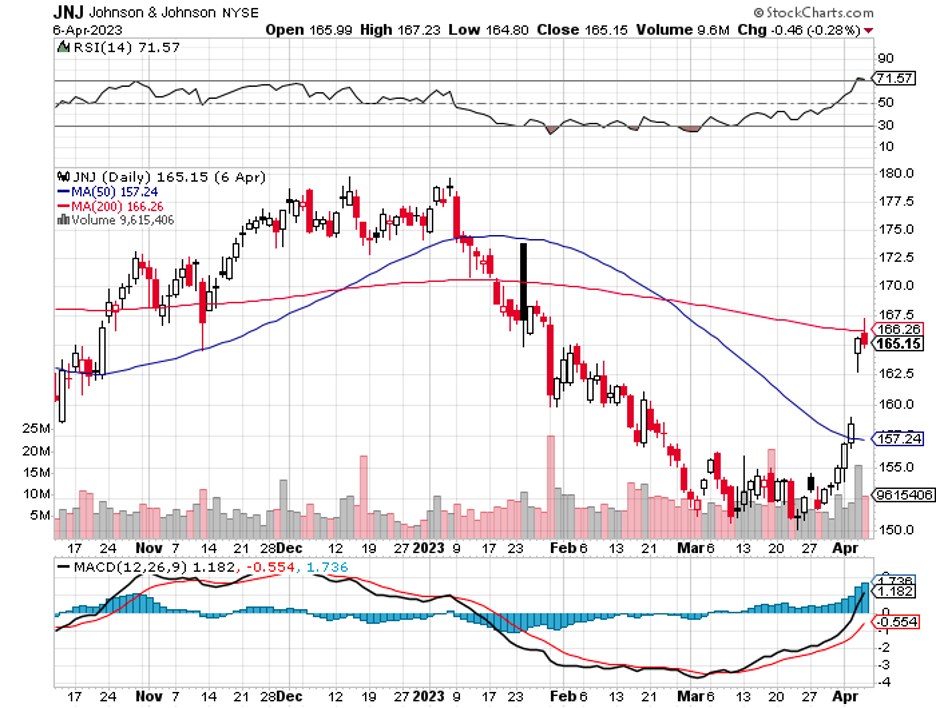
While JNJ may be a top-notch investment option in the long run, the current market conditions make it a tad pricey. So, for now, just give it a spot on your watchlist and wait for the dip to go for a bargain. Remember, patience is not just a virtue but also a lucrative strategy in investing.
Global Market Comments
March 22, 2023
Fiat Lux
Featured Trade:
(THE MAD HEDGE TRADERS & INVESTORS SUMMIT VIDEOS ARE UP!)
(THE BARBELL PLAY WITH BERKSHIRE HATHAWAY),
(BRKA), (BRKA), (BAC), (KO), (AXP), (VZ), (BK) (USB), (TLT), (AAPL), (MRK), (ABBV), (CVX), (GM), (PCC), (BNSF)
CLICK HERE to download today's position sheet.
Mad Hedge Biotech and Healthcare Letter
February 9, 2023
Fiat Lux
Featured Trade:
(AN EMERGING KING OF BIOSIMILARS)
(AMGN), (ABBV), (JNJ), (BAYG), (AZN), (REGN)
Patience is one of the key attributes that long-term investors need to cultivate, but practicing it is challenging. Stock markets are entirely unpredictable, and their ups and downs tend to rattle even the most experienced investors.
However, it’s essential to keep a calm mind and to be confident that the businesses you invest in have the fortitude to overcome even the most challenging economic or market downturn.
The biotechnology industry is an excellent place to search for stocks that can overcome market turmoils and succeed in the long run because the treatments they develop are so crucial to the lives of their clients.
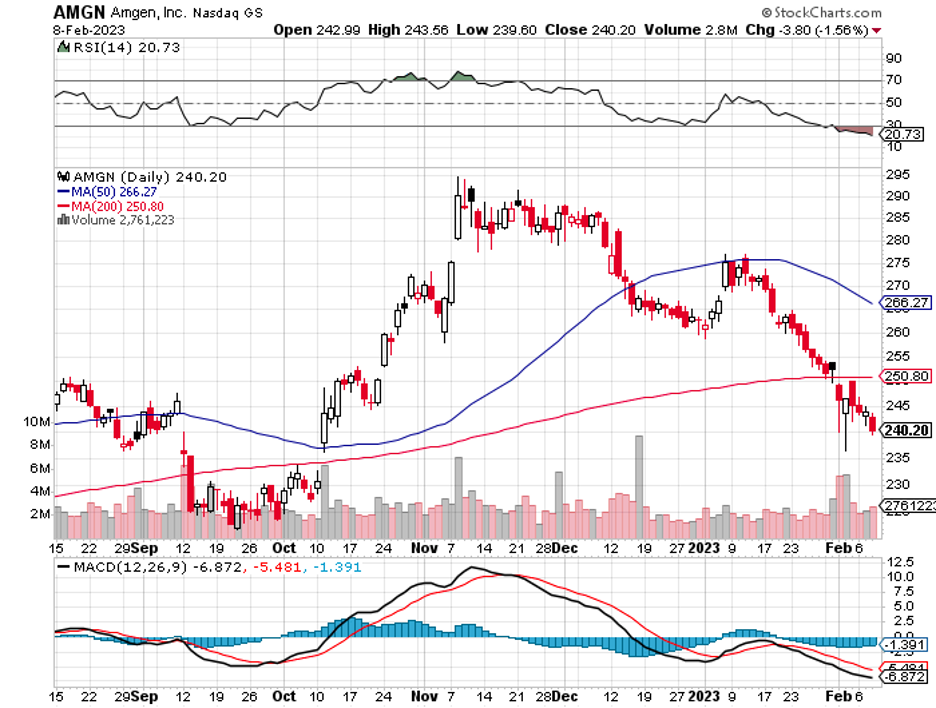
Amgen (AMGN) is a biotech that would make an excellent long-term investment.
This business, which has been a leader in the biotech sector since the 1980s, is among the largest in the world.
Amgen is also a member of the renowned Dow 30 companies, with a focus on oncology, biosimilars, and inflammatory diseases. In the past 10 years, it has established a strong track record and solid revenue growth trajectory.
The company recently released its fourth-quarter results, and they looked a tad flat on the surface. The report disclosed a total revenue growth of only 2%, which could have been caused by the pressures linked to pricing and competition around the company’s top-selling cholesterol-lowering treatment Repatha, migraine drug Aimovig, and immunology medications Otezla and Enbrel.
Still, Amgen continues to be a solid profit-making business, holding an A+ grade in terms of profitability. It sustains considerable pricing power on its treatments under exclusive patents and from its up-and-coming portfolio of biosimilar candidates.
Amgen has maintained a BBB+ rated balance sheet. It also pays a respectable dividend yield of 3.5%, with a well-protected payout ratio of 44%.
The company has also recorded consecutive growth in this aspect for 11 years. Looking at these figures, Amgen has scored primarily As in terms of consistency, growth, dividend, and yield.
Notably, the company’s foray into the biosimilar landscape would make long-term investors of the company quite happy soon.
Its long-awaited biosimilar version of the No. 1 selling drug worldwide, AbbVie’s (ABBV) Humira, has recently been launched to market.
Amgen’s version, called Amgevita, is the leading biosimilar in this market to date. It already has a five-month lead over the next competitor, arming it with a lot of time to establish a more competitive standing.
Beyond this candidate, Amgen has at least six more biosimilars that it plans to launch in the US and across the globe from 2023 until the end of 2030. This timeline would give the company excellent visibility in the long run.
Another potential biosimilar blockbuster is ABP 654, which is a biosimilar of Johnson & Johnson’s (JNJ) top-selling immunology treatment Stelara.
Amgen also has biosimilar versions of Bayer's (BAYG) and Regeneron’s (REGN) eye disorder drug Eylea and AstraZeneca’s (AZN) rare kidney disease treatment Soliris.
Basically, biosimilars are knock-offs for biologic drugs. They cost less because the manufacturers do not spend less in the research, trials, and approval stages. The processes are also shorter and less risky.
Biosimilars provide a way for patients and the whole healthcare system to save billions of dollars, signaling a bright future for this segment. They offer more affordable options to patients, which is an excellent response to the rising prices of medicines.
This means biosimilar development is far less speculative than creating a new drug, as manufacturers only need to replicate the already established results and success of the existing “original” drug.
Moreover, biosimilars bring with them a degree of pricing power. Unlike traditional treatments, no two biosimilars are allowed to carry the same biologic profile and should still undergo a stringent FDA assessment prior to gaining approval.
Overall, Amgen is a good option for long-term investors on the lookout for a quality biotech to add to their portfolios. Thanks to its burgeoning portfolio of potentially top-selling biosimilars, it has long-term solid revenue growth catalysts. These factors make Amgen a compelling buy on the drop.
Mad Hedge Biotech and Healthcare Letter
January 24, 2023
Fiat Lux
Featured Trade:
(A MARKET-BEATING HEALTHCARE STOCK)
(LLY), (ABBV), (AMGN), (BMY), (GILD), (JNJ), (MRK), (PFE), (MRNA)
The previous year was horrible for the stock market, with the S&P 500 dropping in value by roughly 19%, marking its first decline since 2018 and only the second time it sank since the 2008 financial crisis.
It was an even more horrid year for the biotechnology industry, with the flagship SPDR S&P Biotech ETF (XBI) sinking by 26% following its more than 20% decline in 2020—a catastrophic blow for such a promising index which delivered an impressive over 30% gains in 6 of the last 10 years.
Meanwhile, the stock prices in the large-cap pharmaceutical segment generally stayed buoyant. The “Big 8,” in particular—AbbVie (ABBV), Amgen (AMGN), Bristol Myers Squibb (BMY), Eli Lilly (LLY), Gilead Sciences (GILD), Johnson & Johnson (JNJ), Merck & Co (MRK), and Pfizer (PFE)—reported an average share price gains of roughly 15%.
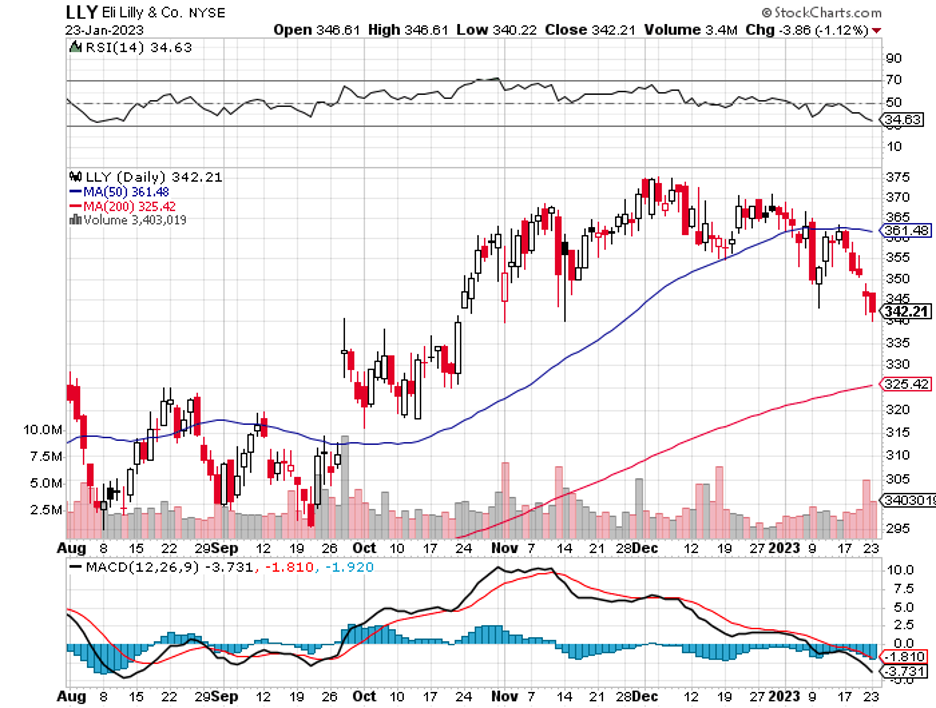
Among the names in this list, Eli Lilly has become one of the go-to “safe” stocks during these turbulent times.
In contrast to the broader market, the company has performed exceptionally well in the last 12 months, with its share prices climbing by 12% within the timeframe.
One of the critical reasons that propelled Eli Lilly’s performance was the regulatory approval it obtained for Mounjaro, a diabetes treatment, in May 2022. Although this pharma giant has been hailed as the leader in the diabetes care segment for decades, Mounjaro is a game changer.
This newly approved diabetes treatment could blow any competitor out of the water, with peak sales estimated to hit $25 billion.
Besides diabetes, Mounjaro is also under review as a potential obesity treatment, signifying label expansions for this drug.
If this pushes through, then Eli Lilly would become one of the first movers in the diabetes and obesity markets, with only Novo Nordisk (NVO) standing as a realistic challenger. Based on the market size and the lack of competitors, the profit margins for these segments could be likened to those recorded by Pfizer and Moderna (MRNA) for the COVID-19 vaccines.
There are also other promising candidates in Eli Lilly’s portfolio. One is Donanemab, which is a potential treatment for Alzheimer’s disease. According to the company's Phase 3 study, its candidate delivered better results than Biogen’s (BIIB) approved Alzheimer’s treatment, Aduhelm.
Eli Lilly recently sent its atopic dermatitis treatment candidate, Lebrikizumab, for regulatory review in both the US and Europe. This marks another potential blockbuster for the company, with many treatments queued for review and possible approval by the end of 2023.
As for the company’s current portfolio, most of its products still report good results. For instance, sales of its cancer drug Verzenio rose by 84% year over year to record $617.7 million in the third quarter of 2022. Revenue for the diabetes treatment Trulicity climbed 16% year over year to reach $1.9 billion.
Another factor that makes Eli Lilly attractive is its dividend. Over the past five years, the company has doubled its payout. In 2022, the company disclosed a 15% hike to its dividend payouts. This marked the fifth consecutive year Eli Lilly implemented.
In December 2022, Eli Lilly shared its updated guidance for 2023. For 2022, the company projected that its top line would be between $28.5 billion and $29 billion. That represents a modest growth rate. Eli Lilly shareholders can anticipate better performance this year.
For 2023, the company estimates sales to climb to $30.8 billion. While that amount may appear underwhelming, it’s essential to keep in mind that this is a very conservative estimate. Eli Lilly is taking into account several concerns that may affect its growth, such as patent exclusivity losses and a decline in its COVID-19 sales.
Overall, Eli Lilly has proven itself to be a good and solid business that looks in excellent shape to continue delivering market-beating returns.
With a market capitalization of over $350 billion and several candidates in its pipeline, this company has a strong potential to be worth much more in the following years. Also, it’s critical to bear in mind that since 2020, Eli Lilly shares have skyrocketed by 176%, dwarfing the S&P 500’s 20%—a trend I expect to continue. I suggest you buy the dip.
Mad Hedge Biotech and Healthcare Letter
January 12, 2023
Fiat Lux
Featured Trade:
(ALL HAIL THE KINGS)
(ABBV), (JNJ), (ABT), (BDX), (SNY), (BMY)
What is the most exclusive category of dividend stocks? The first answer that comes to mind is the Dividend Aristocrats. These are S&P 500 members that have boosted their dividends consecutively for 25 years.
However, there is another more elite category of dividend stocks that gets less attention: the Dividend Kings.
Although they do not need to be part of the S&P 500, Dividend Kings gain this title by achieving an ultramarathon-like streak—a minimum of 50 years of consecutive payout growth.
However, buying shares of Dividend Kings is not a move for some types of investors. Several of these stocks tend to deliver relatively low growth. Some of these Dividend Kings have been underperforming in the past 10 years.
So, why should you consider investing in Dividend Kings?
Companies under this elite category can be an excellent component of any investor’s retirement portfolio or for those looking for reliable sources of income. Truth be told, most of these businesses offer dividend yields that are notably higher than the average dividend yield recorded by members of the S&P 500.
The consistency and dependability of these Dividend Kings in terms of paying out and boosting their dividend payouts also offer a certain degree of confidence for investors relying on income generated by the dividend stocks they added to their portfolio.
Only a few businesses make it to this category. Two segments comprise a significant part of the Dividend Kings category: the consumer goods sector, with 12 companies, and the industrial sector, with 14. Five utility stocks made it to the list as well.
Rounding up the list are four names from the healthcare industry: Johnson & Johnson (JNJ), Abbott Laboratories (ABT), Becton, Dickinson & Co. (BDX), and AbbVie (ABBV).
AbbVie only recently celebrated its 10th birthday after its monumental spinoff from Abbott back in 2013. In each of the past 10 years, this healthcare giant has hiked its dividend.
To date, the payout has risen by a whopping 270%, all but guaranteeing its standing as a Dividend King—a title it inherited from Abbott.
At the moment, the forward dividend yield of AbbVie is somewhere north of 3.6%, paying out approximately 73.7% of its earnings as dividends.
As expected, this relatively high payout ratio has some investors anxious over the wisdom of sustained hikes. After all, a sharp downturn in earnings could easily demand the company to pay out more in terms of dividends compared to how much its earnings rake in.
Nonetheless, it is critical to put everything in the proper context.
The competitors of the company, such as JNJ, Bristol Myers Squibb (BMY), and Sanofi (SNY), all have reported payout ratios of over 60%. That means AbbVie is hardly alone in this strategy of having a somewhat limited overhead to sustain its decision to continue hiking dividends even in the absence of earnings growth.
Apart from the $57.8 billion in revenue the company generated in the trailing 12 months, AbbVie estimates that two of its newer treatments, Skyrizi and Rinvoq, would rake in more than $15 billion in annual sales by 2025. With nine more candidates submitted for regulatory approval for 2023 alone, it is clear that AbbVie has been working hard to ensure that it creates additional new revenue streams in the near term.
As long as AbbVie continues to commercialize new products and work to develop and broaden the approved indications for its existing treatments to expand the reach of its addressable markets, then it is reasonable to believe that the company’s earnings will continue to climb.
It’s highly likely that most of the Dividend Kings will remain on the list this 2023. For one, there is immense pressure on businesses that have boosted their dividends for 50-plus years to sustain the streak. Besides, no CEO would want to be known as the leader who broke an impressive track record.
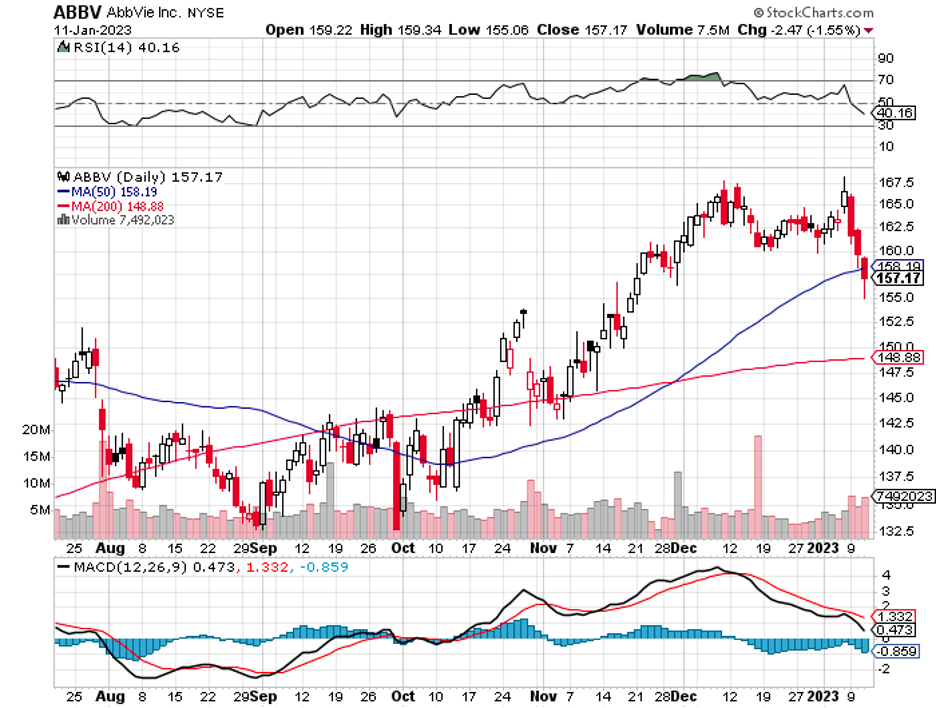
As for AbbVie, this stock is an excellent addition to the portfolio of long-investors and those searching for more sources of income. Buy the dip.
Mad Hedge Biotech and Healthcare Letter
December 13, 2022
Fiat Lux
Featured Trade:
(A LONGER-TERM INVESTMENT FOR PATIENT BIOTECH HOLDERS)
(AMGN), (HZNP), (JNJ), (SNY), (ABBV)