I've owned a lot of assets in my career - currencies, commodities, emerging market equities, a working Texas oil well that produced exactly enough crude to annoy my accountant.
What I've learned is that how you hold something matters nearly as much as what you hold.
Ethereum (ETH-USD) investors who get this right will quietly compound a fortune before this cycle is over.
Of the nine spot Ethereum ETFs currently trading in the US, only two actually pay you to hold them. The other seven are essentially inert wrappers charging annual fees for the privilege of exposure.
With ETH-USD sitting 60% off its August highs and the setup for a long-term recovery increasingly compelling, picking the right vehicle now is the kind of decision that looks obvious in hindsight and gets ignored in the moment.
Start with the fees, because they compound longer than most people's patience.
The Grayscale Ethereum Trust ETF (ETHE) charges a 2.50% annual expense ratio - a number that made sense when it was the only game in town and makes no sense now that cheaper alternatives exist.
At the other end of the spectrum, the Grayscale Ethereum Staking Mini Trust ETF (ETH) charges 0.15%.
The iShares Ethereum Trust ETF (ETHA), now the market leader with $6.07 billion in assets, comes in at 0.25%, as does the Fidelity Ethereum Fund (FETH) with $1.29 billion.
The remaining funds, Bitwise (ETHW), VanEck (ETHV), Franklin (EZET), 21Shares (TETH), and Invesco Galaxy (QETH), cluster between 0.19% and 0.25%.
On a 10-year hold, that 2.35 percentage point gap between the cheapest and most expensive fund will no longer be a simple rounding error. It'll be a compounding disaster in slow motion.
The staking question is where it gets more interesting.
Only two funds currently incorporate staking into their structure: ETHE and the Grayscale Mini Trust (ETH).
Through staking, a portion of the underlying ETH is delegated to validators on the Ethereum network, generating annual yields typically running between 3% and 4%.
For those in it for the long haul, that yield component is the difference between owning a static asset and owning one that quietly earns while you sleep.
The catch is that ETHE's 2.50% expense ratio nearly devours the staking yield entirely, leaving holders with the operational complexity of a staking structure and almost none of the benefit.
The Grayscale Mini Trust (ETH), with its 0.15% fee and full staking access, is the only fund currently offering both advantages without surrendering one to pay for the other.
iShares and Fidelity have the institutional infrastructure to add staking eventually, and when they do, the calculus will shift.
For now, (ETH) holds the edge.
Scale matters too, though not for the reason most people assume. Larger funds generate tighter bid-ask spreads, attract deeper institutional participation, and carry lower closure risk.
ETHA's $6.07 billion AUM makes it the most liquid option in the space. For traders moving in and out of positions, that matters.
For long-term holders prioritizing fee efficiency and staking yield, the Grayscale Mini Trust's $1.58 billion base is sufficient.
The underlying asset itself deserves more credit than the current price action suggests.
Ethereum's stablecoin market capitalization on-chain has expanded dramatically over multiple years, reflecting genuine economic utility rather than speculative froth.
Total value locked across Ethereum's DeFi ecosystem, while off its 2021 peak of over $100 billion, remains substantially above its 2022-2024 baseline.
Active addresses continue trending upward. These are not the metrics of a network in structural decline. They are the metrics of a network digesting a speculative overhang while its actual usage quietly grows.
The technical picture is less cheerful in the short term.
ETH is trading below all significant moving averages, with a weekly RSI of 32.42 - historically the kind of territory where accumulation, not panic, tends to pay off.
Bitcoin (BTC) peaked above $120,000 before this risk-off rotation took hold, and liquidity has been moving steadily down the risk curve into equities and precious metals.
That rotation doesn't last forever. When it reverses, stablecoin balances sitting near all-time highs on-chain represent a substantial pool of deployable capital waiting for the risk appetite to return.
The long-term thesis for Ethereum remains intact.
The dominant Layer-1 network for DeFi activity, the largest developer base in crypto, expanding Layer-2 infrastructure, and now a maturing ETF ecosystem giving institutional investors clean, regulated access - these are durable structural advantages.
Just make sure when the tide comes back in, you're holding the right bucket. The wrong one has a hole in the bottom and charges you 2.50% a year for the experience.
https://madhedgefundtrader.com/wp-content/uploads/2019/05/cropped-mad-hedge-logo-transparent-192x192_f9578834168ba24df3eb53916a12c882.png00april@madhedgefundtrader.comhttps://madhedgefundtrader.com/wp-content/uploads/2019/05/cropped-mad-hedge-logo-transparent-192x192_f9578834168ba24df3eb53916a12c882.pngapril@madhedgefundtrader.com2026-03-13 13:00:062026-03-16 10:25:59The Hole In Your Ethereum Bucket
After a half-century in the markets, I have noticed that it is the investors with the correct long-term views who make the biggest money. My favorite example is my friend, Warren Buffet, who doesn’t care if an investment turns good in five minutes or five years.
Buffet’s Berkshire Hathaway (BRKB) is the largest outside investor in Apple (AAPL). And guess what his cost has been? By the time you add up the compounded dividends he has collected since he started buying the stock in 2011, it's zero. The value today? $15.5 billion.
Buffet didn’t buy Apple for its hardware, iPhone, or iTunes. He bought it for the brand, which has improved astronomically. Look at Berkshire’s portfolio and it is packed with brands, like American Express (AXP), Coca-Cola (KO), and Exxon (XOM).
When did Buffet last buy Apple? In May when it hit $130.
That’s why Warren Buffet is Warren Buffet and you are you.
While the inflation news last week has been great and it is likely to get better, I believe that investors are missing the bigger, more important long-term picture.
The fact is that markets are now discounting an earlier than expected end to the Ukraine War, much earlier.
I get constant updates on the war from the Joint Chiefs of Staff, Britain’s Defense Committee, and NATO headquarters and I can tell you that the war has taken a dramatic turn in Ukraine’s favor just in the last two weeks.
Russian casualties have topped 80,000, nearly half the standing army. They have lost 2,200 of their 2,800 operational tanks. Some 120 front line aircraft have been destroyed. This week, Ukraine attacked the principal Russian air base in Crimea, leaving the smoking ruins of seven more aircraft there.
Russia is in effect fighting a modern digitized war with 50-year-old Cold War weapons and it isn’t working. Its generals have no experience fighting wars against determined opposition. Putin would do better listening to the retired generals on CNN for military advice.
America’s High HIMARS (the M142 High Mobility Artillery Rocket System) has become the Stinger missile of this war. The Lockheed Martin (LMT) factory in Camden, Arkansas that makes these missiles is running 24/7 on doubled orders.
The sanctions against Russia have been wildly successful. The Russian economy is utterly collapsing. What oil they are selling now is at half price. Aircraft are being cannibalized for parts to keep others flying. Much of the educated middle class has fled the country. Draft dodging is rampant.
What does all this mean for you and me?
The commodity price spike the war prompted has ended and most are now in steep downtrends. Gold (GLD), where the Russians were major buyers, has been flat as a pancake. This has put our inflation numbers into freefall. Interest rate fears peaked in June and are now in the rear-view mirror.
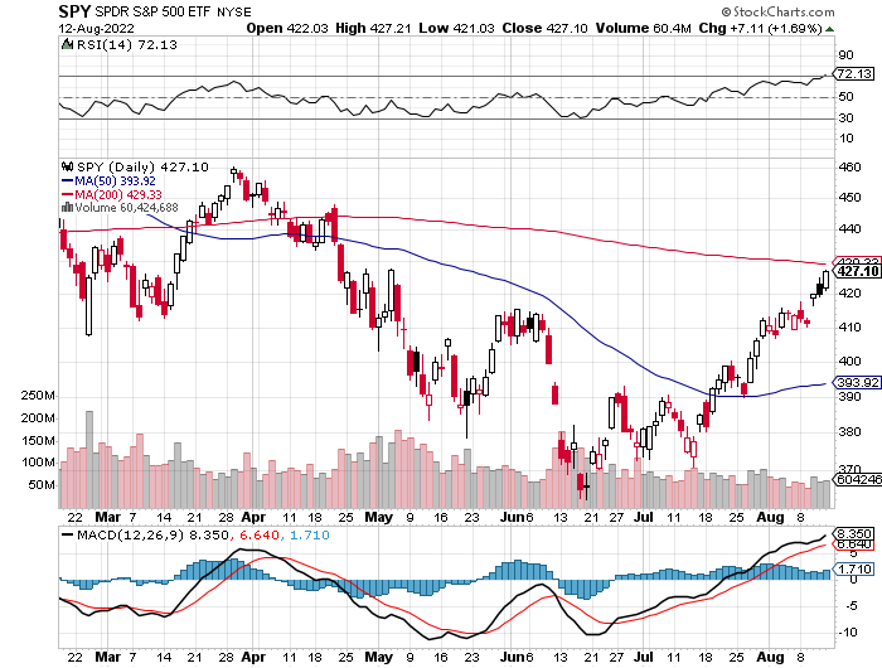
As is always the case, markets have seen these developments and correctly ascertained their consequences far before we humans did (except for maybe me). It has been no surprise that they have been tracking the Russian defeat day by day and have been on an absolute tear since June 15.
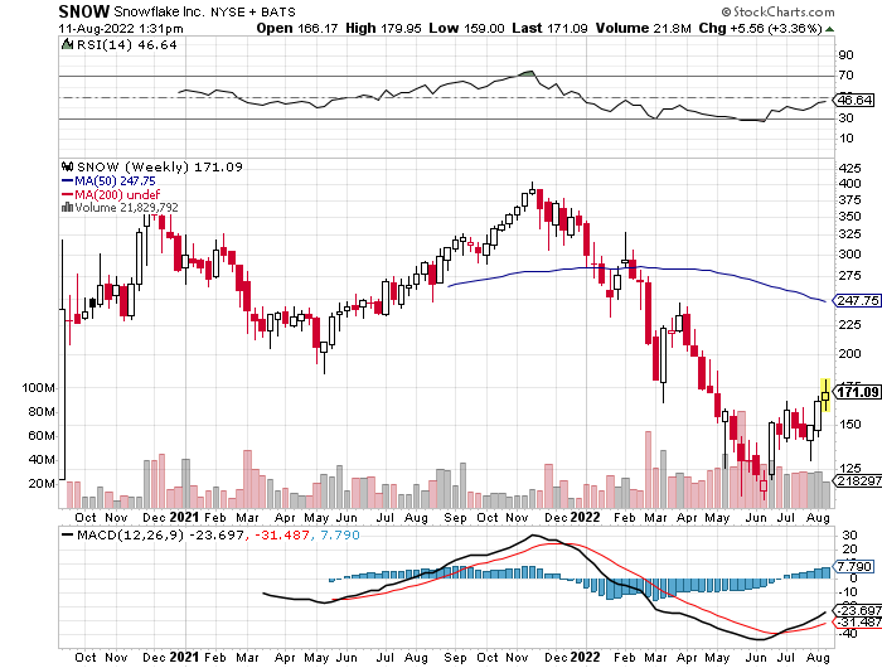
Even small techs suffering 18-month bear markets have now begun major recoveries, with companies like Snowflake (SNOW), up 50%, Netflix (NFLX), up 39%, and Cathie Wood’s Innovation Fund (ARKK) up 57%. Even crypto has returned from the grave, with Ethereum (ETHE) up an eye-popping 105%.
But don’t go gaga over stocks just yet.
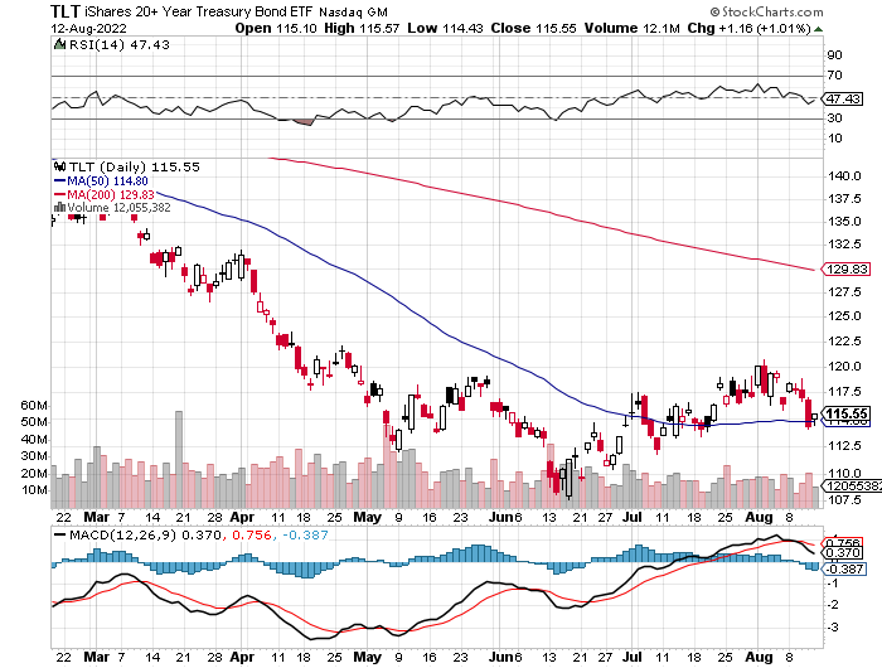
The Fed ramps up quantitative tightening in September to $95 billion a month and will deliver another interest rate hike. That's why I am running a double short in the bond market (TLT), (TBT) once again.
We also have the midterms to worry about which, with recent developments, promise to be more contentious than ever. Look for another round of tiring new election fraud claims.
That’s great because these events will give us good entry points lower down for trade alerts, not the short-term top we are looking at right now.
It helps that with ten-year US Treasury yields at 2.80%, it has an effective price earning multiple of 37, while stocks growing earnings at 10% a year boast a price earnings multiple of only 16. That sets up a massive, long stock/short bond trade which Mad Hedge will be pushing well on into 2023.
And you know what?
The smart guys I know in the hedge fund community are starting to model for the next Fed interest rate CUT. Markets will love it and discount this far in advance.
If you want to get on the train with me before it leaves the station, just keep reading this newsletter.
Yes, markets are now being driven by rate cuts and peace prospects, not rate rises and war!
Your retirement fund will love it.
I just thought you’d like to know.
CPI Dives to 8.5%, down 0.6% in July. The peak is in, and stocks rallied 500. Look for another drop in August, with gasoline prices falling daily. The 800-pound gorilla in the room has exited.
The Producer Price Index Dives 0.5%, confirming last week’s weak CPI number. And many core prices are indicating that we will get another drop when the August numbers are reported in September. It was worth another 300-point rally in the Dow Average, which is getting seriously overbought.
Consumer Inflation Expectations dive to 6.2% for the coming year and only 3.2% for three years. according to a New York Fed Survey. Expectations for food costs saw the largest decline. The CPI is out on Wednesday. No doubt a media onslaught over a coming recession has a lot to do with it.
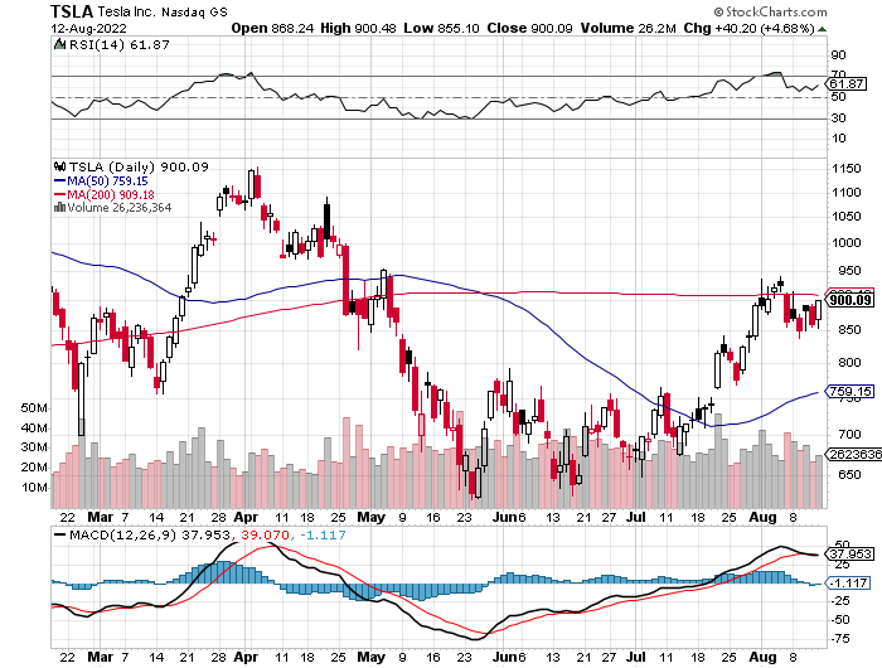
Elon Musk Sells $6.9 billion worth of Tesla (TSLA) Stock, explaining the $100 drop in the shares last week. Ostensibly, this is to pay for Twitter if he loses his court case. Musk clearing took advantage of a 60% rise in (TSLA) to head off distress sales in the future. Musk also opened the door to share buy backs in the future. Buy (TSLA) on dips.
85,000 IRS Agents are Headed Your Way, but only if the government can hire them and only if you are a billionaire or a profitable large oil company. The rest of us will be ignored by this unpublicized portion of the Biden inflation bill.
US Dollar (UUP) Takes a Hit on CPI Report, which effectively showed that the US saw deflation in July. The greenback is pulling back the 20-year highs which gave you the cheapest European vacation in your lives. The prospect of interest rates rising at a slower pace is dollar negative. Buy (FXA) and (FXC) on dips.
Boeing (BA) Delivered its First 787 Dreamliner in a year, after long-awaited regulatory approval. The monster 30% rise in the shares off the June low predicted as much. A global aircraft shortage helps. Airbus is going to have to start earnings its money again. Keep buying (BA) on dips.
Weekly Jobless Claims Pop 12,000 to 262,000, a new high for the year. It’s not at concerning levels yet but is definitely headed in the wrong direction. Maybe it’s just a summer slowdown? Maybe not.
Shipping Container Charges are Plunging Everywhere, except in the US, which currently has the world’s strongest economy. It’s a sign that global supply chain problems are easing. But the US leads the world in demurrage, or delays, with New York the worst, followed by Long Beach. Import Prices are Plunging, thanks to a super strong dollar, taking more pressure off of inflation. They fell 1.4% in July according to the Department of Labor. Easing supply chain problems are helping. Biden has had the run of the table for months now
My Ten-Year View
When we come out the other side of pandemic and the recession, we will be perfectly poised to launch into my new American Golden Age, or the next Roaring Twenties. With oil prices now rapidly declining, and technology hyper accelerating, there will be no reason not to. The Dow Average will rise by 800% to 240,000 or more in the coming decade. The America coming out the other side will be far more efficient and profitable than the old. Dow 240,000 here we come!
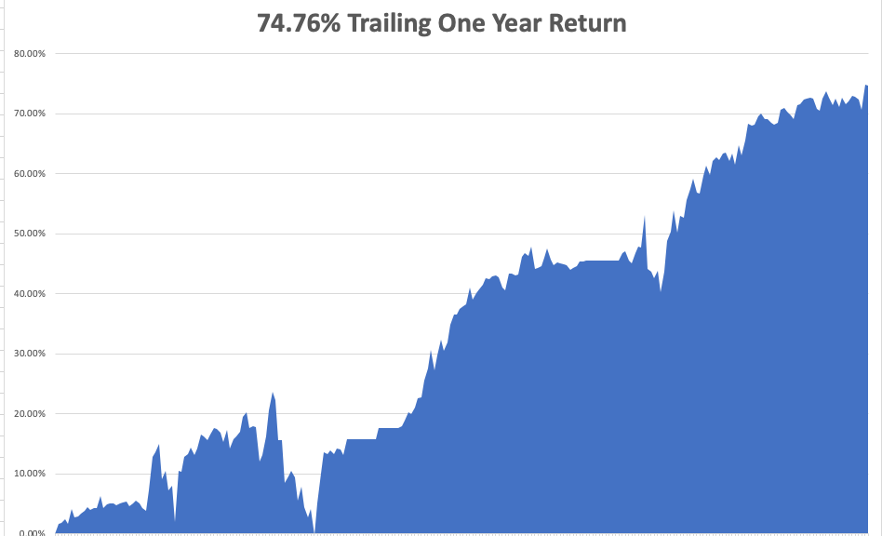
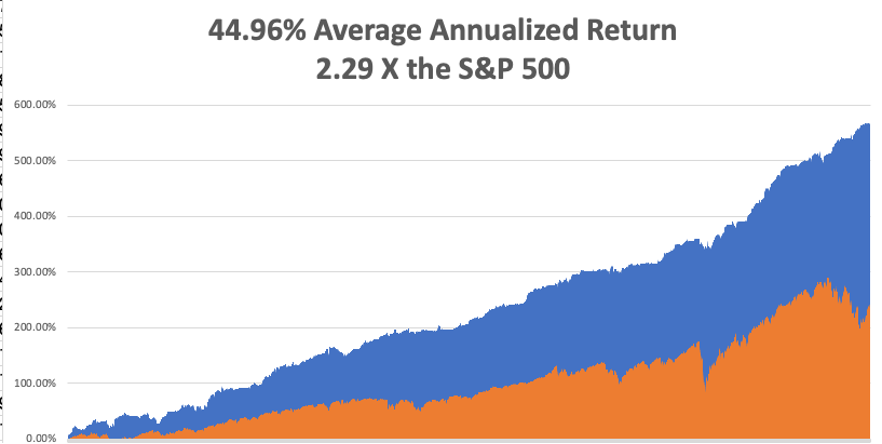
My August performance climbed to +2.14%. My 2022 year-to-date performance ballooned to +56.97%, a new high. The Dow Average is down -7.0% so far in 2022. It is the greatest outperformance on an index since Mad Hedge Fund Trader started 14 years ago. My trailing one-year return maintains a sky-high 74.76%.
That brings my 14-year total return to 569.53%, some 2.56 times the S&P 500 (SPX) over the same period and a new all-time high. My average annualized return has ratcheted up to 44.96%, easily the highest in the industry.
We need to keep an eye on the number of US Coronavirus cases at 93 million, up 300,000 in a week and deaths topping 1,037,000 and have only increased by 2,000 in the past week. You can find the data here.
On Monday, August 15 at 8:30 AM EDT, the New York Empire State Manufacturing Index for August is released.
On Tuesday, August 16 at 8:30 AM, the Housing Starts for July are out.
On Wednesday, August 17 at 8:30 AM, Retail Sales for July are published. At 11:00 AM the Fed Minutes from the last meeting are printed.
On Thursday, August 18 at 8:30 AM, Weekly Jobless Claims are announced. Existing Home Sales for July are announced. On Friday, August 19 at 2:00 the Baker Hughes Oil Rig Count is out.
As for me, while we’re all waiting for the dog days of August to end, it is time to reminisce about my old friend George Schultz who passed away last year at the age of 101.
My friend was having a hard time finding someone to attend a reception who was knowledgeable about financial markets, White House intrigue, international politics, and nuclear weapons.
I asked who was coming. She said Reagan’s Treasury Secretary George Shultz. I said I’d be there wearing my darkest suit, cleanest shirt, and would be on my best behavior, to boot.
It was a rare opportunity to grill a high-level official on a range of top-secret issues that I would have killed for during my days as a journalist for The Economist magazine. I guess arms control is not exactly a hot button issue these days.
I moved in for the kill.
I have known George Shultz for decades, back when he was the CEO of the San Francisco-based heavy engineering company, Bechtel Corp in the 1970s.
I saluted him as “Captain Schultz”, his WWII Marine Corp rank, which has been our inside joke for years. Now that I am a major, I guess I outrank him.
Since the Marine Corps didn’t know what to do with a PhD in economics from MIT, they put him in charge of an anti-aircraft unit in the South Pacific, as he was already familiar with ballistics, trajectories, and apogees.
I asked him why Reagan was so obsessed with Nicaragua, and if he really believed that if we didn’t fight them there, would we be fighting them in the streets of Los Angeles as the then-president claimed.
He replied that the socialist regime had granted the Soviets bases for listening posts that would be used to monitor US West Coast military movements in exchange for free arms supplies. Closing those bases was the true motivation for the entire Nicaragua policy.
To his credit, George was the only senior official to threaten resignation when he learned of the Iran-contra scandal.
I asked his reaction when he met Soviet premier Mikhail Gorbachev in Reykjavik in 1986 when he proposed total nuclear disarmament.
Shultz said he knew the breakthrough was coming because the KGB analyzed a Reagan speech in which he had made just such a proposal.
Reagan had in fact pursued this as a lifetime goal, wanting to return the world to the pre nuclear age he knew in the 1930s, although he never mentioned this in any election campaign. Reagan didn’t mention a lot of things.
As a result of the Reykjavik Treaty, the number of nuclear warheads in the world has dropped from 70,000 to under 10,000. The Soviets then sold their excess plutonium to the US, which has generated 20% of the total US electric power generation for two decades.
Shultz argued that nuclear weapons were not all they were cracked up to be. Despite the US being armed to the teeth, they did nothing to stop the invasions of Korea, Hungary, Vietnam, Afghanistan, and Kuwait.
Schultz told me that the world has been far closer to an accidental Armageddon than people realize.
Twice during his term as Secretary of State, he was awoken in the middle of the night by officers at the NORAD early warning system in Colorado to be told that there were 200 nuclear missiles inbound from the Soviet Union.
He was given five minutes to recommend to the president to launch a counterstrike. Four minutes later, they called back to tell him that there were no missiles, that it was just a computer glitch projecting ghost images on a screen.
When the US bombed Belgrade in 1989, Russian president Boris Yeltsin, in a drunken rage, ordered a full-scale nuclear alert, which would have triggered an immediate American counter-response. Fortunately, his generals ignored him.
I told Schultz that I doubted Iran had the depth of engineering talent needed to run a full-scale nuclear program of any substance.
He said that aid from North Korea and past contributions from the AQ Khan network in Pakistan had helped them address this shortfall.
Ever in search of the profitable trade, I asked Schultz if there was an opportunity in nuclear plays, like the Market Vectors Uranium and Nuclear Energy ETF (NLR) and Cameco Corp. (CCR), that have been severely beaten down by the Fukushima nuclear disaster.
He said there definitely was. In fact, he was personally going to lead efforts to restart the moribund US nuclear industry. The key here is to promote 5th generation technology that uses small, modular designs, and alternative low-risk fuels like thorium.
Schultz believed that the most likely nuclear war will occur between India and Pakistan. Islamic terrorists are planning another attack on Mumbai. This time, India will retaliate by invading Pakistan. The Pakistanis plan on wiping out this army by dropping an atomic bomb on their own territory, not expecting retaliation in kind.
But India will escalate and go nuclear too. Over 100 million would die from the initial exchange. But when you add in unforeseen factors, like the broader environmental effects and crop failures (CORN), (WEAT), (SOYB), (DBA), that number could rise to 1-2 billion. This could happen as early as 2023.
Schultz argued that further arms control talks with the Russians could be tough. They value these weapons more than we do because that’s all they have left.
Schultz delivered a stunner in telling me that Warren Buffet had contributed $50 million of his own money to enhance security at nuclear power plants in emerging markets.
I hadn’t heard that.
As the event ended, I returned to Secretary Shultz to grill him some more about the details of the Reykjavik conference held some 36 years ago.
He responded with incredible detail about names, numbers, and negotiating postures. I then asked him how old he was. He said he was 100.
I responded, “I want to be like you when I grow up”.
He answered that I was “a promising young man.” I took that as encouragement in the extreme.
Stay healthy,
John Thomas
CEO & Publisher
The Diary of a Mad Hedge Fund Trader
We’re Getting Pretty High
https://www.madhedgefundtrader.com/wp-content/uploads/2022/08/wristwatch.jpg331441Mad Hedge Fund Traderhttps://madhedgefundtrader.com/wp-content/uploads/2019/05/cropped-mad-hedge-logo-transparent-192x192_f9578834168ba24df3eb53916a12c882.pngMad Hedge Fund Trader2022-08-15 09:02:082022-08-15 13:26:22The Market Outlook for the Week Ahead, or What the Market is Really Discounting Now
In the investment business, you’re only as good as your last trade. If that is the case, that makes me a pretty worthless person in the wake of a record four stop-losses at the November 19 option expiration.
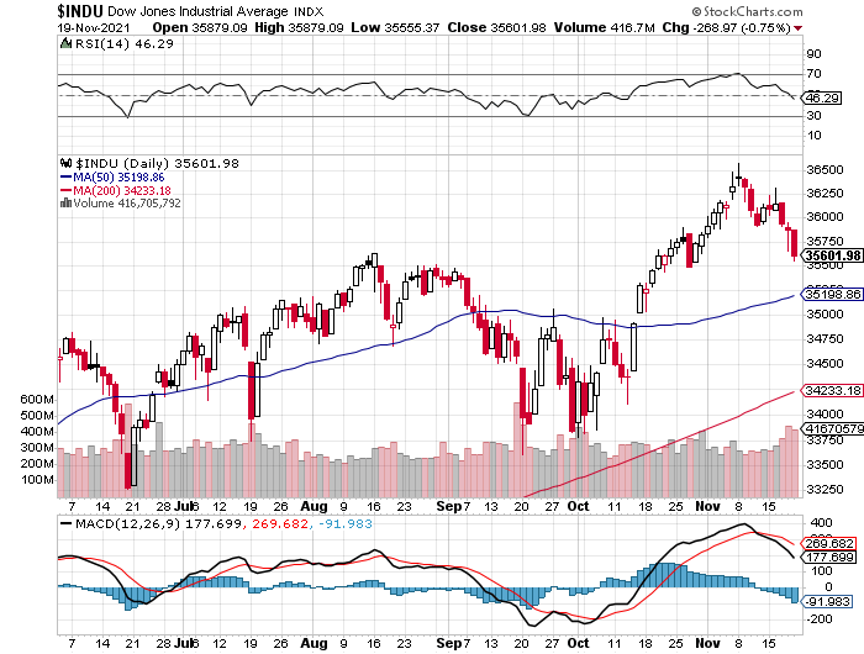
Days before, the market closed with all ten of our positions profitable. But the pandemic lockdown in Austria on Friday morning shattered those plans. Fears of a new Covid wave and another mini-recession send bonds soaring and interest rates crashing. That trashed financial stocks, where I had a heavy exposure.
If you work in the business long enough, you see a black swan on an options expiration day every five or ten years. This was our turn. As a result, we traded a double-digit gain for November for a moderate loss. That still leaves us with a heroic 80% gain for 2021 and 15 consecutive profitable months.
There is nothing to do but pick yourself up, dust yourself off, and go on to the next trade. I wouldn’t be surprised to see all of the Friday losses reversed in the coming weeks. Banks are still outrageously profitable and the cheapest sector in the market. If you have a six-month to one-year view, the action on Friday changed nothing.
You live by the sword, you die by the sword.
There was a lot going on Friday than just another Covid wave. November option expirations used to be a snore. But this year, brokerage firms have stampeded so many retail investors into the options markets where they make the most money that they have become major events.
Some 70% of all options trading now takes place in securities with less than two weeks to expiration. In the meantime, professional traders limit their personal accounts to long term LEAPS which are the subject of the Mad Hedge Concierge Service. Instead of rolling the dice for a 10% profit in a month, you get a very safe 100% return in a year.
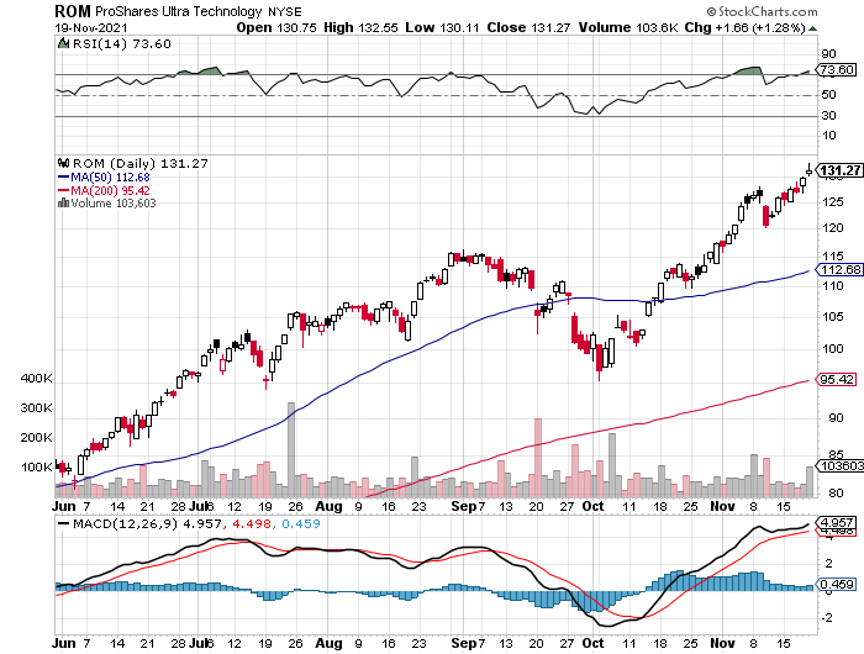
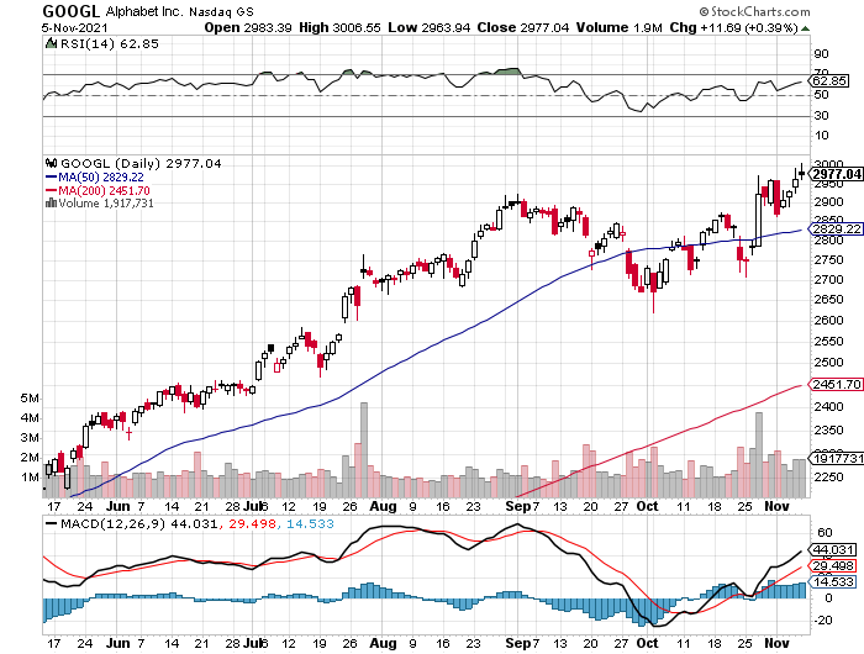
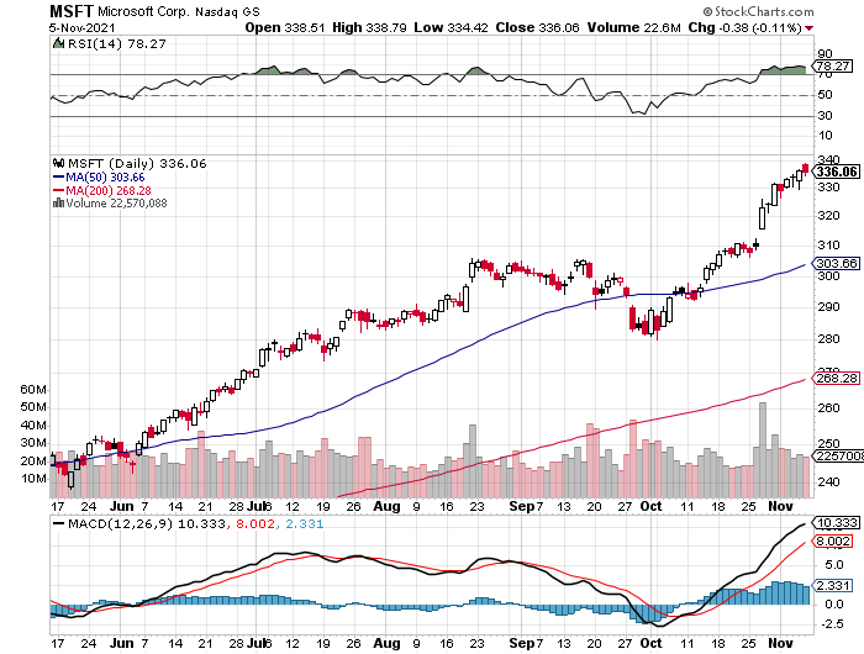
Of course, while financials were getting wrecked, falling interest rates were acting as a steroid for tech stocks. (MSFT) and Google (GOOG) hit new highs for the year. Concierge members in my (ROM) LEAPS were rolling in clover.
The barbell strategy wins again!
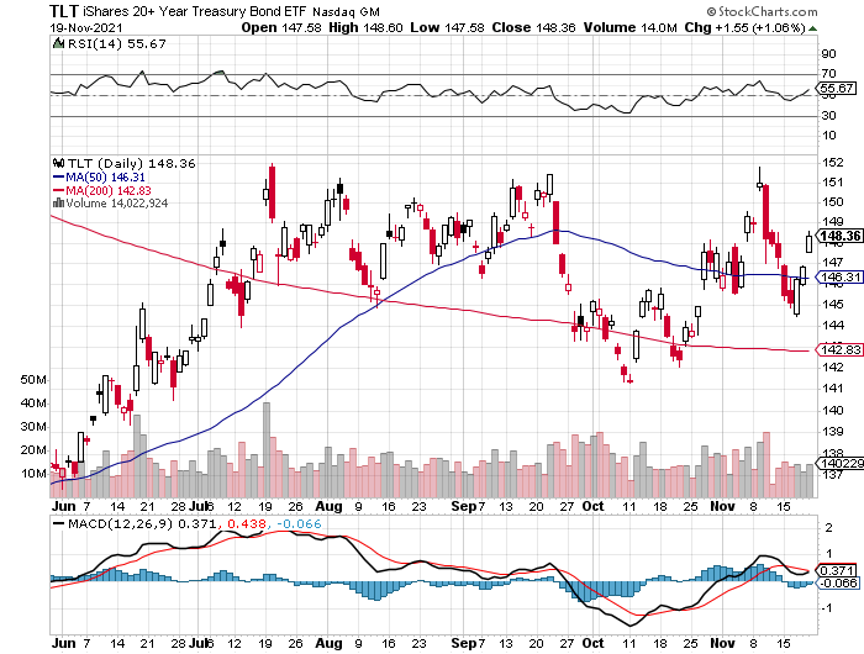
Infrastructure Bill is signed on Monday, injecting another $1.2 trillion into the economy today. This assured the economy will keep booming through 2024. The bond market hates it, down $6.00 in three days. It adds another 3% to GDP over the next five years. Keep selling (TLT) on rallies.
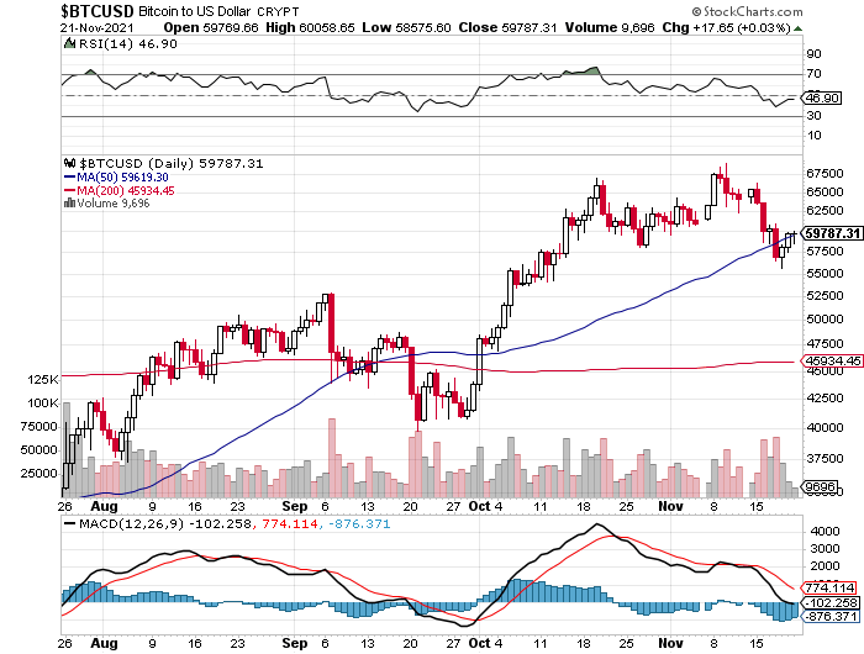
Bitcoin Forks for the first some since 2017, making it much more competitive with Ethereum. It enables the lead crypto to use defi and third party apps. Miner Marathon (MARA) is raising a $500 million bond issue to buy Bitcoin. Keep buying (BITO) and (ETHE) on dips.
US Retail Sales roar, up 1.7% in October compared to 0.8% in September, far more than expected. Receipts for all items are rising. Higher wages are immediately translating into increased spending.
Builder Sentiment jumps, up 3 points to 83, according to the National Association of Homebuilders. A decade-long structural shortage of housing is a huge tailwind. Good luck hiring a contractor right now. The Midwest and the south are the leaders in demand.
Dollar hits 16-Month High, on the strength of yesterday’s red hot Retail Sales. It means higher interest rates soon, which is great for the buck. Currencies with the fastest rising interest rates are always the strongest.
NVIDIA kills it, with revenues up 50% YOY and earnings up 60%. It’s well on the way to becoming the next trillion-dollar company. It’s another Mad Hedge 20 bagger. Buy (NVDA) on dips.
Biden may try an SPR Release to cap gasoline prices. There are 741 barrels in the Strategic Petroleum Reserve, enough for 21 days of US consumption. It’s sitting there costing money, essentially a government subsidiary for the energy industry. Why have it if the US is now a net energy exporter? The concern has been enough to drop oil prices by 10%.
Rents for single-family homes are up 10.2% YOY, and will continue to rise. Miami has the highest rent inflation in the country, and the highest-priced homes are seeing the fastest increases.
Weekly Jobless Claims drop to new post-pandemic low, to 268,000, just fractionally. There are 2 million continuing claims. The great resignation continues.
John Deere strike ends, with some of the best terms for workers in 40 years. It cost the company $2.5 billion. They get an immediate 10% raise and $7,500 bonus, larger out-year raises, and big performance bonuses. There is a lot of making up for 30 years of no real wage growth going on here. It points a loaded gun at the head of the “transitory” argument for inflation. Buy (DE) on dips.
My Ten-Year View
When we come out the other side of pandemic, we will be perfectly poised to launch into my new American Golden Age, or the next Roaring Twenties. With interest rates still at zero, oil cheap, there will be no reason not to. The Dow Average will rise by 800% to 240,000 or more in the coming decade. The American coming out the other side of the pandemic will be far more efficient and profitable than the old. Dow 240,000 here we come!
With the disastrous November options expiration, my November month-to-date performance plunged to -7.73%. My 2021 year-to-date performance took a haircut to 80.82%. The Dow Average is up 16.34% so far in 2021.
My entire portfolio expired on Friday, and I am 100% in cash. Of our ten positions, six made money and four lost. In addition, subscribers to the Mad Hedge Technology letter had another five winners, as tech stocks are still on a tear.
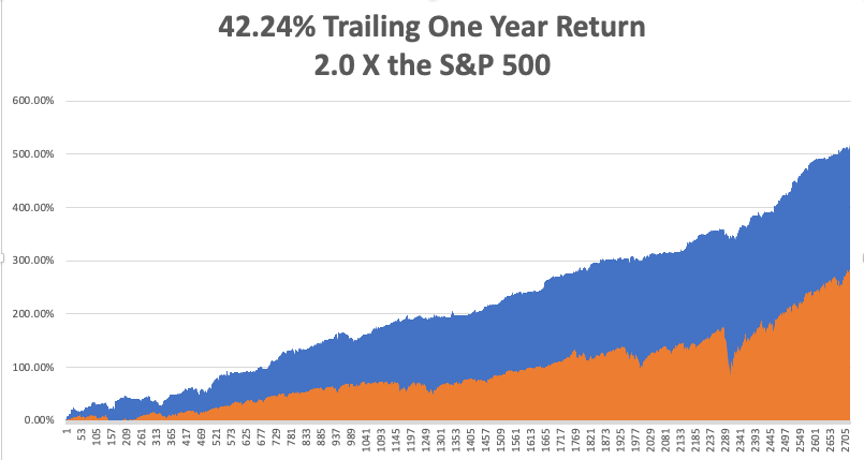
That brings my 12-year total return to 503.37%, some 2.00 times the S&P 500 (SPX) over the same period. My 12-year average annualized return has ratcheted up to 42.24%, easily the highest in the industry.
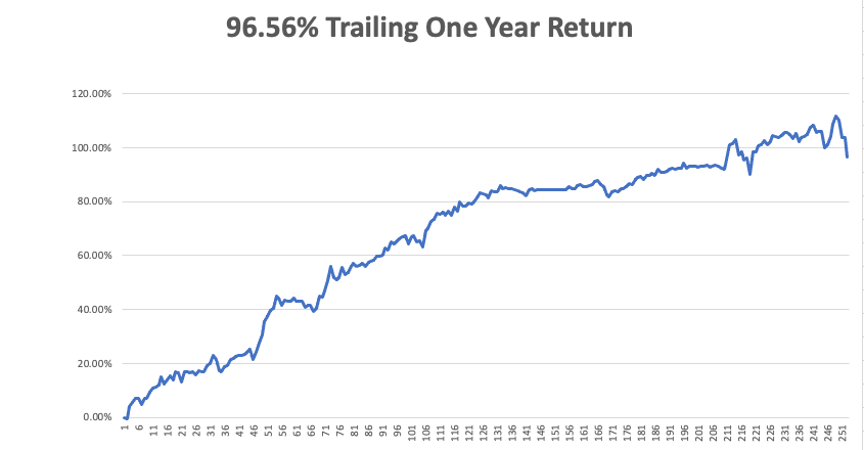
My trailing one-year return popped back to positively eye-popping 96.56%. I bet many of you are making the biggest money of your long lives.
We need to keep an eye on the number of US Coronavirus cases at 48 million and rising quickly and deaths topping 772,000, which you can find here at https://coronavirus.jhu.edu.
The coming week will be all about the inflation numbers.
On Monday, November 22 at 7:00 AM, Existing Homes Sales for October are released.
On Tuesday, November 23 at 6.45 AM, the Flash Manufacturing PMI is announced. On Wednesday, November 24 at 5:30 AM, US Q3 GDP second estimate is published. At 7:00 AM we get New Home Sales for October. Minutes from the last Fed meeting are printed at 2:00 PM.
On Thursday, November 25 markets are closed for Thanksgiving Day.
On Friday, November 26 at 2:00 PM, the Baker Hughes Oil Rig Count are disclosed.
As for me, when I was shopping for a Norwegian Fiord cruise for next summer, each stop was familiar to me because a close friend had blown up bridges in every one of them.
During the 1970s at the height of the Cold War, my late wife Kyoko flew a monthly round trip from Moscow to Tokyo as a British Airways stewardess. As she was checking out of her Moscow hotel, someone rushed at her and threw a bundled typed manuscript that hit her in the chest.
Seconds later a half dozen KGB agents dog-piled on top of her. It turned out that a dissident was trying to get Kyoko to smuggle a banned book to the West and she was arrested as a co-conspirator and bundled away to Lubyanka Prison.
I learned of this when the senior KGB agent for Japan contacted me, who had attended my wedding the year before. He said he could get her released, but only if I turned over a top-secret CIA analysis of the Russian oil industry.
At a loss for what to do, I went to the US Embassy to meet with ambassador Mike Mansfield, who as The Economist correspondent in Tokyo I knew well. He said he couldn’t help me as Kyoko was a Japanese national, but he knew someone who could. Then in walked William Colby, head of the CIA.
Colby was a legend in intelligence circles. After leading the French resistance with the OSS, he was parachuted into Norway with orders to disable the railway system. Hiding in the mountains during the day, he led a team of Norwegian freedom fighters who laid waste to the entire rail system from Tromso all the way down to Oslo. He thus bottled up 300,000 German troops, preventing them from retreating home to defend themselves from an allied invasion.
During the Vietnam war, Colby became notorious for running the Phoenix assassination program.
I asked Colby what to do about the Soviet request. He replied, “give it to them.” Taken aback, I asked how. He replied, “I’ll give you a copy.” Mansfield was my witness so I could never be arrested for being a turncoat. Copy in hand, I turned it over to my KGB friend, and Kyoko was released the next day and put on the next flight out of the country. She never took a Moscow flight again.
I learned that the report predicted that the Russian oil industry, its largest source of foreign exchange, was on the verge of collapse. Only massive investment in modern western drilling technology could save it. This prompted Russia to sign deals with American oil service companies worth hundreds of millions of dollars.
Ten years later, I ran into Colby at a Washington event, and I reminded him of the incident. He confided in me “You know that report was completely fake, don’t you?” I was stunned. The goal was to drive the Soviet Union to the bargaining table to dial down the Cold War. I was the unwitting middleman. It worked. That was Bill, always playing the long game.
After Colby retired, he campaigned for nuclear disarmament and gun control. He died in a canoe accident in the lake near his Maryland home in 1996.
Stay Healthy.
John Thomas
CEO & Publisher
The Diary of a Mad Hedge Fund Trader
https://www.madhedgefundtrader.com/wp-content/uploads/2021/11/santa-monica-1966.png744476Mad Hedge Fund Traderhttps://madhedgefundtrader.com/wp-content/uploads/2019/05/cropped-mad-hedge-logo-transparent-192x192_f9578834168ba24df3eb53916a12c882.pngMad Hedge Fund Trader2021-11-22 10:02:402021-11-22 13:54:45The Market Outlook for the Week Ahead, or The Worst-Case Scenario
If there was ever any doubt that the market was going straight up for the rest of the year, it was dashed when the infrastructure budget passed on late Friday night with bipartisan support. Another $1.2 trillion will be dumped into the economy next year, adding 6% to GDP growth.
Of course, the stock market started sniffing out this possibility and resumed racing yet again to new all-time highs on September 30.
The latest round of earnings reports proved that corporate profit margins are exploding, along with profits. Demand is through the roof. It turned out that demand WASN’T lost, just deferred, as I vociferously begged followers to buy stocks at the April 2020 bottom.
Interest rates went down instead of up sharply on news of the Fed taper.
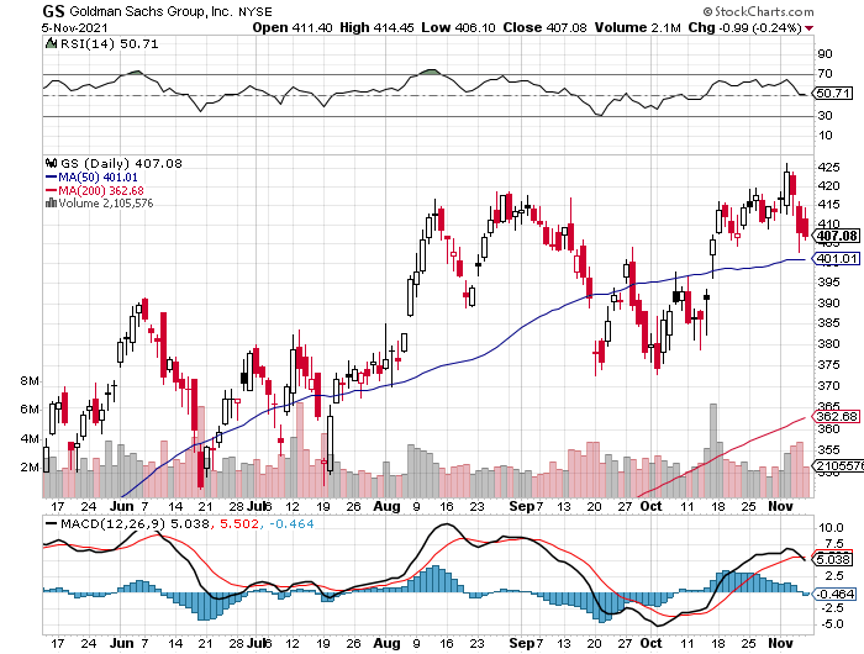
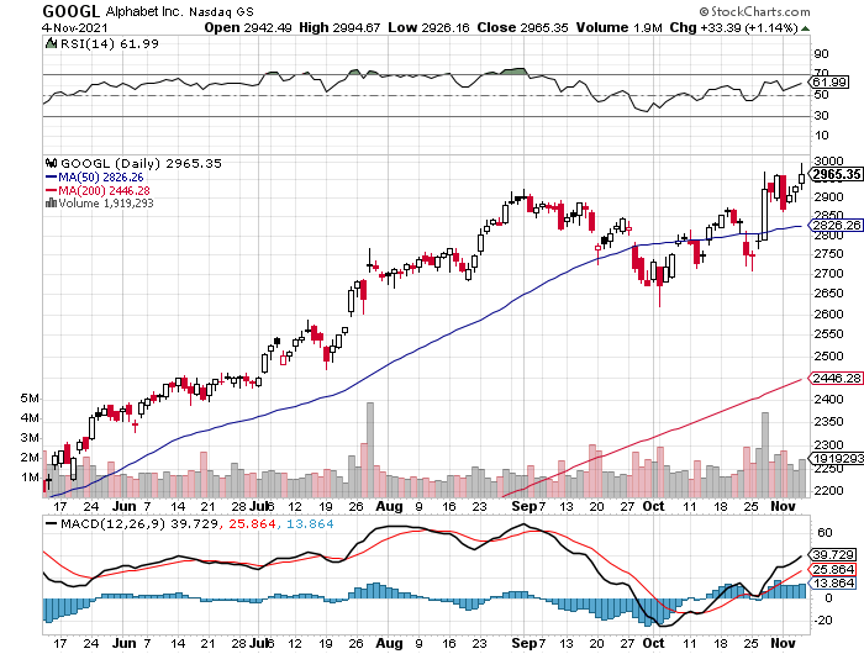
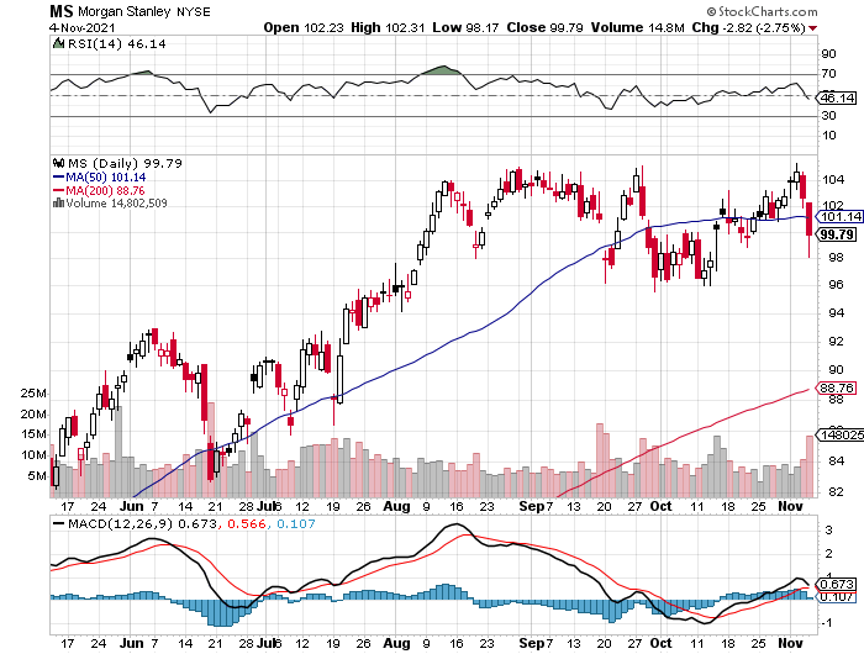
And the 10% correction that many expected never showed, forcing managers to chase the market so they can be seen as fully invested in the right names at yearend. That means buying more Alphabet (GOOGL), Microsoft (MSFT), Goldman Sachs (GS), and Morgan Stanley (MS) at whatever price so managers can look like the brilliant people that they really AREN’T.
There is no doubt that the economic data is turning from mixed to red hot.
We will see a Capital spending renaissance in 2022 as the economy shifts from manufacturing to service-driven, and services account for 80% of US GDP. It’s a perfect formula for an economy that is catching on fire.
As for the missing 5 million workers, I think what we are seeing is a 9/11 effect. That’s when people become aware of the transitory nature of life and ask themselves why they are working at a job they hate, some 80% of the labor force, especially at the minimum wage level. They retrain for better-paying, more meaningful professions, retire early, or otherwise go missing in action.
There is another category of missing workers: those who have made so much in the stock market and Bitcoin in the last 18 months they never have to work another day in their life. Are there 5 million of them? Maybe.
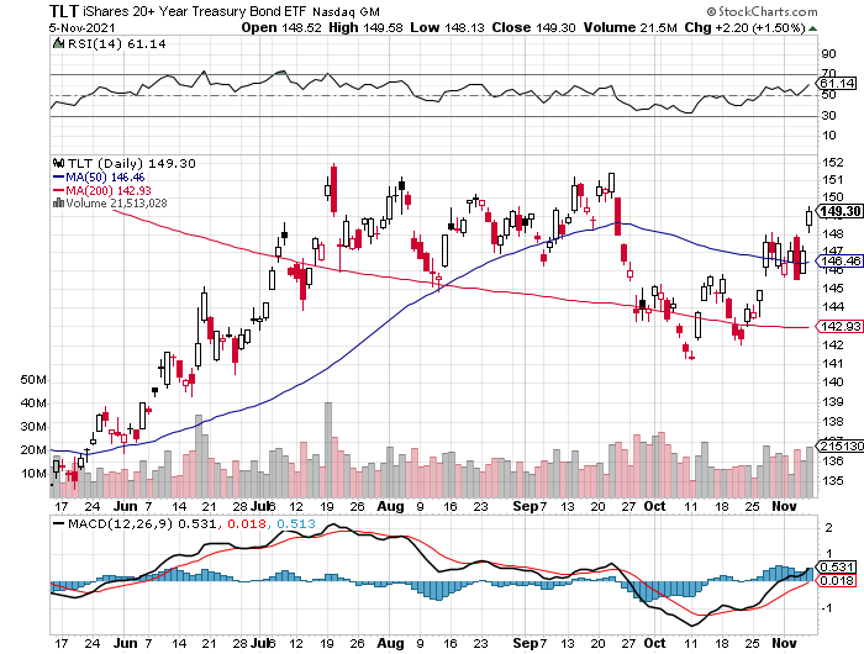
And how come everybody in the world knows that interest rates are rising except the bond market? The United States Treasury Bond Fund (TLT) has seen two, count them, two massive three-point RALLIES in the last ten days. The (TLT) may give all this back this week when we get hot inflation data.
It is a positioning issue and a classic “buy the rumor, sell the news” on interest rates. When the entire world is short bonds, they can only go UP. This means we are likely to see a $141-$151 (TLT) range in bonds for the next six months until we start to see actual interest rate RISES. The Fed Tapers! The Fed taper starts immediately and will accelerate in 2022 until it goes to zero by June. Stocks took off, while bonds dove a $1.50 as soon as they noticed that “transitory” was missing from the release. Will the first interest rate hike in four years be moved up to June? Or do we get a double rate hike in December 2022? That’s where we may see the real volatility, after the market close. Semiconductor growth stocks hit new all-time highs. Financials moving back to highs, as are big tech stocks.
Q3 GDP comes in at a weak 2.0%, down from a 6% rate in Q2, thanks to the ravages of the delta virus, now in the rearview mirror. What happens next? That 4% wasn’t lost, just deferred into 2022. The rip-roaring 6% growth rate returns. That’s why stocks are pushing up to new all-time highs right now. I’m looking for a 5% growth rate next year as government stimulus spending eventually fades.
Nonfarm Payroll Report explodes to the upside in October at 531,000. The Headline Unemployment Rate drops to 4.6%. Pandemic benefits have ended, and a wider vaccination rate encouraged workers it is safe to go back on the job. The back months were revised up 250,000. Manufacturing was up 60,000 and Leisure & Hospitality was up 164,000, The U-6 “discouraged worker” unemployment rate fell to 8.3%. And there is massive pent-up hiring is yet to come. The US could see full employment by the end of Q3 anticipating a 6% GDP growth rate. The markets loved it and the (SPY) is zeroing in my $475 yearend target.
Inflation is rampaging, according to the Department of Commerce, which saw a sizzling 4.4% rate in September. That’s the fastest rate in 30 years. Rising energy and wage costs are big issues. This is why Goldman Sachs has moved up its forecast for the first interest rate rise to July 2022.
US Consumer Spending bounces back, up 0.6% in September after a hot 1% move in August. Demand for services took the lead as shortages head off spending on goods, like cars.
Ethereum hits a new all-time high, ticking at $4,670 in response to the Fed’s immediate taper. Bitcoin is still consolidating its recent three-month doubling. Buy (BITO), (ETHE), and (BLOK) on dips.
US Stock Buy Backs hit record in Q3, topping a staggering $224 billion, and the best is yet to come as companies try to burn through 2021 repurchase budgets. And you wonder why the stock market is going up?
US Dollar hits one-year high on red hot jobs data, presaging higher interest rates. Everyone seems to know that rates are rising except the bond market.
My Ten-Year View
When we come out the other side of pandemic, we will be perfectly poised to launch into my new American Golden Age, or the next Roaring Twenties. With interest rates still at zero, oil cheap, there will be no reason not to. The Dow Average will rise by 800% to 240,000 or more in the coming decade. The American coming out the other side of the pandemic will be far more efficient and profitable than the old. Dow 240,000 here we come!
My Mad Hedge Global Trading Dispatch saw a massive +8.95% gain in October, followed by a decent 1.74% so far in November. My 2021 year-to-date performance maintained 90.30%. The Dow Average is up 16.7% so far in 2021.
After the recent ballistic move in the market, I am continuing to run my longs in Those include (MS), (GS), (BAC), (BRKB), and a short in the (TLT). All are approaching their maximum profit point and we have nothing left but time decay to capture. So, I am going to run these into the November 19 expiration in 9 trading days. It’s like having a rich uncle write you a check one a day.
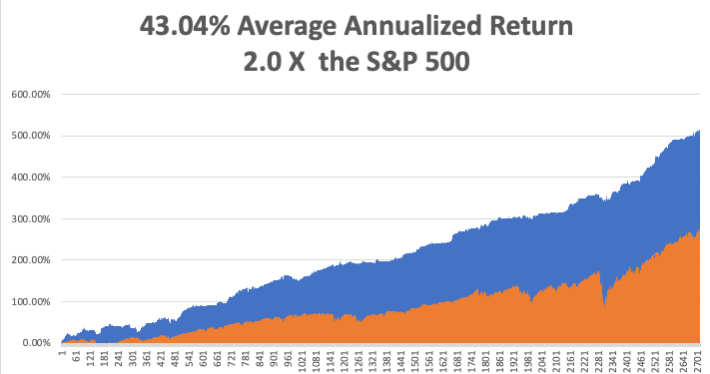
That brings my 12-year total return to 512.85%, some 2.00 times the S&P 500 (SPX) over the same period. My 12-year average annualized return now stands at an unbelievable 43.04 easily the highest in the industry.
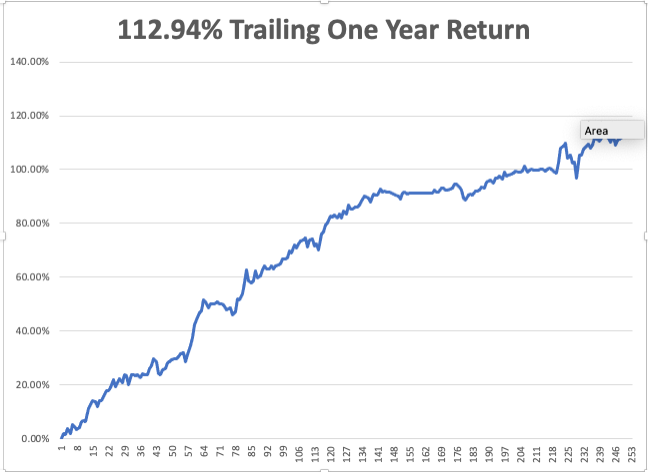
My trailing one-year return popped back to positively eye-popping 112.94%. I truly have to pinch myself when I see numbers like this. I bet many of you are making the biggest money of your long lives.
We need to keep an eye on the number of US Coronavirus cases at 46.5 million and rising quickly and approaching 755,000 deaths, which you can find here.
The coming week will be all about the inflation numbers.
On Monday, November 8 at 9:00 AM, US Consumer Inflation Expectations for October are out. PayPal reports.
On Tuesday, November 9 at 8:30 AM, the all-important Producer Price Index is published. DR Horton (DHI) reports. On Wednesday, November 10 at 8:30 AM, the Core Inflation Rate for October is printed. Walt Disney reports (DIS).
On Thursday, November 11 at 8:30 AM, Weekly Jobless Claims are announced.
On Friday, November 12 at 8:30 AM, the University of Michigan Consumer Sentiment is announced.
At 2:00 PM, the Baker Hughes Oil Rig Count is disclosed.
As for me, dentists find my mouth fascinating as it is like a tour of the world. I have gold inlays from Japan, cheap ceramic fillings from Britain’s National Health, and loads of American silver amalgam.
But my front teeth are the most interesting as they were knocked out in a riot in Paris in 1968.
France was on fire that year. Riots on the city’s South Bank near Sorbonne University were a daily occurrence. A dozen blue police buses packed with riot police were permanently parked in front of the Notre Dame Cathedral ready for a rapid response across the river.
President Charles de Gaulle was in hiding at a French airbase in Germany. Many compared chaos to the modern-day equivalent of the French Revolution.
So, of course, I had to go.
This was back when there were five French francs to the US dollar and you could live on a loaf of bread, a chunk of cheese, and a bottle of wine for a dollar a day. I was 16.
The Paris Metro cost one franc. To save money, I camped out every night in the Parc des Buttes Chaumont, which had nice bridges to sleep under. When it rained, I visited the Louvre, taking advantage of my free student access. I got to know every corner. The French are great at castles….and museums.
To wash I would jump in the Seine River every once in a while. But in those days, not many people in France took baths anyway.
I joined a massive protest one night which originally began over the right of men to visit the women’s dorms at night. Then the police attacked. Demonstrators came equipped with crowbars and shovels to dig up heavy cobblestones dating to the 17th century to throw at the police, who then threw them back.
I got hit squarely in the mouth with an airborne projectile. My front teeth went flying and I never found them. I managed to get temporary crowns which lasted me until I got home. I carry a scar across my mouth to this day.
I visited the Left Bank just before the pandemic hit in 2019. The streets were all paved with asphalt to make the cobblestones underneath inaccessible. I showed my kids the bridges I used to sleep under, but they were unimpressed.
But when I showed them the Mona Lisa at the Louvre, she was as enigmatic as ever.
Everyone should have at least one Paris in 1968 in their lifetime. I’ve had many and am richer for it.
Stay Healthy.
John Thomas
CEO & Publisher
The Diary of a Mad Hedge Fund Trader
1968
2019
https://www.madhedgefundtrader.com/wp-content/uploads/2021/11/John-2019.png554518Mad Hedge Fund Traderhttps://madhedgefundtrader.com/wp-content/uploads/2019/05/cropped-mad-hedge-logo-transparent-192x192_f9578834168ba24df3eb53916a12c882.pngMad Hedge Fund Trader2021-11-08 10:02:422021-11-08 13:52:08The Market Outlook for the Week Ahead, or A Perfect Upside Storm
Below please find subscribers’ Q&A for the November 3 Mad Hedge Fund Trader Global Strategy Webinar broadcast from the safety of Silicon
Valley.
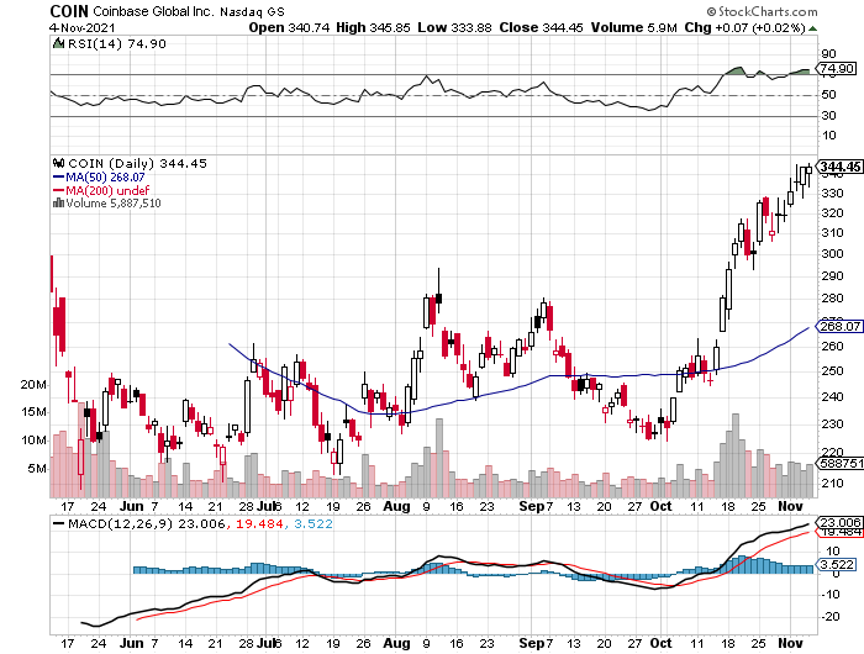
Q: Have you considered buying Coinbase (COIN)?
A: Yes, we actually recommended it as part of our Bitcoin service in the early days back in July. It’s gone up 62% since then, right along with the Bitcoin move itself. So yeah, buy (COIN) on dips—and there will be dips because it will be at least triple the volatility of the main market. And be sure to dollar cost average.
Q: Do you think the breakout in small caps (IWM) will hold and, if so, should we focus on small-c growth?
A: Yes it will hold, but no I would focus on the big cap barbells, which will lead this rally for the next 6 months. And there you’re talking about the best of tech which is Google (GOOGL) and Microsoft (MSFT), and the best of financials which is Morgan Stanley (MS), Goldman Sachs (GS), and JP Morgan (JPM).
Q: Why not time the webinar for after the FOMC? What will be the market reaction?
A: Well, first of all, we already know what they’re going to say—it’s been heavily leaked in the last week. The market reaction will be initially a potential sharp down move that lasts a few minutes or hours, and then we start a grind up for the next two months. So that's why I wanted to be 80% leverage long going into this. Second, we have broadcast this webinar at the same time for the last 13 years and if we change the time we will lose half our customers.
Q: Why do you always do debit spreads?
A: They’re easier for beginners to understand. That’s the only reason. If you’re sophisticated enough to do a credit spread, the results will be the same but the liquidity will be slightly better, and you can also apply that credit to meet your margin requirements. We have a lot of basic beginners signing up for our service in addition to seasoned pros and I always encourage people to do what they're most comfortable with.
Q: Are you still comfortable with the Morgan Stanley (MS) and Berkshire Hathaway (BRKB) positions?
A: I expect both to go up 10-20% by March, so that’s pretty comfortable. By the way, if you have extremely deep in the money call spreads on Goldman Sachs or Morgan, consider taking profits on those and rolling your strikes up. If you have like the $360-$380 vertical bull call spread in Goldman Sachs, realize that gain and roll up to the $420-$430 March position in Goldman Sachs—that will give you another 100% profit by March. With the $360-$ 380s, you have like 97% of the profit already in the price, there’s no leverage left and no point in continuing, you can only go down.
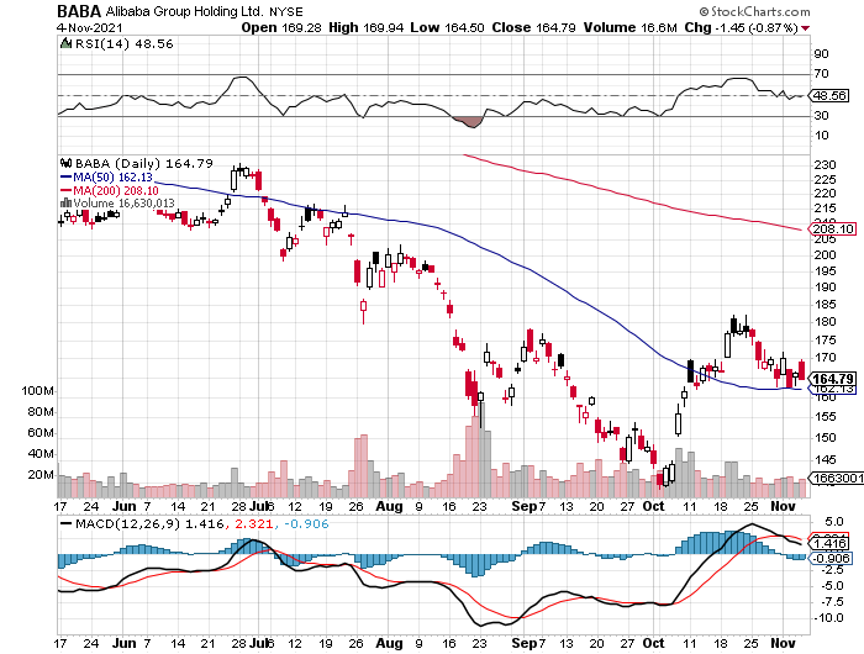
Q: What should I do with my China position?
A: Sell all your positions in China, realize all the losses now so you can offset those with all the huge profits on all your other positions this year. There I’m talking about Ali Baba (BABA), Baidu (BIDU), and (JD), which have been absolutely hammered anywhere from down 50% to down 70%. And do it now before everyone else does it for the same reasons.
Q: Thoughts on Paypal (PYPL) lately?
A: The stock is out of favor as money is moving out of PayPal into newer fintech stocks. The move down is totally unjustified and screaming long term buy here, but for the short-term investors are going to raid the piggy bank, sell the PayPal, and go into the newer apps. This has been my biggest money-losing trade personally this year because PayPal long-term has a great story.
Q: Will earnings fall off next year due to prior year comparisons or supply chain?
A: No, if anything, earnings are accelerating because supply chain problems mean you can charge customers whatever you want and therefore increase margins, which is why the stock market is going up.
Q: Long term, what would your wrong strikes be?
A: I would say don’t get greedy. I’m doing the ProShares Ultra Technology (ROM) $120-$125 call spread for May expiration—the longest expiration they offer. That gives you about 100% return in 6 months; 100% is good enough for me because then I’ll do the same thing again in May and get another 100%. What’s 100% x 100%? It’s 400% because you’re reinvesting a much larger capital base the second time around. If a 100% profit in six months is not enough for you then you are in the wrong line of business.
Q: Do you think Ethereum (ETHE) has long-term potential upside?
A: Yes, is a 10X move enough? We just had a major new high in Ethereum because they made moves to limit the production of new Ethereum. Ethereum is the superior technology because its architecture avoids the code repeats that Bitcoin does and therefore only uses a third of the electricity to create. But Bitcoin is attracting the big institutional cash flows because they have an early mover advantage. By the way, how much electricity does crypto mining consume? The entire consumption of Washington state in a year, so it’s a big deal.
Q: What should I do about Crisper Therapeutics (CRSP)?
Crispr Therapeutics (CRSP) is my other disaster for this year because ignored the move up to $170—we’re now back into the $90’s again. So, I have 2023 LEAPS on that; I’m going to keep them, I’ve already suffered the damage, but the next time it goes up to $170 I’m selling! Once burned, twice forewarned. And part of the problem with the whole biotech sector is we are now in the back end of the pandemic and anything healthcare-related will get hit, except for the vaccine stocks like Pfizer (PFE) which are still making billions and billions of dollars.
Q: I bought Baidu (BIDU) and Alibaba (BABA) years ago at a much lower price and I'm still up quite a lot; what should I do?
A: If you have the big cushion, I would keep them and look for #1 recovery in the Chinese economy next year and #2 for the government to back off from their idiotic anticapitalism strategy because it’s costing them so much money.
Q: Is Robinhood (HOOD) a good LEAP candidate?
A: Only on a really big dip, and then you want to go out two years. With a stock that’s volatile as hell like Robinhood and could drop by half on no notice, so you only buy the big dips. It’s not a slowly grinding upward stock like Goldman Sachs (GS) and Morgan Stanley (MS) where you can add LEAPS now because you know it’s going to keep grinding up.
Q: How can Morgan Stanley go up when the chief strategist is bearish?
A: Their customers aren't listening to their chief strategist—they’re buying. And the volume of the stock, which is where Morgan Stanley makes money, is going through the roof, they’re making record profits there. And I've got Morgan Stanley stock coming out of my ears in LEAPS and so forth.
Q: What are 5 stocks you would buy right now?
A: Easy: Google (GOOGL), Microsoft (MSFT), Morgan Stanley (MS), Goldman Sachs (GS), and JP Morgan (JPM). Buy whatever is down that day. They’re all going up.
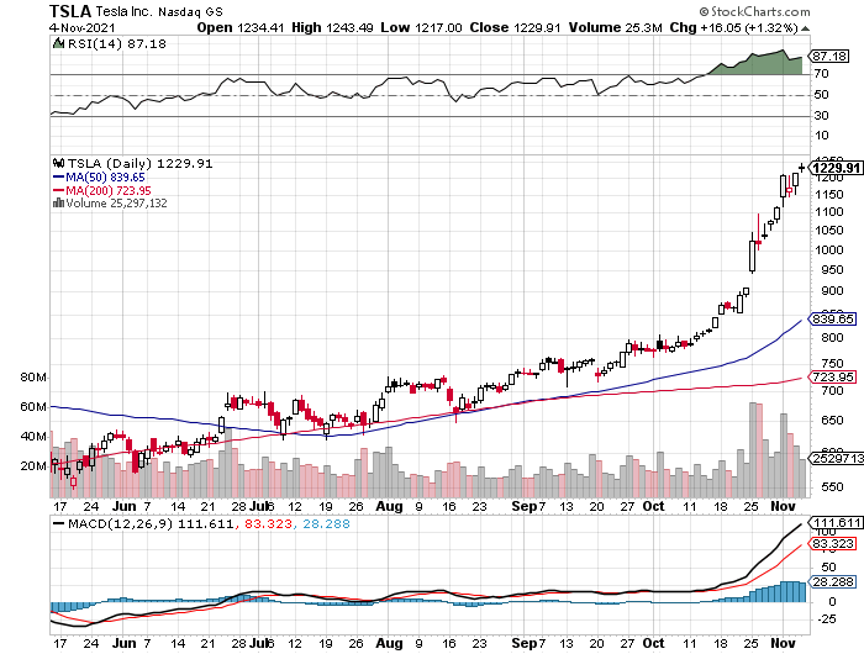
Q: Too late to buy Tesla (TSLA) calls?
A: Yes, it is. Tesla has a long history of 40% corrections; we had one that ended in May, and then it doubled (and then some). So yeah, too late to buy the calls here. Go back and read my research from May which said buy the stock and you get a car for free—and that worked again, except this time, you can get three free Tesla’s. A lot of subscribers have sent me pictures of their Teslas they got for free on my advice; I’m probably the largest salesman for Tesla for the last 10 years and all I got out of it was a free Powerwall (the red one)..
Q: How much higher do you think semiconductor companies will go?
A: Higher but it’s impossible to quantify. You’re getting very speculative short-term buying in there. So, I think it continues to the rest of the year, but with chips, you never know.
Q: Would you be buying Crispr Therapeutics (CRSP) at these levels?
A: Yes, but I would either just buy the stock and not be dependent on the calendar or buy a 2 ½ year LEAP and get an easy double on that.
Q: What about the currencies?
A: I don’t see much action in the currencies as long as the US is raising interest rates. I think the Euro (FXE), the Aussie (FXA), and the British pound (FXB) will be dead for the time being. Nobody wants to sell them but nobody wants to buy them either when you’re looking at a potential short term rise in the dollar from rising interest rates.
Q: What stable coins are the right answer for cryptocurrency?
A: The US dollar stable coin, but for price appreciation, you’re really looking at Bitcoin and Ethereum. Stable coins are stable, they don’t move; you want stuff that’s going to go up 5, 10, or 20 times over the next 10 years like Bitcoin (BITO) and Ethereum (ETHE). That is my crypto answer.
Q: What should I do about the iShares 20 Plus Year Treasury Bond ETF (TLT) $135-$140 put spread expiring in January?
A: If we get another run down to the $141 level that we saw last month, I would come out of all short treasury positions because you’re starting to run into time decay problems with the January expirations. And in case we remain in a range for some reason, I would be taking profits at the bottom end of the range. It was my mistake that I didn’t grab those profits when we hit $141 last time. So don’t let profits grow hair on them, they tend to disappear. We lost six months on this trade due to the delta virus and the mini-recession it brought us.
Q: Will there be accelerated tech selling in December because of the new tax rates?
A: What new tax rates? There has been no new tax bill passed and even if there were, I think people wouldn’t tax sell this year because the profits are enormous. They would rather do any selling in January at higher prices and then defer payment of those taxes by 18 months. I don’t think there will be any tax issues this year at all.
Q: What’s your return on solar power investments?
A: My break-even was four years because our local utility, PG&E, went bankrupt and the only way they're getting out of bankruptcy is raising electricity prices by 10% a year. It turns out that as a result of global warming, the panels have operated at a higher efficiency as well, so we’re getting a lot more power output than originally expected. Now I get free electricity for the remaining 20-year life of the panels which is great because with two Tesla’s and all-electric heating and air conditioning I use a lot of juice. My monthly bill is a sight to behold. I also power the 20 surrounding houses and for that PG&E pays me $1,800 a month.
Q: Do you see China (FXI) invading Taiwan as a potential threat to the market?
A: China will never invade Taiwan. They own many of the companies they're already in, they de facto control Taiwan government from a distance; they would not risk the international consequences of an actual invasion. And we have the US seventh fleet there to stop exactly that. So, they can make all the noise they want but nothing will come of it. I’ve been watching this for 50 years and nothing has ever happened.
Q: Would you buy ProShares Ultrashort 20+ Treasury ETF (TBT) here?
A: Absolutely, with both hands, all I can get.
Q: Can you recommend any water ETF opportunity?
A: Yes there is one I wrote a piece on last month. It’s the Claymore S&P Global Water Index ETF (CGW).
Q: How long can you hold the (TBT) before time decay hurts?
A: It doesn’t hurt, the cost of the TBT is two times the 10-year rate. So that would be 3%, plus 1% a year for management fees, and that’s your slippage on the TBT in a year right now—it’s 4%. Remember if you’re short the bond market, you have to pay the coupon when you’re short. Double the bond market and you have to pay double the coupon.
Q: Is the ProShares Bitcoin Strategy ETF (BITO) a good alternative to buying bitcoin?
A: I would say yes because I’ve been watching the tracking on that very carefully and it’s pretty damn close. Plus there’s a lot of liquidity there, so yeah, buy the (BITO) ETF on dips and dollar cost average.
To watch a replay of this webinar with all the charts, bells, whistles, and classic rock music, just log in to www.madhedgefundtrader.com, go to MY ACCOUNT, click on GLOBAL TRADING DISPATCH, then WEBINARS, and all the webinars from the last ten years are there in all their glory.
Good Luck and Stay Healthy.
John Thomas
CEO & Publisher
The Diary of a Mad Hedge Fund Trader
https://madhedgefundtrader.com/wp-content/uploads/2019/05/cropped-mad-hedge-logo-transparent-192x192_f9578834168ba24df3eb53916a12c882.png00Mad Hedge Fund Traderhttps://madhedgefundtrader.com/wp-content/uploads/2019/05/cropped-mad-hedge-logo-transparent-192x192_f9578834168ba24df3eb53916a12c882.pngMad Hedge Fund Trader2021-11-05 10:02:102021-11-05 11:24:20November 3 Biweekly Strategy Webinar Q&A
https://madhedgefundtrader.com/wp-content/uploads/2019/05/cropped-mad-hedge-logo-transparent-192x192_f9578834168ba24df3eb53916a12c882.png00Mad Hedge Fund Traderhttps://madhedgefundtrader.com/wp-content/uploads/2019/05/cropped-mad-hedge-logo-transparent-192x192_f9578834168ba24df3eb53916a12c882.pngMad Hedge Fund Trader2021-10-08 10:04:272021-10-08 12:25:21October 8, 2021
Legal Disclaimer
There is a very high degree of risk involved in trading. Past results are not indicative of future returns. MadHedgeFundTrader.com and all individuals affiliated with this site assume no responsibilities for your trading and investment results. The indicators, strategies, columns, articles and all other features are for educational purposes only and should not be construed as investment advice. Information for futures trading observations are obtained from sources believed to be reliable, but we do not warrant its completeness or accuracy, or warrant any results from the use of the information. Your use of the trading observations is entirely at your own risk and it is your sole responsibility to evaluate the accuracy, completeness and usefulness of the information. You must assess the risk of any trade with your broker and make your own independent decisions regarding any securities mentioned herein. Affiliates of MadHedgeFundTrader.com may have a position or effect transactions in the securities described herein (or options thereon) and/or otherwise employ trading strategies that may be consistent or inconsistent with the provided strategies.