Global Market Comments
August 25, 2025
Fiat Lux
Featured Trade:
(THE MARKET OUTLOOK FOR THE WEEK AHEAD, or LEADING INTO A PUNCH),
(UUP), (AAPL), (GM), (F), (RKT), (PLD) (AMT),
(PEP), (DUK), (ZION), (IJR), ($SPX), (QQQ), (MS)


Global Market Comments
August 25, 2025
Fiat Lux
Featured Trade:
(THE MARKET OUTLOOK FOR THE WEEK AHEAD, or LEADING INTO A PUNCH),
(UUP), (AAPL), (GM), (F), (RKT), (PLD) (AMT),
(PEP), (DUK), (ZION), (IJR), ($SPX), (QQQ), (MS)
Global Market Comments
April 1, 2025
Fiat Lux
Featured Trade:
(REVISITING THE FIRST SILVER BUBBLE),
(SLV), (SLW)
Global Market Comments
March 31, 2025
Fiat Lux
Featured Trade:
(MARKET OUTLOOK FOR THE WEEK AHEAD, or STAGFLATION IS ON!)
(COST), (BRK/B), (GS), (MS), (NVDA), (AMZN), (TLT), (GLD), (GM), (TSLA)

There is no doubt that the data released out on Friday were a complete disaster for stock investors. The Dow Average futures posted a 1,000-point swing, from up 200 in the overnight markets to down 800 intraday.
Specifically, the Consumer Price Index came in at a hot 0.4%, which is 4.8% annualized. Five-year Inflation Expectations, which the Fed follows most closely, rocketed to 6.0%. Worse yet, Consumer Confidence rose only 0.1% for the second month in a row, the worst performance in 12 years. Friday was the day that the hard data met the soft data and concluded that the recession was on.
That screeching noise you hear is the economy grinding to a halt.
Stock markets absolutely hate stagflation. The last time we had stagflation was during the Ford and Carter administrations during the 1970s, when it took eight years for the Dow to rise a measly 1,000 points. Back then, Wall Street shrank to a fraction of its former self.
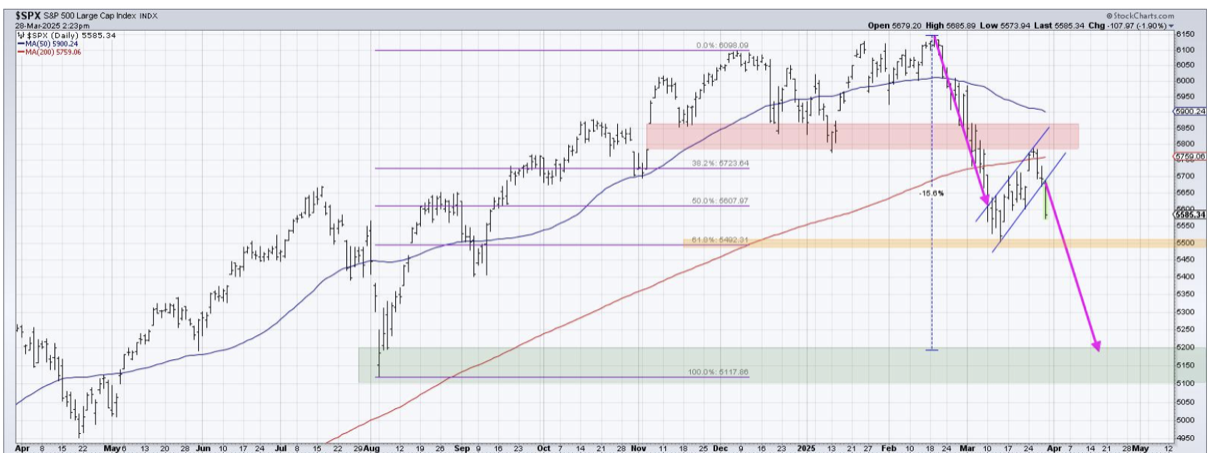
This all richly justifies my downside target of 5,000 for the S&P 500, off 20% from the February top, which is increasingly becoming a mainstream prediction. If I am wrong, it will plunge to 4,500, or down 30%.
We were promised animal spirits that would set markets on fire. Instead, the animals are sent back into hibernation and the markets are being snuffed out. I watch every single data release that comes out on a daily basis, and it is amazing how fast they are almost all rolling over at once.
The combination of rising inflation and a weakening economy is described by one infamous word: Stagflation. What’s worse, we are only one month into a stagflationary trend that could run for many months or years.
As a result, we have seen the worst start to a year since Q1 2020, the last time Trump was president. March was the worst month in 3 ½ years. It seems the stock market heartily agrees with my view.
It gets worse.
All earnings estimates for this year are based on record corporate profit margins. If those margins fail to hold when earnings are announced in the coming weeks, it may trigger the second 10% leg down in the major averages. More concerning is the forward guidance companies may provide.
It turns out that companies watch the daily data releases too. Companies sitting on their hands, not investing or hiring, can itself alone cause recessions. Right now, nobody knows what the heck to do.
The final shoe to fall will be a sharp spike up in the headline Unemployment Rate. We get the next read on this on Friday, April 4. It’s just a question of how soon this shows up in the data. Right now, hundreds of thousands of workers have been fired but are still receiving paychecks while their status is being challenged in the courts. So they aren’t being counted as unemployed….yet.
Some 42% of all the hiring in the US over the past three years has been in just two sectors, healthcare and education. That is where the biggest cuts are being made now. It’s all about getting ahead of the curve.
Let me tell you how bad things can get.
On Wednesday, the president announced 25% import duties for completed cars. General Motors (GM) makes about 30% of its cars in Mexico and Canada. As a result, (GM) may have to raise some car prices by 10%-25%. But the president has ordered (GM) not to raise prices at all.
It costs $20 billion and takes four years to build a new car factory in the US from scratch. This all turns (GM) into the perfect money-destruction machine. (GM) may not survive. And you wonder why I have been short (GM) stock two months in a row. Trump must really hate Detroit.
Believe it or not, there is a silver lining to all this.
If you missed the great bull market of the last five years, when the major indexes more than doubled, you are eventually going to get a second bite at the apple. Share prices are dropping so fast that we may get to a final capitulation selloff rather quickly. Then we will be spoiled for choice with stocks that have easy doubles and triples in them.
Let me tell you a trader’s trick.
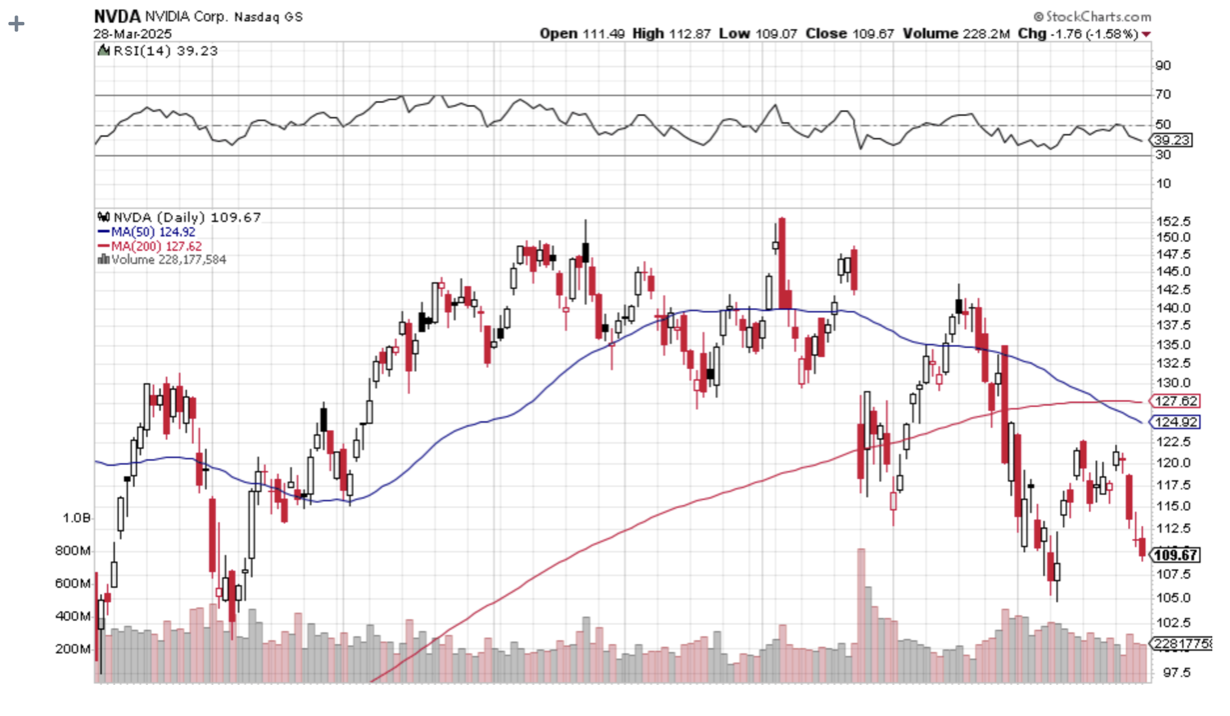
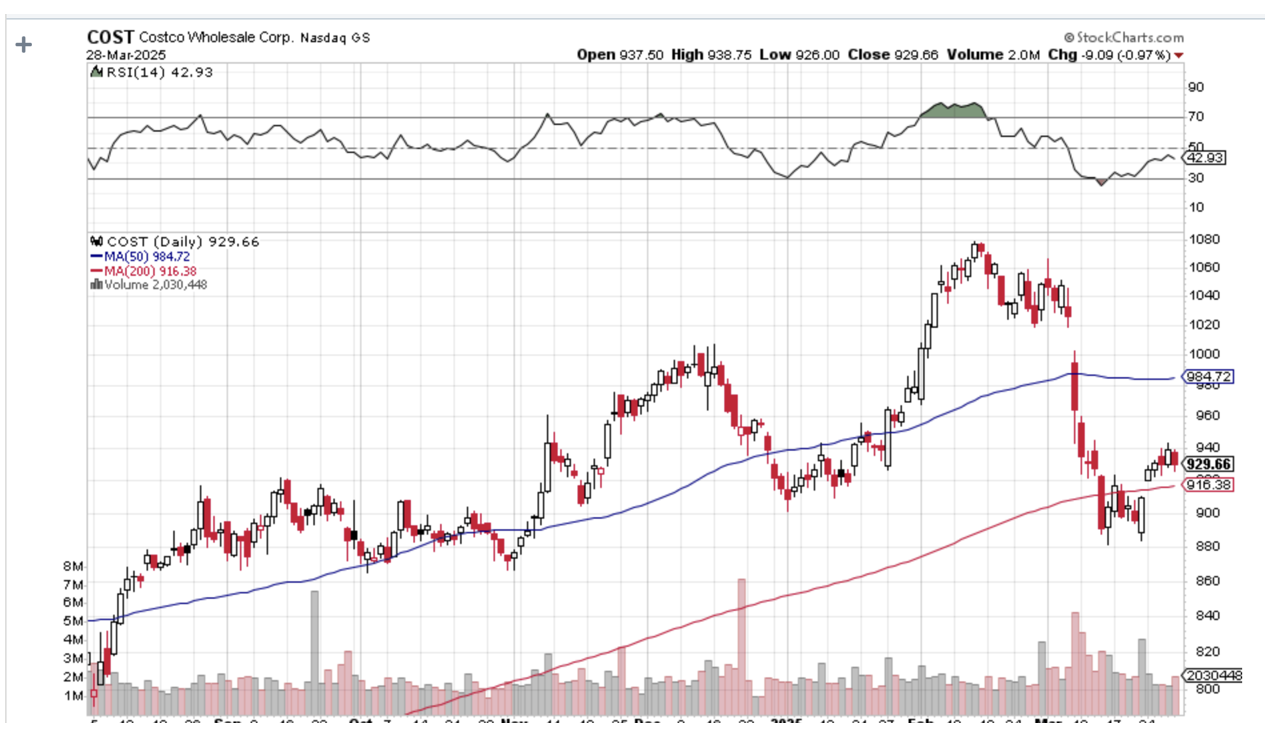
Watch the shares of companies that have the sharpest rises on the rare up days. These are the ones that institutions are willing to jump into and hold on to forever, the permanent earnings compounders. If you take a look at the longs in the Mad Hedge Model Trading Portfolio, they all meet these criteria. They include (COST), (BRK/B), (GS), (MS), (NVDA), and (AMZN).
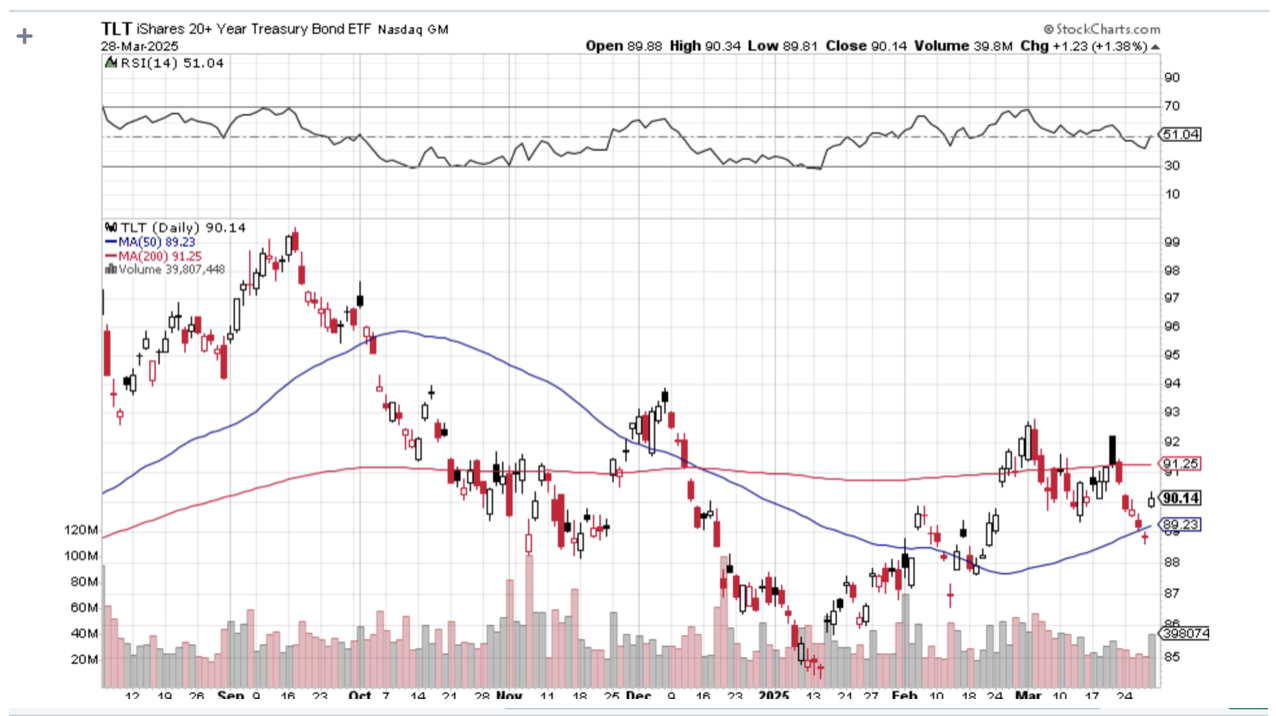
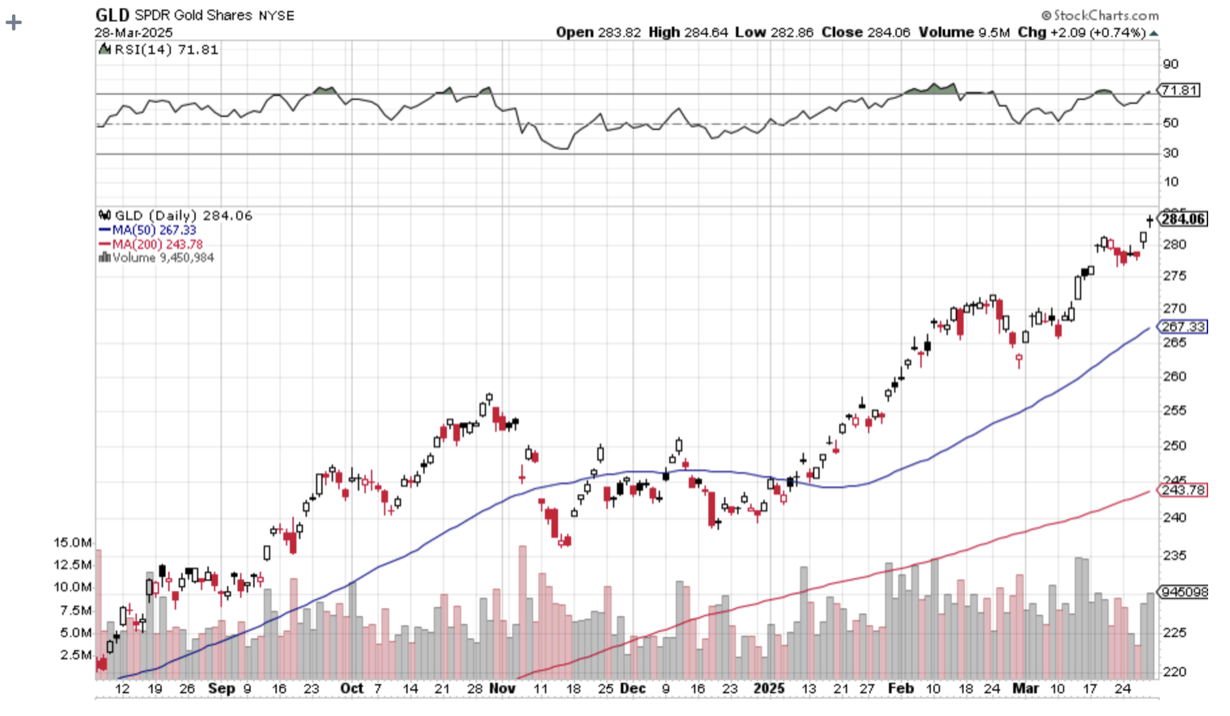
Buying bonds (TLT) and gold (GLD) going into a recession may not be a bad idea either. And for those who don’t want to play when the going gets rough, there are always 90-day US Treasury bills yielding 4.20%. They are government-guaranteed.
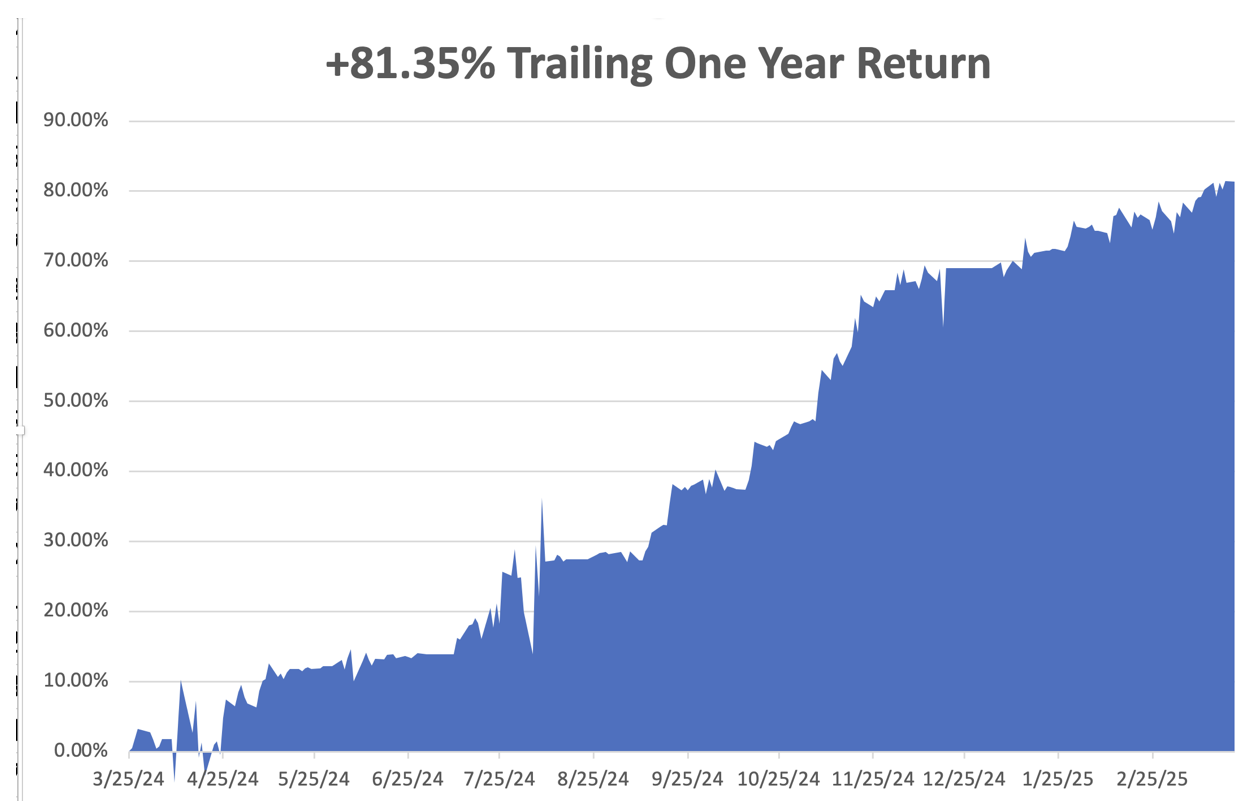
March is now up +3.17% so far. That takes us to a year-to-date profit of +12.64% so far in 2025. That means Mad Hedge has been operating as a perfect -1X short S&P 500 ETF since the February top. My trailing one-year return stands at a spectacular +81.35%. That takes my average annualized return to +49.82% and my performance since inception to +764.63%.
It has been another busy week for trading. I took profits on the short in (NVDA), which collapsed in the latest tech-driven leg down. I added a new long in (COST), a position I have been trying to get into for years, and it immediately started to make money.
I also stopped out of my two auto shorts in (GM) and (TSLA) at cost. Then Trump moved up his auto tariff announcements by a week, and both positions shot up to max profits. Welcome to trading in the Trump administration. In this period of extreme uncertainty, I have tightened up my stop-loss strategy to avoid big losses.
Some 63 of my 70 round trips, or 90%, were profitable in 2023. Some 74 of 94 trades have been profitable in 2024, and several of those losses were really break-even. That is a success rate of +78.72%.
Try beating that anywhere.
Stagflation Accelerates, with a hot 0.4% increase in the Consumer Price Index and a tepid 0.1% increase in Consumer Spending, the worst since the Pandemic. One-year inflation expectations have shot up to 5.0%. Today is the day the hard data met the soft data and jointly agreed that we are in a recession. S&P 500 5,000 here we come!
25% Auto Import Tariffs Become Official on April 2. The auto industry, once the largest in the US, says it will trigger a recession. Car prices will rise an average of $5,000 per vehicle. Expect the economies of Michigan, Indiana, Wisconsin, and Illinois to get demolished as they feed a lot of the parts into Detroit. Steel will also be affected. Some 30% of autos made by US companies are assembled in Canada and Mexico. Which US car makers have the highest share of American content? Tesla.
US GDP Grows 2.4%, during the October-December quarter. These may be the last positive numbers we see for a while as the country heads into recession.
Bonds Rocket, with inflation now running at a 5% annual rate, and the tariffs should add another 1%. That means the next Fed move is likely to be an interest rate RISE, while the unemployment rate is rising. That’s a worst-case scenario for the economy and the stock market.
Moody’s Warns of a Downgrade of the United States, saying Trump’s trade tariffs could hamper the country’s ability to cope with a growing debt pile and higher interest rates. Recession risks are rising.
Canada Freezes Rebates for Tesla Purchasers. Canada has frozen C$43 million ($30.11 million) of rebate payments for Tesla. Buyers had been eligible for a $5,000 rebate on vehicles costing less than $65,000. Tesla’s Q1 sales out next week is expected to be terrible. Avoid (TSLA).
S&P Case Shiller National Home Price Index Rises 4.7% YOY. Home price growth held steady at 0.5% M/M, on a seasonally adjusted basis, in January, according to the S&P CoreLogic Case-Shiller Home Price Index composite for 20 cities. On an unadjusted basis, the Case-Shiller HPI for 20 cities inched up 0.1% from a month earlier, decelerating from the +0.2% consensus and accelerating from the previous month's -0.1%. On a Y/Y basis, the gauge climbed 4.7%, vs. +4.6% expected and +4.5% prior.
Consumer Confidence Plunges, by the most in five years, according to the conference. The Conference Board’s gauge of confidence decreased 7.2 points to 92.9, data released Tuesday showed. The median estimate in a Bloomberg survey of economists called for a reading of 94. The soft data for the economy continues to look horrific.
FedEx Gets Crushed, another early recession indicator. Fewer things are shipped in shrinking economies. Fears about a U.S. recession and President Donald Trump’s new reciprocal tariff rates starting April 2 could threaten FedEx’s earnings, Paterson said in a Friday note to clients. Memphis-based FedEx is generally regarded as a barometer of the global economy, as its business touches a wide variety of global industries.
Next-Gen Chips are Power Hogs. Big tech companies, which are all betting heavily on AI, will undoubtedly buy those chips, even if the price skyrockets. But there’s growing evidence that there won’t be enough electricity to power all of their AI dreams. Some new AI apps use 150 times more power than the old ones.
My Ten-Year View – A Reassessment
We have to substantially downsize our expectations of equity returns in view of the election outcome. My new American Golden Age, or the next Roaring Twenties is now looking at multiple gale-force headwinds. The economy will completely stop decarbonizing. Technology innovation will slow. Trade wars will exact a high price. Inflation will return. The Dow Average will rise by 600% to 240,000 or more in the coming decade. The new America will be far more efficient and profitable than the old. My Dow 240,000 target has been pushed back to 2035.
On Monday, March 31, at 8:30 AM EST, the Chicago PMI is announced.
On Tuesday, April 1, at 8:30 AM, the JOLTS Job Openings Report is released.
On Wednesday, April 2, at 1:00 PM, the ADP Employment Change is published.
On Thursday, April 3, at 8:30 AM, the Weekly Jobless Claims are disclosed. We also get the final report for Q1 GDP.
On Friday, April 4, at 8:30 AM, the Nonfarm Payroll Report for March is printed. At 2:00 PM, the Baker Hughes Rig Count is printed.
As for me, back in 2002, I flew to Iceland to do some research on the country’s national DNA sequencing program called Decode, which analyzed the genetic material of everyone in that tiny nation of 250,000. It was the boldest project yet in the field and had already led to several breakthrough discoveries.
Let me start by telling you the downside of visiting Iceland. In the country that has produced three Miss Universes over the last 50 years, suddenly you are the ugliest guy in the country. Because guess what? The men are beautiful as well, the descendants of Vikings who became stranded there after they cut down all the forests on the island for firewood, leaving nothing with which to build long boats.
I said they were beautiful, not smart.
Still, just looking is free and highly rewarding.
While I was there, I thought it would be fun to trek across Iceland from North to South in the spirit of Shackleton, Scott, and Amundsen. I went alone because, after all, how many people do you know who want to trek across Iceland? Besides, it was only 150 miles, or ten days to cross. A piece of cake really.
Near the trailhead, the scenery could have been a scene from Lord of the Rings, with undulating green hills, craggy rock formations, and miniature Icelandic ponies galloping in herds. It was nature in its most raw and pristine form. It was all breathtaking.
Most of the central part of Iceland is covered by a gigantic glacier over which a rough trail is marked by stakes planted in the snow every hundred meters. The problem arises when fog or blizzards set in, obscuring the next stake and making it too easy to get lost. Then you risk walking into a fumarole, a vent from the volcano under the ice, always covered by boiling water. About ten people a year die this way.
My strategy for avoiding this cruel fate was very simple. Walk 50 meters. If I could see the next stake, I would proceed. If I couldn’t, I pitched my tent and waited until the storm passed.
It worked.
Every 10 kilometers stood a stone rescue hut with a propane stove for adventurers caught out in storms. I thought they were for wimps but always camped nearby for the company.
One of the challenges in trekking near the North Pole is getting to sleep. That’s because the sun never sets and it's daylight all night long. The problem was easily solved with the blindfold that came with my Icelandic Air first-class seat.
I was 100 miles into my trek, approached my hut for the night, and opened the door to say hello to my new friends.
What I saw horrified me.
Inside was an entire German Girl Scout Troop spread out in their sleeping bags all with a particularly virulent case of the flu. In the middle was a girl lying on the floor, soaking wet and shivering, who had fallen into a glacier-fed river. She was clearly dying of hypothermia.
I was pissed and instantly went into Marine Corps Captain mode, barking out orders left and right. Fortunately, my German was still pretty good then, so I instructed every girl to get out of their sleeping bags and pile them on top of the freezing scout. I then told them to strip the girl of her wet clothes and reclothe her with dry replacements. They could have their bags back when she got warm. The great thing about Germans is that they are really good at following orders.
Next, I turned the stove burners up high to generate some heat. Then I rifled through backpacks and cooked up what food I could find, force-fed it into the scouts, and emptied my bottle of aspirin. For the adult leader, a woman in her thirties who was practically unconscious, I parted with my emergency supply of Jack Daniels.
By the next morning, the frozen girl was warm, the rest were recovering, and the leader was conscious. They thanked me profusely. I told them I was an American “Adler Scout” (Eagle Scout) and was just doing my job.
One of the girls cautiously moved forward and presented me with a small doll dressed in a traditional German Dirndl, which she said was her good luck charm. Since I was her good luck, I should have it. It was the girl who was freezing to death the day before.
Some 20 years later, I look back fondly on that trip and would love to do it again.
Anyone want to go to Iceland?

Iceland 2002

Good Luck and Good Trading,
John Thomas
CEO & Publisher
The Diary of a Mad Hedge Fund Trader
Global Market Comments
March 14, 2025
Fiat Lux
Featured Trade:
(REMEMBERING THE OLD DAYS AT MORGAN STANLEY),
(MS), (GS), (GLD)
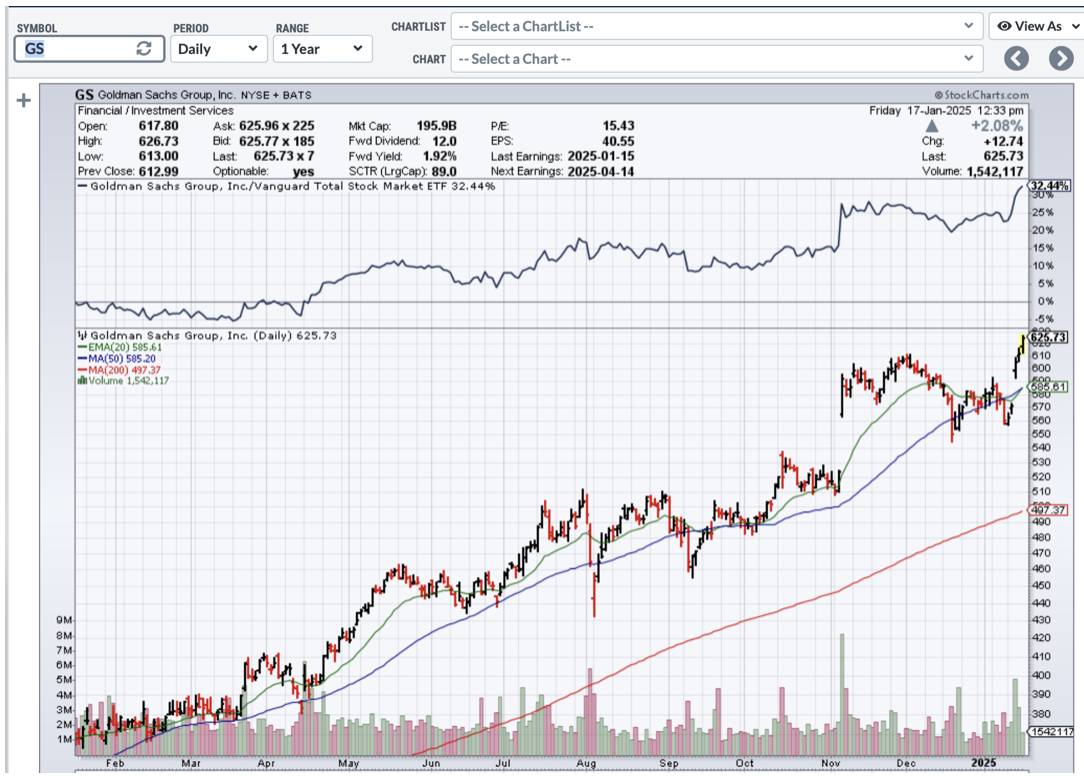
It’s a good thing that the #MeToo movement wasn’t around 40 years ago. For if it was, Morgan Stanley would have been publicly humiliated in the press daily.
The firm was an “old boy” network on steroids. Employees with skirts definitely worked overtime in those prehistoric days.
However, firms evolve over the vast expanse of time. Back then, Morgan Stanley was a 1,000-man private partnership hidden away in the old General Motors building on Avenue of the Americas. Today, it is a 50,000-member global behemoth in your face on Times Square.
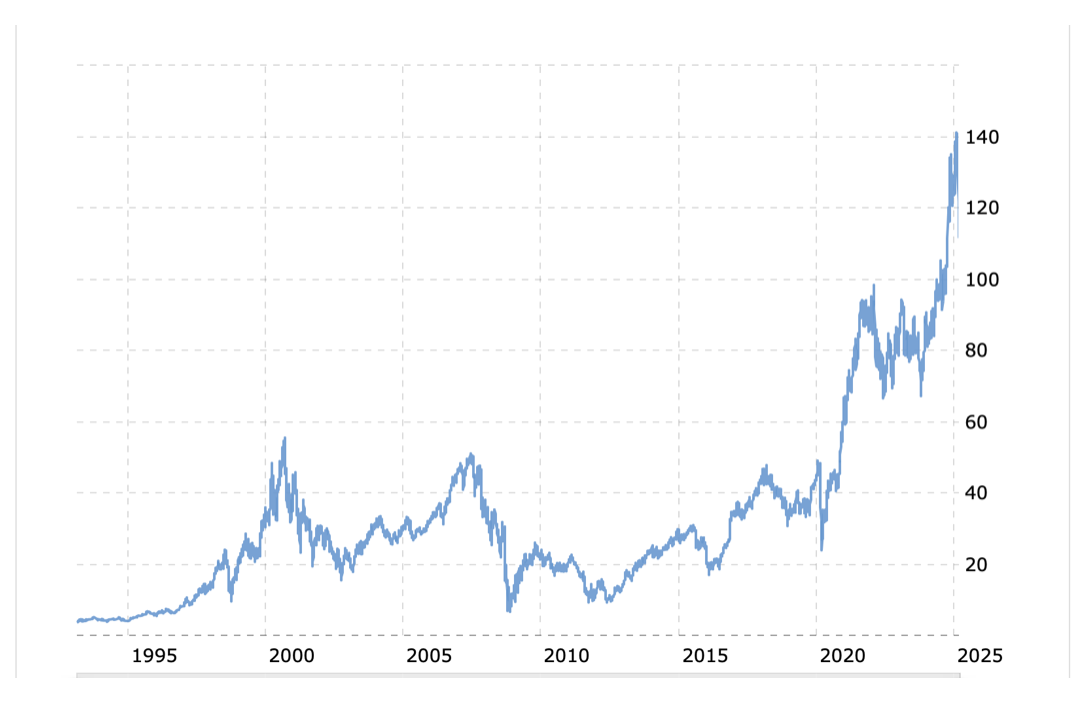
The share price has changed a bit, too. The average cost of my original partnership shares is 25 cents. They traded at a split-adjusted $1,000 a share today. My own share has risen 4,000 times from my original cost. And you wonder why brokers are so rich. It’s 100% capital gain now.
And like Warren Buffet, I never sold my shares so I wouldn’t have to pay the capital gains taxes. In fact, my shares cost far less than the company’s 85-cent quarterly dividend today.
It wasn’t always like this. Morgan drank the Kool-Aid big time during the 2000’s real estate bubble. When the bill came due, the firm almost went under, with the stock trading down to $5 (which was still 20 times more than my cost). Only a government bailout in the form of the TARP kept my former partners from losing everything.
The Morgan Stanley of today is a shadow of its former self in other ways. There are no more wild practical jokes, BSD’s, Masters of the Universe, or Liar’s Poker.
I can’t imagine the heads of the various equity trading desks meeting at my Manhattan Sutton Place coop to play high/low poker every Friday night, as they did for years. Carl Icahn lived a couple of floors down.
No one bets the ranch anymore. Morgan Stanley has become boring. However, boredom has a silver lining as it also brings stability, and stock investors absolutely love stability, as we are finding out now. As incredible as it may sound, Morgan Stanley has become the safe play on Wall Street.
While investors considered the immense trading profits the firm once made as coming out of a black box, fee-based earnings are predictable and reliable as a coupon stream.
You can see this newfound boredom in the firm’s employee compensation. A decade ago, it was 78% of investment banking revenue, compared to only 18% now. In my day, the janitor wouldn’t work for that.
You can thank my late mentor, Barton Biggs, for planting the seeds of the modern firm in the early 1980’s. For it was he who founded the firm’s fee-based asset management division, which is the great wellspring of profits today. Since 2005, Wealth Management’s share of profits has leaped from almost nothing during my tenure to 25% to 45% now. Today, Morgan Stanley manages an incredible $6.6 trillion, and 15% more two months ago.
Mortgage loans to customers collateralized by their shareholdings is currently the second largest source of profits. These didn’t even exist in my day (Lou Ranieri at Salomon Brothers had the lock on this business back then).
Morgan Stanley has learned some hard lessons along the way. It was forced by the Dodd-Frank financial regulation act to massively recapitalize. No more 40:1 leverage. 10:1 is much safer.
As a result, its capital position has more than doubled from $35 billion during the dark days of the 2008 crash to an astonishing $180 billion today. Profit margins are the highest since the Dotcom Bubble top in 1999. The firm is even now crafting products and services aimed at the growing band of wealthy Millennials.
Sobriety is in.
Goldman Sachs, on the other hand, has stuck to the old Wild West ways. Its earnings remain volatile, as several recent disappointing quarters of bond trading losses have attested to. The firm is now significantly smaller than Morgan, and its share price has been punished accordingly, lagging the heady appreciation of Morgan shares.
Here’s the main reason I love my old firm. It is in the catbird seat for what I call the “Exploding Deficit” trade, whereby all future investment is driven by the prospect of rising inflation.
Banks are absolutely in the sweet spot for this strategy, as is gold (GLD).
Add all this up and you have my explanation for sending out my past Trade Alerts for a long position in Morgan Stanley. They won’t be the last ones.
As for those poker nights, I think some of you guys out there still owe me a couple of grand.
Not a Bad Play

Global Market Comments
January 21, 2025
Fiat Lux
Featured Trades:
(MARKET OUTLOOK FOR THE WEEK AHEAD or NOW WE ENTER THE GREAT UNKNOWN),
(GS), (MS), (JPM), (C), (BAC) (TLT), (TSLA)

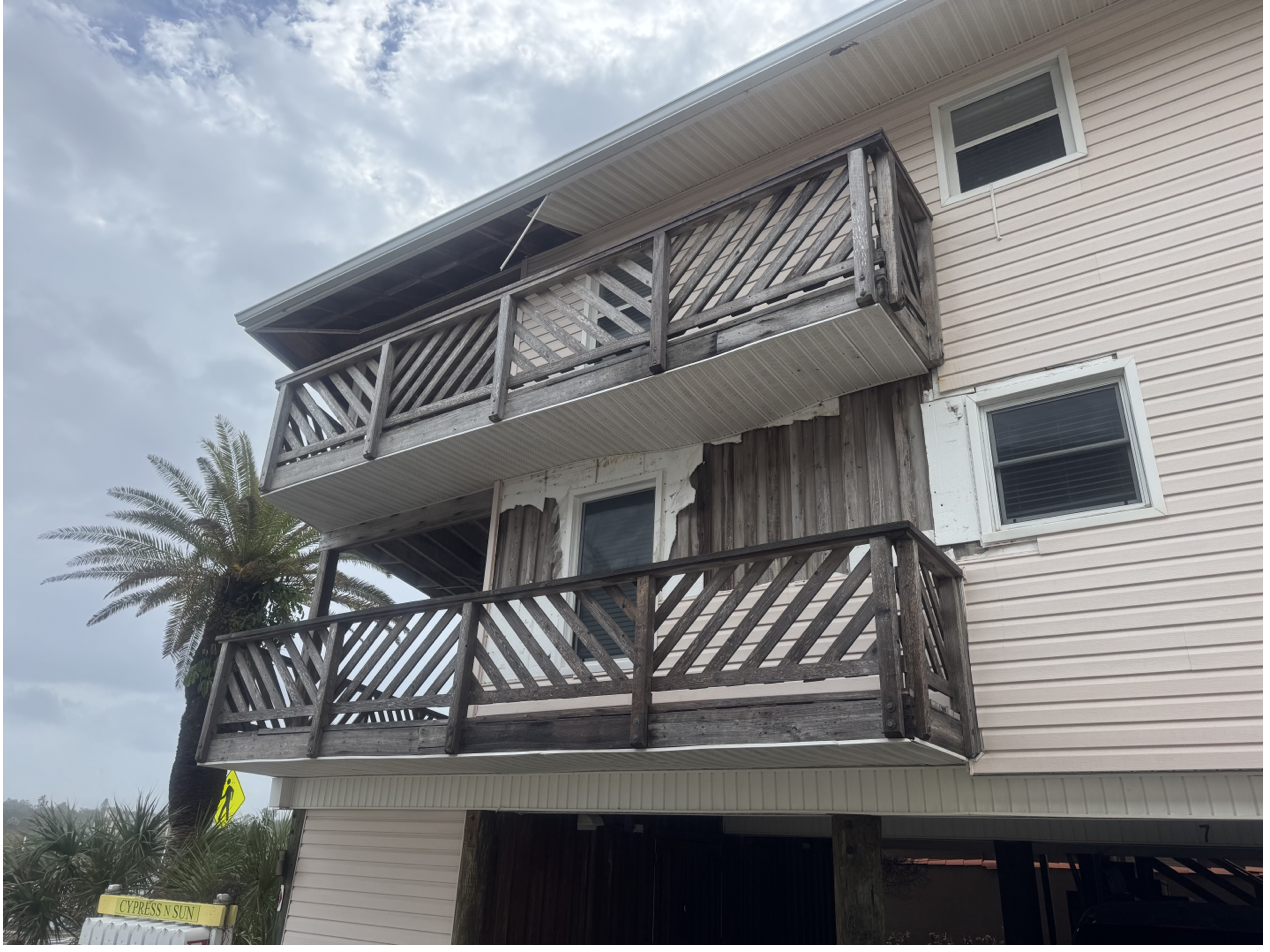
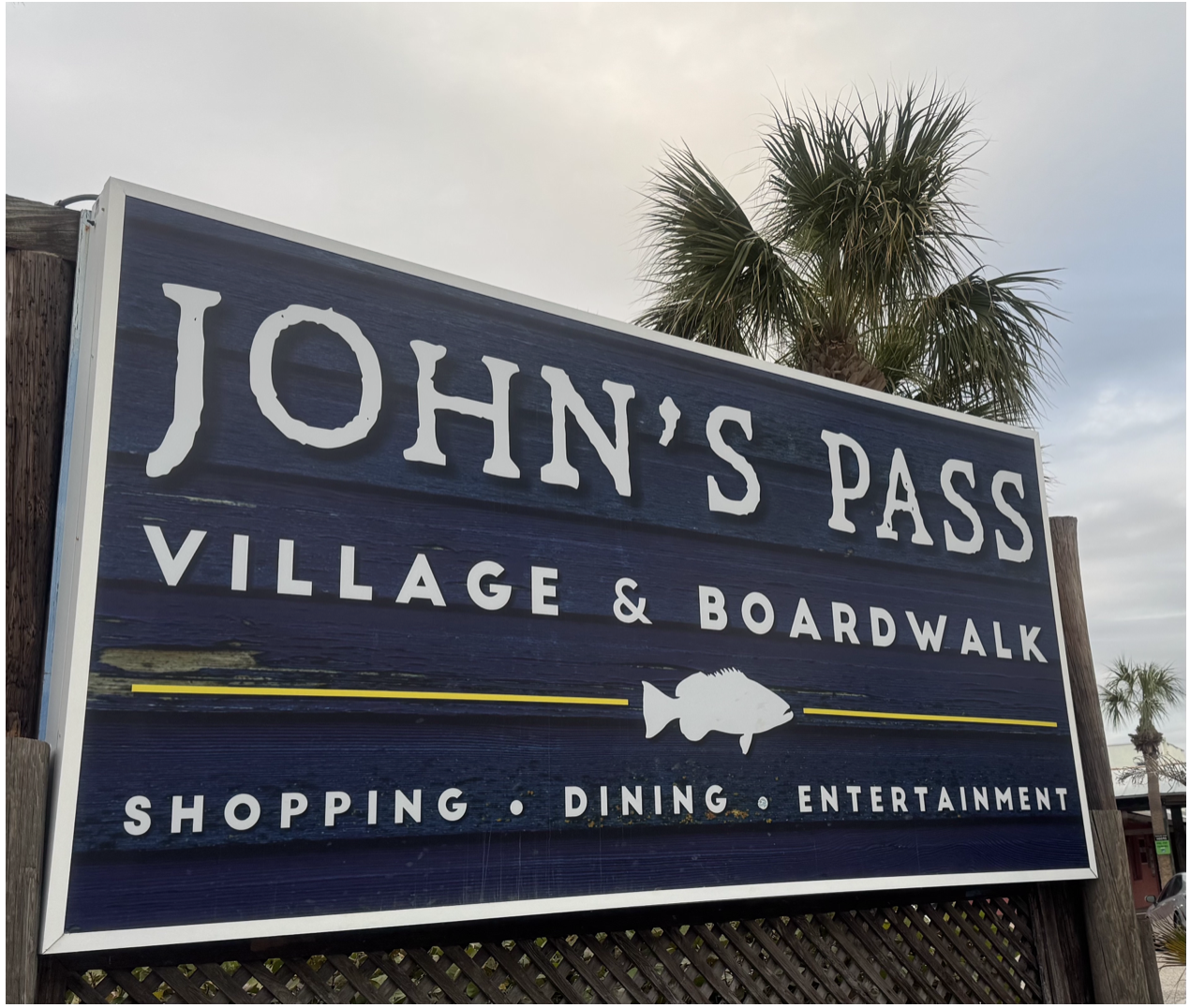
I am writing this to you from Indian Rock Beach, Florida, an extended sand bar outside of Tampa on the west coast. Cabin cruisers pass by every five minutes. There is not much fishing though with rain and temperatures in the low 40s, the coldest of the year. leaving a lot of free time for indoor work. Every building is missing a chunk of wall or roof if not totally destroyed from the October hurricane Helena, including my own Airbnb. The last hurricane here took place in 1921.
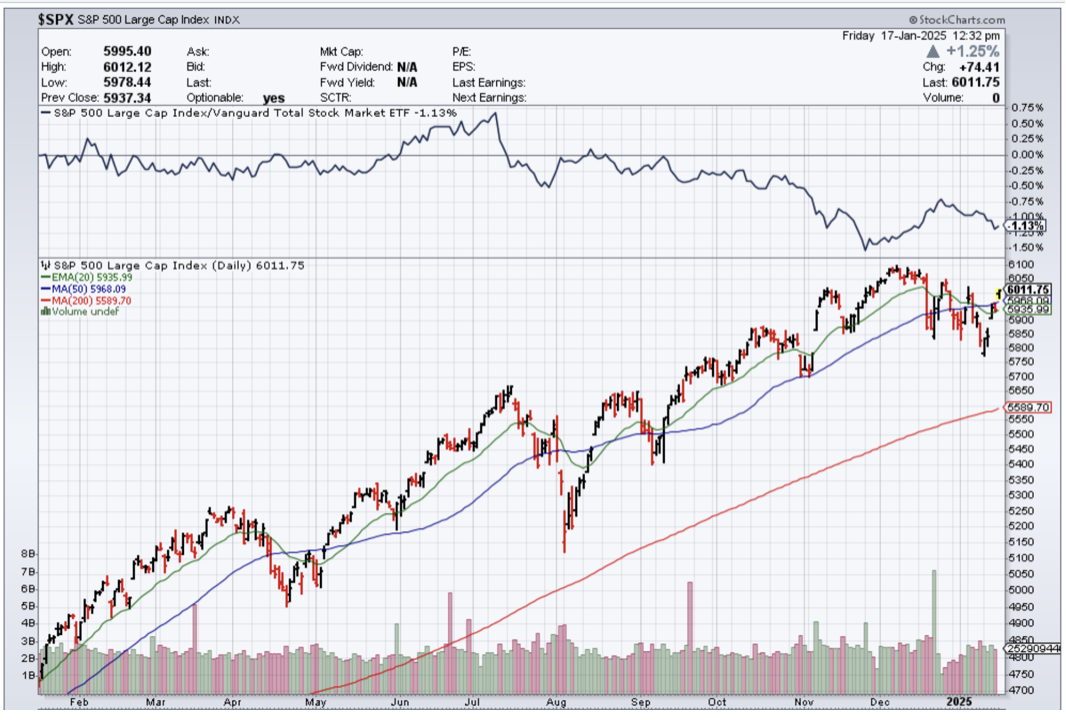
Everywhere I look, hedge fund managers are derisking, cutting exposure, and laying on hedges. The reason is that no one has a handle on what is going to happen in financial markets in the short term. Do we go up, down, or nowhere? The rapid unwind of the post-election rally has put the fear of markets back in them once again.
There is also a rare shortage of news in the financial media. It’s as if someone is sucking all the oxygen out of the room.
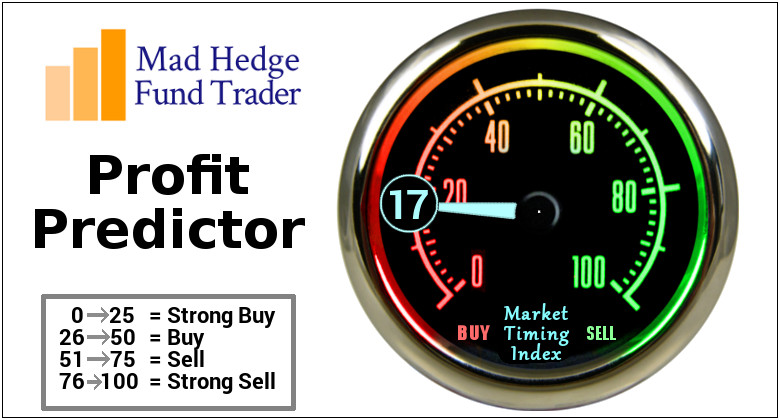
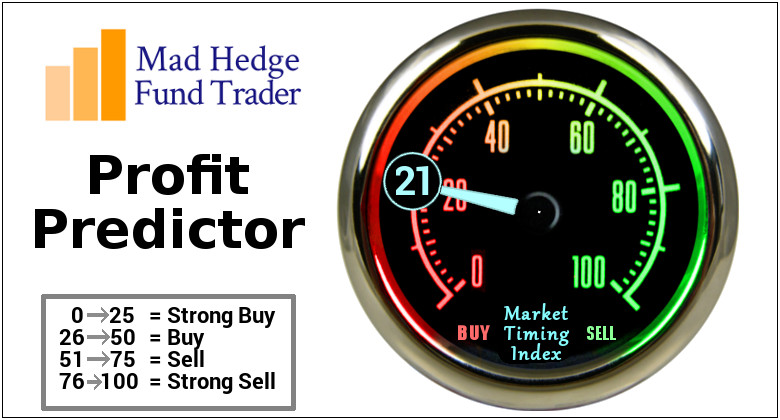
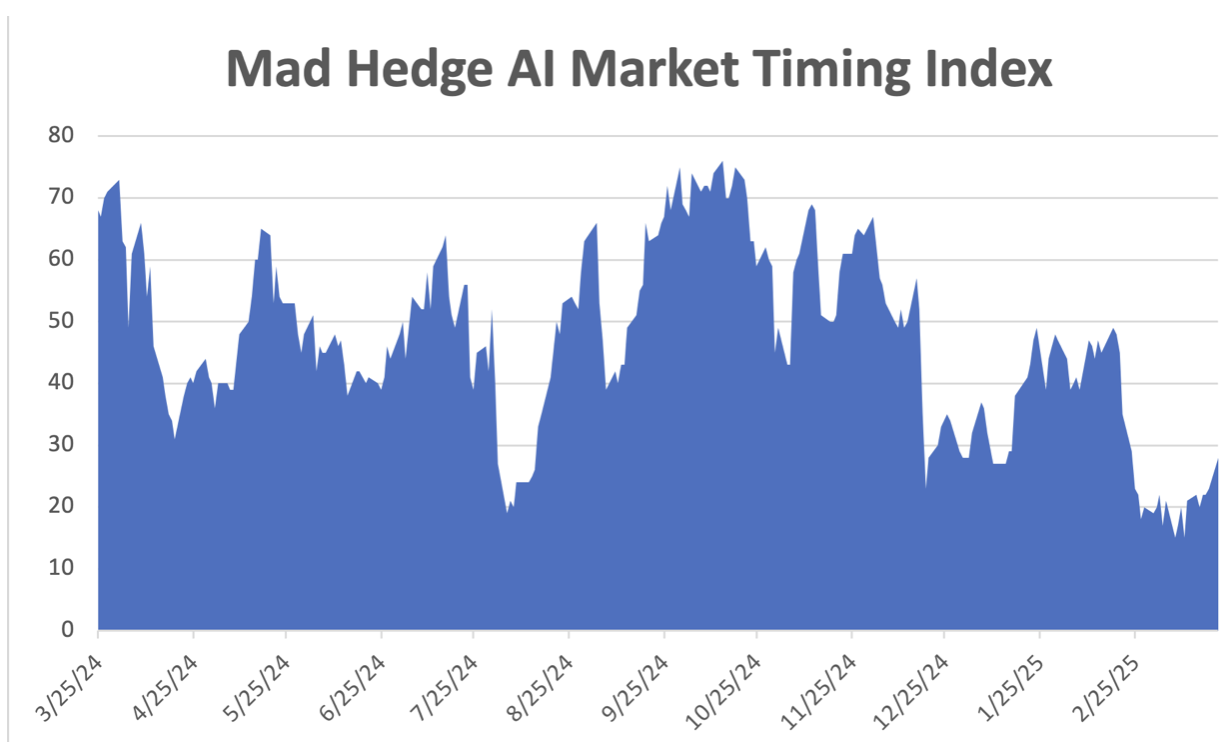
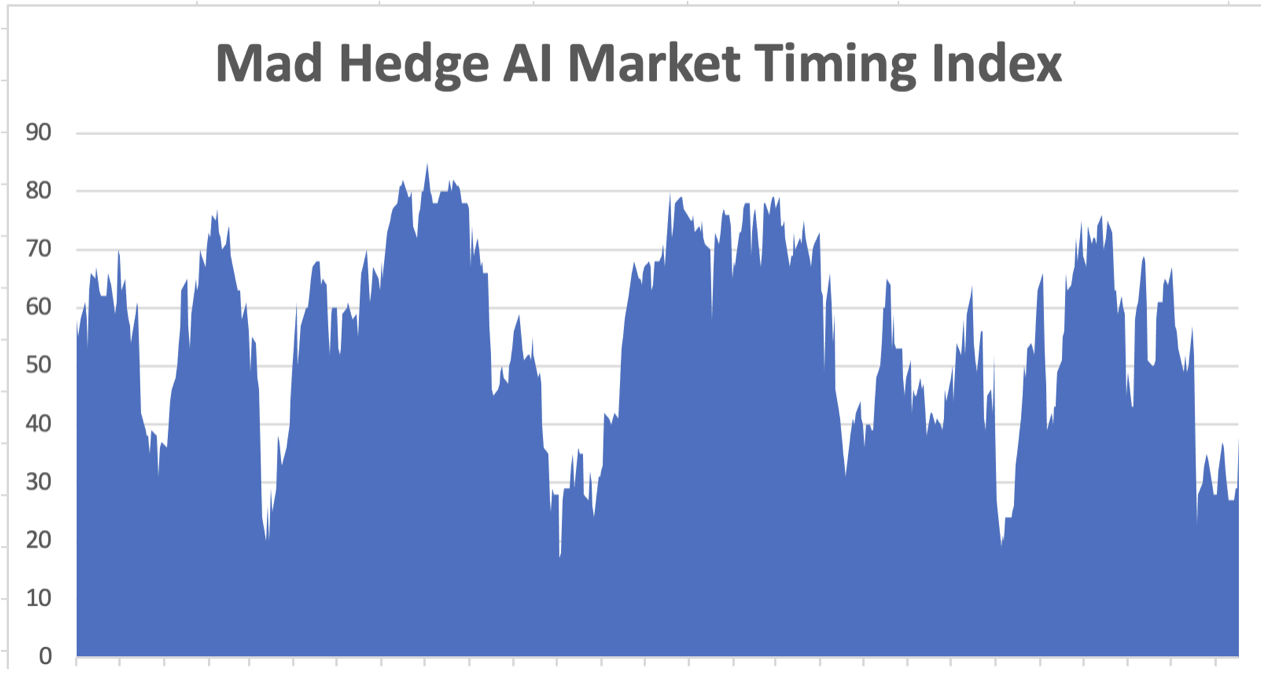
We had about a week where the Mad Hedge Market Timing Index in the mid-twenties was enticing us back into the market. I was expecting a hot December Consumer Price Index to give us a nice selloff and the perfect entry point I had been waiting a month for, in line with all the economic warm data of the last three months.
But it was not to be. The CPI printed at a cool 2.9% YOY and the Dow Average opened up 700 points the next morning, the first step in a 1,700-point three-day rally. Half the December losses came back in a heartbeat.
So much for the great entry point.
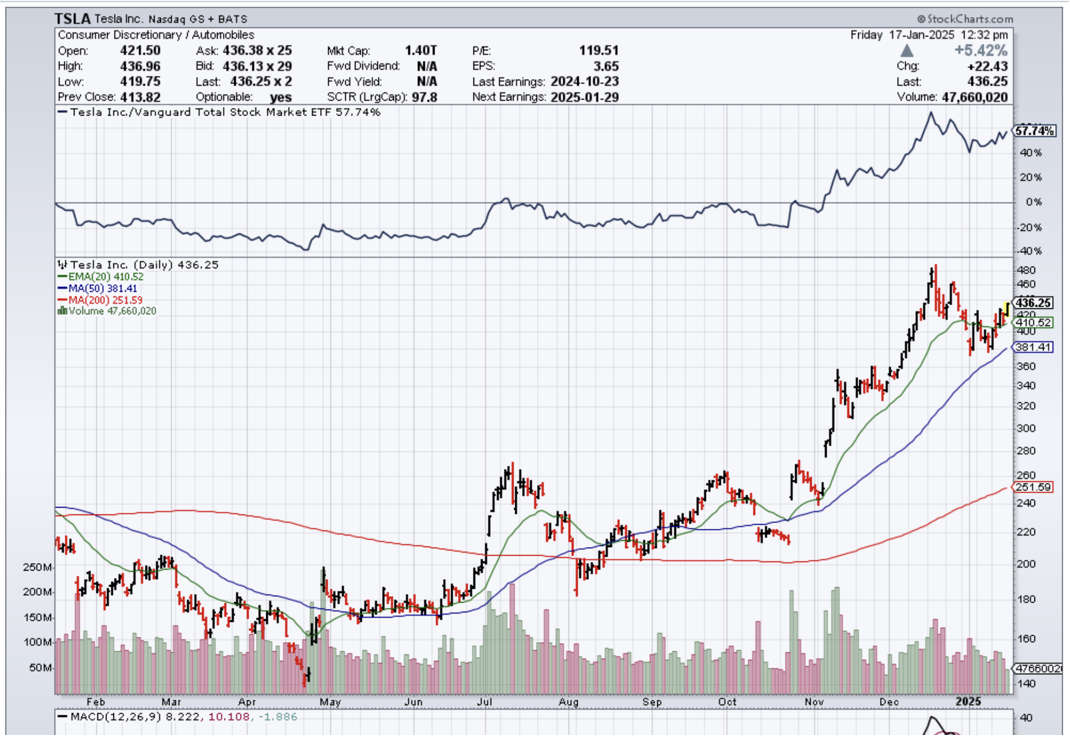
All of my target stocks like (GS), (MS), (JPM), (C), and (BAC) went ballistic. I only managed to get into a long in Tesla (TSLA) because the implied volatility was a sky-high 70%. That way, the stock could take a surprise hit and I still would have a safety cushion large enough to eke out the maximum profit by the February 20 option expiration. What’s next? How about a $100 in-the-money bearish Tesla put spread, once the rally burns out?
I can’t remember a time when there was such a narrow field of attractive trading targets. Rising interest rates have killed off bonds, foreign currencies, precious metals, and real estate. A weak China has destroyed commodities and energy, with US overproduction contributing to the latter. Only financials look interesting for the short term and big tech for the long term.
At that point, financials are not exactly undiscovered investments, but they should have another three months of life in them. That’s when big tech should reclaim the leadership, when we get another surprise AI-driven earnings burst.
What does this get us in the major indexes? With so much of the stock market on life support, not much, maybe 10% at best. After that, who knows?
There is no point in looking for any more financial news today (Sunday), as there isn’t any with a holiday tomorrow. So I am headed out for a one-hour walk of the beach.
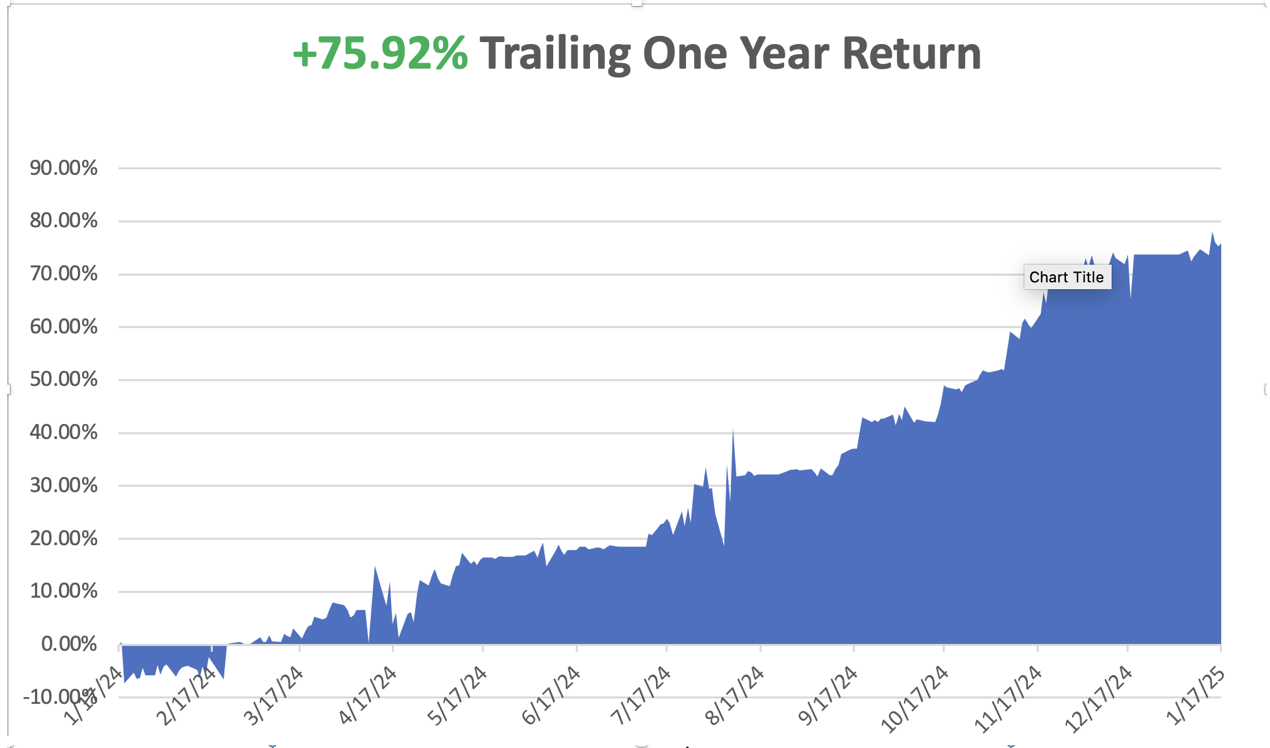
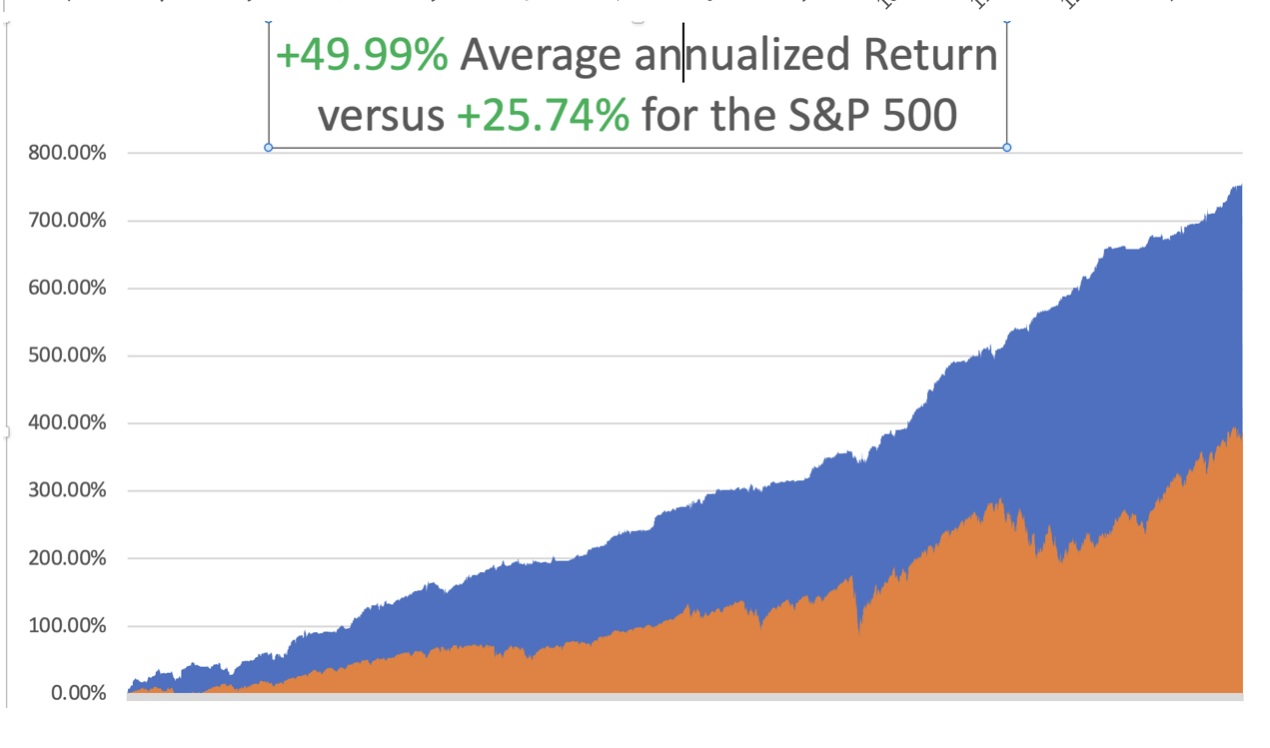
We managed to grind out a +2.07% return so far in January. That takes us to a year-to-date profit of +2.07% so far in 2025. My trailing one-year return stands at +75.92%. That takes my average annualized return to +49.99% and my performance since inception to +753.93%.
I stopped out of my long position in (TLT) near cost. My January 2025 (TSLA) expired on Friday at its maximum profit point, soaring a torrid $50 in the two days going into expiration.
Some 63 of my 70 round trips, or 90%, were profitable in 2023. Some 74 of 94 trades were profitable in 2024, and several of those losses were really break-evens. That is a success rate of +78.72%.
Try beating that anywhere.
My Ten-Year View – A Reassessment
When have to substantially downsize our expectations of equity returns in view of the election outcome. My new American Golden Age, or the next Roaring Twenties is now looking at a headwind. The economy will completely stop decarbonizing. Technology innovation will slow. Trade wars will exact a high price. Inflation will return. The Dow Average will rise by 600% to 240,000 or more in the coming decade. The new America will be far more efficient and profitable than the old.
My Dow 240,000 target has been pushed back to 2035.
Consumer Price Index Cools at 0.2%, or 3.2% YOY, the first drop in six months. Economists see the core gauge as a better indicator of the underlying inflation trend than the overall CPI which includes often-volatile food and energy costs. The headline measure rose 0.4% from the prior month, with over 40% of the advance due to energy.
Los Angeles Fires to Cost $270 Billion, with only $30 billion covered by insurance. Inflation will rise as the cost of construction labor and materials soar. Tradesmen around the country are packing their trucks and heading west to snare work at double the normal rate. There is no trade here as the new home builders are not involved, who are set up to only build mass-produced tract homes. Yet another black swan for 2025.
$4 Trillion in Asset Management Disrupted by the Los Angeles Fires, with some relocating office space and supporting staff members who have lost their homes. The LA area is home to large industry players like Capital Group, TCW Group, hedge funds Oaktree Capital and Ares Management.
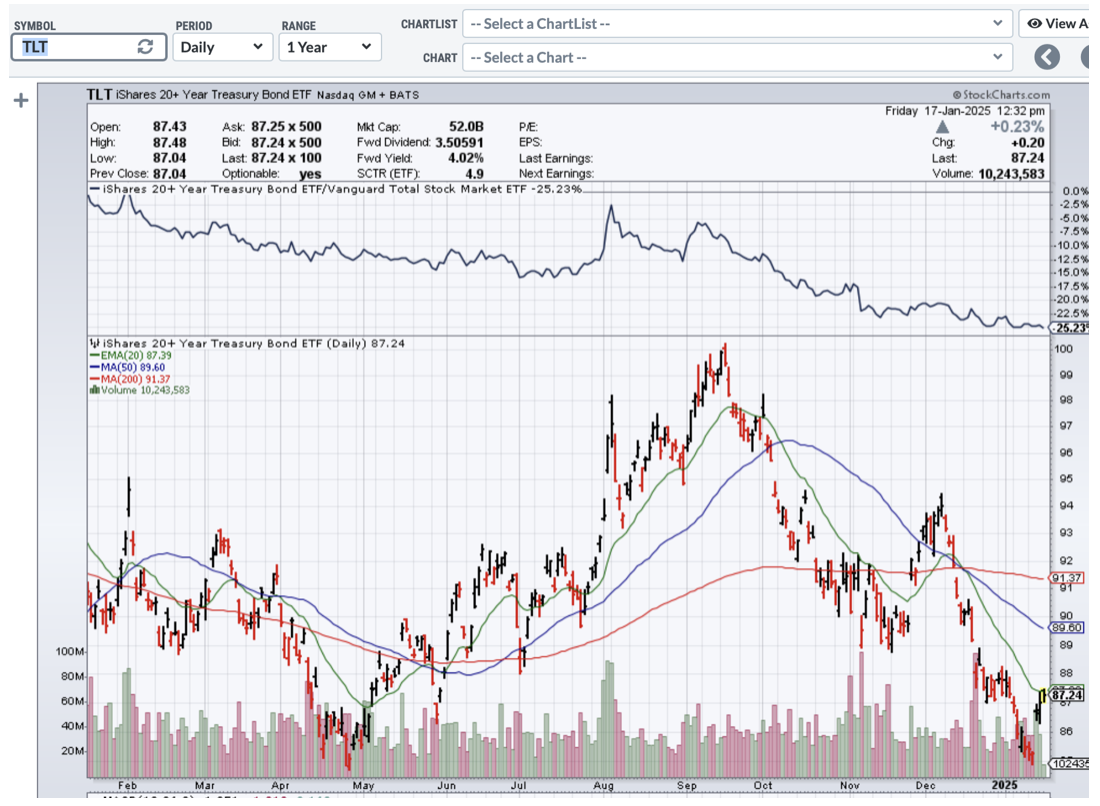
Bonds Hit 14-Month Lows at a 4.80% Yield, as fixed income dumping continues across the board. “Higher Rates for longer” don’t fit in here anywhere. But there may be a BUY setting up for (TLT) at 5.0%.
The Trump Bump is Gone, stock markets giving up all their post-election gains. Technology was especially hard hit, with lead stock NVIDIA down 15%. It seems that people finally examined the implications of what Trump was proposing for the stock market. Tax-deferred selling of the enormous profits run up under the Biden administration is a big factor.
Amazon is Getting Ready for Another Run. Strong earnings and continuing excitement about artificial intelligence will help Amazon stock move back into the green. The e-commerce and cloud company to beat estimates when it reports its fourth-quarter results—analysts are expecting a profit of $1.48 a share on sales of $187.3 billion, according to data from FactSet. Buy (AMZN) on dips.
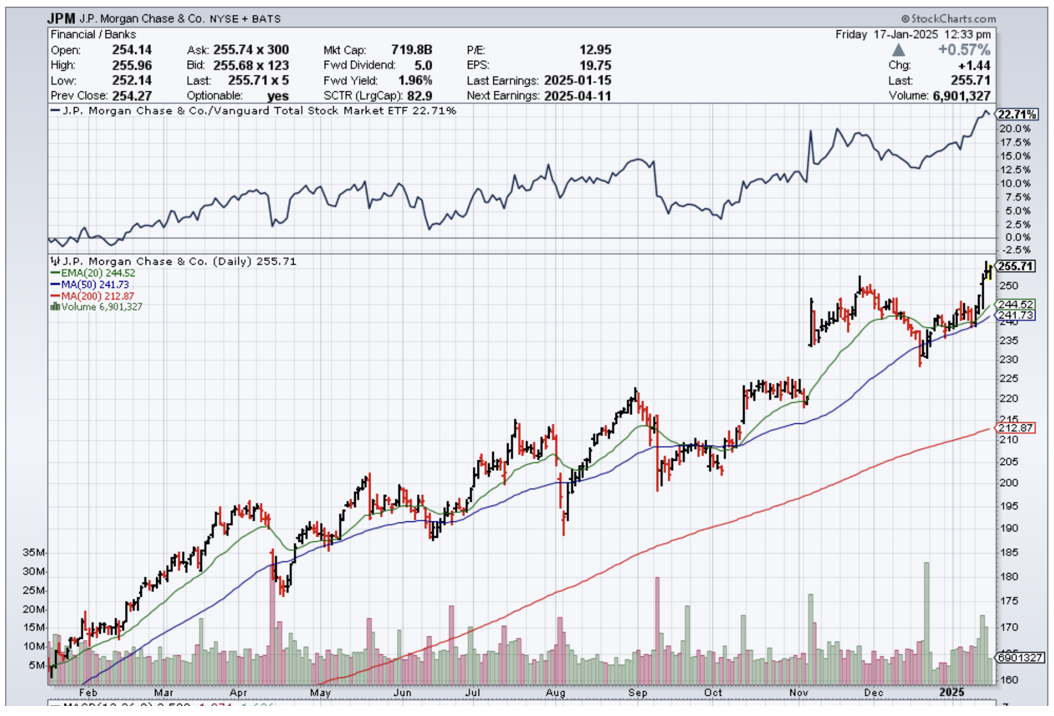
JP Morgan Announces Record Profits, boosted by volatility tied to the US elections in November. Trading revenue at the firm rose 21% from a year earlier, jumping to $7.05 billion. Fixed income was the star, with revenue beating analysts’ estimates, while equities-trading revenue fell short. Buy (JPM) on dips.
Goldman Sachs Beats. The firm’s fourth-quarter profits more than doubled to $4.1 billion, buoyed by strength in its investment bank, expansion of its asset management business, and a surprise $472 million gain from a balance sheet bet. Goldman ended 2024 as the best-performing stock among major US banks with a 48% advance. The bank is positioning itself for a long-awaited resurgence in deals after ditching major parts of a consumer foray.
Morgan Stanley Doubles Profits. Equities were the big winner, with revenue jumping 51% in the quarter and reaching an all-time high for the full year. In the wealth business, net new assets fell just shy of estimates even as revenue topped expectations.
SEC Sues Elon Musk, alleging the billionaire violated securities law by acquiring Twitter shares at “artificially low prices.” In his purchases, Musk underpaid for Twitter shares by at least $150 million, the SEC says. Musk bought Twitter in 2022 for about $44 billion, later changing the name to X. Expect this case to get lost behind the radiator next week.
Fed Minutes are Turning Hawkish, making an interest rate cut at the March 19 meeting unlikely. Inflation is stubbornly above target, the economy is growing at about 3% pace and the labor market is holding strong. Put it all together and it sounds like a perfect recipe for the Federal Reserve to raise interest rates or at least to stay put.
EIA Expects Weak Oil Prices for All of 2025. Many analysts expect an oversupplied oil market this year after demand growth slowed sharply in 2024 in the top consuming nations: the U.S. and China. The EIA said it expects Brent crude oil prices to fall 8% to average $74 a barrel in 2025, then fall further to $66 a barrel in 2026.
Housing Starts were up 3.0% in December, with single-family homes up only 3%, while multifamily saw a 59% rise. It should shift away from home sales crushed by 7.2% mortgage rates. You can write off real estate in 2025.
EV and Hybrid Sales Reach a Record 20% of US Vehicle Sales in 2024 and now account for 10% of the total US fleet. And you wonder why oil prices are so low. That includes 1.9 million hybrid vehicles, including plug-in models, and 1.3 million all-electric models. Tesla continued to dominate sales of pure EVs but Cox Automotive estimated its annual sales fell and its market share dropped to about 49%.
SpaceX Starship Blows Up on test launch number seven. The Federal Aviation Administration issued a warning to pilots of a “dangerous area for falling debris of rocket Starship,” according to a pilots’ notice. Looks like that Mars trip will be delayed.
On Monday, January 20, the markets are closed for Martin Luther King Day.
On Tuesday, January 21 at 8:30 AM EST, nothing of note takes place.
On Wednesday, January 22 at 8:30 AM, the API Crude Oil Stocks are printed.
On Thursday, January 23 at 8:30 AM, the Weekly Jobless Claims are announced.
On Friday, January 24 at 8:30 AM, Existing Home Sales are published. At 2:00 PM the Baker Hughes Rig Count is printed.
As for me, back in the early 1980s, when I was starting up Morgan Stanley’s international equity trading desk, my wife Kyoko was still a driven Japanese career woman.
Taking advantage of her near-perfect English, she landed a prestige job as the head of sales at New York’s Waldorf Astoria Hotel.
Every morning, we set off on our different ways, me to Morgan Stanley’s HQ in the old General Motors Building on Avenue of the Americas and 47th street and she to the Waldorf at Park and 34th.
One day, she came home and told me there was this little old lady living in the Waldorf Towers who needed an escort to walk her dog in the evenings once a week. Back in those days, the crime rate in New York was sky-high and only the brave or the reckless ventured outside after dark.
I said, “Sure, what was her name?”
Jean MacArthur.
I said, "THE Jean MacArthur?"
She answered, “Yes.”
Jean MacArthur was the widow of General Douglas MacArthur, the WWII legend. He fought off the Japanese in the Philippines in 1941 and retreated to Australia in a dramatic night PT Boat escape.
He then led a brilliant island-hopping campaign, turning the Japanese at Guadalcanal and New Guinea. My dad was part of that operation, as were the fathers of many of my Australian clients. That led all the way to Tokyo Bay where MacArthur accepted the Japanese in 1945 on the deck of the battleship USS Missouri.
The MacArthurs then moved into the Tokyo embassy where the general ran Japan as a personal fiefdom for seven years, a residence I know well. That’s when Jean, who was 18 years the general’s junior, developed a fondness for the Japanese people.
When the Korean War began in 1950, MacArthur took charge. His landing at Inchon Harbor broke the back of the invasion and was one of the most brilliant tactical moves in military history. When MacArthur was recalled by President Truman in 1952, he had not been home for 13 years.
So it was with some trepidation that I was introduced by my wife to Mrs. MacArthur in the lobby of the Waldorf Astoria. On the way out, we passed a large portrait of the general who seemed to disapprovingly stare down at me taking out his wife, so I was on my best behavior.
To some extent, I had spent my entire life preparing for this job.
I had stayed at the MacArthur Suite at the Manila Hotel where they had lived before the war. I knew Australia well. And I had just spent a decade living in Japan. By chance, I had also read the brilliant biography of MacArthur by William Manchester, American Caesar, which had only just come out.
I also competed in karate at the national level in Japan for ten years, which qualified me as a bodyguard. In other words, I was the perfect after-dark escort for Midtown Manhattan in the early eighties.
She insisted I call her “Jean”; she was one of the most gregarious women I have ever run into. She was grey-haired, petite, and made you feel like you were the most important person she had ever run into.
She talked a lot about “Doug” and I learned several personal anecdotes that never made it to the history books.
“Doug” was a staunch conservative who was nominated for president by the Republican party in 1944. But he pushed policies in Japan that would have qualified him as a raging liberal.
It was the Japanese who begged MacArthur to ban the army and the navy in the new constitution for they feared a return of the military after MacArthur left. Women gained the right to vote on the insistence of the English tutor for Emperor Hirohito’s children, an American Quaker woman. He was very pro-union in Japan. He also pushed through land reform that broke up the big estates and handed out land to the small farmers.
It was a vast understatement to say that I got more out of these walks than she did. While making our rounds, we ran into other celebrities who lived in the neighborhood who all knew Jean, such as Henry Kissinger, Ginger Rogers, and the UN Secretary-General.
Morgan Stanley eventually promoted me and transferred me to London to run the trading operations there, so my prolonged free history lesson came to an end.
Jean MacArthur stayed in the public eye and was a frequent commencement speaker at West Point where “Doug” had been a student and later the superintendent. Jean died in 2000 at the age of 101.
I sent a bouquet of lilies to the funeral.
Kyoko passed away in 2002.
In 2014, China’s Anbang Insurance Group bought the Waldorf Astoria for $1.95 billion, making it the most expensive hotel ever sold. Most of the rooms were converted to condominiums and sold to Chinese looking to hide assets abroad.
The portrait of Douglas MacArthur is gone too. During the Korean War, he threatened to drop atomic bombs on China’s major coastal cities.

Good Luck and Good Trading,
John Thomas
CEO & Publisher
The Diary of a Mad Hedge Fund Trader



Global Market Comments
January 17, 2025
Fiat Lux
Featured Trades:
(JANUARY 15 BIWEEKLY STRATEGY WEBINAR Q&A),
(GS), (MS), (JPM), (C), (BAC), (TSLA), (HOOD), (COIN), (NVDA), (MUB), (TLT), (JPM), (HD), (LOW), FXI)

Below please find subscribers’ Q&A for the January 15 Mad Hedge Fund Trader Global Strategy Webinar, broadcast from Sarasota, Florida.
Q: What would I recommend right now for my top five stocks?
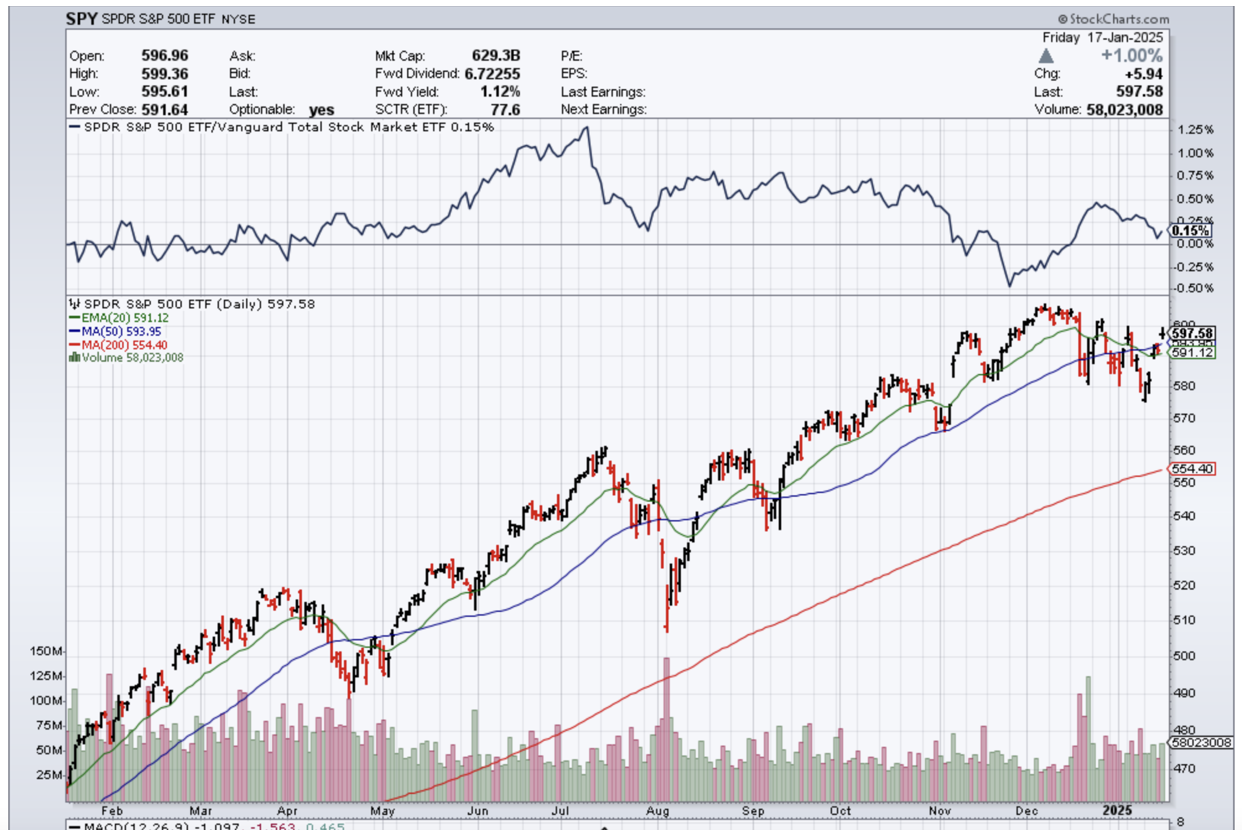
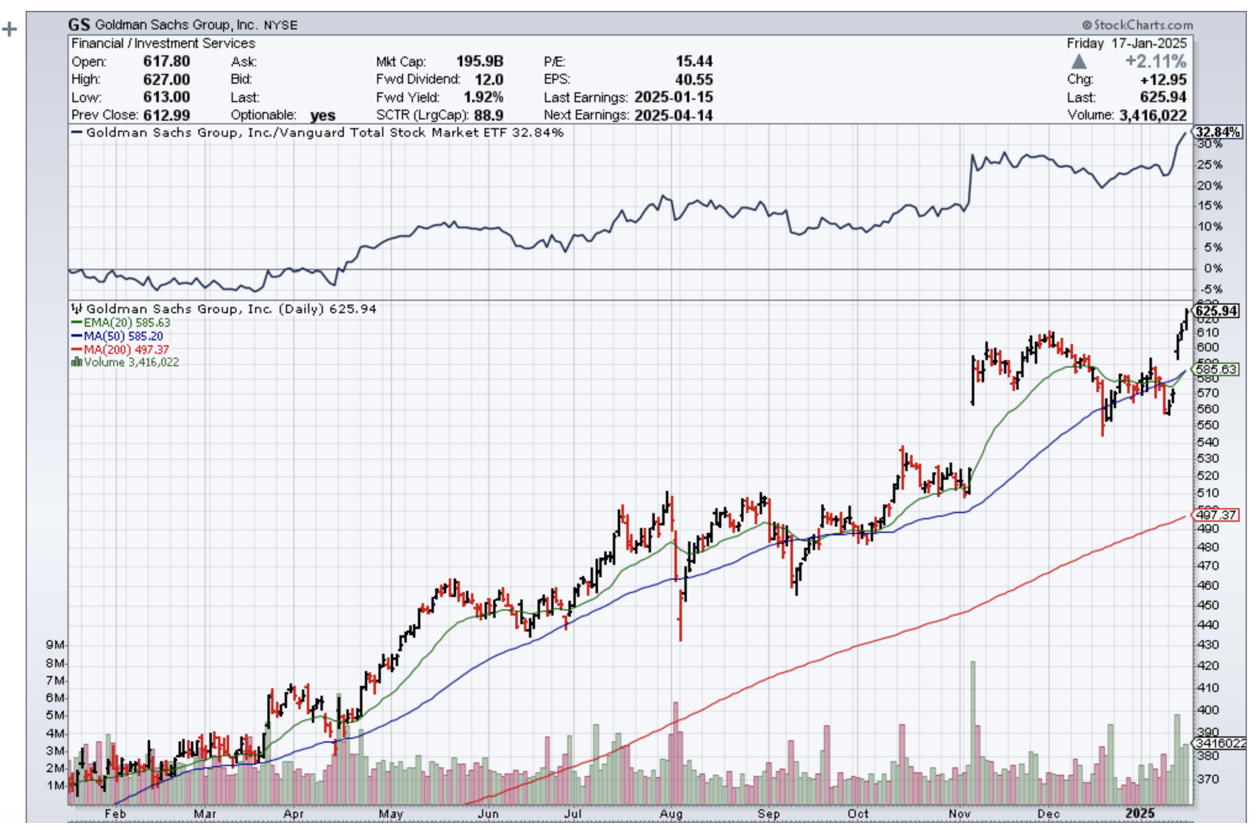
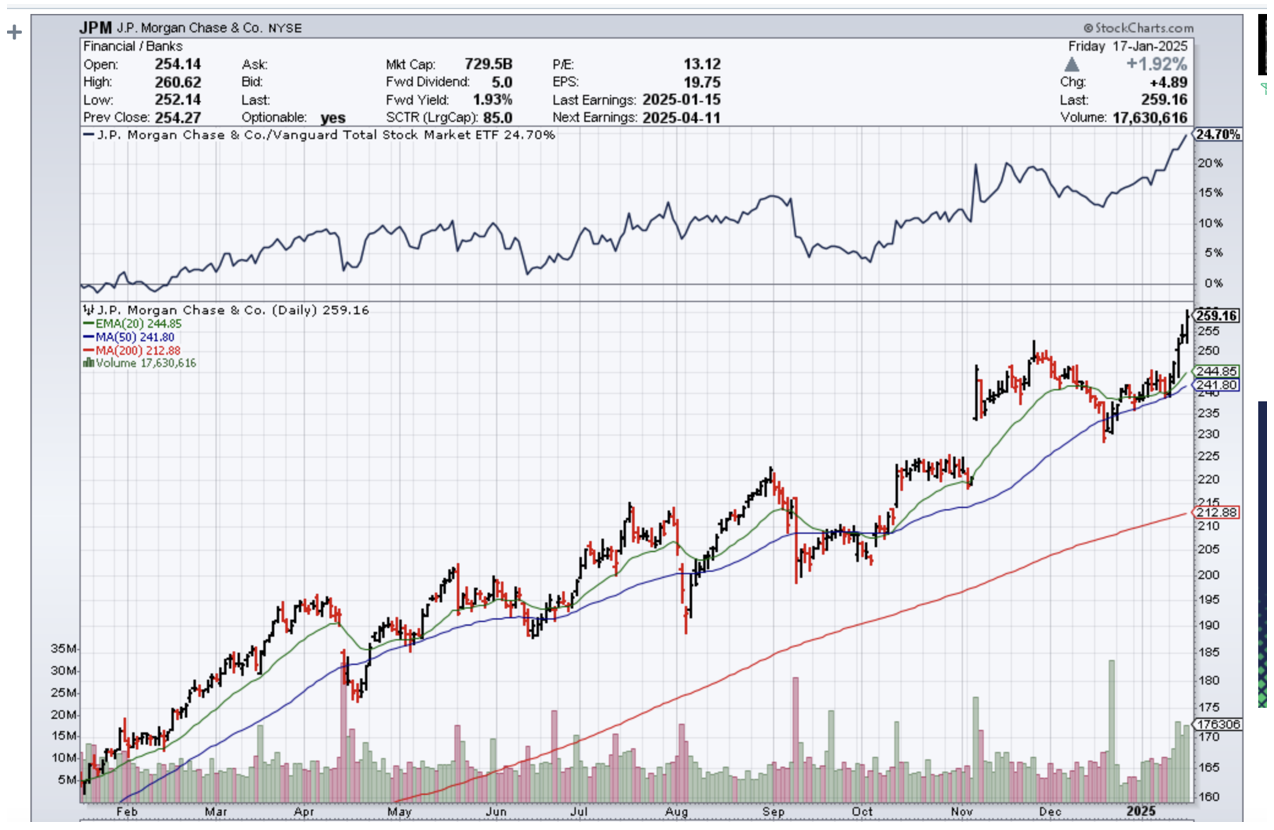
A: That’s easy. Goldman Sachs (GS), Morgan Stanley (MS), JP Morgan (JPM), Citibank (C), and Bank of America (BAC). There's five right there—the top five financials that are coming out of a decade-long undervaluation. A lot of the regional banks, which are also viable, are still trading to discount the book value, which all the financials used to trade out only a couple of years ago. Of course, JP Morgan's reaching a two-year return of around double, but the news just keeps getting better and better, so buy the dips. Buy every sell-off in financials and you will be a happy camper for the year.
Q: What do you think about Robin Hood (HOOD)?
A: Well, the trouble with Robinhood is it’s very highly dependent on crypto volumes. If you think crypto is going to go higher and volumes will increase, this is a great play. However, you get another 95%, out-of-the-blue selloff in crypto like we had three years ago and Coinbase (COIN) will follow it right back down again. On the last downturn, there were concerns that Coinbase would go under, so if you can hack the volatility, take a shot, but not with my money. I have the largest banks in the country that are about to double again; I would much rather be buying LEAPS in that area and getting anywhere from 100% to 1000% percent returns on a 2-year view—much more attractive risk-reward for me. And they pay a dividend.
Q: How do you define a 5% correction?
A: Well, if you have a $100 stock and it drops $5, that is a 5% correction.
Q: Can you please explain what Tesla 2X leverage actually means and is it a way to trade Tesla as an alternative?
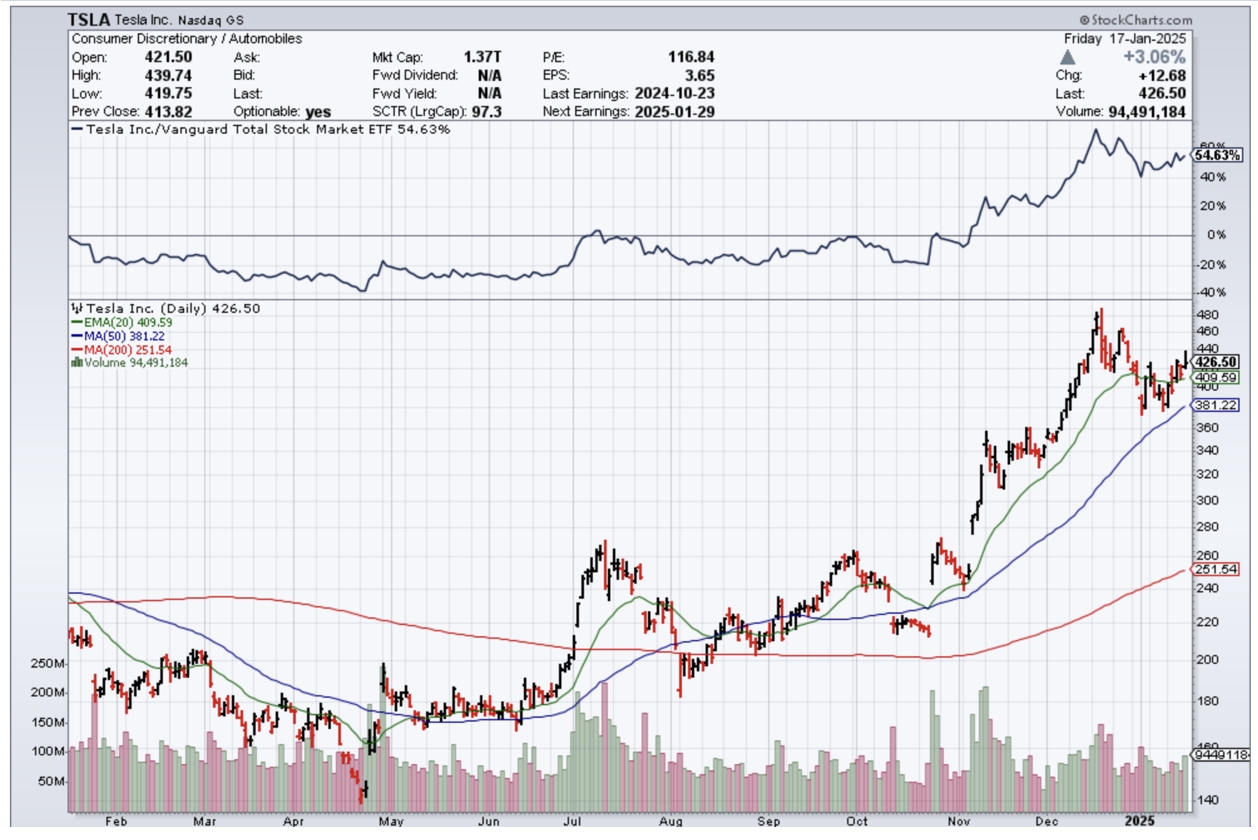
A: I steer people away from the 2Xs because the tracking error is really quite poor. You only get 1.5% of the upside, but 2.5 times the downside over time. These are more day trading vehicles. They take out huge fees, and huge dealing spreads—it's a very expensive way to trade. Far cheaper is just to buy Tesla (TSLA) stock on margin at 2 to 1, and there your tracking error is perfect, your fees are much lower, and you just have the margin interest rate to pay on the position, which is 6% a year or 50 basis points a month. No reason to make the ETF people richer than they already are. They keep coining these products—1x, 2x, 3x long shorts on every one of the high volume stocks, and it sucks a lot of people in, but it's higher risk, lower returns for the amount of money you're risking as far as I'm concerned. So that's the way to do it.
Q: What are your projections for Nvidia (NVDA)?
A: I think not just Nvidia, but all of the big tech is going to be kind of trading in a sideways range for a while, maybe 6 months, and then we get an upside breakout if you get the earnings breakout, which we are all expecting. AI is still in business, and still growing gangbusters. There are always a lot of Cassandra's out there saying that we're going to crash anytime, and I just don't see it. I know a lot of these people, I'm in touch with a lot of the companies, I see Beta releases of all products, the consumer products, and…the slowdown just ain't happening, I'm sorry. And I've been through a lot of these tech booms over the last 40 years, and this is only showing signs of just getting started.
Q: How come Tesla (TSLA) is up and down $30 every couple of days?
A: Number one, it is the most actively traded stock in the market right now. It has implied volatility on the options of 70%, which is really the highest in the market of any individual stock. That just creates immense amounts of trading by options traders, volatility traders, by call writing, and 2x and 3x ETF long and short players. All of the financial engineering and new products that we see all gravitate toward the high volume stocks like Nvidia, Tesla, and Apple because that's where the money is being made. Some days Tesla accounts for 25% of all the market trading. Financial engineers go where the action is, where the volume is, where the customer demand is.
Q: Why do you expect only 5% to 10% corrections if the Fed rate cuts get completely priced out?
A: I don't expect the Fed to keep cutting interest rates. We should get another rate cut this year, and that may be it for the year. If inflation comes back (and of course, all of the new administration’s policies are highly inflationary) it’s just a question of how long it takes for it to hit the system.
Q: Do you believe I should hold all of my municipal bonds (MUB) with 10-year call protection at 4.75%?
A: On a tax-adjusted basis, I would say yes. You know, stock markets may peak and deliver a zero return, and in that situation, muni bonds are very attractive. The nice thing about bonds is that you hold on to maturity—you get 100% of your money back. With stocks, that is not always the case. Stocks you have to trade because the volatility can be tremendous. And in fact, what I do is I keep all of my money in one year Treasury bills. Last time I did this, which was in September, I locked in a one-year return for 5%.
Q: Would you prefer to buy deep in the money and put spreads on top of any rally?
A: Absolutely yes. If this is a real trading year, you not only buy the dips, you sell the rallies. We did almost no real selling last year. We really only did it in June and July because the market essentially went straight up, except for two hickeys. This could be the year of not only call sprints but put spreads as well. You just have to remember to sit down when the music stops playing.
Q: You say buy the dips; what would your dip be in JP Morgan (JPM)?
A: Well lower volatility stocks by definition have smaller drawdowns. JP Morgan (JPM) is one of those, so I'd be very happy to buy a 5% dip in JP Morgan. If it drops more, you double the position on a 10% pullback. Higher volatility stocks like Tesla—I'm really waiting for 10% or 20% corrections. You saw I just bought a 22% correction twice in Tesla with it down 110 points. One of those trades is at max profit right now and the other one has probably made half its money since yesterday. That is the game. The amount of dip you buy is directly related to the volatility of the stock.
Q: Should you let your cash go uninvested?
A: Yes, never let your cash go uninvested just sitting as cash. Your broker will take that money and put it in 90-day T-bills and keep the money for himself. So buy 90-day T-bills as a cash management tool—they're paying about 4.21% right now— and you can always use those as collateral under my positions on margin.
Q: Is Home Depot (HD) a buy on the LA reconstruction story?
A: I would say no, Los Angeles is probably no more than 5% of Home Depot's business—the same with Lowe's (LOW). A single city disaster is not enough to move the stock for more than a few days, and the fact is: Home Depot is mostly dependent on home renovation, which tends not to happen during dead real estate markets because, you know, it takes the flippers out of the market. It really needs lower interest rates to get Home Depot back up to new highs.
Q: Do you expect a big market move at the end of the day when the Fed makes its announcement?
A: The market has basically fully discounted the move on January 28, and if anything happens, there'll probably be a “sell on the news.” So, I expect we could give up a piece of the recent performance on the announcement of the Fed news.
Q: Should we expect trade alerts for LEAPS coming from you?
A: Absolutely, yes. However, LEAPS are something you really only want to do on down moves. If we don't get any, we'll just do the front-month call spreads. You can still make 10%, 20% a month just concentrating on financial call spreads.
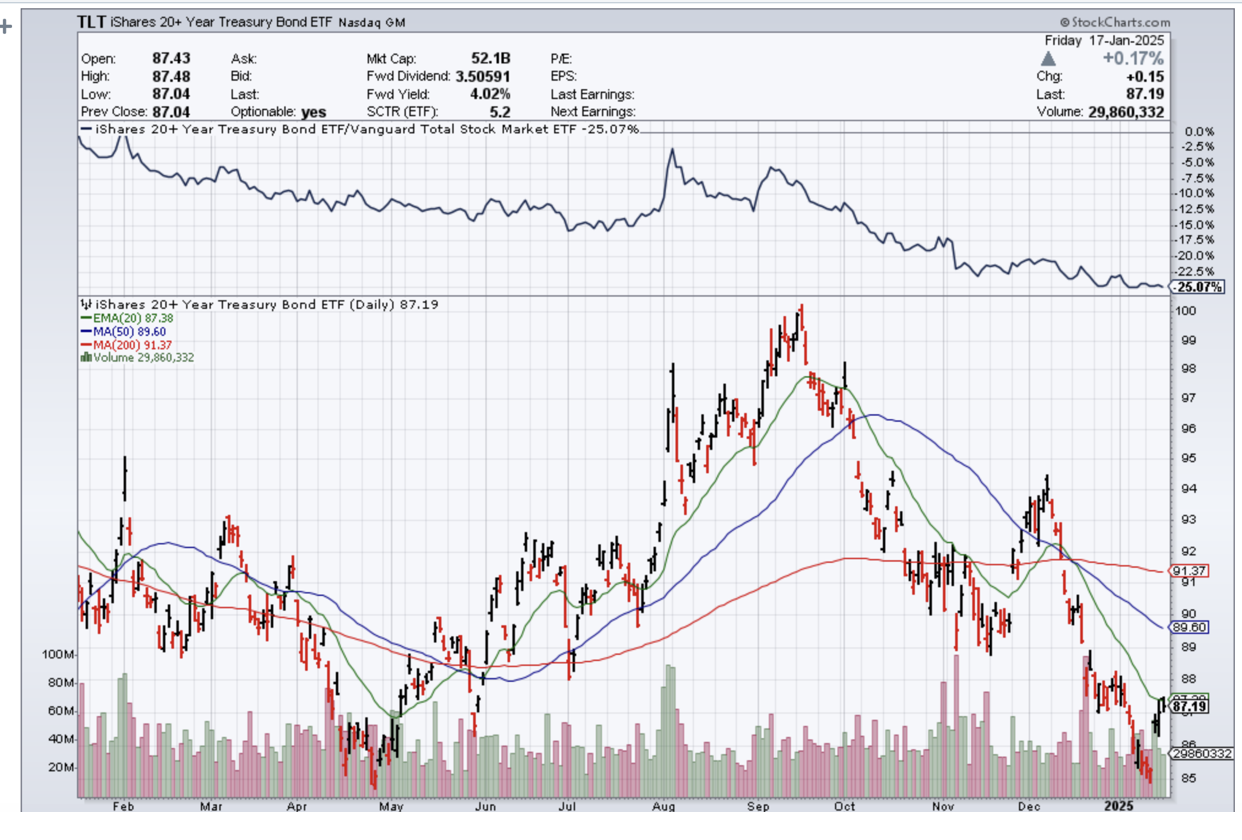
Q: What would have happened to our accounts if we kept the (TLT) $82-$85 iShares 20+ Year Treasury Bond ETF (TLT) call spread and it went all the way down to $82?
A: The value of your investment goes to zero. Of course, it was declining at a very slow rate, and the $80: you might have gotten a bounce off the $85 level. But if the inflation number had come in hot, as had all other economic data of the last month, then you could have easily gotten a gap down to $82 and lost your entire investment, because two days is not enough time to expiration to recover that 3-point loss. And that's why I stopped out yesterday.
Q: Didn't David Tepper buy China (FXI)?
A: With both hands last September, yes he did. And my bet is he got out before he got killed. I mean, that's what hedge funds do. He probably got out close to cost, and you likely won't see him promoting China again anytime in the near future.
Q: I have June 530 puts on the S&P 500, should I get rid of them?
A: Yes, I don't see a big crash coming. You probably paid a lot going all the way out to June, and it's probably not worth hanging on to. Put spreads are the better way to go—that cuts your cost by two-thirds and those you only want to put on at market tops.
To watch a replay of this webinar with all the charts, bells, whistles, and classic rock music, just log in to www.madhedgefundtrader.com, go to MY ACCOUNT, click on GLOBAL TRADING DISPATCH, TECHNOLOGY LETTER, or JACQUIE'S POST, then WEBINARS, and all the webinars from the last 12 years are there in all their glory.
Good Luck and Good Trading,
John Thomas
CEO & Publisher
The Diary of a Mad Hedge Fund Trader