• support@madhedgefundtrader.com
  • Member Login
Mad Hedge Fund Trader
  • Home
  • About
  • Store
  • Luncheons
  • Testimonials
  • Contact Us
  • Click to open the search input field Click to open the search input field Search
  • Menu Menu

Tag Archive for: (TSLA)

april@madhedgefundtrader.com

The Market Outlook for the Week Ahead

Diary, Newsletter

I’m not so worried that the market won’t go up. It really bothers me that stocks are unable to go down.

That means you don’t get a flush out of positions that generates the cash needed to finance the next leg up in the bull market.

Usually, that happens in the fall because historically that’s when farmers are at maximum distress, when they have run out of cash after paying for seed, fertilizer, and labor all year long but have yet to be paid for their harvest.

This was a big deal in 1900 when farming accounted for 50% of the economy. With farming now at 2% it’s not such a big deal, but once cyclicality in the market is established, it lives on forever.

With the Fed, traders, and investors fixated on inflation, you usually get a big reaction in the monthly release of the Consumer Price Index. This time, we got nada, nothing, bupkiss, even though the 0.6% rise in inflation should have triggered a meaningful market selloff.

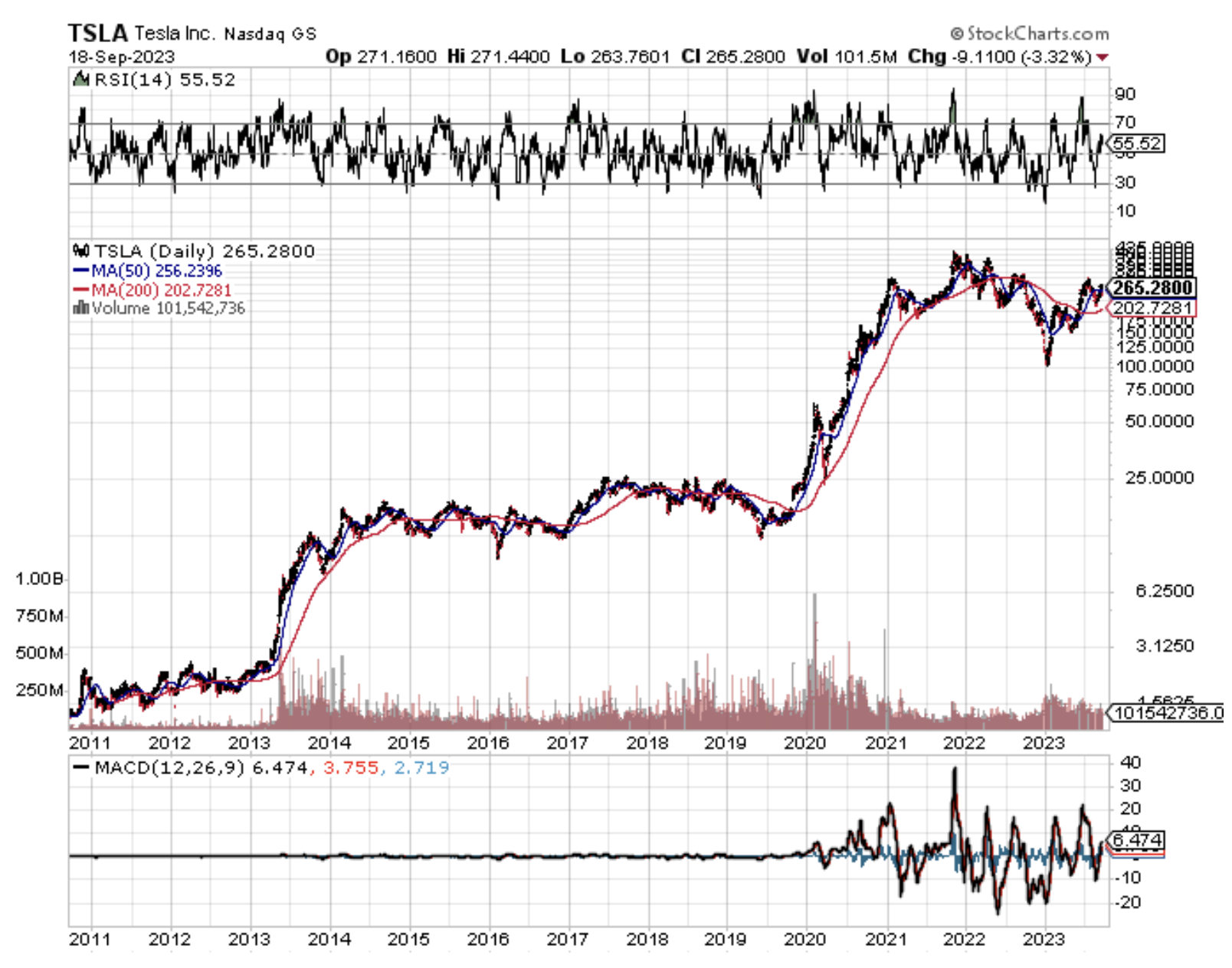
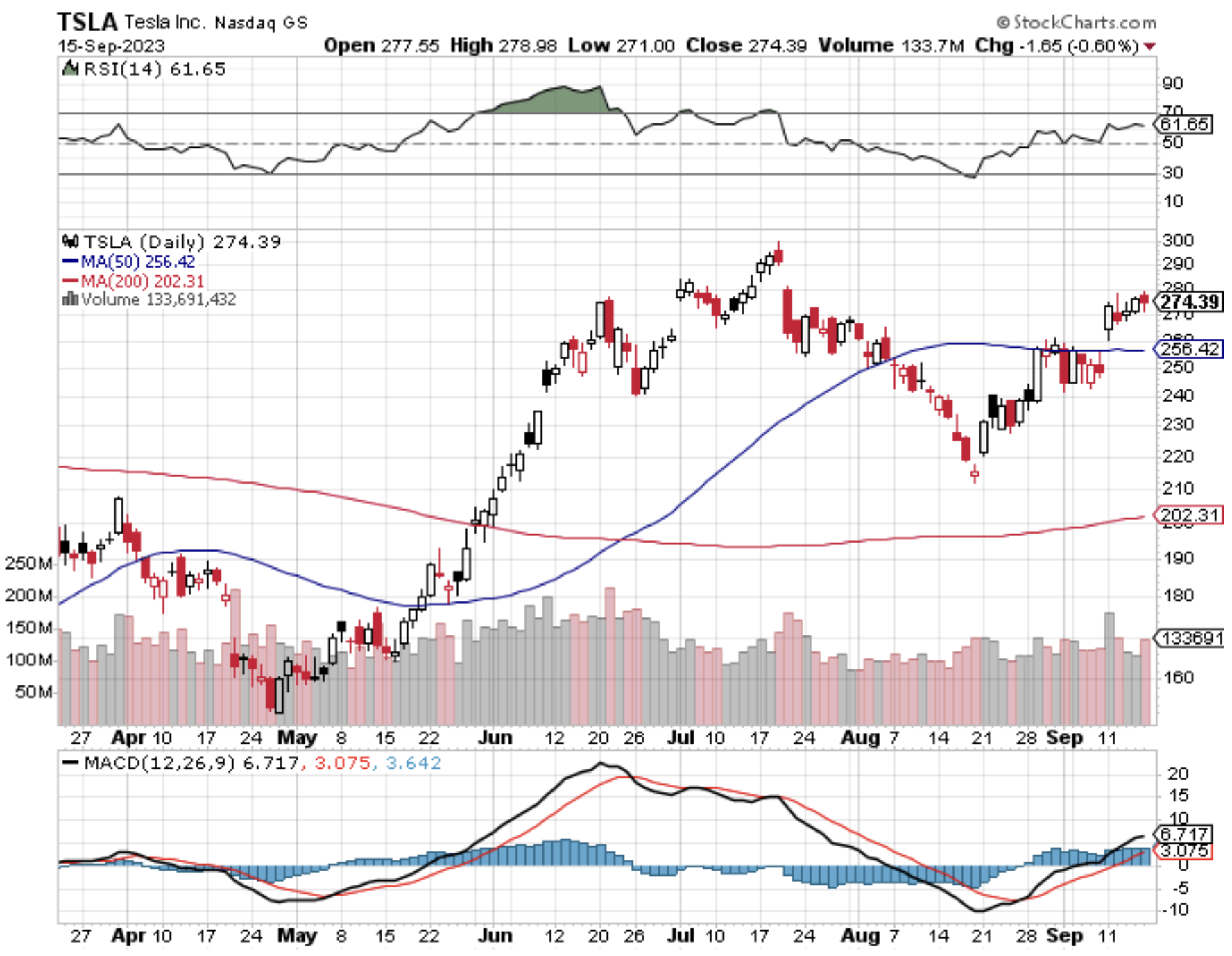
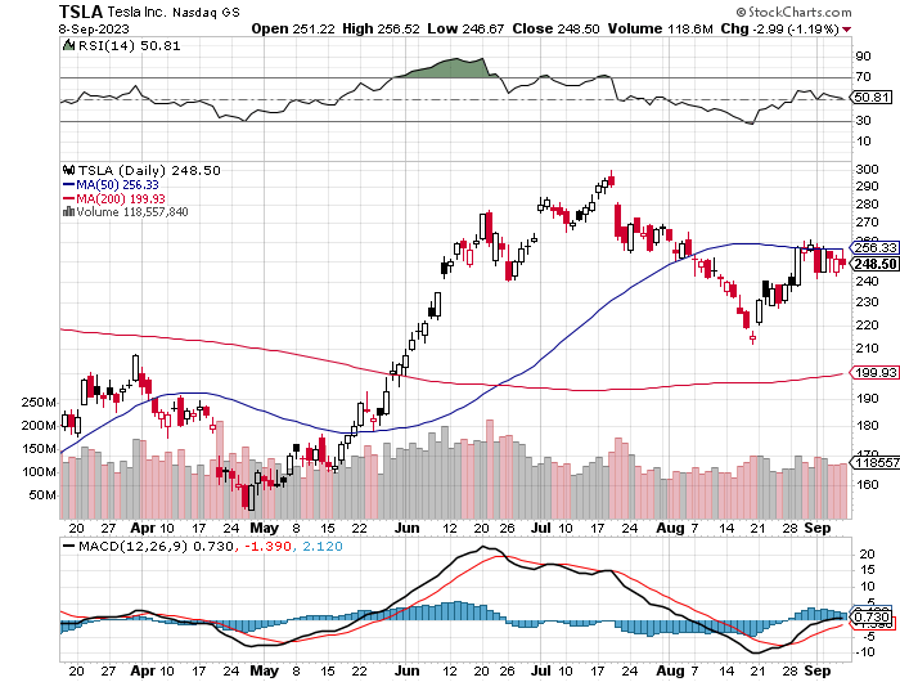
You know it’s a pretty dead week when the lead news item is about a union that has been going out of business for 40 years. That’s because all the growth in the country during this period has been in nonunion industries, namely in technology (XLK) and at Tesla (TSLA). Notice that nonunion (TSLA) was up 10% this week, the big winner in the strike. Elon Musk has fought unionization tooth and nail for 20 years and is now coming up roses.

As a result, UAW membership plunged from 1.4 million in 1978 to 400,000, a decline of some 71.4%. The union now has more retirees than workers. That’s a lot of dead weight to carry.

One effect of this decline has been a fall in real wages during the same 45 years. What the UAW is attempting in their demands is to make up for the entire 45 years of real wage losses in one shot with a whopping great 40% increase over five years, a 32-hour work week, and better medical benefits.

It isn’t going to work.

When I picked up my first Tesla Model S some 14 years ago, I was given a tour of the factory. I was blown away by what I saw. There were no people!

I literally saw a vast factory floor of machines making machines. Occasionally, someone passed me by on a bicycle on their way to change a tool on a robot or lubricate a joint. EVs have 80% fewer parts than internal combustion vehicles and therefore require 80% fewer workers.

This is what caused me to immediately plunge into Tesla stock at a split-adjusted $2.45 a share and take my readers there as well.

One is reminded of the Luddite movement in England in 1812 when workers destroyed machines to avoid work. It was an effort to protect home spinning wheels which had until then produced the world’s cotton fabric. After an armed rebellion was put down, the machines eventually reduced the cost of cotton cloth 100-fold and launched the Industrial Revolution.

Some 200 years ago, most people could only afford one set of clothes. Now they have dozens, or hundreds if they have daughters (I have three).

Hint to the UAW: Destroying General Motors (GM), Ford (F), and Stellantis (the old Chrysler) isn’t going to get you a better job.

It's not that I am anti-union. After all, my grandfather was in the Teamsters Union during the great depression at the height of union power. It’s just that this strike is particularly stupid, grasping, and overreaching.

If you want to learn more about the Luddite movement, please click here for the history.

When the market does come out of its coma, there is no doubt where the big money is headed.

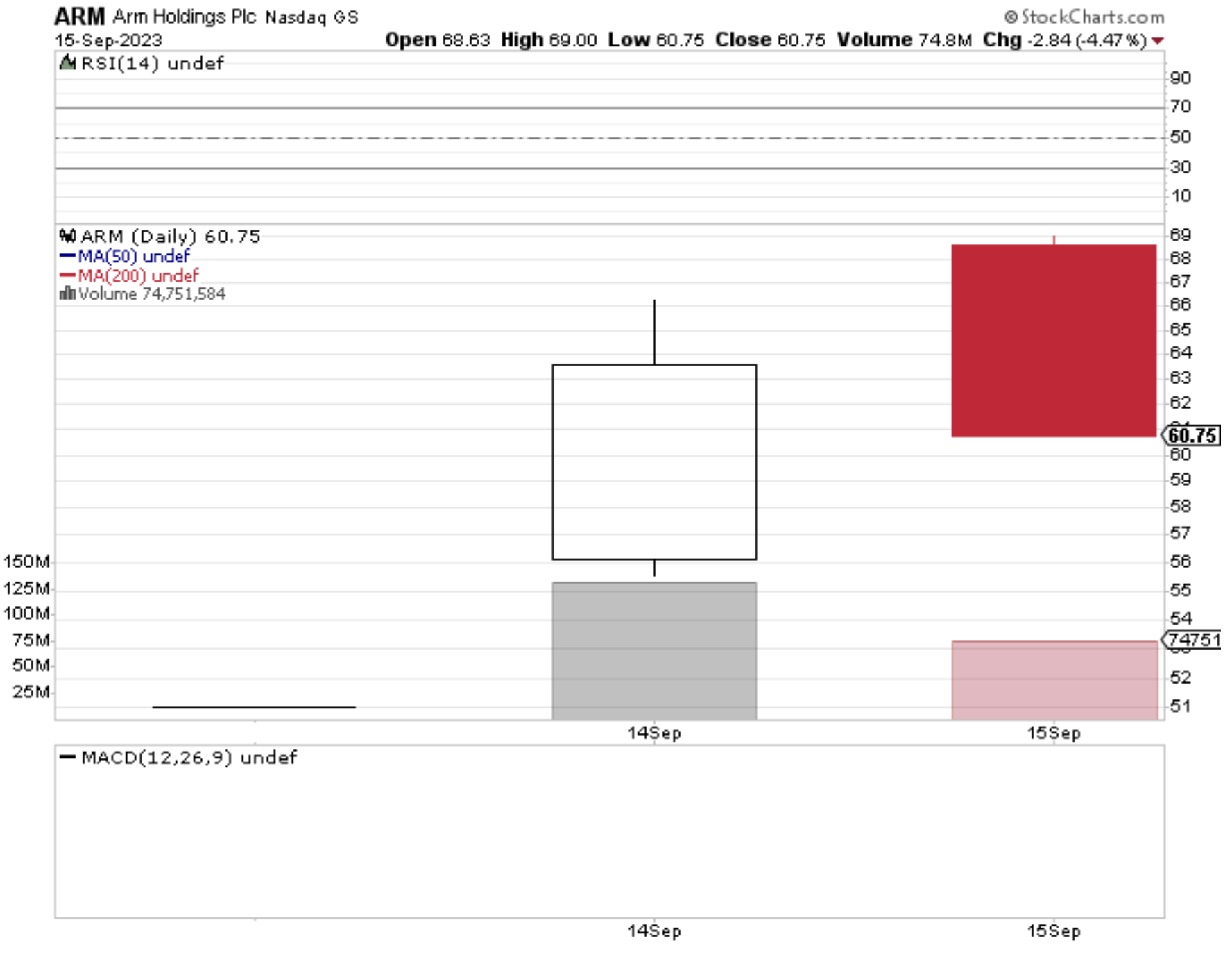
The Arm Holdings IPO (ARM) was some six times oversubscribed and it rose 25% from its initial $51 pricing on the first day as institutions rushed to top up meager allocations. The word is out. Stay underweight AI chip design companies at your peril….at whatever the price. At $69, (ARM) sports a positively bubblicious price-earnings multiple of 100X.

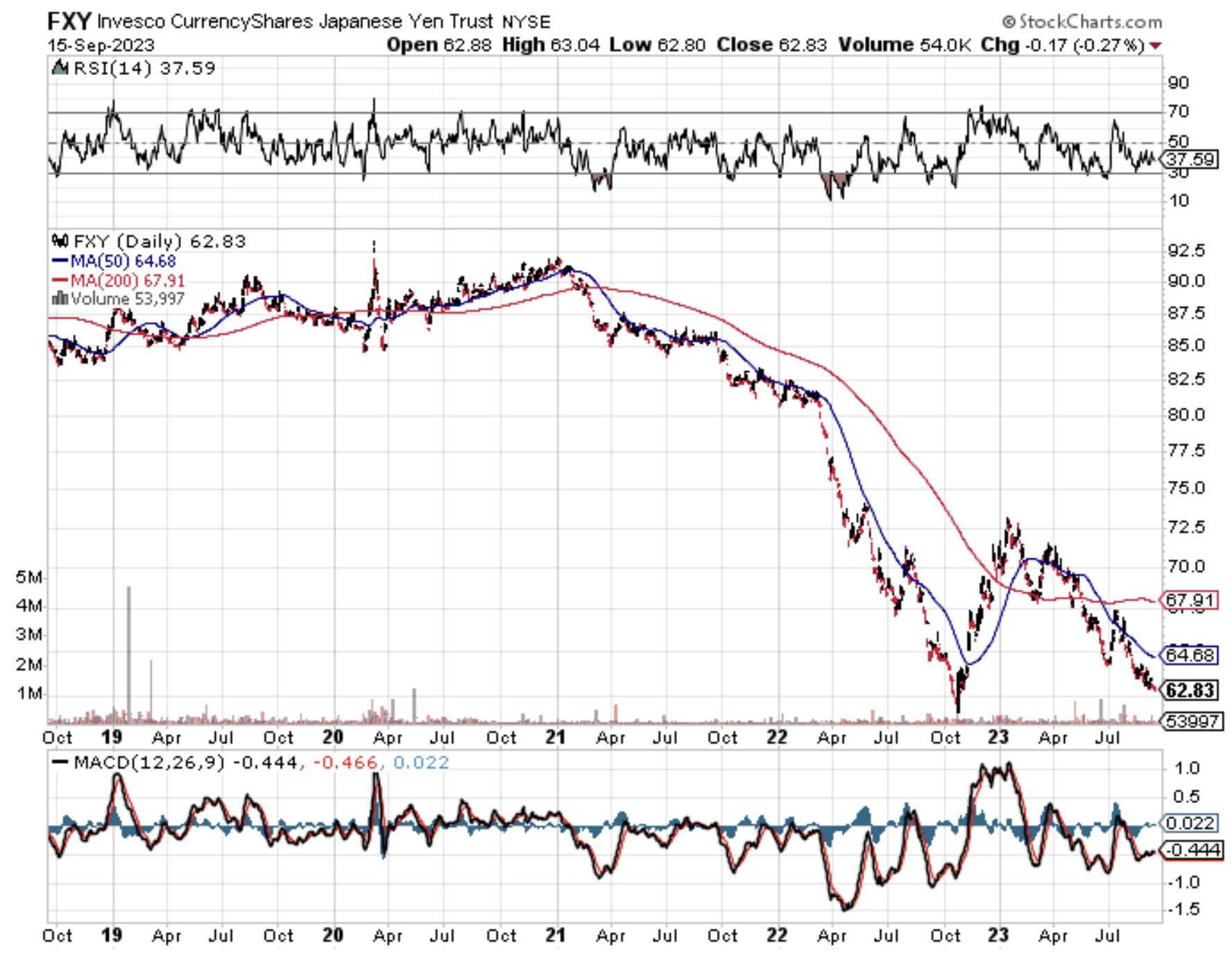
Sometimes, the greatest trades are those sitting right in front of our noses begging for attention. That would be the Japanese yen, which has been in free fall for three years.

If the Bank of Japan ends its zero-interest rate policy, the last in country the world to have one, the Japanese yen will rocket, and the Nikkei average will crash. With Japan’s inflation rate now at a 40-year high at 3.30% how far away can that be?

It might be setting up the long of the year in the foreign exchange market. You would think that is a certainty after a 33% drop in recent years. Maybe this is why the Nikkei has been in the doldrums since June.

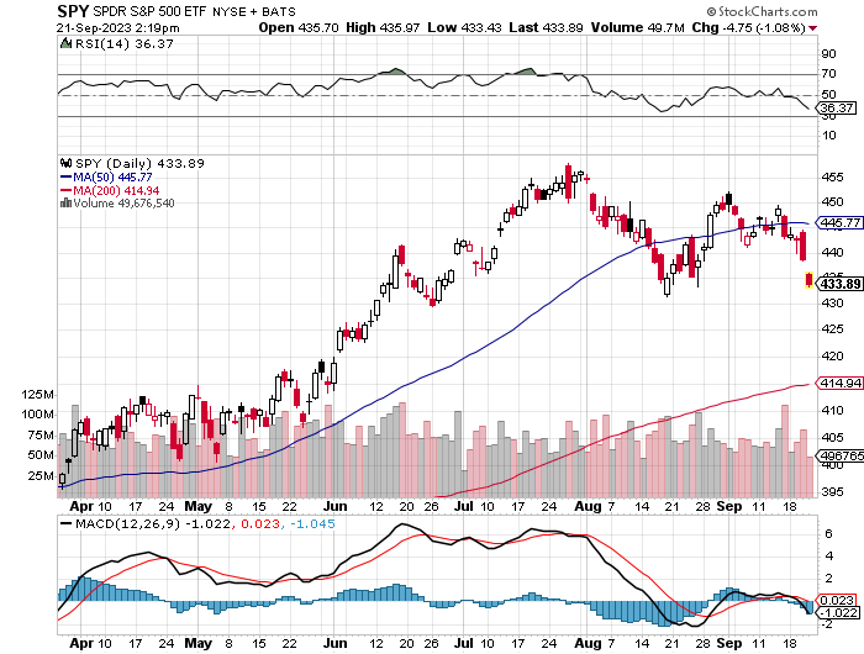
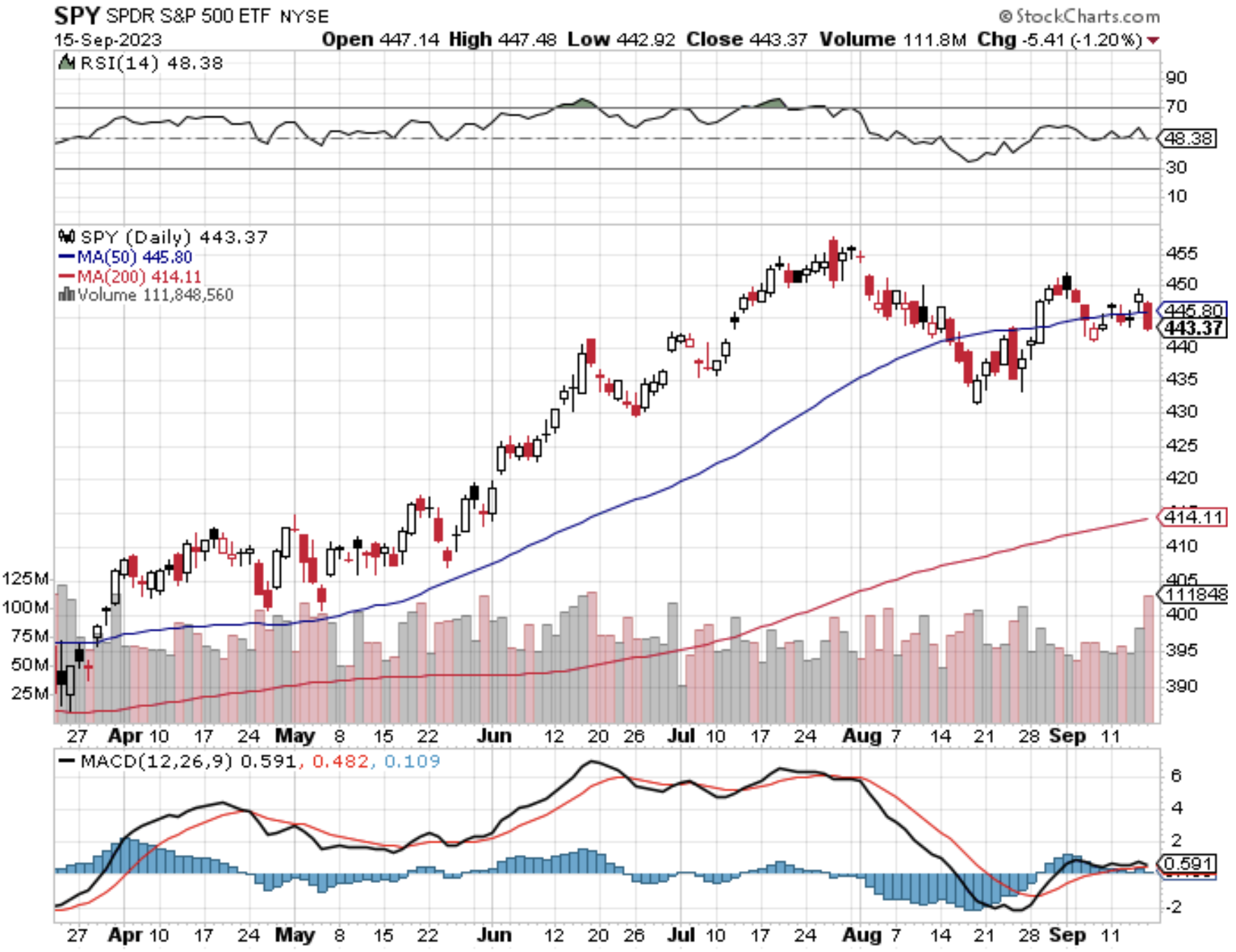
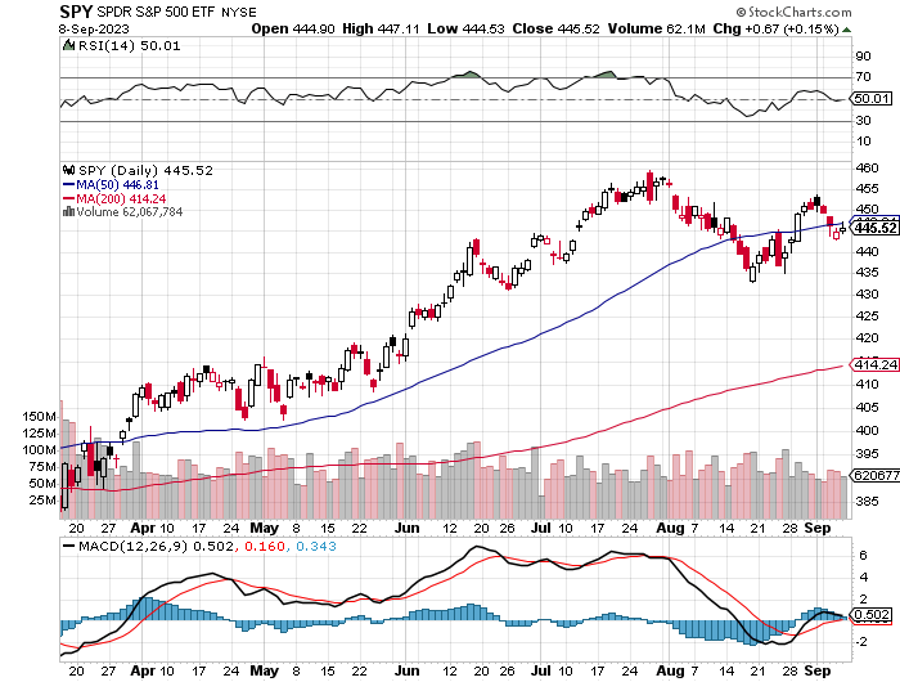
So far in September, we are down unchanged, with no trade alerts issued. Patience is the name of the game here. My 2023 year-to-date performance is still at an eye-popping +60.80%. The S&P 500 (SPY) is up +16.57% so far in 2023. My trailing one-year return reached +83.85% versus +20.47% for the S&P 500.

That brings my 15-year total return to +657.99%. My average annualized return has fallen back to +47.85%, some 2.47 times the S&P 500 over the same period.

Some 41 of my 46 trades this year have been profitable.

Consumer Price Index Rises 0.6% in August, the hottest read in 18 months, but in line with expectations. Energy was the main cause, which is up 40% from its May low. The Core and Inflation Rate was up only 0.3%. Stocks and bonds barely reacted. A huge increase in auto insurance was another factor, no doubt the result of the multiple climate disasters taking place across the country.

Arm Holdings Jumps 25% on First Day of Trading. Masayoshi Sohn is happy because he still owns the remaining 90% of the company. This is where the hot money is going, and it pulled the rest of tech up as well.

EV Sales Soared by 70% in California in August, and the rest of the country is likely to follow. The coming Cybertruck release will add fuel to the fire. EV is going mainstream. China, the US, and Germany lead in global EV sales. California would be fourth if it were broken out as a separate country at 109,069 units in Q2.

US Jobless Claims Fall Again to 220,000, a drop of 5,000. The US economy is reigniting again.

Gold and Bonds are Bottoming, or so says a UK hedge fund. Distress selling off the UK’s selling of gold market the low for both bonds and the yellow metal back in 1999-2002. We could be seeing a repeat today. I think they’re right.

Morgan Stanley Upgrades Tesla, off the back of its massive AI business, which could add $600 billion in value to the company. (MS) had previously been bearish on Tesla, so (TSLA) rose 6%. (Tesla has long been the largest user of AI with a fleet of 5 million AI-driven EVs. Why was (MS) so slow to figure this out? Buy (TSLA) on dips.

Hydrogen is Going Nowhere, and the stocks are a great short, says the Argonaut hedge fund. While electric power is infinitely scalable, hydrogen demands the same inefficient infrastructure as does gasoline. Saudi Arabia has a massive advantage in that it has an unlimited supply of other energy form to convert oil into hydrogen, and solar power.

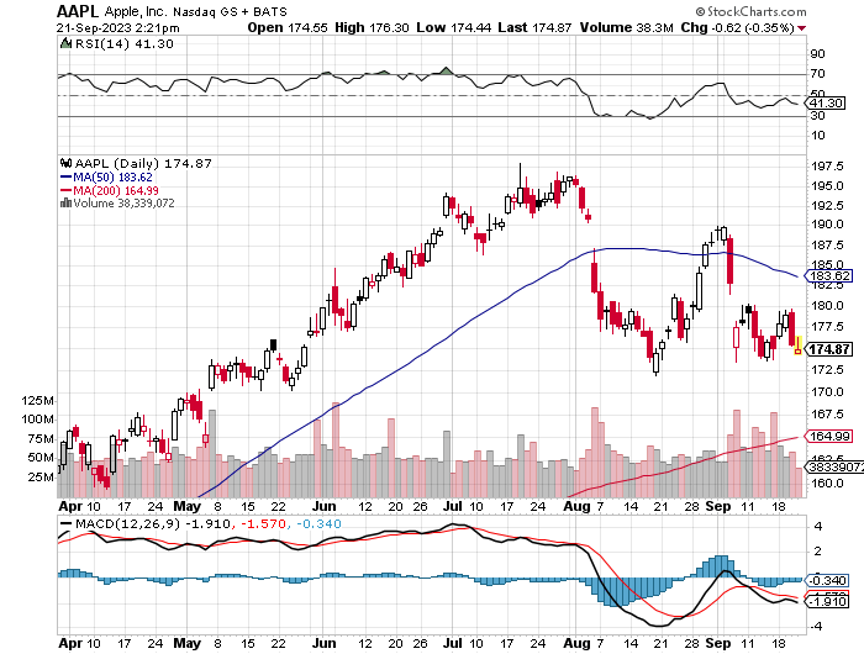
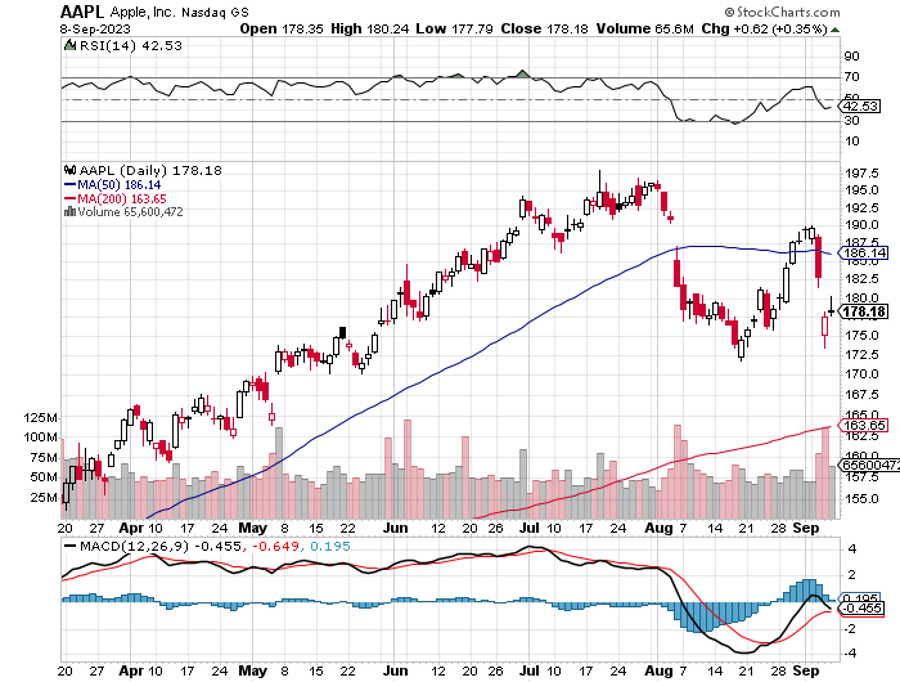
Apple is Still a Hold, for the long term and a “BUY” on any 10% correction. It is now basically an India play, as that is where future growth lies. China is peaking out. The titanium finish for the new iPhone 15 looks cool. There is a USB-C charging cable in your future to bring it in compliance with EC rules. The camera goes from a 2X to a 5X zoom. The new Special Video is a killer app. There is also a major increase in the use of artificial intelligence.

Space X is Moving into the Cargo Business, shipping goods from New York to Australia in 35 minutes. That’s what is possible for high value-added freight with rockets that can reliably take off and land. The move should take the value of Space X from the present $150 billion to $500 billion. So thinks my friend Ron Baron of the Baron Funds, and early Tesla investor. He also thinks Tesla will soar from $857 billion today to $5 trillion in five years, making it the most valuable company in the world by far. I couldn’t agree more.

Caesars Entertainment Suffers Major Hack, paying a ransom thought to be in the millions of dollars. The crooks threatened to leak the casino’s entire customer list to the dark web, including mine. A serious hack can wipe out a company, as happened to Sony a decade ago. 1234 no longer works as a password. Buy Palo Alto Networks (PANW).

My Ten-Year View

When we come out the other side of the recession, we will be perfectly poised to launch into my new American Golden Age, or the next Roaring Twenties. The economy decarbonizing and technology hyper accelerating, creating enormous investment opportunities. The Dow Average will rise by 800% to 240,000 or more in the coming decade. The new America will be far more efficient and profitable than the old.

Dow 240,000 here we come!

On Monday, September 18, the NAHB Housing Market Index is out.

On Tuesday, September 19 at 8:30 PM EST, US Building Permits are released.

On Wednesday, September 20 at 2:00 PM EST, the Federal Reserve released its interest rate decision. A press conference follows.

On Thursday, September 21 at 8:30 AM EST, the Weekly Jobless Claims are announced. We also get Existing Homes Sales.

On Friday, September 22 at 6:45 AM the NS&P Global Composite Flash PMI for August is published. At 2:00 PM the Baker Hughes Rig Count is printed.

As for me
, having visited and lived in Lake Tahoe for most of my life, I thought I’d pass on a few stories from this historic and beautiful place.

The lake didn’t get its name until 1949 when the Washoe Indian name was bastardized to come up with “Tahoe”. Before that it was called the much less romantic Lake Bigler after the first governor of California.

A young Mark Twain walked here in 1863 from nearby Virginia City where he was writing for the Territorial Enterprise about the silver boom. He described boats as “floating in the air” as the water clarity at 100 feet made them appear to be levitating. Today, clarity is at 50 feet, but it should go back to 100 feet when cars go all-electric.

One of the great engineering feats of the 19th century was the construction of the Transcontinental Railroad. Some 10,000 Chinese workers used black powder to blast a one-mile-long tunnel through solid granite. They tried nitroglycerine for a few months but so many died in accidents they went back to powder.

The Union Pacific moved the line a mile south in the 1950s to make a shorter route. The old tunnel is still there, and you can drive through it at any time if you know the secret entrance. The roof is still covered with soot from woodfired steam engines. At midpoint, you find a shaft to the surface where workers were hung from their ankles with ropes to place charges so they could work on four faces at once.

By the late 19th century, every tree around the lake had been cut down for shoring at the silver mines. Look at photos from the time and the mountains are completely barren. That is except for the southwest corner, which was privately owned by Lucky Baldwin who won the land in a card game. The 300-year-old growth pine trees are still there.

During the 20th century, the entire East Shore was owned by one man, George Whittell Jr., son of one of the original silver barons. A man of eclectic tastes, he owned a Boing 247 private aircraft, a custom mahogany boat powered by two Alison aircraft engines, and kept lions in heated cages.

Thanks to a few well-placed campaign donations, he obtained prison labor from the State of Nevada to build a palatial granite waterfront mansion called Thunderbird, which you can still visit today (click here at https://thunderbirdtahoe.org ). During Prohibition, female “guests” from California crossed the lake and entered the home through a secret tunnel.

When Whittell died in 1969, a Mad Hedge Concierge Client bought the entire East Shore from the estate on behalf of the Fred Harvey Company and then traded it for a huge chunk of land in Arizona. Today the East Shore is a Nevada State Park, including the majestic Sand Harbor, the finest beach in the High Sierras.

When a Hollywood scriptwriter took a Tahoe vacation in the early 1960’s, he so fell in love with the place that he wrote Bonanza, the top TV show of the decade (in front of Hogan’s Heroes). He created the fictional Ponderosa Ranch, which tourists from Europe come to look for in Incline Village today.

In 1943, a Pan Am pilot named Wayne Poulson who had a love of skiing bought Squaw Valley for $35,000. This was back when it took two days to drive from San Francisco. Wayne flew the China Clippers to Asia in the famed Sikorski flying boats, the first commercial planes to cross the Pacific Ocean. He spent time between flights at a ranch house he built right in the middle of the valley.

His wife Sandy bought baskets from the Washoe Indians who still lived on the land to keep them from starving during the Great Depression. The Poulson’s had eight children and today, each has a street named after them at Squaw.

Not much happened until the late forties when a New York Investor group led by Alex Cushing started building lifts. Through some miracle, and with backing from the Rockefeller family, Cushing won the competition to host the 1960 Winter Olympics, beating out the legendary Innsbruck, Austria, and St. Moritz, Switzerland.

He quickly got the State of California to build Interstate 80, which shortened the trip to Tahoe to only three hours. He also got the state to pass a liability limit for ski accidents to only $2,000, something I learned when my kids plowed into someone, and the money really poured in.

Attending the 1960 Olympic opening ceremony is still one of my fondest childhood memories, produced by Walt Disney, who owned the nearby Sugar Bowl ski resort.

While the Cushing group had bought the rights to the mountains, Poulson owned the valley floor, and he made a fortune as a vacation home developer. The inevitable disputes arose and the two quit talking in the 1980’s.

I used to run into a crusty old Cushing at High Camp now and then and I milked him for local history in exchange for stock tips and a few stiff drinks. Cushing died in 2003 at 92 (click here for the obituary at https://www.nytimes.com/2006/08/22/obituaries/22cushing.html )

I first came to Lake Tahoe in the 1950s with my grandfather who had two horses, a mule, and a Winchester. He was one-quarter Cherokee Indian and knew everything there was to know about the outdoors. Although I am only one-sixteenth Cherokee with some Delaware and Sioux mixed in, I got the full Indian dose. Thanks to him I can live off the land when I need to. Even today, we invite the family medicine man to important events, like births, weddings, and funerals.

We camped on the beach at Incline Beach before the town was built and the Weyerhaeuser lumber mill was still operating. We caught our limit of trout every day, ten back in those days, ate some, and put the rest on ice. It was paradise.

During the late 1990’s when I built a home in Squaw Valley I frequently flew with Glen Poulson, who owned a vintage 1947 Cessna 150 tailwheel, looking for untouched high-country lakes to fish. He said his mother was lonely since her husband died in 1995 and asked me to have tea with her and tell her some stories.

Sandy told me that in the seventies she asked her kids to clean out the barn and they tossed hundreds of old Washoe baskets. Today Washoe baskets are very rare, highly sought after by wealthy collectors, and sell for $50,000 to $100,000 at auction. “If I had only known,” she sighed. Sandy passed away in 2006 and the remaining 30-acre ranch was sold for $15 million.

To stay in shape, I used to pack up my skis and boots and snowshoe up the 2,000 feet from the Squaw Valley parking lot to High Camp, then ski down. On the way up I provided first aid to injured skiers and made regular calls to the ski patrol.

After doing this for many winters, I finally got busted when they realized I didn’t have a ski pass. It turns out that when you buy a lift ticket you are agreeing to a liability release which they absolutely had to have. I was banned from the mountain.

Today Squaw Valley is owned by the Colorado-based Altera Mountain Company, which along with Vail Resorts own most of the ski resorts in North America. The concentration has been relentless. Last year Squaw Valley’s name was changed to the Palisades Resort for the sake of political correctness. Last weekend, a gondola connected it with Alpine Meadows next door, creating the largest ski area in the US.

Today there are no Washoe Indians left on the lake. The nearest reservation is 25 miles away in the desert in Gardnerville, NV. They sold or traded away their land for pennies on the current value.

Living at Tahoe has been great, and I get up here whenever I can. I am now one of the few surviving original mountain men and volunteer for North Tahoe Search & Rescue.

On Donner Day, every October 1, I volunteer as a docent to guide visitors up the original trail over Donner Pass. Some 175 years later the oldest trees still bear the scars of being scrapped by passing covered wagon wheels, my own ancestors among them. There is also a wealth of ancient petroglyphs, as the pass was a major meeting place between Indian tribes in ancient times.

The good news is that residents aged 70 or more get free season ski passes at Diamond Peak, where I sponsored the ski team for several years. My will specifies that my ashes be placed in the Middle of Lake Tahoe. At least I’ll be recycled. I’ll be joining my younger brother who was an early Covid-19 victim and whose ashes we placed there in 2020.

Stay Healthy,
John Thomas
CEO & Publisher
The Diary of a Mad Hedge Fund Trader


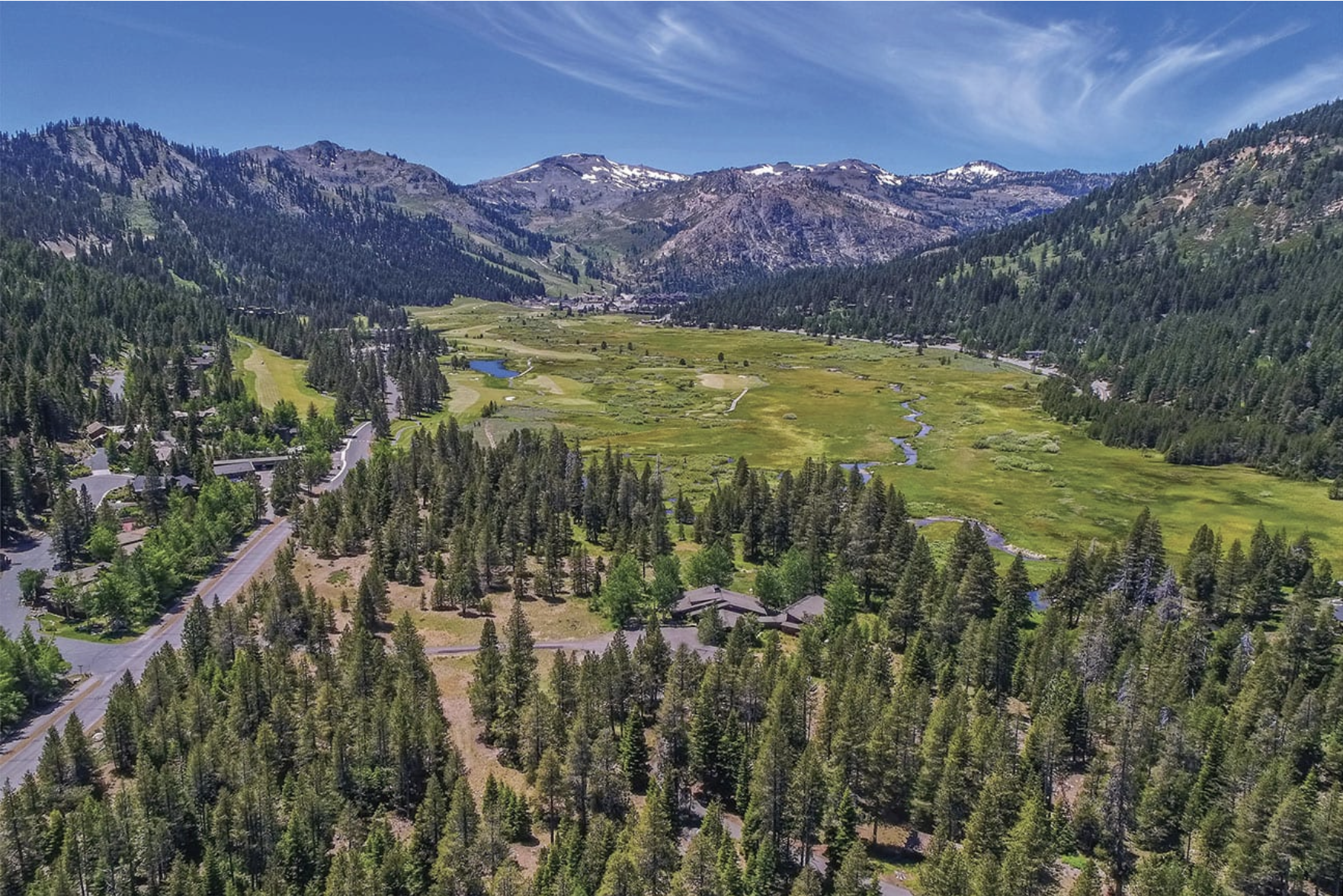
The Ponderosa Ranch


The Poulson Ranch


Donner Pass Petroglyphs


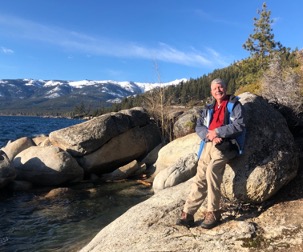
An Original Mountain Man


https://madhedgefundtrader.com/wp-content/uploads/2019/05/cropped-mad-hedge-logo-transparent-192x192_f9578834168ba24df3eb53916a12c882.png 0 0 april@madhedgefundtrader.com https://madhedgefundtrader.com/wp-content/uploads/2019/05/cropped-mad-hedge-logo-transparent-192x192_f9578834168ba24df3eb53916a12c882.png april@madhedgefundtrader.com2023-09-18 09:02:452023-09-18 20:27:49The Market Outlook for the Week Ahead
april@madhedgefundtrader.com

September 12, 2023

Diary, Newsletter, Summary

Global Market Comments
September 12, 2023
Fiat Lux

Featured Trade:

(THE GREAT AMERICAN ONSHORING TREND IS ACCELERATING),
(GE), (TSLA),
(MURRAY SAYLE: THE PASSING OF A GIANT IN JOURNALISM)
(THE LAST PEARL HARBOR ARIZONA SURVIVOR)

https://madhedgefundtrader.com/wp-content/uploads/2019/05/cropped-mad-hedge-logo-transparent-192x192_f9578834168ba24df3eb53916a12c882.png 0 0 april@madhedgefundtrader.com https://madhedgefundtrader.com/wp-content/uploads/2019/05/cropped-mad-hedge-logo-transparent-192x192_f9578834168ba24df3eb53916a12c882.png april@madhedgefundtrader.com2023-09-12 09:08:502023-09-12 12:26:20September 12, 2023
Mad Hedge Fund Trader

The Great American Onshoring Trend is Accelerating

Diary, Newsletter

Onshoring, the return of US manufacturing from abroad, is rapidly gathering pace.

It is increasingly playing a crucial part in the unfolding American industrial renaissance. It could well develop into the most important new trend on the global economic scene during the early 21st century. It is also paving the way for a return of the roaring twenties to our home shores.

Of course, it is hard to quantify this assumption with hard data. US government statistics are a deep lagging indicator and are unable to keep up with a rapidly changing, interconnected, fluid world. No doubt, they will tell us this epoch-making sea change is underway in ten years.

However, it is possible to track what a single company is accomplishing. In 1973, General Electric (GE) ran the largest home appliance manufacturing facility in the world. Its Appliance Park in Louisville, Kentucky, employed 23,000 workers packed into six gigantic buildings, each as large as a shopping mall. It was so big, it even earned its own postal zip code (40225).

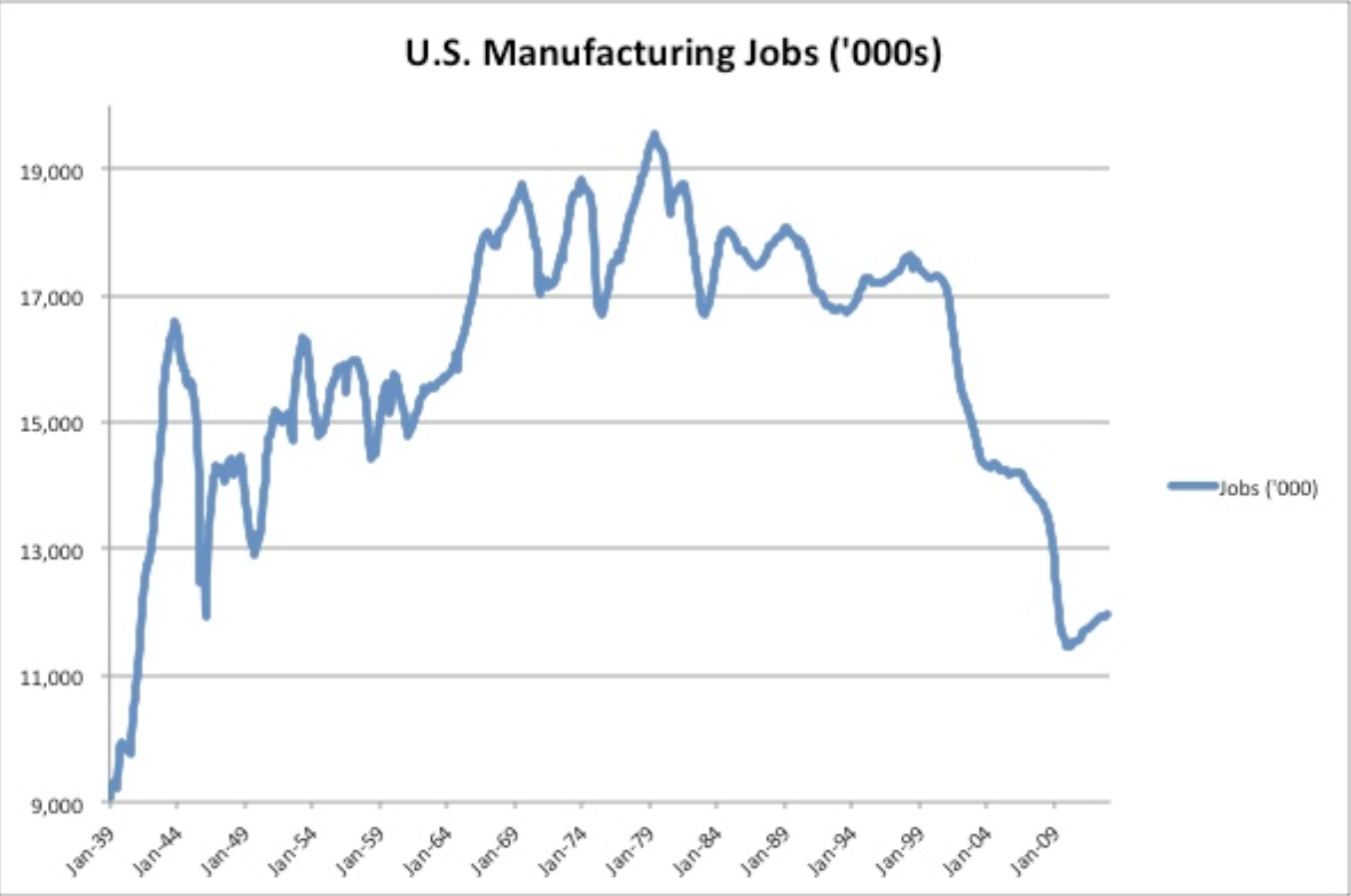
After that, the offshoring mania kicked in, with the firm motivated by a single factor: hourly wages. You could hire 30 men in China for the cost of one American union worker. The savings were too compelling to pass up, and The Great Hollowing Out of US manufacturing was off to the races.

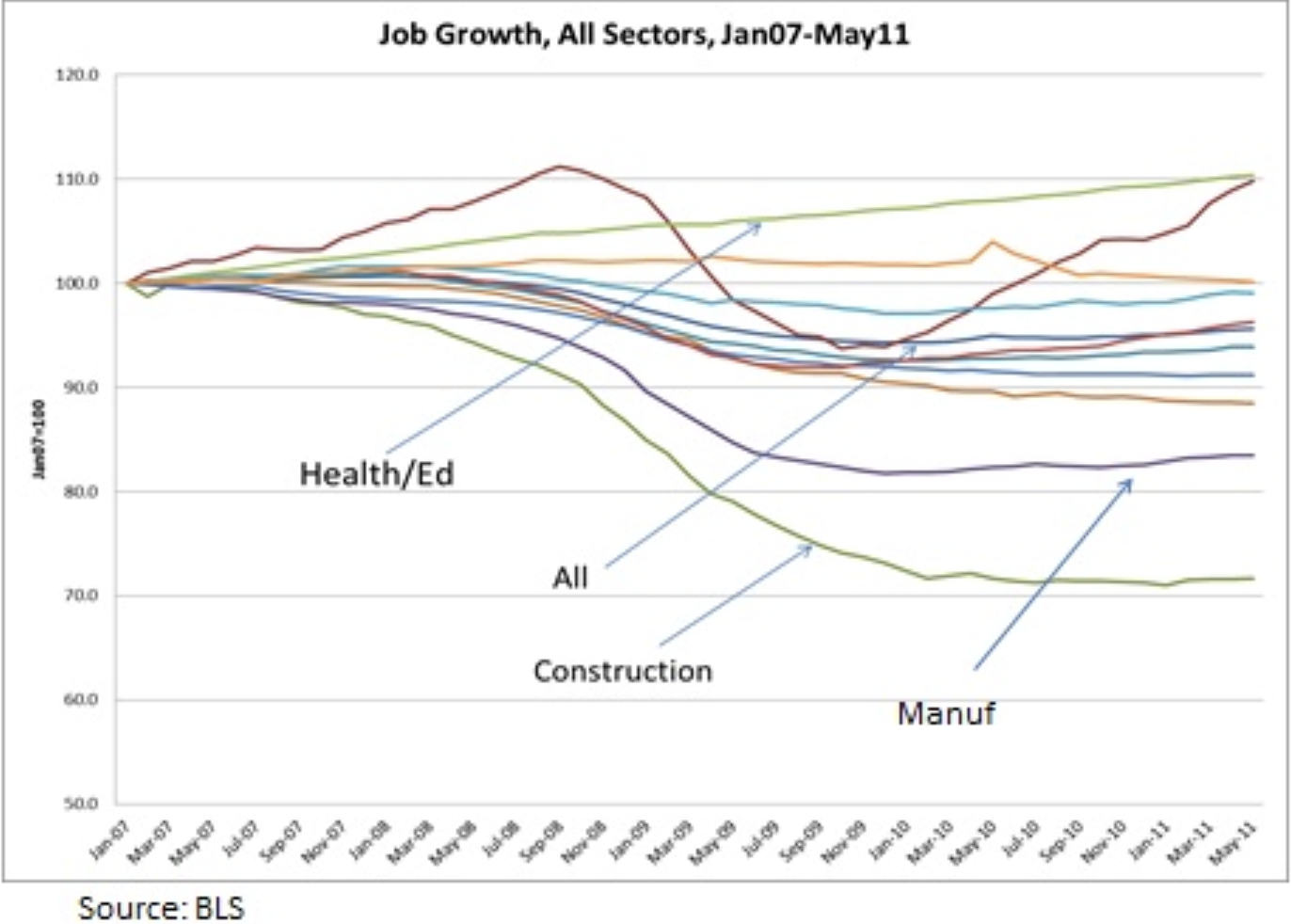
GE tried to sell the entire operation but was too late. The 2008 financial crisis decimated the market for Midwest industrial facilities. You could only get the scrap metal value, or three cents on the dollar. By 2011 employment at Appliance Park had plunged to 1,863, and the region’s new “Rust Belt” sobriquet was well earned.

Then, almost imperceptibly at first, the trend started to reverse. Decades of 20% a year wage increases took the cost of a skilled Chinese worker from $300 a year to $25,000. The 2011 Japanese tsunami, followed by huge floods in Thailand, caused massive disruptions to the international parts supply network.

A minor strike by the Longshoreman’s Union at the Port of Oakland in California brought the distribution channel to a grinding halt. Business plans that looked great on an Excel spreadsheet turned out to be not so hot in practice.

It gets worse. When Chinese workers walked across the street to collect bigger pay packages, they often took blueprints, business plans, and proprietary software with them. Six months later, a local competitor would show up with a similar, although inferior, product at half the cost. Suddenly, globalization was not all it was cracked up to be.

In the meantime, the American labor force, reading the Chinese characters on the wall, evolved. Unions were disbanded. Antiquated work rules were tossed. The unions that were left agreed to two tier wage structures that had entry level employees coming in at $13.50 an hour, a fraction of the original rate.

Then management got smarter. By removing the assembly line from the marketplace, companies lost touch with customers. Designers lost contact with the manufacturing process, creating products that could only be built expensively, or not at all. Quality plummeted. Innovation suffered. By bringing manufacturing home, firms not only solved these problems, they were able to build better ones for less money.

China turned out to be farther away than people thought. Having middle management jet lagged up to three months a year proved to be very expensive. It takes six weeks to ship an appliance from the Middle Kingdom to the US if the shipping schedules are perfect.

An American plant can truck product to most US stores within two days. That wasn’t a problem when consumer products saw lives that ran into decades. It is a big deal when rapidly accelerating technological improvements require them to be turned over every three years or less, as they are today.

The energy picture is undercutting the arithmetic that used to justify offshoring. Oil prices levitating near $100 a barrel are up 400% in 14 years, elevating the cost of production in Asia and shipments to the US. In the US, the fracking boom has let lose a gusher of cheap oil. It has also freed up a few centuries worth of low carbon burning natural gas, giving American manufacturers a further cost advantage.

Better American management techniques are giving US based factories an edge. I saw this up close at the Tesla (TSLA) factory in Fremont, California, where workers have the ability to improve the assembly process daily and are incented to do so. The place was so clean and quiet, it felt more like a hospital than a factory. It turns out that a drive train with only 11 parts doesn’t require much labor to assemble it, and robots do most of that.

By adopting similar techniques, GE, is building the same number of appliances as it did during the 1960’s peak, about 250,000 a year, with one third of the employees.

Using the new thinking, many companies are finding out that offshoring was a big mistake in the first place, and are bringing production home.  Some business analysts estimate that up to a quarter of the companies that offshored lost money doing it.

The fact that GE is onshoring is important. It is considered by many to be the best-run industrial company in the United States, and when it leads, many follow. On the heels of the GE move, Whirlpool has relocated its mixer assembly from China to Ohio, and Otis has brought home elevator making from Mexico.

Even Wham-O has jumped on board, the maker of Frisbees, Slinkies, and Hula Hoops, and a company that is dear to my heart (I dated the founder’s daughter in high school), moving production from the Middle Kingdom back to Southern California.

If I am right, and onshoring speeds up into the next decade, we may get another opportunity to relive the roaring twenties. By then, a shortage of workers will lead to higher wages, greater consumer spending, and rising standards of living. The price of everything will rocket, including your stocks and homes. US GDP growth will surge to 4%-5% a year. Inflation will, at long last, make its long-predicted return.

It will be an economy in which Jay Gatsby will feel right at home.


A Trend Reversal?


Leonard DiCaprio

The Roaring Twenties Are Headed Our Way

https://www.madhedgefundtrader.com/wp-content/uploads/2013/05/Leonard-DiCaprio-e1415560921439.jpg 271 400 Mad Hedge Fund Trader https://madhedgefundtrader.com/wp-content/uploads/2019/05/cropped-mad-hedge-logo-transparent-192x192_f9578834168ba24df3eb53916a12c882.png Mad Hedge Fund Trader2023-09-12 09:06:002023-09-12 12:25:47The Great American Onshoring Trend is Accelerating
Mad Hedge Fund Trader

September 11, 2023

Diary, Newsletter, Summary

Global Market Comments
September 11, 2023
Fiat Lux

Featured Trade:

(MARKET OUTLOOK FOR THE WEEK AHEAD, or THE BIG PULL FORWARD)
(AAPL), (UUP), (TSLA), (USO), (BYDDF)

https://madhedgefundtrader.com/wp-content/uploads/2019/05/cropped-mad-hedge-logo-transparent-192x192_f9578834168ba24df3eb53916a12c882.png 0 0 Mad Hedge Fund Trader https://madhedgefundtrader.com/wp-content/uploads/2019/05/cropped-mad-hedge-logo-transparent-192x192_f9578834168ba24df3eb53916a12c882.png Mad Hedge Fund Trader2023-09-11 09:04:042023-09-11 12:16:41September 11, 2023
Mad Hedge Fund Trader

The Market Outlook for the Week Ahead, or The Big Pull Forward

Diary, Newsletter

Somehow, the summer got moved this year.

For here it is September, and the stock market is behaving like it is only July. July was different from normal as well, going straight up almost every day when it is usually asleep. This year, July acted like May, when you’re supposed to sell and go away.

If you’re thoroughly confused by all of this, so am I. The historic cyclicality of the markets, the ebb and flow of share prices according to the calendar, has gone out the window. But then, what isn’t confusing these days?

I went to buy a green drink from Whole Foods on Friday and the counter was closed because of staff shortages. Whole Foods unable to sell a green drink?

I tried to climb the Matterhorn this summer but was told that the guides weren’t taking anyone up because of the extreme heat. The mountain was literally melting, dropping rocks on the heads of climbers. No climbing the Matterhorn in Switzerland? I went to the Dolomites instead where you climb ice-free shear rock faces.

I tried to get into the Pantheon in Rome this summer and was met with a five-hour line. The Sistine Chapel in the Vatican was worse. When I first went there in the 1960’s the place was empty. The fact is that Italy now has more tourists than Italians. Oh, and the pope is from Argentina.

Has the world gone mad?

What has happened is that there has been a great pull forward that took place in financial markets during the first half of the year. I’ve seen this before. When a conclusion becomes obvious, everyone jumps on the bandwagon and brings everything forward.

So from January to July stock markets saw the blatantly obvious future that inflation would fall, interest rates decline, the US dollar weaken, and commodities and precious metals would rise. That’s why the “Magnificent Seven” led.

What happens next?

Now shares have to wait until these predictions actually happen before they can move any further. Markets have moved as far as they can on faith alone. Next, we need facts. This could take weeks or even months.

I knew this was going to happen. That’s why I went pedal to the metal, full speed ahead, damn the torpedoes aggressive during the first half of the year and clocked a 60% profit. I expected that if you didn’t make a profit in the first half of the year, you wouldn’t have any profits in 2023 at all.

And the trade alert drought continues.

There isn’t a day that goes by when I am not asked if America’s $33 trillion national debt will destroy the economy, cause the stock market to crash, and bring the end of Western Civilization. The answer is no, never, not in our lifetimes.

The reason is very simple. Any dollar the government borrows today sees its purchasing power go to zero in 30 years. That’s where the massive Civil War debt went, that's where the WWI debt went, and that’s where the gigantic WWII debt went, some 105% of GDP. Today’s debt will similarly vaporize over time.

Who pays for this cataclysmic decline in value? US government debt holders, who similarly see their purchasing power disappear over time. It turns out that the ultimate avoiders of risk, investors in US government debt, not only don’t get paid for their cowardice, they lose their entire principal as well, at least in terms of purchasing power.

There is a wonderful article in Barron’s this week entitled “Government Debt Needs to Be Repaid, And Other Myths About the Federal Deficit” by Paul Sheard which explains how all this works, which I quote below in its entirety.

“The U.S. national debt currently stands at $32.91 trillion, and 10 months into this fiscal year, the U.S. government has spent $1.6 trillion more than it has collected in revenue. Those intimidating figures animate political battles that can shut down the government and even bring it to the brink of default. But the meaning of this money isn’t as simple as it seems. Five myths in particular deserve straightening out.

The first is that the government has to borrow in order to spend and run deficits. It’s the other way around. The government creates money (injects it into the economy) when it spends and destroys money (withdraws it from the economy) when it taxes. The government taxes variously to correct for negative externalities, to redistribute income, and to modulate aggregate demand; “raising revenue” is just a cover story. 

A related myth is that the government needs to repay its debt. “Debt” is a misnomer; government debt is just money (or purchasing power) in another form. A $20 bill is a liability of the Fed, which makes it a liability of the federal government. A $20 bill never has to be repaid; it just is. Fundamentally, Treasuries aren’t much different.

That government debt never needs to be repaid doesn’t mean the government can or should create as much of it as it likes.

Too big a pile of debt because of prior and ongoing budget deficits may be inflationary, as too much money chases insufficient goods and services. That will require some combination of monetary and fiscal tightening. A mountain of debt may indicate a government that is too big and intrusive in the economy for many people’s liking, an issue that can be fought out at the ballot box. 

A third myth is that the Fed prints money when it does quantitative easing. The money-printing happens when the government runs a budget deficit; QE just changes the form of that money. 

QE is really just a debt refinancing operation of the consolidated government—that is, the government including the Fed—whereby it refinances one form of debt (government bonds or guarantees) into another (reserves). QE changes the composition of the (consolidated) government debt in the hands of the private sector, but it doesn’t directly add one iota of new purchasing power. For every dollar the Fed “pumps into” the economy by doing QE, it “sucks out” a dollar of assets. Conversely, quantitative tightening just returns assets to private sector portfolios, expunging reserves in the process. 

Reserves are like banknotes: The Fed can withdraw them, but it never has to repay them as such. It looks like the government has to repay Treasuries, but this is an institutional artifact. In extremis, the Fed could convert all outstanding Treasuries into reserves, and it could maintain monetary control by it, rather than the fiscal authorities, paying interest on reserves. 

Japan is the poster child for a miserable-looking fiscal picture. Yet, the Bank of Japan, the pioneer of QE, owns almost half of the stock of outstanding Japanese government securities and, at the same time, since 2016 has managed the 10-year yield, with some leeway, to be “around zero percent.” 

It is precisely because the government can create money at will that the modern monetary and fiscal architecture has been designed to put shackles on its ability to do so: The creation of an “independent” central bank within the government, the central bank not allowing the government’s account with it to go into overdraft, the central bank not buying bonds directly from the government, and governments issuing debt securities rather than leaving their deficits in the form of reserves all serve that purpose. But what the government taketh away, it can give back. Faced with the need, it could loosen those shackles.

A fourth, and related, myth is that banks could, if so moved, “lend out” the excess reserves created by QE. Banks can lend these reserves to one another but they cannot turn them into lending to companies and households in the broader economy.

It isn’t just the government that creates money. Banks do, too. A fifth myth is that banks are just financial intermediaries “taking in” deposits and “lending them out.” Not so. Banks create money when they lend. For an individual bank making a new loan, it may not feel like this, because the first thing borrowers do is spend their money. If none of that money flows back into the same bank, its reserves at the central bank will decline by the amount of the loan. It will then probably want to attract deposits to “fund” the loan, but doing so will just top up its lost reserves. Bank lending for the system is entirely self-funding (so long as none of the money created leaks into bank notes).

The U.S. economy currently produces about $27 trillion of goods and services annually, a little more than the amount of federal debt held by the public and the QE-embracing Fed. The money needed to sustain this giant prosperity-generating machine comes from the government running deficits and from banks extending credit, with the Fed’s activities linking the two. Political debates and decisions currently are based on a befuddled grasp of how this monetary system works. The stakes for society are too high for that.”

So far in August, we are down -4.70%. My 2023 year-to-date performance is still at an eye-popping +60.80%. The S&P 500 (SPY) is up +17.10% so far in 2023. My trailing one-year return reached +92.45% versus +8.45% for the S&P 500.

That brings my 15-year total return to +657.99%. My average annualized return has fallen back to +48.15%, another new high, some 2.50 times the S&P 500 over the same period.

Some 41 of my 46 trades this year have been profitable.

Beige Book Shows Consumer Spending Slowing, long a pillar of this recovery, as the last of the pandemic bonuses work their way for the system. It’s putting a dent in corporate profits and hints at a shrinking economy, contrary to recent economic data.

The US Dollar (UUP) is Soaring, thanks to “higher interest rates for longer” and a strengthening US economy. Asian currencies are at ten-month lows and central bank intervention is looking. The dollar shorting selling opportunity of the decade is setting up.

China Restricts Sales of iPhones (AAPL), barring sales to government agencies. It’s only a small nick in overall sales, but certainly casts of cloud over doing business in the Middle Kingdom. Some $200 billion, (AAPL)’s market cap has been vaporized.

Weekly Jobless Claims Dive, down 13,000 to 216,000, a seven-month low. It’s the fourth consecutive decline and not what the Fed wanted to hear.

Rate Hikes Will Drag on the Economy for at Least a Decade, as the Fed's $8.24 trillion balance sheet unwinds, according to the San Francisco Fed. The balance sheet was only at $800 million before the 2008 Great Recession.

Saudi Arabia and Russia Engineer Short Squeeze on Oil (USO), taking the price over $90 a barrel this year. Large production cuts announced in June will be maintained until yearend. Will Biden counter with a release from the Strategic Petroleum Reserve, or SPR?

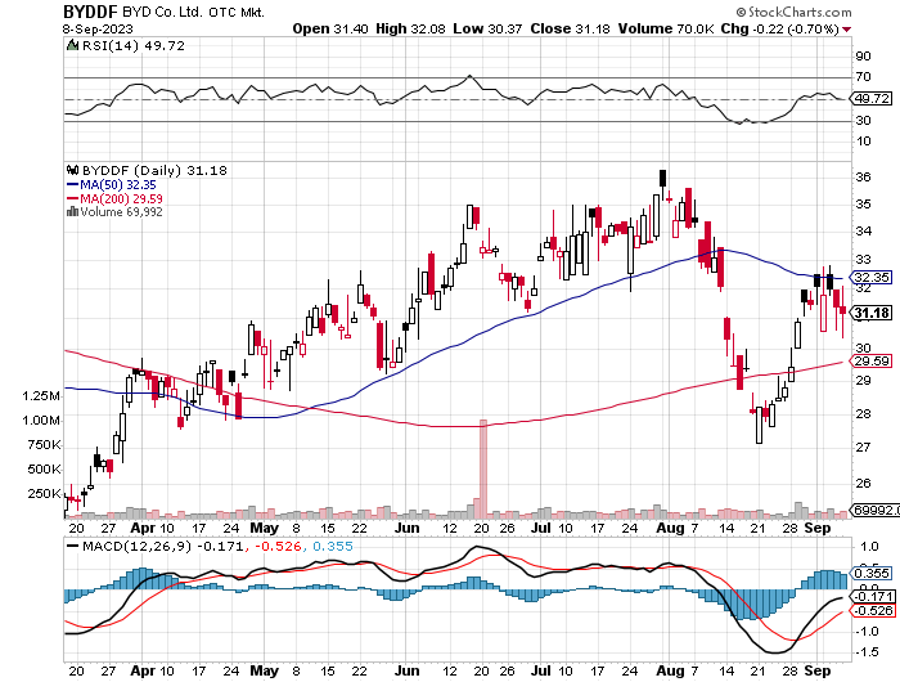
Tesla’s Chinese EV Deliveries Rise 9.3% in August, thanks to aggressive price cuts. There is a two-month wait for the Model Y. Chinese rival BYD (BYD), with its Dynasty and Ocean series of EVs and petrol-electric hybrid models, recorded deliveries of 274,086 passenger vehicles in August, a jump of 57.5% year-on-year. China has the world’s largest car market.

My Ten-Year View

When we come out the other side of the recession, we will be perfectly poised to launch into my new American Golden Age, or the next Roaring Twenties. The economy decarbonizing and technology hyper-accelerating, creating enormous investment opportunities. The Dow Average will rise by 800% to 240,000 or more in the coming decade. The new America will be far more efficient and profitable than the old.

Dow 240,000 here we come!

On Monday, September 11, US Consumer Inflation Expectations are announced.

On Tuesday, September 12 at 8:30 PM EST, NFIB Business Optimism Index is released. Apple announced the new iPhone 15.

On Wednesday, September 13 at 8:30 AM, the Core Inflation Rate for August is published.

On Thursday, September 14 at 8:30 AM, the Weekly Jobless Claims are announced. ARM started trading after its IPO, which was five times oversubscribed. NVIDIA tried but failed to take over the chip maker.

On Friday, September 15 at 2:30 PM, the Producer Price Index for August is published. At 2:00 PM the Baker Hughes Rig Count is printed.

As for me
, not just anybody is allowed to fly an aircraft in Hawaii. You have to undergo special training and obtain a license endorsement to cope with the Aloha State’s many aviation challenges.

You must learn how to fly around an erupting volcano, as it can swing your compass by 30 degrees. You must master the fine art of not getting hit by a wave on takeoff since it will bend your wingtips forward. And you’re not allowed to harass pods of migrating humpback whales at a low level, a sight I will never forget.

Traveling interisland can be highly embarrassing when pronouncing reporting points that have 16 vowels. And better make sure your navigation is good. Once a plane ditched interisland and the crew was found six months later off the coast of Australia. Many are never heard from again.

And when landing on the Navy base at Ford Island you were told to do so lightly, as they still hadn’t found all the bombs the Japanese had dropped during their Pearl Harbor attack in 1941.

You are also informed that there is one airfield on the north shore of Molokai you can never land at unless you have the written permission from the Hawaii Department of Public Health. I asked why and was told that it was the last leper colony operating in the United States.

My interest piqued, the next day found me at the Hawaiian state agency with an application in hand. I still carried my UCLA ID which described me as a DNA researcher, which did the trick.

When I read my flight clearance to the controller at Honolulu International Airport, he blanched, asking if I had authorization because he’d never seen one before. I answered that yes, I did, I really was headed to the dreaded Kalaupapa Airport, the Airport of no Return.

Getting into Kalaupapa is no mean feat. You have to follow the north coast of Molokai, a 3,000-foot-high series of vertical cliffs punctuated by spectacular waterfalls. Then you have to cut your engine and dive for the runway in order to land into the wind. You can only do this on clear days, as the airport has no navigational aids. The crosswind is horrific.

If you don’t have a plane it is a 20-mile hike down a slippery trail to get into the leper colony. It wasn’t always so easy.

During the 19th century, Hawaiians were terrified of leprosy, believing it caused the horrifying loss of appendages, like fingers, toes, and noses, leaving bloody open wounds.  So, King Kamehameha I exiled lepers to Kalaupapa, the most isolated place in the Pacific.

Sailing ships were too scared to dock. They simply threw their passengers overboard and forced them to swim for it. Once on the beach, they were beaten a clubbed for their possessions. Many starved.

Leprosy was once thought to be a result of sinfulness or infidelity. In 1873, Dr. Gerhard Henrik Armauer Hansen of Norway was the first person to identify the germ that causes leprosy, the Mycobacterium leprae.

Thereafter, it became known as Hanson’s Disease. A multidrug treatment that arrested the disease, but never cured it, did not become available until 1981.

Leprosy doesn’t actually cause appendages to drop off as once feared. Instead, it deadens the nerves, and then rats eat the fingers, toes, and noses of the sufferers when they are sleeping. It can only be contracted through eating or drinking live bacteria.

When I taxied to the modest one-hut airport, I noticed a huge sign warning “Closed by the Department of Health.” As they so rarely get visitors the mayor came out to greet me. I shook his hand but there was nothing there. He was missing three fingers.

He looked at me, smiled, and asked, “How did you know?”

I answered, “I studied it in college.” Even today, most are terrified of shaking hands with lepers.

Not me.

He then proceeded to give me a personal tour of the colony. The first thing you notice is that there are cemeteries everywhere filled with thousands of wooden crosses. Death is the town’s main industry.

There are no jobs. Everyone lives on food stamps. A boat comes once from Oahu a week to resupply the commissary. The government stopped sending new lepers to the colony in 1969 and is just waiting for the existing population to die off before they close it down.

Needless to say, it is one of the most beautiful places on the planet.

The highlight of the day was a stop at Father Damien’s church, the 19th century Belgian catholic missionary who came to care for the lepers. He stayed until the disease claimed him and was later sainted. My late friend Robin Williams made a movie about him, but it was never released to the public.

The mayor invited me to stay for lunch, but I said I would pass. I had to take off from Kalaupapa before the winds shifted.

It was an experience I will never forget.

Stay Healthy,

John Thomas
CEO & Publisher
The Diary of a Mad Hedge Fund Trader


The Airport of No Return


Father Damien


https://madhedgefundtrader.com/wp-content/uploads/2019/05/cropped-mad-hedge-logo-transparent-192x192_f9578834168ba24df3eb53916a12c882.png 0 0 Mad Hedge Fund Trader https://madhedgefundtrader.com/wp-content/uploads/2019/05/cropped-mad-hedge-logo-transparent-192x192_f9578834168ba24df3eb53916a12c882.png Mad Hedge Fund Trader2023-09-11 09:02:122023-09-11 16:04:06The Market Outlook for the Week Ahead, or The Big Pull Forward
Mad Hedge Fund Trader

September 5, 2023

Diary, Newsletter, Summary

Global Market Comments
September 5, 2023
Fiat Lux

Featured Trades:

(The Mad Hedge September Traders & Investors Summit is ON!)
(MARKET OUTLOOK FOR THE WEEK AHEAD, or THE NEW GOLDEN AGE IS ABOUT TO BEGIN!)
(TLT), (TSLA), (AAPL), (AMGN)


CLICK HERE to download today's position sheet.

https://madhedgefundtrader.com/wp-content/uploads/2019/05/cropped-mad-hedge-logo-transparent-192x192_f9578834168ba24df3eb53916a12c882.png 0 0 Mad Hedge Fund Trader https://madhedgefundtrader.com/wp-content/uploads/2019/05/cropped-mad-hedge-logo-transparent-192x192_f9578834168ba24df3eb53916a12c882.png Mad Hedge Fund Trader2023-09-05 09:06:262023-09-05 16:32:26September 5, 2023
Mad Hedge Fund Trader

The Market Outlook for the Week Ahead, or The New Golden Age is About to Begin!

Diary, Newsletter

If any of you ever had concerns about the long-term future of the United States of America you can put them to rest.

Escaping from Silicon Valley to the cooling majestic heights of the High Sierras ahead of the Labor Day weekend, Google Maps directed to a series of back roads to avoid the traffic Armageddon taking place on the freeways.

Known as the “Delta Highway,” I had to cross three ancient rickety 100-year-old bridges just to get to Stockton.

And you know what I saw?

The proverbial “majestic waves of grain.”

I passed square mile after square mile of ripening corn “as high as an elephant’s eye”. Next came square miles of fields in fallow planted with clover capturing nitrogen. That was followed by miles of the darkest and richest earth you ever saw ready for new planting.

The fields were intermittently spaced with You-Pick cherry and peach orchards crowded with Asian customers. To them, the fact you can just drive out into the countryside and pick fresh fruit for $5 a bucket was utterly amazing.

One of the questions I get asked most often from the top down is whether China will invade Taiwan. My answer is always the same: Not a chance. They’ll never do more than bluff as they have done for the last 70 years.

That is because modern China exists only because of America’s good graces. If they invaded, we would cut of their food supply the next day. There are no alternative food supplies for 1.2 billion people anywhere in the world.

 
Over time, they might develop some supplies in South America or Africa but by the time those had any meaningful impact, half the population would starve to death. Everything in agriculture happens slowly.

I’ve been in China during famines and let me tell you it’s no fun. There is no substitute for food, not at any price.

We know this, the Chinese know this, everybody knows this.

The power of nations used to be measured in food production, bushels of wheat in the West and baskets of rice in Asia. To some extent it still is. Who are the largest producers of food in the world? China, India, the US, and Brazil. But the first two consume their entire output and then some, while the last two are the world’s largest food exporters by miles.

Of course, China will take Taiwan if we give it to them. That’s why it’s useful to keep our Seventh Fleet in the neighborhood just to remind them that we’re still watching. It’s also not a bad idea to bring some of our semiconductor production home as well just as a hedge, a risk control measure.

So you can stop asking me if China will invade Taiwan.

In the meantime, regarding your personal investment strategy, there is only one number you need to know: $5.6 trillion. That is the amount of cash, cash equivalents, money, market funds, and 90-day T-bills sitting on the sidelines waiting to go into risk assets.

And by risk assets, I mean stocks, bonds, commodities, precious metals, energy, and real estate.

Incredible as it may seem, the majority of investors still don’t believe that the greatest bull market of the ages started on October 15, 2022. They think we are in a bear market and are waiting for better buying opportunities much lower down.

Partly this is happening because they are being told by their political leaders that the US has the worst economy in the world. When they come to the harsh reality that the opposite is true, that the US has the best economy in the world by far, money will come pouring off the sidelines and take stocks up at least until 2030.

This will take place no later than October by my reckoning.

That’s when a New Golden Age kicks off that will last a decade or more, driven by AI, quantum computers, graphene, carbon fiber, free energy, superconductivity, solid state batteries, and 100 other hyper-accelerating technologies.

Make concentration of the wealth at the top work for you and get involved in the market. Become one of the 1%. I’ve done it starting from a very low base. Keep those 90-day T-bills at your peril, no matter how attractive those 5.35% guaranteed yields may be.

Which leads us to a quandary.

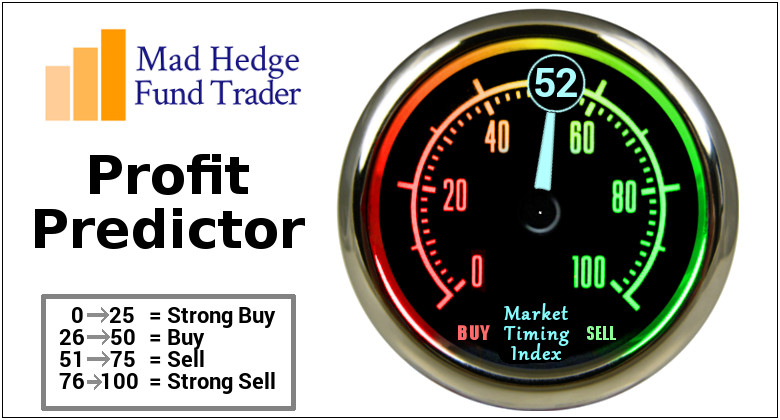
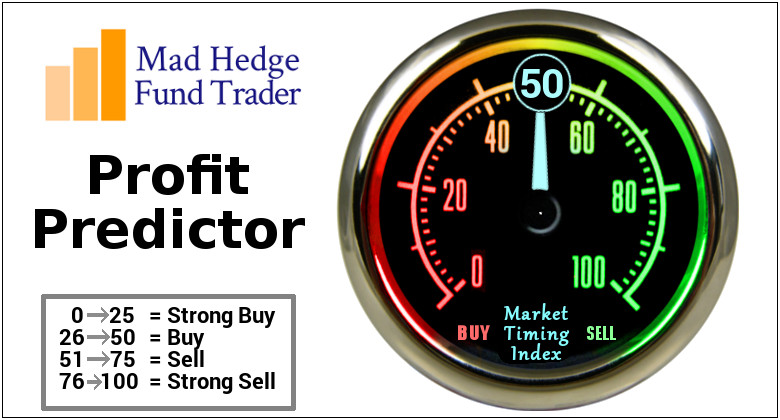
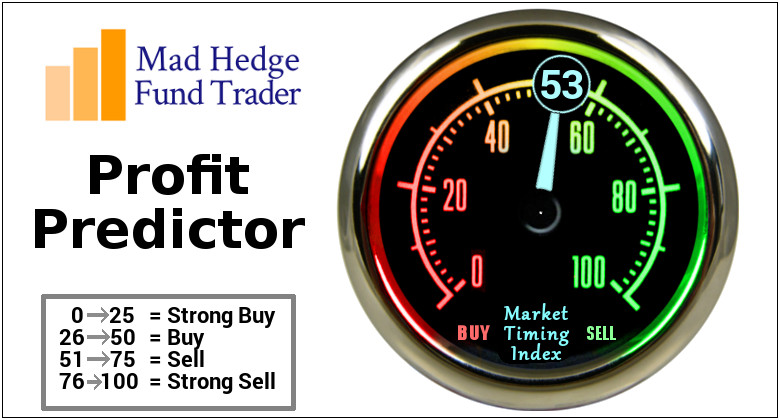
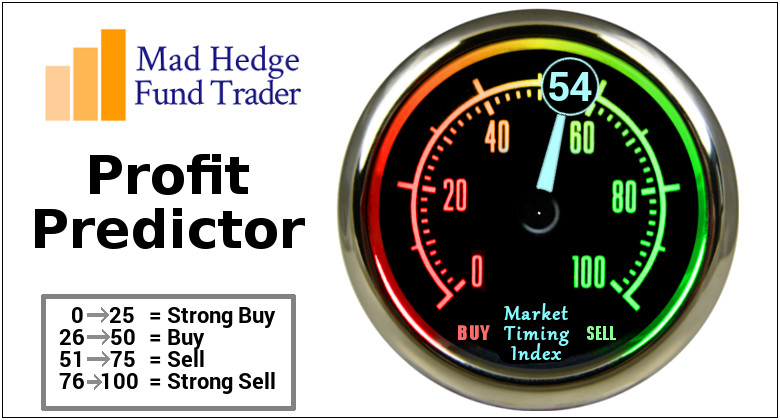
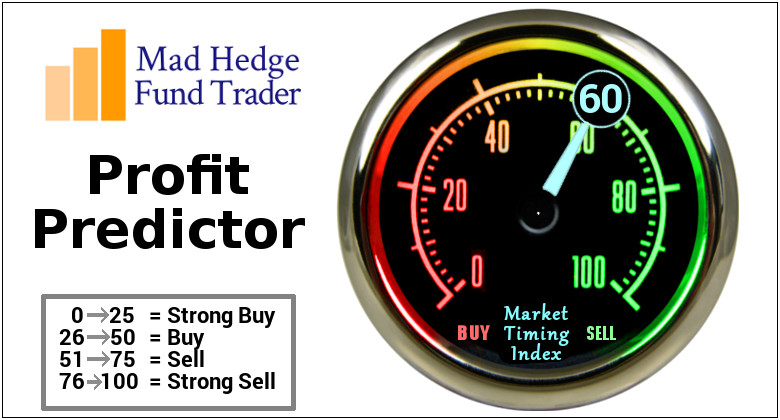
Stocks never got cheap during the summer selloff, they just dropped from very expensive to expensive. The Mad Hedge AI Market Timing Index didn’t get lower than 45 compared to the usual low of 20, or even 3 (the pandemic low).

That means we are going to have to invest on the basis of stocks going from expensive to extremely expensive. It’s not the game we are used to playing. But stocks have done this before.

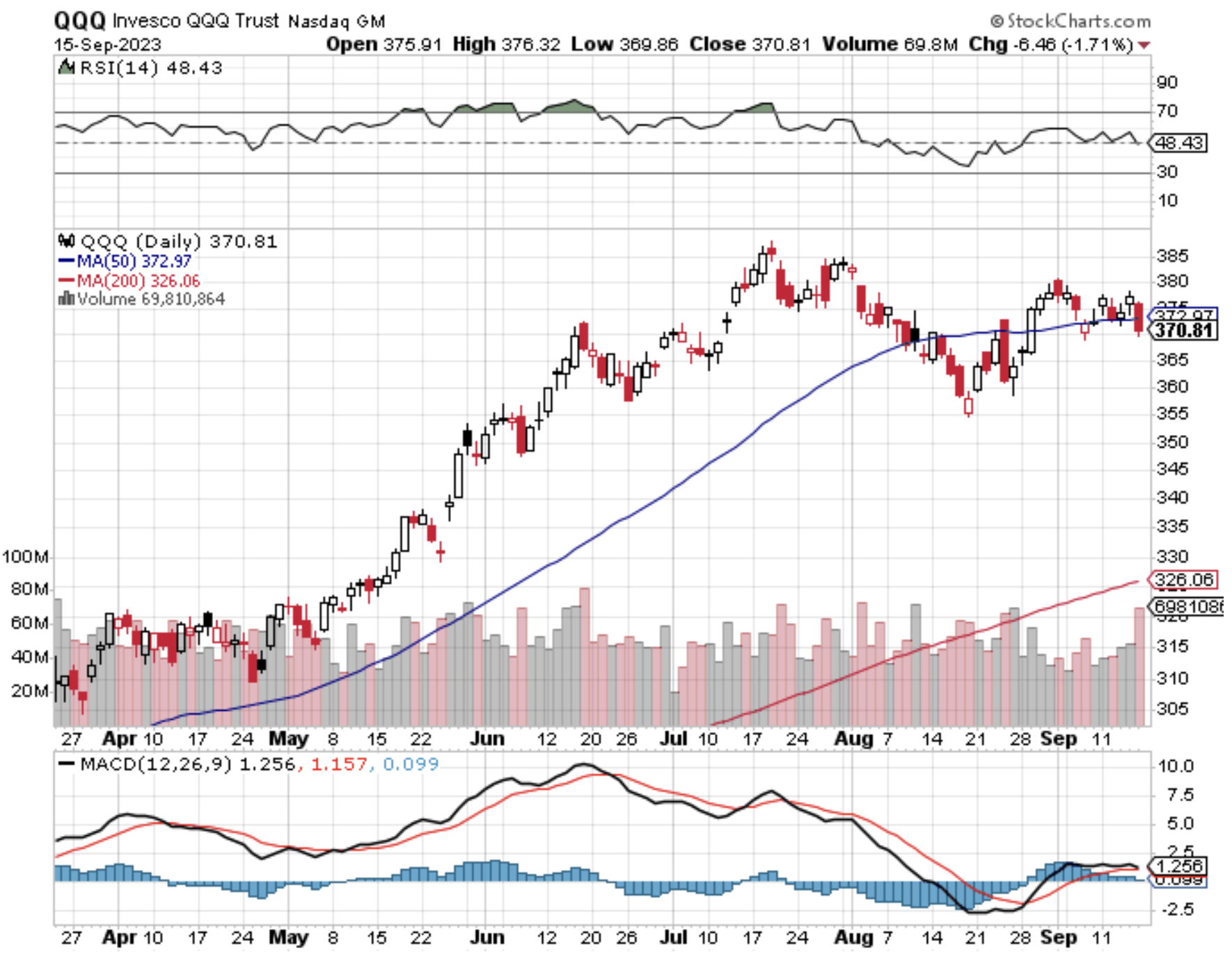
The (QQQ) traded at a price-earnings multiple of 100 times earnings at the Dotcom Bubble top in 2000 compared to only 30.79 times now and that was only with a fraction of the emerging technologies currently under development.

You can wait for The Mad Hedge AI Market Timing Index to get to 20, or even 3, but it might never happen.

I just thought you’d like to know.

So far in September, we are unchanged with a +0.00% return. My 2023 year-to-date performance is still at an eye-popping +60.80%. The S&P 500 (SPY) is up +17.10% so far in 2023. My trailing one-year return reached +92.45% versus +8.45% for the S&P 500.

That brings my 15-year total return to +657.99%. My average annualized return has fallen back to +48.15%, another new high, some 2.50 times the S&P 500 over the same period.

Some 41 of my 46 trades this year have been profitable.

Nonfarm Payroll Comes in Weak, at 187,000, in August. The Headline Unemployment rate posted at near a 50-year low at 3.8%.
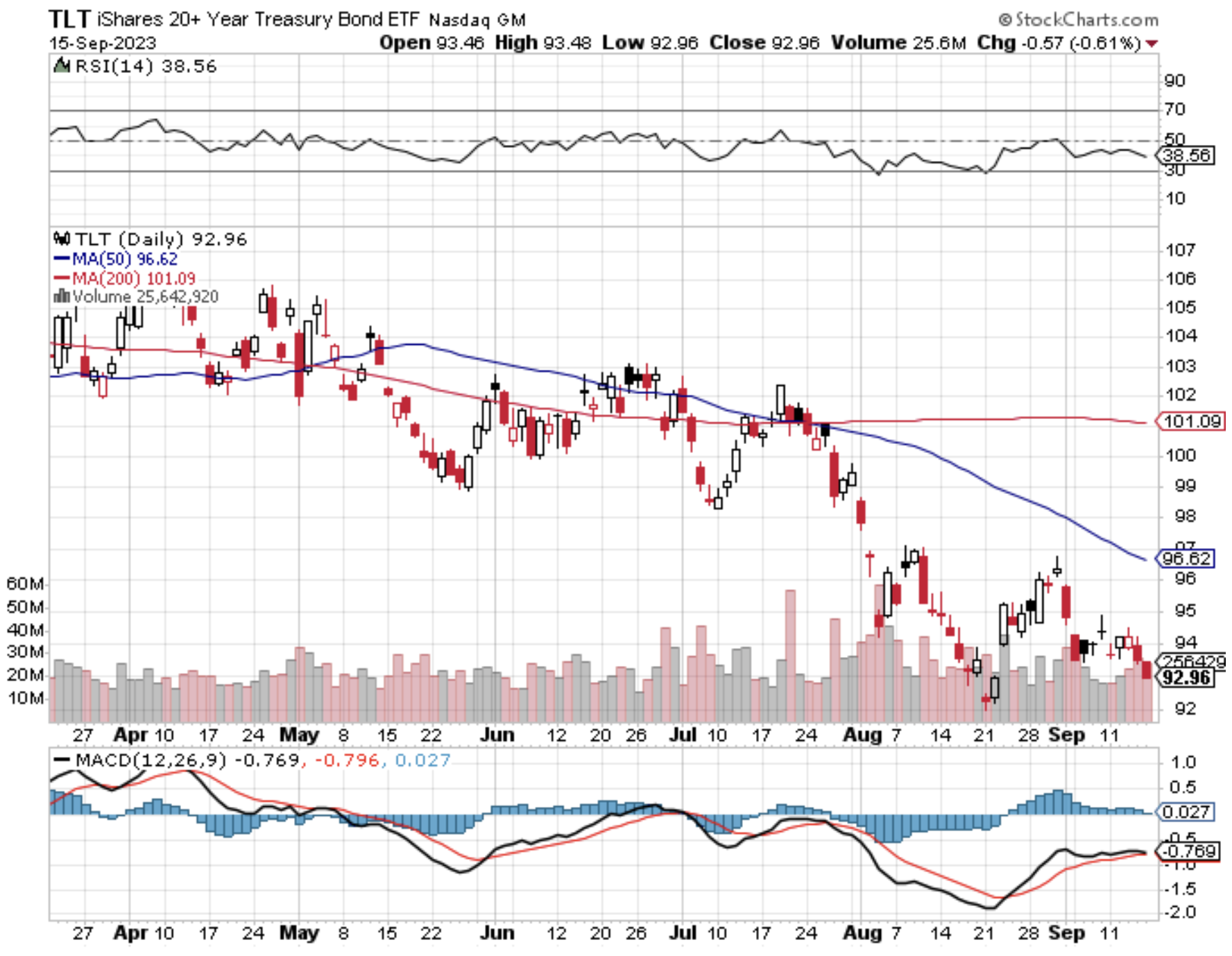
It’s the third month in a row under 200,000. The U-6 “discouraged worker” rate popped from 6.7% to 7.1%. Strikes are becoming a factor. The news took the ten-year US Treasury bond yield (TLT) under 4.0% for the first time in months.

Weekly Jobless Claims Decline to 228,000 as the economy heats up. 235,000 was expected. Continuing Claims are at 1.9 million.

Jolts Disappoints, with new job openings coming in at only 8.83 million, a 2 ½ year low. The labor shortage is getting worse, suggesting that the headline Unemployment Rate could rise on Friday and that inflation will continue falling. The drop in openings reflected declines in professional and business services, health care, and government. Hold on to your hat!

Apple (AAPL) to Launch New iPhone 15 on September 15. The highlight of the event will be the iPhone 15 lineup, which will include two entry-level models and two high-end models. The lower-end devices, likely to be called the iPhone 15 and 15 Plus, will get some capabilities of last year’s Pro models — the A16 chip, Dynamic Island interface, and a 48-megapixel rear camera — but retain the current design.

Bank Earnings Forecasts Cut, by Wells Fargo’s Mike Mayo, a noted bank analyst. New regulations are raising costs across the board. Capital requirements are rising. You can count on share buybacks to be paid back. More business is being pushed outside the banking system. Stand back from bank shares until we learn the new paradigm.

India Attempts to Win the Next Tesla Factory (TSLA), buy offering to cut import duties. Elon Musk would certainly love the non-union labor costs there. The world’s third largest car market has only an EV penetration of 2% because of the high duties, which currently range from 60%-100%.

Hedge Fund Exposure to “Magnificent Seven” at All-Time High, says Goldman Sachs. It amounts to 20% of all hedge fund holdings. Megacap tech and AI still rule. It’s momentum on steroids.

Crypto Trading Volume Hits Four-Year Low. With the SEC cracking down on all intermediaries this asset class will eventually shrink down to “hot wallets” only. No helping is a hangover of massive fraud and theft. Avoid all crypto like the plague.

Case Shiller Rises 0.7% in June, launching the shares on its usual preannouncement uptrend. High mortgage interest rates seem to no longer be having an effect. Chicago, Cleveland, and New York again reported the highest year-over-year gains among the 20 cities in June at 4.2%, 4.1%, and 3.4%, respectively.

Bigfoot Sightings are Rising, in the form of Tesla Cybertruck whose widespread release in imminent. It will be one of the greatest automotive events in history, with several generational upgrades for the general Tesla platform in store. The waiting list is 2 million long, including myself. Buy (TSLA) on dips or sell short out-of-the-money puts.

Amgen Gets FTC Go Ahead on $27.8 billion Horizon Deal and holds on to monster August gains. (AMGN) is a long-term Mad Hedge Biotech & Health Care favorite. The Stock has popped an impressive 27% since June. You can’t keep a good stock down!

My Ten-Year View

When we come out the other side of the recession, we will be perfectly poised to launch into my new American Golden Age, or the next Roaring Twenties. The economy decarbonizing and technology hyper accelerating, creating enormous investment opportunities. The Dow Average will rise by 800% to 240,000 or more in the coming decade. The new America will be far more efficient and profitable than the old.

Dow 240,000 here we come!

On Monday, September 4, US markets are closed for Labor Day.

On Tuesday, September 5 at 7:00 AM EST, US Factory Orders are released.

On Wednesday, September 6 at 7:00 AM, the ISM Services PMI is published.

On Thursday, September 7 at 8:30 AM, the Weekly Jobless Claims are announced.

On Friday, September 8 at 12:00 PM, the Used Car Prices for August are published. At 2:00 PM, the Baker Hughes Rig Count is printed.

As for me
, as a lifetime oenophile, or wine lover, I long searched for the Holy Grail of the perfect bottle. I finally found my quarry in 1989.

During the 19th century, Russia was still an emerging country that sought to import advanced European technology. So, they sent agents to the top wine-growing regions of the continent to bring back cuttings from the finest first-growth Bordeaux vineyards to create a domestic wine industry. They succeeded beyond all expectations building a major wine industry in Crimea on the Black Sea.

Then the Russian Revolution broke out in 1918.

Czar Nicholas II and his family were executed in Yekaterinburg, and eventually, the wine industry was taken over by the Soviet state. They kept it going because wine exports brought in valuable foreign exchange which the government could use to import expensive foreign equipment and industrialize the country.

Then the Germans invaded in 1941.

Not wanting the enemy to capture a 100-year stockpile of fine wine, the managers of the Massandra winery dug a 100-yard-deep cave, moved their bottles in, bricked up the entrance, and hid it with shrubs. Then everyone involved in hiding the wine was killed in the war.

Some 45 years later, looking to expand the facility some Massandra workers stumbled across the entrance to the cave. Inside, they found a million bottles dating back to the 1850s kept in perfect storage conditions. It was a sensation in the wine-collecting world.

To cash in they hired Sotheby’s in London to repackage and auction off the wine one case at a time. It was the auction event of the year. For years afterwards, you could buy glasses of 100-year-old ports and sherries from the Czar’s own private stock at your local neighborhood restaurant in London for $5, the deal of the century. The market was flooded.

I attended the auction at Sotheby’s packed Bond Street showroom. The superstars of the wine-collecting world were there with open checkbooks, including one of the Koch brothers from Texas. I sat there with my paddle number 138 but was outbid repeatedly and wondered if I would get anything. In the end, I managed to pick up three of the less popular cases, an 1894 Lividia port, a 1938 sherry, and a 1940 port for about $25 a bottle each.

For years, these were my special occasion wines. I opened one when I was appointed a director of Morgan Stanley. Others went to favored hedge fund clients at Christmas. My 50th, 60th, and 70th birthdays ate into the inventory. So did the birth of children numbers four and five. Several high school fundraisers saw bottles earn $1,000 each.

One of the 1894s met its end when I came home from the Gulf War in 1992. Hey, the last Czar didn’t drink it and look at what happened to him! Another one bit the dust when I sold my hedge fund at the absolute Dotcom Bubble market top in 2000. So did capturing 6,000 new subscribers for the Mad Hedge Fund Trader in 2010, leaving me with 2,000 checks to cash.

It turns out that the empties were quite nice too, 130-year-old hand-blown green glass, each one is a sculpture in its own right.

I am now reaching the end of the road and only have a half dozen bottles left. I could always sell them on eBay where they now fetch up to $6,000 per bottle.

But you know what? I’d rather have six more celebrations than take in a few grand.

Any suggestions?


My Massandra 1894 Lividia Port


https://www.madhedgefundtrader.com/wp-content/uploads/2015/10/John-Thomas2-e1445546669777.jpg 298 400 Mad Hedge Fund Trader https://madhedgefundtrader.com/wp-content/uploads/2019/05/cropped-mad-hedge-logo-transparent-192x192_f9578834168ba24df3eb53916a12c882.png Mad Hedge Fund Trader2023-09-05 09:02:032023-09-05 16:31:57The Market Outlook for the Week Ahead, or The New Golden Age is About to Begin!
Mad Hedge Fund Trader

September 1, 2023

Diary, Newsletter, Summary

Global Market Comments
September 1, 2023
Fiat Lux

Featured Trades:

(AUGUST 30 BIWEEKLY STRATEGY WEBINAR Q&A),
(AMZN), (NVDA), (AAPL), (GOOG), (TSLA), (TLT), (TSLA), (FXI), (GOLD), (WPM), (AMC), (MSFT), (CCJ)


CLICK HERE to download today's position sheet.

https://madhedgefundtrader.com/wp-content/uploads/2019/05/cropped-mad-hedge-logo-transparent-192x192_f9578834168ba24df3eb53916a12c882.png 0 0 Mad Hedge Fund Trader https://madhedgefundtrader.com/wp-content/uploads/2019/05/cropped-mad-hedge-logo-transparent-192x192_f9578834168ba24df3eb53916a12c882.png Mad Hedge Fund Trader2023-09-01 09:04:132023-09-01 14:00:55September 1, 2023
Mad Hedge Fund Trader

August 30 Biweekly Strategy Webinar Q&A

Diary, Newsletter

Below please find subscribers’ Q&A for the August 30 Mad Hedge Fund Trader Global Strategy Webinar, broadcast from Silicon Valley, CA.

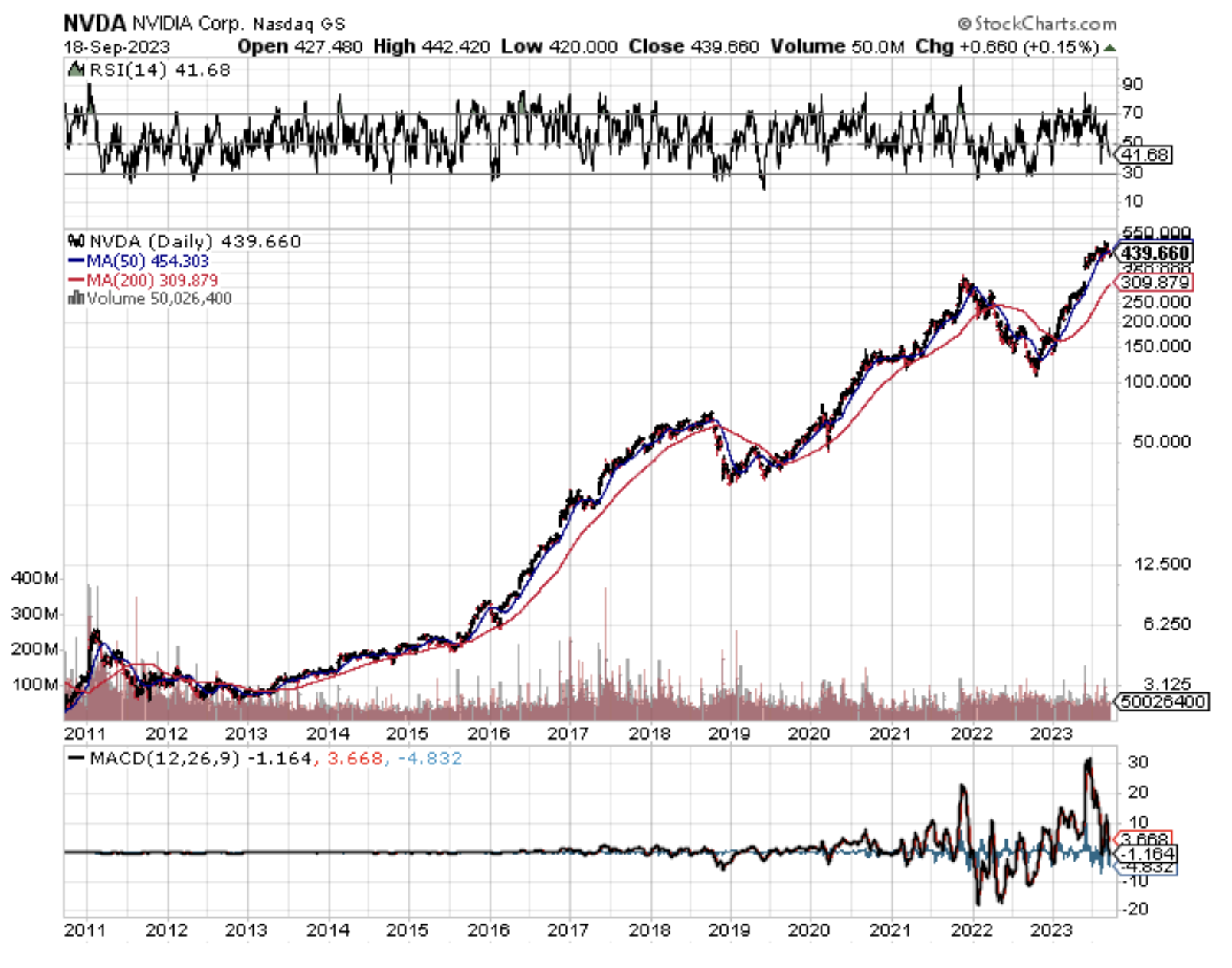
Q: I have a question about NVDA. While NVIDIA is a top-of-the-line chip company, there are many companies, i.e., Amazon (AMZN), Microsoft (MSFT), and of course, China (FXI), that are looking to get into the arena and build their own chips-cutting into (NVDA) space. How soon do you think this will happen and how good will those chips be?   

A: NVIDIA is ahead now because of decisions on software and platforms they made 20 years ago. As all the important employees are also shareholders with minimal cost there is no way you’re going to pry them away to another company. You can’t copy NVIDIA with a simple cut-and-paste operation as you can with most other companies and the market has figured this out. (NVDA) has a moat that will remain unassailable for years. Now they have the AI turbocharger. My short-term target is $1,000 and it probably goes much higher. I reiterate my strong “BUY” issued in 2015 at $15.

Q: Why do you think the demise of crypto is coming?

A: Not so much a demise as a long nuclear winter. The SEC has declared war on all the intermediaries, and if you don’t have intermediaries you can’t trade. That shrinks the market to hot wallets only, which only computer programmers can do. That is much smaller than the current market. The other reason is that crypto prospered when we had a cash surplus and an asset shortage. We had to invent new assets to soak up all that cash—that's what Bitcoin did, it soaked up about $2 trillion dollars. Now we have the opposite: a cash shortage thanks to high-interest rates and an asset oversupply—all of the busted stocks that emanated from crypto, all the SPACS, the ETFs, and so on, where people lost 90%-100% of their money. #3, there is still a massive fraud and theft problem with crypto running in the hundreds of billions of dollars. I’d rather just buy Apple (AAPL) or Google (GOOG) or Tesla (TSLA) with my money. Those are cheaper alternatives than existed 18 months ago.

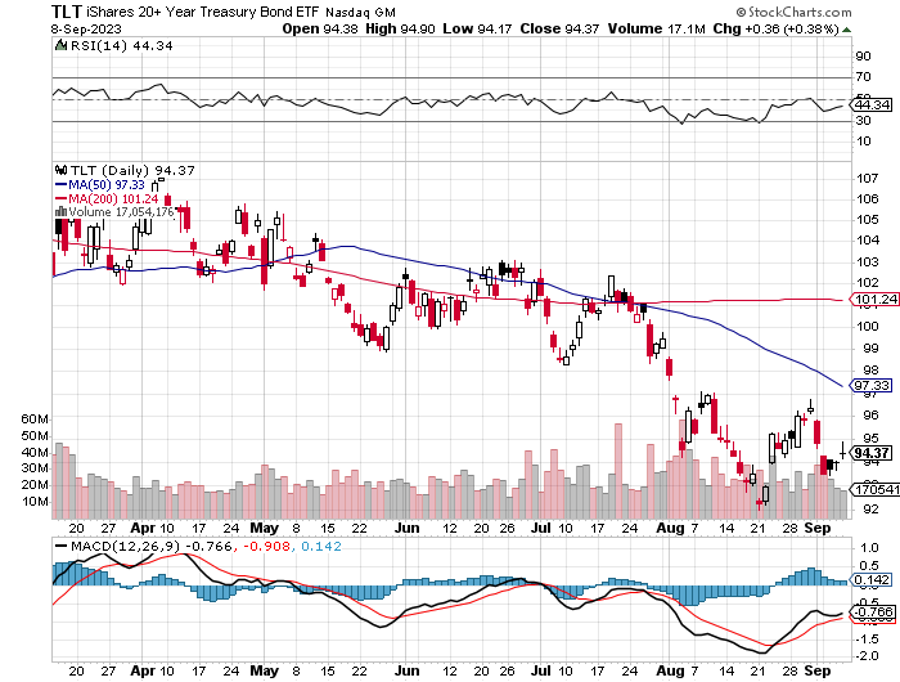
Q: Will iShares 20+ Year Treasury Bond ETF (TLT) visit the $92.25 low or have yields peaked?

A: I hope it visits the $92 low—I’m going to be buying my pants off if we get that low, plus issuing two-year LEAPs with 100% returns. So absolutely, yes. (TLT) is bottoming here and starting to discount interest rate cuts which will begin in March or June.

Q: What do you think of sells on Tesla (TSLA)?

A: I ignore all sells on Tesla, as I have done for the last 13 years. Keep in mind that Tesla has always had one of the largest short interests in the market, and will continue to do so as many people don’t buy the hype, or the vision.

Q: Why haven’t we gotten any trade alerts on gold and silver?

A: We sent out trade alerts for the concierge customers on gold (GOLD) and silver (WPM), and if we see another good entry point we’ll send those out also to the regular Global Trading Dispatch customers.

Q: When you say dip, how much of a dip do you mean?

A: We’ve really only had a 7% dip in the S&P 500 (SPY) this summer top to bottom. Usually, you get 10%, but with $5.6 trillion in cash on the sideline and with AI and multiple other technologies accelerating, people are just not willing to wait. When you throw cold water on the market, as we have been doing all summer, you buy the heck out of it.

Q: Will China’s (FXI) real estate collapse cause a black swan for US markets? Will China go the way of Japan?

A: No, the Chinese real estate market is almost completely isolated from the rest of the global economy. Additionally, most of the Chinese debt is owned by a dozen or so government-controlled banks. So, real estate prices there can implode and have virtually no effect on anywhere else. I’m not worried about that at all. You might get a down day of a few hundred points when one of the biggest companies goes under, but no more than that, and it doesn’t affect China’s trading economy at all. On a list of things to worry about, that’s probably number 100.

Q: It’s said a lot of the recent gains in the market are from short covering—how do you determine the number of shorts out there?

A: Well, most short interest in stocks is in the public domain; all you have to do is Google the term “how many Tesla shorts,” and you’ll get a number—it’ll be like 20-25% of the outstanding shares. For some companies, like AMC Entertainment Holdings (AMC), the short interest can be 50% or more. So, it’s easy to find out; however, you want to buy the market before people start covering shorts, not after, because that buying power is then already in the market, and that would have been a couple of months ago. For any of the big hedge funds, almost none of them were shorting stocks. All of them were looking to buy on any declines; that’s what they’ve been doing all summer, and that's why the market was unable to appreciably fall.

Q: Outlook on Microsoft Corp (MSFT)?

A: Double in the next 3 years, as is the case with all of big tech.

Q; What about my iShares 20+ Year Treasury Bond ETF (TLT) 2024 LEAPS?

A: I think we will get enough of a rally in TLT by January for all of those Jan 2024 LEAPS to expire at max profit. They’re only $4 points away from max profit for the $95/$100s and $9 points away for the $100/$105s, and that is entirely doable if the Fed stops raising interest rates or even cuts them. At one point these LEAPS were up 70% from cost so that might have been a great time to take profits.

Q: Is your AI product different from the one offered by Tradesmith?

A: Yes, we have completely different trade alerts than Tradesmith has; and they are using different algorithms than we are, so, totally they’re different services. If you have the Tradesmith product, just keep watching it and see if it performs. Usually, it takes six months to decide whether a new service is worth renewing, so I would keep watching it. Also, Tradesmith has a ton of analytical tools which we don’t offer. They made a massive seven-year investment in their own AI tools, which are completely different than ours. They disclose some of theirs, but we don’t. Why give away the keys to the kingdom? We’ll just send you our trade alerts, which by the way have been 100% profitable. 

Q: Whatever happened to meme stocks like AMC Entertainment Holdings (AMC)? Should I look at these?

A: Absolutely not—they’re pure gambling. You’re better off just buying a New York lottery ticket. No fundamentals; I’m amazed AMC is even still in business. I went to the movies a few weeks ago and I was the only person in the theater. I went to see the Oppenheimer movie, which I highly recommend by the way. I’m still radioactive from when I worked with his lot.

Q: Credit card debt has spiked to historic levels—will this eventually come back to haunt the US economy?

A: Not really, it really doesn’t translate to lower consumer spending or a weaker economy yet. My bet is these people get bailed out by falling interest rates again as they always are.  Consumer Spending Rocketed in July, up a monster 0.8%, the second-best number of the year, in further evidence of improving economic growth. Never underestimate the ability of Americans to spend money

Q: Can we access recordings of these webinars?

A: Yes, we post them on the website in your members' section two hours after it’s recorded. Just log into madhedgefundtrader.com, go to your membership section, and it’ll list webinars as one of the services you have purchased and have access to.

Q: How will markets respond if Trump gets back in the White House?

A: Major market crash—that’s an easy one. The Trump who won in 2016 is not the same Trump as today.

Q: What will happen to the price of EVs when the world runs out of lithium?

A: The world will never run out of lithium, it’s one of the world's most abundant elements. The bottleneck is in lithium processing, and there are multiple lithium processing facilities using new technologies under construction around the country. That gets you around that bottleneck, and you also free yourself from Chinese sources of processed lithium. Elon Musk planned all this out 25 years ago when he first started Tesla. He planned for a 20 million unit/year scale-up and has locked up the lithium supplies to accommodate that level of construction, leaving the rest of the world in the dust.

Q: Would you comment on the potential of new EV car batteries to enhance travel distances?

A: Tesla has a new solid-state battery that increases battery ranges from 10 times to 20 times, but it hasn’t been able to economically produce them in large enough numbers to put them in new cars. That’s in the wings. If that happens, Tesla will be able to cut costs by $10,000 per car and shrink the battery size from 1,000 pounds to 50 pounds, which would be revolutionary and absolutely wipe out Detroit, China, and Japan. That would allow Tesla to take over the entire global car market. So, yes, when you consider all that, it makes my current forecast of $1,000 for Tesla look stupidly conservative.

Q: What’s your take on the state of the Russia/Ukraine war?

A: Ask me in three weeks, when I will be in Ukraine seeing the actual state of the war, visiting the front lines, delivering doctors and supplies to children’s hospitals, and doing assorted odd jobs that have been requested of me. You’ll get the full read on Ukraine then. For now, I can tell you that Ukraine is still winning, but 18 months in, the people are getting tired. The people in my team in Ukraine who are organizing this trip sometimes break down in tears from the sheer weight of the war on them. Of course, being bombed every day doesn’t help your sleep either. So be prepared for my report and video of the century on the Ukraine war.

Q: Stanley Druckenmiller has a big position in Cameco Corp (CCJ).

A: That’s absolutely true, and I’d be a LEAPS buyer there on any kind of pullback. Stanley is a billionaire for a reason.

Q: What happens to gold at the introduction of the US government's digital currency?

A: It probably goes up. Actually, it’ll probably have no impact, but if it’s going to do anything it’ll make gold go up because people who are frightened of digital currencies will buy gold as a safe haven. I happen to know a few of those who have millions of dollars worth of gold stashed away under their mattresses for this purpose.

To watch a replay of this webinar with all the charts, bells, whistles, and classic rock music, just log in to www.madhedgefundtrader.com, go to MY ACCOUNT, click on GLOBAL TRADING DISPATCH, then WEBINARS, and all the webinars from the last 12 years are there in all their glory.

Good Luck and Stay Healthy,

John Thomas
CEO & Publisher
The Diary of a Mad Hedge Fund Trader
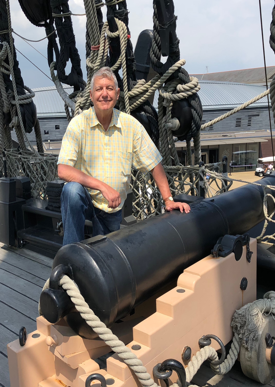
 

2023 in the Naval & Military Club in London


https://www.madhedgefundtrader.com/wp-content/uploads/2023/09/john-naval-military-club.jpg 271 211 Mad Hedge Fund Trader https://madhedgefundtrader.com/wp-content/uploads/2019/05/cropped-mad-hedge-logo-transparent-192x192_f9578834168ba24df3eb53916a12c882.png Mad Hedge Fund Trader2023-09-01 09:02:132023-09-01 14:02:50August 30 Biweekly Strategy Webinar Q&A
Mad Hedge Fund Trader

August 28, 2023

Diary, Newsletter, Summary

Global Market Comments
August 28, 2023
Fiat Lux

Featured Trades:

(MARKET OUTLOOK FOR THE WEEK AHEAD, or THE FAILED RALLY)
(SPY), (TLT), (FCX), (TSLA), (AAPL), (UPS)


CLICK HERE to download today's position sheet.

https://madhedgefundtrader.com/wp-content/uploads/2019/05/cropped-mad-hedge-logo-transparent-192x192_f9578834168ba24df3eb53916a12c882.png 0 0 Mad Hedge Fund Trader https://madhedgefundtrader.com/wp-content/uploads/2019/05/cropped-mad-hedge-logo-transparent-192x192_f9578834168ba24df3eb53916a12c882.png Mad Hedge Fund Trader2023-08-28 09:04:252023-08-28 15:45:52August 28, 2023
Page 33 of 112«‹3132333435›»

tastytrade, Inc. (“tastytrade”) has entered into a Marketing Agreement with Mad Hedge Fund Trader (“Marketing Agent”) whereby tastytrade pays compensation to Marketing Agent to recommend tastytrade’s brokerage services. The existence of this Marketing Agreement should not be deemed as an endorsement or recommendation of Marketing Agent by tastytrade and/or any of its affiliated companies. Neither tastytrade nor any of its affiliated companies is responsible for the privacy practices of Marketing Agent or this website. tastytrade does not warrant the accuracy or content of the products or services offered by Marketing Agent or this website. Marketing Agent is independent and is not an affiliate of tastytrade. 
Legal Disclaimer

There is a very high degree of risk involved in trading. Past results are not indicative of future returns. MadHedgeFundTrader.com and all individuals affiliated with this site assume no responsibilities for your trading and investment results. The indicators, strategies, columns, articles and all other features are for educational purposes only and should not be construed as investment advice. Information for futures trading observations are obtained from sources believed to be reliable, but we do not warrant its completeness or accuracy, or warrant any results from the use of the information. Your use of the trading observations is entirely at your own risk and it is your sole responsibility to evaluate the accuracy, completeness and usefulness of the information. You must assess the risk of any trade with your broker and make your own independent decisions regarding any securities mentioned herein. Affiliates of MadHedgeFundTrader.com may have a position or effect transactions in the securities described herein (or options thereon) and/or otherwise employ trading strategies that may be consistent or inconsistent with the provided strategies.
Copyright © 2026. Mad Hedge Fund Trader. All Rights Reserved. support@madhedgefundtrader.com
Scroll to top