“When you give everyone a voice and give people power, the system usually ends up in a really good place. So, what we view our role as, is giving people that power.” – Said Co-Founder and CEO of Facebook Mark Zuckerberg
Mad Hedge Technology Letter
March 28, 2022
Fiat Lux
Featured Trade:
(THE TECH PANACEA TO LOGISTICS)
(LSTR), (JBHT), (ODFL), (KNX), (CVLG)
Sure, technology is advancing at a rapid clip, many of us try to harness it for the better as well as make a little coin from it.
A new tailwind is arriving just at a time when investors have been sick and tired of the barrage of inflation news.
Honestly, I am sick of it too.
Even if oil somehow goes to $300 per barrel, which it won’t, but just visualize that it does: automation will bail out the logistic industry.
This is what we have been waiting for, and it’s coming down the pipeline whether we are ready for it or not.
Self-driving technology is almost a generation old and yes, there have been massive improvements and the part of the world this will first filter down to isn’t individuals, but commerce.
Logistic companies are chomping at the bit to integrate this technology into long-haul transport routes.
We are just about there, as the dearth of truck drivers in the United States has slowed to a crawl.
Apparently, most don’t like to sit and drive all day!
It’s also not a secret that many of the employed truck drivers are not Americans; visa issuance was almost entirely halted for 2 years during the health situation, and these workers must be coaxed into immigrating in order to truck drive from places as far as Uzbekistan and Honduras.
On arrival, salaries are dreamy, with starting pay up to $70,000 per year and closer to $100,000 per year for experienced drivers.
Yet, there is still a massive shortage of drivers, much like construction workers, today.
Well, that’s all about to change because many parts of the United States won’t need that long-haul driver anymore to shuttle around goods.
Automation is transforming the trucking industry as self-driving trucks are already on America's highways, currently in the testing phase, as a new study warns up to a half-million jobs are at risk of being displaced by robots.
The integration of automation in long-haul trucking could replace 97% of human truck drivers, the equivalent of approximately 550,000 jobs.
Researchers developed several automated trucking deployment scenarios, including deployment in southern states, deployment for journeys more than 500 miles, and widespread deployment across the country.
This study was the first to combine a geospatial analysis based on shipment data with explicit consideration of the specific capabilities of automation and how those might evolve over time.
Depending on the scenario, they found the rollout of automation may have up to a 94% impact on long-haul operator hours, equivalent to up to 550,000 jobs that could be displaced.
Researchers received feedback from trucking companies, logistical experts, and tractor-trailer operators to develop a roadmap for the automation rollout within the trucking industry.
At the bare minimum, the highway part of the automation is solved, allowing technology to solve other parts of the logistical conundrum.
Long haul is first and foremost the easiest part of the equation and I am talking about those large stretches of hundreds of miles that require trucks to merely drive in a straight line.
Certainly, the “last mile” challenge is a whole different animal with navigating through narrow city streets that include one-way streets much harder to just program up in software.
Trucks move 70% of U.S. freight in weight, and labor and fuel costs pressure logistics companies' margins, forcing them to raise shipping rates or face margin compression.
The current dilemma of astronomical oil prices is forcing logistic companies to make some real headway into this much-awaited technology.
Putting the kibosh on costs is sometimes impossible to do, but with this shift on the horizon, logistic companies are about to get a lot more profitable very quickly.
Think about it: truck drivers get tired, perform worse than automated technology, and eventually want to unionize.
Getting rid of the human will result in cost savings, and no need to worry about the immigration process that currently has severe backlogs of over one year because of the Covid knock-on effect.
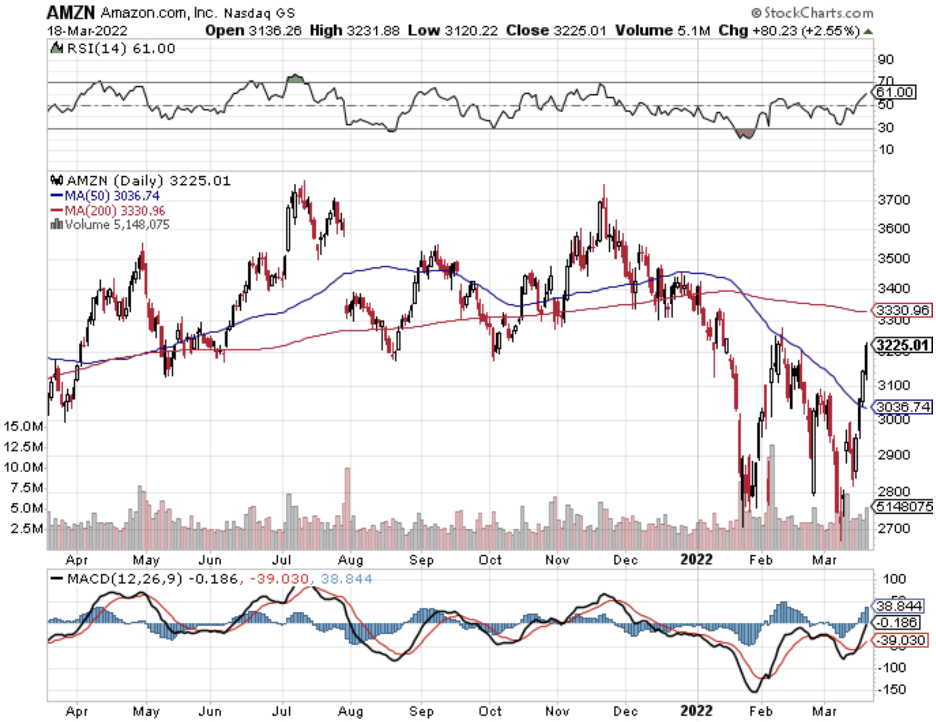
Eventually, Americans will be able to receive their Amazon package for cheaper in the future with the logistic companies able to pass on some of the savings to the end-user.
Win-win situations are hard to come by in this day and age, but this is definitely one of them.
Stocks in this space poised to win from this new technology are Landstar System (LSTR), J.B. Hunt Transport (JBHT), Old Dominion Freight Line (ODFL), Knight-Swift Transportation (KNX), and Covenant Logistics Group (CVLG).
“My aim is to develop affectionate robots that can make people smile.” – Said CEO of Softbank Masayoshi Son
Mad Hedge Technology Letter
March 25, 2022
Fiat Lux
Featured Trade:
(THE DUMPSTER FIRE SUB-SECTOR OF TECH)
(SSYS), (DDD), (PRLB)
Avoid 3D printing stocks.
It’s not because I hate these companies, but when I delve beneath the surface of these business models, they just aren’t good enough.
3D printing is a great phenomenon, but so was the digital handheld pet Tamagotchi invented by Japanese company Bandai in 1996.
Tamagotchis only went so far, and so will 3D printing.
Take for instance, in just a decade, 3D-printed guns have come a long way from a fully functional 3D-printable semiautomatic pistol carbine entirely printed at home to what now appears to be a rocket launcher-like device.
Does that mean that the U.S. military will start manufacturing Blackhawk helicopters and industrial-grade surface-to-air missile weapons on a 3D printer?
Hell no.
The fact is that for the crème of the crop products, the ones that bring in the revenue that make your eyes big, manufacturers aren’t going to choose a 3D printer to make these products.
If 3D printing isn’t used for these premium products, it means that building an accelerated revenue model will be almost impossible.
Take for instance automobiles, they aren’t a subscription-based business, but car companies scale globally and to all parts of the globe.
I can’t think of one country that doesn’t need cars as a main input in their domestic economy apart from possibly Papa New Guinea.
A classic car dealership might have a 3D printer to replace a few cosmetic parts and if the parts squeak, it's either that part or nothing as there are no more spare parts.
For high quality German cars, drivers would need to wait for the specific part from the specific supplier.
Car manufacturers have high standards, car parts have specific requirements concerning strength, fatigue, heat, fire, color, finish level, recycling, the classic parts are rather cheap to make for cars that sell in high volume, car parts are in general not designed to make with a 3D printer.
Good luck if you’re waiting around for an entire car to be printed, because it will probably never happen.
Most parts in cars need to be strong, lightweight, heat resistant, have a fine finish.
They are often quite big it would be unfeasible to have a 3D printer the size of a 500 sq foot room.
3D printers that size also scale poorly.
With all this being said, let’s take a peak at the financials.
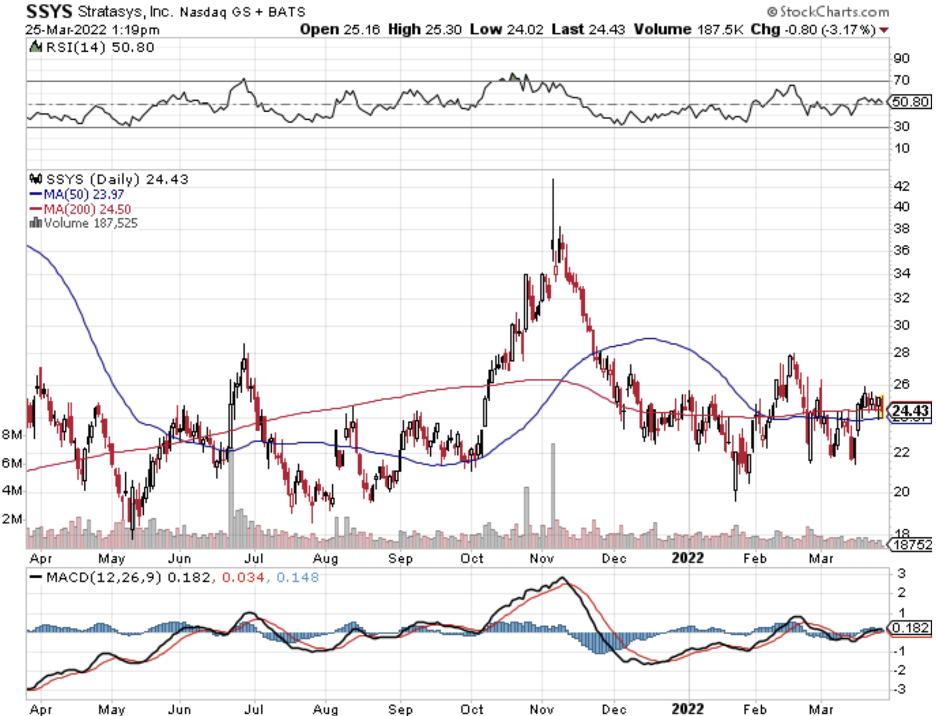
One of the top 3D printing companies Stratasys Ltd. (SSYS) achieved $663 million of annual revenue in 2018 and fast forward to 2021, they decelerated to $607 million.
Not only is revenue decelerating, but they don’t turn a profit.
SSYS lost $62 million in 2021 and they have lost money for the past 4 years.
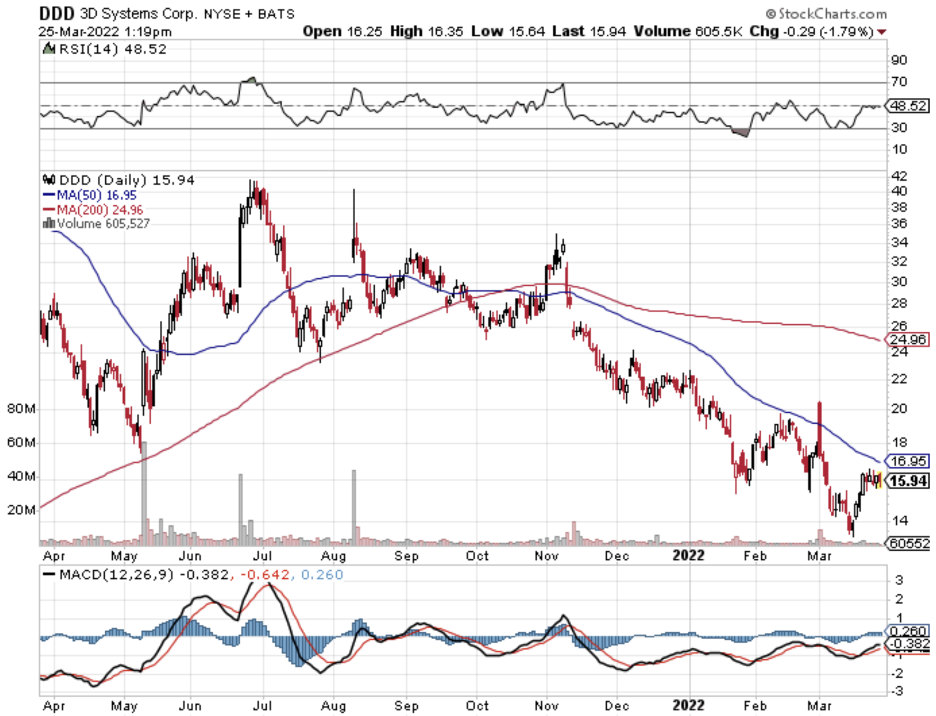
Let’s find another example in 3D Systems Corporation (DDD) headquartered in Rock Hill, South Carolina.
In 2018, they achieved $691 million of annual revenue and continued to decelerate and earn $615 million in revenue in 2021.
Essentially, some of the largest 3D printing stocks have topped out at a sub-$700 million per year clip and are going in the opposite direction.
Loss-making and revenue deceleration are the two characteristics that investors hate most.
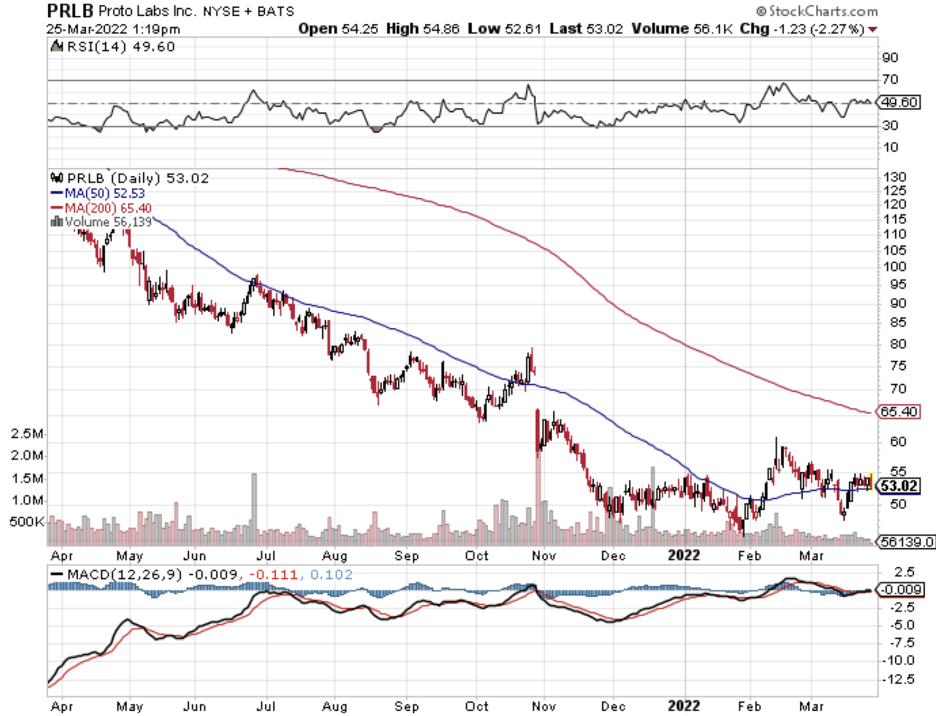
One of the only 3D printing companies to grow revenue in the past 4 years was Proto Labs, Inc. (PRLB).
In 2018, PRLB achieved annual revenue of $445 million and surged ahead to make $488 million in revenue in 2021.
These growth numbers are paltry relative to any other tech sub-sector.
In short, these companies have little access to big revenue-making opportunities, and lucrative industries don’t view them as high quality enough to mass produce anything of real value.
Decelerating revenue, decelerating EPS, and unprofitability are all deal breakers.
Avoid 3D printing stocks like the plague.
“I couldn't imagine a more incompetent politician than myself.” – Said Co-Founder and Co-CEO of Salesforce
Mad Hedge Technology Letter
March 23, 2022
Fiat Lux
Featured Trade:
(NVDA STRENGTHENING INTO THE FUTURE)
(NVDA)
The growing meaning of the metaverse to Nvidia (NVDA) is something that could strengthen the long-term trajectory for a company that I have loved for years.
It’s really the best of breed in terms of artificial intelligence if you look at it through the lens of a semiconductor.
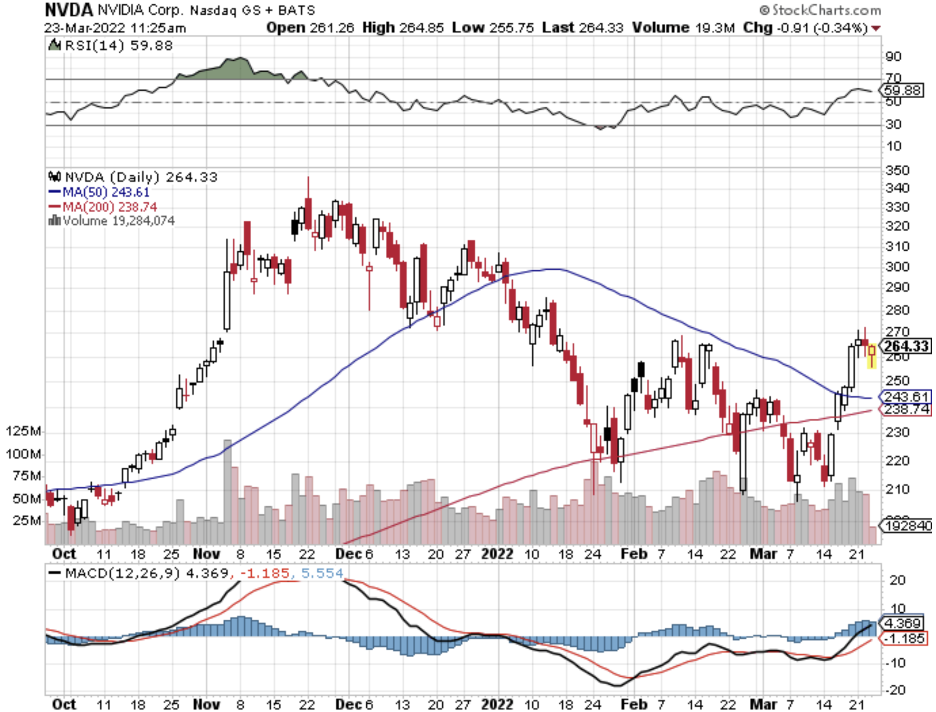
Nvidia shares have rebounded quickly from the earlier dip and the 19% uptick is something that many investors have come to expect.
The stock is extremely resilient, and investors expect incessant dip-buying.
Nvidia’s strategic importance at the cutting edge of multiple industries makes it hard to discard this company.
Yesterday they had an investor call to showcase their newest product – Omniverse.
NVIDIA Omniverse is an easily extensible, open platform built for virtual collaboration and real-time physically accurate simulation. Creators, designers, researchers, and engineers can connect major design tools, assets, and projects to collaborate and iterate in a shared virtual space.
This product will nudge NVDA headfirst into the omniverse so much so that accelerating revenue projections are already starting to reflect the outperformance of omniverse.
This division is just another notch in the belt for Nvidia who presides over many successful initiatives from gaming, data centers, crypto mining, AI, autonomous vehicles — they all offer significant growth potential for this company.
NVDA could be described as the jack of all trades, master of all.
Let me remind you that regarding the metaverse revenue of the expected growth to Nvidia’s existing market segments, the company could reach $140 billion in annual sales by 2040.
What Is the Metaverse?
The meaning and term “metaverse” has been liberally bandied around lately.
Despite what some companies might want you to believe, it’s not a single entity or platform.
It’s more of a shift toward interacting digitally instead of purely physically. This can include virtual reality (VR), or a mix between digital and physical in the form of augmented reality (AR).
There will be dedicated spaces such as games and virtual worlds, and a digital economy is springing up to serve these communities.
Interoperable digital worlds is the core of metaverse and it will become real very quickly.
When that happens, expect Nvidia to be one of the biggest winners of metaverse economics.
Think of the metaverse today as the early days of the internet to get a visualization of how it is primed to explode in capabilities and importance.
Nvidia’s technology will be an important cog in the metaverse’s future development. The metaverse requires massive server infrastructure to host virtual worlds. Nvidia has leveraged the parallel processing capabilities of its GPUs to become a leader in GPU-accelerated data center solutions. The company’s data center revenue was up 71% year over year in its latest earnings report.
AI will be in high demand for an interactive metaverse experience — another strong point for NVDA.
Making the most of a PC-based metaverse will require the installation of high-powered graphics cards.
The creators who design metaverse experiences and populate them with virtual goods will also need high-powered GPUs and software tools.
Therefore, it makes sense that NVDA is rolling out the omniverse platform to facilitate the construction of the metaverse.
Investors should look forward to NVDA allocating the incremental resource to the metaverse in order to corner the market for its technology.
This is very much one of those situations where if NVDA is a critical element to the start-up phase, they won’t be kicked out of the next phase of development.
Readers should be adding this stock on any tech sell-off, it’s rare that NVDA is on discount.
“I fear the day when the technology overlaps with our humanity. The world will only have a generation of idiots.” – Said German-born Theoretical Physicist Albert Einstein
Legal Disclaimer
There is a very high degree of risk involved in trading. Past results are not indicative of future returns. MadHedgeFundTrader.com and all individuals affiliated with this site assume no responsibilities for your trading and investment results. The indicators, strategies, columns, articles and all other features are for educational purposes only and should not be construed as investment advice. Information for futures trading observations are obtained from sources believed to be reliable, but we do not warrant its completeness or accuracy, or warrant any results from the use of the information. Your use of the trading observations is entirely at your own risk and it is your sole responsibility to evaluate the accuracy, completeness and usefulness of the information. You must assess the risk of any trade with your broker and make your own independent decisions regarding any securities mentioned herein. Affiliates of MadHedgeFundTrader.com may have a position or effect transactions in the securities described herein (or options thereon) and/or otherwise employ trading strategies that may be consistent or inconsistent with the provided strategies.