Mad Hedge Technology Letter
December 4, 2024
Fiat Lux
Featured Trade:
(MANAGEMENT TURNOVER IN TECH SPURRING CHANGES)
(INTC), (CRWD), (PANW)


Mad Hedge Technology Letter
December 4, 2024
Fiat Lux
Featured Trade:
(MANAGEMENT TURNOVER IN TECH SPURRING CHANGES)
(INTC), (CRWD), (PANW)
CEO’s are toast as the CEO turnover tally starts to explode at the end of 2024.
There appears to be a strong trend that will grow in 2025, and that is corporate tech companies looking to the bullpen to substitute out the CEO.
They aren’t doing enough for their respective companies, and that needs to change.
This speaks volumes to the tough times in which debt has become too expensive to fund growth.
Tech companies have always played by the idea of the “winner takes all” mentality, and 2024 underscored this trend by seeing the likes of the Magnificent 7 grow in size and stature.
Through October, more than 1,800 CEOs have announced their departures this year. The outperformance of big tech stocks means that shareholders are putting massive pressure on management to juice up their own stock prices.
The number of exits is up 19% from the more than 1,500 departures during the same period last year, which was the previous year-to-date record.
Boards of directors are becoming impatient and ambitious, holding their CEOs accountable for underperformance — both in terms of profits and stock price.
The expected length of tenure as a CEO, on average, is declining as a result of these performance pressures.
The massive stock market gains of the past two years — the S&P gained roughly 20% in 2023 and is set to gain more than that by the end of 2024 — also pose challenges to US companies.
The outperformance of big tech is forcing shareholders to lean into their own management and demand answers to why they are falling behind.
The answer is complicated, and I acknowledge that many CEOs aren’t in the position to throw around capital like the CEO of Apple, Tim Cook, or CEO of Meta Zuckerberg.
These leaders can chase the next big thing and can strike out many times and not even bat an eyelid.
High turnover shows growing risk appetites and "a desire for leaders who can navigate increasing complexity in the macro business environment, including tech transformation, sustainability, geopolitical crises, and social issues."
If a company’s figurative boat is sinking while most others are enjoying a rising tide, corrective action must be taken by the CEO and or the Board.
If the CEO doesn’t have a clear plan for a turnaround, the Board finds someone who has a plan and the strength to execute that plan. It doesn’t matter if the CEO is actually at fault. Blame is assigned, and heads roll. It isn’t always fair.
Many of these tech CEOs cannot just issue dividends or execute stock buybacks to manipulate the share prices higher.
I believe these shareholder returns will be a key tool for big tech to jump over the low bar after a bevy of lower-than-expected guidance.
Next year, we could experience the haves and have nots in tech separate from each other even further.
Many of these hot chip names are right in the middle of their growth curves.
Software stocks still look good on the dips.
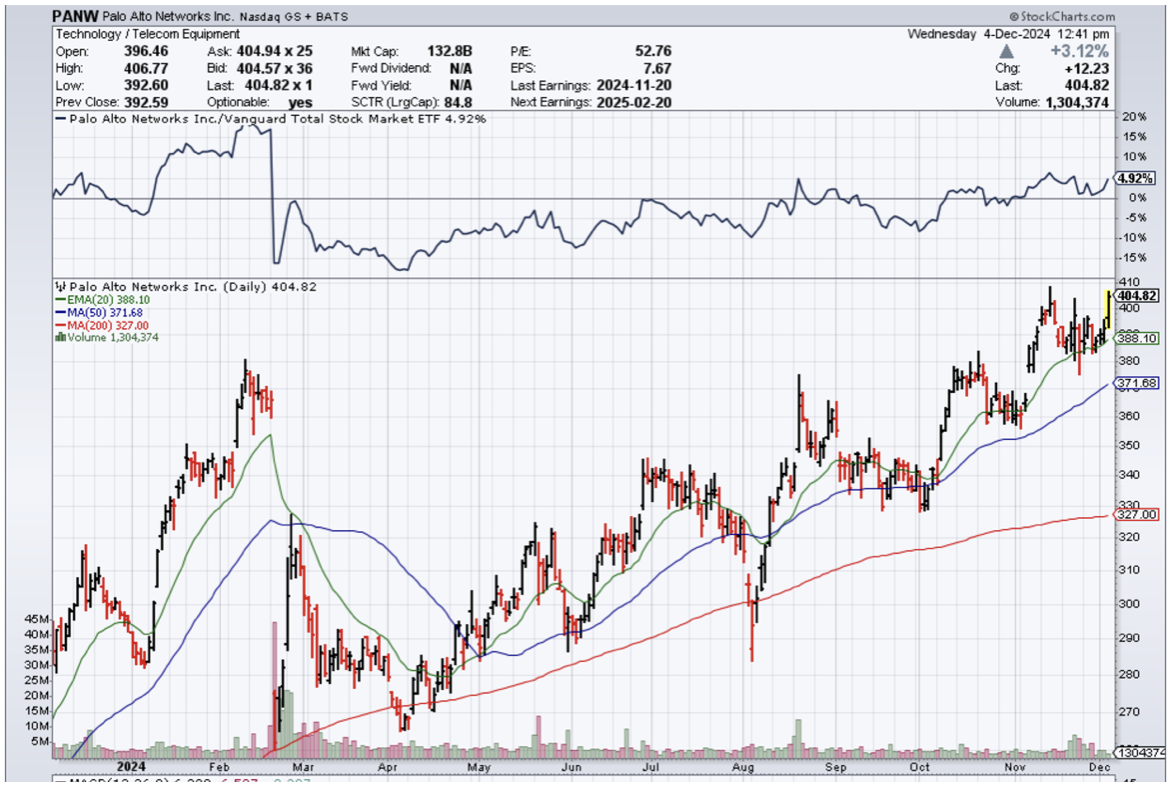
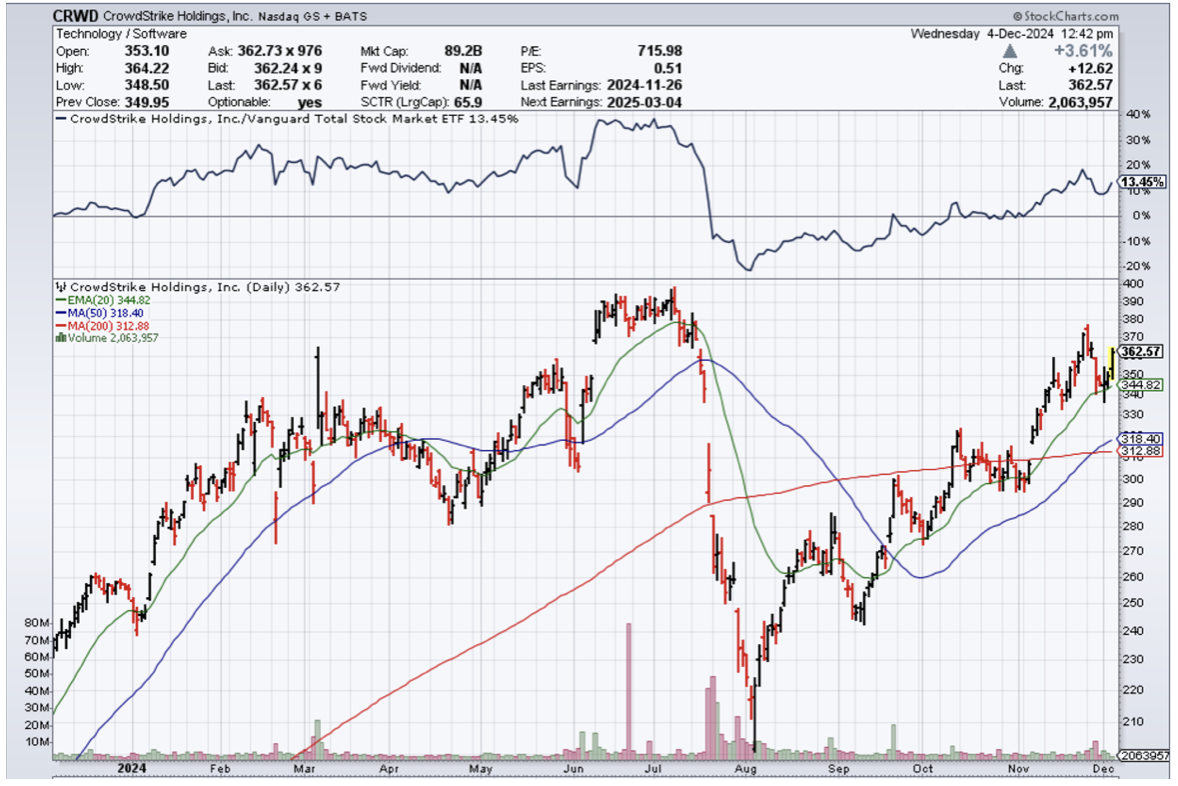
Lately, there were selloffs in cyber security stocks like Palo Alto Networks (PANW) and CrowdStrike (CRWD).
Traders bought the dip after weak guidance, and this is an example of where there is an opportunity as a trader to get in at optimal entry points.

“AI and the robots will provide any goods and services that you want.” – Said Elon Musk

Mad Hedge Technology Letter
December 2, 2024
Fiat Lux
Featured Trade:
(STICK WITH ENTERPRISE TECH IN 2025)
(HPE), (DELL), (TSLA), (NVDA)

Although, on the surface, tech stocks might be performing quite well, we need to talk about an imminent issue that could affect them.
I would even say that I am quite surprised by how the year is panning out.
There was so much uncertainty going into this year, and the election was a brutal contest that was bitterly fought.
However, the election gave us a clear winner, triggering a short-term tsunami of capital into tech stocks with the likes of Tesla (TSLA) leading the charge.
Even institutional money from heavyweights like Blackrock and others poured into tech stocks like there was no tomorrow.
TSLA is up today again on more stock upgrades.
If one ever needed a skinny variety of reliable tech stocks, then investing capital in Nvidia, Tesla, and perhaps Netflix or a Meta would be a solid foundation.
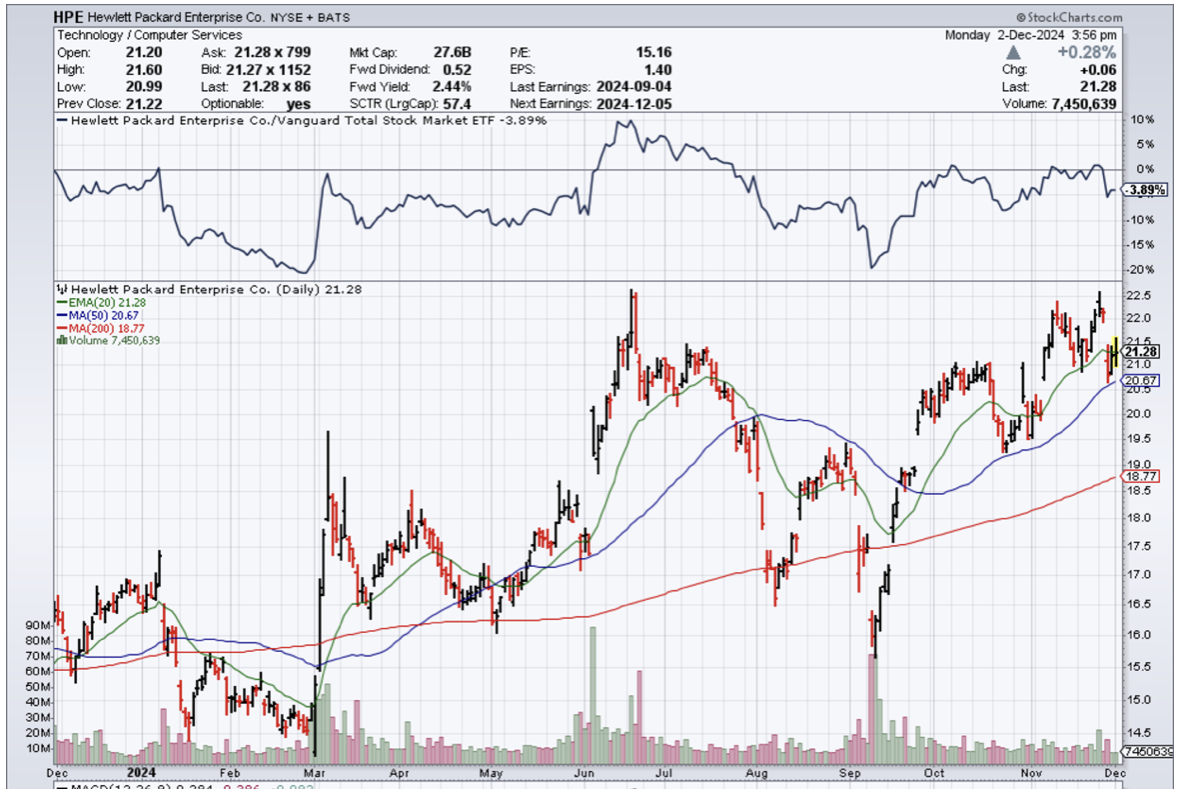
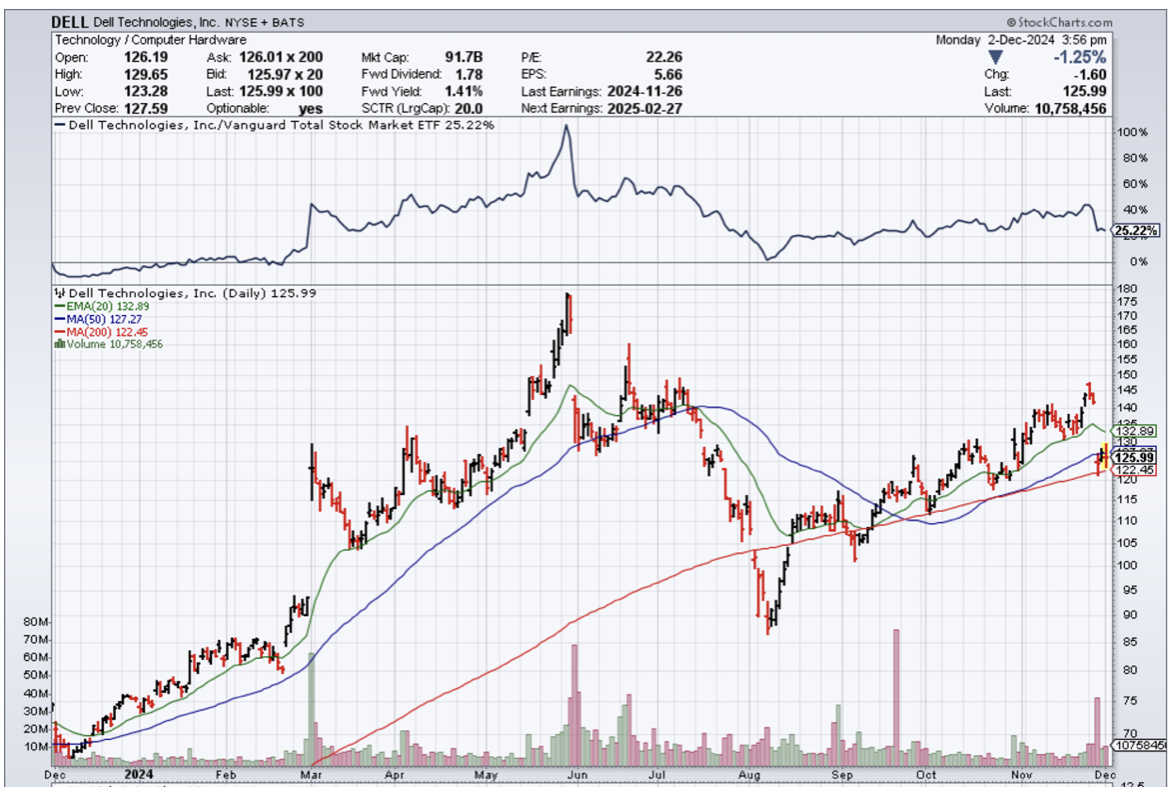
It is not only the Midas touch in the tech world, with management at HP and Dell saying the computer and laptop business isn’t all too hot.
Revenue generated by Dell’s (DELL) PC business declined 1% to $12.1 billion in the fiscal third quarter, falling short of estimates. While sales in HP’s (HPE) PC unit rose 2% to $9.59 billion, missing forecasts.
The PC refresh cycle is pushing into next year (2025), said Dell management.
HP Chief Executive Officer Enrique Lores said in an interview that the release of Microsoft’s new edition of Windows software hasn’t fueled PC sales from corporate clients as quickly as in previous releases.
The market had seen a historic decline in recent years after a burst of demand for new laptops in the early months of the pandemic when students and corporate employees were stuck at home. While signs of a rebound began to materialize this year, shipments again dipped in the third quarter.
This type of narrative has been put in motion by the crowd who think a new administration and their immigration stance will cause rampant inflation in wages.
No doubt, a lot of changes will take place in the next 50 days and after, and that type of uncertainty could deliver us a sharp selloff if short-term pain is sensed by the market.
Comments from Best Buy already set a very low bar even lower, as the recession that was supposed to take place in 2018 could be sneaking up on us.
The unemployment rate is forecasted to peak at 4.4% and has been steadily trending higher, highlighting the weakening of the US consumer.
There is a good chance that in 2025, retail tech will be in a recession before enterprise tech and enterprise tech stocks will be the last bastion of a narrowing market growth.
The key signal to focus on is a big Bitcoin sell-off that could trigger a flight to safety.
As long as market action stays orderly, I expect the pain trade to go higher in tech stocks in an uneven way, and I would avoid any tech stocks directly connected to American retail shoppers.
“AI will be the best or worst thing ever for humanity.” – Said Elon Musk
Mad Hedge Technology Letter
November 27, 2024
Fiat Lux
Featured Trade:
(BEST BUY THROWS UP SOME WARNING SIGNALS)
(BBY), (AAPL)

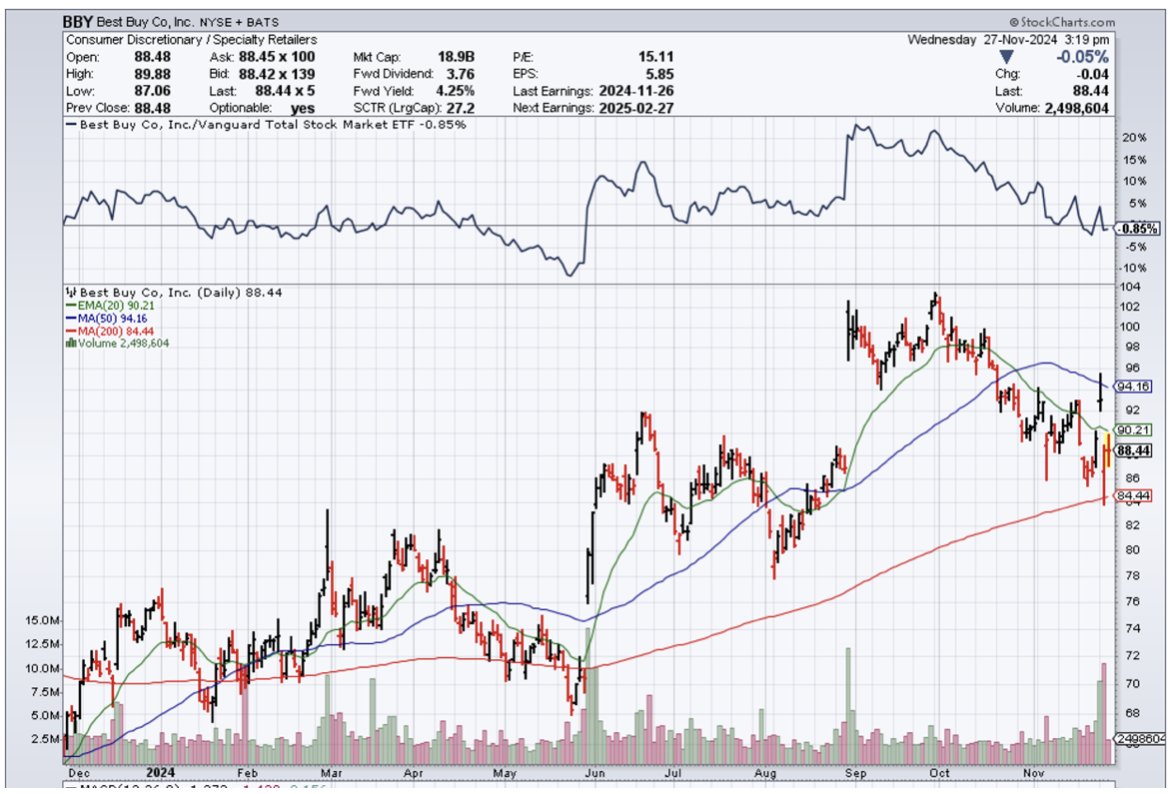
Best Buy (BBY) tanking their earning results is indicative of where we are right now, not only as a society but also in the tech sector.
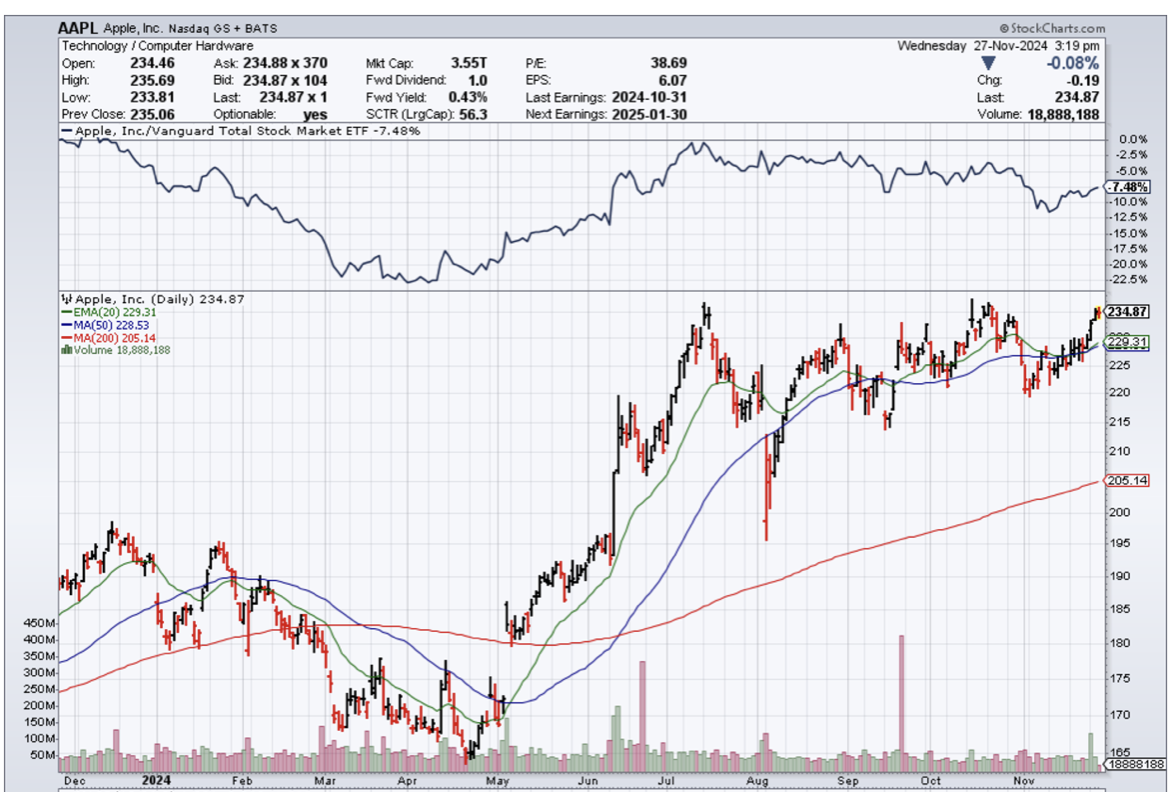
People just don’t have that extra dollar or 2 to fund that iPhone (AAPL) upgrade, and that is why Best Buy sales are so underwhelming.
It isn’t the end of the world, but we need the consumers to stay healthy for the short-term health of the tech sector.
Sure, it is true that a great deal of spend comes from enterprise sources, but that is not the entire economy.
The U.S. economy is held up by consumers, and that isn’t the case in many other economies like China or India.
Get ready for a lukewarm Christmas season, which should manifest itself in some pretty sweet deals for the individual.
At the aggregate level, it looks quite sluggish in the mid-term as electronic retailer Best Buy ponders about how to reverse the dimming outlook.
Best Buy cut its full-year sales forecast and missed revenue targets.
Best Buy expects full-year comparable sales to decline by between 2.5% and 3.5%, compared with its prior expectations of a 1.5% to 3% drop.
Granted, the holiday season is five days shorter than last, so some of the softness is a one-off.
Management did say shoppers are responding to big deals and sales events. Management said it expects the peak in sales during times like Black Friday and Cyber Monday to be higher but the valleys before and after those to be lower.
Best Buy is waiting for a wave of shoppers to replace old devices and upgrade to new, higher-tech ones after an approximately two-year sales slump in the consumer electronics category.
Management said they anticipate this year to be one that brings “increasing industry stabilization.” They also mentioned specifically about Apple’s fresh collection of iPads, as well as artificial intelligence-enabled laptops from Microsoft, will drive sales.
Tariffs could put Best Buy’s sales at risk, too, if they result in higher costs for the company and for customers. President-elect Donald Trump said he would raise tariffs by an additional 10% on all Chinese goods and impose tariffs of 25% on imports from Mexico and Canada.
Artificial intelligence products are nowhere near the shelves of Best Buy, and nobody knows when they will debut.
A.I. continues to be strictly an enterprise build-out with a future use case, which doesn’t help companies like Best Buy and their bottom line.
Apple and its micro-improvements don’t move the needle enough for shoppers to get off the sidelines and splurge.
This type of transitory environment for consumer tech isn’t what investors like to hear.
I also mentioned earlier about the inflation effect of households redirecting funds to essentials like housing, insurance, and food.
Therefore, it is better for investors to stay out of the tech consumables and target the enterprise side of the equation.
I don’t believe the enterprise part of tech needs a reboot of growth is waning, and I am still executing bullish trades in stocks that are exposed to the A.I. story.
However, the times of the “tide lifts all boats” all long gone in the rearview mirror.
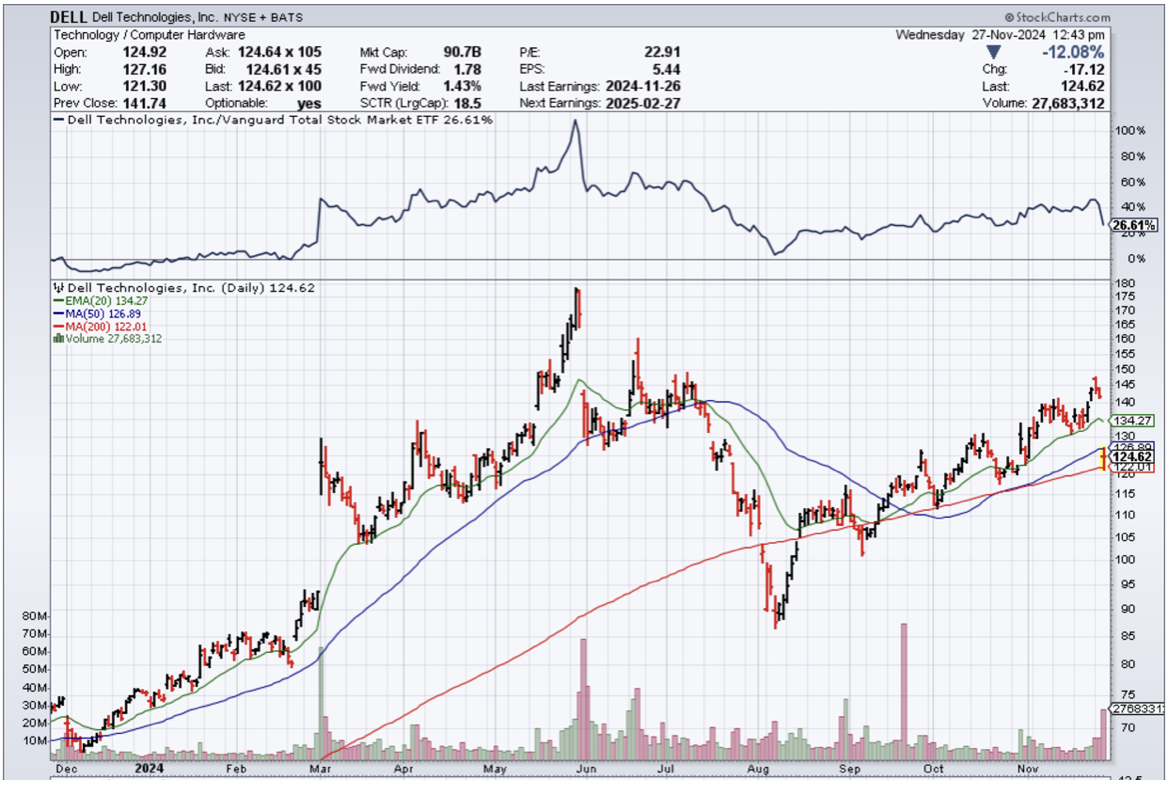
Today, I executed another bullish trade in Dell (DELL) on a monster dip of 12%. Weak guidance is another manifestation of stalling tech growth. I will exit this position before the year is over.
Mad Hedge Technology Letter
November 25, 2024
Fiat Lux
Featured Trade:
(TECH STOCKS COULD ENTER A RENAISSANCE)
(NVDA), (TSLA), ($COMPQ)

The consensus of AI and robotics only taking “blue-collar” jobs is now steadily morphing into a new type of rhetoric.
It was once seen that heavy labor, like Amazon’s robots hauling away heavy items in a warehouse, was the widespread case for robots and AI.
However, I’ve been talking to many industry experts who have privately confided that it could be white-collar jobs that receive the most dramatic cuts.
Think about it, can AI and a robot really do the same job as an HVAC repairman or even a plumber?
If tech is able to solve that level of complexity, then the sky is the limit for tech, but I don’t believe we are anywhere near that yet. It is more likely that people typing simple code into computers will be swapped out for an algorithm, which would be an easy one-to-one switch. Jobs that don’t require a physical presence will always be first in line to be cut.
AI has proven that it operates with limited common sense or street smarts, and in some jobs, these 2 skills are essential to performing well.
By analyzing over 24,000 AI-related patents filed between 2015 and 2022, the researchers were able to identify which occupations might be most affected by emerging AI technologies.
Surprisingly, some of the occupations with the highest scores were white-collar jobs requiring advanced education and specialized skills. Topping the list were cardiovascular technologists and technicians, sound engineering technicians, and nuclear medicine technologists. Other jobs at high risk of automation included air traffic controllers, magnetic resonance imaging (MRI) technologists, and even neurologists.
In the information technology sector, 47% of software developers’ tasks and 40% of computer programmers’ tasks were found to align closely with recent AI patents. These patents focused on automating programming tasks and developing workflows, suggesting that even highly skilled tech jobs may not be immune to AI’s influence.
The least likely to be impacted by AI in the near future tended to be blue-collar jobs requiring physical labor or manual dexterity, such as pile driver operators, dredge operators, and aircraft cargo handling supervisors.
Just looking at the new increases in amount of robots suggests that job replacement is coming thick and fast.
Slightly more than 10% of South Korea's workforce has been replaced with robots.
The country has increased its use of robots by 5% each year since 2018.
China, with 470 robots per 10,000 employees, has overtaken Germany and Japan and landed in third place behind Singapore.
The United States ranked 10th with 295 robots per 10,000 employees.
North America's robot density is 197 units per 10,000 employees – up 4.2%.
America has lost around half a million jobs to robots so far, but I believe this concept isn’t linear, and we won’t be able to just extrapolate our current trends into the future.
Once it rains, it will really pour.
It is no coincidence that software companies are firing software engineers in large groups. Silicon Valley has really trimmed the fat off the boat, taking the cue from Elon Musk firing 80% of Twitter and functioning meaningfully better.
I come back to this concept of tech companies operating with algorithms powered by AI with a few “managers” and executives.
We aren’t a few days or months from this coming to fruition, but we are years.
The complete overhaul in staff numbers would mean that tech stocks would enjoy a renaissance and rise 5X to 10X from today’s levels to the joy of shareholders.
American society has never held such a high portion of its wealth in tech stocks, and that will continue as tech stocks get bid up and tech companies doing anything under the sun to massage the stock higher.