“When we launch a product, we're already working on the next one. And possibly even the next, next one.” – Said Current CEO of Apple Tim Cook
Mad Hedge Technology Letter
December 18, 2020
Fiat Lux
Featured Trade:
(TECH IN 2021)
(ZM), (WORK), (NVDA), (AMD), (QCOM), (SQ), (PYPL), (INTU), (PANW), (OKTA), (CRWD), (SHOP), (MELI), (ETSY), (NOW), (AKAM), (TWLO)
The tech sector has been through a whirlwind in 2020, and if investors didn’t lose their shirt in March and sell at the bottom, many of them should have ended the year in the green.
My prediction at the end of 2019 that cybersecurity and health cloud companies would outperform came true.
What I didn’t get right was that almost every other tech company would double as well.
Saying that video conferencing Zoom (ZM) is the Tech Company of 2020 is not a revelation at this point, but it shows how quickly a hot software tool can come to the forefront of the tech ecosystem.
M&A was as hot as can be as many cash-heavy cloud firms try to keep pace with the Apples and Googles of the tech world like Salesforce’s purchase of workforce collaboration app Slack (WORK).
Not only has the cloud felt the huge tailwinds from the pandemic, but hardware companies like HP and Dell have been helped by the massive demand for devices since the whole world moved online in March.
What can we expect in 2021?
Although I don’t foresee many tech firms making 100% returns like in 2020, they are still the star QB on the team and are carrying the rest of the market on their back.
That won’t change and in fact, tech will need smaller companies to do more heavy lifting come 2021.
The only other sector to get through completely unscathed from the pandemic is housing, and unsurprisingly, it goes hand in hand with converted remote offices that wield the software that I talk about.
The world has essentially become silos of remote offices and we plug into the central system to do business with each other with this thing called the internet.
In 2021, this concept accelerates, and cloud companies could easily check in with 20%-30% return by 2022. The true “growth” cloud firms will see 40% returns if external factors stay favorable.
This year was the beginning of the end for many non-tech businesses and just because vaccines are rolling out across the U.S. doesn’t mean that everyone will ditch the masks and congregate in tight, indoor places.
There is nothing stopping tech from snatching more turf from the other sectors and the coast couldn’t be clearer minus the few dealing with anti-trust issues.
I can tell you with conviction that Facebook, Google, Apple, and Amazon have run out of time and meaningful regulation will rear its ugly head in 2021.
We are already seeing the EU try to ratchet up the tax coffers and lawsuits up the wazoo on Facebook are starting to mount.
Eventually, they will all be broken up which will spawn even more shareholder value.
Even Fed Chair Jerome Powell told us that he thinks stocks aren’t expensive based on how low rates have become.
That is the green light to throw new money at growth stocks unless the Fed signal otherwise.
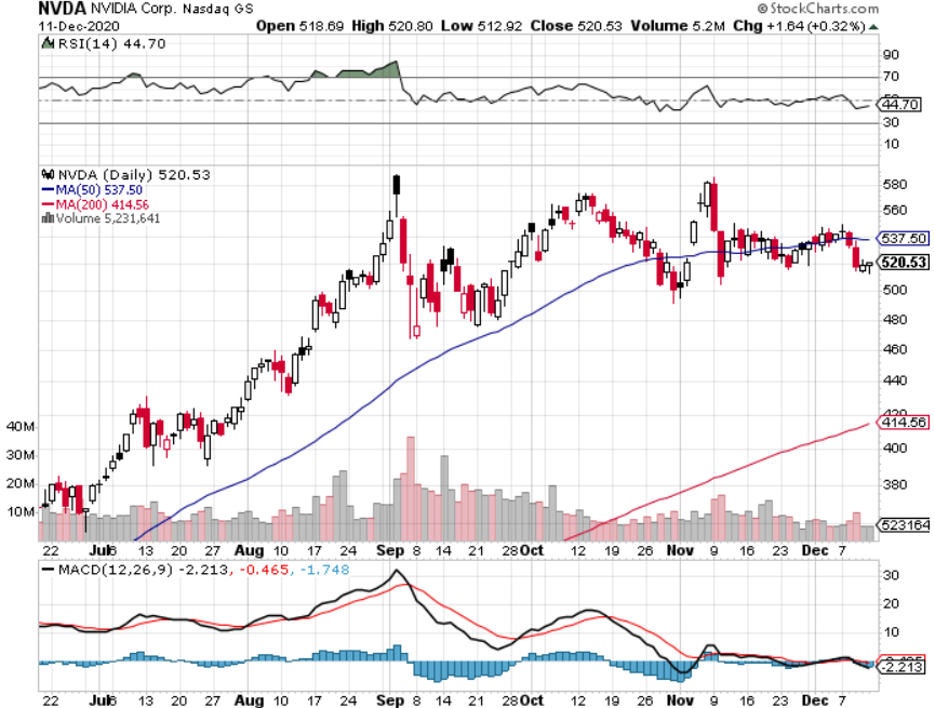
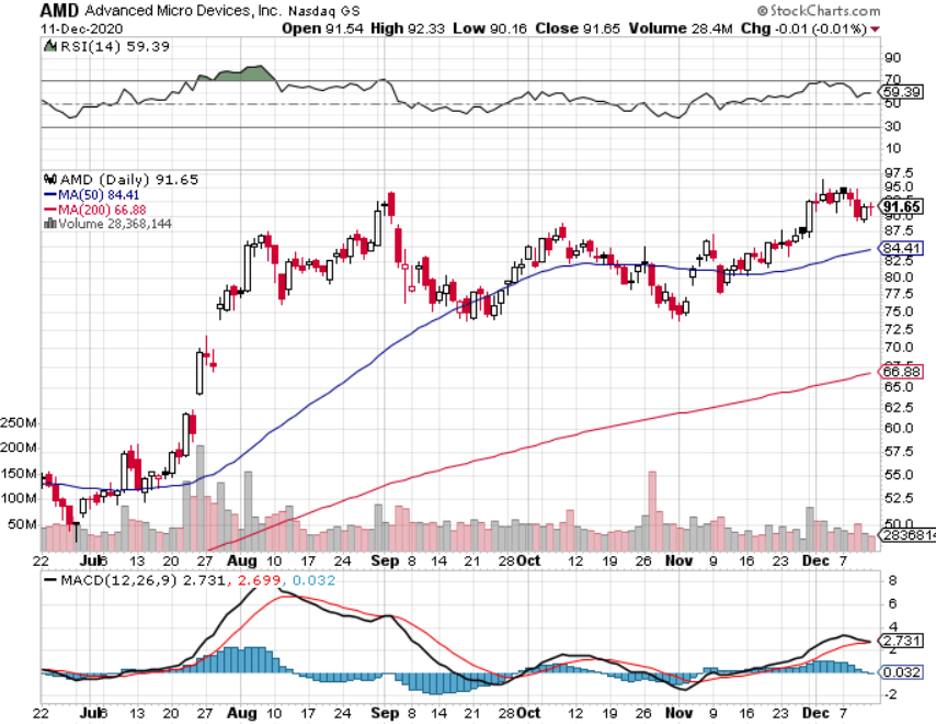
As we head into the 5G world, I would not bet against the semiconductor trade and the likes of Nvidia (NVDA), AMD (AMD), Qualcomm (QCOM) should overperform in 2021.
Communication is the glue of society and communications-as-a-platform app Twilio (TWLO) will improve on its 2020 form along with cloud apps that make the internet more efficient and robust like Akamai (AKAM).
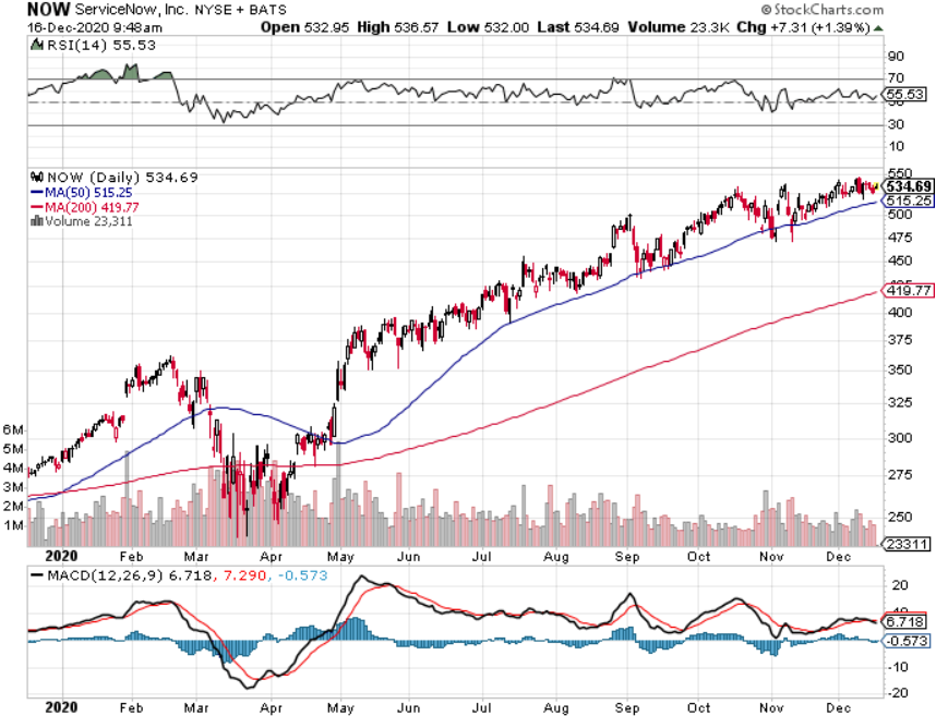
Workflow cloud app ServiceNow (NOW) is another one that will continue its success.
The uninterrupted shift to the cloud will not stop in 2021 and will be a strong growth driver for numerous tech companies next year.
I will not say this is a digital revolution, but as corporate executives realize they haven’t spent enough on the cloud in the lead-up to the pandemic and must now play catch-up in order to satisfy new demands in the business.
The most recent CIO survey was the thesis that cloud and digital adoption at 10% of enterprise and 15% of consumer spend entering 2020 would continue to accelerate post-pandemic and into 2021-2022.
A key dynamic playing out in the tech world over the next 12 to 18 months is the secular growth areas around cloud and cybersecurity that are seeing eye-popping demand trends.
Consumers will still be stuck at home, meaning e-commerce will still be big winners in 2021 such as Shopify (SHOP), Etsy (ETSY), and MercadoLibre (MELI).
The reliance on e-commerce will open the door for more tech companies to participate in the digital flow of transactions and the U.S. will finally catch up to the Chinese idea of paying through contactless instruments and not cards.
This highly benefits U.S. fintech companies like Square (SQ) and PayPal (PYPL). Intuit (INTU) and its accounting software is another niche player that will dominate.
Intuit most recently bought Credit Karma for $8.1 billion signaling deeper penetration into fintech.
Since we are all splurging online, we need cybersecurity to protect us and the likes of Palo Alto Networks (PANW), Okta (OKTA), and CrowdStrike Holdings, Inc. (CRWD).
The side effect of the accelerating shift to digital and cloud are troves of data that need to be stored, thus anything related to big data will also outperform.
Most of the information created (97%) has historically been stored, processed, or archived.
As new mountains of digital gold are created, we expect AI will have an increasingly critical role.
I believe that 2021 will finally see the integration of 5G technology ushering in another wave of digital migration and data generation that the world has never seen before and above are some of the tech companies that will make out well.
The average household is using 38x the amount of internet data they were using ten years ago and this is just the beginning.
“I see little commercial potential for the Internet for at least 10 years.” – Said Co-Founder of Microsoft Bill Gates in 1993
Mad Hedge Technology Letter
December 16, 2020
Fiat Lux
Featured Trade:
(THE NEW SALESFORCE)
(NOW), (CRM), (SAP), (ORCL), (IBM), (MSFT)
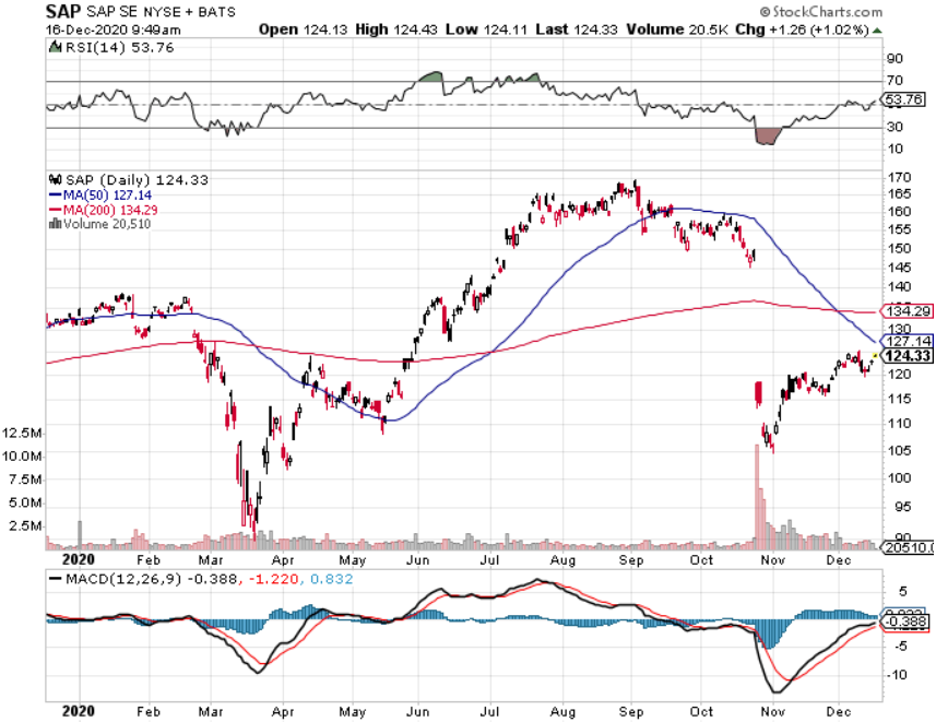
During Bill McDermott’s leadership as CEO, German software firm SAP's market value increased from $39 billion to $156 billion.
No doubt that this experience at SAP paved the way to become one of the fastest-growing major cloud vendors in 2020.
McDermott is now CEO of ServiceNow (NOW), a company that offers specific IT solutions. It allows you to manage projects and workflow, take on essential HR functions, and streamline your customer interaction and customer service. It does all of this, thanks to a comprehensive set of ServiceNow web services, as well as various plug-ins and apps.
Their market value has doubled to $100 billion and this is just the beginning.
ServiceNow almost doesn’t exist after numerous attempts to be acquired, like the time it was almost sold to VMware for $1.5 billion.
Company founder Fred Luddy, who is now chairman, and the board of directors were intrigued by the VMware offer, but venture-capital firm Sequoia Capital argued that $1.5 billion wasn’t a premium at that time let alone market rate for this burgeoning cloud player.
Then-CEO Frank Slootman was eventually replaced by former eBay Inc. (EBAY) CEO John Donahoe in February 2017, who took the company to $3.46 billion in annual 2019 sales.
Donahoe then bolted for Nike Inc. (NKE), and McDermott joined from SAP, locking in the firm for a new era of meteoric growth.
ServiceNow is now on its way to become the defining enterprise-software company of the 21st century and if you look at their position in the market today, they’re the only born-in-the-cloud software company to have surpassed $100 billion market cap without large-scale M&A.
This underdog cloud company whose automation software is deployed to improve productivity is leading to what is known as a “workflow revolution.”
Their set of software tools fused with the sudden emphasis on digital tracking of employees and business systems — has played into ServiceNow’s strengths.
The seismic shift is accelerating: By 2025, most of the millennial generation will work from home permanently, based on internal company reports.
It expects revenue of $4.49 billion in fiscal 2020 and still has a mountain to climb with revenue of just 20% of Salesforce, one-sixth of SAP, and one-ninth of Oracle Corp. (ORCL).
But ServiceNow is catching up as corporations and government agencies pour billions of dollars into their digital infrastructures.
So far, more than $3 trillion has been invested in digital transformation initiatives. Yet only 26% of the investments have delivered meaningful returns on investment.
This is launching the workflow revolution, where ServiceNow is the missing cog that can integrate systems, silos, departments, and processes, all in simple, easy-to-use cross-enterprise workflows.
A demand surge for “workflow automation” technology went parabolic in 2020 and is part of the puzzle helping ServiceNow sustain 25%-plus revenue growth.
ServiceNow most recently raised its full-year guidance after disclosing it has 1,012 customers with more than $1 million in annual contract value, up 25% year-over-year.
That included 41 such transactions in the third quarter, with new customers such as the U.S. Senate and New York City’s Mount Sinai Hospital.
ServiceNow raised guidance for the full year on subscription-revenue range to between $4.257 billion and $4.262 billion, up 31% year-over-year in constant currency.
The company has detailed a goal of $10 billion in annual sales as something feasible in the mid-term and its bevy of strategic relationships will help, like in July, Microsoft Corp. (MSFT) expanded its relationship with ServiceNow; shortly thereafter, Accenture (CAN) and IBM created new business units in partnership with ServiceNow to develop new opportunities.
In March, ServiceNow added a new computing platform, Orlando, that added artificial intelligence and machine learning that lets the MGM Macau casino resort, for example, use a virtual agent to automate and handle repetitive requests.
The integration of virtual agents will supplement casino employees with 24/7 support experiences when human staff is unavailable.
After hitting the $100 billion market cap, McDermott has identified M&A as the catalyst to take NOW higher with the CEO squarely looking at artificial intelligence targets.
ServiceNow has enabled firms to unite front, middle and back office functions, increasing productivity during this time period when speed and simplicity matter the most to digital customers.
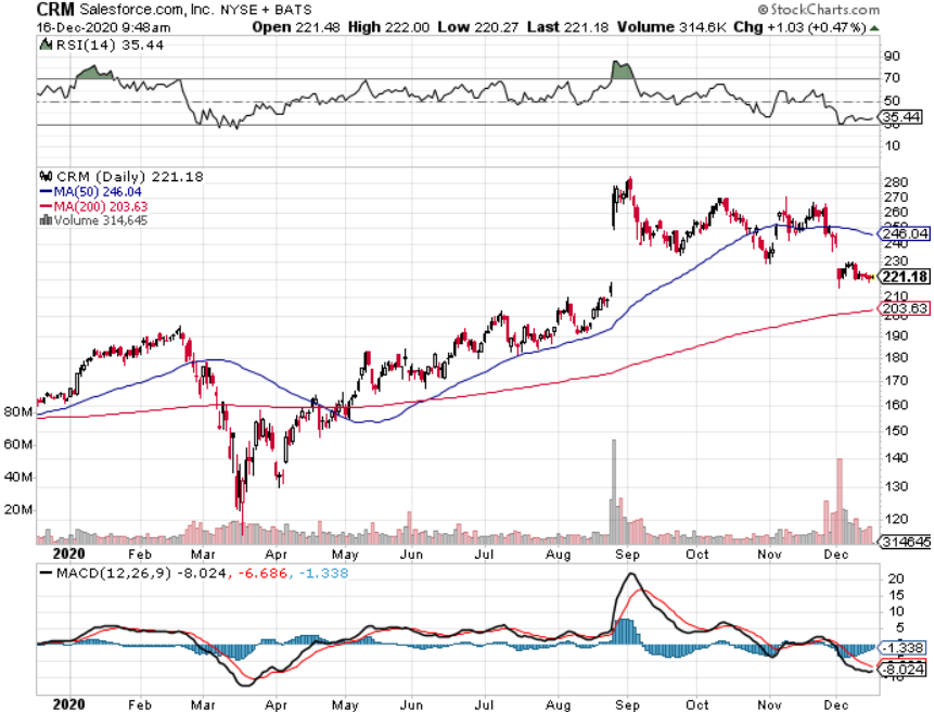
I would describe NOW as a baby brother to Salesforce and its entrance into the first and most likely continuous acquisition cycle will most probably result in higher share prices.
ServiceNow turns out to be placed in the perfect position benefitting from Americans moving their careers online with the added effect of the broad-based secular digital migration to remote work.
As long as this firm is generating revenue in the mid-20% annually, it will be a constant buy-the-dip candidate for the foreseeable future regardless of whether there is a pandemic or not.
“In the old world, you devoted 30% of your time to building a great service and 70% of your time shouting about it. In the new world, that inverts.” – Said Founder and CEO of Amazon Jeff Bezos
Mad Hedge Technology Letter
December 14, 2020
Fiat Lux
Featured Trade:
(NVIDIA’S SHOW OF FORCE)
(NVDA), (AMD), (APPL), (OTC:SFTBF), (INTC), (QCOM)
One of the best buy and hold tech stock has to be Nvidia (NVDA).
They are positioned at the vanguard of every major cutting-edge technology in the world such as self-driving technology, data center, and artificial intelligence.
Their cash cow business of manufacturing GPUs (graphics processing unit) which are essential to video gaming has been bolstered by the shelter-at-home movement.
Video games as an activity or something to just pass the time has never been so popular and Nvidia is the best of breed in this department.
The key takeaway from Nvidia’s asset portfolio is the diversity.
They aren’t beholden to any one division and I wouldn’t bet anytime soon that video games are going to go out of fashion because of the generational tailwind occurring.
In fact, the underlying Nvidia stock has risen more than 120% in 2020 and semiconductors have proven to be an astute place to put your money in during the pandemic.
The same goes for competitive rivals such as Advanced Micro Devices (AMD), Intel (INTC), and Qualcomm (QCOM) who explore some of those same markets.
Nvidia counts Amazon (AMZN) Web Services as a customer for data-center chips. It is partnering with VMware (VMW) and Amazon on an AI-driven cloud platform for big businesses.
Be mindful that semiconductor stocks are volatile because of the boom-bust nature of their business cycle.
Global chip sales cratered in late 2018 and fell 12% in 2019.
They rallied early this year on signs of an industry recovery and on a U.S.-China trade deal, then sold off on coronavirus fears.
The trade war has also thrown a spanner in the works of global chip production.
Production was first halted in China and then put global economies under strain.
Despite the pandemic, the semiconductor industry will return to growth in 2020.
Chip sales will rise by 5.1% to $433 billion this year and accelerate to 8.4% in 2021.
The spread of 5G wireless networks is a key catalyst.
Moving forward, it’s highly likely that U.S. lawmakers maintain an anti-China doctrine, and Nvidia and AMD derive only 1% to 2% of revenue from Huawei.
In fact, other companies are more exposed like Cisco and Intel.
How well is Nvidia doing?
They increased revenue by 57% year over year in the third quarter predominately due to its data center business, which grew revenue by 162% over the same period.
In Q3, the data center division accounted for $1.9 billion of the company's $4.7 billion of revenue.
Nvidia is also growing through acquisitions with its blockbuster pending $40 billion acquisition of chip design licensor ARM Holdings from Softbank (OTC:SFTBF).
ARM’s acquisition will help NVIDIA maintain the best of breed quality through 2021 and beyond.
That is important because the semiconductor industry is becoming more cutthroat with many big players sourcing chips in-house after deeply investing in this technology.
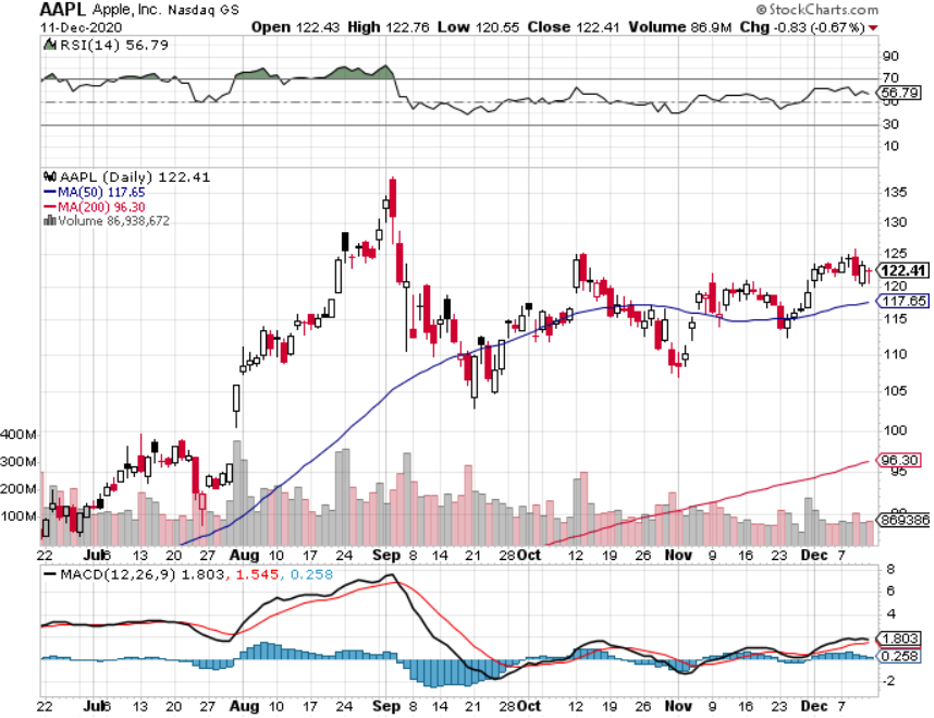
Apple (AAPL) recently unveiled its own stable of Mac processors, the M1, making its debut in late 2020. Manufacturing chips is historically a capital-intensive activity, and new chips don’t roll out that fast. In any case, cash-rich companies the size of Google and Apple have the firepower to pull this off.
ARM holds many unique patents forcing many companies to license from them, Apple can customize those designs, and the actual fabrication is outsourced to Taiwan Semiconductor (TSM), the largest and most technologically advanced semiconductor fabricator in the world.
In this specific case, Intel is the direct loser from the production of Apple M1 chips and at this point, this is becoming an existential crisis for Intel.
The acquisition of ARM is a gamechanger, and not just because NVIDIA would gain access to new markets like CPUs for mobile as early as 2021.
Integrating with ARM signals NVIDIA's future shift toward licensing of technology - a far more stable business model than the traditionally cyclical nature of semiconductor industry sales driven by upgrade cycles.
It all comes down to the quality of NVIDIA's chips which remain highly competitive in secular growth areas of tech, such as data centers and artificial intelligence. This alone should keep NVIDIA high up investors' list for years to come.
Demand for the new Nvidia GeForce RTX GPU has been “overwhelming” and the company completed its Mellanox acquisition, a tech firm that sells adapters, switches, software, cables, and silicon for markets including high-performance computing, data centers, cloud computing, computer data storage, and financial services, in April, helping it to double down on their revenue drivers.
Sales for Nvidia's chips remain robust across some of the most desirable end markets and there is nothing meaningful out there to suggest that Nvidia won’t continue its overperformance next year even if the shelter-at-home economy stops.
I am highly bullish on Nvidia stock into 2021 and beyond.
“Virtual reality, all the A.I. work we do, all the robotics work we do - we're as close to realizing science fiction as it gets.” – Said CEO of Nvidia Jensen Huang
Legal Disclaimer
There is a very high degree of risk involved in trading. Past results are not indicative of future returns. MadHedgeFundTrader.com and all individuals affiliated with this site assume no responsibilities for your trading and investment results. The indicators, strategies, columns, articles and all other features are for educational purposes only and should not be construed as investment advice. Information for futures trading observations are obtained from sources believed to be reliable, but we do not warrant its completeness or accuracy, or warrant any results from the use of the information. Your use of the trading observations is entirely at your own risk and it is your sole responsibility to evaluate the accuracy, completeness and usefulness of the information. You must assess the risk of any trade with your broker and make your own independent decisions regarding any securities mentioned herein. Affiliates of MadHedgeFundTrader.com may have a position or effect transactions in the securities described herein (or options thereon) and/or otherwise employ trading strategies that may be consistent or inconsistent with the provided strategies.