“I do not fear computers. I fear lack of them.” – Said American writer and professor of biochemistry at Boston University Isaac Asimov
Mad Hedge Technology Letter
October 14, 2020
Fiat Lux
Featured Trade:
(TECH OPTION VOLUME UNHINGED)
($COMPQ), (APPL), (FB), (MSFT), (GOOGL), (NFLX)
The euphoria in big cap tech shares is the catalyst moving the Nasdaq index recently.
Call option activity is taking the top off of tech shares with usual low beta stocks surging over 5% in single trading sessions.
This unfortunately is causing our options trades to experience heightened stock volatility and the knock-on effect is our strikes getting blown out.
Some of the excess volatility comes down to traders making big bets in the run-up to the election.
Remember when Trump won in 2016, the market exploded higher when many “experts” guaranteed a massive sell-off would ensue.
In the short-term, the unsustainable pace of speculation in derivatives will translate into wild price swings. Monday brought the biggest rally for the Nasdaq 100 Index since April, but measures of volatility rallied as well.
One proxy for the froth still latent in options, the percentage of overall volume represented by single-stock contracts, remains up 19% from a year ago.
Most of the action is concentrated in mega cap technology and momentum-driven shares.
A consensus is coalescing around a few big buyers coming into the options market to corner it with rumors of purchases around $300 million worth of call contracts on tech stocks in a single day.
The Nasdaq 100 Index has gained in all but two sessions this month and just notched its best week since July after last month’s sharp drop.
Whipsawing markets are also possible when liquidity remains thin.
Trading in options showed itself capable of influencing share movement in August and September when dealer hedging (demand from people who sell options for the underlying stock) created feedback loops that helped drive the Nasdaq higher.
That dynamic can also make sell-offs worse than they should be as well as sellers adjust positions.
Big trades in thin markets, especially in technology or momentum trades considered overbought or oversold, increase the potential for exacerbated stock moves as dealers hedge exposure.
Call open interest in Facebook (FB), Amazon (AMZN), Netflix (NFLX), Alphabet (GOOGL), Apple (APPL) and Microsoft (MSFT) has averaged 12.8 million contracts over the 30 days through Friday, the highest since early 2019.
The tech-heavy Nasdaq index has gyrated an average of 1.8% per day since the beginning of September, while the broader market gauge has fluctuated by 1.2% over that time period.
Recent options activity has been momentum-based, meaning that stocks tend to attract more interest in calls when it’s rallying versus when it trades lower.
Throw in structural forces that are contributing to a sustained high implied volatility environment, and election hedgers have their work cut out for them.
There are fewer short-volatility players as well in the wake of the health crisis.
There’s also less volatility selling by retail investors after the delisting of some popular VIX products earlier this year like the volatility ETF ticker symbol XIV.
It could take a few years for the imbalances to work itself through the system.
Then there’s the resurfacing of an event similar to the “Nasdaq whale” which is reported as Softbank acting like a hedge fund and buying as many big tech call options they could afford.
Softbank CEO has essentially turned his failed hedge fund named the Vision Fund from a start-up investor into a speculative hedge fund in risky option contracts solely betting on the rise of Silicon Valley tech in the age of the coronavirus.
After being burnt by Uber and WeWork, he finally decided to stay out of the messy acquisitions/seed funding and just speculative through derivatives from Tokyo.
The avalanche of options volume will no doubt cause the tech markets to become jittery and it certainly puts a floor under tech implied volatility for a while.
Retail investors have taken notice of this insane volume and largely stayed on the sideline.
At the apex of the madness, retail traders spent more than $511 billion in notional value on call options and that figure was slashed to $343 billion in the first week of October.
Retail traders tend to buy less-expensive short-dated contracts which tend to have greater convexity and ability to exacerbate share movements.
The level of risk-taking occurring in the public markets is at an all-time high.
Just look at America’s most elite university endowments who have slashed their exposure to the stock markets to the lowest levels since before the crash of 1929. And now they’re betting the ranch on secretive, illiquid, and high-risk private-equity funds and hedge funds.
A US teachers’ pension fund has sued Allianz Global Investors, accusing one of the world’s biggest asset managers of employing a “reckless strategy” that cost retirees almost $800m during this year’s market turmoil.
This is just one example of the high-risk strategies taking place with pension money.
In a lawsuit filed on Monday in New York, the Arkansas Teacher Retirement System claims that Alpha Funds, investment vehicles marketed by AllianzGI, had placed bets against an escalation of market volatility in an effort to recover losses they incurred from the same strategy in February.
So here we stand with derivative trading in tech options and general equity strategies leveraged to the hills that are betting on the system not breaking, or at least not breaking yet.
Even if the system reaches breaking point, many of these private investors are betting on governments to come rescue them perpetuating the feedback loop and offers a conundrum to savvy asset managers to miss or partake in the gaps up themselves.
“Success can cause people to unlearn the habits that made them successful in the first place.” – Said current CEO of Microsoft Satya Nadella
Mad Hedge Technology Letter
October 12, 2020
Fiat Lux
Featured Trade:
(DATA ANALYTICS IS THE WAY FORWARD FOR ANY BUSINESS)
(DDOG)
As the coronavirus shows no signs of stopping in the short-term, it only delays the economic recovery that was first labeled as a “V-shaped” recession.
I do believe the negative economic news is being understated when the broader global picture is being looked at.
The sad fact is that emerging countries have taken the harder hit to relative GDP than the US and the US has financial levels in dollar-denominated debt that other countries don’t have access to.
While this macro uncertainty remains in the near term, it only gives more proof that investors need to be digital-first and agile and confirms the cloud as the best path to achieve these results over the long term.
The evidence of this transformation is growing with the overall demand in the form of new customers and new use cases existing customers.
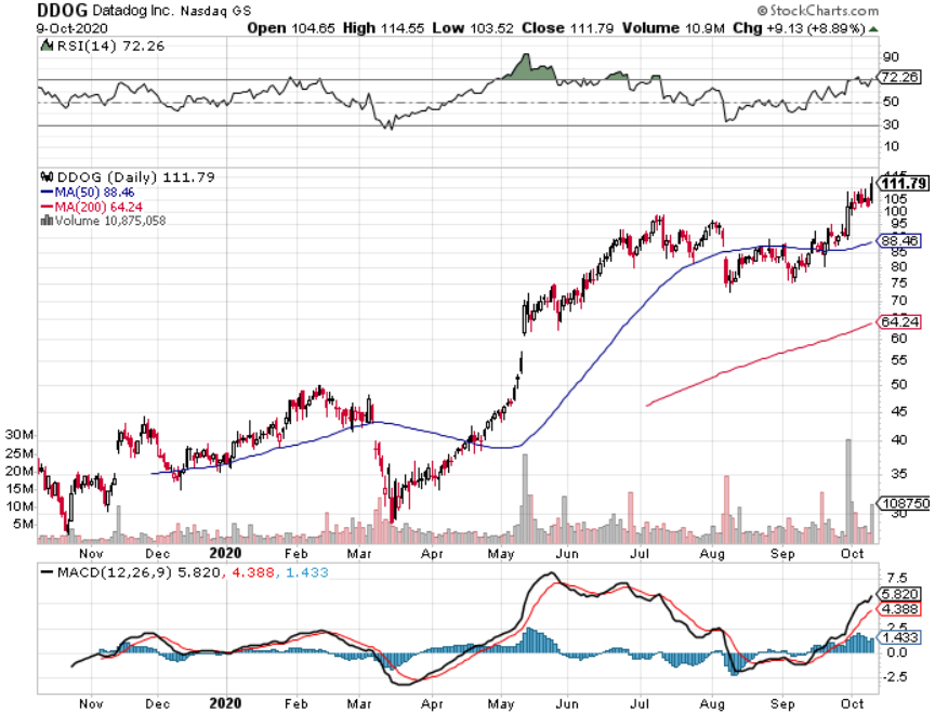
Data analytics will facilitate this renaissance towards digital offerings and that is why, for the first time, I am recommending Datadog (DDOG) — a monitoring service for cloud-scale applications, providing monitoring of servers, databases, tools, and services, through a SaaS-based data analytics platform.
Why are they a great tech firm to buy and hold in?
Their 2nd quarter performance was nothing short of breathtaking.
Revenue was $140 million, an increase of 68% year-over-year and they ended the quarter with 1,015 customers with new client accounts of $100,000 or more — an increase of 71% from last year.
As of the end of Q2, 68% of customers are using two or more products, which is up 40% a year ago.
Can you believe that it’s going so well now that 15% of Datadog’s customers are now using four or more products?
That figure is up from 0% the year before.
The support of cloud and other ephemeral architectures is more important than ever as the rapid change from work-from-home has demonstrated the limitation of legacy infrastructure.
Recent macro events like the pandemic that have accelerated the pivot to digital will unequivocally accelerate the migration to the cloud as the economy improves.
How does Datadog become one of the outsized winners?
They offer a broader solution with end-to-end visibility from back-end infrastructure all the way through to the end-user experience and now security as well. And they win because they offer a truly integrated platform for a single paid view into the IT stack.
Analyzing the management, execution was strong, being able to uphold accounts with larger customers who already have sizable cloud environments. Given macro uncertainty, these customers look to conserve cash while they still could and therefore optimize the consumption of cloud infrastructure and those management relationships are critical to preserving client accounts in major players.
Lower quality customers with large cloud deals from AWS, Azure, or Google Cloud look for immediate short-term savings and focus less on Datadog’s management and client relationships.
These quality customers will lead to a high rate of upselling into more robust packages as the broader economy strengthens.
Customers have been highly receptive of the single platform deliverability from Datadog — the customer has been able to move from multiple disparate monitoring tools to using a single platform for all three pillars of observability.
This allowed them to refocus engineering teams on building new features, and not out of the realm of possibility to expect more than 15% in savings from consolidating disparate monitoring and logging vendors into Datadog.
Another example of a recent deal is with a large entertainment platform that continued to upgrade its Datadog packages and now pledge to commit to over $10 million in the year.
This company has decided to increase investment in observability and broader use of Datadog both with new products and by scaling up on existing products.
So now they can use Datadog to quickly drill down into any failed request and easily identify layers. This company is now using all three pillars, including Synthetics, RUM, and NPM, and has standardized monitoring on Datadog.
The pathway to profits in 2020 is now to be a digital-first business, and the cloud is the best path to achieve this outcome.
Datadog will be the primary beneficiary of this trend and remains very well-positioned to win in the market.
In the near term, the macro environment is likely to continue to cause uncertainty, but in relative terms, Datadog will have no problem in scoring new deals as the volume of companies becoming digital will not cease.
Sustaining strong growth both in the near term and over time is something of a safe bet for Datadog and growing from $100 million of annual revenue in 2017 to $200 million in total revenue in 2018, and $362 million in annual revenue in 2019 is hard evidence the parabolic trajectory will continue uninterrupted for the foreseeable future.
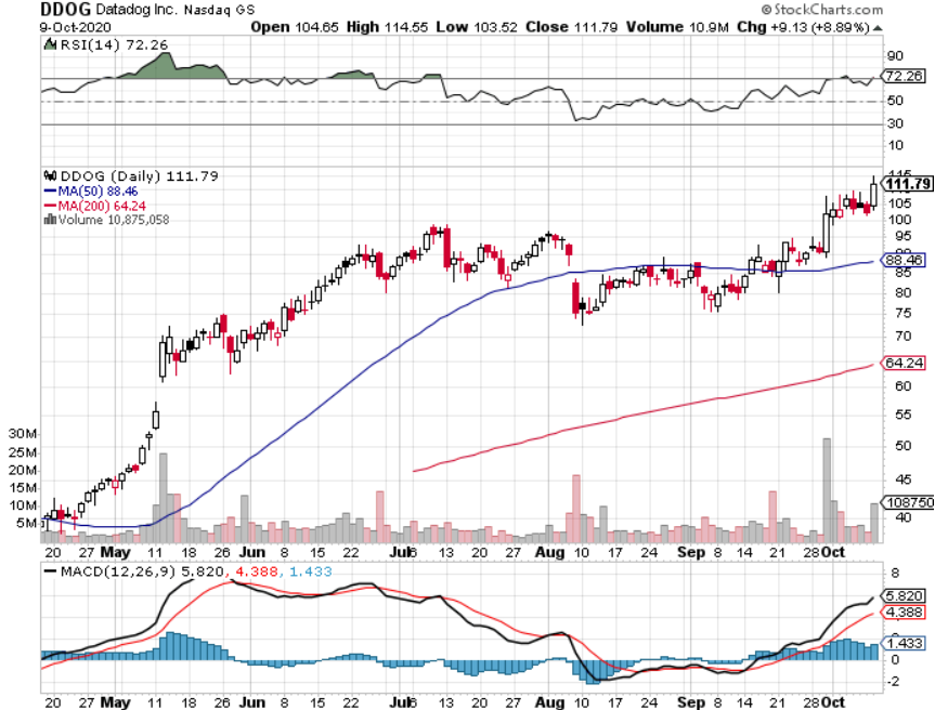
I am bullish Datadog and not surprised that shares of the stock are up over 300% in 2020. This is just the beginning of share appreciation.
Mad Hedge Technology Letter
October 9, 2020
Fiat Lux
Featured Trade:
(INCHING TOWARDS A KICK IN THE TEETH),
(TECH ANTITRUST)
House Democrats have proposed a massive overhaul of U.S. laws that will take the air out of big tech, or will it?
We are seriously inching our way to a meaningful change in anti-trust regulation in the U.S.
The conclusions offer a legislative road map for congressional Democrats — something that could become an even poignant threat to Silicon Valley if the party regains full control of Congress and a major overhaul could be in the cards.
The House Judiciary antitrust subcommittee is in the midst of a 16-month bipartisan investigation that analyzed the dark practices of Facebook, Google, Apple, and Amazon.
These companies have used their dominant power to abuse the spirit of competition and the side effects have been widespread, often negatively affecting U.S. society.
A major strategy at preventing competition is the “catch and kill method” acquiring up-and-coming rivals because of their financial advantage.
Unfairly favoring their own products on the online storefronts they operate, such as Amazon's Marketplace and Apple's App Store is another trick they have perfected.
There have been calls to ban major tech platforms from acquiring future startups or potential rivals and barring them from both owning marketplaces — such as Amazon’s broad-based e-commerce hub — and selling competing products on them.
Either way, there will be some sort of actionable legislation once Congress returns in 2021 — this is ultimately negative for tech stocks because most of the investor capital is overweight in the biggest tech names.
Democratic hopeful Joe Biden is currently the favorite in the polls and if he wins, the pressure to expedite this cause will grow. Trump hasn’t moved on this issue in 4 years and it could get bogged down if he were to be re-elected.
Senators are pushing to rewrite antitrust law and advocate breakups of the largest American tech companies.
Tech companies wouldn’t be able to hide behind some outdated law infamously called Section 230.
This 1996 statute became known as "a core pillar of Internet freedom" and "the law that gave us modern Internet" — a critical component of free speech online. But the egregiousness of Section 230 flows through some of the darkest corners of the Web. Most glaringly, the law had been used to defend the now-defunct Backpage.com, a website featuring ads for sex with children forced into prostitution.
Section 230 would be on the top of the heap to get rewritten, meaning Facebook would now have to pay monetary damages to harmful content posted on their platform which they have proven they cannot moderate.
This opens up an avalanche of potential lawsuits and compliance issues which ultimately adds up to higher costs.
At this point, it’s even a question mark whether these companies will be allowed to acquire any more start-ups to cement their gains before the regulations kick in. Just look at Europe’s blocking of Google’s purchase of tech wearable company Fitbit.
Besides China, this is one of the few bipartisan issues both parties agree on, and if they get their act together the pipeline of regulation could even be started before the end of 2020.
The pandemic has only helped highlight the diversion of fortunes between tech and non-tech as millions of Americans are out on the street with no food to eat.
Biden has already launched a scathing attack on Facebook calling it “the nation’s foremost propagator of disinformation about the voting process” last month in a letter to Facebook CEO Mark Zuckerberg.
Punitive actions against some of the world’s most valuable companies will most likely come in droves, not to mention that the balkanization of global tech revenues will translate into a lower future income trajectory.
There is still a chance that this is all bluster and no bite but only time will show what the politicians truly intend to do in terms of meaningfulness and duration.
Big tech has had a history of seizing uncanny ways to get around regulation; and just look at rideshare company Lyft who is hoping to pass legislation to avoid paying their employees as employees with an upcoming vote on Proposition 22.
This is definitely not the end of the road for big tech, but they are confronted by a situation where even if they are broken up, the value of those companies would be even greater than they are now.
But why not play it safe when you don’t need to compete with yourself?
That’s the essential problem as just a few CEOs harvest the fruit from the success of tech; and the San Francisco Bay Area has been a symbol of this, with an island of rich people among a sea of homelessness.
The last card up their sleeve is charging more for services such as Gmail and Facebook while increasing fees for digital ads. There are ways to fiddle with the structure to keep it intact, and although regulation is now staring us right in the face, I still believe in the big tech narrative.
On the flip side, this paves the way for the “2nd tier” tech firms to catch up with the entrenched.
“A founder is not a job, it's a role, an attitude.” – Said CEO of Twitter Jack Dorsey
Mad Hedge Technology Letter
October 7, 2020
Fiat Lux
Featured Trade:
(THE HOTTEST TECH GROWTH INDUSTRY)
(DKNG), (LVS)
Legal Disclaimer
There is a very high degree of risk involved in trading. Past results are not indicative of future returns. MadHedgeFundTrader.com and all individuals affiliated with this site assume no responsibilities for your trading and investment results. The indicators, strategies, columns, articles and all other features are for educational purposes only and should not be construed as investment advice. Information for futures trading observations are obtained from sources believed to be reliable, but we do not warrant its completeness or accuracy, or warrant any results from the use of the information. Your use of the trading observations is entirely at your own risk and it is your sole responsibility to evaluate the accuracy, completeness and usefulness of the information. You must assess the risk of any trade with your broker and make your own independent decisions regarding any securities mentioned herein. Affiliates of MadHedgeFundTrader.com may have a position or effect transactions in the securities described herein (or options thereon) and/or otherwise employ trading strategies that may be consistent or inconsistent with the provided strategies.