Mad Hedge Technology Letter
June 16, 2023
Fiat Lux
Featured Trade:
(THE SKINNY ON AI)
(CRM), (NVDA), (MSFT), ($COMPQ)
Mad Hedge Technology Letter
June 16, 2023
Fiat Lux
Featured Trade:
(THE SKINNY ON AI)
(CRM), (NVDA), (MSFT), ($COMPQ)
One misunderstanding about generative artificial intelligence is that it is advertised as the panacea that will cure the economy and global business in one second.
It’s not.
These types of technologies take time to absorb and integrate.
The type of hype surrounding AI feels like every tech company should 100X revenue next year.
That’s not going to happen right away.
It’s obviously going to be an incremental phenomenon instead of a parabolic rise.
People also seem to miss there will be a swath of AI failures that will disappear into the dustbin of history and everything in between.
Just because Nvidia (NVDA) and Microsoft (MSFT) are making hay during this hot money AI investor pandemonium, doesn’t mean all tech companies will.
In the long term, access to high-quality artificial intelligence will unlock a long-term productivity miracle.
The United States economy is suffering from a bout of unproductivity as young workers mostly spend their time perusing Instagram than tangibly delivering results.
Moving a finger is a hard slog these days for Generation Z.
The net result is poorly trending productivity gains.
Productivity growth in the US has been a paltry 1%.
This week alone brought two examples of generative AI's potential for economic output.
First, a new McKinsey study identified 63 generative AI use cases spanning 16 business functions that could unleash $2.6 trillion to $4.4 trillion in economic benefits annually.
The same study found that generative AI could perform each of more than 2,100 detailed work activities such as communicating with others about operational plans.
Generative AI has the potential to change the anatomy of work, augmenting the capabilities of individual workers by automating some of their individual activities.
Current generative AI and other technologies have the potential to automate work activities that absorb 60 to 70 percent of employees’ time today.
Meanwhile, software company Salesforce (CRM) launched its new GPT enterprise products designed to boost worker productivity.
The company introduced "AI Cloud" at a New York City investor day. Salesforce says its AI Cloud product will allow marketers to auto-generate personalized content for customers and developers to auto-generate code.
Salesforce employees also showed off coming AI functions in the workplace collaboration platform Slack.
It’s true that this AI wave is going to be the biggest that anyone has ever seen, but it will take time to get there.
I think there are meaningful lags in AI's impact. And the idea there will be a surge in economic growth in the next seven to ten years because of AI and technology.
It won’t happen in 2 or 3 years.
Goldman Sachs estimated recently that generative AI could expose the equivalent of 300 million jobs globally to automation over the next decade. That's a nice way of saying a person may lose their job to a robot.
AI could also eventually increase the annual global Gross Domestic Product (GDP) by 7%.
There is the thought that AI will make production faster and more voluminous but the quality and understanding will be poor. Just like all those online chat assistants that companies use. If you have a very specific question not covered by the FAQs they just spit back unhelpfulness.
The takeaway is that there will be winners and losers, but it will take time.
In many cases, the outsized winner is someone we have never heard of that brings something new to the table.
A critical part of this investor play is to avoid AI failures as well because there is bound to be a pile of body bags on the way to AI riches.
“AI will probably most likely lead to the end of the world, but in the meantime, there'll be great companies.” – Said Current CEO of OpenAI Sam Altman
Mad Hedge Technology Letter
June 14, 2023
Fiat Lux
Featured Trade:
(ANOTHER ONE TO ADD TO THE AI BANDWAGON)
(ORCL)
We are starting to get to the overhype stage of AI in the short term because the sub-sector has gone too far too fast in such a short period of time.
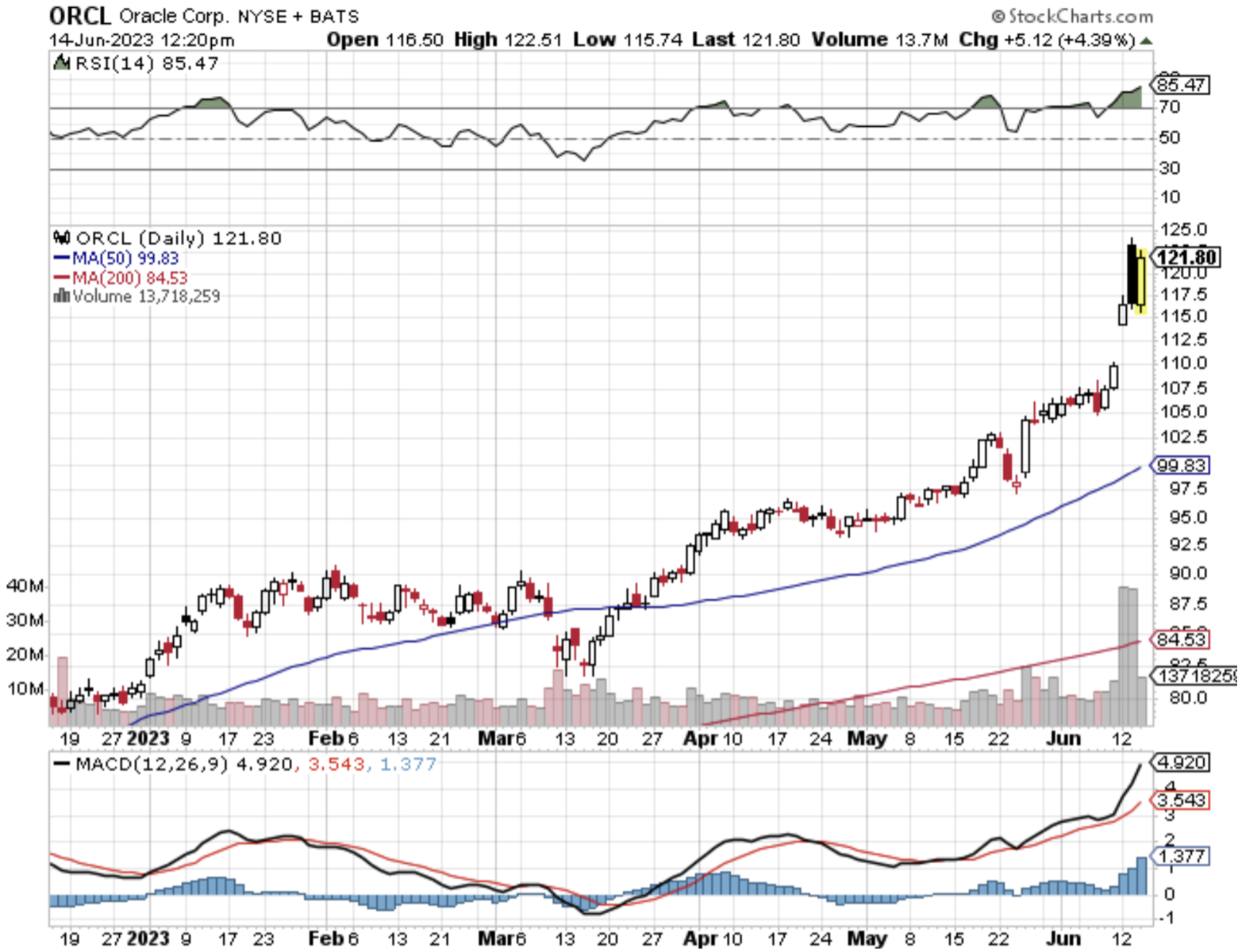
Software company Oracle (ORCL) needs to be mentioned as another AI participant chomping at the bit.
ORCL has been quite the laggard for some time as their warehouse cloud system was considered behind the times.
It’s fair to say that the stock has benefited the most from the AI hype simply because its stock was priced so cheaply before it caught the AI bid.
Now they have finally told us how they will integrate generative AI into their products and this has triggered strong interest in the stock.
Oracle is offering its enterprise customers a way to build their own generative AI apps leveraging a company that is similar to OpenAi called Cohere.
Oracle will be embedding Cohere's generative AI technology into a bevy of its products and Cohere will be using Oracle's cloud to train, build, and deploy its generative AI models.
Cohere doesn't have an exclusivity contract with Oracle. Fellow investor Salesforce, for instance, already offers a service that embeds Cohere's chat capabilities into Salesforce. This is just one of the many AI tools Salesforce offers customers.
Oracle does have some of its own homegrown AI technology and uses it for features like its "autonomous" database where its cloud software detects and automatically solves problems.
Cohere is the only partner Oracle announced to power its generative AI services for customers.
Perhaps the main reason Cohere has emerged as an alternative to OpenAI is that it was founded by Aidan Gomez.
He was a research intern at Google Brain in 2017 when he co-authored a paper on a way of training AI models to improve their abilities to understand language.
His sharp ideas have become the basis for the generative AI tech that has so engulfed the industry today, including some models used by OpenAI.
Along with cofounders and fellow AI experts Nick Frosst and Ivan Zhang, Gomez founded Cohere in 2019 to bring Google-quality AI to the masses.
Oracle said that Cohere’s large language models will be directly integrated into Oracle’s cloud applications.
The company will add generative AI features not only to its flagship enterprise resource planning software, but also to applications for human resources, supply chain management, and customer experience management.
The tsunami of AI short-term hot money diving into stocks has been a boon for the tech this year.
The Nasdaq has gone from strength to strength and outpacing the other indices has meant it’s been the only game in town in 2023.
With the likes of Tesla in the green for 13 straight sessions, it’s hard to see when this pandemonium ends.
Surely, there will be a pullback at some point but the good news keeps getting shoved in my face and traders are inclined to buy.
The regional bank crisis also provided an extra swath of liquidity that was largely pumped into the stock market and the Fed’s quantitative tightening dramatically curtailed.
Even though tech stocks are oversold including Oracle, my analysis has shown that traders are waiting for any and every dip to add to their long tech positions.
Put ORCL down as another tech stock to buy on the dip.
“If you're offered a seat on a rocket ship, don't ask what seat.”- Said Former Chief Operating Officer of Facebook Sheryl Sandberg
Mad Hedge Technology Letter
June 12, 2023
Fiat Lux
Featured Trade:
(GREEDFLATION WINS OUT)
($COMPQ), (UBER)
Tech companies are doing well and so is the overall stock market.
It doesn’t make sense to listen to all the doomsday personalities going on national TV to scare us out of making money.
Just zone them out – they are useless.
Back in the real world, the excellent performance is great news for holders of US tech stocks who have been carrying the load in 2023.
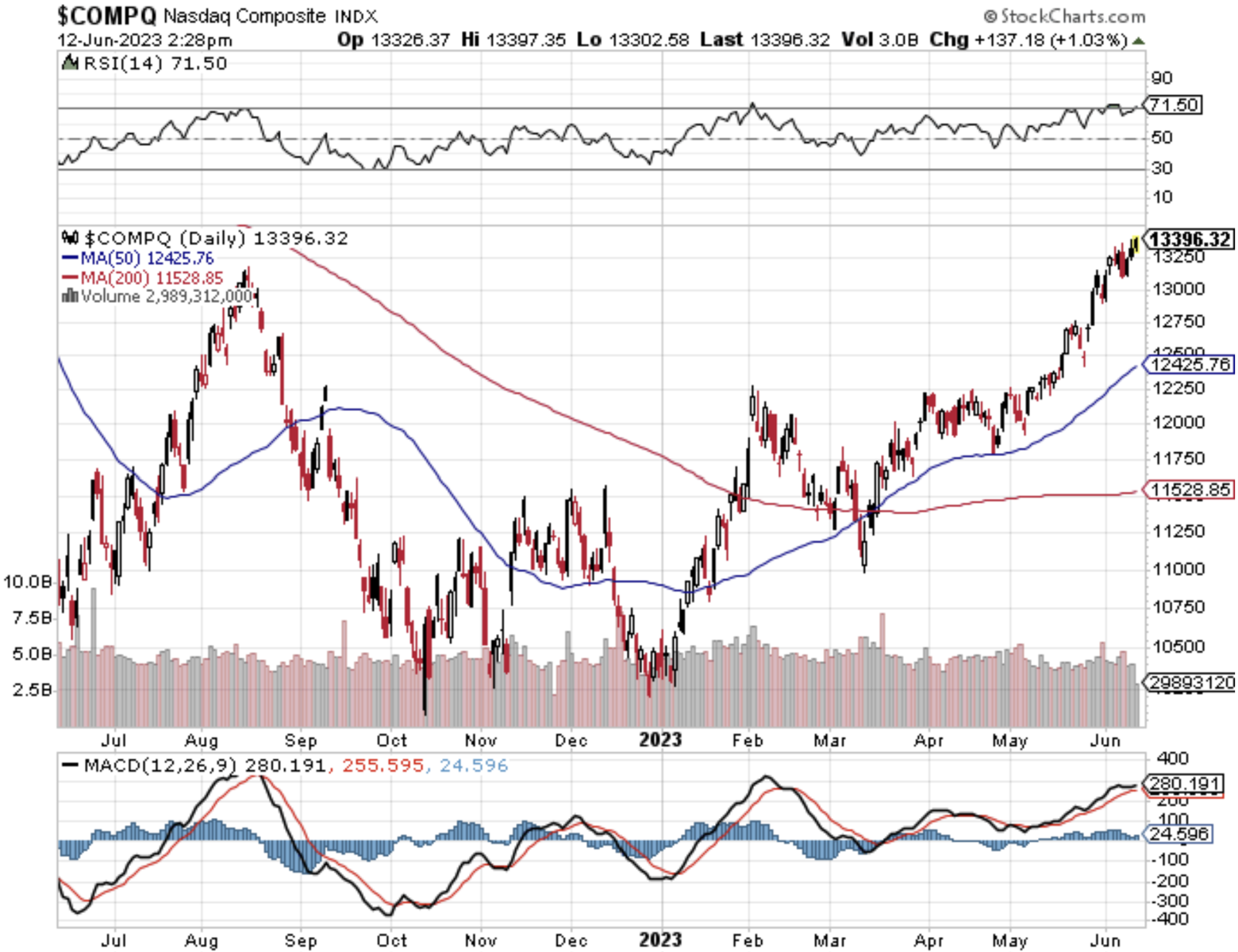
The tech-based Nasdaq index ($COMPQ) has returned 27% YTD and anyone betting on an “earnings recession” has had their head handed to them.
Mr. Market has continued to look through any risk presented and shrugging it off like it doesn’t matter.
We have been waiting for that recession which hasn’t arrived for almost 3 years now.
People will have to continue to wait too as the job numbers have been excellent.
Instead, we should focus on why tech companies are doing so well and what makes their balance sheets tick.
In a widespread industry survey, 89% of respondents said US companies have been raising prices in excess of their own costs since the pandemic began in 2020. Almost four out of five said that tight monetary policy is the right way to tackle profit-led inflation.
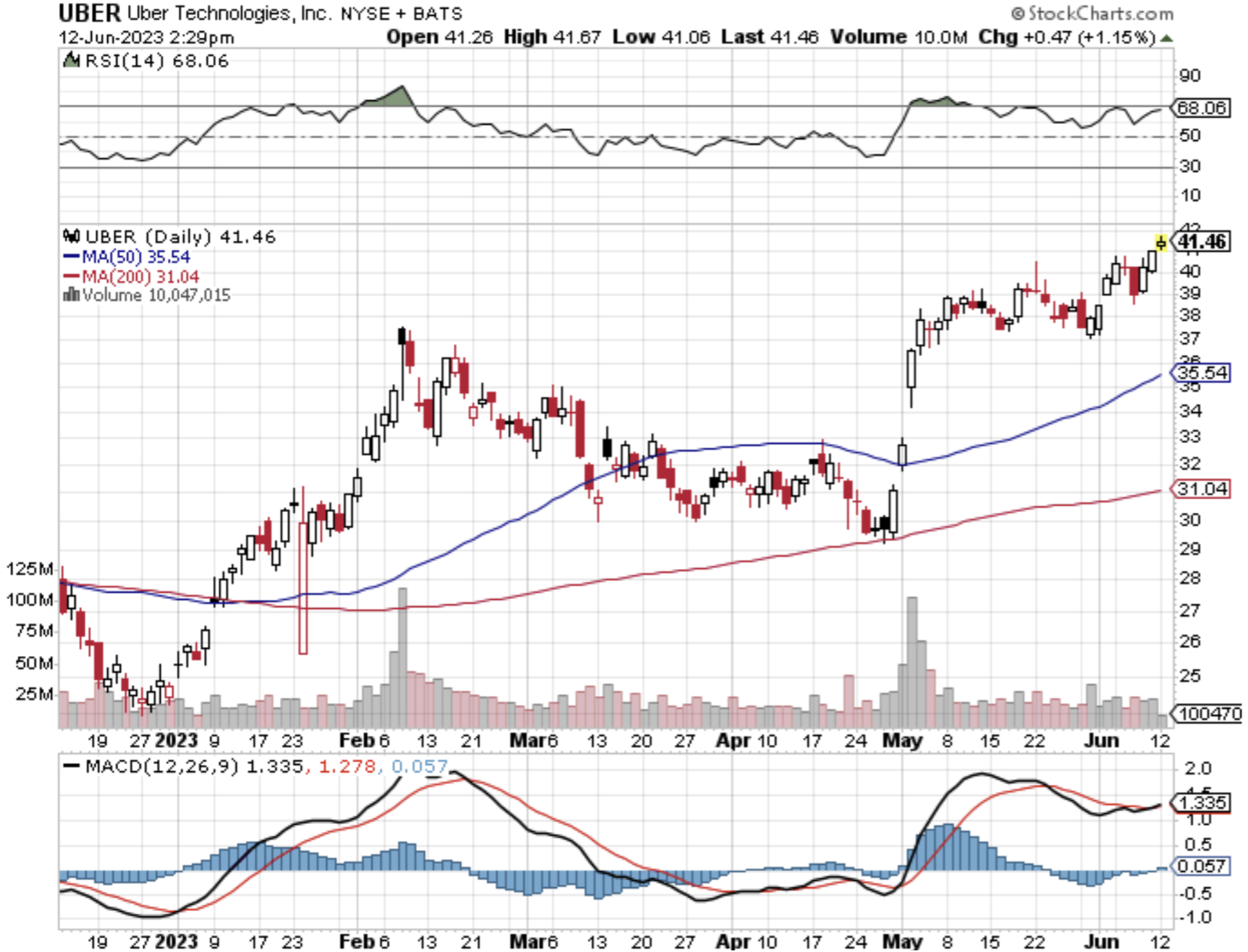
The surge in corporate markups cannot be understated and tech companies have done exceptionally well with Uber (UBER) rides more costly as just one little example among many.
Margins soared in the initial pandemic years, and have defied convention by remaining historically high since then.
The unique circumstances of the pandemic – severe supply constraints, followed by an unprecedented burst of stimulus-fueled demand – lie behind the widening of profit margins, which hit 70-year highs in the US.
Even if margins come down a little because customers start to balk at high prices, the price reductions will be most likely incremental.
Standard economic theory holds that profit margins are “mean-reverting’’ – in other words, they tend to be pulled back to normal levels. It’s supposed to work like this: An industry with high profits should attract new entrants, with increased competition forcing margins lower.
However, many tech companies are operating as de-facto monopolies in their subsector and possess an unprecedented amount of pricing power for the products they sell.
This has led to the idea more colloquially known as “greedflation.’’
Until a rising backlash against monopolies or oligopolies triggers buyer protests, the tech playbook should be to buy those companies that look most similar to monopolies.
Ultimately “greedflation’’ is great for holders of tech stocks and not necessarily good for US consumers.
Clearly, there is a profit honeymoon with the likes of big tech raking in the dough.
They can even push out aggressive and abstract products like the Apple VR headset for $3,500 per clip.
That’s not a defensive strategy as well as absorbing billions to develop the product.
Coupled with the lust for anything generative AI, the conflation with higher margins has triggered a momentous rally in tech stocks.
As we narrow down our paths for the rest of the year, a demonstrative easing cycle is setting up promising to catapult tech stocks another leg up from current levels.
The considers that inflation is dropping fast from 5% to 4% and projections could find us in the 3%-ish range in the next month or two which is a strong tailwind for tech stocks.
It’s hard to see where the sellers come in and I would continue to buy every small dip in every quality tech stock name.
“Take risks now. Do something bold. You won’t regret it.” – Said CEO of Tesla Elon Musk
Mad Hedge Technology Letter
June 9, 2023
Fiat Lux
Featured Trade:
(SHOULD YOU BUY CARVANA?)
(CVNA)
Legal Disclaimer
There is a very high degree of risk involved in trading. Past results are not indicative of future returns. MadHedgeFundTrader.com and all individuals affiliated with this site assume no responsibilities for your trading and investment results. The indicators, strategies, columns, articles and all other features are for educational purposes only and should not be construed as investment advice. Information for futures trading observations are obtained from sources believed to be reliable, but we do not warrant its completeness or accuracy, or warrant any results from the use of the information. Your use of the trading observations is entirely at your own risk and it is your sole responsibility to evaluate the accuracy, completeness and usefulness of the information. You must assess the risk of any trade with your broker and make your own independent decisions regarding any securities mentioned herein. Affiliates of MadHedgeFundTrader.com may have a position or effect transactions in the securities described herein (or options thereon) and/or otherwise employ trading strategies that may be consistent or inconsistent with the provided strategies.