Monthly Archives: July 2011

July 14, 2011 – The Gold Bulls Are Vindicated

(SPECIAL GOLD ISSUE)

Featured Trades: (GLD), (RGLD), (AEM), (GBG)


1) The Gold Bulls Are Vindicated. For the faithful who have successfully crossed the desert and suffered the slings and arrows of critics and the ridicule of non-believers, gold’s move today to an all-time high of $1,586 delivers the greatest of all vindications. All it took was some comments by Ben Bernanke about the remote prospect of a future QE3, and it was off to the races. Another round of the European sovereign debt crisis is sending panicky continentals into gold in droves. Yesterday, buying of gold ETF’s like (GLD) reached 21 tonnes in gold equivalent, one of the largest days on record.

It didn’t hurt that we are about to enter a period of traditional strength in the gold market, with the Indian wedding season only two months away. Actually, it wasn’t much of a desert, maybe more of a Zen rock garden, as the barbarous relic was stuck in a tedious and tiresome $100 range before it resumed its recent ascent. The Chinese buying I predicted put a floor under the price much higher than traders anticipated, frustrating hoards of buyers lower down.

So now the question arises of what to do with your bounteous profits, and how much risk does the yellow metal present here. I get asked this question a dozen times a day, by some who have been long since the current move started more than a decade ago at $260, and others who stood on the sidelines and watched in awe as it went to the moon, kicking themselves all the way. Is it too late to get in?

They call the yellow metal the barbarous relic for a reason. Let’s face it. We’ve had a great run. Gold has been one of the top performing assets by a long shot, soaring some 510% since 2002, while most other asset classes sucked. Investors did even better in the futures, leveraged ETF’s like the (UGL), and gold mining shares or their out of the money calls.

Anyone considering a short here will be insane to do so, as you will be going against the long term trend. Obama has not suddenly turned into a paragon of fiscal rectitude, and Ben Bernanke still has the keys to the printing presses. The Fed has yet to even admit its role in the credit bubble of the last decade. Fiat paper currencies are still running a frenzied race to the bottom. Politicians of both parties see the only way to win elections is to inflate, and to debase the greenback.

Almost all short term money market alternatives globally are yielding close to zero, meaning that the opportunity cost of owning the gold is nil. It turns out that they aren’t making gold any more. The output of gold has fallen by 12% annually for the past decade, compared to a doubling of production costs to over $500/ounce.

Reserves everywhere are playing out, and top producer Barrick Gold (ABX) isn’t opening a new mine at 15,000 feet in the Andes because it likes the fresh air. The upcoming slugfest in Congress over the debt ceiling will almost certainly cause many investors to just throw up their hands in despair and start shopping for American gold eagles at Amazon.

Now that we have broken out to a new high, many traders think the yellow metal won’t pause to catch its breath until we hit $1,600. I still think my long term target of $2,300 is a chip shot, but it might take three years to get there. There are higher predictions of $5,000, $10,000, and $50,000 based on ratios of gold to broadening definitions of monetary assets (see below).

Below are the downside support points on the charts, with my comments.

$1,521 -50 day moving average, probably holds, but a break signals a more serious pull back
$1,422 ‘“ 200 day moving average held last time, should work again. Unlikely to get there, but the world is a big buyer if it does.
$1,050- The 2010 low, the old multiyear high, and the place where the Reserve Bank of India kicked off the current love fest with its surprise 200 tonne purchase in 2009 months ago. Unlikely to get there, but the world is a big buyer if it does. Bet the ranch here.
$680 ‘“ The 2008 low- In your dreams. We aren’t going to get a full blown flight to liquidity we saw in that dreadful year. Relegated to the history books for good.

Use any serious dips to accumulate low cost, growing, gold miners with decent valuations, which are enjoying escalating operating leverage the higher the barbaric relic runs. Some new names you might entertain are Royal Gold (RGLD), Agnico-Eagle Mines (AEM), and Great Basin Gold (GBG).

-

-

-

-

July 14, 2011 – China’s Insatiable Appetite for Gold

(SPECIAL GOLD ISSUE)

Featured Trades: (GLD)


2) China’s Insatiable Appetite for Gold. Gold bugs and naysayers alike take note. When the world’s second largest and fastest growing economy liberalizes gold ownership by individuals, who happened to be the planet’s most fastidious savers at a 17% rate, you better pay attention.

Among other reforms, the Middle Kingdom has repealed the death penalty for the illegal importation of the yellow metal, and is now going to some lengths to encourage individual gold ownership.  The potential demand this will unleash boggles the mind. China historically has been a hard currency culture, and only started using paper banknotes when they were forced upon them as a way to repay debts by foreign colonial powers in the late 19th century.

But the Chinese desire to own gold and silver never went away. In 2010, China imported 73 metric tonnes of the barbaric relic worth $2.6 billion to bring its official holdings to 1,054 metric tonnes. That leaves it far behind the US, which at 8,133 tonnes is the world’s largest gold owner. China’s gold holdings amount to only $37 billion, or only 1.5% of its $2.45 trillion foreign exchange reserves.

To get China’s gold investment up to American levels on a GDP basis, it needs to buy 25 million ounces worth $31 billion. That amounts to 34% of the 2009 global annual production of $110 billion. Being astute traders, the Mandarins at the People’s Bank of China are loathe to chase prices, so don’t expect them to make up the gap in one shot. Instead, expect a quiet diversion of new current account surpluses out of the greenback and into gold.

You can also expect other emerging market central banks to make the same move. If non G7 central banks from the current 20% average of reserves to the 35% weighting now owned by the G7, it will require 1.3 billion ounces of new purchases, or 20% of the total world supply. I can hear the ‘BUY’ tickets being written already.

The Chinese aren’t going to provide the next spike in gold prices, but they are building a floor higher than anyone expects. That’s why the last sell off took us down only 5% to $1,480 before a rebound.

July 14, 2011 – The Ultra Bull Argument for Gold

(SPECIAL GOLD ISSUE)

Featured Trades: (GLD)


3) The Ultra Bull Argument for Gold. I am constantly barraged with emails from gold bugs who passionately argue that their beloved metal is trading at a tiny fraction of its true value, and that the barbaric relic is really worth $5,000, $10,000, or even $50,000 an ounce (GLD). They claim the move in the yellow metal we are seeing is only the beginning of a 30 fold rise in prices similar to what we saw from 1972 to 1979, when it leapt from $32 to $950.

So when the chart below popped up in my in-box showing the gold backing of the US monetary base, I felt obligated to pass it on to you to illustrate one of the intellectual arguments these people are using. To match the 1936 peak, when the monetary base was collapsing, and the double top in 1979 when gold futures first tickled $950, this precious metal has to increase in value by eight times, or to $9,600 an ounce.

I am long term bullish on gold, other precious metals, and virtually all commodities for that matter. But I am not that bullish. It makes my own three year $2,300 prediction positively wimp-like by comparison. The seven year spike up in prices we saw in the seventies, which found me in a very long line in Johannesburg to unload my own krugerands in 1979, was triggered by a number of one off events that will never be repeated.

Some 40 years of demand was unleashed when Richard Nixon took the US off the gold standard and decriminalized private ownership in 1972. Inflation then peaked around 20%. Newly enriched sellers of oil had a strong historical affinity with gold. South Africa, the world's largest gold producer, was then a boycotted international pariah and teetering on the edge of disaster. We are nowhere near the same geopolitical neighborhood today, and hence my more subdued forecast. But then again, I could be wrong.

-

July 13, 2011 – Markets Get a Stiff Dose of Reality

Featured Trades: (MARKETS GET A STIFF DOSE OF REALITY),
(GLD), (SLV), (TLT), (SPX)


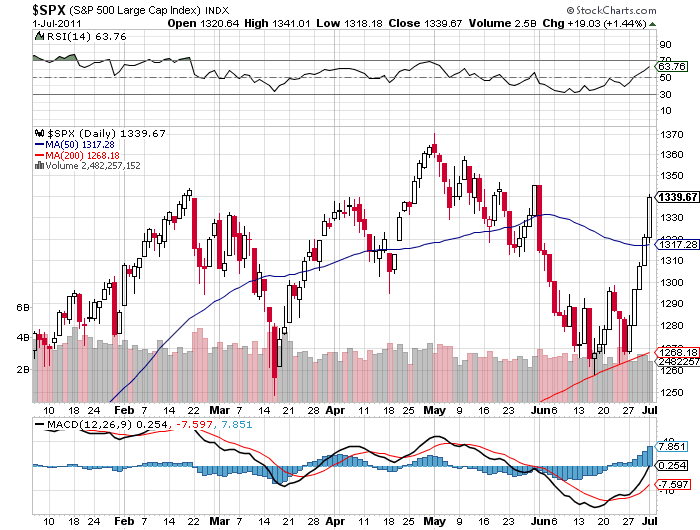
1) Markets Get a Stiff Dose of Reality. The global 'RISK ON' TRADE was administered with a stiff dose of smelling salts on Friday with the horrific nonfarm payroll report. The stock market was really leading with its chin. It expected 150,000-200,000 in job gains but got only a pitiful 18,000. The ensuing melt down was global in scale.

The moves recently have been nothing less than stunning. In the last two weeks, the S&P 500 has rallied 100 points and then given up 65. Technical levels have been rendered meaningless, falling like a hot knife through butter. Surveying the carnage from the comfort of a 99% cash position, it's like watching the games in the coliseum where all of the gladiators are getting the thumbs down. Only those in the stands will be left standing.

The data are entirely consistent with the 2%-2.5% GDP growth forecast that I have been pounding the table about since the beginning of the year. On by one, others have come into my fold, continuously ratcheting down their own ebullient predictions, from Goldman Sachs to the Federal Reserve. As a result, traders are getting chopped to death, their momentum driven models forcing them to buy every rally and sell every dip.

I still think too many analysts, economists, and fund managers are working off of old models, expecting unemployment to fall back to 5%, as it has done in past recoveries. I think we will be lucky to see the 7% handle, if that. Structural unemployment is here to stay, no matter how much money the government throws at it. What people seem to be missing is that corporate profits were so good in Q1, and will be nearly as good in Q2, because they aren't hiring anyone.

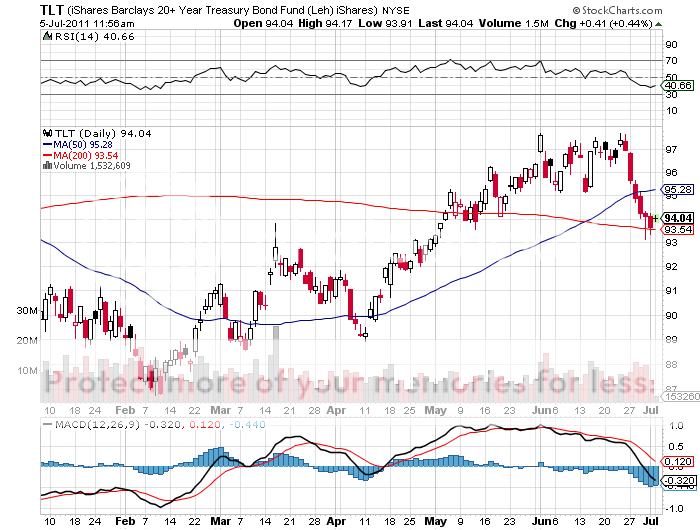
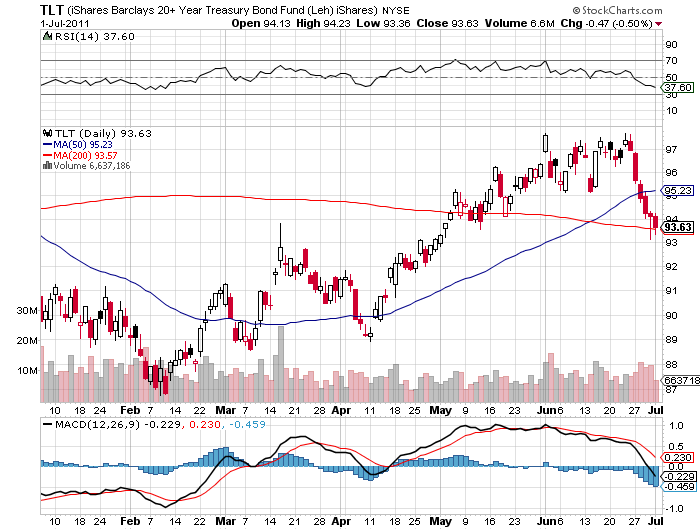
My only position, short calls on the (TLT) is still looking good. While the ten year Treasury bond has risen four points against me in the latest shakeout, time decay means my position has dropped by a welcome 57%. I'll be looking to increase this short at the next peak in bond prices.

Only gold (GLD) seems to be doing well here, the barbarous relic probing the top end of its six month range. Europeans spooked by the new crisis in Italy and the potential demise of the European currency system are pouring into the safe haven of the yellow metal. Silver (SLV) in the meantime, has taken a nosedive.

All I can say is if Paul Tudor Jones, Louis Bacon, and John Paulson can't make money in this market, I bet you can't either. Better to watch in awe from the sidelines and until the dust settles and let others do the bleeding.

-

-

-

Did You Say Buy, or Sell?

July 13, 2011 – China’s Great Grain Robbery

Featured Trades: (CHINA’S GREAT GRAIN ROBBERY), (CORN), (JJG)


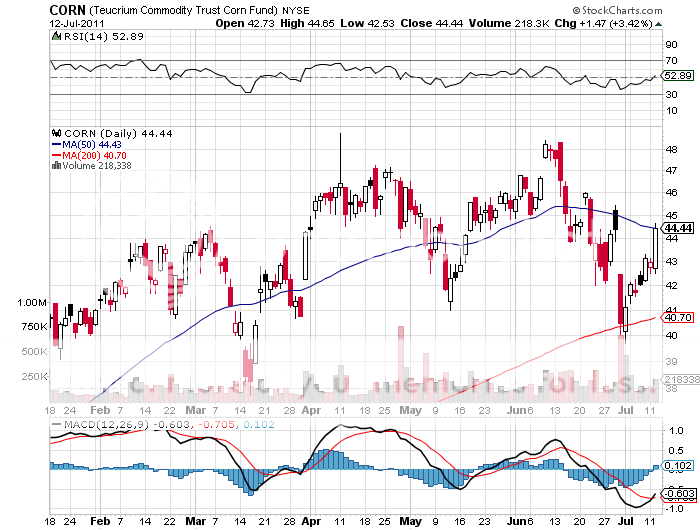
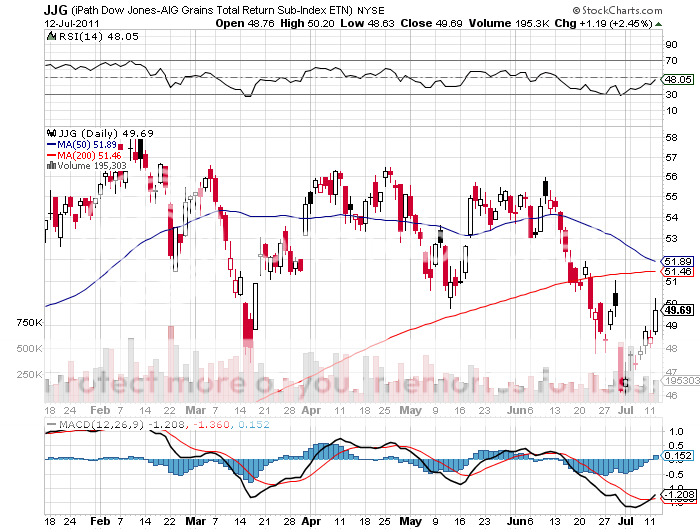
2) China’s Great Grain Robbery. The Chinese are nothing if not opportunistic. You may recall that a shocking increase in this year’s corn crop predicted by the US Department of Agriculture triggered a series of limit down moves in the grain markets only 12 days ago (click here for ‘The Great Grain Massacre’). The corn ETF (CORN) was down by a gut churning 13.2% by the time the crying was over, while the grain ETF (JJG) was off by 9.8%. Despite terrible weather and soil conditions, farmers planted anyway, leading to a 1.52 million bushel increase in the forecast crop.

Last week, The Chinese came in and bought over 500,000 bushels, some one third of the surprise excess, and more than they buy in a normal year. Indications are that the buying may continue, with senior Chinese government officials openly doubting the veracity of the USDA figures.

All I can say is ‘Great Trade’. The Middle Kingdom is no doubt driven by serious draughts in the western part of the country which has forced them to become a major importer for the first time in years.

I believe that there is something much bigger going on here. I refer you to the piece I sent you last week, ‘The Bull Market in Food is Only Just Starting’ (click here). The improving Chinese diet is starting to take a big bite out of the global grain market, with the total number of calories per person nearly doubling over the past two decades. Expect this to continue for the rest of your investment lifetime. The moral here is to use any serious dips in the ag space to pick up exposure to this sector.
-
-

Look Who’s Eating Your Lunch
July 13, 2011 – An Evening with Jack Welch

Featured Trades: (A NIGHT WITH JACK WELCH), (GE)


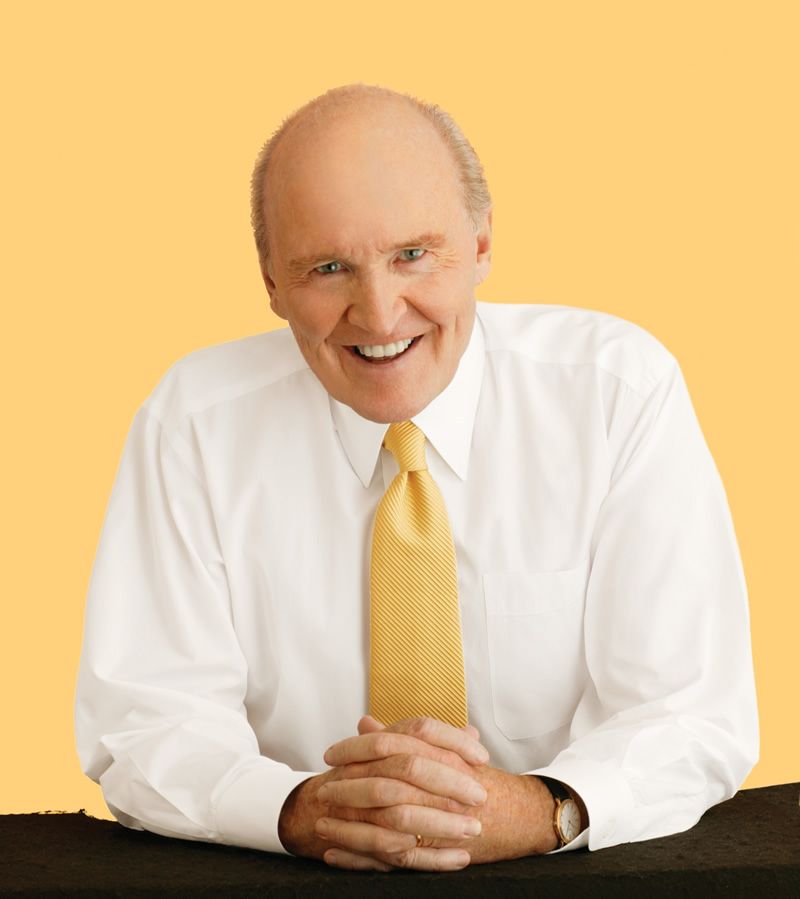
3) An Evening with Jack Welch. I met Jack Welch recently, the legendary retired CEO of General Electric (GE). 'Neutron' Jack gets the credit for boosting the market cap of GE from $13 billion to $400 billion in 20 years, turning it into a Wall Street darling in the process.

The 'hedge fund that makes light bulbs' is the last big industrial finance company standing, and it will make a fortune, because there is no competition left. Jack is currently on the board of a private equity firm, several Internet media startups, and is advising me on the startup of this newsletter.

He gives Obama an 'A' for leadership and communication, but believes his economic policies are seriously flawed. They are based on a 4% annual growth assumption for the next decade, versus my own forecast of 2.0%-2.5%. We never managed to achieve that rate during the go-go days of the eighties and nineties, let alone attempt it during a new age fraught with downsizing, deleveraging and frugality. If we get only 2.5% instead, the deficit will explode from $13 trillion to $30 trillion, at which point 'we will be cooked.' Who knew Jack was a closet gold bug, dollar bear, and inflation hawk?

Jack was passing through San Francisco at the end of a national tour promoting his wife Suzy's new book '10-10-10', which is about how to create a 'values driven life.' In his heyday, Jack was considered the best Fortune 500 manager in the country. Never one to mince words, he is an absolute terror now that shareholder feelings are no longer a consideration.

July 12, 2011 – The Cooling Market for Hedge Fund Traders

Featured Trades: (THE COOLING MARKET FOR HEDGE FUND TRADERS)


1) The Cooling Market for Hedge Fund Traders. The tide is suddenly heading out to sea for aspiring hedge fund traders. Ilana Weinstein of the IDW Group, which specializes in hedge fund recruitment, says that the new financial regulation bill has fundamentally changed the supply and demand balance for hedge fund managers.

Star traders at major investment banks with great track records used to be able to pick and choose among the large funds bidding for their services. Now there is a torrent of talent pouring into the marketplace fleeing the onerous restrictions of the Dodd-Frank, pay caps, greater disclosure, and more scrutiny from the SEC. Low trading volumes have caused the banks to scale back from a first half hiring binge.

Hedge funds, whose own recruiting is driven more by capital flows, have also crimped new hiring, their own modest first half returns keeping new investors at bay. With short interest rates near zero, and the yield curve flattening beyond all recognition, the double digit returns of yesteryear are but distant memories. Instead, many hot shots are heading out on their own, setting up new boutique firms with substantially smaller amounts of capital.

Could we be setting up for a bonus draught like the one we saw in 2008?

Hedge12

July 12, 2011 – The Skinny on Lithium

Featured Trades: (THE SKINNY ON LITHIUM)


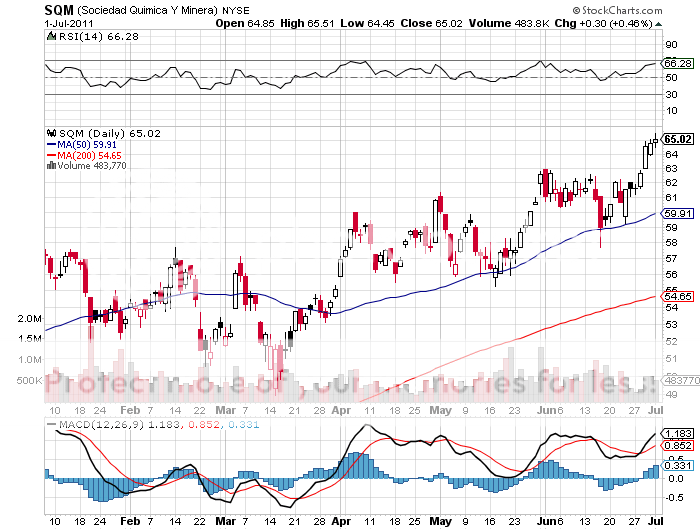
2) The Skinny on Lithium. Long time readers of this letter know that I have been a bull on lithium plays, my pick in the sector, Chile's Sociedad Quimica Y Minera (SQM), bringing in a handy 440% pop off the lows in 2009. You couldn't lose, because if the car battery boom faded, they always had a great fertilizer business to fall back on.

Since I'm in a report reading mood, I thought I would sit back in my Aeron office chair, put my feet up on my polished beech desk, and plow through the numerous submissions forwarded to me by readers who attended the first 'Lithium Supply and Markets Conference' in Santiago, Chile.

The bad news is that a truly economic, price competitive lithium battery is still some ways off. Prices for lithium-ion batteries for hybrid electric vehicles (HEV) need to drop by 50% and those for plug-in hybrid electric vehicles (PHEV) by 67%-80% in order to compete on a level playing field with carbon based fuels.

Gasoline has 64 times more energy per unit of weight than lithium batteries, but this advantage is partially offset by electric motors that are four times more efficient than conventional piston engines. Lighter weight cars and other design improvements, like recapturing power when braking, shrink the lead further.

Dr. Steven Chu's Department of Energy is pouring money into research on an amazingly wide front, and strides are being made with different electrodes (silver, sulfur, manganese), leading to rapid advances in inorganic chemistry. The challenges are formidable, with overcharged large lithium ion batteries prone to explode or catch on fire, or internally or externally short circuit.

The conservative big car companies, Toyota and Honda, have stuck with proven nickel metal hydride batteries offering half the power per weight, and are understandably reluctant to make the needed multibillion dollar investments until more is known about the long term life of lithium batteries.

Another wrinkle is that Bolivia, the Saudi Arabia of lithium salt reserves, has effectively nationalized the industry before it got off the ground, limiting its investment in development to $350 million. As the production of EV's, HEV's, and PHEV's is expected to ramp up to 5 million vehicles a year by 2020, this could be a problem.

Many in the industry expect that lithium prices will not be driven by demand from car makers, but by the price of oil. Take crude up to $150 again, and all of a sudden, everything works.

The intelligent way to approach the industry now is to invest in low cost producers of proven battery technology, like Enersys (ENS), Exide Technologies (XIDE), C&D Technologies (CHP), and ZBB Energy (ZBB). Leave the pie in the sky stuff for later.

Unlike past battery car movements, this one is not going to end up crushed in a junkyard. I'll let you know how my lithium battery powered all electric (EV) Nissan Leaf works out, which I just took delivery of last week.

July 12, 2011 – A Conversation With the Boots on the Ground

Featured Trades: (A CONVERSATION WITH THE BOOTS ON THE GROUND)


3) A Conversation With the Boots on the Ground. I have spent many hours speaking at length with the generals who are running our wars in the Middle East, like David Petraeus (click here for ‘The Spotlight Moves to Petraeus’), and James E. Cartwright (click here for ‘My Briefing with the Joint Chiefs of Staff’). To get the boots on the ground view, I attended the graduation of a friend at the Defense Language Institute in Monterey, California, the world’s preeminent language training facility.

As I circulated at the reception at the once top secret installation, I heard the same view repeated over and over in the many conversations swirling around me. While we can handily beat armies, defeating an idea is impossible. With the planet’s fastest growing population, Muslims are expected to double from one to two billion by 2050, the terrorists can breed replacements faster than we can kill them. The US will have to maintain a military presence in the Middle East for another 100 years. The goal is not to win, but to keep the war at a low cost, slow burn, over there, and away from the US.

I have never met a more determined, disciplined, and motivated group of students. There were seven teachers for 16 students, some with PhD’s, and all native Arabic speakers. The Defense Department calculates the cost of this 63 week, total emersion course at $200,000 per student. UC Berkeley, eat your heart out.

They are taught not just language, but also the history, culture, and politics of the region as well. I found myself discussing at length the origins of the Sunni/Shiite split in the 7th century, the rise of the Mughals in India in the 16th century, and the fall of the Ottoman Empire after WWI, and this was with a 19 year old private from somewhere in Kentucky! I doubt most Americans his age could find the Middle East on a map. Students graduated with near perfect scores. If you fail a class, you get sent to Iraq, unless you are in the Air Force, which kicks you out of the service completely.

As we feasted on hummus and other Arab delicacies, I studied the pictures on the wall describing the early history of the DLI in WWII, and realized that I personally knew several of the participants. The school was founded in 1941 to train Japanese Americans in their own language to gain an intelligence advantage in the Pacific war. General ‘Vinegar Joe’ Stillwell said their contribution shortened the war by two years. General Douglas McArthur believed that an army had never before gone to war with so much advance knowledge about its enemy. To this day, the school’s motto is ‘Yankee Samurai’.

My old friends at the Foreign Correspondents’ Club of Japan will remember well the late Al Pinder. He spent the summer of 1941 photographing every Eastern facing beach in Japan, successfully smuggled them out hidden in a chest full of Japanese sex toys, and beat it out of the country two months before Pearl Harbor. He then spent the rest of the war working for the OSS in China. I know this because I shared a desk in Tokyo with Al for nearly ten years. His picture is there in all his youth, with a team accepting the Japanese surrender in Korea with DLI graduates.

-

-

I Guess I Should Have Studied Harder

July 11, 2011 – Don’t Hold Your Breath for Residential Real Estate

Featured Trades: (DON’T HOLD YOUR BREATH FOR RESIDENTIAL REAL ESTATE)


1) Don’t Hold Your Breath for Residential Real Estate. Every few weeks I get a warm and fuzzy feeling when I see my old house for sale in the Wall Street Journal. I’m sure you’ve seen it. It’s the 8,500 square foot, four bedroom, seven bathroom white elephant perched on a mountain peak, with a dramatic waterfall pouring into a marble swimming pool, and panoramic 360 degree views of the San Francisco Bay Area.

I picked it up for a song from the Sultan of Brunei in 1998, when crude crashed to $8/ barrel, and he was dumping properties to meet a cash flow crisis. The actor, Steve McQueen, had owned the property once, and the local teenagers used to park out front and make out, taking in the stunning view of the Golden Gate Bridge and shimmering city lights. The parties! Oh, the parties!

But one day in 2005, my gardener, Jose, mentioned that he had just obtained a $500,000 loan to buy a new place in which to house his seven kids, along with a home equity loan to cover the first year’s mortgage payments. How would he make the next year’s payments? The broker said the value of the house would go up, and he could then increase his home equity loan to cover that too.

I knew I had to sell my home immediately, hitting the bid for a tidy $12 million, along with the rest of my real estate holdings around the Fog City and Lake Tahoe. At the closing, I couldn’t help but notice that my broker, Olivia, was drunk with greed, with 360,000 dollar bills dancing in front of her eyes.

Regretfully, I had to let Jose go. I have been renting ever since. The last price I saw for my former ‘Xanadu’ was $7 million, and I know that a cash offer well below that would talk. I could also lease it for $19,500 a month, which wouldn’t even cover the taxes and the maintenance.

I’m not a person who normally wishes ill on people, but really, what were these buyers thinking? When people urge me to buy it back, I lie down and take a nap, and when I wake up, the feeling has refreshingly gone away.

If you strip away the industry fig leaves, and ignore the paid apologists, the excesses in this sector are truly of Biblical proportions. ‘Official,’ shadow, and bank inventories, and another 1.5 million imminent option arm induced foreclosures, probably mean there is a decade’s worth of supply out there. The demographic pressure of 80 million retiring and downsizing baby boomers easily adds another five years. A capital constrained and soon to disappear Fannie Mae is taking down 75% of the new mortgages in the secondary market, the FHA is taking almost all of the rest, and there is no way the socialization of the mortgage market can continue indefinitely.

Residential real estate is at best a push, and worst case will drop by half again if the ‘W’ recession pans out. This is why banks, already choking on foreclosed properties, will only lend if you hold a gun to their head. They know there are more big hits to their capital coming their way in the form of tsunamis of more bad loans.

Only buy a home if your wife is nagging you about living in that cardboard box under the freeway overpass. But expect to put up your first born child as collateral, and bring in your entire extended family in as cosigners, if you want to get a bank loan. I heard that Olivia lost her commission and everything else in the stock market crash and committed suicide. Jose took his family back to Mexico to look for a better paying job. And no, I won’t be uttering the word ‘rosebud’ on my deathbed.

Mansion11

July 11, 2011 – Buy Russia, But You May Want to Take a Shower

Featured Trades: (BUY RUSSIA, BUT YOU MAY WANT TO TAKE A SHOWER), (RSX)


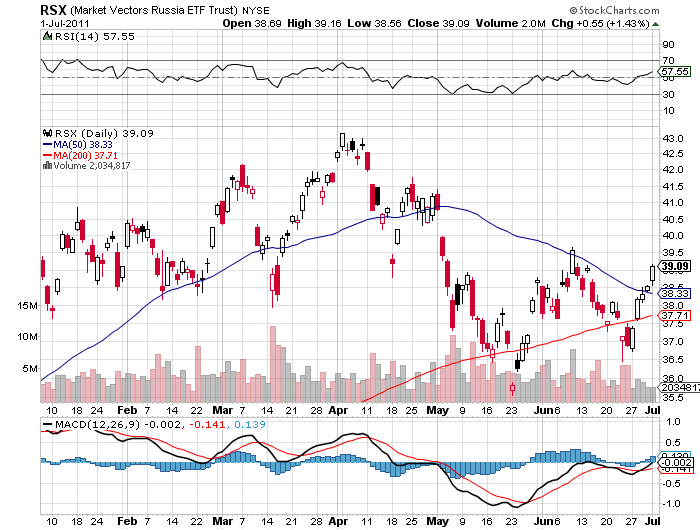
2) Buy Russia, But You May Want to Take a Shower If you wonder why I recommend a shower after investing in Russia, Bill Browder will give you the reasons at length on his YouTube video (click here for the link). Bill is the founder and CEO of Hermitage Capital Management, one of the firms that pioneered equity investment in the former Soviet Union in the nineties.

After a decade of pursing a campaign of activist investing that brought major changes in corporate governance in big companies like Gazprom (OGZPF.PK) (click here for the link at http://www.gazprom.com/ ) and Sberbank (SBRPF.PK), a mafia connected government struck back with a vengeance. It deported Browder in 2005, arrested his lawyer, and pressured him to provide false testimony against his boss, which he refused. A year later, the man died in prison from ‘natural causes.’

The Russian government then seized Browder’s operating companies, but fortunately for investors, not before he was able to sell off $4.5 billion in holdings and spirit the funds out of the country.

Browder, who is of Russian descent, and whose grandfather was chairman of the American Communist Party, says his case is but the tip of the iceberg. Major multinationals like Shell, BP, and Ikea have also been the victims of corruption and faced arbitrary seizure of assets by the well connected. This lawlessness is the reason why Russian companies perennially trade at single digit multiples. They are cheap on paper, but carry hidden, unquantifiable risks.

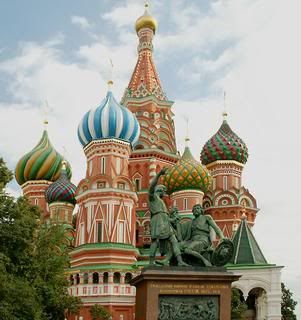
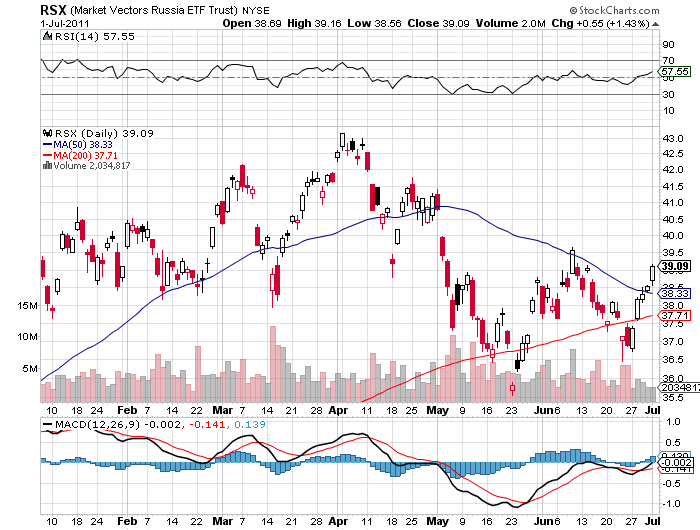
Despite all of the above, mega hedge fund Traxis Partners founder, Barton Biggs, says there is still a case to make for investment in Russia. It is the classic emerging middle class story. Russians have no credit card debt, no home mortgages, and terrible housing, but the resource wealth to buy what they need. Barton sees Russia eventually becoming a basic, functioning European country, but will first have to engineer a growth spurt to get there. That is the play. The principal vehicle for most foreigners to get into the land of Lenin and Red Square is to buy the ETF, (RSX).

No doubt that investing in Russia is a double edged sword. It offers enormous oil reserves and natural resources, with GDP flipping from a -7.9% rate in 2009 to an expected 3.2% in 2010. But you run the risk of a knock on the door in the middle of the night.

-

July 11, 2011 – Murray Sayle: The Passing of a Giant in Journalism

Featured Trades: (MURRAY SAYLE, THE PASSING OF A GIANT IN JOURNALISM)


3) Murray Sayle: The Passing of a Giant in Journalism. I was saddened to hear of the death of my close friend, the Australian, Murray Sayle, after a long battle with Parkinson’s disease at the age of 84.

Murray was one of the giants of journalism in the second half of the 20th century. He started by editing the newspaper at University of Sydney, where his incendiary opinions got him expelled from school. It seems there was a problem with his suggestion to erect a statue of Priapus at the administration building honoring the chancellor, but only at the back door. He moved on to London’s Fleet Street in 1952, arriving as a wet behind the ears, but sassy colonial, and landed a job with a small paper named The People. This was when the media was then dominated by giant daily broadsheets, landing. He went on to become the quintessential war correspondent, reporting for the London Times, known in the trade as the ‘Thunderer’ because the building shook when its giant presses ran.

I first met Murray in 1975 at a Mensa meeting in Tokyo where I was presenting a paper on the chemical structure and properties of tetrahydrocanabinol. Murray was on the hunt for a story, as always. He was cooling off after a decade of dodging bullets, bombs, shrapnel, and napalm covering the war in Vietnam. Murray once told me that since his writings were often perceived as antiwar, it was a tossup who would shoot him first, the Vietcong or the Americans. Murray told me that the Foreign Correspondents’ Club of Japan had one of the best English language libraries in the country, and that he would be happy to sponsor me for membership; thus inadvertently, launching me on a career in journalism.

Murray moved into a converted 19th century silk worm grower’s farm house in a small mountain hamlet three hours outside of Tokyo with his wife Jenny, his tireless and loyal supporter. There, they raised three children who went through the local Japanese school system, soldiering on in their 19th century black German cadet uniforms as the only white kids in the district, emerging as flawless interpreters. I often made the arduous trip to Aikawa-cho (‘Love River’) over weekends, spending long nights over endless flasks of hot sake listening to Murray quote extended passages from Rudyard Kipling verbatim. We passionately debated the issues of the day until we fell asleep at the kotatsu. If I learned nothing else, it was that there is always another way to look at any issue. As I had the tendency to always turn up with a different Japanese girlfriend, his pet name for me became ‘Randy’.

Over a career that spanned nearly 70 years, Murray scored countless interviews with notoriously difficult to reach figures, like Che Guevara and Yassir Arafat. He managed to nail defecting British spy, Kim Philby, by staking out the one newspaper stand in Moscow that sold the Financial Times. Murray would regale me with tales of Ugandan dictator ‘Big Daddy’ Idi Amin, who stored the severed head of his wife’s former lover in his refrigerator. Murray won numerous awards for his Vietnam coverage and for his description of the barbarous downing of Korean Airlines flight 007 off the coast of Japan by a Russian fighter in 1983, which killed 269 helpless civilians.

Just before he died, the university that shamefully ejected him 65 years earlier made amends by awarding him an honorary doctorate. The wit, candor, and insight of this larger than life figure will be sorely missed.

July 8, 2011 – Industries You Will Never Hear From Me About

Featured Trades: (INDUSTRIES YOU WILL NEVER HEAR FROM ME ABOUT)


2) Industries You Will Never Hear From Me About. The focus of this letter is to show people how to make money through investing in fast growing, highly profitable companies which have stiff, long term macroeconomic winds at their backs. That means I ignore a large part of the US economy whose time has passed and are headed for the dustbin of history.

According the Department of Labor’s Bureau of Labor Statistics (click here at http://www.bls.gov/), the ten industries listed below are least likely to generate positive job growth in the next decade. As most of these stocks are already bombed out, it is way too late to short them. As an investor you should consider this a ‘no go’ list. I have added my comments, not all of which should be taken seriously.

1) Construction ‘“ Gale force headwinds of 80 million retiring and downsizing baby boomers have saddled this industry with a decade’s worth of unwanted inventory. Rent, don’t own, and let the landlord unclog your toilet.

2) Automotive manufacturing ‘“ At its peak a few years ago, 20 million cars rolled off the assembly lines. This year it will struggle to make 14 million. What’s left of the industry is far leaner and meaner than the bloated dinosaurs of the past, from management, down to the manufacturing plants and the dealer networks. My next car is going to be an electric Nissan Leaf made in Japan.

3) Realtors ‘“ Despite a halving of prices, and therefore commissions, the number of realtors is only down 10% from its 1.3 million peak in 2006. On open house days you can find some of the remainder in the spare bathroom hanging from the shower head.

4) Pharmaceuticals ‘“ With a number of blockbuster drugs seeing patents expire soon and going generic, the downsizing at the major firms has been ferocious. The survivors will merge to cut costs, sending more masses to the unemployment office.

5) Newspapers ‘“ these probably won’t exist in five years, as five decades of hurtling technological advances have already shrunk the labor force by 90%. Go online, or go away.

6) Airline employees ‘“ This is your worst nightmare of an industry, as management has no idea what interest rates, fuel costs, or the economy will do. Pilots will eventually work for minimum wage just to keep their flight hours up and to score dates with the flight attendants.

7) Big telecom ‘“ Can you hear me now? Nobody uses landlines anymore, leaving these companies with giant rusting networks that are costly to maintain. Since cell phone market penetration is 90%, survivors are slugging it out through price competition, cost cutting, and all that annoying advertising.

8) State and Local government ‘“ With employment still at levels private industry hasn’t seen since the seventies, firing state and municipal workers will be the principal method of balancing ailing budgets. Expect class sizes to soar to 80, to put out your own damn fires, and keep the 9 mm loaded and the back door booby trapped for home protection.

9) Installation, maintenance, and repair ’“ I have explained to my mechanic that my new electric car has only five moving parts, compared to 500 in my old clunker, and this won’t be good for business. But he just doesn’t get it. The winding down of our wars in the Middle East is about to dump a million more applicants into this sector. The last refuge of the trained blue collar worker is about to get cleaned out.

10) Bank tellers ‘“ Since the ATM made its debut in 1968, this profession has been on a long downhill slide. Banks have lost so much money in the financial crisis, they can’t afford to hire humans any more. It hasn’t helped that 283 banks have closed during the recession, with many survivors merging to cut costs (read fire more people). You next bank teller may be a Terminator.

Teller08

Out With the Old

-

And in With the New

July 8, 2011 – The Bull Market in Food Is Only Just Starting

Featured Trades: (THE BULL MARKET IN FOOD IS ONLY JUST STARTING), (AGU), (POT), (MON), (DBA)


3) The Bull Market in Food Is Only Just Starting. I believe that the surge in the price of food we have seen in the past two years is the beginning of a major, secular, long term trend. During the sixties, new dwarf varieties, irrigation, fertilizer, and heavy duty pesticides tripled crop yields, unleashing a green revolution. But guess what? The world population has doubled from 3.5 to 7 billion since then, eating up surpluses, and is expected to rise to 9 billion by 2050.

Now we are running out of water in key areas like the American West and Northern India, droughts are hitting Australia, Africa, and China, soil is exhausted, and global warming is shriveling yields. Underground water supplies are so polluted with toxic pesticide residues that rural cancer rates are soaring.

Food reserves are now at 30-40 year lows, depending on who you listen to. Rising emerging market standards of living are consuming more and better food, with Chinese pork demand rising 45% from 1993 to 2005. The problem is that meat is an incredibly inefficient calorie transmission mechanism. To produce one pound of beef, you need 16 pounds of grain and over 2,000 gallons of water. I won't even mention the strain the politically inspired ethanol and biofuel programs have placed on the food supply.

It is possible that genetic engineering, sustainable farming, and smart irrigation could lead to a second green revolution, but the burden is on scientists to deliver.

The amount of arable land per person has fallen precipitously since 1960, from 1.1 acres to 0.6 acres, and that could halve again by 2050. Water is about to become even more scarce than land. Productivity gains from new seed types are hitting a wall.

China, especially, is in a pickle because it has 20% of the world's population, but only 7% of the arable land. It has committed $5 billion to agricultural land in Africa. There are now thought to be over one million Chinese agricultural workers on the Dark Continent. Similarly, South Korea has leased half the arable land in Madagascar to insure their own food supplies.

An impending global famine has not escaped the notice of major hedge funds. George Soros has snatched up 650,000 acres of land in Argentina and Brazil on the cheap, an area half the size of Rhode Island, Others are getting into the game, quietly building portfolios of farms in the Midwest and the South.

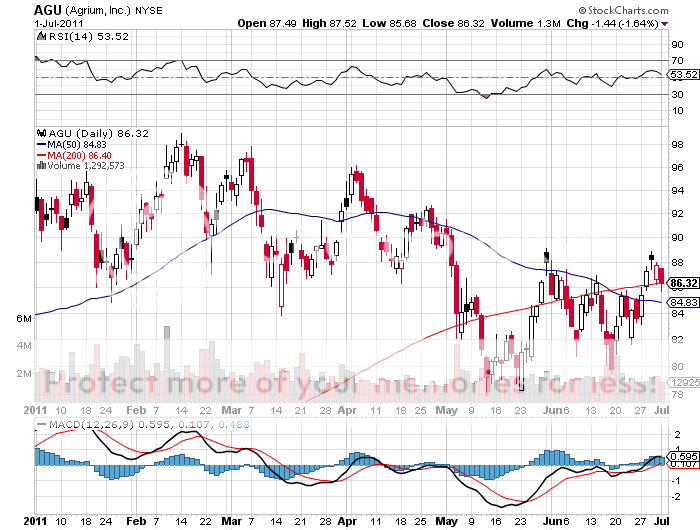
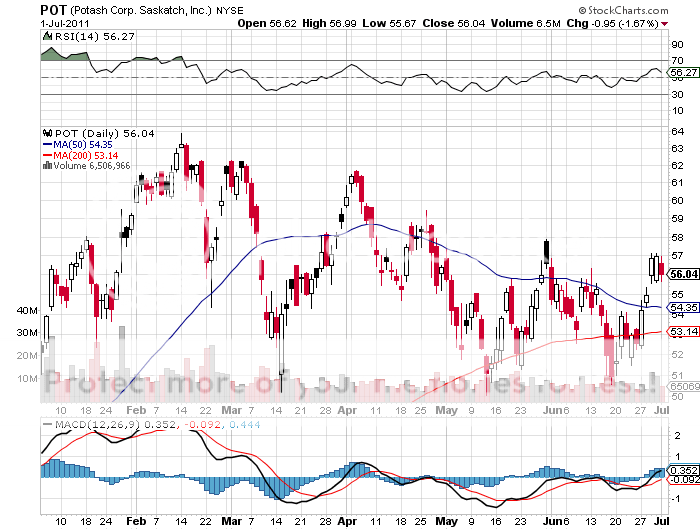
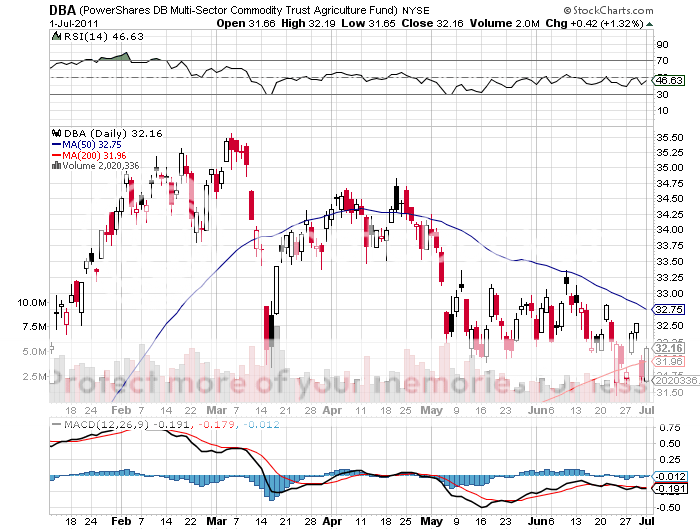
The net of all of this is that food prices are going up, a lot. While prices are certainly overheated at the moment, you should use any decent pull back to build core long positions in corn, wheat, and soybeans, as well as in the second derivative plays like Agrium (AGU), Potash (POT) and Monsanto (MON). You might also look at the PowerShares Multi Sector Agricultural ETF (DBA).

-

-

-

Food08