If you have a solid portfolio that rakes in dividend income every few months, you’re in an excellent position to enjoy an early retirement.
Having a dividend income not only means ensuring that you pad your returns and grow your portfolio’s worth over the years but also eases the pressure to look for other revenue streams.
On top of that, if the businesses you’ve put your money in over the years boost their dividend payments, then you’ll also be receiving more recurring income, making it even easier to retire early.
In the biotechnology and healthcare world, the list of dividend stocks that hold outstanding track records in terms of delivering dividend payments regularly includes Medtronic (MDT). This stock can form part of the pillars to build your strong portfolio and is an investment worth considering for those who aim to retire early.
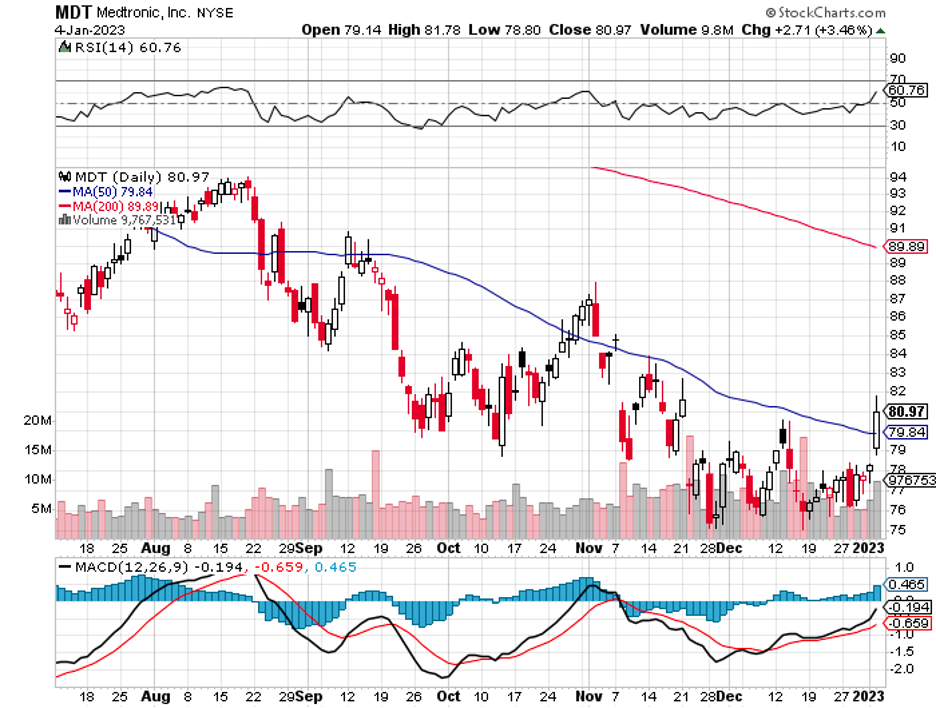
Medtronic qualifies as a dividend aristocrat, recording an impressive 45 consecutive years of payout increases. Unfortunately, shares of this business have not been less impressive lately. In fact, its stock is down 28% thus far.
At first blush, this stock performance looks discouraging. However, there are reasonable explanations behind it. A key factor is that practically half of Medtronic’s profits come from the international market. Taking into consideration the strength of the US dollar against other currencies, Medtronic’s constant-currency revenue should have risen.
Either way, Medtronic has been active in its research and development plans. In 2021, the company spent $2.7 billion on these efforts. As Medtronic sustains its record of clearing more than 200 regulatory approvals in the past 12 months and with the anticipated cooling off of the inflation woes, profitability will likely rebound.
Nonetheless, Medtronic’s consistent payouts make it an attractive buy for dividend growth investors looking for a stock that can serve as an anchor in their portfolio.
Medtronic offers a 3.6% dividend yield, which is more than twice the S&P 500 index of 1.7% yield. If this isn’t enough to entice shareholders to stay, the company is actually on pace to turn into a Dividend King by 2027. For context, a Dividend King is a stock in the S&P 500 that has boosted its dividend every year for at least 50 consecutive years.
Here’s a quick background on Medtronic.
The company is a titan in the medical device sector, boasting a dominant presence in more than 150 countries and generating a total of roughly $31 billion over the past trailing 12 months.
Its impressive array of products covers insulin pumps, pacemakers, and stents, offering treatments for about 70 different health conditions and reaching more than 76 million patients annually.
It has a solid patent base and stellar track record of medical innovation, equipping it with pricing power and practically insulating the company from headwinds that may affect any of its product categories or territory.
Thanks to its extensive and diverse product portfolio, Medtronic is considered the biggest pure-play medical devices company across the world, recording a whopping $104 billion in market capitalization.
All in all, this medical devices giant continues to be one of the most reliable names in the healthcare industry. Its longstanding history of success, continuous innovation, and solid business model all but guarantee that it can sustain its momentum no matter the economic conditions. While some factors have hurt its near-term performance, it’s clear that these setbacks are temporary.
The dip in Medtronic's share price is good news for long-term investors, especially since the company would recover from the setbacks soon enough. The recent bearishness has turned it into an even better buy, as it’s trading at only 15 times future earnings based on estimates.
https://madhedgefundtrader.com/wp-content/uploads/2019/05/cropped-mad-hedge-logo-transparent-192x192_f9578834168ba24df3eb53916a12c882.png00Mad Hedge Fund Traderhttps://madhedgefundtrader.com/wp-content/uploads/2019/05/cropped-mad-hedge-logo-transparent-192x192_f9578834168ba24df3eb53916a12c882.pngMad Hedge Fund Trader2023-01-05 16:00:162023-01-10 14:46:13Take Advantage Of This Discounted Stock
I just closed out a January (TLT) $150 put option for the biggest single trade profit in my life. I just made 20% of my annual salary today alone.
THANK YOU, JOHN!
Kyle,
Jersey City, NJ
I Have Big Shoes to Fill
https://www.madhedgefundtrader.com/wp-content/uploads/2019/04/john-thomas-5.png297397Mad Hedge Fund Traderhttps://madhedgefundtrader.com/wp-content/uploads/2019/05/cropped-mad-hedge-logo-transparent-192x192_f9578834168ba24df3eb53916a12c882.pngMad Hedge Fund Trader2023-01-05 10:04:252023-01-05 12:07:25Testimonial
Passive investing, or piling all your money in major stock indexes like the S&P 500 (SPX) or the Dow Average (INDU), just got killed off by the bear market.
The days when you could just index and then go play golf for the rest of the day are gone for good.
Rest in Peace.
On a good day, your investments reliably underperformed the indexes, less management fees and hidden expenses. Even indexers have to work to earn a living.
That was fine as long as the indexes went up like clockwork, as they did almost every year for the last 12 years. Enter Covid-19. Many individual investors will instantly have heart attacks when they opened their annual pension fund and 401k statements.
I have to admit that I was getting pretty sick of index investing. People like me would slave over their computers all day long in some years barely beating the returns of those who never lifted a finger. That is now ancient history.
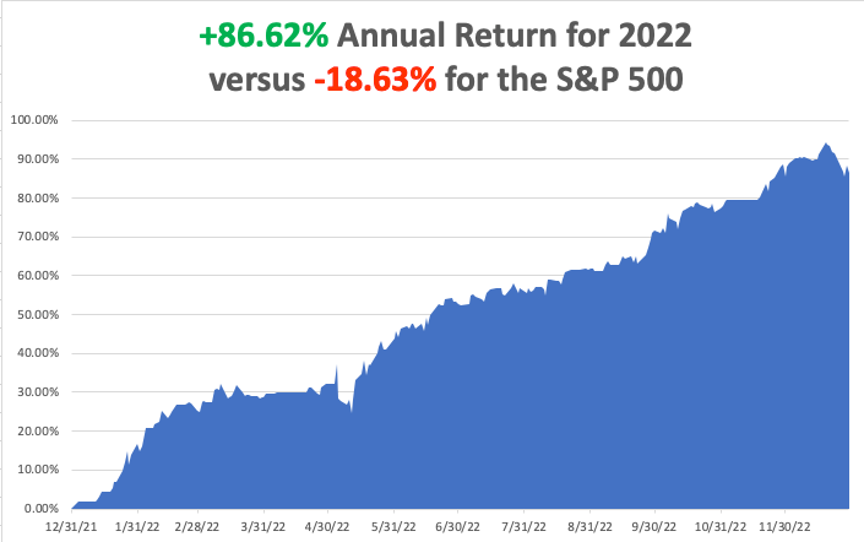
Look no further than my own performance year to date. Last year, I managed to clock an 86.62% gain, compared to a pitiful 18% for the Dow Average. 2023 could be another great year for me.
How will your index fund perform when US pandemic deaths hit over 1 million as reported by Johns Hopkins University?
The global pandemic is creating a brave new world on countless fronts, and management of your retirement funds is no different. Passive investing will be replaced by active investment whereby educated individuals pick winning stocks and judiciously avoid the awful ones.
The bad news is that you will have to work harder to oversee your nest egg. The good news is that you will make a lot more money. The difference between passive and active investment is now greater than at any time in history, and that chasm is set to increase.
While the bull market allowed all stocks to go up equally, the new one is totally different. There is about to be a huge differentiation between winners and losers like never seen before. The difference between the wheat and the chaff will be enormous.
Those who figure out the new game early will prosper mightily. Those who don’t will crash and burn.
I have been fighting a daily battle with some of my own subscribers, as they are arguing that the biggest gains will simply be made from buying the biggest losers.
I’m not buying that logic for a nanosecond. Many of the worst performers are never coming back to their former glory, such as airlines, cruise lines, hotels, movie theaters, restaurant chains, and casinos. Sure, they may have a brief dead cat bounce off the bottom for a trade. But the long-term outlook for these ill-fated industries is grim at best.
No, the future lies in buying Teslas and Rolls Royces at KIA prices. Come in today and these distressed levels and you may earn as much as 15% a year for the next decade.
You know the companies I am talking about, the ones I have been covering at great length in Global Trading Dispatch, The Mad Hedge Technology Letter, and the Mad Hedge Biotech & Healthcare Letter. If you are missing any of these publications, please feel free to pick them up at our store. Please note that all our prices are going up substantially soon.
This is going to lead to a very interesting future. Those who continue to index are looking at years of subpar performance. Those who go active and do it the right way are going to be looking pretty.
It’s going to be a fun decade. The Roaring Twenties have only just begun.
Good Luck and Good Trading,
John Thomas
Mad Hedge Fund Trader
https://www.madhedgefundtrader.com/wp-content/uploads/2021/03/john-thomas-horse.png530404Mad Hedge Fund Traderhttps://madhedgefundtrader.com/wp-content/uploads/2019/05/cropped-mad-hedge-logo-transparent-192x192_f9578834168ba24df3eb53916a12c882.pngMad Hedge Fund Trader2023-01-05 10:02:042023-01-05 12:04:23The Death of Passive Investing
"Since 9-11, the government knows a lot more about you than you know about them, and the government likes that. But that's not what the American people want," said California Republican Congressman, Daryl Issa.
https://www.madhedgefundtrader.com/wp-content/uploads/2016/02/Uncle-Sam-Is-Watching-You-e1486502639587.jpg186300The Mad Hedge Fund Traderhttps://madhedgefundtrader.com/wp-content/uploads/2019/05/cropped-mad-hedge-logo-transparent-192x192_f9578834168ba24df3eb53916a12c882.pngThe Mad Hedge Fund Trader2023-01-05 10:00:262023-01-05 12:02:18Quote of the Day - January 5, 2023
Another year is upon us and I’m sure we have all made plans to save money, eat healthy, exercise more, learn something new, spend time with friends and family, etc.
I didn’t.
I don’t make New Year's resolutions anymore.
I got wise.
There are people out there making a fortune on your willingness to achieve each resolution but all too often, the desire fades after the first month or two.
So, instead, I just plan on being a better version of myself each year. That takes all the pressure off. Phew!!
So, what’s ahead this year?
Hawaii strategy luncheon on February 17, 2023
Queen Mary II strategy update on July 13 while you enjoy a transatlantic crossing.
Go to Luncheons on John’s site to book.
Sounds good to me.
At the beginning of the year, it is natural to reassess what is in your portfolio and what is not.
So, I always ask this question. What does everyone need the most outside food, water, and shelter?
Security.
In other words, protection against the myriad of ways criminals invade the privacy of your life.
Here, I’m particularly talking about cyber security. The thought of my computer being hacked, or my identity being stolen is enough to keep me wide-eyed all night.
Therefore, I’m going to list the top cybersecurity stocks that you should be watching. Please make sure at least a couple are in your portfolio.
These cybersecurity companies provide critical support and services to businesses that operate online and through electronic communication networks.
All these security companies specialise in a different area of security. Basically, they all focus on safeguarding data and systems from unauthorised users.
As more and more companies move online, there is an increasing threat from cybercriminals. Let’s take a closer look at the four listed above.
1. Zscaler (ZSUS)
Zscaler was founded in 2007 and became a publicly traded cybersecurity company in 2018. It’s now listed on the Nasdaq and in 2022 had a market cap of more than $25 billion with more than 100 data centres around the world, serving customers in 185 countries.
ZSUS is an authorised partner for Microsoft Office 365 and more than 450 companies on the Forbes 2,000 list use Zscaler.
In the last four quarters, Zscaler achieved revenue of more than $125 million. In the last quarter, revenue was up 60% year on year at $176.4 million.
Presently, they are a company that is focused on growth rather than profitability. In other words, they are continually pouring money into marketing, growth, and acquisition – a clear, long-term strategy.
2. Fortinet (FTNT)
Fortinet is one of the oldest cybersecurity companies and has been around since 2000, achieving a market cap of more than $35 billion. The company develops and sells a whole range of different cybersecurity products and services. This includes firewalls, anti-virus protection, endpoint security components, and much more.
An increase in revenue and increased forward guidance were reported in the company’s most recent earnings announcement. They have also taken part in an aggressive expansion plan with more than 65 deals last year, including a $75 million investment into Linksys.
3. Palo Alto Networks (PANW)
Palo Alto Networks is a multinational cybersecurity company that was founded in 2005. Last year, revenues topped $3 billion as the company services 70,000 businesses in more than 150 countries. The company was listed eighth in the Forbes Digital 100 list, and they count 85 companies of the Fortune 100 list as a client.
The main focus of products offered by the company revolves around network security, advanced firewalls, cloud security, and endpoint protection among other niches. PANW also operates Unit 42 which is an advanced threat intelligence team focused on finding new cyber threats and working with the FBI.
Shareholder returns are very good, and the company also has an excellent track record of consistent sales. The uptrend in the stock has accelerated since the lows of the pandemic in 2020.
4. CrowdStrike (CRWD)
CrowdStrike was founded in 2011 and focuses on proactive and incident response services. Its products include cloud systems for threat intelligence, endpoint security, and more. The company, with a former FBI official as one of its founders, has been active in the cyber-attacks of Sony Pictures in 2014 and the Democratic National Committee (DNC) in 2016.
Analysts believe the company still has huge growth potential as it can tap into international markets.
Since the company’s (IPO) launch in 2019, it has already become a market leader in the cybersecurity space. CrowdStrike is well-positioned to meet the issues faced by businesses today. Dealing with threats when they come is no longer viable. Companies must build the right infrastructure to mitigate threats in the first place. We just need to think about Medibank Private to know how important the right infrastructure really is.
CrowdStrike shines as a cloud-based platform. Its stock price is trading much higher than when it first launched in 2019. It is one to watch this year.
Ransomware demands amounted to nearly $20 billion last year. There is now huge pressure on companies to build the right infrastructure and systems before the threat.
The growth potential for cybersecurity stocks is now very interesting. It is not hard to see why investors are keen to focus on this sector and the companies leading the race forward.
Now, which one will I choose…
On Friday I will summarize John’s All Asset Class look at 2023.
You’ll get to see what’s in favour and what’s not.
May 2023 bless you with all you desire.
Cheers,
Jacque
“The big lesson in life, baby, is never be scared of anyone or anything.” - Frank Sinatra
“Do all the good you can, for all the people you can, in all the ways you can, as long as you can.” - Hilary Clinton (inspired by John Wesley quote).
Those of you who have received Jacque's Post for the last two years have been getting it for free. However, in this inflationary world, ever high bills have to be met and colleges paid for. So, I am asking you to chip in a modest $170 to continue your subscription for the coming year. Just click here and complete the form.
If for some reason the link doesn't work, please google Mad Hedge Fund Trader to get to our main site, click on the Store tab at the top, and click on the blue BUY NOW tab for Jacque's Post.
Many thanks for your support and I look forward to working with you for another year.
Jacque
https://madhedgefundtrader.com/wp-content/uploads/2019/05/cropped-mad-hedge-logo-transparent-192x192_f9578834168ba24df3eb53916a12c882.png00Mad Hedge Fund Traderhttps://madhedgefundtrader.com/wp-content/uploads/2019/05/cropped-mad-hedge-logo-transparent-192x192_f9578834168ba24df3eb53916a12c882.pngMad Hedge Fund Trader2023-01-05 02:00:192023-01-05 12:09:59January 5, 2022
We never got the Santa Clause Rally of 2022 and I correctly predicted that.
There is still a boatload of uncertainty as we gaze into the 2023 crystal ball.
I am not sitting here telling everyone to bet the ranch on tech stocks right now because that would be irresponsible.
I will say that highly tactical investors will win out in the race to not get slammed by heightened volatility.
Remember some of the most epic moves take place in a bear market rally in the midst of a big correction.
What does that mean in simple terms?
Discovering great entry points to sell big rallies and buy the capitulating dips.
It’s not as easy as buying the dip and taking a nap anymore, and anybody who got body slammed by 2022 performance understands that.
The good news is that many tech firms are firing staff like it’s going out of fashion.
Wages are the most expensive part of running a tech company and Twitter’s Elon Musk firing 75% of the staff has offered a blueprint for firing everyone but the most essential workers.
The cheerleaders must find work elsewhere.
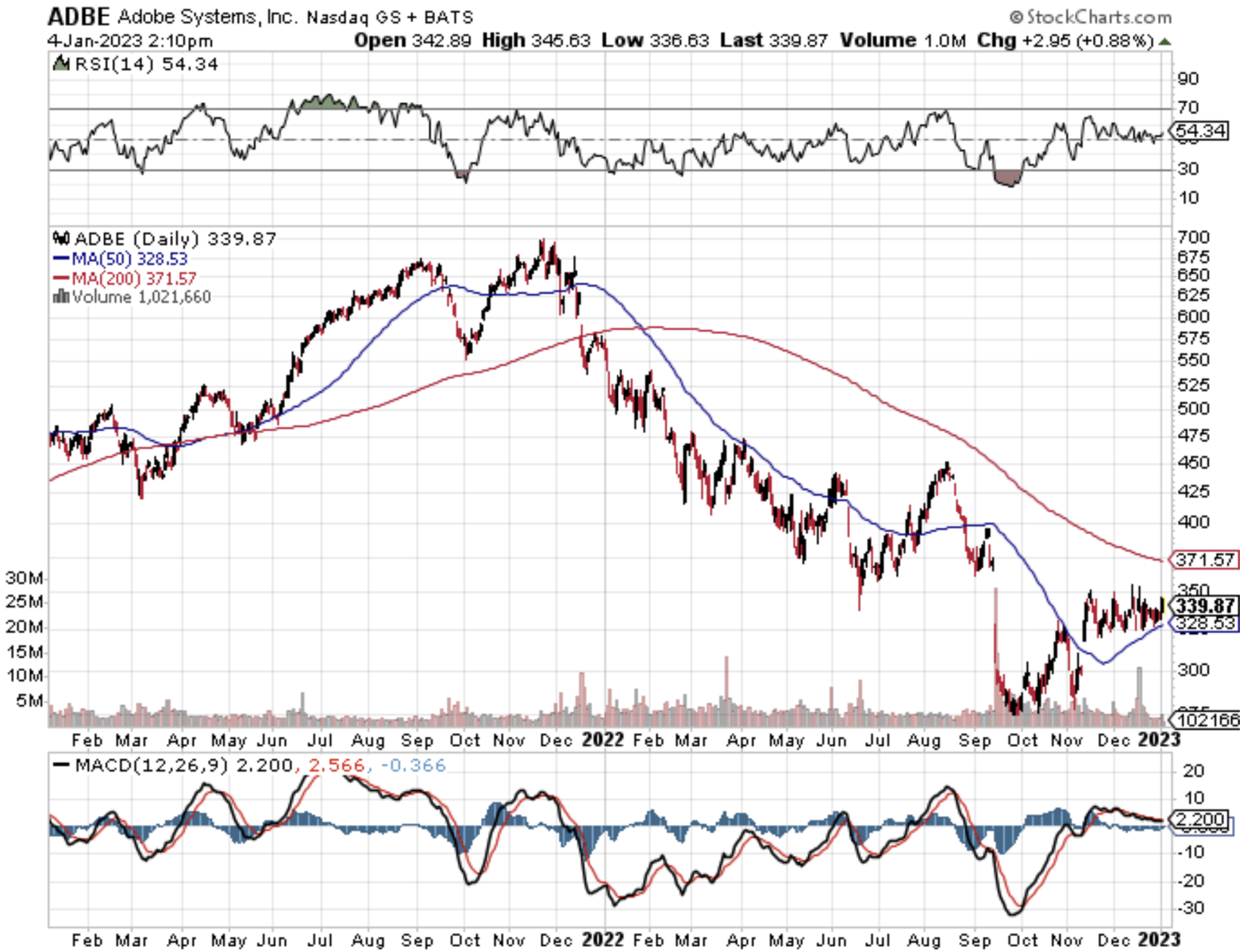
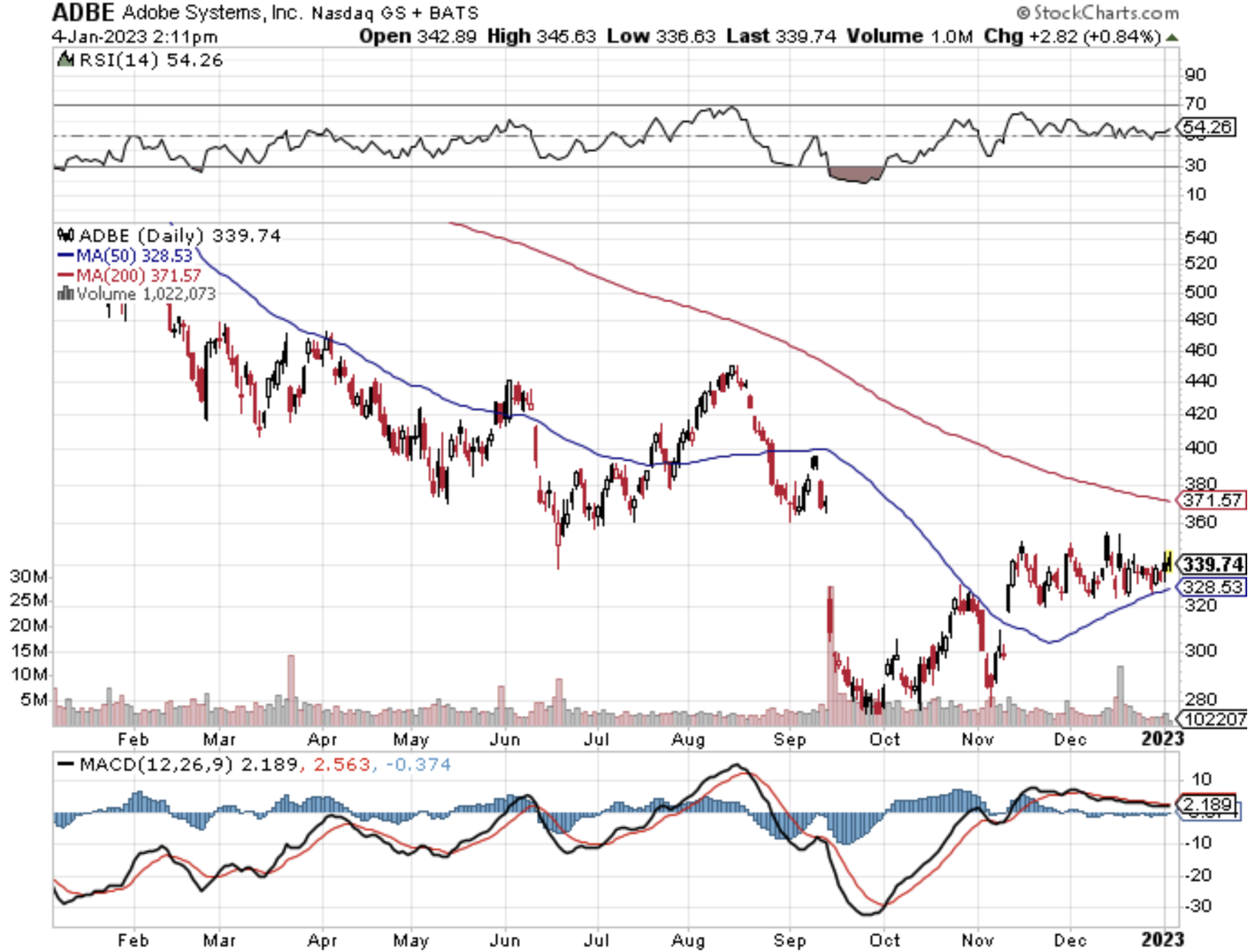
One cloud stock that does pretty well in not hiring the cheerleaders is Adobe (ADBE).
Adobe's array of applications is a tech mainstay for everyone from global enterprises to freelance designers.
It’s true that last year Adobe's share price suffered amid a larger tech stock sell-off, but there was nobody left unscathed as the macro factors brought the whole sector down.
First, it’s not ideal that Adobe spent $20 billion to buy the software design company Figma.
It’s damn expensive.
ADBE clearly didn’t get much bang for the buck and will need a quarter or two to digest the higher expenses and lack of bottom-line follow-through.
Additionally, Adobe's annual sales growth has been slowing over the past few years, and hawks point to this as a key reason to avoid the stock right now.
Adobe must still be looked at because it expanded revenue at 15% year over year in 2022 which is relatively positive for such a mature tech stock.
It shows that ADBE’s software is incredibly sticky for the end consumer.
ADBE’s 2022 earnings also expanded by 10% year over year in 2022, which I would call a victory as loss-making tech companies went out of business.
ADBE has also issued a sales forecast of 13% in 2023 highlighting its uncanny steady performance no matter how bad inflation is.
Many companies and artists simply cannot forego the usage of ADBE and that will keep ADBE in the mix for tech stocks to buy on the way up.
It’s hard to believe that wider macro factors will be worse in 2023 than in 2022.
Many of the strong balance sheet tech firms are hoping for a reversion to the mean type of share price bump.
I am not touting the beginning of 2023 as the seeds to a golden year of Silicon Valley, but trading nimbly in a strong cloud name like ADBE could represent overperformance if great entry points are located.
To be frank, it’s not as easy to make money in technology stocks as it used to be, but the money is still out there for investors to take.
That’s why it’s my job to guide traders and investors on this fascinating journey in tech stocks, as tech stocks are poised to benefit from fully priced Fed Funds interest rate increases.
Investors need to keep their eye out for ADBE.
https://www.madhedgefundtrader.com/wp-content/uploads/2022/07/buyer-beware-e1659126879996.png236500Mad Hedge Fund Traderhttps://madhedgefundtrader.com/wp-content/uploads/2019/05/cropped-mad-hedge-logo-transparent-192x192_f9578834168ba24df3eb53916a12c882.pngMad Hedge Fund Trader2023-01-04 15:02:172023-01-10 14:22:36Creative Cloud Seeks An Edge
I am once again writing this report from a first-class sleeping cabin on Amtrak’s legendary California Zephyr.
By day, I have two comfortable seats facing each other next to a panoramic window. At night, they fold into two bunk beds, a single and a double. There is a shower, but only Houdini could navigate it.
I am anything but Houdini, so I foray downstairs to use the larger public hot showers. They are divine.
We are now pulling away from Chicago’s Union Station, leaving its hurried commuters, buskers, panhandlers, and majestic great halls behind. I love this building as a monument to American exceptionalism.
I am headed for Emeryville, California, just across the bay from San Francisco, some 2,121.6 miles away. That gives me only 56 hours to complete this report.
I tip my porter, Raymond, $100 in advance to make sure everything goes well during the long adventure and to keep me up to date with the onboard gossip.
The rolling and pitching of the car is causing my fingers to dance all over the keyboard. Microsoft’s Spellchecker can catch most of the mistakes, but not all of them.
As both broadband and cell phone coverage are unavailable along most of the route, I have to rely on frenzied Internet searches during stops at major stations along the way to Google obscure data points and download the latest charts.
You know those cool maps in the Verizon stores that show the vast coverage of their cell phone networks? They are complete BS.
Who knew that 95% of America is off the grid? That explains so much about our country today.
I have posted many of my better photos from the trip below, although there is only so much you can do from a moving train and an iPhone 14 Pro Max.
Here is the bottom line which I have been warning you about for months. In 2023, we will probably top the 84.63% we made last year, but you are going to have to navigate the reefs, shoals, and hurricanes. Do it and you can laugh all the way to the bank. I will be there to assist you to navigate every step.
The first half of 2023 will be all about trading. After that, I expect markets to go straight up.
And here is my fundamental thesis for 2023. After the Fed kept rates too low for too long, then raised them too much, it will then panic and lower them again too fast to avoid a recession. In other words, a mistake-prone Jay Powell will keep making mistakes. That sounds like a good bet to me.
Let me give you a list of the challenges I see financial markets are facing in the coming year:
The Ten Key Variables for 2023
1) When will the Fed pivot?
2) How much of a toll will the quantitative tightening take?
3) How soon will the Russians give up on Ukraine?
4) When will buyers return to technology stocks from value plays?
5) Will gold replace crypto as the new flight to safety investment?
6) When will the structural commodities boom get a second wind?
7) How fast will the US dollar fall?
8) How quickly will real estate recover?
9) How fast can the Chinese economy bounce back from Covid-19?
10) How far will oil prices keep falling?
Whether we get a recession or not, you can count on markets fully discounting one, which it is currently doing with reckless abandon.
Anywhere you look, the data is dire, save for employment, which may be the last shoe to fall. Technology companies seem to be leading us in the right direction with never-ending mass layoffs. Even after relentless cost-cutting though, there are still 1.5 tech job offers per applicant, which is down from last year’s three.
The Fed is currently predicting a weak 0.5% GDP growth rate for 2023, the same feeble rate we saw for 2022. What we might get is two-quarters of negative growth in the first half followed by a sharp snapback in the second half.
Whatever we get, it will be one of the mildest recessions or growth recessions in American economic history. There is no hint of a 2008-style crash. The banking system was shored up too well back then to prevent that. Thank Dodd/Frank.
Since my job is to make your life incredibly easy, I am going to narrow my equity strategy for 2023.
It's all about falling interest rates.
When interest rates are high, as they are now, you only look at trades and investments that can benefit from falling interest rates.
In the first half, that will be value plays like banks, (JPM), (BAC), (C), financials (MS), (GS), homebuilders (KBH), (LEN), (PHM), industrials (X), capital goods (CAT), (DE).
As we come out of any recession in the second half, growth plays will rush to the fore. Big tech will regain leadership and take the group to new all-time highs. That means the volatility and chop we will certainly see in the first half will present a generational opportunity to get into the fastest-growing sectors of the US economy at bargain prices. I’m talking Cadillacs at KIA prices.
A category of its own, Biotech & Healthcare should do well on their own. Not only are they classic defensive plays to hold during a recession, technology and breakthrough new discoveries are hyper-accelerating. My top three picks there are Eli Lily (ELI), Abbvie (ABBV), and Merck (MRK).
Block out time on your calendars because whenever the Volatility Index (VIX) tops $30, I am going pedal to the metal, and full firewall forward (a pilot term), and your inboxes will be flooded with new trade alerts.
There is another equity subclass that we haven’t visited in about a decade, and that would be emerging markets (EEM). After ten years of punishment by a strong dollar, (EEM) has also been forgotten as an investment allocation. We are now in a position where the (EEM) is likely to outperform US markets in 2023, and perhaps for the rest of the decade.
Amtrak needs to fill every seat in the dining car to get everyone fed on time, so you never know who you will share a table with for breakfast, lunch, and dinner.
There was the Vietnam Vet Phantom Jet Pilot who now refused to fly because he was treated so badly at airports. A young couple desperately eloping from Omaha could only afford seats as far as Salt Lake City. After they sat up all night, I paid for their breakfast.
A retired British couple was circumnavigating the entire US in a month on a “See America Pass.” Mennonites are returning home by train because their religion forbade automobiles or airplanes.
The national debt ballooned to an eye-popping $30 trillion in 2021, a gain of an incredible $3 trillion and a post-World War II record. Yet, as long as global central banks are still flooding the money supply with trillions of dollars in liquidity, bonds will not fall in value too dramatically. I’m expecting a slow grind down in prices and up in yields.
The great bond short of 2021 never happened. Even though bonds delivered their worst returns in 19 years, they still remained nearly unchanged. That wasn’t good enough for the many hedge funds, which had to cover massive money-losing shorts into yearend.
Instead, the Great Bond Crash will become a new business. This time, bonds face the gale force headwinds of three promised interest rate hikes. The year-end government bond auctions were a complete disaster.
Fed borrowing continues to balloon out of control. It’s just a matter of time before the last billion dollars in government borrowing breaks the camel’s back.
That makes a bond short a core position in any balanced portfolio. Don’t get lazy. Make sure you only sell a rally lest we get trapped in a range, as we did for most of 2021.
With a major yield advantage over the rest of the world, the US dollar has been on an absolute tear for the past decade. After all, we have the world’s strongest economy.
That is about to end.
If your primary assumption is that US interest rates will see a sharp decline sometime in 2023, then the outlook for the greenback is terrible.
Currencies are driven by interest rate differentials and the buck is soon going to see the fastest shrinking yield premium in the forex markets.
That shines a great bright light on the foreign currency ETFs. You could do well buying the Australian Dollar (FXA), Euro (FXE), Japanese yen (FXE), and British Pound (FXB). I’d pass on the Chinese yuan (CYB) right now until their Covid shutdowns end.
5) Commodities (FCX), (VALE), (DBA)
Commodities are the high beta play in the financial markets. That’s because the cost of being wrong is so much higher. Get on the losing side of commodities and you will be bled dry by storage costs, interest expenses, contangos, and zero demand.
Commodities have one great attribute. They predict recessions earlier than any other asset class. When they peaked in March of 2022, they were screaming loud and clear that a recession would hit in early 2023. By reversing on a dime on October 14, they also told us that the recovery would begin in July of 2023.
You saw this in every important play in the sector, including Broken Hill (BHP), Peabody Energy (BTU), Freeport McMoRan (TCX), and Alcoa Aluminum (AA). Excuse me for using all the old names.
The heady days of the 2011 commodity bubble top are about to replay. Now that this sector is convinced of a substantially weaker US dollar and lower inflation, it is once more a favorite target of traders.
China will still demand prodigious amounts of imported commodities once its pandemic shutdown ends, but not as much as in the past. Much of the country has seen its infrastructure built out, and it is turning from a heavy industrial to a service-based economy, much like the US. Investors are keeping a sharp eye on India as the next major commodity consumer.
And here’s another big new driver. Each electric vehicle requires 200 pounds of copper and production is expected to rise from 1 million units a year to 25 million by 2030. Annual copper production will have to increase three-fold in a decade to accommodate this increase, no easy task, or prices will have to rise.
The great thing about commodities is that it takes a decade to bring new supply online, unlike stocks and bonds, which can merely be created by an entry in an excel spreadsheet. As a result, they always run far higher than you can imagine.
Accumulate all commodities on dips.
Snow Angel on the Continental Divide
6) Energy (DIG), (RIG), (USO), (DUG), (UNG), (XLE), (AMLP)
Energy was the top-performing sector of 2022. But remember, you will be trading an asset class that is eventually on its way to zero sooner than you think. However, you could have several doublings on the way to zero. This is one of those times.
The real tell here is that energy companies are bailing on their own industry. Instead of reinvesting profits back into their future exploration and development, as they have for the last century, they are paying out more in dividends and share buybacks.
Take the money and run.
There is the additional challenge in that the bulk of US investors, especially environmentally friendly ESG funds, are now banned from investing in legacy carbon-based stocks. That means permanently cheap valuations and share prices for the energy industry.
Energy now counts for only 5% of the S&P 500. Twenty years ago, it boasted a 15% weighting.
The gradual shutdown of the industry makes the supply/demand situation infinitely more volatile.
Unless you are a seasoned, peripatetic, sleep-deprived trader, there are better fish to fry.
And guess who the world’s best oil trader was in 2022? That would be the US government, which drew 400 million barrels from the Strategic Petroleum Reserve in Texas and Louisiana at an average price of $90 and now has the option to buy it back at $70, booking a $4 billion paper profit.
The possibility of a huge government bid at $70 will support oil prices for at least early 2023. Whether the Feds execute or not is another question. I’m advising them to hold off until we hit zero again to earn another $18 billion. Why we even have an SPR is beyond me, since America has been a large net energy producer for many years now. Do you think it has something to do with politics?
To understand better how oil might behave in 2023, I’ll be studying US hay consumption from 1900-1920. That was when the horse population fell from 100 million to 6 million, all replaced by gasoline-powered cars and trucks. The internal combustion engine is about to suffer the same fate.
The train has added extra engines at Denver, so now we may begin the long laboring climb up the Eastern slope of the Rocky Mountains.
On a steep curve, we pass along an antiquated freight train of hopper cars filled with large boulders.
The porter tells me this train is welded to the tracks to create a windbreak. Once, a gust howled out of the pass so swiftly that it blew a passenger train over on its side.
In the snow-filled canyons, we saw a family of three moose, a huge herd of elk, and another group of wild mustangs. The engineer informs us that a rare bald eagle is flying along the left side of the train. It’s a good omen for the coming year.
We also see countless abandoned 19th century gold mines and the broken-down wooden trestles leading to huge piles of tailings, relics of previous precious metals booms. So, it is timely here to speak about the future of precious metals.
Fortunately, when a trade isn’t working, I avoid it. That certainly was the case with gold last year.
2022 was a terrible year for precious metals until we got the all-asset class reversal in October. With inflation soaring, stocks volatile, and interest rates soaring, gold had every reason to fall. Instead, it ended up unchanged on the year, thanks to a 15% rally in the last two months.
Bitcoin stole gold’s thunder until a year ago, sucking in all of the speculative interest in the financial system. Jewelry and industrial demand were just not enough to keep gold afloat. That is over now for good and that is why gold is regaining its luster.
Chart formations are starting to look very encouraging with a massive head-and-shoulders bottom in place. So, buy gold on dips if you have a stick of courage on you, which I hope you do.
Higher beta silver (SLV) will be the better bet as it already has been because it plays a major role in the decarbonization of America. There isn’t a solar panel or electric vehicle out there without some silver in them and the growth numbers are positively exponential. Keep buying (SLV), (SLH), and (WPM) on dips.
Crossing the Great Nevada Desert Near Area 51
8) Real Estate (ITB), (LEN), (KBH), (PHM)
The majestic snow-covered Rocky Mountains are behind me. There is now a paucity of scenery, with the endless ocean of sagebrush and salt flats of Northern Nevada outside my window, so there is nothing else to do but write.
My apologies in advance to readers in Wells, Elko, Battle Mountain, and Winnemucca, Nevada.
It is a route long traversed by roving banks of Indians, itinerant fur traders, the Pony Express, my own immigrant forebearers in wagon trains, the Transcontinental Railroad, the Lincoln Highway, and finally US Interstate 80, which was built for the 1960 Winter Olympics at Squaw Valley.
Passing by shantytowns and the forlorn communities of the high desert, I am prompted to comment on the state of the US real estate market.
Those in the grip of a real estate recession take solace. We are in the process of unwinding 2022’s excesses, but no more. There is no doubt a long-term bull market in real estate will continue for another decade, once a two year break is completed.
There is a generational structural shortage of supply with housing which won’t come back into balance until the 2030s. You don’t have a real estate crash when we are short 10 million homes.
The reasons, of course, are demographic. There are only three numbers you need to know in the housing market for the next ten years: there are 80 million baby boomers, 65 million Generation Xers who follow them, and 86 million in the generation after that, the Millennials.
The boomers (between ages 58 and 76) have been unloading dwellings to the Gen Xers (between ages 46 and 57) since prices peaked in 2007. But there are not enough of the latter, and three decades of falling real incomes mean that they only earn a fraction of what their parents made. That’s what caused the financial crisis. That has created a massive shortage of housing, both for ownership and rentals.
There is a happy ending to this story.
Millennials now aged 26-41 are now the dominant buyers in the market. They are transitioning from 30% to 70% of all new buyers of homes. They are also just entering the peak spending years of middle age, which is great for everyone.
The Great Millennial Migration to the suburbs and Middle America has just begun. Thanks to the pandemic and Zoom, many are never returning to the cities. That has prompted massive numbers to move from the coasts to the American heartland.
That’s why Boise, Idaho was the top-performing real estate market, followed by Phoenix, Arizona. Personally, I like Reno, Nevada, where Apple, Google, Amazon, and Tesla are building factories as fast as they can.
As a result, the price of single-family homes should continue to rise during the 2020s, as they did during the 1970s and the 1990s when similar demographic forces were at play.
This will happen in the context of a labor shortfall, soaring wages, and rising standards of living.
Rising rents are accelerating this trend. Renters now pay 35% of their gross income, compared to only 18% for owners, and less, when multiple deductions and tax subsidies are considered. Rents are now rising faster than home prices.
Remember, too, that the US will not have built any new houses in large numbers in 16 years. The 50% of small home builders that went under during the Financial Crisis never came back.
We are still operating at only a half of the 2007 peak rate. Thanks to the Great Recession, the construction of five million new homes has gone missing in action.
There is a new factor at work. We are all now prisoners of the 2.75% 30-year fixed rate mortgages we all obtained over the past five years. If we sell and try to move, a new mortgage will cost double today. If you borrow at a 2.75% 30-year fixed rate, and the long-term inflation rate is 3%, then, over time, you will get your house for free. That’s why nobody is selling, and prices have barely fallen.
This winds down towards the end of 2023 as the Fed realizes its many errors and sharply lowers interest rates. Home prices will explode…. again.
Quite honestly, of all the asset classes mentioned in this report, purchasing your abode is probably the single best investment you can make now after you throw in all the tax breaks. It’s also a great inflation play.
That means the major homebuilders like Lennar (LEN), Pulte Homes (PHM), and KB Homes (KBH) are a buy on the dip.
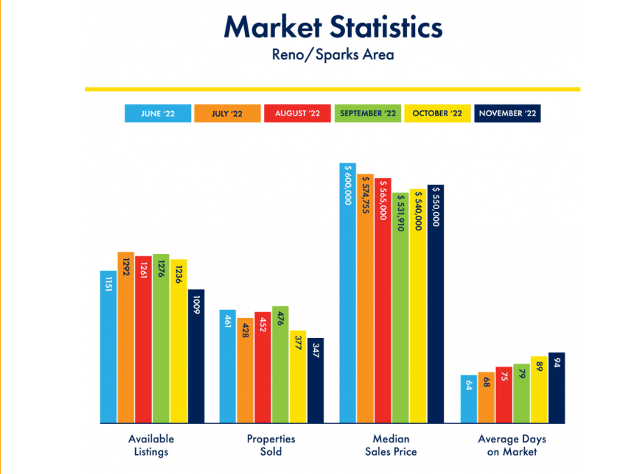
Recent Reno Real Estate Statistics
Crossing the Bridge to Home Sweet Home
9) Postscript
We have pulled into the station at Truckee amid a howling blizzard.
My loyal staff has made the ten-mile trek from my estate at Incline Village to welcome me to California with a couple of hot breakfast burritos and a chilled bottle of Dom Perignon Champagne, which has been resting in a nearby snowbank. I am thankfully spared from taking my last meal with Amtrak.
After that, it was over legendary Donner Pass, and then all downhill from the Sierras, across the Central Valley, and into the Sacramento River Delta.
Well, that’s all for now. We’ve just passed what was left of the Pacific mothball fleet moored near the Benicia Bridge (2,000 ships down to six in 50 years). The pressure increase caused by a 7,200-foot descent from Donner Pass has crushed my plastic water bottle. Nice science experiment!
The Golden Gate Bridge and the soaring spire of Salesforce Tower are just around the next bend across San Francisco Bay.
A storm has blown through, leaving the air crystal clear and the bay as flat as glass. It is time for me to unplug my MacBook Pro and iPhone, pick up my various adapters, and pack up.
We arrive in Emeryville 45 minutes early. With any luck, I can squeeze in a ten-mile night hike up Grizzly Peak and still get home in time to watch the ball drop in New York’s Times Square on TV.
I reach the ridge just in time to catch a spectacular pastel sunset over the Pacific Ocean. The omens are there. It is going to be another good year.
I’ll shoot you a Trade Alert whenever I see a window open at a sweet spot on any of the dozens of trades described above, which should be soon.
Good luck and good trading in 2023!
John Thomas
The Mad Hedge Fund Trader
The Omens Are Good for 2023!
https://www.madhedgefundtrader.com/wp-content/uploads/2023/01/market-statistics.png474632Mad Hedge Fund Traderhttps://madhedgefundtrader.com/wp-content/uploads/2019/05/cropped-mad-hedge-logo-transparent-192x192_f9578834168ba24df3eb53916a12c882.pngMad Hedge Fund Trader2023-01-04 15:00:552024-01-03 10:44:502023 Annual Asset Class Review
Legal Disclaimer
There is a very high degree of risk involved in trading. Past results are not indicative of future returns. MadHedgeFundTrader.com and all individuals affiliated with this site assume no responsibilities for your trading and investment results. The indicators, strategies, columns, articles and all other features are for educational purposes only and should not be construed as investment advice. Information for futures trading observations are obtained from sources believed to be reliable, but we do not warrant its completeness or accuracy, or warrant any results from the use of the information. Your use of the trading observations is entirely at your own risk and it is your sole responsibility to evaluate the accuracy, completeness and usefulness of the information. You must assess the risk of any trade with your broker and make your own independent decisions regarding any securities mentioned herein. Affiliates of MadHedgeFundTrader.com may have a position or effect transactions in the securities described herein (or options thereon) and/or otherwise employ trading strategies that may be consistent or inconsistent with the provided strategies.