• support@madhedgefundtrader.com
  • Member Login
Mad Hedge Fund Trader
  • Home
  • About
  • Store
  • Luncheons
  • Testimonials
  • Contact Us
  • Click to open the search input field Click to open the search input field Search
  • Menu Menu
april@madhedgefundtrader.com

An Old, Boring Dog With New Tricks

Biotech Letter

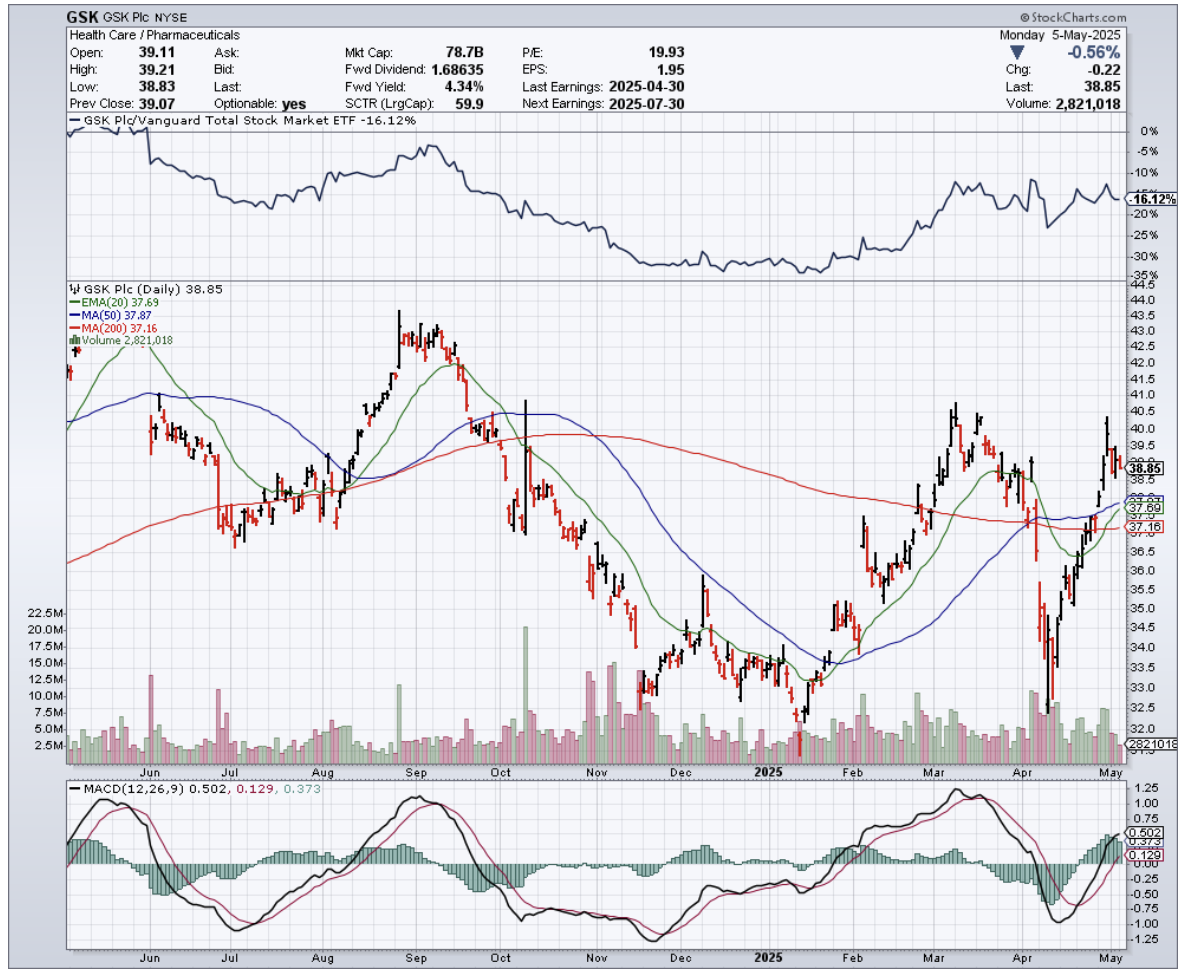
GSK (GSK) isn’t the name that makes your inbox light up or your broker call in a frenzy. No breaking news banner, no meme-stock frenzy. Just a 15% YTD climb while the rest of the healthcare sector stayed in bed.

It’s the kind of move that doesn’t come with fanfare — but it does make you sit up and ask, wait a minute, what’s going on here?

I was at a biotech conference in Basel once, back when I was helping Swiss Bank sort out its Japanese equity derivatives book. Sitting across from me was a pharma strategist with a pension for skepticism and a wine list habit to match. We were trading war stories about the market’s favorite pastime: chasing biotech rocket ships.

He shook his head and said, "The flash fades. The cash sticks." I laughed, nodded, and promptly forgot about it. But seeing GSK quietly tack on 15% YTD while the rest of the healthcare sector has been napping? That line just came roaring back.

That stuck with me. GSK — the British pharma mainstay formerly known as GlaxoSmithKline — isn’t anyone’s idea of a moonshot. No one’s quitting their day job because of a GSK short squeeze. But what it lacks in fireworks, it makes up for in fundamentals, and frankly, that’s more useful in a market like this one.

Let’s get right into it: Q1 2025 numbers just dropped, and they did not disappoint. Revenue was up 4% year-over-year, and earnings per share beat analyst expectations by a comfortable 15.6%. Not the kind of thing that gets retail investors frothing, but real, tangible outperformance in a quarter when much of the healthcare sector has been flatlining.

GSK’s guidance for the year calls for 3–5% revenue growth and 6–8% EPS growth. These aren't blockbuster figures, but they’re dependable. And in a year where the S&P 500 has had more mood swings than a caffeinated options trader, boring might just be beautiful.

Now let’s talk valuation. GSK’s forward non-GAAP price-to-earnings ratio is currently sitting at 8.8x. That’s well below its five-year average of 12.3x, which implies around 40% upside if the market decides to re-rate the stock closer to historical norms.

Even if it doesn’t, that low P/E means you’re not paying up for growth that may or may not materialize. You're buying earnings now, and at a discount.

The dividend doesn’t hurt either. At 4.4%, it’s comfortably above the sector median of 1.6%. And this isn’t a fly-by-night payout either. GSK has shelled out dividends for 23 straight years, with a payout ratio of just 19%.

There’s also the buyback angle. Management has approved $1.33 billion in repurchases for Q2 2025, which is roughly 3.4% of the company’s market cap. That’s not nothing, and it signals a level of confidence from inside the house that’s worth noting.

Of course, it’s not all sunshine and roses. GSK expects its long-term revenue growth to slow post-2026, projecting a CAGR of 3.5% through 2031. That’s down from the 7% they’re targeting through 2026.

Some might see that as a red flag. I see it as realism. Pharma is cyclical. Patent cliffs are real. And growth eventually slows — even in biotech land.

But margins tell another story. GSK’s core operating margin hit 33.7% in Q1, already above their 2026 target of 31%. If that holds, or improves, the impact on profit leverage over the next couple of years could be meaningful.

In plain English: they’re squeezing more out of every pound they earn.

On a longer timeline, the math still works. Assuming steady margins and modest revenue expansion, GSK’s forward P/E could drop to 6.7x by 2031. At that level, it’s almost unreasonably cheap for a company still growing, still paying a dividend, and still buying back its own stock.

In the late 1990s, I was running one of the first global hedge funds with exposure to Japanese equity derivatives — a market that made GSK look like a thrill ride. What I learned back then was that patience, paired with a good entry point, often beats flash and momentum.

GSK right now feels a lot like that. Quietly undervalued. Misunderstood. But building.

No one’s getting rich overnight with this stock. But if you get a dip, it’s worth stepping into. Not for drama. Not for headlines. But for the sort of predictable, well-capitalized earnings stream that keeps the portfolio steady when the rest of the market forgets what a balance sheet looks like.
 

https://madhedgefundtrader.com/wp-content/uploads/2019/05/cropped-mad-hedge-logo-transparent-192x192_f9578834168ba24df3eb53916a12c882.png 0 0 april@madhedgefundtrader.com https://madhedgefundtrader.com/wp-content/uploads/2019/05/cropped-mad-hedge-logo-transparent-192x192_f9578834168ba24df3eb53916a12c882.png april@madhedgefundtrader.com2025-05-06 12:00:032025-05-06 12:13:10An Old, Boring Dog With New Tricks
april@madhedgefundtrader.com

May 1, 2025

Biotech Letter

Mad Hedge Biotech and Healthcare Letter
May 1, 2025
Fiat Lux


Featured Trade:

(TELEHEALTH'S NEW WEIGHT CLASS)

(HIMS), (NVO)

https://madhedgefundtrader.com/wp-content/uploads/2019/05/cropped-mad-hedge-logo-transparent-192x192_f9578834168ba24df3eb53916a12c882.png 0 0 april@madhedgefundtrader.com https://madhedgefundtrader.com/wp-content/uploads/2019/05/cropped-mad-hedge-logo-transparent-192x192_f9578834168ba24df3eb53916a12c882.png april@madhedgefundtrader.com2025-05-01 12:02:152025-05-01 12:35:39May 1, 2025
april@madhedgefundtrader.com

Telehealth's New Weight Class

Biotech Letter

Clinging to Mount Everest at 20,000 feet, fingers numb and oxygen tank hissing like an annoyed cobra, I had an epiphany that would later serve me well on Wall Street: the most promising paths aren't always the obvious ones — they're the routes that quietly keep you alive while everyone else is busy with their cameras and guided tours.

That same principle is quietly guiding Hims & Hers Health (HIMS) right now.

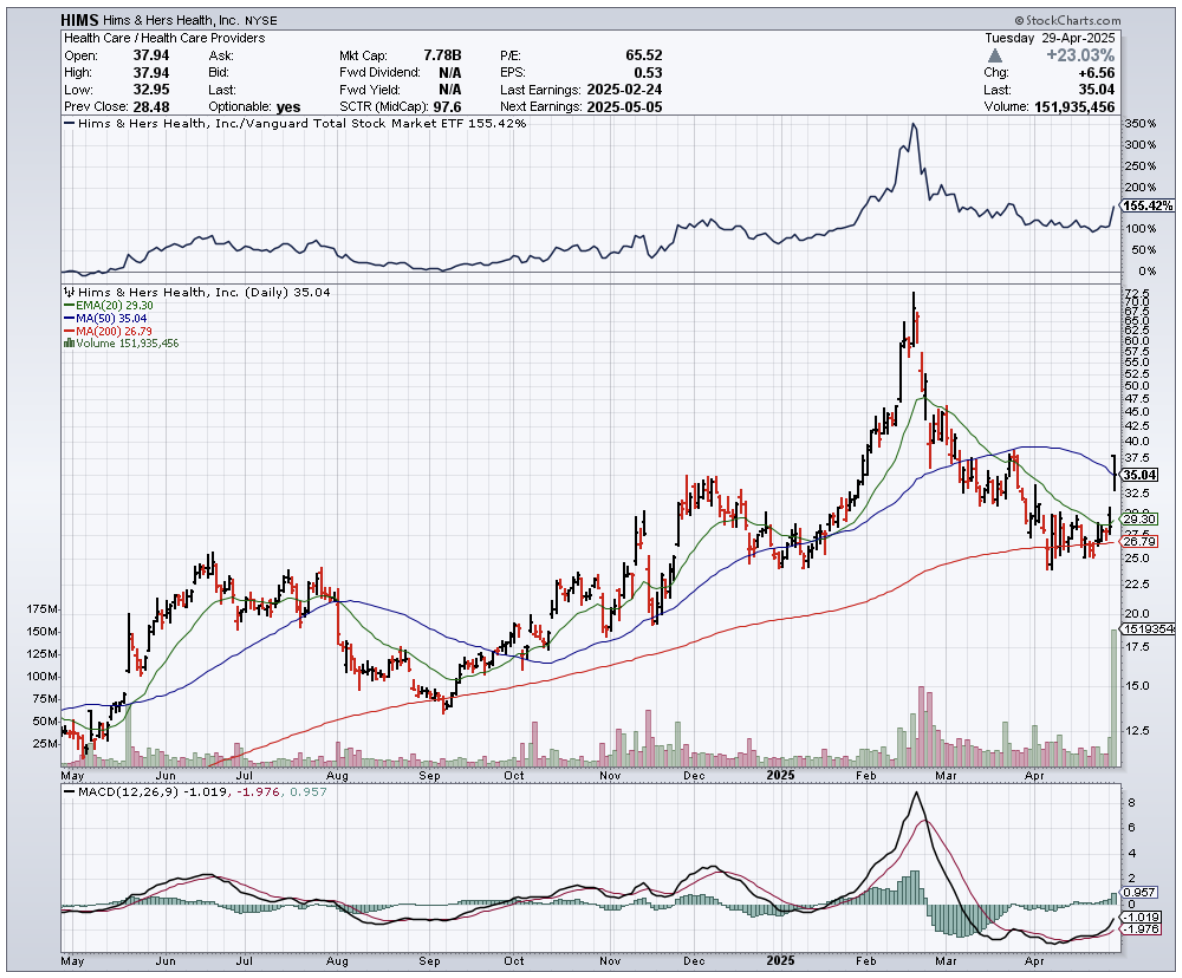
While the market obsesses over their new Wegovy partnership with Novo Nordisk (NVO), sending HIMS stock jumping 25% to $35, savvy investors should look deeper.

The company isn't suddenly becoming a weight-loss play — they're eliminating doubt and positioning themselves at the center of healthcare's digital transformation.

This reminds me of a pattern I've observed across decades of tracking successful businesses and leaders. The most effective ones don't chase trends. Instead, they position themselves to win regardless of which way the wind blows.

I witnessed this firsthand during a memorable interview with Deng Xiaoping back in the late 70s. Despite the chaotic economic landscape he inherited, his focus remained steadfastly on fundamentals rather than fleeting opportunities.

That's precisely the Hims playbook with these GLP-1 partnerships.

Fascinatingly, they're charging $599 monthly for Wegovy — $100 more than Novo's direct offering.

In my decades managing hedge fund portfolios, I've learned that pricing power is the ultimate business aphrodisiac. It signals you have something people genuinely value enough to pay a premium for.

Wall Street, in its infinite wisdom, is once again squinting at the wrong spreadsheet.

Hims projects $2.35 billion in 2025 revenue, with $725 million from weight management alone — a forecast that completely excluded branded GLP-1s. Their core business in sexual health, dermatology, and mental wellness already generates $1.2 billion annually.

That's 83% of revenue from decidedly non-injectable sources!

Their growth figures are impressive, too: 60% projected sales growth and 70% adjusted EBITDA growth. Yet HIMS trades at just 3.5x 2025 revenue estimates.

If I pitched you a company growing this fast in any other sector at that multiple, you'd think I was selling oceanfront property in Nebraska.

But what truly separates Hims from competitors is retention. Their internal data shows 70% patient retention after 12 weeks, compared to 42% in standard clinical settings. Their users interact with providers three times more frequently in the first month and five times more over three months.

That's not marginally better — it's an entirely different universe of care.

Like those guerrilla fighters I once interviewed in Southeast Asia, who held territory against superior forces by knowing the terrain better — Hims isn’t just in the healthcare war, they know exactly where to strike.

The stock previously touched $70 after posting 95% year-over-year growth in Q4. It retreated on fears about GLP-1 access that were largely imaginary.

Now it's climbing again on news that merely confirms what company executives already knew: their business model doesn't hinge on any single medication.

This situation reminds me of trading Japanese equities in the late '80s—watching rational people make irrational decisions based on incomplete information. The market is simultaneously overvaluing the importance of GLP-1s while undervaluing Hims' overall growth trajectory.

With $300 million in projected 2025 adjusted EBITDA (13% margins), expanding to 20% as they scale, HIMS at 27x EBITDA represents the kind of opportunity that makes me sit up straighter in my ergonomic chair. That multiple would make perfect sense for a company growing at half this rate.

What's more telling than spreadsheets, though, is customer loyalty. During my years managing portfolios worth more than some small nations' GDPs, I developed a simple litmus test: if a company disappeared tomorrow, would its customers feel inconvenienced or devastated?

Hims has clearly crossed into "devastated" territory for its growing user base - the kind of emotional moat that Warren Buffett probably dreams about between bites of his McDonald's breakfast.

For those hunting increasingly endangered species - growth with reasonable valuation, momentum with sustainable model, actual substance beneath the hype - HIMS offers a compelling specimen. These GLP-1 deals aren't the main story; they're just the latest chapter in a much longer narrative about healthcare's digital transformation.

And if there’s one thing I’ve learned from diving shipwrecks in Truk Lagoon to decoding market trends from Tokyo to New York — it’s that the journey tells you more than any single milestone ever could.

This one looks increasingly profitable for those with the patience to stay the course.


https://madhedgefundtrader.com/wp-content/uploads/2019/05/cropped-mad-hedge-logo-transparent-192x192_f9578834168ba24df3eb53916a12c882.png 0 0 april@madhedgefundtrader.com https://madhedgefundtrader.com/wp-content/uploads/2019/05/cropped-mad-hedge-logo-transparent-192x192_f9578834168ba24df3eb53916a12c882.png april@madhedgefundtrader.com2025-05-01 12:00:162025-05-01 12:35:28Telehealth's New Weight Class
april@madhedgefundtrader.com

April 29, 2025

Biotech Letter

Mad Hedge Biotech and Healthcare Letter
April 29, 2025
Fiat Lux


Featured Trade:

(BIOTECH’S AWKWARD MIDDLE CHILD)

(GILD), (VRTX), (AMGN), (BMY)

https://madhedgefundtrader.com/wp-content/uploads/2019/05/cropped-mad-hedge-logo-transparent-192x192_f9578834168ba24df3eb53916a12c882.png 0 0 april@madhedgefundtrader.com https://madhedgefundtrader.com/wp-content/uploads/2019/05/cropped-mad-hedge-logo-transparent-192x192_f9578834168ba24df3eb53916a12c882.png april@madhedgefundtrader.com2025-04-29 12:02:212025-04-29 11:58:05April 29, 2025
april@madhedgefundtrader.com

Biotech's Awkward Middle Child

Biotech Letter

Well, folks, I've been trading biotech stocks since before most of today's analysts had their first internships.

After countless dinners with pharma execs and more investor conferences than I care to remember, there's one thing I've learned about this sector – these stocks are a lot like the experimental drugs themselves: sometimes miraculous, sometimes disappointing, and always requiring patience.

That brings us to Gilead Sciences (GILD), which has recently pulled off the financial equivalent of finding a $100 bill in an old jacket: a 90% gain since May 2024.

If you're an income-focused investor eyeing GILD's promising yield like a prospector spotting gold, I'd suggest taking a breath before you stake your claim.

After diving into this company's financial innards with the ruthless precision of a veteran hedge fund manager, I've uncovered some fascinating contradictions.

First off, GILD has undergone a remarkable transformation, shedding its growth-focused biotech skin to become what I call a "mature dividend machine" – offering 9 consecutive years of dividend increases since 2015.

Its current annual dividend of $3.16 per share yields 2.99%, significantly outpacing the biotechnology sector average of 1.92%. Not too bad for a company that cut its teeth on groundbreaking HIV and COVID treatments.

But here's where things get interesting. Despite GILD's revenue looking as seasonal as a summer blockbuster (with predictably lower earnings in the first half of each year), the company's fundamentals show troubling signs beneath the surface.

While Q1 2025 revenue was expected to land around $6.77 billion, the company's economic profitability has fallen off a cliff since 2024. Blame it on negative net income in early 2024 and a Cash Tax Rate that jumped from 25.4% to 30.6% faster than a trader fleeing a market crash.

The historical performance tells an even more sobering tale. From IPO to 2015, GILD delivered average annual returns of 32.25% in 79% of years – performance that would make even the most jaded investor whistle.

But since 2015? The stock managed profits in only 50% of years with an anemic average return of 0.99%, which translates to a 2.17% loss when adjusted for inflation. Ouch.

You might say that the entire sector's going through a rough patch these days, and I would have agreed with you except there are several biotechs still performing well.

Take Vertex Pharmaceuticals (VRTX). Those guys are up 36.7% over the past 52 weeks.

Or consider Amgen (AMGN), whose dividend is growing at a mouth-watering 8.94% annually over five years – nearly triple what GILD is serving up to its shareholders.

Even BioMarin (BMRN), a company most retail investors couldn't pick out of a lineup, has been quietly crushing it with 27.3% revenue growth while GILD's top line moves sideways like a crab with performance anxiety.

And don't get me started on Bristol Myers Squibb (BMY). Despite facing their own patent cliff dramas, they're maintaining a forward P/E of just 7.2 – practically giving away shares – while offering a dividend yield of 4.7%.

So, let me tell you something the glossy investor presentations won't: GILD's forward P/E ratio of 13.35x looks attractively cheap compared to the healthcare sector's 20.13x and the S&P 500's 18.60x.

After having had drinks with several institutional investment managers last week, though, I can assure you that discount exists for a reason.

The smart money has correctly identified that this company is no longer growing profitably, and certain whispers about their pipeline aren't inspiring confidence.

For dividend investors hoping to beat inflation while preserving capital, GILD presents a mixed bag. The dividend growth continues but remains stubbornly below inflation, creating a slow leak in real returns.

And, look, I know the Trump White House isn't exactly making life easy for companies like Gilead. Over whiskey last month with a former FDA bigwig (who shall remain nameless), I heard some concerning murmurs about potential cuts to HIV prevention programs.

Bad news when you're sitting on 40% of the U.S. PrEP market like GILD is.

Bottom line? I'm sticking with "hold" for now. The smart money moves when the smart money knows, and my Rolodex isn't flashing buy signals yet.

I've watched enough biotech darlings flame out to know that patience outperforms panic every time.

When GILD shows signs of recapturing that pre-2014 magic, you'll hear it from me before the CNBC talking heads catch wind of it.


https://madhedgefundtrader.com/wp-content/uploads/2019/05/cropped-mad-hedge-logo-transparent-192x192_f9578834168ba24df3eb53916a12c882.png 0 0 april@madhedgefundtrader.com https://madhedgefundtrader.com/wp-content/uploads/2019/05/cropped-mad-hedge-logo-transparent-192x192_f9578834168ba24df3eb53916a12c882.png april@madhedgefundtrader.com2025-04-29 12:00:202025-04-29 11:58:00Biotech's Awkward Middle Child
april@madhedgefundtrader.com

April 24, 2025

Biotech Letter

Mad Hedge Biotech and Healthcare Letter
April 24, 2025
Fiat Lux


Featured Trade:

(DIVIDEND HUNTING IN BEAR COUNTRY)

(BMY)

https://madhedgefundtrader.com/wp-content/uploads/2019/05/cropped-mad-hedge-logo-transparent-192x192_f9578834168ba24df3eb53916a12c882.png 0 0 april@madhedgefundtrader.com https://madhedgefundtrader.com/wp-content/uploads/2019/05/cropped-mad-hedge-logo-transparent-192x192_f9578834168ba24df3eb53916a12c882.png april@madhedgefundtrader.com2025-04-24 12:02:182025-04-24 13:03:33April 24, 2025
april@madhedgefundtrader.com

Dividend Hunting In Bear Country

Biotech Letter

One stock in the pharmaceutical sector has been calling to me lately like a siren song amid market turbulence.

I'm talking about Bristol-Myers Squibb Co. (BMY), which has taken a beating in the March-April selloff but is dangling a forward estimated 5% dividend yield while generating a whopping 14% annual free cash flow — tops among the largest drug names.

I've been watching this one since January, when it first dipped below $52. Like a patient fisherman, I've been waiting for just the right moment to cast my line. That moment appears to be now, as BMY slides toward the $50 mark amid broader market jitters and sector rotation. It’s remarkable how often Wall Street throws the proverbial baby out with the bathwater during these periodic fits of selling.

The beauty of BMY is not just valuation. It’s historically proven itself as a financial bomb shelter — outperforming the S&P 500 in four major recessions since 1990.

During the 2020 pandemic, it returned 36% vs. the S&P’s 26%. In the Great Recession, it gained 13% while the broader market fell 16%.

During the 1990 Persian Gulf War recession, it delivered a jaw-dropping 76%.

And here’s one more kicker: BMY’s current 14% free cash flow yield is nearly 10% higher than equivalent cash investment yields — among the best “relative yields” it’s posted in 35 years.

On top of that, its 5%+ dividend towers over the S&P’s 1.3% and Big Pharma’s 3.65% median.

This is a rare setup where both the cash yield and the ability to sustain it align — a combination that’s very hard to beat in a defensive play.

Of course, no stock is bulletproof. BMY will need to navigate patent cliffs and increased regulatory scrutiny on drug pricing.

Wall Street is also pricing in little to no growth in the near term — and that’s probably fair. But the current setup suggests BMY could still outperform, especially if the S&P enters a decline in 2025.

This defensive mindset is why Warren Buffett and other veterans have been moving to abnormally extreme levels of cash since 2024. They're battening down the hatches while the financial seas are still relatively calm.

And speaking of smart investors, I had lunch last week at Tadich Grill with a hedge fund manager I’ve known for decades. When I mentioned I was looking for defensive plays, he immediately brought up BMY.

“What’s rare these days,” he said, “is a company with both a high dividend and the cash flow to actually back it up.” He then showed me his firm’s spreadsheets — stress-tested across recession scenarios back to Nixon — and BMY held firm.

Having run similar models myself (if not quite as colour-coded), I nodded in agreement.

At the current ~$50 share price, BMY’s free cash flow yield stands near 14%. That’s nearly 10% better than risk-free Treasury rates and more than double the Big Pharma peer group median of 6.15%.

So what could go wrong? A steeper summer selloff. Or an aggressive federal move to mandate drug pricing — a risk that’s always on the table, but rarely moves quickly. Supply chain issues, especially for ingredients sourced from China, are also worth watching.

That said, BMY has manufacturing facilities globally, and 71% of its revenue comes from the US. That gives it some insulation if trade tensions flare.

But here’s the thing: those risks hit all major pharma companies. BMY starts from a stronger base: better cash flow, better history, better defensive positioning.

My view? BMY is worth owning for its super-sized dividend and battle-tested resilience. I suggest you buy the dip.


https://madhedgefundtrader.com/wp-content/uploads/2019/05/cropped-mad-hedge-logo-transparent-192x192_f9578834168ba24df3eb53916a12c882.png 0 0 april@madhedgefundtrader.com https://madhedgefundtrader.com/wp-content/uploads/2019/05/cropped-mad-hedge-logo-transparent-192x192_f9578834168ba24df3eb53916a12c882.png april@madhedgefundtrader.com2025-04-24 12:00:562025-04-24 13:02:27Dividend Hunting In Bear Country
april@madhedgefundtrader.com

April 22, 2025

Biotech Letter

Mad Hedge Biotech and Healthcare Letter
April 22, 2025
Fiat Lux


Featured Trade:

(NO MORE TEARS)

(JNJ)

https://madhedgefundtrader.com/wp-content/uploads/2019/05/cropped-mad-hedge-logo-transparent-192x192_f9578834168ba24df3eb53916a12c882.png 0 0 april@madhedgefundtrader.com https://madhedgefundtrader.com/wp-content/uploads/2019/05/cropped-mad-hedge-logo-transparent-192x192_f9578834168ba24df3eb53916a12c882.png april@madhedgefundtrader.com2025-04-22 12:02:002025-04-22 12:43:48April 22, 2025
april@madhedgefundtrader.com

No More Tears

Biotech Letter

Remember when your mom told you to eat your vegetables? "They're boring but good for you," she'd insist while you eyed that chocolate cake across the room.

Well, in today's market, Johnson & Johnson (JNJ) is that plate of nutritious broccoli – not the sexiest option on the table, but exactly what your financial diet needs.

And if Q1 earnings are any indication, this particular vegetable is secretly packed with more flavor than the market gave it credit for.

Their recent earnings report confirms what I've been telling anyone who would listen: this pharmaceutical tortoise is quietly outpacing flashier hares.

Sales increased 2.4% year-over-year to $21.9 billion, exceeding analyst expectations and demonstrating that steady growth doesn't need to make headlines to fill portfolios.

While the headline diluted EPS was an eye-popping $4.54 (up over 235%), those savvy enough will look at the adjusted figure of $2.77 (excluding one-time charges) for a more realistic picture of operational performance.

Diving deeper into the numbers reveals a company firing on multiple cylinders.

The MedTech division grew 4.1% to $8 billion, with cardiovascular products leading the charge at 17.7% growth.

Meanwhile, Pharmaceuticals grew 4.2% to $13.87 billion, with oncology growing an impressive 20% to $5.68 billion.

Multiple myeloma therapy Darzalex continues its blockbuster trajectory at $3.24 billion, while the approval of Rybrevant in non-small-cell lung cancer adds yet another potential multi-billion dollar earner to the medicine cabinet.

Now, let's talk about pharmaceutical patent cliffs.

Stelara, JNJ's immunology golden goose, is mid-plummet, with Q1 revenues down 33% to $1.63 billion. As expected, though, JNJ has been quietly lining up replacements.

Their immunology bullpen includes nipocalimab (sporting FDA Fast Track status) and icotrokinra (which cleared skin in 84% of adolescent psoriasis patients).

You can actually practically smell the confidence wafting from management's quarterly statements.

They've bumped their full-year revenue guidance to $91.6-$92.4 billion and hiked the quarterly dividend by 4.8% to $1.30 per share. That makes 63 consecutive years of dividend increases.

I'd be remiss not to mention the twin storm clouds hovering over our healthcare heavyweight.

First, there's the $6.97 billion charge for talc lawsuits after a bankruptcy judge essentially told JNJ their "Texas two-step" legal maneuver was more of a stumble.

Second, the Trump administration's threatened 25% pharmaceutical tariffs. With roughly 44% of Q1 revenues coming from overseas ($9.6 billion compared to $12.3 billion domestic), JNJ isn't completely sheltered from cross-border economic squabbles.

But here's where JNJ's strategic thinking earns my respect: they're doubling down on America with a $55 billion U.S. expansion planned over the next four years.

Back when I was launching hedge funds in the late '80s, I quickly learned to separate companies that merely react to policy changes from those that anticipate and adapt. JNJ falls firmly in the latter category.

For the number-crunchers among you (my people!), JNJ trades at 25.6 times earnings with a price-to-free-cash-flow ratio of 19.95. I ran this through my DCF model using a 10% discount rate.

The math suggests JNJ needs approximately 5% annual free cash flow growth to justify today's price.

With MedTech projected to grow 5-7% annually and Pharmaceuticals showing similar potential, plus those steady share buybacks reducing the float at 1.14% yearly, my spreadsheets spit out an intrinsic value of about $168.39 per share – roughly 7% above where we stand today.

Not a screaming bargain, but a fair price for a company that's mastered the art of sustainable growth.

JNJ won't make you the star of your next cocktail party investment brag-fest. But when markets start convulsing like they've touched a live wire, these steady healthcare veterans tend to keep their vital signs stable.

While your trendier holdings might need intensive care during volatility, JNJ has spent over a century perfecting the art of financial first aid.

In a market that often leaves investors reaching for tissues, JNJ's steady performance lives up to its most famous promise: no more tears.


https://madhedgefundtrader.com/wp-content/uploads/2019/05/cropped-mad-hedge-logo-transparent-192x192_f9578834168ba24df3eb53916a12c882.png 0 0 april@madhedgefundtrader.com https://madhedgefundtrader.com/wp-content/uploads/2019/05/cropped-mad-hedge-logo-transparent-192x192_f9578834168ba24df3eb53916a12c882.png april@madhedgefundtrader.com2025-04-22 12:00:412025-04-22 12:43:38No More Tears
april@madhedgefundtrader.com

April 17, 2025

Biotech Letter

Mad Hedge Biotech and Healthcare Letter
April 17, 2025
Fiat Lux


Featured Trade:

(THIS BIG PHARMA'S GRAND DIVORCE SHOWS PROMISE)

(NVS), (SDZNY), (MRK), (RHHBY)

https://madhedgefundtrader.com/wp-content/uploads/2019/05/cropped-mad-hedge-logo-transparent-192x192_f9578834168ba24df3eb53916a12c882.png 0 0 april@madhedgefundtrader.com https://madhedgefundtrader.com/wp-content/uploads/2019/05/cropped-mad-hedge-logo-transparent-192x192_f9578834168ba24df3eb53916a12c882.png april@madhedgefundtrader.com2025-04-17 12:02:032025-04-17 12:08:57April 17, 2025
Page 2 of 115‹1234›»

Legal Disclaimer

There is a very high degree of risk involved in trading. Past results are not indicative of future returns. MadHedgeFundTrader.com and all individuals affiliated with this site assume no responsibilities for your trading and investment results. The indicators, strategies, columns, articles and all other features are for educational purposes only and should not be construed as investment advice. Information for futures trading observations are obtained from sources believed to be reliable, but we do not warrant its completeness or accuracy, or warrant any results from the use of the information. Your use of the trading observations is entirely at your own risk and it is your sole responsibility to evaluate the accuracy, completeness and usefulness of the information. You must assess the risk of any trade with your broker and make your own independent decisions regarding any securities mentioned herein. Affiliates of MadHedgeFundTrader.com may have a position or effect transactions in the securities described herein (or options thereon) and/or otherwise employ trading strategies that may be consistent or inconsistent with the provided strategies.

Copyright © 2026. Mad Hedge Fund Trader. All Rights Reserved. support@madhedgefundtrader.com
Scroll to top