• support@madhedgefundtrader.com
  • Member Login
Mad Hedge Fund Trader
  • Home
  • About
  • Store
  • Luncheons
  • Testimonials
  • Contact Us
  • Click to open the search input field Click to open the search input field Search
  • Menu Menu
april@madhedgefundtrader.com

How One Smug Dane Made Me Eat My Words

Biotech Letter

Back in 2008, I found myself in a private dining room at Copenhagen's Noma restaurant – then barely known outside culinary circles – seated next to a senior Novo Nordisk (NVO) executive who couldn't stop talking about their early-stage GLP-1 research.

"This will change diabetes treatment forever," he insisted between bites of moss and lichen. I nodded politely while thinking he'd had too much aquavit. Fast forward to today, and I've never been happier to have been dead wrong.

That same GLP-1 technology now powers Ozempic and Wegovy, creating a weight-loss revolution that's transformed both waistlines and balance sheets.

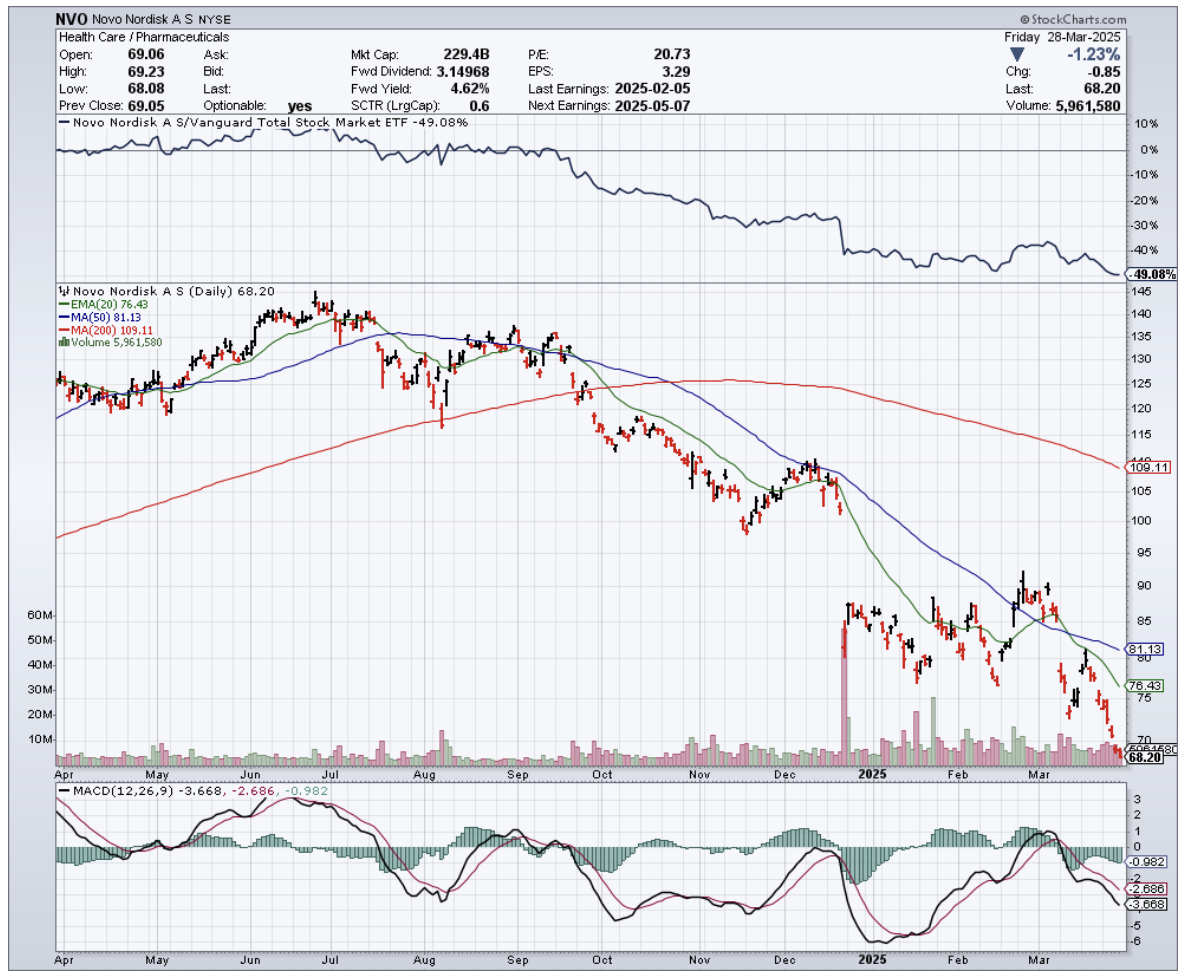
But here's what has me reaching for my trading account: Novo Nordisk's stock has somehow crashed 50% since last summer, creating what might be the buying opportunity of the decade in the pharmaceutical space.

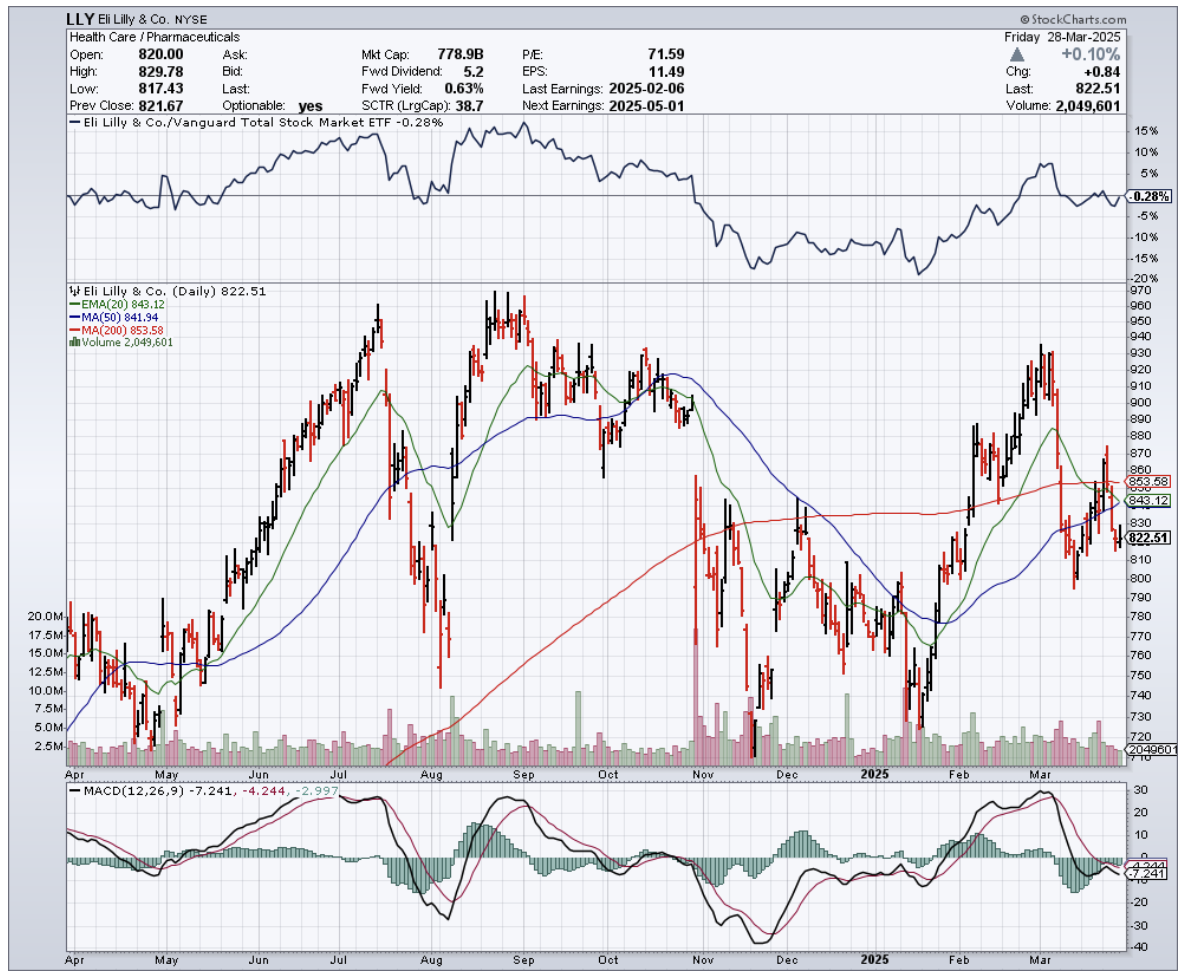
Meanwhile, their American rival Eli Lilly (LLY) has remained relatively stable despite identical market challenges. Let's dissect this peculiar divergence.

The facts paint a compelling picture: Novo Nordisk remains the undisputed global leader in the GLP-1 segment with a commanding 55.1% market share.

Their quarterly revenue hit $11.95 billion, up 25.13% year-over-year – not quite matching Lilly's impressive 44.7% growth, but still exceptional by any standard.

What's particularly striking is the valuation disconnect. Novo now trades at just 17.9x forward earnings compared to Lilly's 35.4x multiple. That gives Novo a PEG ratio of 0.97 – catnip for value investors hunting growth at a reasonable price.

The Danish giant's financial position remains rock-solid with lower net debt ($10.6B vs. Lilly's $31B) and a superior debt/EBITDA ratio. Their EBIT margin stands at an impressive 48.2% versus Lilly's 38.9%.

The precipitous stock decline stems from two primary concerns: recent clinical trial results for their next-generation Cagrisema showed 22.7% weight loss versus their 25% target, and potential U.S. tariffs could pressure margins on European-manufactured drugs. Both fears seem drastically overblown.

For context, Novo's monthly RSI has dropped below 40 – a rare technical signal that has occurred only three times this century (2002, 2009, and 2016), with each instance preceding returns exceeding 500% before the next correction.

Historical patterns aren't guaranteed, but they certainly make me sit up straighter in my trading chair.

The company isn't standing still either. They've committed $4.1 billion to expand U.S. manufacturing facilities, reducing tariff exposure.

They've also signed deals worth up to $3 billion with United Laboratories (ULIHF) and Lexicon Pharmaceuticals (LXRX) to bolster their weight-loss drug pipeline, ensuring they remain competitive with Lilly's offerings.

Last month at a healthcare conference in Boston, I cornered a veteran endocrinologist who's been prescribing these medications since their approval.

"The competition between Lilly and Novo is creating better outcomes for patients," she told me. "But from a prescription perspective, we still reach for Novo's products first in most cases."

That kind of clinical preference creates a moat that's difficult to quantify on balance sheets but enormously valuable over the long term.

While Eli Lilly deserves its premium valuation with a more diversified therapeutic portfolio spanning oncology, immunology, and neurology, Novo's singular focus on diabetes and obesity has created unparalleled expertise in categories representing massive long-term growth markets.

The obesity treatment market alone is projected to grow at 22% annually, with GLP-1 drugs leading the charge. Approximately 25% of the world's population will be obese by 2035, and Western markets like the U.S. and Europe (Novo's primary territories) will see the highest rates.

Both companies will thrive in this expanding market, but at current prices, Novo represents a superior investment opportunity. Analyst consensus targets suggest 57% upside potential for Novo versus 23% for Lilly.

I've initiated a position in Novo Nordisk at these levels while maintaining a smaller holding in Lilly for diversification. After all, in pharma investing, sometimes the most profitable opportunities emerge when the market overreacts to short-term concerns.

As for that Danish executive from 2008? He retired to a villa overlooking the Øresund Strait last year. I sent him a congratulatory gift basket filled with moss and lichen – a reminder of where billion-dollar ideas sometimes begin.


https://madhedgefundtrader.com/wp-content/uploads/2019/05/cropped-mad-hedge-logo-transparent-192x192_f9578834168ba24df3eb53916a12c882.png 0 0 april@madhedgefundtrader.com https://madhedgefundtrader.com/wp-content/uploads/2019/05/cropped-mad-hedge-logo-transparent-192x192_f9578834168ba24df3eb53916a12c882.png april@madhedgefundtrader.com2025-04-01 12:00:232025-04-01 11:38:50How One Smug Dane Made Me Eat My Words
april@madhedgefundtrader.com

March 27, 2025

Biotech Letter

Mad Hedge Biotech and Healthcare Letter
March 27, 2025
Fiat Lux


Featured Trade:

(NO SHERPA REQUIRED)

(MRK), (BMY)

https://madhedgefundtrader.com/wp-content/uploads/2019/05/cropped-mad-hedge-logo-transparent-192x192_f9578834168ba24df3eb53916a12c882.png 0 0 april@madhedgefundtrader.com https://madhedgefundtrader.com/wp-content/uploads/2019/05/cropped-mad-hedge-logo-transparent-192x192_f9578834168ba24df3eb53916a12c882.png april@madhedgefundtrader.com2025-03-27 12:02:172025-03-27 12:54:30March 27, 2025
april@madhedgefundtrader.com

No Sherpa Required

Biotech Letter

Perched high above the timberline on Colorado's Mt. Elbert last weekend, I found myself short on oxygen and long on questions—namely, which pharmaceutical heavyweight deserves a spot in my portfolio: Merck (MRK) or Bristol-Myers Squibb (BMY)?

At 14,438 feet, the air thins out fast, but the thinking gets clearer. Clarity tends to arrive when your brain’s running at 60% capacity.

I’d stuffed my pack with company reports, earnings transcripts, and a few too many granola bars—one of which was being stalked by a very persistent marmot as I paused to catch my breath. I must’ve looked like an underprepared Everest hopeful, hunched over charts and trying to find altitude-adjusted alpha.

On paper, both firms dominate the oncology space and have made a career out of telling cancer where to shove it. But markets don’t care about reputations—they care about margins, pipelines, and who's going to make it through the next patent cliff without blowing out their kneecaps.

Let’s start with the money.

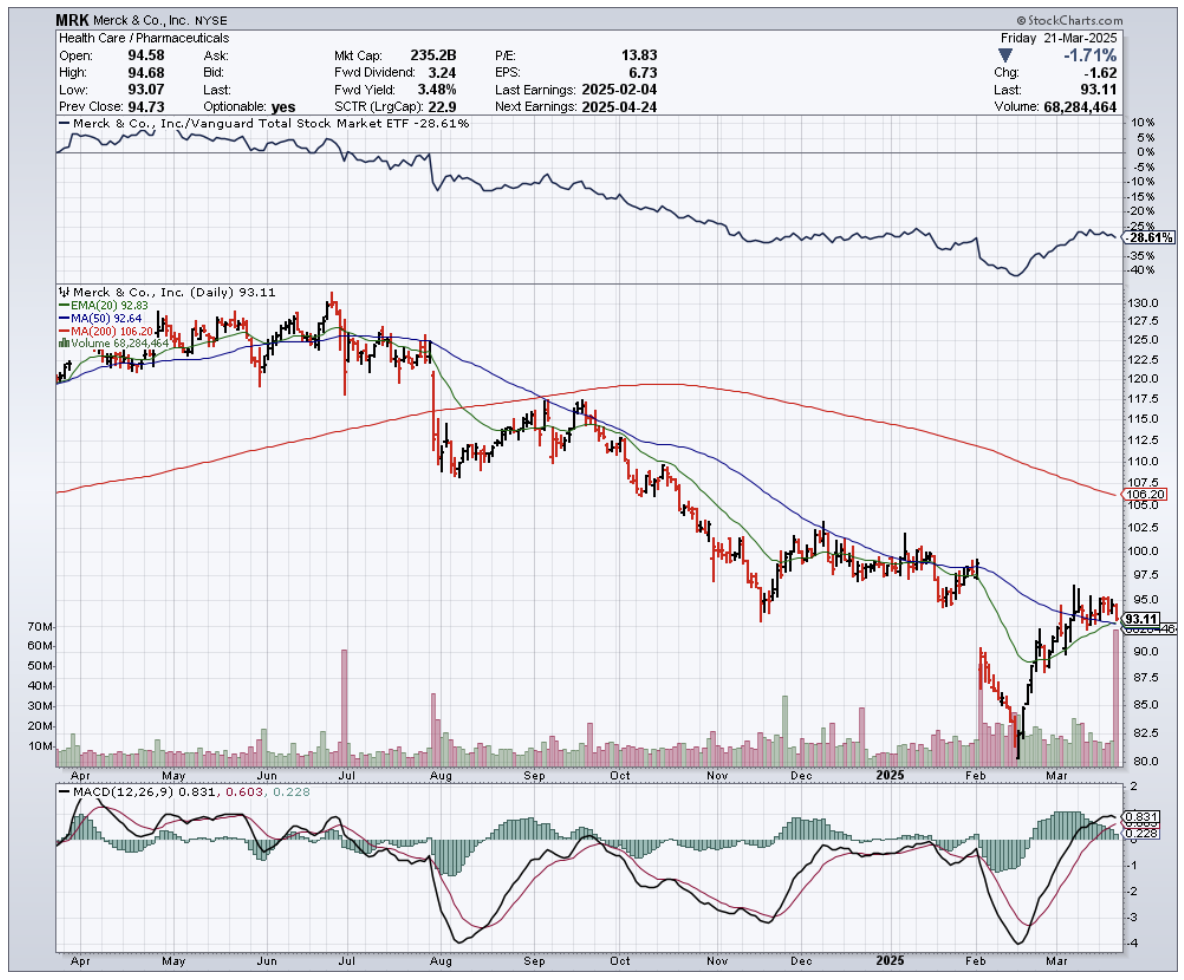
Merck posted Q4 2024 revenue of $17.76 billion, up 6.77% year-on-year. Its price-to-sales ratio sits at 3.74x—above the sector median, but still 14.7% cheaper than its own five-year average. It’s also beaten revenue expectations for 12 straight quarters. That’s not a hot streak. That’s clinical precision.

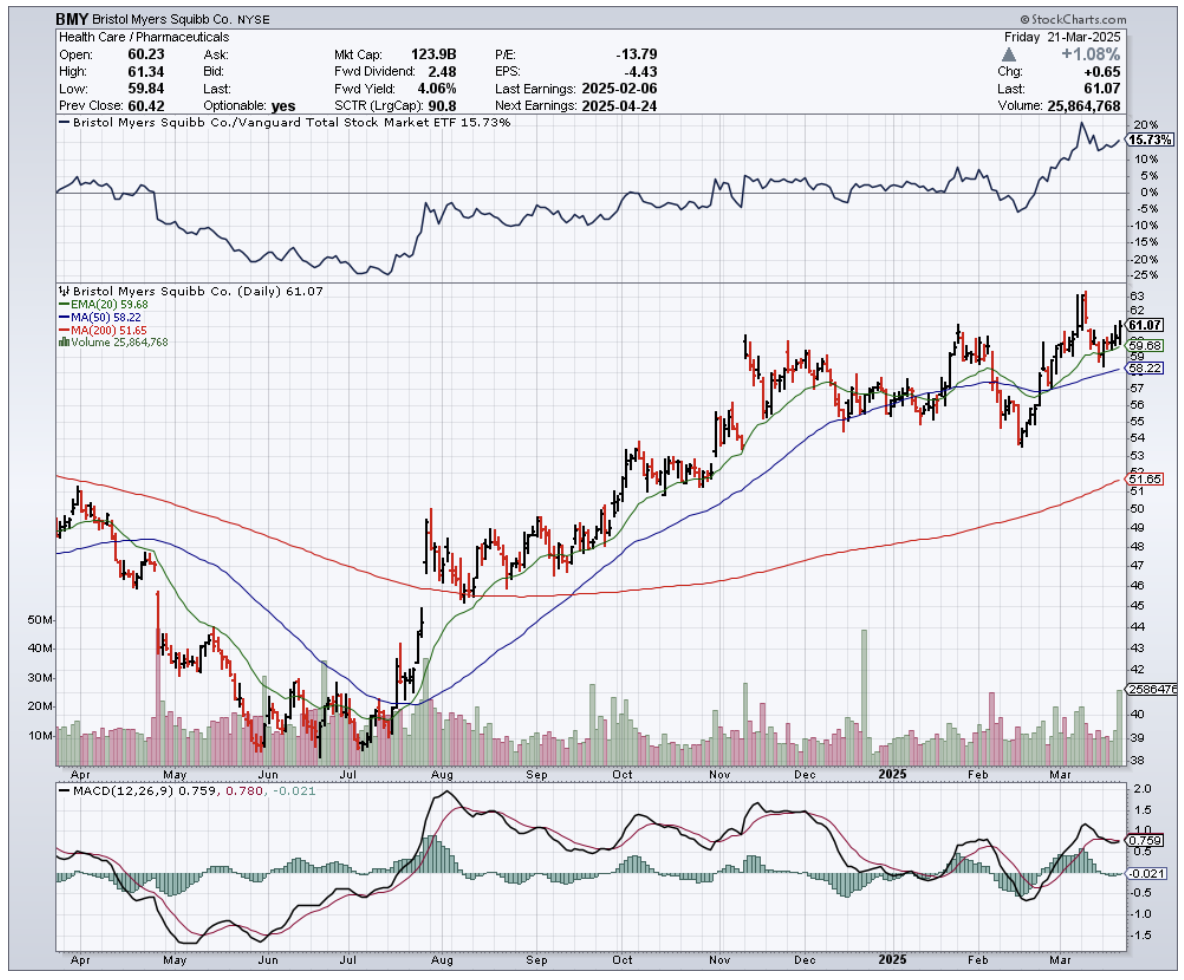
Bristol-Myers pulled in $12.34 billion last quarter with 7.5% YoY growth, but it trades at a much lower 2.51x P/S. That’s a discount—16.5% under the sector median. Ten out of twelve quarters beating the Street is nothing to sneeze at either. You get the sense both firms have their accounting departments on creatine.

Debt? Merck sits on $24.6 billion in net debt, but with a net debt/EBITDA ratio of 0.84x, it's practically sipping debt through a paper straw. Bristol-Myers, on the other hand, carries $40.1 billion with a 2.07x ratio. Still manageable, but not the kind of leverage that makes you sleep like a baby—unless you're the baby in question.

Dividends? Bristol-Myers pays more—4.14% vs. Merck’s 3.42%. That might earn it a second glance from income hawks, but when you zoom out, Merck still wears the financial crown.

Now here’s where things get messier.

Merck has a bit of a single-product addiction problem. Keytruda brought in $7.83 billion last quarter, making up a jaw-dropping 50.2% of total revenue. It's a blockbuster, yes, but when one drug makes up half your business, you start looking like a biotech version of Jenga. Merck’s top five products represent 75.7% of sales.

Bristol-Myers shows better balance. Eliquis is its biggest hitter, pulling in 25.9%, while its top five products account for 71.6% overall. Not exactly ironclad diversification, but a more even spread than Merck’s lineup.

Still, Keytruda is a monster. It outsold Bristol’s Opdivo by a whopping $5.4 billion in Q4 alone. That’s not a competition—that’s a beatdown. But both companies are running out the clock on their oncology flagships. Keytruda loses U.S. patent protection in 2028. Merck’s answer is a subcutaneous version—MK-3475A—patent-protected until 2039. Bristol’s already fired back with Opdivo Qvantig, a smart preemptive strike that could buy them time and market share.

Pipelines? Merck leads here too. BMY has 74 active R&D projects, 11 in Phase 3. Merck? Over 90 clinical-stage assets, 31 of them in Phase 3, and five are already under regulatory review. They’re not just defending Keytruda—they’re building the next dynasty.

Meanwhile, Bristol-Myers’ stock is flashing overbought signals like a Christmas tree. Merck, by contrast, trades below its VWAP, and Wall Street sees an 18.3% upside from here. Bristol-Myers? A yawn-worthy 1.36%. That's a rounding error, not an investment thesis.

Fast forward to 2029. I expect Merck to print a non-GAAP EPS of $11, led by Keytruda, Welireg, and a few wild cards currently in late-stage trials. Bristol-Myers might reach $6.80 EPS on $44 billion in revenue. Not bad, just... not Merck.

After sorting through this on the summit—between water breaks, altitude headaches, and one increasingly assertive marmot—the picture came into focus. Merck is the better long-term pick. They’ve got the product, the pipeline, the margin, and the momentum.

As I packed up and started the long descent, I dropped my guard for half a second and the marmot made his move—snatched my energy bar right off my pack. Bold little bastard. But honestly, he earned it.

Sometimes, the one who climbs higher sees further and waits patiently gets the prize. Merck just did all three.

After all, in investing—as in mountain climbing—peaks and profits favour those who don’t lose their breath or their nerve.


https://madhedgefundtrader.com/wp-content/uploads/2019/05/cropped-mad-hedge-logo-transparent-192x192_f9578834168ba24df3eb53916a12c882.png 0 0 april@madhedgefundtrader.com https://madhedgefundtrader.com/wp-content/uploads/2019/05/cropped-mad-hedge-logo-transparent-192x192_f9578834168ba24df3eb53916a12c882.png april@madhedgefundtrader.com2025-03-27 12:00:252025-03-27 12:35:42No Sherpa Required
april@madhedgefundtrader.com

March 25, 2025

Biotech Letter

Mad Hedge Biotech and Healthcare Letter
March 20, 2025
Fiat Lux


Featured Trade:

(WHEN SILENCE IS GOLDEN)

(ALNY), (PFE)

https://madhedgefundtrader.com/wp-content/uploads/2019/05/cropped-mad-hedge-logo-transparent-192x192_f9578834168ba24df3eb53916a12c882.png 0 0 april@madhedgefundtrader.com https://madhedgefundtrader.com/wp-content/uploads/2019/05/cropped-mad-hedge-logo-transparent-192x192_f9578834168ba24df3eb53916a12c882.png april@madhedgefundtrader.com2025-03-25 12:02:032025-03-25 12:15:30March 25, 2025
april@madhedgefundtrader.com

When Silence Is Golden

Biotech Letter

I was halfway through my morning coffee when my trader buddy in New York called me at some ungodly pre-market hour. He's one of those Wall Street guys who never sleeps and hasn't taken a real vacation since the Reagan administration.

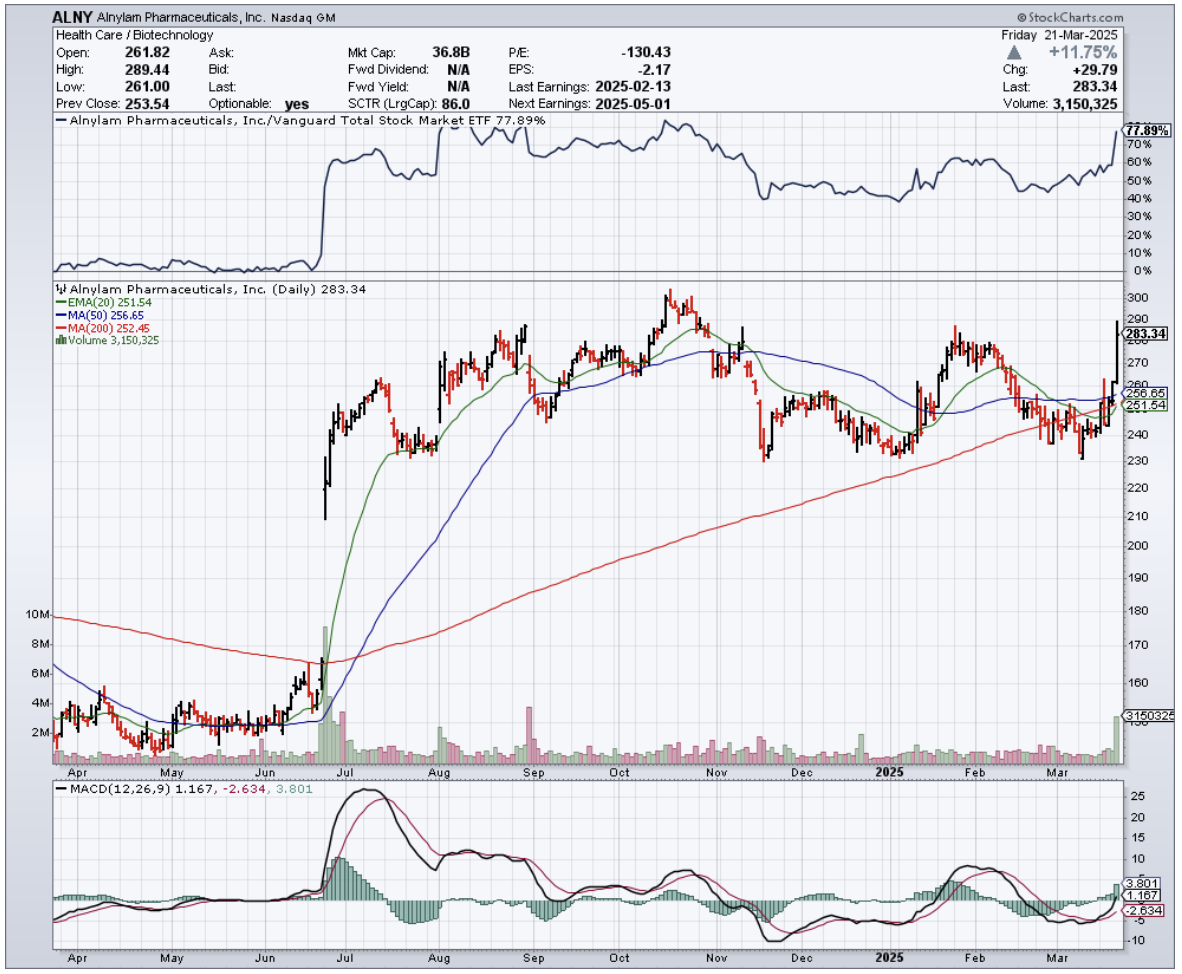
"So what's your take on Alnylam?" he barked, not bothering with pleasantries. "Stock's been trading sideways for months between $230-$300. I'm getting impatient."

I took another sip of my Kona blend, remembering why I left the trading floor years ago. "Let me guess – you're looking at your Bloomberg terminal right now instead of enjoying the sunrise?"

"Cut the Zen master crap, John. What's the play here?"

The reality is that Alnylam Pharmaceuticals (ALNY) just snagged FDA approval for Amvuttra in ATTR-CM, opening the door to potential revenue north of $6 billion. But my friend, like most traders, was looking for the angle that wasn't already priced in.

"You know," I said, "when I was a combat pilot, we had a saying: 'It's not the missile everyone sees coming that gets you.' The approval announced on March 20th was expected, sure. But the label is better than most anticipated – approved for both hereditary and wild-type ATTR-CM. It's the first drug green-lighted for both polyneuropathy and cardiomyopathy, with the latter being more common and potentially more lucrative."

The label includes language about reducing "cardiovascular mortality, cardiovascular hospitalizations, and urgent heart failure visits" – with that last bit about urgent heart failure visits exclusive to Amvuttra. Seems small, but in pharmaceutical marketing, these distinctions matter.

"So should I buy the stock or not?" he pressed, always impatient.

"Here's what the Wall Street research notes won't tell you," I continued. "The HELIOS-B clinical study was a home run. Amvuttra will eventually muscle its way into front-line treatment, but initially, expect it to grab the 30% of ATTR-CM patients who deteriorate on Pfizer's (PFE) tafamidis or BridgeBio's (BBIO) acoramidis. Those are the 'stabilizers,' while Amvuttra is a 'silencer' – and in this case, silence is golden."

I could hear him typing furiously. "What about patient switchovers from stabilizers?" he asked.

"Doctors hate changing treatments that work, even if something better comes along. It's like trying to convince an old trader to use an app instead of calling his broker – not happening unless there's overwhelming evidence. But there's another angle – Amvuttra requires only four injections yearly versus daily pills. Plus, it's covered under Medicare Part B with zero copays, while the others fall under Part D. When patients realize they can save thousands in out-of-pocket costs, watch what happens."

Management is sticking with their hefty list price of $476,000 per year, though the real-world price after rebates and discounts will be lower. Given the clinical data and market dynamics, I'm convinced this indication alone is worth $6+ billion to Alnylam, with an upside to $7-8 billion if their newest compound, nucresiran, maintains efficacy with twice-yearly dosing.

"Fine, but is this a one-hit wonder or do they have more in the pipeline?" he pressed.

"Their R&D engine is firing on all cylinders. They've expanded beyond the liver to target neurodegenerative and ocular diseases, with plans to cover all major tissue types by 2030. Their batting average is impressive – three self-commercialized drugs, one partnered drug on the market, and another likely approval coming soon via Sanofi (SNY). That's the kind of success rate that makes venture capitalists weak in the knees."

I won't sugarcoat it though – currently, about 75% of their revenue comes from the TTR franchise, with Givlaari and Oxlumo making up the rest. Diversification is coming, but it's not an overnight process.

Keep your eye on zilebesiran, their antihypertensive being developed with Roche (RHHBY). Early results look promising, with KARDIA-3 results due later this year. It won't move the revenue needle immediately, but could eventually contribute significantly.

There's also mivelsiran for cerebral amyloid angiopathy and Alzheimer's – still in Phase II but potentially worth billions if successful. Not to mention early-stage programs targeting Huntington's, bleeding disorders, diabetes, obesity, and AMD. The pipeline is loaded like a billionaire's stock portfolio.

"Bottom line it for me, John. I've got a morning call in five minutes."

"Management's guiding for 30% product sales growth in 2025, mostly from Amvuttra in ATTR-CM. Their forecasts tend to be conservative but achievable – not the pie-in-the-sky numbers you get from pre-revenue biotechs promising to cure cancer with fairy dust."

In my model, the TTR franchise contributes about $202 per share to my $312 fair value estimate. Zilebesiran adds roughly $35, with an upside beyond $50 if clinical data continues to impress.

Admittedly, a 10% upside isn't the sexiest call for a biotech stock. But after watching thousands of companies come and go during my decades on Wall Street, I've learned to appreciate the rare combination of proven technology, commercial products, and pipeline depth that Alnylam offers.

"So you're saying buy?" he asked, clearly rushing now.

"I'm saying Alnylam isn't the stock you brag about at cocktail parties, but it might just be the one that pays for your kid's college education. Speaking of which, when was the last time you saw your children?"

He hung up without answering. Some things never change on Wall Street.


https://madhedgefundtrader.com/wp-content/uploads/2019/05/cropped-mad-hedge-logo-transparent-192x192_f9578834168ba24df3eb53916a12c882.png 0 0 april@madhedgefundtrader.com https://madhedgefundtrader.com/wp-content/uploads/2019/05/cropped-mad-hedge-logo-transparent-192x192_f9578834168ba24df3eb53916a12c882.png april@madhedgefundtrader.com2025-03-25 12:00:372025-03-25 11:59:00When Silence Is Golden
april@madhedgefundtrader.com

March 20, 2025

Biotech Letter

Mad Hedge Biotech and Healthcare Letter
March 20, 2025
Fiat Lux


Featured Trade:

(EVEN A PIG COULD MAKE MONEY HERE)

(OGN), (MRK), (RHHBY), (BAYRY), (PFE), (AZN)

https://madhedgefundtrader.com/wp-content/uploads/2019/05/cropped-mad-hedge-logo-transparent-192x192_f9578834168ba24df3eb53916a12c882.png 0 0 april@madhedgefundtrader.com https://madhedgefundtrader.com/wp-content/uploads/2019/05/cropped-mad-hedge-logo-transparent-192x192_f9578834168ba24df3eb53916a12c882.png april@madhedgefundtrader.com2025-03-20 12:02:422025-03-21 09:02:18March 20, 2025
april@madhedgefundtrader.com

Even A Pig Could Make Money Here

Biotech Letter

I was camped out in Kyiv the other month when news of Organon's (OGN) earnings hit my phone.

While Russian drones buzzed overhead, I was studying pharmaceutical balance sheets—talk about surreal. Did I mention I've led a strange life?

In mid-February, Organon pleasantly surprised me with Q4 2024 results. Hadlima, their biosimilar to Humira, rocketed to $44 million in quarterly sales, up 83.3% year-on-year.

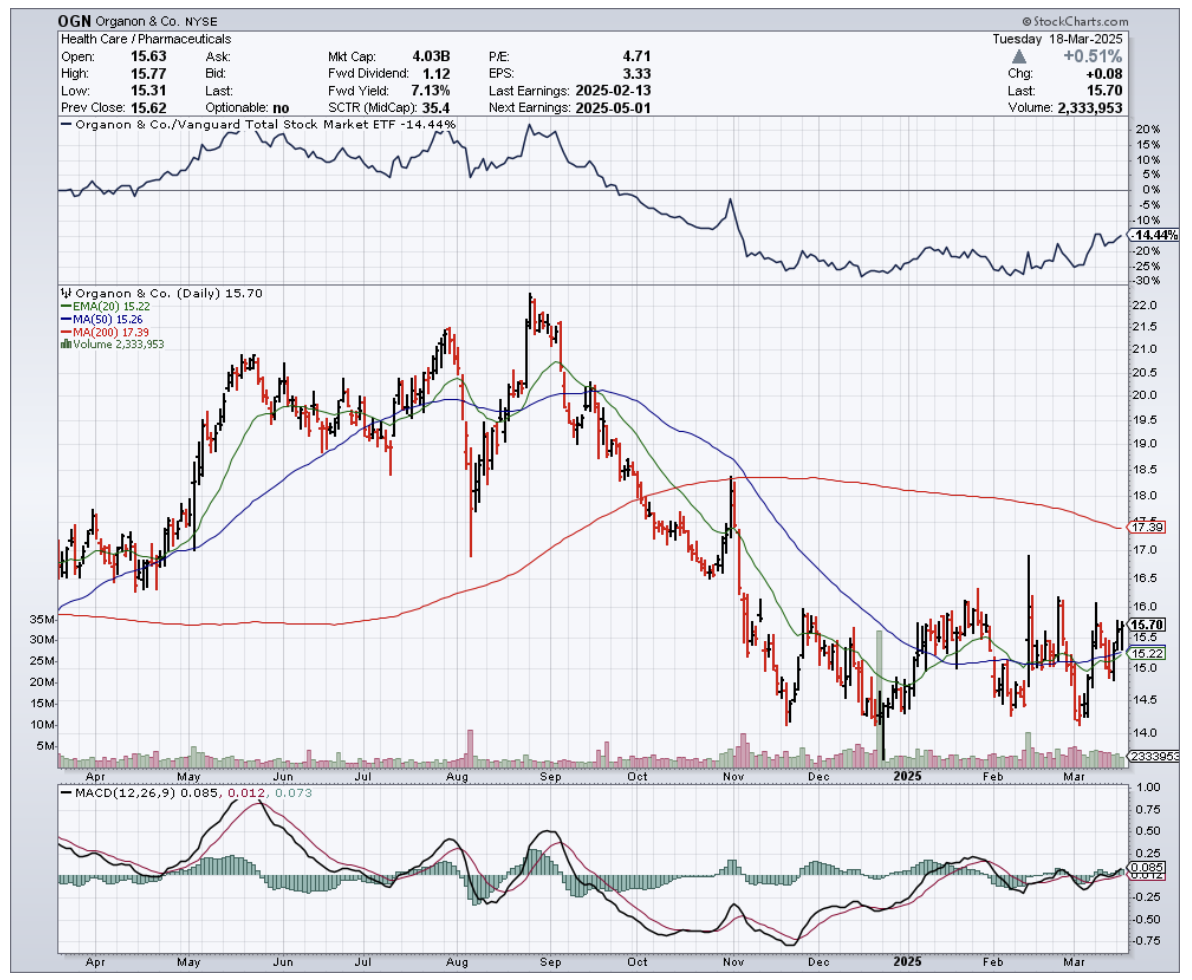
Meanwhile, Organon's dividend yield sits at a whopping 7.32%, blowing away the healthcare sector average.

Let me be blunt: this is an income investor's dream hiding in plain sight.

Organon emerged in 2021 when Merck (MRK) spun off its women's health, biosimilars, and off-patent drugs businesses. This allowed Merck to focus on its immunology and oncology pipeline while Organon became a pure-play commercial entity.

These spinoffs often create enormous value that the market misses in the early years.

Organon's share price has been trading sideways since early 2025 despite several wins: commercializing Hadlima, acquiring Dermavant, and maintaining a 23% operating margin even as some medications face generic competition.

The market clearly isn't paying attention. When stocks with this kind of dividend yield maintain solid margins, my antennae start twitching.

Their recent Phase 3 ADORING 3 study showed that even 79.8 days after stopping Vtama treatment, atopic dermatitis remained mild. That's patient retention gold, folks.

When patients can stop medication and still see benefits almost three months later, that's the kind of sticky customer base pharmaceutical execs dream about.

Revenue hit $1.59 billion in Q4 2024, down just 0.63% year-over-year but up 0.63% quarter-over-quarter.

Renflexis sales reached $64 million, down 16.9% due to competition from other Remicade biosimilars and superior new medications like AbbVie's (ABBV) Skyrizi.

But here's where things get interesting—this sales decline was expected and already priced in. Organon isn't being valued in Renflexis's future.

The real stars? Nexplanon and Vtama. Nexplanon sales reached $258 million in Q4, up 11.7% year-on-year.

Even better, its patent protection runs until August 2030. CEO Kevin Ali expects it to "comfortably get beyond $1 billion in 2025."

When a CEO uses words like "comfortably" about billion-dollar projections, I tend to listen.

Vtama, acquired in the $1.2 billion Dermavant purchase, brought in $12 million in partial Q4 sales.

The FDA expanded its label in December 2024 to include atopic dermatitis in patients over age 2—a condition affecting 31.6 million Americans. This approval significantly expands its market potential.

Remember, blockbuster drugs don't announce themselves with trumpets—they sneak up on you through expanded indications and growing prescriber bases.

Now, many folks will point to Organon's debt—$8.36 billion at 2024's end. But that's lazy analysis.

Look deeper and you'll see its net debt/EBITDA ratio improved from 5.01x to 4.74x over 12 months. They're steadily strengthening their financial position.

I've watched this happen before with pharma spin-offs—initial debt concerns gradually fade as strong cash flows tackle the balance sheet.

Management knows what they're doing. For 2025, they forecast a slight revenue dip but improved EBITDA margins of 31-32%, outperforming competitors like Perrigo, Alvotech, and Amneal.

In the broader pharmaceutical landscape, Organon competes with heavyweights like Roche (RHHBY), Ferring Pharmaceuticals, Bayer (BAYRY), Pfizer (PFE), and AstraZeneca (AZN)—but with a more specialized focus that gives them maneuverability these giants lack.

Wall Street's average price target is $20.50, suggesting a 33.9% upside. When was the last time you saw a 7.32% dividend yield with 33.9% upside potential?

I project non-GAAP EPS to reach $4.52 by 2029, slightly above analyst estimates, driven by Hadlima, Nexplanon, and Vtama growth, plus upcoming biosimilars HLX14 and HLX11. My friends at major healthcare funds are starting to take notice, but the broader market hasn't caught on yet.

At $15.31 per share, Organon trades at a non-GAAP P/E of 3.39x—80.8% below the sector median and 25.7% below its 5-year average. That's not just cheap—that's backing up the truck cheap.

You know what they say about bears and bulls making money, while pigs get slaughtered? Well, at these valuations, even a pig could make money on Organon.


https://madhedgefundtrader.com/wp-content/uploads/2019/05/cropped-mad-hedge-logo-transparent-192x192_f9578834168ba24df3eb53916a12c882.png 0 0 april@madhedgefundtrader.com https://madhedgefundtrader.com/wp-content/uploads/2019/05/cropped-mad-hedge-logo-transparent-192x192_f9578834168ba24df3eb53916a12c882.png april@madhedgefundtrader.com2025-03-20 12:00:112025-03-20 11:51:38Even A Pig Could Make Money Here
april@madhedgefundtrader.com

March 18, 2025

Biotech Letter

Mad Hedge Biotech and Healthcare Letter
March 18, 2025
Fiat Lux


Featured Trade:

(WHEN THE MARKET GIVES BACK WHAT IT ONCE TOOK AWAY)

(ABT), (ISRG), (SYK), (BSX)

https://madhedgefundtrader.com/wp-content/uploads/2019/05/cropped-mad-hedge-logo-transparent-192x192_f9578834168ba24df3eb53916a12c882.png 0 0 april@madhedgefundtrader.com https://madhedgefundtrader.com/wp-content/uploads/2019/05/cropped-mad-hedge-logo-transparent-192x192_f9578834168ba24df3eb53916a12c882.png april@madhedgefundtrader.com2025-03-18 12:02:042025-03-18 12:21:14March 18, 2025
april@madhedgefundtrader.com

When The Market Gives Back What It Once Took Away

Biotech Letter

If Wall Street had a confessional booth, I'd be first in line. "Forgive me, market gods, for I underestimated how quickly sentiment could shift."

When I last wrote about Abbott Laboratories (ABT), the market was treating this medical device powerhouse like last week's leftovers—despite growth that would make most CEOs weep with joy.

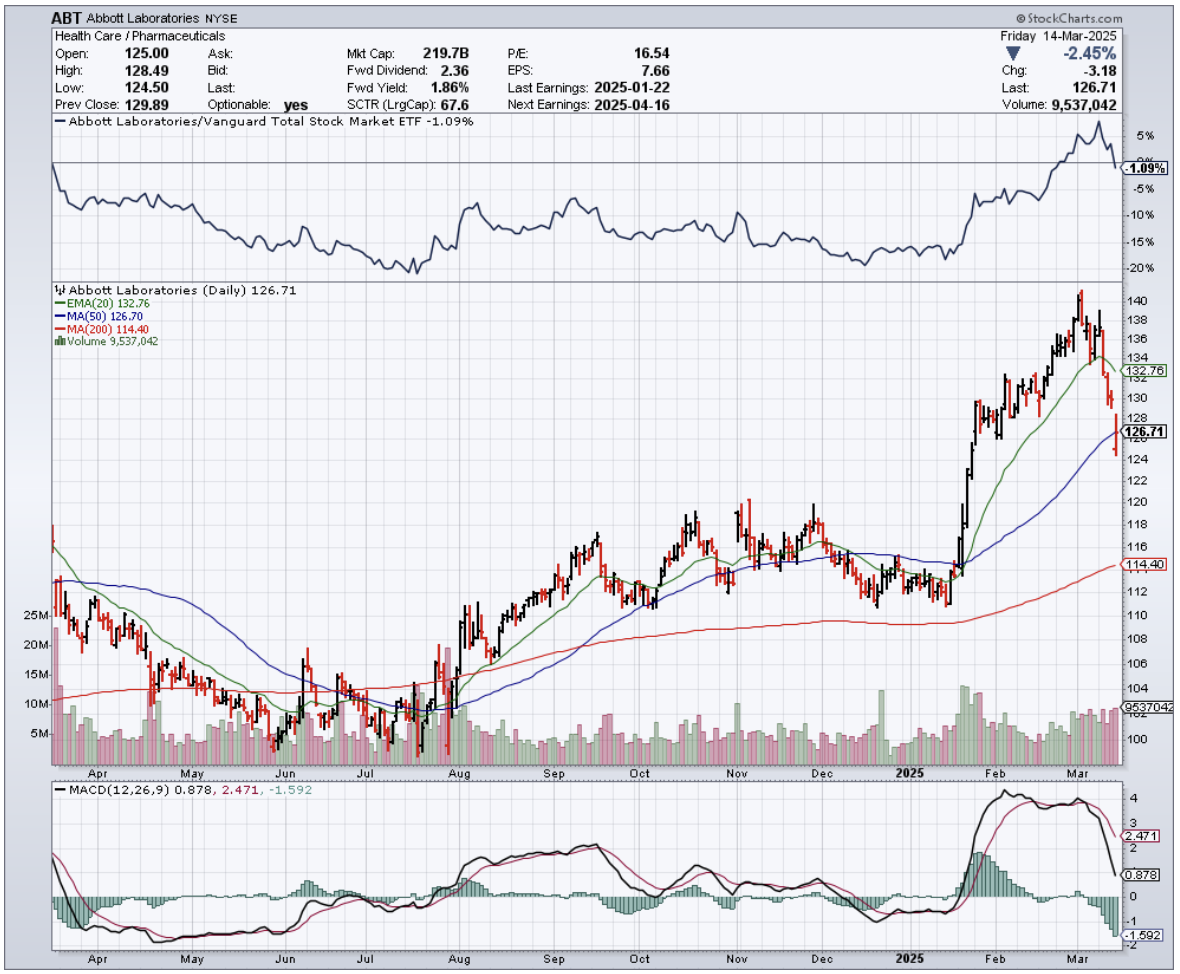
Fast forward a few months, and Abbott's stock has rocketed 25%, outpacing the broader medical device sector by about 20%.

It has kept stride with Boston Scientific (BSX) while leaving Intuitive Surgical (ISRG) and Stryker (SYK) eating dust.

This kind of market whiplash reminds me of reporting from Tokyo trading floors in the 1980s—fortunes changing direction faster than a day trader after espresso, fundamentals barely shifting while sentiment performed aerial gymnastics.

So what changed? Abbott became a flight-to-safety darling.

While economic storms gather, it sits comfortably in its non-elective procedure fortress, with minimal tariff exposure and a recent legal victory reducing liability concerns.

The irony? Sentiment has now sprinted ahead of business performance. While Abbott remains a leader, its valuation leaves little room for missteps.

And if I'm overpaying for med-tech, I might as well reach for Boston Scientific instead, where growth is comparable but the valuation looks more reasonable.

Abbott’s fourth-quarter results weren’t showstopping, but they were reassuring.

Revenue landed slightly below expectations in some areas, but crucial segments—like Medical Devices—delivered strong results. Meanwhile, profit margins surprised pleasantly, reinforcing Abbott’s operational strength.

Overall revenue grew 9% organically, with Medical Devices leading at 14% growth.

The Diagnostics division posted just 1% growth, but that’s misleading—strip out COVID-19 testing effects, and underlying growth jumps to 6%.

Margins impressed, too. Gross margin improved to 56.9%, and adjusted operating income climbed 10%.

Abbott even managed a narrow revenue beat while missing slightly on EBITDA and free cash flow, largely due to tax timing that caught most analysts off guard.

I've spent decades analyzing companies across multiple sectors, and I can tell you Abbott’s medical device business deserves genuine admiration.

It maintained 14% growth from start to finish—a remarkable consistency while competitors slowed from 9.5% to 9.2% growth during the same period.

Looking at the fourth-quarter specifics, Structural Heart shone with 23% growth, outpacing Boston Scientific’s 20% and Medtronic’s 12%.

The Diabetes segment posted an impressive 20% growth, more than doubling DexCom’s 8%. Even in slower segments like Cardiac Rhythm (7%) and Neuromodulation (8%), Abbott still outperformed key competitors.

The bottom line: Abbott is executing at an exceptional level across its device portfolio.

Even its Diagnostics business, with 6% underlying growth, holds up well against Roche’s 8% and substantially outperforms Siemens Healthineers’ anemic sub-1% and Danaher’s 2% contraction.

There are three developments that investors should be paying attention to.

First, Abbott’s exposure to new tariffs is minimal—just 5% of COGS from Mexico and 1% from China. This translates to a low single-digit EPS impact, barely a rounding error in today’s environment.

Second, TriClip may have more growth potential than I previously thought. Recent data from Edwards Lifesciences’ (EW) competing Evoque device showed no mortality benefit and only modest hospitalization improvements.

This lets Abbott position TriClip as the safer approach without sacrificing quality-of-life benefits.

Third—and most significant—Abbott won a crucial legal victory in October regarding its infant formula.

A jury unanimously found the company not at fault in a necrotizing enterocolitis case, though the judge recently granted a new trial.

With 10,000 cases still pending, this development could strengthen Abbott’s settlement position and potentially cap damages below $1 billion—substantial but manageable.

I expect slight moderation next year, but Abbott should still deliver 7% growth over the next three to five years.

Newer products like Lingo (blood glucose monitoring for non-diabetics) are performing well, with significant potential in Amulet and upcoming PFA and lithotripsy offerings.

On margins, I expect EBITDA to climb above 28% within four years, with free cash flow margins reaching high-teens to low-20%.

This should drive high single-digit to low double-digit FCF growth—performance that typically earns management teams effusive praise.

Valuation, however, is challenging after the recent surge. My former 5x revenue multiple only gets to around $125, while a more aggressive 6x model approaches $150—making me about as comfortable as a cat in a dog show.

I’m surprised by how quickly sentiment shifted on Abbott, likely due to investors seeking safety amid economic uncertainty.

Whether this outperformance has staying power remains uncertain, but Abbott is certainly delivering growth that matches or exceeds competitors across most business lines.

For now, I'm watching Abbott with the same fascination I once had for Sierra mountain expeditions—impressed by the ascent but keenly aware that the air gets thinner the higher you climb.

After all, what's that old market adage? Oh right—the view is spectacular, but nobody rings a bell at the top.


https://madhedgefundtrader.com/wp-content/uploads/2019/05/cropped-mad-hedge-logo-transparent-192x192_f9578834168ba24df3eb53916a12c882.png 0 0 april@madhedgefundtrader.com https://madhedgefundtrader.com/wp-content/uploads/2019/05/cropped-mad-hedge-logo-transparent-192x192_f9578834168ba24df3eb53916a12c882.png april@madhedgefundtrader.com2025-03-18 12:00:502025-03-18 12:20:48When The Market Gives Back What It Once Took Away
april@madhedgefundtrader.com

March 13, 2025

Biotech Letter

Mad Hedge Biotech and Healthcare Letter
March 13, 2025
Fiat Lux


Featured Trade:

(THE 10,000 DAILY CONSULTATIONS YOU'LL NEVER SEE)

(HIMS), (TDOC), (GDRX), (NVO), (LLY)

https://madhedgefundtrader.com/wp-content/uploads/2019/05/cropped-mad-hedge-logo-transparent-192x192_f9578834168ba24df3eb53916a12c882.png 0 0 april@madhedgefundtrader.com https://madhedgefundtrader.com/wp-content/uploads/2019/05/cropped-mad-hedge-logo-transparent-192x192_f9578834168ba24df3eb53916a12c882.png april@madhedgefundtrader.com2025-03-13 12:02:022025-03-13 12:52:51March 13, 2025
Page 4 of 115«‹23456›»

Legal Disclaimer

There is a very high degree of risk involved in trading. Past results are not indicative of future returns. MadHedgeFundTrader.com and all individuals affiliated with this site assume no responsibilities for your trading and investment results. The indicators, strategies, columns, articles and all other features are for educational purposes only and should not be construed as investment advice. Information for futures trading observations are obtained from sources believed to be reliable, but we do not warrant its completeness or accuracy, or warrant any results from the use of the information. Your use of the trading observations is entirely at your own risk and it is your sole responsibility to evaluate the accuracy, completeness and usefulness of the information. You must assess the risk of any trade with your broker and make your own independent decisions regarding any securities mentioned herein. Affiliates of MadHedgeFundTrader.com may have a position or effect transactions in the securities described herein (or options thereon) and/or otherwise employ trading strategies that may be consistent or inconsistent with the provided strategies.

Copyright © 2026. Mad Hedge Fund Trader. All Rights Reserved. support@madhedgefundtrader.com
Scroll to top