• support@madhedgefundtrader.com
  • Member Login
Mad Hedge Fund Trader
  • Home
  • About
  • Store
  • Luncheons
  • Testimonials
  • Contact Us
  • Click to open the search input field Click to open the search input field Search
  • Menu Menu
april@madhedgefundtrader.com

The 10,000 Daily Consultations You'll Never See

Biotech Letter

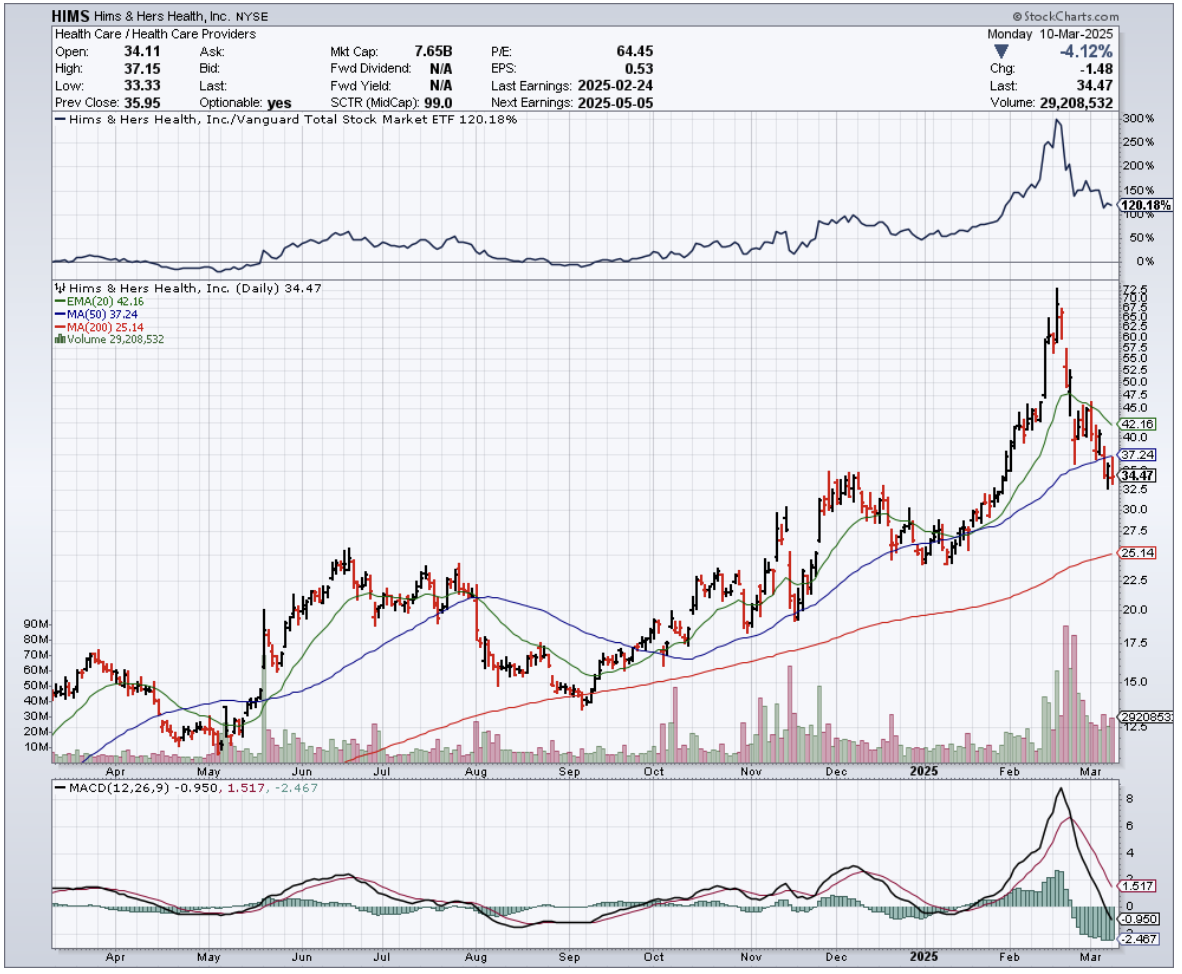
Did you know that 100 years ago, the average American lifespan was just 54 years? Today, we're approaching 80.

But what's truly remarkable isn't just that we're living longer—it's that a 36-year-old former Tinder executive named Andrew Dudum is revolutionizing how we access healthcare.

His company, Hims & Hers (HIMS), has exploded from a niche men's health startup into a $1.5 billion healthcare powerhouse in just a few years.

What exactly does HIMS do?

HIMS is transforming healthcare with a tech-first approach. They began by solving embarrassing men's health problems like ED and hair loss through an online platform, but have since built a vertically integrated healthcare powerhouse.

Now they handle everything from virtual doctor's visits and AI-powered diagnostics to personalized medication compounding and doorstep delivery.

All without the patient ever leaving their couch or explaining their problems to three different receptionists. It's healthcare reimagined for the digital age—and patients are flocking to it.

The numbers don't lie. By the end of 2024, they hit 10,000 patient visits per day - that's more than some mid-sized hospitals.

Their subscriber base swelled to 2.2 million, up 45% year-over-year. Even more impressive is that 55% of those subscribers are using at least one personalized solution, not just generic treatments.

What makes HIMS so disruptive is their mastery of the tech playbook that Wall Street has been drooling over for years. They're capturing data at every patient touchpoint and have built one of healthcare's largest proprietary datasets.

My sources tell me they've got over 500,000 square feet of compounding pharmacies and fulfillment centers spread across Ohio, Arizona, and California. These aren't your father's drugstores.

Unlike Teladoc (TDOC) and GoodRx (GDRX), who dabble in AI for basic tasks, HIMS goes much deeper.

They're personalizing treatments, fine-tuning dosages, improving adherence, and creating custom supplement plans. Their AI chatbots handle everything from prescription refills to progress tracking.

I met a guy last week who manages a tech fund in Boston who put it best: "Each new subscriber makes their entire system smarter." That's a competitive moat that gets wider by the day.

Revenue has followed this growth trajectory like a heat-seeking missile. In 2024, the company raked in $1.5 billion, a staggering 69% increase year-over-year. Their Q4 revenue hit $481 million, nearly doubling with a 95% year-over-year increase.

But here's where it gets even more interesting. Their weight loss treatments have been absolute rocket fuel for growth.

Their oral-based offering reached a $100 million revenue run rate within just seven months of launch. And their GLP-1 offering (launched in Q2-24) generated more than $225 million in incremental revenue during 2024 alone.

My friend Janet at the Fed would be impressed by their margins, too.

Adjusted EBITDA margins reached 12% in 2024, with adjusted EBITDA increasing by 160% year-over-year to $54 million in Q4.

They hit their first full year of GAAP profitability with net income of $126 million and strong cash flow of approximately $200 million. That's what I call a healthy business.

But here's the rub. HIMS is betting big—perhaps too big—on weight loss treatments.

They generated $225 million from GLP-1 offerings in 2024 and project $725 million in 2025. That's a massive chunk of revenue hanging on one specialty.

The FDA isn't thrilled about compounded semaglutide, which HIMS relies on. If regulators clamp down, they're in trouble.

Worse, supply is controlled by Novo Nordisk (NVO) and Eli Lilly (LLY), creating a precarious position for HIMS. If insurance coverage expands for branded GLP-1s, patients might flee HIMS' alternatives.

They're trying to pivot to oral therapies and AI coaching, but it's a high-stakes gamble. As my hedge fund buddies would say, that's a lot of eggs in one regulatory basket.

So, what about valuation? There's no getting around it—HIMS is trading at premium multiples: 3.76x forward EV/Sales versus the sector median of 3.19x, an EV/EBITDA of 29.69x compared to 12.12x, and a sky-high forward P/E of 65.96x against the sector's more modest 25.46x.

When you stack it up against competitors, the gap grows even wider. HIMS' forward P/E makes GoodRx (29.65x) seem downright affordable, and its EV/Sales ratio towers over both Teladoc (0.74x) and GoodRx (2.42x).

Is that premium justified? With revenue growth cruising at 69%, there's a case to be made—but investors should be cautious. I've watched this story unfold countless times: today's darling of Wall Street can easily turn into tomorrow's cautionary tale.

Still, for those with a strong stomach and the patience to see this through, HIMS is definitely worth a closer look. After all, we're witnessing one of the most significant transformations in healthcare in over a century.

Just think about it – In 1924, Americans relied on house calls and patent medicines. Today, personalized treatments arrive at our doorsteps after a five-minute video chat.

And the company leading this healthcare revolution? Founded by a guy who used to help people swipe right on Tinder.

From patent tonics to AI-prescribed pharmaceuticals in a century. Seems our approach to awkward health problems has evolved even faster than our lifespans.

Who knew swiping right would someday fix more than just your dating life?
 

https://madhedgefundtrader.com/wp-content/uploads/2019/05/cropped-mad-hedge-logo-transparent-192x192_f9578834168ba24df3eb53916a12c882.png 0 0 april@madhedgefundtrader.com https://madhedgefundtrader.com/wp-content/uploads/2019/05/cropped-mad-hedge-logo-transparent-192x192_f9578834168ba24df3eb53916a12c882.png april@madhedgefundtrader.com2025-03-13 12:00:162025-03-13 12:52:37The 10,000 Daily Consultations You'll Never See
april@madhedgefundtrader.com

March 11, 2025

Biotech Letter

Mad Hedge Biotech and Healthcare Letter
March 11, 2025
Fiat Lux


Featured Trade:

(WHEN INSIDERS GO SHOPPING, PAY ATTENTION)

(MRNA), (MRK)

https://madhedgefundtrader.com/wp-content/uploads/2019/05/cropped-mad-hedge-logo-transparent-192x192_f9578834168ba24df3eb53916a12c882.png 0 0 april@madhedgefundtrader.com https://madhedgefundtrader.com/wp-content/uploads/2019/05/cropped-mad-hedge-logo-transparent-192x192_f9578834168ba24df3eb53916a12c882.png april@madhedgefundtrader.com2025-03-11 12:02:452025-03-11 12:42:39March 11, 2025
april@madhedgefundtrader.com

When Insiders Go Shopping, Pay Attention

Biotech Letter

In 1815, Nathan Rothschild made his legendary fortune buying British securities when they were deeply discounted after Waterloo. “Buy when there's blood in the streets,” he allegedly said. That kind of contrarian wisdom has made fortunes across centuries.

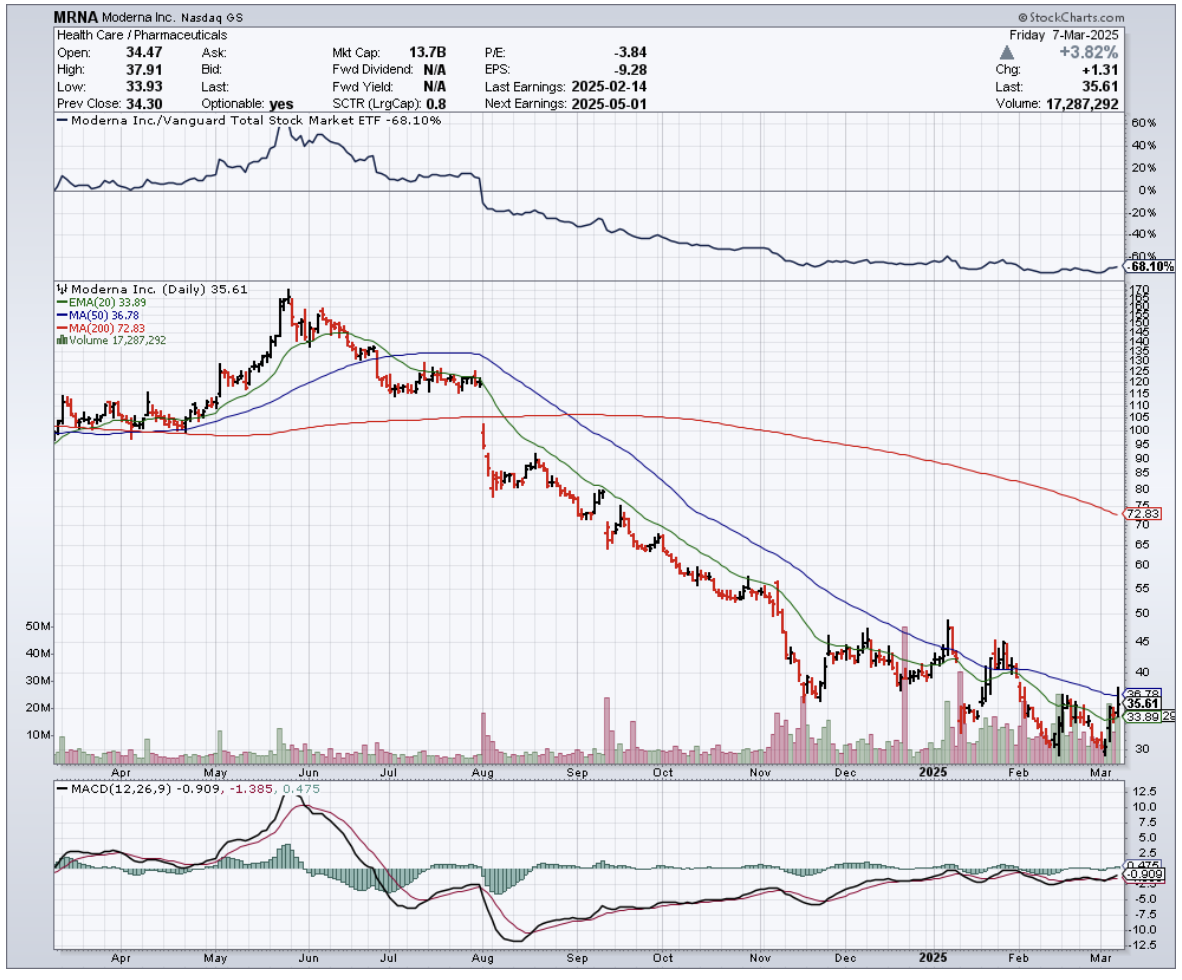
Two centuries later, I find myself applying this timeless principle to Moderna (MRNA). The biotech darling has shed over 90% of its value since the pandemic peak, plummeting from $400+ to under $30. And now, insiders are quietly loading up.

The shift in insider activity at Moderna has been striking. Over the past year, insiders unloaded more than 602,000 shares, with the heaviest selling in 2024 when the stock was trading above $120.

One director alone offloaded 202,832 shares in a single transaction, pocketing $30 million. But as Moderna’s share price took a nosedive, insider selling slowed to a trickle. By the time the stock fell below $100, most trades involved fewer than 1,000 shares.

Then, on March 3, the narrative took a dramatic turn: two insiders — including CEO Stéphane Bancel — scooped up nearly 200,000 shares, investing about $6 million. Bancel accounted for $5 million of that sum.

This move is telling. Bancel already controls over 21 million shares. You don’t drop another $5 million into a stock unless you believe you're buying Manhattan for beads and trinkets. The contrast is stark: when prices were high, executives couldn’t sell fast enough. Now, they’re buying.

The timing of these insider purchases is even more intriguing. Moderna had just slashed its 2025 revenue target by $1 billion, bringing guidance down to $2.5 to $3.5 billion. Yet, insiders chose that precise moment to buy, signaling confidence that sales will bottom out this year.

The company's drug pipeline isn't barren, either. Ten drugs are expected to receive FDA approvals by 2027, including a skin cancer vaccine developed with Merck (MRK) slated for a 2027 launch, pending Phase 3 data.

These ten anticipated drugs collectively target a market exceeding $30 billion, with analysts projecting Moderna's revenue to climb to $3.3 billion in 2027 and $4.77 billion by 2028.

On their Q4 '24 earnings call, President Stephen Hoge underscored the cancer vaccine’s potential: "As for INT, obviously, we're all looking forward to the melanoma -- adjuvant melanoma Phase 3 readout. As you know, and as I mentioned, there are additional Phase 3s as well as two randomized Phase 2s, including bladder cancer, renal cell carcinoma, which, depending on the rate of approval of events, could have readouts that we would be updating on as well in the coming years."

Still, the road ahead isn’t without challenges. Moderna expects to burn up to $3.5 billion in cash during 2025, reducing its cash position to $6 billion. Estimated cash costs for 2025 stand at $5.5 billion, projected to decline to $5 billion in 2026.

To reach breakeven by 2028, the company needs to generate $6+ billion in sales at 80% gross margins or implement further cost-cutting measures.

Despite these financial hurdles, Moderna's market cap is a mere $14 billion — practically pocket change for a company with multiple promising vaccine candidates.

There's undeniable risk in buying Moderna at these levels, but historically, the most profitable investments come before the financials improve. The company has effectively announced that its numbers will likely deteriorate further before rebounding — and yet, insiders are still buying.

Speaking of gathering valuable insights from industry leaders, I’ve been preparing for our Mad Hedge Traders & Investors Summit on March 11-13.

After decades in the markets, I’ve learned there’s something uniquely valuable about getting multiple perspectives in one place. It reminds me of my time in Tokyo during the '70s, where real opportunities often emerged from late-night conversations between veteran traders.

Even in today’s volatile environment, the wisdom of those who’ve navigated every market cycle remains invaluable.

In the end, Moderna presents a textbook contrarian opportunity. The stock is deeply out of favor, yet insider buying suggests a potential shift in sentiment as shares hover around $30.

The real question isn’t whether Moderna will recover but whether investors have the stomach to buy when others are still heading for the exits.

As for me, I’m keeping Moderna firmly on my watchlist, right next to my dog-eared copy of "Extraordinary Popular Delusions and the Madness of Crowds."

Some things never change.


https://madhedgefundtrader.com/wp-content/uploads/2019/05/cropped-mad-hedge-logo-transparent-192x192_f9578834168ba24df3eb53916a12c882.png 0 0 april@madhedgefundtrader.com https://madhedgefundtrader.com/wp-content/uploads/2019/05/cropped-mad-hedge-logo-transparent-192x192_f9578834168ba24df3eb53916a12c882.png april@madhedgefundtrader.com2025-03-11 12:00:022025-03-11 12:42:49When Insiders Go Shopping, Pay Attention
april@madhedgefundtrader.com

March 6, 2025

Biotech Letter

Mad Hedge Biotech and Healthcare Letter
March 6, 2025
Fiat Lux


Featured Trade:

(THE DANISH DILEMMA)

(LLY), (NVO)

https://madhedgefundtrader.com/wp-content/uploads/2019/05/cropped-mad-hedge-logo-transparent-192x192_f9578834168ba24df3eb53916a12c882.png 0 0 april@madhedgefundtrader.com https://madhedgefundtrader.com/wp-content/uploads/2019/05/cropped-mad-hedge-logo-transparent-192x192_f9578834168ba24df3eb53916a12c882.png april@madhedgefundtrader.com2025-03-06 12:02:592025-03-06 12:20:32March 6, 2025
april@madhedgefundtrader.com

The Danish Dilemma

Biotech Letter

I was having dinner with a group of Mad Hedge Fund Trader readers in Salt Lake City the other week.

One, a successful financial advisor who's been following my market calls for years, posed a question that got the whole table talking: "Between Eli Lilly (LLY) and Novo Nordisk (NVO), which horse should I bet on in this weight loss drug race?"

It's the kind of direct question I appreciate. No beating around the bush, just cut straight to the investment thesis.

And the question couldn't have come at a better time—I'd spent the previous months analyzing the shifting dynamics between these two pharmaceutical powerhouses.

For those who haven't been following the battle between Eli Lilly and Novo Nordisk closely, you've been missing one of the most fascinating corporate duels in recent memory.

The American challenger has been steadily gaining ground against the Danish heavyweight in the GLP-1 market—drugs that were originally developed for diabetes but have become blockbusters for weight loss.

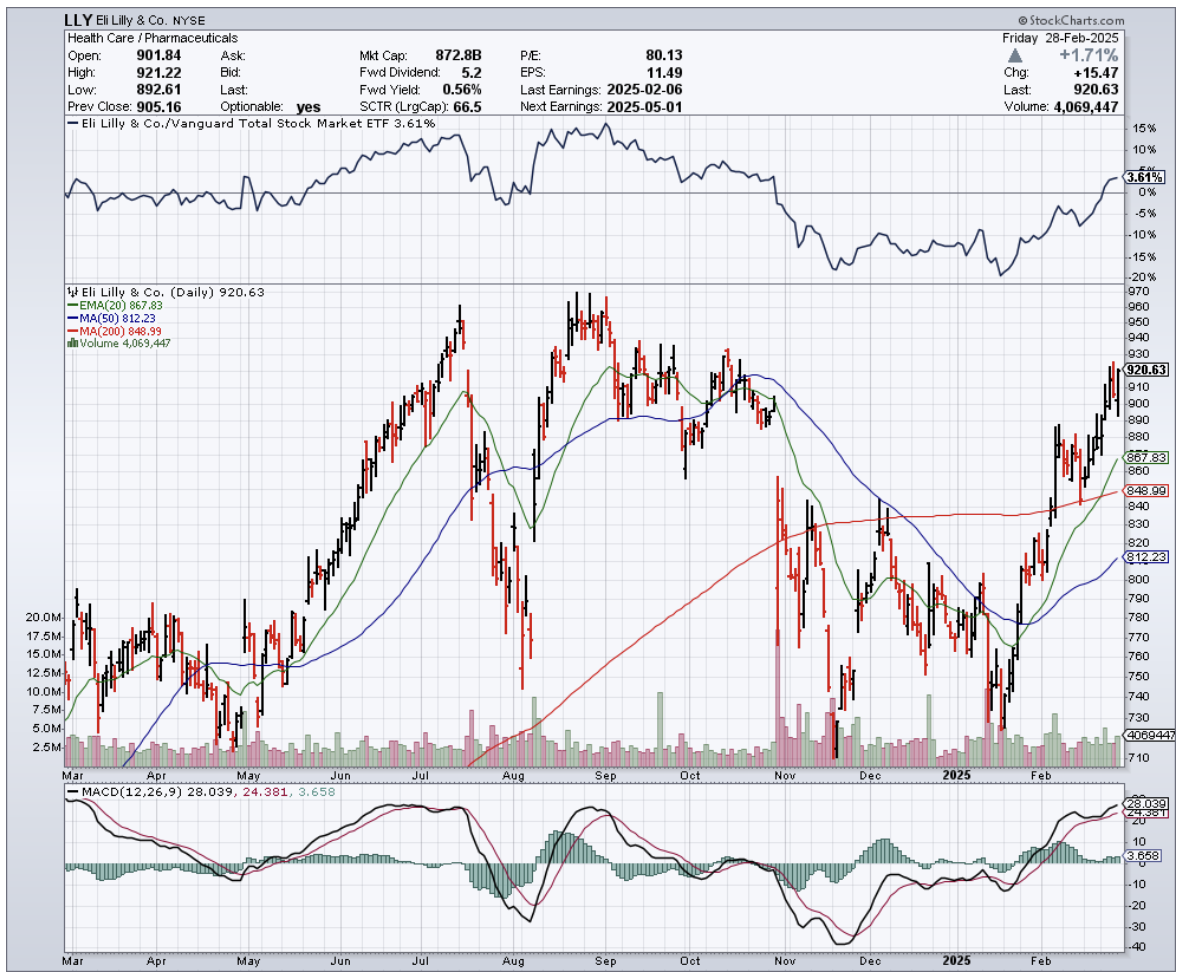
What's particularly interesting is the momentum shift that began in May 2024, with Lilly's upward trajectory continuing through February while Novo Nordisk's stock halted its precipitous decline at a critical juncture.

While bargain hunters are picking through NVO's wreckage, I'm skeptical we'll see a mass migration back to the Danish giant. Here's why.

First, there's the Trump factor. Our newly reinstalled president hasn't been subtle about demanding pharma companies shift production capacity back to American soil or face potential tariffs.

This presents a much bigger problem for Novo Nordisk than for Lilly.

The Indiana-based Lilly has a well-diversified manufacturing footprint, including substantial domestic capacity, while NVO relies heavily on non-U.S. production.

Years spent covering the White House taught me one thing: when a president threatens tariffs, smart investors listen—even if those threats haven't materialized yet.

Trump's policy shifts can come suddenly and dramatically. I've seen enough administration policy pivots over decades to know that being caught flat-footed when the music stops is a recipe for portfolio pain.

Beyond geopolitical considerations, Lilly's Zepbound (their branded weight loss medication) has been steadily gaining share in new prescriptions, showing more robust efficacy than Novo's offerings, and—in a savvy competitive move—is priced at a relative discount. It's a triple threat that's steadily eroding Novo's first-mover advantage.

But what's really impressive about Lilly's position is that they aren't putting all their eggs in the weight loss basket.

They've made solid advances in immunology and oncology, with a diverse pipeline that doesn't rely solely on incretin-based growth drivers.

This brings to mind a conversation I had with a pharmaceutical executive while flying my Ercoupe to an industry conference last weekend.

"The companies that survive long-term in this industry," he told me, "never let themselves become dependent on a single breakthrough, no matter how big."

Meanwhile, Wall Street has been revising upward its estimates for the total addressable market for weight loss drugs, anticipating expanded indications, sustained consumer adoption, and penetration into markets outside the U.S.

This strengthens the bull case for Lilly while simultaneously raising concerns about Novo Nordisk's ability to maintain its market leadership.

Speaking of market leadership, Lilly's oral GLP-1 receptor agonist Orforglipron could be submitted for regulatory approval in late 2025, potentially beating Novo's next-generation product to market.

If commercialized in 2026 as anticipated, it could further disrupt Wegovy's (Novo's weight loss drug) market position.

Some might argue that Lilly's outperformance against Novo since mid-2024 has already priced in these advantages.

But a closer look at Lilly's valuation suggests the market still isn't fully convinced of the company's growth potential.

Is this caution warranted? Perhaps. Wall Street doesn't expect Lilly's current surge in revenue growth to continue through 2027.

Lilly's management has indicated pricing will likely remain stable, but the broader expectation is that medium-term pricing may remain muted or even decline, especially as Novo's products face pricing negotiations by 2027.

This could pressure Lilly's market position, particularly given the relatively high prices in U.S. markets.

We should anticipate a more competitive landscape after 2027 as other competitors enter the weight loss drug market, though market share dynamics should remain relatively stable through 2030.

Let's talk valuation. Lilly is trading at a forward non-GAAP P/E of 37.8x, almost double its sector peers. That sounds expensive until you realize it's more than 10% below its five-year average.

More tellingly, when accounting for earnings growth prospects, Lilly's PEG ratio of 1.13 is almost 40% below the sector median.

Translation? The market hasn't gone full FOMO on Lilly yet, despite its recent outperformance of the S&P 500. In fact, price action suggests growing conviction that the stock is poised to retest its all-time highs.

Lilly weathered two setbacks in 2024 as the market questioned whether it could credibly challenge Novo's dominance.

Yet the stock found firm support above the $700 level in August, November, and again in January, confirming my belief that this support zone is rock-solid, attracting value-conscious buyers who recognize Lilly's growth potential relative to its valuation.

The breakout above the $840 zone (December highs) marks a decisive move that validates the bull case.

And while the outlook beyond 2027 remains murky, the market's restraint in valuing Lilly gives investors who've been watching from the sidelines another opportunity to board this train before it leaves the station.

"So what's your call?" pressed the advisor, who like many in his field has been forced to dump expensive research analysts while still needing solid investment ideas for his growing client base.

The rest of the table, a mix of successful entrepreneurs and self-taught traders, leaned in to hear my response.

"If you're picking between the two for a long position, Lilly is the clear choice," I replied. "They've got the edge on domestic production, they're better insulated from potential tariffs, they have a more diverse pipeline, and the market momentum is clearly in their favor."

As the waiter cleared our plates, one of the younger traders at the table asked about price targets. I tapped my wineglass thoughtfully with my pen—a habit that drives my wife crazy.

"The breakout above $840 was significant," I said. "If the fundamentals hold, which I believe they will, we could see a return to all-time highs before the bears even realize what hit them."

This led to a spirited debate about pharmaceutical valuations that lasted well past dessert.

It's these impromptu investment summits that remind me why I still travel the country meeting readers, despite having technically "retired" years ago.

The collective wisdom and diverse perspectives always sharpen my own thinking.

When the check arrived, someone joked that talking about weight loss drugs had made them lose their appetite.

“Not Lilly,” I quipped. “They're happily eating Novo's lunch”


https://madhedgefundtrader.com/wp-content/uploads/2019/05/cropped-mad-hedge-logo-transparent-192x192_f9578834168ba24df3eb53916a12c882.png 0 0 april@madhedgefundtrader.com https://madhedgefundtrader.com/wp-content/uploads/2019/05/cropped-mad-hedge-logo-transparent-192x192_f9578834168ba24df3eb53916a12c882.png april@madhedgefundtrader.com2025-03-06 12:00:362025-03-06 12:22:42The Danish Dilemma
april@madhedgefundtrader.com

March 4, 2025

Biotech Letter

Mad Hedge Biotech and Healthcare Letter
March 4, 2025
Fiat Lux


Featured Trade:

(A PHARMA GIANT BUILT FOR THE LONG HAUL)

(ABBV)

https://madhedgefundtrader.com/wp-content/uploads/2019/05/cropped-mad-hedge-logo-transparent-192x192_f9578834168ba24df3eb53916a12c882.png 0 0 april@madhedgefundtrader.com https://madhedgefundtrader.com/wp-content/uploads/2019/05/cropped-mad-hedge-logo-transparent-192x192_f9578834168ba24df3eb53916a12c882.png april@madhedgefundtrader.com2025-03-04 12:02:362025-03-04 12:17:35March 4, 2025
april@madhedgefundtrader.com

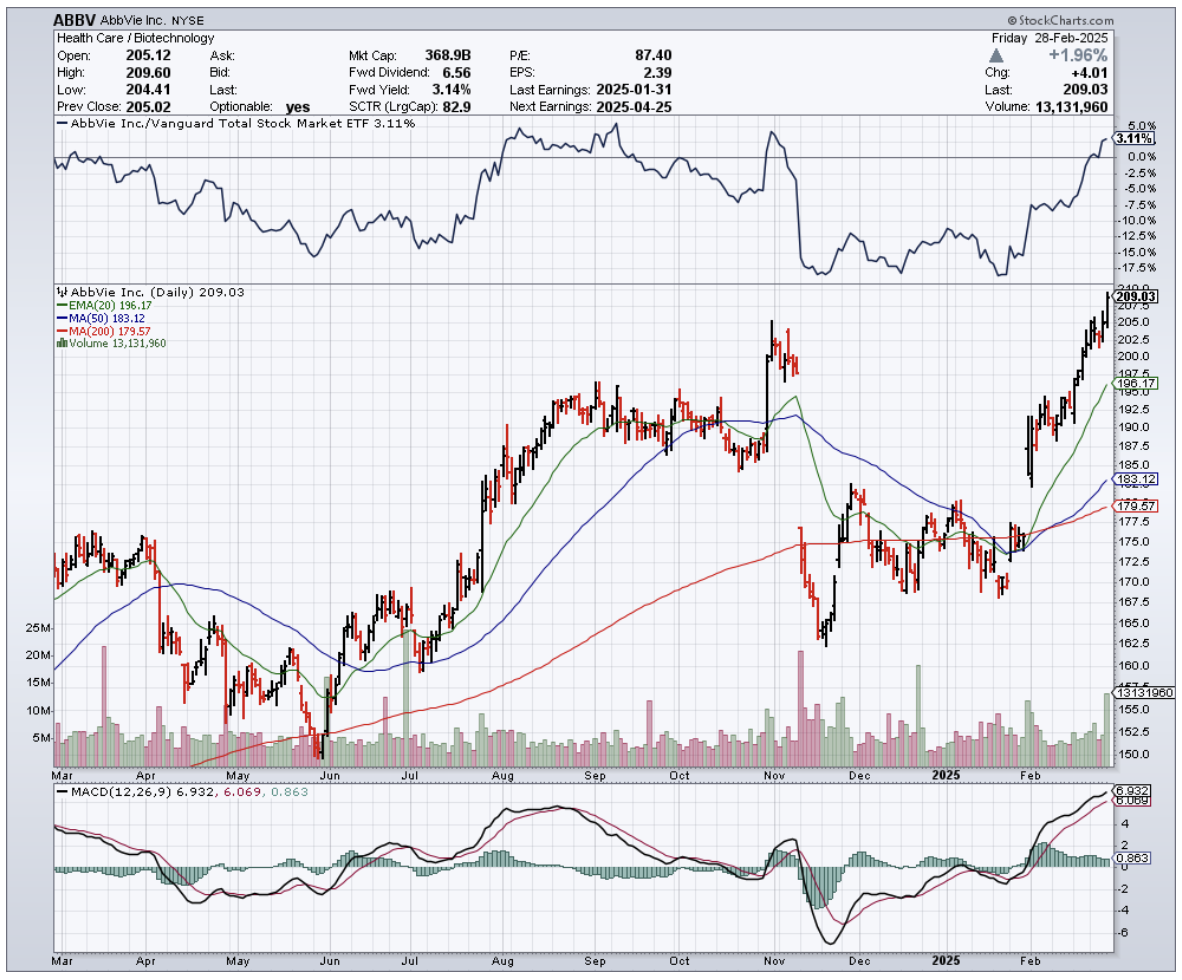
A Pharma Giant Built For The Long Haul

Biotech Letter

I was sitting in my 1946 Ercoupe at the Nevada airfield last weekend, waiting for clearance to take off for a quick joy flight, when my phone buzzed with a text from a longtime Concierge client.

"What's the deal with AbbVie (ABBV)?" he wanted to know. "Is it worth adding to my portfolio now?"

The timing was perfect. I'd just spent the previous evening poring over AbbVie's financials while sipping a particularly good Napa Cabernet I'd picked up at an estate sale for $15 (retail: $95).

There's something about the methodical drone of analyzing pharmaceutical company balance sheets that pairs beautifully with a rich red wine.

With a market cap north of $340 billion, AbbVie isn't exactly flying under anyone's radar.

But what fascinates me about this pharmaceutical behemoth is how it's managed to construct a business that's both defensively positioned and aggressively growing. It's like finding a Sherman tank that can also win drag races.

Let's dissect this beast, shall we?

Half of AbbVie's revenue comes from its immunology portfolio. The rest flows from neuroscience, oncology, and—here's where it gets interesting—aesthetics. This diversity isn't just window dressing; it's strategic positioning in markets growing far faster than inflation or GDP.

Take the immunology market, which analysts project will deliver a 10.2% CAGR over the next decade. That's the kind of growth that makes central bankers nervous and investors giddy.

AbbVie dominates this space with Rinvoq, Skyrizi, and the now-patent-expired but still lucrative Humira.

Speaking of Humira, it's worth noting what happened when this superstar drug lost patent protection in 2023.

After nearly two decades of market dominance, Humira finally faced the onslaught of biosimilars (think generic drugs, but for biologic medications).

Most pharmaceutical companies would have curled into the fetal position watching their golden goose get plucked. But AbbVie had been preparing, transitioning patients to newer offerings like Rinvoq and Skyrizi.

How well did that strategy work? These two upstarts now command a jaw-dropping 50% market share in inflammatory bowel disease indications.

If you've ever had to overcome entrenched competition in a market, you'll appreciate just how remarkable that achievement is.

Then there's neuroscience, where AbbVie's footprint includes Botox (not just for smoothing frown lines, folks), Qulipta, and Ubrelvy.

This Central Nervous System therapeutics market is projected to grow at 10.5% annually through 2030. Again, that's the kind of growth that makes you sit up straight in your ergonomic office chair.

The oncology space is a bit more challenging for AbbVie, with other pharmaceutical giants claiming larger market shares.

Still, AbbVie managed 10.8% revenue growth in oncology for 2024. Not too shabby for a supposedly "smaller player."

But the real head-turner is aesthetics medicine, projected to grow at a blistering 12.8% CAGR through 2030.

AbbVie isn't just participating here – it's dominating with Botox and Juvéderm holding 60% and 40% market shares in the U.S. toxins segment, respectively.

I remember speaking with a plastic surgeon at a conference in New York last year who told me, "When someone walks in asking for 'Botox,' it's like when people ask for a 'Kleenex' instead of a tissue. The brand has become the generic term."

That's market penetration you simply can't buy with advertising.

AbbVie's growth strategy is two-pronged: aggressive R&D investment (which increased from 13.44% to 15.22% of revenue year-over-year) and strategic acquisitions.

The company maintains a robust pipeline of new products, with several in late-stage FDA approval processes. They're also not too proud to partner with other pharmaceutical companies to develop new offerings—a pragmatic approach I've always admired in business leaders.

For income-focused investors, AbbVie offers a particularly compelling story.

The company just declared a $1.64 quarterly dividend per share, translating to a 3.4% forward yield.

More impressively, AbbVie is a member of the S&P Dividend Aristocrats Index, meaning it has increased its dividend annually for at least 25 consecutive years.

Is AbbVie financially strong enough to maintain this dividend streak while funding growth? With over $7 billion in cash and moderate leverage, all signs point to yes.

The company's stellar profitability provides additional confidence, despite slightly higher R&D expenses eating into operating margins.

The latest quarterly earnings release should put any remaining doubts to rest, with Q4 year-over-year revenue growth accelerating to 5.6%—significantly better than previous quarters—and a slight improvement in gross margin.

Of course, no investment comes without risks.

Competition in pharmaceuticals is brutal, with both innovative giants and generic producers constantly nipping at AbbVie's heels.

The rapid decline in Humira revenue following patent expiration serves as a stark reminder of how quickly fortunes can change. While the company has successfully navigated this transition, there's no guarantee it will repeat this feat with future patent expirations.

Manufacturing complexity and supply chain vulnerabilities also present risks, though these aren't unique to AbbVie.

Perhaps more concerning is the political and regulatory uncertainty following Donald Trump's return to the White House, including potential trade wars and controversial appointments like vaccine critic Robert F. Kennedy Jr.

Despite these risks, AbbVie presents an exceptionally attractive combination of growth potential and income generation.

The company's diversified business mix, strong positions in growing markets, aggressive growth strategy, and shareholder-friendly capital allocation make it a compelling addition to almost any portfolio.

As I finally got clearance and my little Ercoupe lifted off the Nevada runway, I texted my Concierge client back: "ABBV is a buy on the dip. Rock-solid business with growth. Don't overthink this one."

One of the benefits of our Mad Hedge Concierge service is exactly this kind of real-time market guidance—though most questions don't catch me mid-takeoff.

Sometimes the best investment ideas aren't the most exotic or revolutionary. Sometimes they're just exceptionally well-run businesses selling products people need, returning value to shareholders, and positioned in growing markets.

AbbVie checks all of these boxes with room to spare.


https://madhedgefundtrader.com/wp-content/uploads/2019/05/cropped-mad-hedge-logo-transparent-192x192_f9578834168ba24df3eb53916a12c882.png 0 0 april@madhedgefundtrader.com https://madhedgefundtrader.com/wp-content/uploads/2019/05/cropped-mad-hedge-logo-transparent-192x192_f9578834168ba24df3eb53916a12c882.png april@madhedgefundtrader.com2025-03-04 12:00:142025-03-04 12:17:29A Pharma Giant Built For The Long Haul
april@madhedgefundtrader.com

February 27, 2025

Biotech Letter

Mad Hedge Biotech and Healthcare Letter
February 27, 2025
Fiat Lux


Featured Trade:

(THE KENNEDY-ERA STOCK THAT'S STILL PAYING MY DINNER BILLS)

(JNJ), (ITCI)

https://madhedgefundtrader.com/wp-content/uploads/2019/05/cropped-mad-hedge-logo-transparent-192x192_f9578834168ba24df3eb53916a12c882.png 0 0 april@madhedgefundtrader.com https://madhedgefundtrader.com/wp-content/uploads/2019/05/cropped-mad-hedge-logo-transparent-192x192_f9578834168ba24df3eb53916a12c882.png april@madhedgefundtrader.com2025-02-27 12:02:572025-02-27 12:17:37February 27, 2025
april@madhedgefundtrader.com

The Kennedy-Era Stock That's Still Paying My Dinner Bills

Biotech Letter

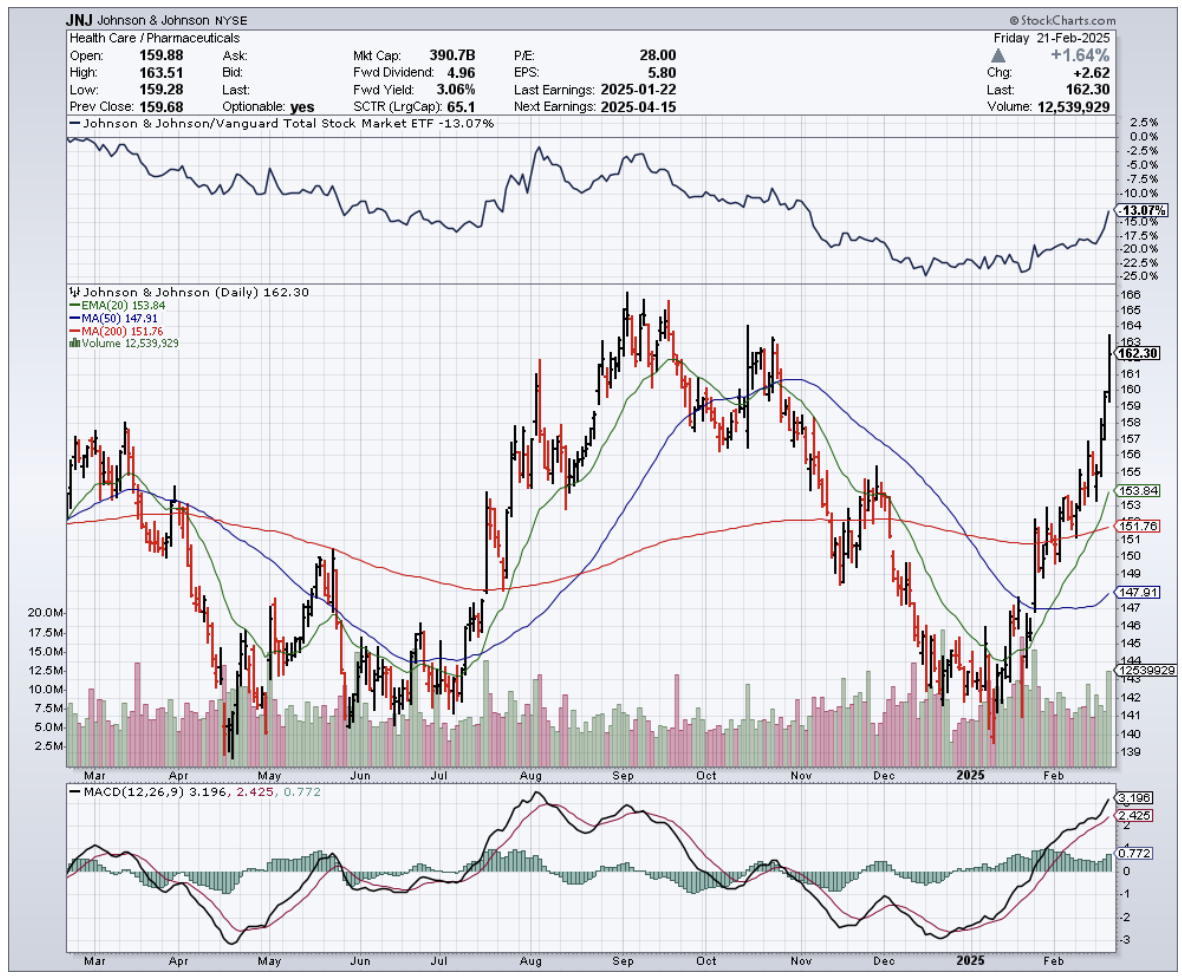
The other day, while sorting through my oldest trading records (yes, I keep everything), I found my first Johnson & Johnson (JNJ) dividend check from decades ago. It wasn't much—just enough for a nice dinner back then.

But here's the kicker: that dividend has grown every single year since, weathering oil shocks, dot-com bubbles, financial crises, and even pandemics. It got me thinking about what truly makes a fortress stock in today's market.

While everyone's chasing the latest biotech and healthcare moonshot, JNJ has been quietly building an empire.

With a market cap of $375 billion and revenue growing at an impressive 7.55% annual clip since the 1980s, this company has accomplished something few others have—long-term, consistent growth while raising dividends for over six decades. And then there's the balance sheet.

JNJ is sitting on $25 billion in cash against $38 billion in total debt, resulting in a covered ratio of 29.4. That means they could pay their debt service with spare change found in their corporate couch cushions.

Some investors dismiss JNJ as just another mature healthcare stock, but that perspective overlooks the quiet revolution happening within the company.

In the first two months of 2025 alone, JNJ secured multiple FDA approvals. The most notable? SPRAVATO, the first and only monotherapy for treatment-resistant depression. And they're not stopping there.

JNJ recently announced a $14.6 billion acquisition of Intra-Cellular (ITCI), securing CAPLYTA, a blockbuster drug for bipolar disorder and schizophrenia.

With the global Central Nervous System therapeutics market projected to grow at a 10.5% CAGR through 2034, JNJ is strategically positioning itself for future expansion.

What's particularly impressive is how JNJ has transformed its research and development approach. They're not just throwing money at problems—they're getting smarter about their investments.

Their R&D success rate has been climbing, with a higher percentage of late-stage trials making it to market compared to industry averages. This isn't by accident.

JNJ has been leveraging artificial intelligence and machine learning to better predict which compounds are most likely to succeed, potentially saving billions in development costs. It's like having a crystal ball in the lab, and it's giving them a significant edge over competitors who are still using traditional development methods.

Despite its fortress balance sheet and track record of reliability, JNJ is currently trading at a discount to historical averages.

Its forward P/E ratio sits at 15.8, compared to a five-year average of 17.9. The dividend yield is at 3.18%, higher than its 10-year average of 2.7%. Its price-to-sales (P/S) ratio stands at 4.4, below its five-year average of 4.8.

These numbers suggest the market is underpricing JNJ's resilience and growth potential.

Of course, no investment is risk-free. JNJ is facing looming patent expirations on key drugs, including Stelara, which generated $10.3 billion in 2024 sales, and Xarelto, which brought in $2.3 billion.

However, history suggests that patent cliffs aren't a new challenge for JNJ—they've successfully navigated them for decades. Their strong drug pipeline, along with strategic acquisitions, should help offset any revenue declines.

Beyond pharmaceuticals, JNJ's business diversification is a major advantage.

With roughly two-thirds of revenue coming from Innovative Medicine and the remainder from MedTech, and with 43% of total revenue sourced outside the U.S., this diversified revenue mix helps mitigate risks tied to any single product or market.

What many investors miss is how JNJ's MedTech division is quietly becoming a powerhouse in its own right.

The division has been making strategic moves in robotics and AI-enabled surgical tools, positioning itself at the intersection of healthcare and technology.

This isn't just about selling more medical devices—it's about creating entirely new categories of treatment options. In an aging global population, this kind of innovation could be worth billions in future revenue streams.

With a 16.7% return on invested capital (ROIC) over the last decade and a modest 49% payout ratio, JNJ's dividend isn't just stable—it's poised for growth. The market's current pessimism has created a 24% discount on a company that has delivered for generations.

That's the kind of opportunity that made me start buying JNJ decades ago—and why I'm still adding to my position today.

In a world where even tech giants stumble, owning a company that's been raising its dividend since the Kennedy administration isn't just smart—it's common sense.

The question isn't whether JNJ is a buy. The real question is whether you'll regret not buying the dip.


https://madhedgefundtrader.com/wp-content/uploads/2019/05/cropped-mad-hedge-logo-transparent-192x192_f9578834168ba24df3eb53916a12c882.png 0 0 april@madhedgefundtrader.com https://madhedgefundtrader.com/wp-content/uploads/2019/05/cropped-mad-hedge-logo-transparent-192x192_f9578834168ba24df3eb53916a12c882.png april@madhedgefundtrader.com2025-02-27 12:00:072025-02-27 12:15:15The Kennedy-Era Stock That's Still Paying My Dinner Bills
april@madhedgefundtrader.com

February 25, 2025

Biotech Letter

Mad Hedge Biotech and Healthcare Letter
February 25, 2025
Fiat Lux


Featured Trade:

(WALL STREET'S MYOPIA IS YOUR OPPORTUNITY)

(REGN), (RHHBY), (AMGN), (AZN), (ABBV), (LLY)

https://madhedgefundtrader.com/wp-content/uploads/2019/05/cropped-mad-hedge-logo-transparent-192x192_f9578834168ba24df3eb53916a12c882.png 0 0 april@madhedgefundtrader.com https://madhedgefundtrader.com/wp-content/uploads/2019/05/cropped-mad-hedge-logo-transparent-192x192_f9578834168ba24df3eb53916a12c882.png april@madhedgefundtrader.com2025-02-25 12:02:212025-02-26 11:06:11February 25, 2025
Page 5 of 115«‹34567›»

Legal Disclaimer

There is a very high degree of risk involved in trading. Past results are not indicative of future returns. MadHedgeFundTrader.com and all individuals affiliated with this site assume no responsibilities for your trading and investment results. The indicators, strategies, columns, articles and all other features are for educational purposes only and should not be construed as investment advice. Information for futures trading observations are obtained from sources believed to be reliable, but we do not warrant its completeness or accuracy, or warrant any results from the use of the information. Your use of the trading observations is entirely at your own risk and it is your sole responsibility to evaluate the accuracy, completeness and usefulness of the information. You must assess the risk of any trade with your broker and make your own independent decisions regarding any securities mentioned herein. Affiliates of MadHedgeFundTrader.com may have a position or effect transactions in the securities described herein (or options thereon) and/or otherwise employ trading strategies that may be consistent or inconsistent with the provided strategies.

Copyright © 2026. Mad Hedge Fund Trader. All Rights Reserved. support@madhedgefundtrader.com
Scroll to top