Archive
Hot Tips

Lost Apache Helicopter Tank Markets,
shot down by Iran over the Straits of Hormuz, according to the US, taking the (SPY) down $26 from top to bottom. NASDAQ was down 4% at the lows. The crew was recovered, but Trump has promised retaliation.
OpenAI confidentially filed for an IPO,
the ChatGPT maker said on Monday, joining rival Anthropic in a push toward a stock market listing as it looks to tap into insatiable investor demand for AI shares. OpenAI did not disclose the size or terms of the offering and said a timeline has not yet been determined. "It may be a while because there are things we want to do that are likely easier as a private company," it said in a statement.
Existing Homes Sales Jump 3.2% in May,
to 4.1 million units annualized on a closing basis only. It’s the highest sales pace since December. Inventories rose to 1.55 million units MOM, up 3.2%, or a 4 ½ month supply when six months is considered normal. The median price of an existing home rose to $429,000, up 1.3% YOY, a new high. First-time buyers rose from 33% to 35%, the highest since June 2020.
Traders Pile on Semiconductor Shorts.
The (SMH) ETF is now off more than 10% from the record high reached last week, and options traders are betting it will get worse. Put volume outnumbered call volume by a factor of four as of midday Tuesday, according to data from ThinkOrSwim, and traders bought more than five times as many puts as calls. Of the almost $350 million in premiums traded on SMH, $260 million was tied to puts, SpotGamma data show.
SpaceX is Four Times Over-Subscribed,
drawing more than $250 billion of investor demand for what stands to be the largest-ever IPO, dwarfing the $75 billion the firm is seeking to raise. Long-only funds have put in what one source described as sizable orders. Musk briefly joined some Zoom meetings with potential investors.
The Mad Hedge June Traders & Investors Summit is On!
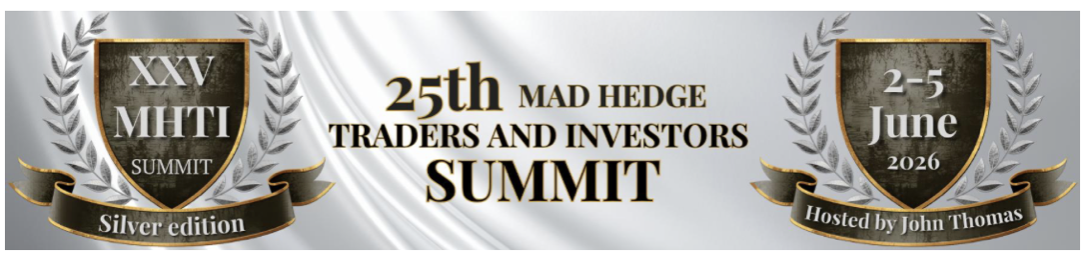
Attend the Mad Hedge Traders & Investors Summit from June 2-5. Learn from 30 of the best professionals in the market with decades of experience and the track records to prove it. They are offering a smorgasbord of successful trading strategies. Best of all, by signing up, you will automatically have a chance to win up to $100,000 in prizes. To register, please click here.
Nonfarm Payroll Comes in Hot at 172,000.
The headline Unemployment Rate held steady at 4.3%. Labor participation rate stayed at a four-year low at 61%. The U-6 long-term unemployment rate rose to 8.1%. Bonds sold off on the news. Here comes inflation!
Bitcoin Approaches One-Year Low,
as the market loses its dominant narrative and liquidity continues to rotate into other assets. The combination has left the flagship cryptocurrency vulnerable to further downside pressure as investors scale back risk and capital shifts toward markets with more momentum or more obvious near-term catalysts, like the chip rally or the SpaceX IPO. Bitcoin is down 13% this week and heading for its worst week since February, according to Coin Metrics. The one-year low is at $55,000.
Blackstone Restricts Private Credit Withdrawals,
following a spike in investor redemption requests, as fears over liquidity pressures rattled private markets. Partners Group said on Thursday it was prepared to restrict withdrawals in more of its funds, warning that the spike in client withdrawals is now spreading from private credit into private equity. You chase for yield, you pay the price.
US Crude Inventories are in Free Fall,
extending their decline to six weeks as exports rose and refineries ran near full capacity, according to data released Wednesday by the U.S. Energy Information Administration. Commercial crude oil stocks excluding the Strategic Petroleum Reserve fell by 8 million barrels to 433.7 million barrels in the week ended May 29 and were about 3% below the five-year average for the time of year, the EIA said.
The Mad Hedge June Traders & Investors Summit is On!
Attend the Mad Hedge Traders & Investors Summit from June 2-5. Learn from 30 of the best professionals in the market with decades of experience and the track records to prove it. They are offering a smorgasbord of successful trading strategies. Best of all, by signing up, you will automatically have a chance to win up to $100,000 in prizes. To register, please click here.
Broadcom Dives 15% from Weak Guidance.
The company said AI semiconductor revenue will be $16 billion in the fiscal third quarter, which is lower than the average estimate of $17.2 billion. Broadcom Chief Executive Officer Hock Tan said the company will sell $56 billion in AI chips in the fiscal year, which fell short of the average estimate of $57.6 billion. Is this the beginning of the end?
NVIDIA Boosts Dividend and Buyback.
Demand has been a cash-flow windfall for the company, which recently said it would return even more money to shareholders. It declared a 2,400% dividend increase — from a 1-cent per share quarterly dividend to 25 cents a share — as well as an $80 billion share buyback program. The dividend will be paid on June 26 to shareholders on record as of Thursday. The chipmaker has seen “parabolic” demand for its artificial intelligence chips in data centers and recently said it will expand into chips for personal computers, which will “reinvent the PC,” according to CEO Jensen Huang.
Israel Lebanon Cease Fire Shaves $5 a Barrel for Oil.
Iran warned it could target sites inside Israel if attacks on Beirut continue and said a deal with the US requires a ceasefire in Lebanon. The Strait of Hormuz remains the market's central focus, with its near-closure pushing energy prices higher and raising concerns about a spike in inflation and a slowdown in economic growth. Don’t hold your breath.
Weekly Jobless Claims See Biggest Pop of 2026.
Applications for US unemployment benefits rose last week to the highest level since February, potentially reflecting volatility around the Memorial Day holiday. Initial claims increased by 13,000 to 225,000 in the week ending May 30, according to Labor Department data. Despite the pickup in claims, the figures still remain close to historically low levels, with continuing claims falling to 1.78 million in the previous week.
The Mad Hedge June Traders & Investors Summit is On!
Attend the Mad Hedge Traders & Investors Summit from June 2-5. Learn from 30 of the best professionals in the market with decades of experience and the track records to prove it. They are offering a smorgasbord of successful trading strategies. Best of all, by signing up, you will automatically have a chance to win up to $100,000 in prizes. To register, please click here.
Morning Star Rates SpaceX (SPCX) at Half Its Proposed Value.
Prospects for the company's artificial intelligence business, which includes xAI and social media platform X, were uncertain given unclear economics and competition from OpenAI and Anthropic, the research firm said. Grok is not one of the leading AI labs today; the chatbot was developed by xAI. The future promise of SpaceX's AI segment relies on untested technology such as orbital data centers. Starlink, the satellite broadband business, also faces technological hurdles, many of which may be outside the company's control.
The Private Credit Panic is Still On.
Cliffwater LLC's flagship private credit fund capped redemptions at 5% in the second quarter after investors looked to pull about 17% of shares. The Cliffwater Corporate Lending Fund informed shareholders they'd get about one-third of their requested money back. Cliffwater Chief Executive Officer Stephen Nesbitt said the repurchase program is designed to provide shareholders with periodic liquidity that aligns with the fund's long-term investment strategy and its underlying assets.
Private Employment Rose by 122,000 Jobs last month,
after a downwardly revised 105,000 gain in April, the ADP national employment report showed on Wednesday. Economists polled by Reuters had forecast private employment increasing by 117,000 jobs after a previously reported 109,000 advance in April.
U.S. Services Sector Picked up in May
as businesses preemptively placed orders and rebuilt inventories in anticipation of shortages and higher prices because of the war with Iran. The Institute for Supply Management said on Wednesday its non-manufacturing purchasing managers index increased to 54.5 last month from 53.6 in April. Economists polled by Reuters had forecast the services PMI rising to 53.8.
The Mad Hedge June Traders & Investors Summit is On!
Attend the Mad Hedge Traders & Investors Summit from June 2-5. Learn from 30 of the best professionals in the market with decades of experience and the track records to prove it. They are offering a smorgasbord of successful trading strategies. Best of all, by signing up, you will automatically have a chance to win up to $100,000 in prizes. To register, please click here.
NVIDIA to Move into the Laptop Business,
sending its shares up 6%, but sending consumer electronics giant Apple (AAPL) down $6.00. New RTX Spark chip puts AI capability directly in PCs. Vera, RTX Spark show Nvidia is increasingly focused on PCs and CPUs. RTX Spark will debut this fall in PCs from Dell, Lenovo, among others. Shares of PC chip makers fall sharply after Nvidia announcement. NVIDIA CEO speaks ahead of the Computex conference in Taiwan.
Anthropic Files for IPO.
Anthropic's IPO could reshape US equity markets and boost the sluggish IPO market. Analyst says Anthropic aims to beat OpenAI to public markets for strategic advantage. Anthropic's valuation has surged, drawing major investors like Blackstone and Insight Partners.
US Manufacturing Activity Hits Four-Year High.
Manufacturing PMI increases 1.3 points to 54.0 in May. Supplier delivery performance slows for the sixth consecutive month. Iran war dominates comments from manufacturers, with many complaining about the negative impact on supply chains.
United States Oil Fund ETF (USO) Jumps $15 of the Friday Low,
an eye-popping move on news that Iran walked away from the Peace Talks. My Friday (USO) long hit max profit right at the market opening. This is going to remain a volatile market, and a profitable one to trade on both sides.