
Mad Hedge Technology Alerts!
If you asked me which is the best company that most people do not know about then there is one clear answer.
The Trade Desk (TTD).
This company was founded by one of the pioneers of the ad tech industry Jeff Green, and he has spent the past 20 years improving data-based digital advertising.
Green established AdECN in 2004 and its claim to fame was the world’s first online ad exchange.
After three years, Microsoft gobbled up this firm and Green stayed on until 2009 when he launched The Trade Desk. This is where he planned to infuse everything he learned about the digital ad agency into his own brainchild.
Green concluded that creating a self-service platform, avoiding privacy issues, and harnessing big data for digital ad campaigns was the best route at the time.
Green hoped to avoid the pitfalls that damaged the digital ad industry mainly bundling random ads together that diluted the quality and potency of the ad campaigns.
It did not make sense that a digital ad for baby diapers could be commingled with an ad for retirement homes.
Green created real-time bidding (RTB), which is a process in which an ad buyer bids on a digital ad and, if won, the buyer’s ad is instantly displayed on the selected site.
This revolutionary method allowed ad buyers to optimize ad inventory, prioritize ad channels, and boost the effectiveness of campaigns.
(RTB) is a far better way to optimize digital ad campaigns than static auctions, which group ads by the thousand.
In real time, advertisers are able to determine a bespoke ad for the user to display on a website. Green used this model to develop his company by building a platform tailor-made to execute (RTB).
Naturally, he won over many naysayers and his company took off like a rocket.
Results, in a results-based business, were seen right away by ad buyers.
A poignant example was aiding a performance-based ad agency in trimming ad waste by more than 50% for a national fast food chain with thousands of locations across America.
It took just one year for The Trade Desk to carve out a profitable business as ad agencies flocked to its platform desiring to take advantage of (RTB) or also commonly known as programmatic advertising.
Customer satisfaction is evident in its client retention rate of 95% for the past few years highlighting the dominating position The Trade Desk possesses in the digital ad industry.
The Trade Desk has not raised fees for ad buyers lately, but the value added from The Trade Desk to customers is accelerating at a brisk pace.
A great value proposition for potential clients.
The vigor of the business was highlighted when Green cited that each second his company is “considering over 9 million ad opportunities” for their ad inventory shows how The Trade Desk is up to date on almost every single ad permutation out there.
This speaks volume of the ad tech, which is the main engine powering the bottom lines at Google search and rogue ad seller Facebook (FB).
Google only gets 63,000 searches per second and shows that The Trade Desk has pushed the envelope in providing the best platform for ad buyers to seek its perfect audience.
Green’s mission of supporting big ad buyers optimize their ad budget has really caught fire and in a way that is completely transparent and objective.
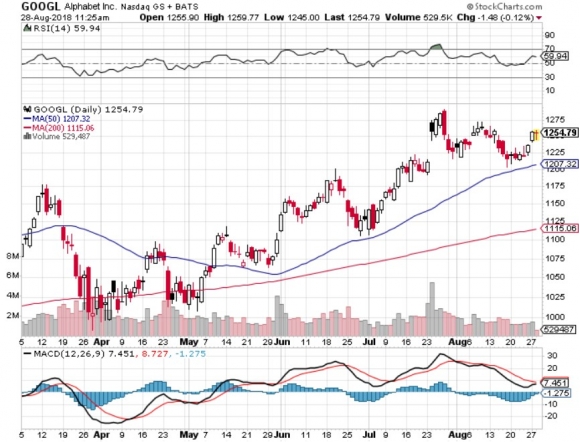
The foundations that Green has assembled became even more valuable when Alphabet (GOOGL) chose to remove DoubleClick IDs, which would now prevent ad buyers from cross-platform reporting and measurement.
Previously, DoubleClick ID could cull data from assorted ads and online products based on a unique user ID named DoubleClick ID.
Ad purchasers then would data transfer to pull DoubleClick log files and measure them against impressions served from other ad servers across the web.
Effectively, ad buyers could track the user through the whole ad process and determine how useful an ad would be to that specific user.
In an utter conservative move to satisfy Europe’s General Data Protection Regulation (GDPR), DoubleClick IDs are no longer available for use, and tracking the ad inventory performance from start to finish became much harder.
Cutting off the visibility of the DoubleClick ID in the DoubleClick ecosystem was a huge victory for The Trade Desk because DoubleClick ID measured 75% of the global ad inventory.
Ad buyers would be forced to find other measurement systems to help calculate ad performance.
Branding and executing as the transparent and fair ad platform helping ad agencies was a great idea in hindsight with the world becoming a great deal more sensitive to data privacy.
The Trade Desk is perfectly placed to reap all the benefits and boast excellent technology to capitalize on this changing big data landscape. It is already seeing this happen with new business wins including large global brands such as a major food company, a global airline, and another large beverage company.
The global digital ad market is a $700 billion market today and trending toward $1 trillion in the next five to seven years
The generational shift to mobile and online platforms will invigorate The Trade Desk’s bottom line as more big ad buyers will make use of its proprietary platform to place programmatic ads.
Content distribution systems are fragmenting into skinny bundles hyper-targeting niche content users such as Sling TV, FuboTV, and Hulu.
There are probably 30 different ways to watch ESPN now, and these 30 platforms all require ad placement and optimization.
Some of the names The Trade Desk is working with are the who’s who of digital content ownership or distribution including Baidu (BIDU), Google, Alibaba (BABA), Pandora (P), and Spotify (SPOT) -- and the names are almost endless.
It’s the Wild West of ads and content these days because TV distribution has never been more fragmented.
Content creation avenues are desperate to boost ad income and are increasingly attempting to go direct to consumers.
Ad-funded Internet TV barely existed a few years ago. And ad inventory is all up for grabs benefitting The Trade Desk.
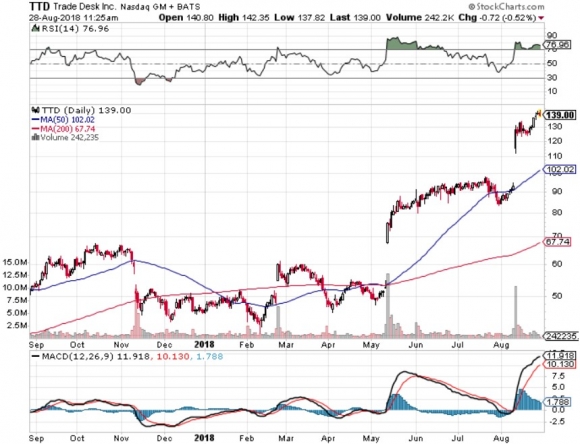
All of this explains why the stock is up more than 180% in 2018, and this is just the beginning.
The growth numbers put Amazon (AMZN) and Netflix (NFLX) to shame.
The Trade Desk scale on inventory has spiked by more than 700% YOY.
The option to hyper-target increases as more ad inventory is stocked.
Management mentioned in its second-quarter performance that “nearly everything went right. We executed well and one of the most dynamic environments we've seen.”
It is one of the most bullish statements I have heard from a public company.
Quarterly revenue ballooned 54% YOY to a record $112 million, and the 54% YOY growth equaled the 54% YOY growth in Q2 2017.
Ad Age's top 50 worldwide advertisers doubled ad spend in the past year positioning The Trade Desk for continued hyper-growth, not only for 2018 but in 2019 and beyond.
Mobile spend jumped nearly 100% YOY, accounting for 45% of ad spend on the platform, which is 400% higher than the industry average for mobile ad spend according to eMarketer.
Data spend was also a huge winner rising by nearly 100% smashing another record.
In the meantime, the overseas business continued its robust growth in Europe and Asia, up 85% YOY.
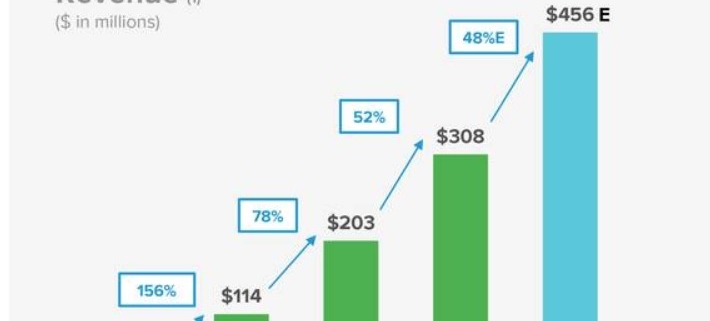
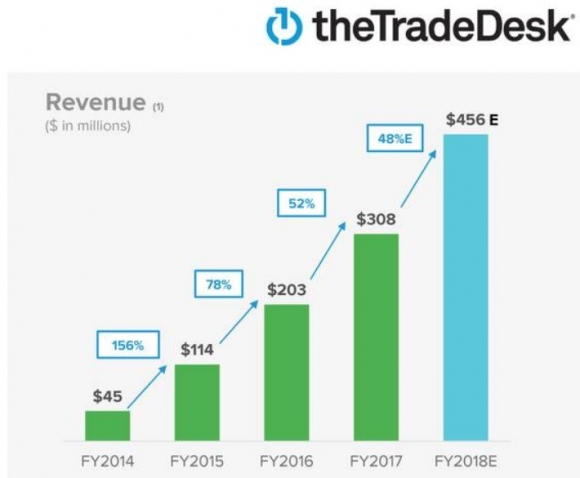
The Trade Desk confidence in its performance chose to increase guidance to $456 million for the year, a 48% YOY improvement.
When upper management says “when we see surprises, they typically are to the upside” you take notice, because this tech company is perfectly placed in a growth sweet spot.
Massive developing markets are just starting to dabble with programmatic advertising. Markets such as China will see it become the new normal soon, opening up even more business for The Trade Desk.
The Trade Desk is also rolling out new products that will automate more of the process and reduce the number of clicks.
Wait for the pullback to get into this ad tech stock because even though it is up big this year, we are still in the early innings, and shares will march even higher.
________________________________________________________________________________________________
Quote of the Day
“I have a deep respect for the fundamentals of television, the traditions of it, even, but I don't have any reverence for it,” – said Netflix chief content officer Ted Sarandos.

Mad Hedge Technology Letter
August 28, 2018
Fiat Lux
Featured Trade:
(SPOTIFY STILL HAS SOME UPSIDE),
(SPOT), (AMZN), (AAPL), (P)


Investors sulking about Spotify’s (SPOT) inability to make money do not get the point.
Yes, the job of every company to be in the black, but the No. 1 responsibility for a modern tech company is to grow, and grow fast.
Tech investors pay for growth, period.
As investors have seen from Netflix, companies can always raise prices after seizing market share because of the stranglehold on eyeballs inside a walled garden.
That potent formula has been the bread and butter of powerful tech companies of late.
Spotify is a captive of the music industry, of which it is entirely dependent for its source of goods, in this case songs.
At the same time, the music industry has fought tooth and nail to destroy the likes of Spotify, which benefits immensely from distributing the content it creates.
History is littered with failed music streaming services outgunned in the courtroom. Pandora (P) is the biggest public name out there whose share price has tanked over the long haul.
The music industry will battle relentlessly to exterminate Spotify and force up the royalties these Internet giants must pay as their main input.
But that does not mean Spotify is a bad company or even a bad stock.
Every company has its share of pitfalls. Throw in the mix that Amazon (AMZN) and Apple (AAPL) have music streaming services that do not even need to make a profit, and you will understand why some might be wary about putting new money to work in music streaming business stocks.
The primary reason that Spotify shares will outperform for the foreseeable future is because it is the preeminent music streaming platform.
Also, there is favorable latitude to make way toward the goal of monetization, and ample space to improve gross margins.
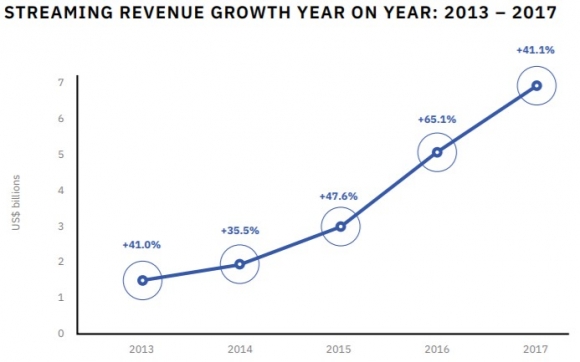
Global streaming revenue growth has gone ballistic as the migration to mobile and cord cutting has exacerbated the monetization prospects of the music industry.
Streaming revenue was a shade under $2 billion in 2013, and continued to post a growth trajectory of more than 40% each year since.
As it stands now, total global streaming revenue registered just a tick under $7 billion per year in 2017, and that was an improvement of 41.1% from 2016.
There are no signs of yielding as more avid music fans push into the music streaming space.
Social media platforms have helped publicize popular artists’ content.
Music is effectively a strong part of youth culture, which will eventually see the youth integrate a music streaming app into their daily lives for the rest of their adult lives.
The choice among choices is Spotify in 2018.
The company was dogged by many years of famous artists removing their proprietary content from the platform citing unfavorable terms.
A prime example was in 2009 when Lady Gaga’s hit song “Poker Face” only received $167 in royalty payments from Spotify for the first million streams. This highlighted the rock-solid position Spotify has curated inside the music industry.
Individual artists’ fight against Spotify has been dead on arrival from the outset, but the benefits and exposure from cooperating with the company far outweigh the drawbacks.
Eventually, almost all artists have relented and reinstalled their music on Spotify. They depend on alternative moneymaking avenues to compensate for lack of royalties, which is mainly live music.
That is why it costs an arm and a leg to go see Taylor Swift in living flesh now, and why those summer festivals dotted around America such as Coachella command premium ticket prices.
How does Spotify make money?
It earns its crust of bread through paid subscriptions but lures in eyeballs using an ad-supported free version of its platform.
Naturally, the paid version is ad-less, and this subscription is around $5 to $15 per month.
In the second quarter, Spotify’s paid subscription volume surpassed 83 million, a sharp uptick of 40% YOY.
Ad-supported users came in at more than 101 million, even under the damage that General Data Protection Regulation (GDPR) did to western tech companies.
The ad-supported subscribers rose 23% YOY, and the paid version expects between 85 million to 88 million paid subscribers in the third quarter.
Many of the new paid subscribers are converts from its free model.
Spotify is poised to increase revenue between 20%-30% for the rest of the year.
The rise of Spotify's developing data division could extract an additional $580 million of revenue in 2023, making up 2% of total revenue.
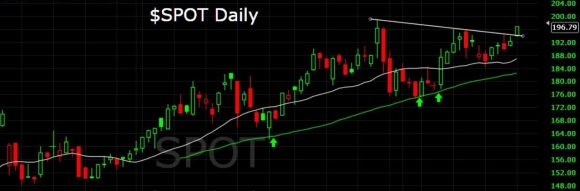
Remember that Spotify’s reference price set by the New York Stock Exchange (NYSE) was $132 in April 2018. The parabolic move in the stock on the verge of eclipsing $200 undergirds the demand for high-quality tech companies.
When Spotify did go public, the robust price action was with conviction, making major investors - such as China’s Tencent, which possess a 9.1% stake and Tiger Global Management, which owns 7.2% - happy stakeholders.
In the last quarter’s earnings report, Spotify CFO Barry McCarthy reiterated the company’s goal to push gross margins from the mid-20% range to “gross margins in the 30% to 35% range.”
A jump in gross margins would go a long way in making Spotify appear more profitable, and that is the imminent goal right now.
The path to real profitability is still a long way down the road and small victories will offer short-term strength to the share price.
If Spotify can retrace to around the $185, that would serve as a perfect entry point into a stock that has given investors few chances in which to participate.
July and August have only offered meager entry points into this stock, one around the $180 level in August, and another around $170 in July.
Spotify enjoyed a great first day of being public after its unorthodox IPO ending the day at $149. The momentum has continued unabated while Spotify has posted all the growth targets investors come to expect from companies of this ilk.
Bask in the glow of the growth sweet spot Spotify finds itself in right now.
The long-term narrative of this stock is intact for a joyous ride upward, and only whispers of Amazon and Apple meaningfully attempting to monetize this segment could derail it.
For the time being, the music part of Amazon and Apple are just a side business. They have other priorities, such as Apple’s battle to avoid being exterminated from communist China, and Amazon’s integration of Whole Foods and new-fangled digital ad business.

The Dominant Music Streaming Platform of 2018
________________________________________________________________________________________________
Quote of the Day
“Ever since Napster, I’ve dreamt of building a product similar to Spotify,” – said cofounder and CEO of Spotify Daniel Ek.