Global Market Comments
May 2, 2025
Fiat Lux
Featured Trade:
(APRIL 30 BIWEEKLY STRATEGY WEBINAR Q&A),
(FXI), (AGQ), (NVDA), (SH), (UNG), (USO),
(TSLA), (SPX), (CCJ), (USO), (GLD), (SLV)

Global Market Comments
May 2, 2025
Fiat Lux
Featured Trade:
(APRIL 30 BIWEEKLY STRATEGY WEBINAR Q&A),
(FXI), (AGQ), (NVDA), (SH), (UNG), (USO),
(TSLA), (SPX), (CCJ), (USO), (GLD), (SLV)

Below, please find subscribers’ Q&A for the April 30 Mad Hedge Fund Trader Global Strategy Webinar, broadcast from Incline Village, NV.
Q: Why is the Australian dollar not moving against the US dollar as much as the other currencies?
A: Australia is too closely tied to the Chinese economy (FXI), which is now weak. When the Chinese economy slows, Australia slows. Australia is basically a call option on the Chinese economy. So they're not getting the ballistic moves that we've seen in, say, the Euro and the British pound, which are up about 20%. Live by the sword, die by the sword. If you rely on China as your largest customer for your export commodities, you have to take the good and the bad.
Q: I see we had a terrible GDP print on the economy this morning, down 0.3%. When are we officially in a recession?
A: Well, the classical definition of a recession is two back-to-back quarters of negative GDP growth. We now have one in the bank. One to go. And this quarter is almost certain to be much worse than the last quarter, because the tariffs basically brought all international trade to a complete halt. On top of that, you have all of the damage to the economy done by the DOGE cuts in government spending. Approximately 80% of the US states, mostly in the Midwest and South, are very highly dependent on Washington spending for a healthy economy, and they are going to really get hit hard. So the question now is not “do we get a recession?”, but “how long and how deep will it be?” Two quarters, three quarters, four quarters? We have no idea. Even if trade deals do get negotiated, those usually take years to complete and even longer to implement. It just leaves a giant question mark over the economy in the meantime.
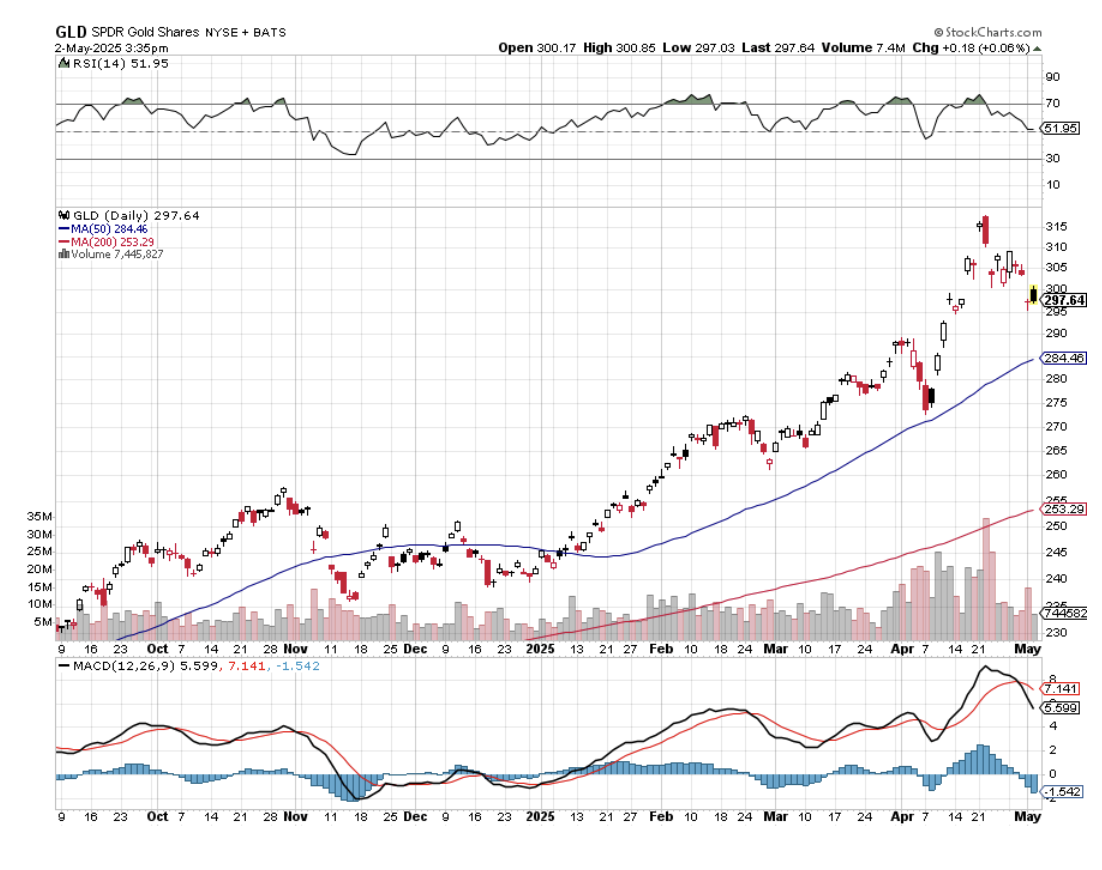
Q: Is SPDR Gold Trust (GLD) the best way to play gold, or is physical better?
A: I always go for the (GLD) because you get 24-hour settlement and free custody. With physical gold, you have to take delivery, shipping is expensive, and insurance is more expensive. Plus, then you have to put it in a vault. Private vaults have a bad habit of going bankrupt and disappearing with your gold. You keep it in the house, and then if the house burns down, all your gold is gone there. Plus, it can get stolen. There's also a very wide dealing spread between bid and offer on physical gold coins or bars; usually it's at least 10%, often more. So I often prefer the ease of trading with the GLD, which owns futures on physical gold, which is held in London, England. So that is my call on that.
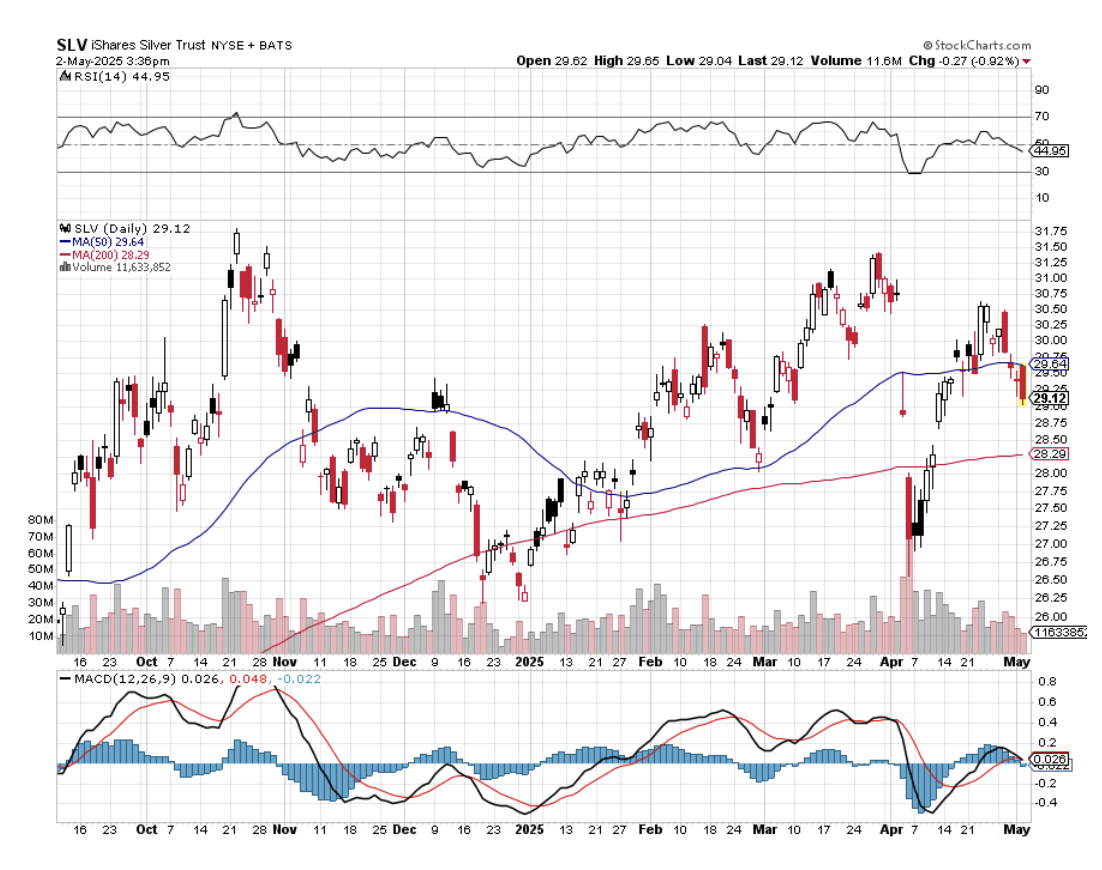
Q: Is ProShares Ultra Silver (AGQ) the leveraged silver play?
A: It absolutely is, but beware: (AGQ) is only good for short, sharp rises because the contango and the storage operating costs of any 2x are very, very high—like 10% a year. So, good if you're doing a day trade, not good for a one-year hold. Then you're just better off buying silver (SLV).
Q: What is more important with the Fed's mandate—unemployment or fear of inflation?
A: That's an easy one. Historically, the number one priority at the Fed has been inflation. That is their job to maintain the full faith and credit of the U.S. Dollar, and inflation erodes the value, or at least the purchasing power of the US dollar, so that has always historically been the priority. Until we see inflation figures fall, I think the chance of them cutting interest rates is zero, and we may not see actual falls until the end of the year, because the next influence on prices is up because of the trade war. The trade war is raising prices everywhere, all at the same time. So that will at least add 1 or 2% to inflation first before it starts to fall. You can imagine how if we get a 6% inflation rate, there's no way in the world the Fed can cut rates, at least for a year, until we get a new Fed governor. So that has always historically been the priority.
Q: Do you think the 10-year yield is going down to 5%?
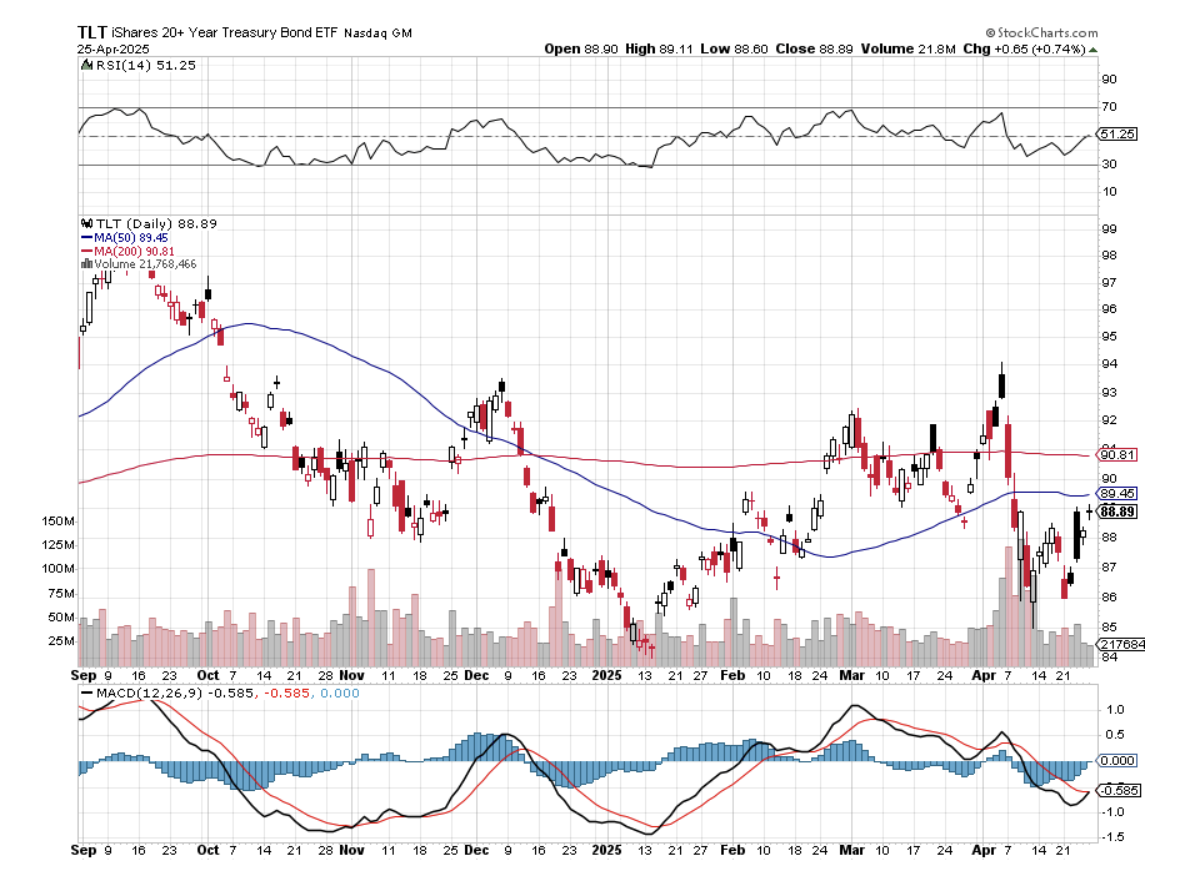
A: You know, we're really in a no-man's-land here. Recession fears will drive rates down as they did yesterday. I haven't even had a chance to see where the bond market is this morning because. So, rates are rising on a recessionary GDP, which is the worst possible outcome. Rates should be falling on a recessionary GDP print. Of course, Washington’s efforts to undermine the U.S. dollar aren't helping. Threatening to withhold taxes on interest payments to foreign owners is what caused the 10% down move in bonds in one week—the worst move in the bond market in 25 years. So, the mere fact that they're even thinking about doing something like that scares foreign investors, not only from the bond market, but all US investments period. And certainly, we've seen some absolutely massive stock selling from them.
Q: Why won't the market go down to 4,000 in the S&P 500?
A: Absolutely, it could; that is definitely within range. That would put us down 30% from the February highs, it just depends on how long the recession lasts. If you just get a two-quarter shallow recession, we could bounce off 4800 for the (SPX) until we come out. If the recession continues for several quarters, and it's looking like it will, then 4,000 is definitely within range. So, it's all about the economy. And remember, stocks are expensive. They don't get cheap until we get a PE multiple of 16, and even then, that alone, just a multiple shrinkage would take us down to 4,000.
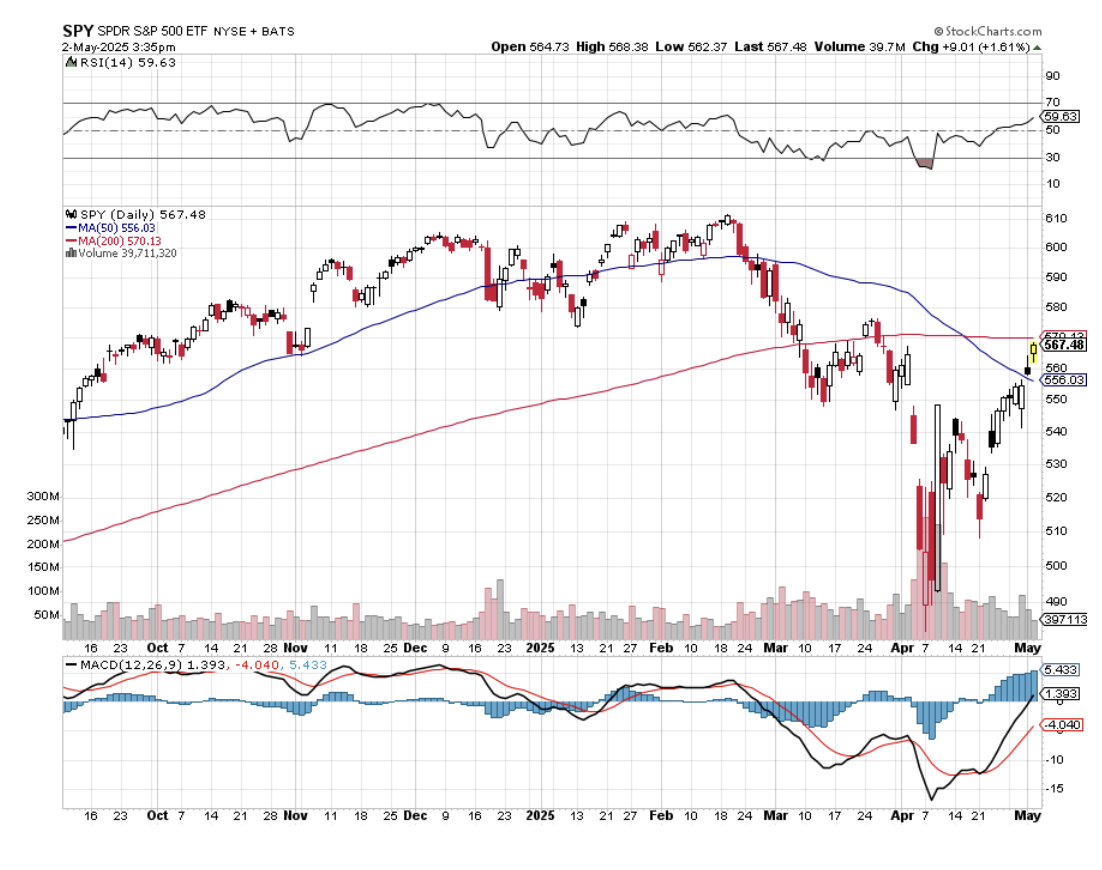
Q: Would it be a good idea to buy the S&P 500 (SPY) as it falls?
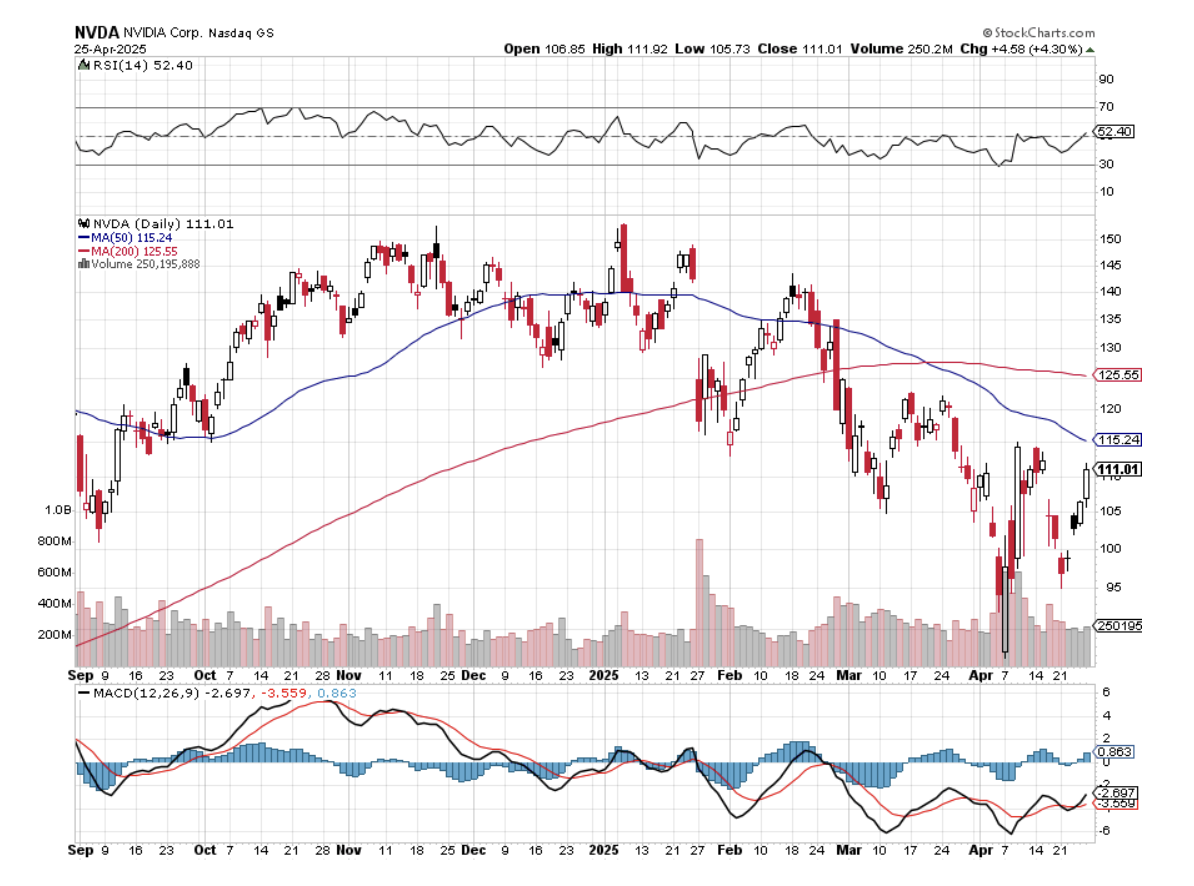
A: I'm getting emails from readers asking if it's time to buy Nvidia (NVDA) or time to buy Tesla (TSLA). What I've noticed is that investors are constantly fighting the last battle. They're always looking for what worked last time, and that does not succeed as an investment strategy. As long as I'm selling rallies, I'm not even thinking about what to buy on the bottom. The world could look completely different on the other side. The MAG-7 may not be the leadership in the future, especially with the Trump administration trying to dismantle four out of seven companies through antitrust, and the rest are tied up in the trade wars. So, tech is still expensive relative to the main market, and we're going to need to look for new leaders. My picks are going to be mining shares, gold, and banking. Those are the ones I'm looking to buy on dips, but right now, cash is king unless you want to play on the short side. Being paid 4.3% to stay away sounds pretty good to me, especially when your neighbors have 30% losses. You know, I've heard of people having all of their retirement funds in just two stocks: Nvidia and Tesla, and they're getting wiped out. So, you don't want to become one of them.
Q: After a tremendous run in Gold, is Silver a better risk-reward right now?
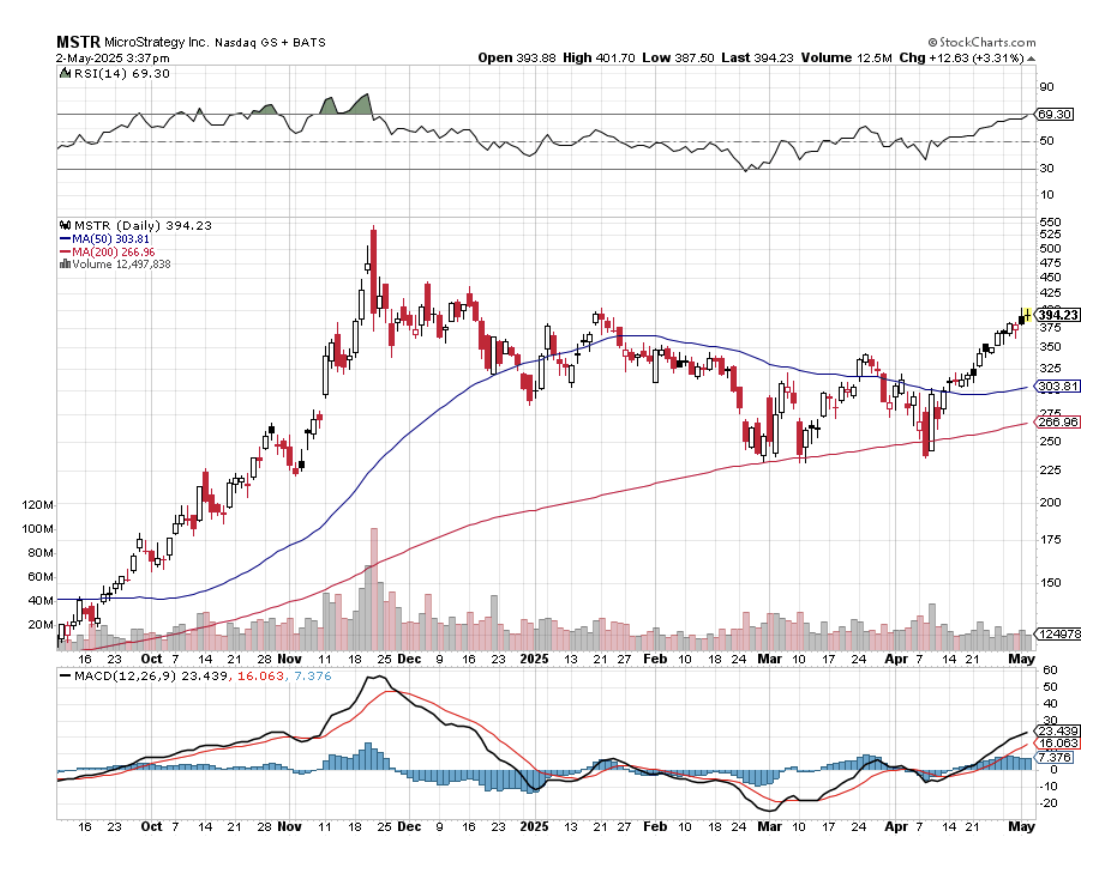
A: I would say yes, it is. Silver has been lagging gold all year because central banks, the most consistent buyers for the past decade, buy gold—they don't buy silver. But what we may be in store for here now is a prolonged sideways move in gold while the technicals catch up with it. And in the meantime, the money goes elsewhere into silver and Bitcoin. That's my bet.
Q: Is Apple (APPL) a no-touch now?
A: I’d say yes. The trade war is changing by the day, and Apple probably does more international trade than any other company in the world. Also, Apple gets hit with recessions like everybody else. There was a big front run to buy Apple products ahead of tariffs—my company bought all its computer and telephone needs for the whole year ahead of the tariffs. We're not buying anything else this year. And I would imagine millions more are planning to do the same, so you could get some really big hits in Apple earnings going forward.
Q: Should I sell my August Proshares Short S&P 500 (SH) LEAPS?
A: No, I would keep them. If the (SPX) IS trading between 5,000 to 5,800, your $4-$42 SH LEAPS should expire at max profit in August, so I'm hanging on to mine. Next time we take a run at 5,000, you should be able to get out of your SH LEAPS at 80% to 90% of the max profit.
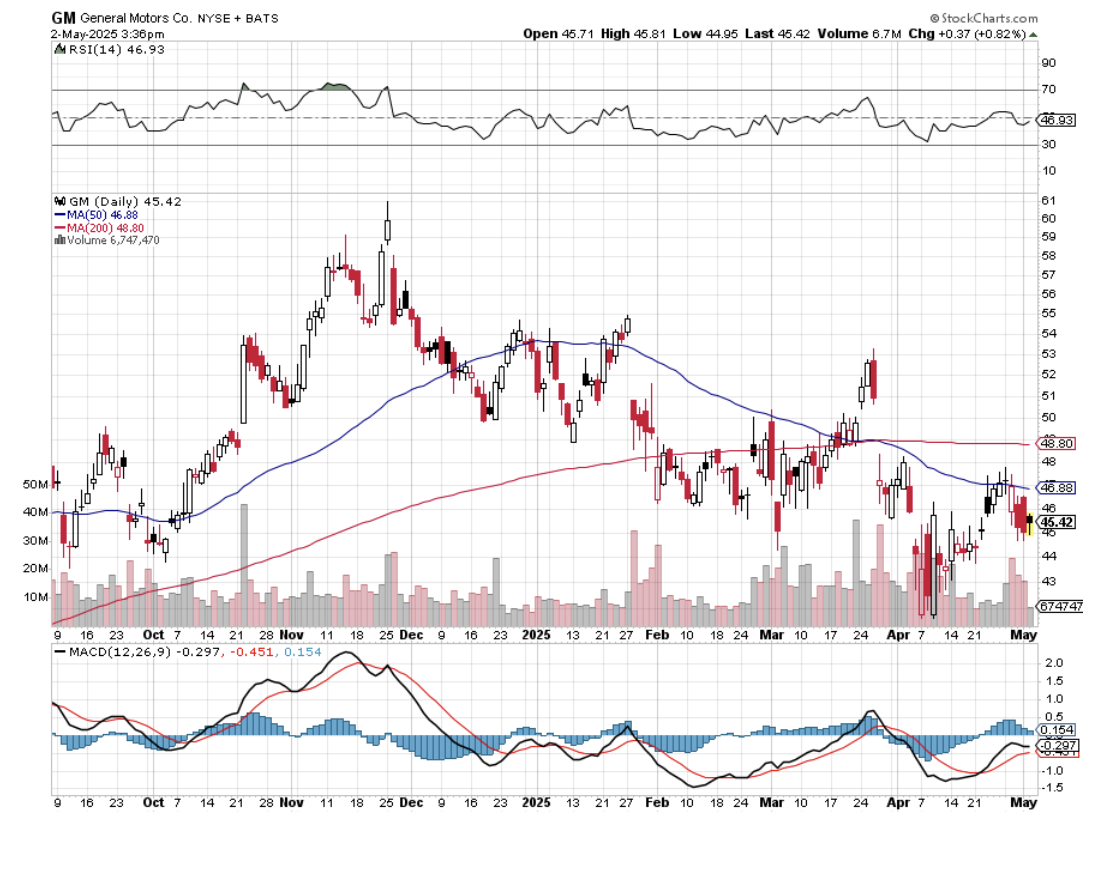
Q: What car company stock will do the best in a high-tariff global economy?
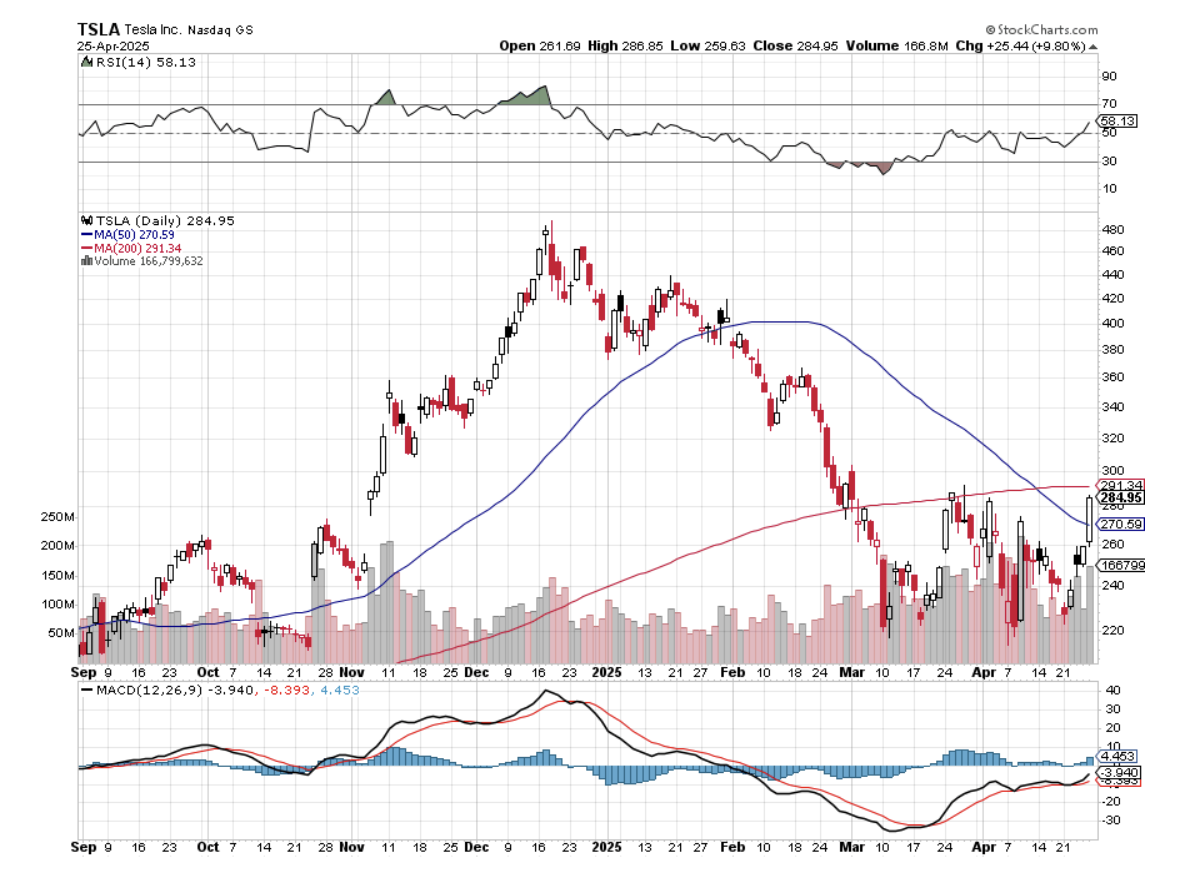
A: Tesla (TSLA), because 100% of their cars are made in the US with 90% US parts (the screens come from Panasonic in Japan). Their foreign components are only about 10%, so they can eat that. For General Motors (GM), it's more like 30% of all components are made abroad, and they can't eat that; their profit margins are too low. (GM) expects to lose $5 billion because of tariffs. By the way, the profit margins on Tesla have fallen dramatically from 30% down to 10% in two years, so it's not like they're in great shape either. Also, Tesla hasn’t had a CEO for ten months, which is why the board is looking for a replacement.
Q: Is it a good time to buy the dip in oil (USO)?
A: Absolutely not. Oil is the most sensitive sector to recessions, because if you can't sell oil, you have to store it, very expensively. It costs 30 to 40% a year to store oil—that's the contango; and once all the storage is full, then you have to cap wells, which then damages the long-term production of the wells. I think at some point you will expect an announcement from Washington to refill the Strategic Petroleum Reserve, which was basically sold by Biden at $100 a barrel. You can now get it back for $60. That may not be a bad idea if you're going to have a strategic petroleum reserve. What's better is just to quit using oil completely, which we were on trend to do.
Q: Will interest rates drop by year-end?
A: They may drop by year-end once unemployment runs up to 5% or 6% —which is likely to happen in a recession—and inflation starts to decline, even if it declines from a higher level. Even if they don't cut by year end, they'll still cut in a year when the president can appoint a new Fed governor. What the Trump really needs to do is appoint Janet Yellen as the Fed governor. She kept interest rates near zero for practically all of her term. We need another Yellen monetary policy.
Q: The job market here seems to be slowing quite fast. Is there any way this will rebound and stave off recession?
A: No, there is not. Companies are going to be looking to cut costs as fast as they can to offset the shrinkage in sales, but also to help cope with tariffs. So no, the job market is actually surprisingly strong now. That means future data releases are probably going to get a lot worse. In April, we saw job gains in Health care, adding 51,000 jobs. Other sectors posting gains included transportation and warehousing (29,000), financial activities (14,000), and social assistance. I highly doubt any of these sectors will show gains next month.
Q: What about nuclear energy plays?
A: I like them, partly because people are buying stocks like Cameco Corp (CCJ) as a flight to safety commodity play, like they're buying gold, silver, and copper. But also, this administration is supposed to be deregulation-friendly, and the only thing holding back nuclear (at least new modular reactors) is regulation. That and the fact that no one wants to live next door to a nuclear power plant, for some strange reason.
Q: What do I think about natural gas (UNG)?
A: Don't touch. Don't buy the dip. All energy plays look terrible right here, going into recession.
Q: What are your thoughts on manufacturing returning to the U.S? And how will that affect the stock market?
A: I think there's zero chance that any manufacturing returns to the U.S. Companies would rather just shut down than operate money-losing businesses. You know, if your labor cost goes from $5 to $75 an hour, there's no chance anyone can make money doing that, and no shareholders are going to want to touch that stock. That is the basic flaw in having a government where no one is actually running a manufacturing business anywhere in the government. They don't know how things are actually made. They're all real estate or financial people.
To watch a replay of this webinar with all the charts, bells, whistles, and classic rock music, just log in to www.madhedgefundtrader.com , go to MY ACCOUNT, click on GLOBAL TRADING DISPATCH, then WEBINARS, and all the webinars from the last 12 years are there in all their glory.
Good Luck and Good Trading
John Thomas
CEO & Publisher
The Diary of a Mad Hedge Fund Trader
Global Market Comments
May 1, 2025
Fiat Lux
Featured Trade:
(THE SEVEN WORST FINANCIAL MISTAKES THAT RETIREES MAKE)

A significant proportion of my Mad Hedge subscribers are either retired or are about to do so. I have therefore gained from them a lot of valuable information about how retirees can best manage their financial resources, as well as the worst mistakes they commit, which I thought I might pass on.
I have also learned a lot by researching my own retirement, not that it will ever happen, but it’s nice to know what choices are out there. So, let me get on with the show.
1) Spend Like There’s No Tomorrow
Because there might not be a tomorrow. We all had parents who suffered through the Great Depression, so Baby Boomers (Those born between 1946 and 1962) are inveterate savers. They continue saving well after they retire, beyond any need to do so.
The cruel fact is that after the age of 80, it becomes physically impossible to do any expensive international travel. If you don’t believe me, try slinging some 50-pound suitcases onto a train in the three-minute window you’re allowed in Europe to board in the midst of a teeming mass of other passengers.
This is where the “4% Rule” kicks in. You should be spending, not saving 4% of your assets every year to support your lifestyle. If you don’t retire until the mandatory Social Security payout year of 72, that’s enough to last until you’re 97. After that, you become the responsibility of your children, your grandchildren, your great-grandchildren, or the state. Note: You have only a 2.68% actuarial chance of making it to 97.
I had four aunts who lived to over 105. Believe me, it’s no fun. You can’t see or hear, taste your food, or have sex. You need full-time care. And your kids start to die off. That’s not for me. I have told my own kids that if I ever reach that stage, take me on a long walk on a short pier and then pour my ashes into Lake Tahoe.
2) Invest Like a Retiree, not a 25-Year-Old
I have seen a number of my friends and clients completely change their investment styles once they quit work. When they have all the time in the world to trade, they become more aggressive and overtrade. They take on more risk than they can handle.
They also subscribe to other newsletters that lead them into disastrous strategies, like naked put selling at market tops. As a result, they morph from money makers to money losers, right when they can least afford to do so.
3) Not Claiming Social Security
Incredible as it may seem, some retirees don’t claim the Social Security benefits they deserve. This happens because they think that the amounts will be too small to be worth the trouble, they forget, or they think Social Security is already bankrupt, a common Internet conspiracy theory.
Social Security will allow you your senior moment and let you apply for benefits up to the age of 72 ½ and still get your full benefits. In my case, I applied at the last possible moment, and the Feds promptly sent me a check for $18,000. After that, you will lose them. Assuming you paid the maximum amount in Social Security taxes during your life, you should receive around $36,000 a year. This is indexed for inflation, with the 2023 payout rising by a generous 8.7%. Add this up over 20 years of compounding, and the total benefits can reach millions of dollars. As I tell my friends, you paid for it and deserve it, so take it.
4) Borrowing
One of the dumbest things I have seen retirees do is take out high-interest loans when they don’t need to. They do this by running up big credit card balances at 27% a year, coddling the above errant kids, buying the above-mentioned boat or plane, or picking up a second home where the fire or flood insurance is higher than the mortgage payment.
The best investment you can make is to pay off your own debt, reduce your leverage, and eliminate nontax-deductible interest payments. As a retiree, your life is about getting simpler, not more complex. My sole exception to this rule is if you are one of the millions who received a Covid-era 30-year government-subsidized loan with an interest rate near the long-term average inflation rate of 3%. I don’t mind going to the grave (or the lake) owing the government a few bucks.
5) Don’t Coddle Your Children
While I was in New York working for Morgan Stanley during the 1980s, I had a lot of free time on my hands during the day because the Tokyo market didn’t open until 8:00 PM local time. So, the higher-ups handed me a lot of odd jobs to make me look busy. I taught an international economics course at Princeton, where I met Game Theory Nobel Prize winner John Nash. I took clients from obscure places like Kansas and Arkansas (The Walls of Wal-Mart fame) to lunch at Windows of the World at the top of the old World Trade Center.
I was also called in to help out the kids of our largest clients. It seems becoming a billionaire takes a lot of time, and there is certainly no time to raise your own kids. They tried to atone for this lapse by giving their kids anything they wanted when they attained adulthood.
I ended up arranging cushy jobs, setting up meetings with politicians in Washington DC, scouting out Manhattan penthouse apartments, obtaining the best theater tickets, and even bailing some out of jail. I drew the line at buying drugs.
Over time, I observed that this excess coddling ruined these kids’ lives. They never developed careers, at best picking up expensive hobbies (like racing cars or falconry). They never learned financial responsibility, often investing in the failing startups of college buddies. Not a few died of drug overdoses.
The best favor you can do your kids is to train them well, invest in their education, provide a good role model, and let them stand on their own two feet. I have told my own kids that I plan to spend every penny I have and hope that the check to the undertaker bounces. If there’s any money left over, it’s an accident.
6) Dial Back Your Lifestyle
Remember that you are not Jeff Bezos or Elon Musk, the richest men in the world. Match your lifestyle to your income. A friend of mine once told me that when he retired, suddenly everything became expensive. Writing this from Florida, I can’t help but notice the vast number of boats, which a friend described as “A hole in the water you throw money into.” Many of these are parked in long-term moorings with barnacle-encrusted hulls because the owners can’t afford to sail them. I was a victim for many years of aircraft ownership, a “Hole in the sky you throw money into.” At least I could write these off as unreimbursed business expenses and claim the accelerated depreciation. The best case is to have a rich friend and borrow his boat. They’re usually unused.
7) How much is Enough?
I have surveyed many of my hedge fund friends as to the minimal amount of money needed to retire comfortably, and the number of $10 million keeps coming up. That covers 20% of any surprise medical expenses that Medicare won’t pay, $50,000 in the case of open-heart surgery. Sure, you could go to Mexico or Belize for much cheaper health care, as I have seen many do, but that wouldn’t be MY first choice.
Other surveys put the minimum retirement number at $1.46 million, and 40% more if you live in California. But remember, even if you own your home outright, home ownership costs are skyrocketing, such as for insurance, association fees, utilities, amenity associations, and repairs. The world is changing, and you need to bank for the unexpected.
Send me Your Suggestions
I have great confidence in the ability of my subscribers to make mistakes and blow money. After all, I make them, so why shouldn’t they? So, if you have any additional suggestions for the above, I’m all ears. Please email them in. I can make this a recurring piece that I update for the next 25 years.
Good Luck and Good Trading
John Thomas
CEO & Publisher
The Diary of a Mad Hedge Fund Trader

A Friend’s Boat
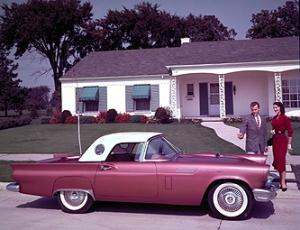
“We are one budget deal away from being the hot spot of the world. Europe is in the toilet, China’s growth has fallen down, and the Middle East is going backwards. We have a lot of potential for fracking and innovation. If we can prove our nation is governable, we will be the golden spot in the world,” said David Brooks, a conservative columnist for the New York Times.
Global Market Comments
April 30, 2025
Fiat Lux
Featured Trade:
(THE LAZY MAN’S GUIDE TO TRADING),
(ROM), (UXI), (BIB), (UYG)
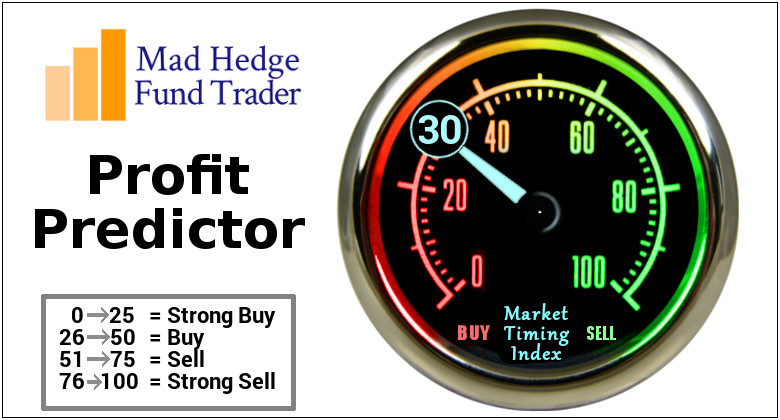
Global Market Comments
April 29, 2025
Fiat Lux
Featured Trade:
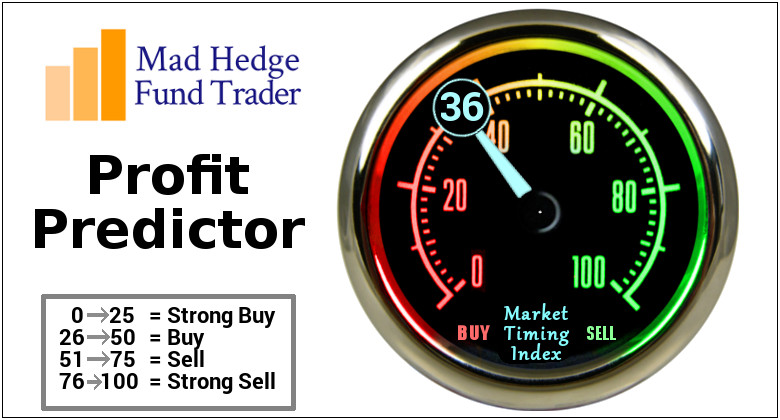
(THE NEXT THING FOR THE FED TO BUY IS GOLD)
(GLD), (GOLD), (GDX), (NEM)

A huge new buyer may eventually enter the gold market.
That could be a year off, maybe two, or three at the most.
I’ll give you a hint who: your taxes will pay for it.
If true, it could send the price of the barbarous relic soaring above $5,000, or even $50,000 an ounce, a target long led by the tin hat Armageddon crowd.
When I spoke to a senior official at the Federal Reserve the other day, I couldn’t believe what I was hearing.
If the American economy moves into the next recession with rising inflation, a near certainty, its hands will be tied. It dare not cut rates for fear of further fanning the flames.
At that point, our central bank’s primary tool for stimulating US businesses will become utterly useless, ineffective, and impotent.
What else is in the tool bag?
How about large-scale purchases of Gold (GLD)?
You are probably as shocked as I am by this possibility. But there is a rock-solid logic to the plan. As solid as the vault at Fort Knox.
The idea is to create asset price inflation that will spread to the rest of the economy. It already did this with great success from 2009-2014 with quantitative easing, whereby almost every class of debt securities was hoovered up by the government.
“QE on steroids” would involve large-scale purchases of not only gold, but stocks, government bonds, and exchange-traded funds as well.
If you think I’ve been smoking California’s largest cash export (it’s not almonds), you would be in error. I should point out that the Japanese government is already pursuing QE to this extent, at least in terms of equity-type investments.
And, as the history buff that I am, I can tell you that it has been done in the US as well, with tremendous results.
If you thought that President Obama had it rough when he came into office in 2009, it was nothing compared to what Franklin Delano Roosevelt inherited.
The country was in its fourth year of the Great Depression. US GDP had cratered by 43%, consumer prices had crashed by 24%, the unemployment rate was 25%, and stock prices had vaporized by 90%.
Mass starvation loomed.
Drastic measures were called for.
FDR issued Executive Order 6102 banning private ownership of gold, ordering citizens to sell their holdings to the US Treasury at a lowly $20.67 an ounce.
He then urged Congress to pass the Gold Reserve Act of 1934, which instantly revalued the government’s holdings at $35.00, an increase of 69.32%. These and other measures caused the value of America’s gold holdings to leap from $4 to $12 billion.
Since the US was still on the gold standard back then, this triggered an instant dollar devaluation of more than 50%. The high gold price sucked in massive amounts of the yellow metal from abroad creating, you guessed it, inflation.
The government then borrowed massively against this artificially created wealth to fund the landscape-altering infrastructure projects of the New Deal.
It worked.
During the following three years, the GDP skyrocketed by 48%, inflation eked out a 2% gain, the unemployment rate dropped to 18%, and stocks jumped by 80%. Happy days were here again.
However, in the 21st-century version of such a gold policy, it is highly unlikely that we would see another gold ownership ban.
Instead, the Fed would most likely move into the physical gold market, sitting on the bid for years, much like it did in the 2010s Treasury bond market for five years. Gold prices would increase by a multiple of current levels.
It would then borrow against its new gold holdings, plus the 4,176 metric tonnes worth $40 billion at today’s market prices already sitting in Fort Knox, to fund a multibillion-dollar tax cut.
Yes, this all sounds like a fantasy. But negative interest rates were considered an impossibility only a few years ago.
The Fed’s move on gold would be only one aspect of a multi-faceted package of desperate last-ditch measures to resuscitate the economy at some point in the future. The time to start buying gold is RIGHT NOW!
Persistent urban legends and Internet rumors claim that the vault is actually empty or filled with fake steel bars painted gold.
That is, until Treasury Secretary Steven Mnuchin visited the vault on his way to view the solar eclipse at government expense in August 2017.
He says the gold is still there. But only if you believe Steve Mnuchin. A lot don’t.
We’ll never know for sure. Visitors are not allowed.


Global Market Comments
April 28, 2025
Fiat Lux
Featured Trade:
(MARKET OUTLOOK FOR THE WEEK AHEAD, or HERE’S THE BEST-CASE SCENARIO)
(SPY), (TLT), (NFLX), (COST), (NVDA), (TSLA), (MSTR)

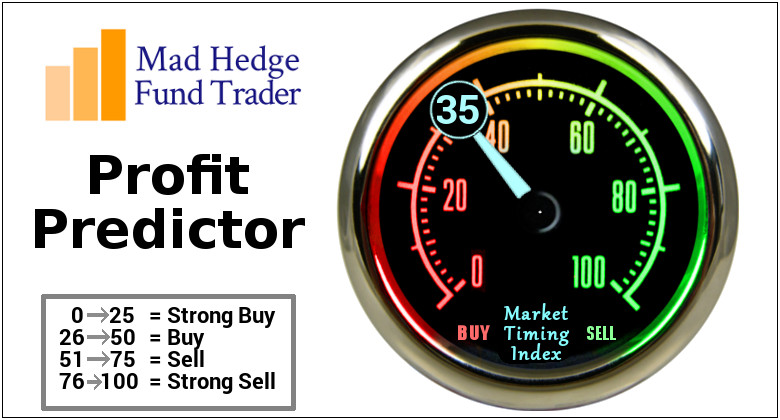
Last week, a concierge customer asked me an excellent question. Having correctly called the top in this market to the hour, what would it take for me to go all in on the long side and get maximum bullish?
With everyone now laser-focused on downside risks, which was really a last February game, I thought I’d take the opportunity this morning to examine the upside possibilities, if there are any at all.
Let’s say that the trade war ends before the ninety-day deadline is up on July 9, and the Chinese tariffs are reduced from a trade embargo of 145% to, say, only 20%. Markets will instantly rally 10%, with possibly half of that move happening at a market opening, so you can’t participate.
That is in effect, as what happened last week, with investors willing to look through the trade war to a less onerous business environment sometime in the future. A 20% tariff still takes the US growth rate down to zero, but it at least takes a recession off the table. Problem number one: Zero-growth economies don’t command high earnings multiples.
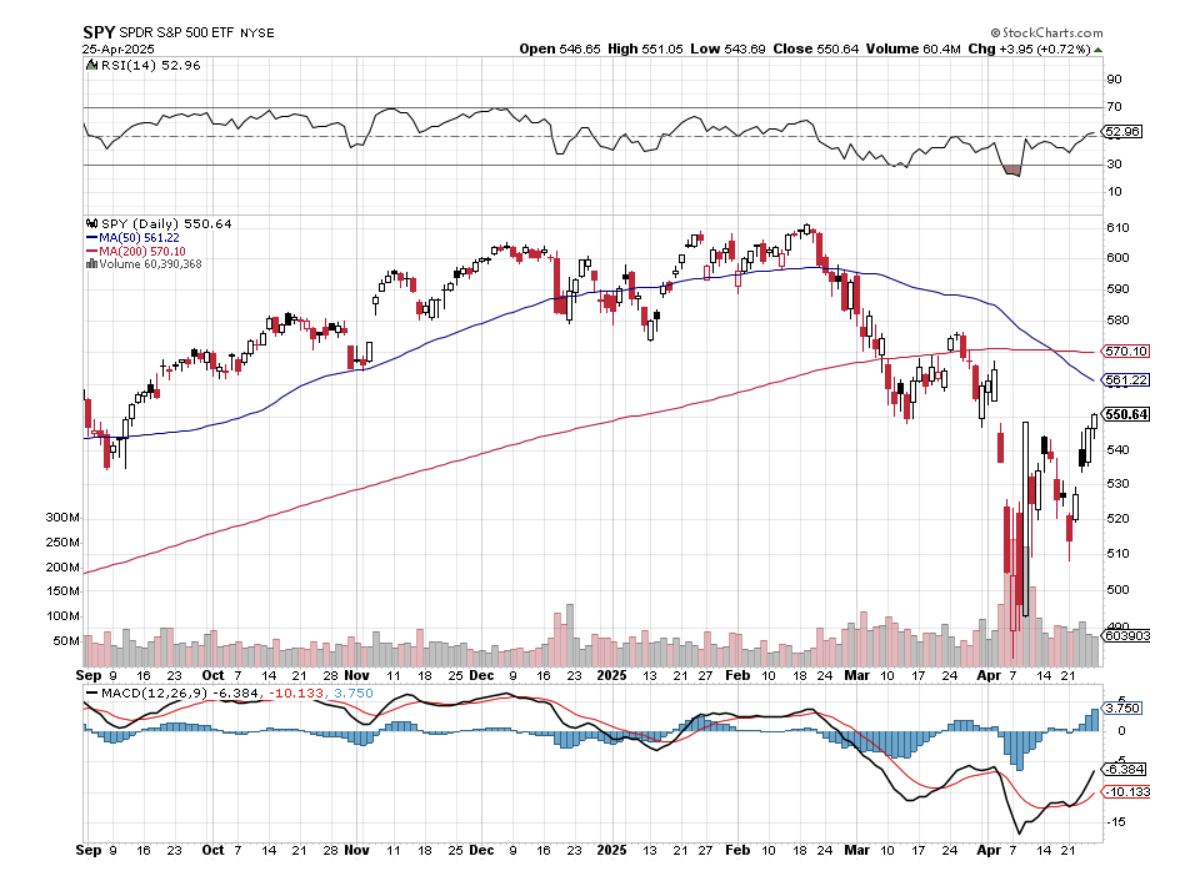
The problem with that scenario is that we hit a wall of selling above 5,800, where the late entrants came in but are now trying to get out, at close to cost. To get above that level, we need a really powerful fundamental bull case, which is now nowhere on the horizon. That’s why it’s unlikely that the stock market will see any positive returns for 2025.
The reality is that the trade war is not the only place where the economy has been driven off the rails. Even a 20% tariff brings substantially higher prices. International trade is falling off a cliff. Massive cuts in government spending are highly deflationary. Deporting large numbers of immigrants reduces demand and shrinks the labor supply. Unless Congress can pass a budget bill soon, we are on track to see an automatic $5 trillion tax increase by yearend. The budget deficit will hit a new record for this year.
Needless to say, companies will continue to sit on their hands with this amount of uncertainty and wait for the many unknowns to play out. None of these commands higher multiples for equities, let alone the near record S&P 500 multiple at 20X that prevails now.
To really get maximum bullish like I was for most of the last 15 years, the economy would have to return to the conditions that took stocks to record highs like we had until three months ago. That would be a globalized free-trading economy with the US playing a dominant role. That’s an economy that deserves high earnings multiples.
We won’t see that for at least four more years, but markets may start to discount it in only three years as we run up to the next presidential election in 2028. Imagine a future presidential candidate who campaigns on a zero-tariff regime and a return to globalization.
To get a sustainable multi-year bull market in stocks, it would help a lot if we started from a much lower base first. New bull markets don’t start at 20X multiples. A 16X multiple is much more likely, or 20% lower than we are now. We may get that.
The government is currently trying to break up three of the Magnificent Seven with antitrust actions, which led the march to higher stock markets for years. Corporate earnings are now rapidly shrinking, but we won’t see the hard numbers until August. Until then, we only get forecasts. Lower earnings command much lower multiples. That leaves on the table my 4,500 forecast low for the (SPX).
We could well be stuck in a trading range for years. Stocks could continue to bump their heads up against a (SPX) 5,800 ceiling but also get talked up by the administration whenever it collapses towards 4,800. Some 1,000 (SPX) points is quite a wide trading range to play with and plenty enough to make money on.
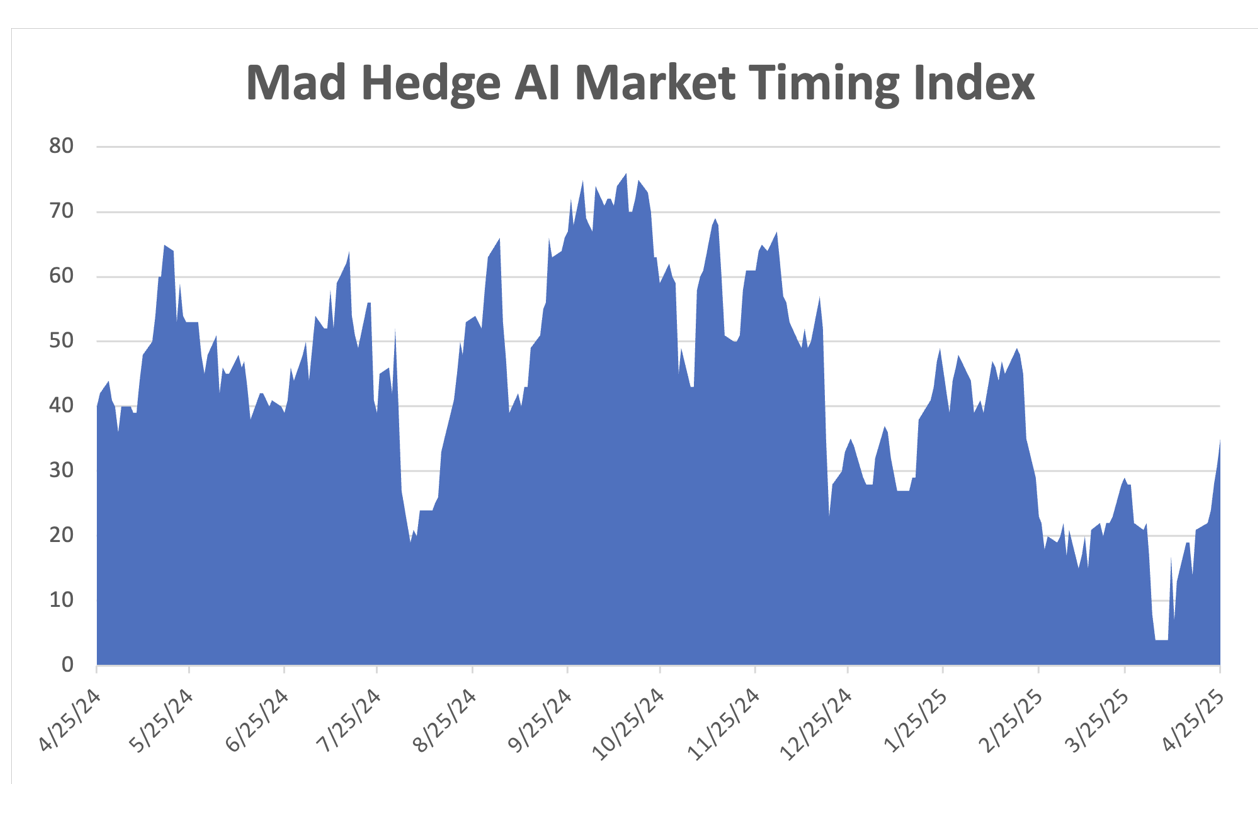
I did it only last week. You have to ignore the news flow and use the volatility index ($VIX) for your market timing. When the ($VIX) hit $54 last week, I piled on longs in (NFLX), (NVDA), (MSTR), and (JPM). By Friday, I gained 8.12% in new performance, my best weekly return in the 17-year history of Mad Hedge Fund Trader.
What if you just want to take a long-term view and not have to check the ($VIX) in between every putt on the golf course?
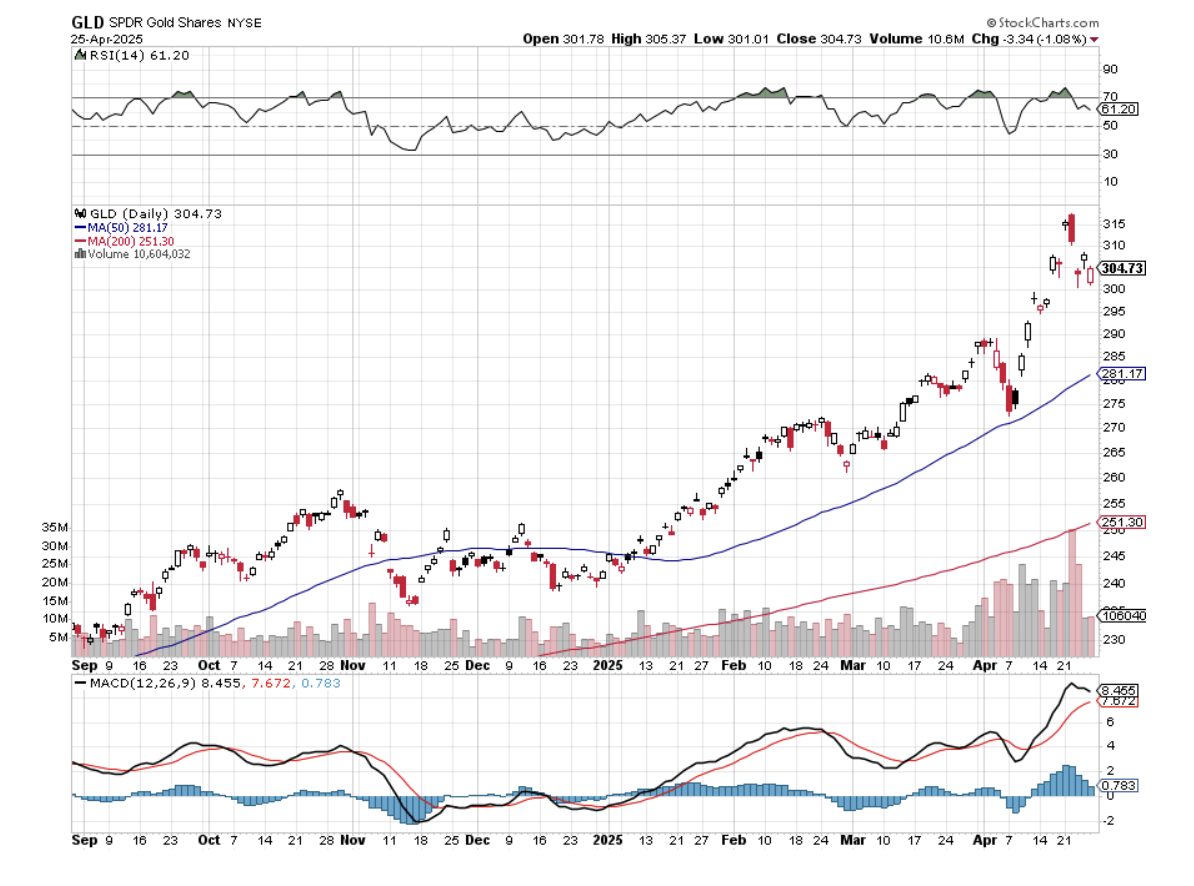
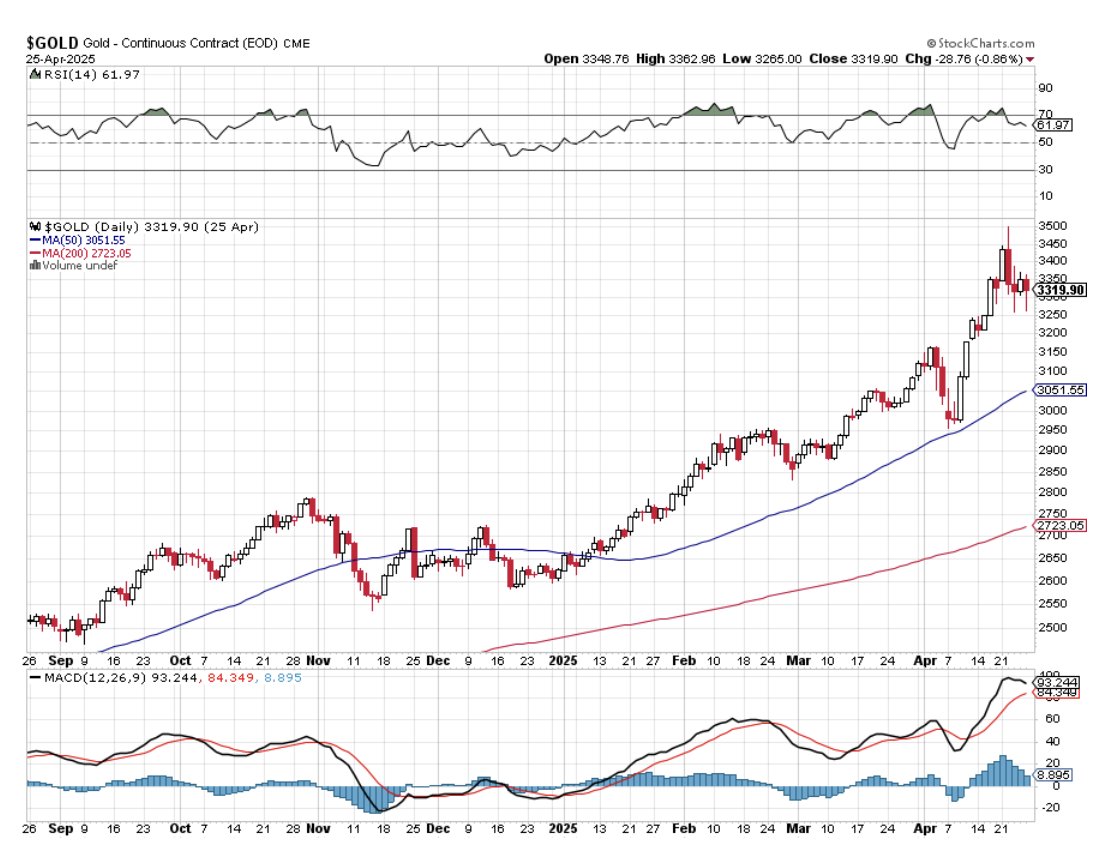
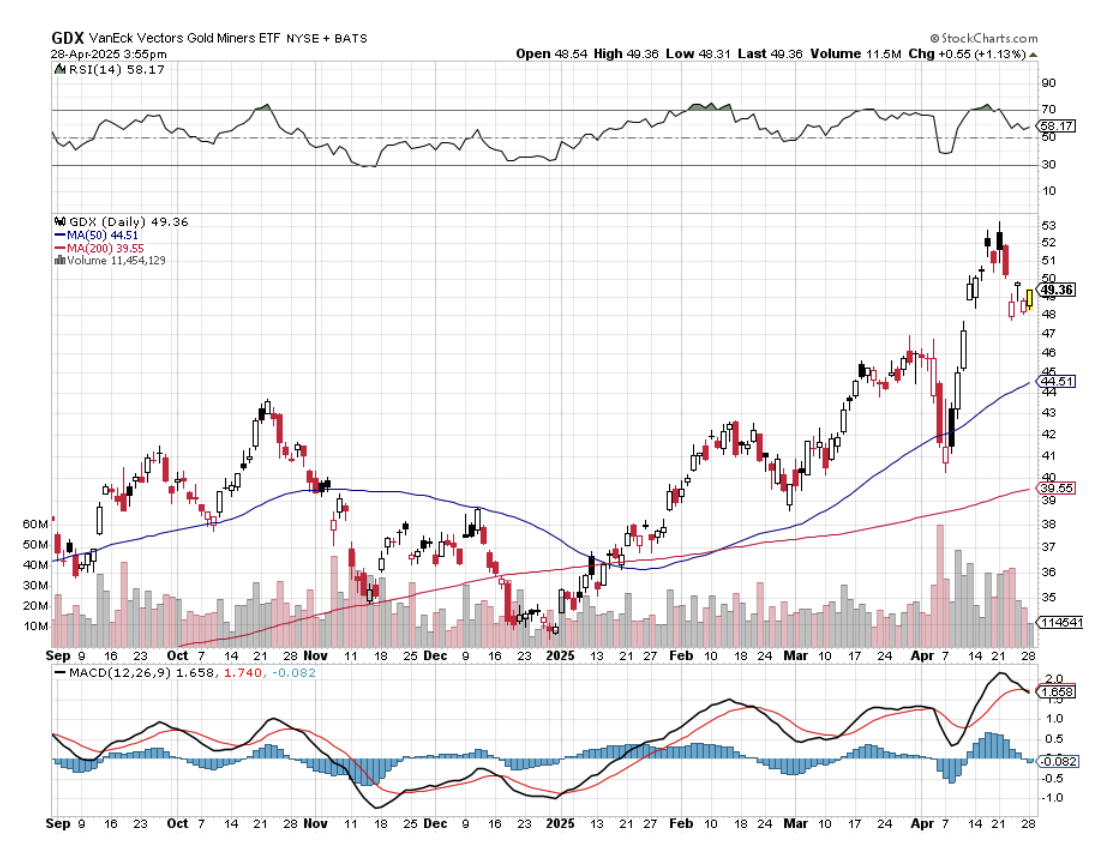
Gold (GLD) is looking pretty darn good right now. With the collapse of the US dollar ongoing, flight to safety assets is in short supply. American economic conditions will get worse before they get better. Central bank accumulation has continued at its torrid decade-long pace. And gold seems to have broken the link with interest rates that held it back for so long, eliminating opportunity cost as an issue. Even ultra-cautious JP Morgan expects the barbarous relic to reach $4,000 an ounce this quarter.
The great mystery in the sector has been the lagging performance of the gold miners. While gold doubled, the shares of Barrack Gold (GOLD) went nowhere.
Gold miners have yet to be taken seriously by mainstream institutional investors, as they are often the subject of excessive promotion, scams, and outright fraud. Token or non-existent dividends are another impediment. Millennials have clearly gravitated towards crypto instead. Miners also got a bad rap from the ESG investment trend as they are considered a “dirty” industry. Anything US dollar-denominated is being dragged down by the weak greenback. That’s why gold only accounts for 0.54% of global portfolios today, versus 2.48% in 1998.
That may all be about to change.
Last week, Barrack Gold, which mines gold at a cost of $1,600 an ounce and sells it at the recent $3,500, completed a monster 23% move in the shares. Newmont Mining (NEM) completed an incredible 32% move. Gold attractiveness is such that only a 5% decline was enough to pull me back in on the long side last week.
High prices atone for a lot of sins.
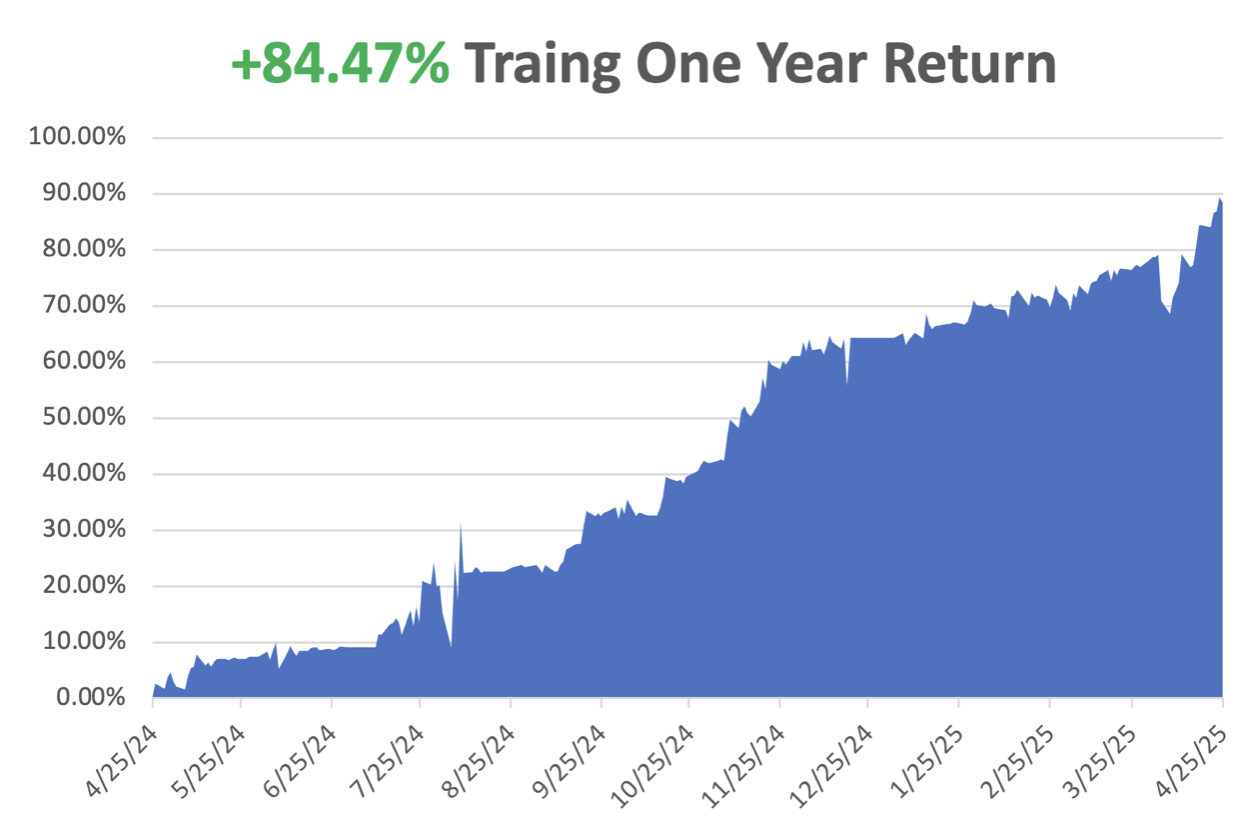
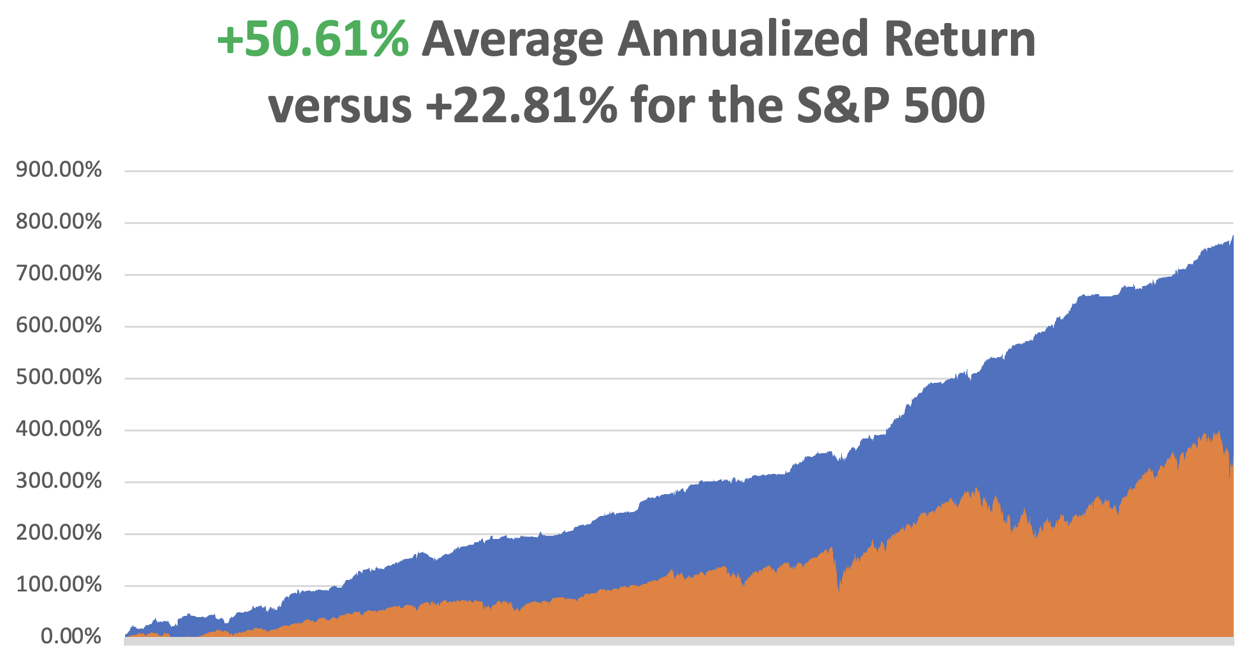
April is now up by a spectacular +10.31%. That takes us to a year-to-date profit of +24.14% so far in 2025. My trailing one-year return stands at a spectacular +84.47%. That takes my average annualized return to +50.61% and my performance since inception to +776.03%, a new all-time high.
It has been another wild week in the market. I used the 1,200-point meltdown in the Dow Average on Monday to add longs in (NFLX), (JPM), and (MSTR). I also quickly covered a short in (MSTR). After the market rallied 2,000 points, I added shorts in (TSLA), (SPY), and a new long in (GLD). That leaves me 40% long, 30% short, and 30% cash. If everything goes our way on the May 16 options expiration day, we will be up 30% on the year.
Some 63 of my 70 round trips in 2023, or 90%, were profitable. Some 74 of 94 trades were profitable in 2024, and several of those losses were really break-even. That is a success rate of +78.72%.
Try beating that anywhere.
Stock Market Suffers the Worst Start to a Year in History. April was the worst since 1932, and lower lows beckon. The Real “Trump Trade” was a “Sell America” trade, with stocks, bonds, energy, and the US dollar all collapsing.
Fed Beige Books Point to Stagflation. Prices are rising and economic activity has begun to slow across parts of the nation as businesses and households try to adapt to Trump’s erratic rollout of sweeping tariffs aimed at reshaping global trade, a report Wednesday from the Federal Reserve showed. Uncertainty around international trade policy was pervasive across reports, the U.S. central bank said.
Leading Economic Indicators Plunge, published Monday by research group The Conference Board, fell 0.7%, to 100.5, in March, following an upwardly revised 0.2% decline in February. Economists polled by The Wall Street Journal had expected a 0.5% decline for March. The recession is here, you just don’t know it yet.
Europe Lowers Interest Rates, down 0.25% to 2.25%, to head off a recession caused by Trump tariffs. The bank’s rate-setting council decided at a meeting in Frankfurt to lower its benchmark rate by a quarter percentage point to 2.25%. The bank has been steadily cutting rates after raising them sharply to combat an outbreak of inflation from 2022 to 2023.
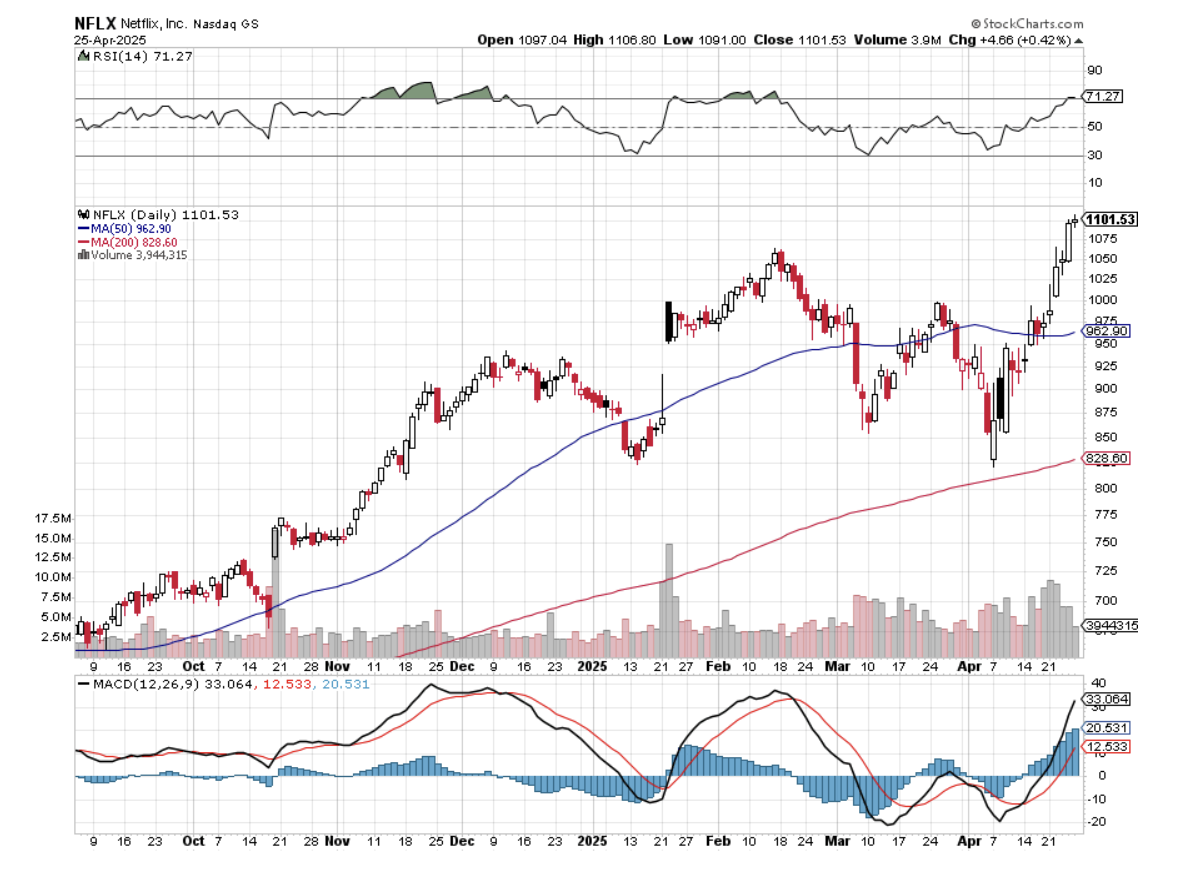
Netflix Earnings rocket, setting the stock on fire, as an indication that the stock may be recession-proof. Netflix reported first-quarter adjusted earnings of $6.61 a share on revenue of $10.54 billion. Analysts surveyed by FactSet expected earnings of $5.67 a share on revenue of $10.5 billion. The stock climbed 3.4% in after-hours trading. As of the market close Thursday, it has risen 9.2% this year. Buy (NFLX) on dips.
IMF Cuts US GDP forecast for 2025 from 2.8% to 1.8%, and they are a deep lagging indicator. The prediction is part of a wide-ranging reduction in global growth. Tariffs are to blame.
US Dollar Hits Three-Year Low, as the flight from American trade accelerates. No trade with the US means no need to buy the greenback.
Gold Tops $3,424, the 1980 inflation-adjusted all-time high. A shortage of “Sell America” trades is driving everyone into gold all at once. The (GDX) gold miners ETF hit a 13-year high. Gold imports are now a major contributor to the US trade deficit.
JP Morgan Targets Gold at $4,000 in Q2, as the “Sell America” trade gathers steam. Central banks are the big winners here, which have been hoovering up the barbarous relic for years.
Tesla Bombs, with Q1 earnings down a gob-smacking 71%, a four-year low. Sales are in free fall globally. Tesla’s cost of making and selling vehicles dropped over 17% year over year, driven by lower raw material prices and reduced expenses of ramping up Cybertrucks production. Automotive gross margin for the period, excluding regulatory credits, was 12.5%, down from 30% a year ago, compared with expectations of 11.8%. Tesla short sellers have earned $11.5 billion so far this year, including myself, with the stock down 55%. The shares rose $10 on news that Elon Musk will spend significantly less time with DOGE. Buy only the biggest dips in (TSLA).
Record Funds are Pouring into Japan. Overseas investors have bought a net ¥9.64 trillion ($67.5 billion) of the Asian nation’s debt and equities so far in April, according to preliminary weekly figures released by the Ministry of Finance on Thursday. That level is already the most for any month on record, based on balance-of-payments data going back to 1996. What was the only thing Warren Buffett was buying last year? Japanese trading companies.
Existing Homes Sales Hit 16-Year Low. Sales of previously owned US homes fell 5.9% in March to an annualized rate of 4.02 million, the weakest March since 2009. The median sales price increased 2.7% from a year ago to $403,700, a record for the month of March and extending a run of year-over-year price gains dating back to mid-2023.
Apple to Move All iPhone Production to India. It is a move that has been underway for some time due to China’s soaring labor costs. Since I began covering China in the early 1970s, China's average annualized income has risen from $300 a year to $16,000, up 5,300%.
Alphabet (GOOG) Beats, after the company topped Wall Street estimates and showed growth in its advertising and search business. The company suggested that it’s too soon to tally the impact of Trump’s tariffs, but the ending of the de minimis loophole could create a “slight headwind” to its advertising business. The really interesting number was Alphabet’s estimate of a potential market size of 4 billion rides a year for its Waymo autonomous driving taxi service.
My Ten-Year View – A Reassessment
We have to substantially downsize our expectations of equity returns in view of the election outcome. My new American Golden Age, or the next Roaring Twenties, is now looking at multiple gale-force headwinds. The economy will completely stop decarbonizing. Technology innovation will slow. Trade wars will exact a high price. Inflation will return. The Dow Average will rise by 600% to 240,000 or more in the coming decade. The new America will be far more efficient and profitable than the old. My Dow 240,000 target has been pushed back to 2035.
On Monday, April 28, at 8:30 AM EST, the Dallas Fed Manufacturing Index is announced.
On Tuesday, April 29, at 3:30 AM, the S&P Case Shiller National Home Price Index is released. We also get the JOLTS job openings report.
On Wednesday, April 30, at 8:30 PM, the Q1 GDP growth rate is published, as is the CPI for April.
On Thursday, May 1, at 8:30 AM, the Weekly Jobless Claims are disclosed.
On Friday, May 2, at 8:30 AM, we get the Nonfarm Payroll Report for April.
As for me, when I was shopping for a Norwegian Fjord cruise a few years ago, each stop at a port was familiar to me because a close friend had blown up bridges in every one of them during WWII.
During the 1970s at the height of the Cold War, my late wife Kyoko flew a monthly round trip from Tokyo to Moscow as a British Airways stewardess. As she was checking out of her Moscow hotel, someone rushed up to her and threw a bundled typed manuscript that hit her in the chest.
Seconds later, a half dozen KGB agents dog piled on top of Kyoko. It turned out that a dissident was trying to get her to smuggle a banned book to the West. She was arrested as a co-conspirator and bundled away to the notorious Lubyanka Prison.
I learned of this when the senior KGB agent for Japan contacted me, who had attended my wedding the year before and filmed it. He said he could get her released, but only if I turned over a top-secret CIA analysis of the Russian oil industry.
At a loss for what to do, I went to the US Embassy to meet with Ambassador Mike Mansfield, whom, as The Economist correspondent in Tokyo, I knew well. He said he couldn’t help me as Kyoko was a Japanese national, but he knew someone who could.
Then in walked William Colby, head of the CIA.
Colby was a legend in intelligence circles. After leading the French resistance with the OSS, he was parachuted into Norway with orders to disable the railway system. Hiding in the mountains during the day, he led a team of Norwegian freedom fighters who laid waste to the entire rail system from Tromso all the way down to Oslo. He thus bottled up 300,000 German troops, preventing them from retreating home to defend from an allied invasion.
During Vietnam, Colby became known for running the Phoenix assassination program. It was wildly successful.
I asked Colby what to do about the Soviet request. He replied, “Give it to them.” Taken aback, I asked how. He replied, “I’ll give you a copy.” Mansfield was my witness, so I could never be arrested for being a turncoat.
Copy in hand, I turned it over to my KGB friend, and Kyoko was released the next day and put on a flight out of the country. She never took a Moscow flight again.
I learned that the report predicted that the Russian oil industry, its largest source of foreign exchange, was on the verge of collapse. Only a massive investment in modern Western drilling technology could save it. This prompted Russia to sign deals with American oil service companies worth hundreds of millions of dollars.
Ten years later, I ran into Colby at a Washington event, and I reminded him of the incident. He confided in me, “You know that report was completely fake, don’t you?” I was stunned. The goal was to drive the Soviet Union to the bargaining table to dial down the Cold War. I was the unwitting middleman. It worked.
That was Bill, always playing the long game.
After Colby retired, he campaigned for nuclear disarmament and gun control. He died in a canoe accident on the lake in front of his Maryland home in 1996.
Nobody believed it for a second.

William Colby

Kyoko
Good Luck and Good Trading,
John Thomas
CEO & Publisher
The Diary of a Mad Hedge Fund Trader