
As most of my subscribers? know, I try to call all of them at least once a year and address their individual concerns.
Not only do I pick up some great information about regions, industries, businesses, and companies, I also learn how to rapidly evolve the Diary of a Mad Hedge Fund Trader service to best suit my voracious readers.
So when a gentleman asked me the other day to reveal to him the top performing asset of the next 30 years, I didn?t hesitate: your home. He was shocked.
I listed off the many reasons why residential housing is just entering a Golden Age that will drive prices up tenfold, if not 100-fold in the decades to come.
1) Demographics
This has been the hard decade for housing, when 80 million downsizing baby boomers unloaded their homes for greener pastures at retirement condos and assisted living facilities.
The 65 million Gen Xers who followed were not only far fewer in number, they earned much less, thanks to globalization and hyper accelerating technology.
All of this conspired to bring us a real estate crash that bottomed out in 2011.
During the 2020s, the demographics reverse. That?s when 85 million millennials start chasing the homes owned by 65 million Gen Xers. And, as they age, this group will be earning a lot more disposable income, thanks to a coming labor shortage.
2) Population Growth
If you think it's crowded now, you haven?t seen anything yet.
Over the next 30 years, the US population is expected to soar from 322 million today to 400 million. California alone will rocket from 38 million to 50 million.
That means housing for 78 million new Americans will have to come from somewhere. It sets up a classic supply/demand squeeze.
That?s why megaprojects like the San Francisco to Los Angeles bullet train, which may seem wasteful and insane today, might be totally viable by the time they are finished.
3) They?re Not Building Them Anymore
Or at least not as much as they used to.
In August, 2016, new home building delivered an annualized pace of a scant 609,000 new units, compared to a peak of 2 million a month prior to 2008. That means they are producing less than a third of peak levels.
The home building industry has to more than double just to meet current demand.
Builders blame regulations, zoning, the availability of buildable land, lack of financing, and labor shortages.
The reality is that the companies that survived the 2008 crash are a much more conservative bunch than they used to be. They are not looking for market share.
Instead, they are targeting a specific return on capital for their business, probably 20% a year pre tax.
It is no accident that new home builders like Lennar (LEN), Pulte Homes (PHM) and DR Horton (DHI) make a fortune when building into rising prices and restricted supply.
This strategy is creating a structural shortage of 5 million new homes in this decade alone.
4) The Rear View Mirror
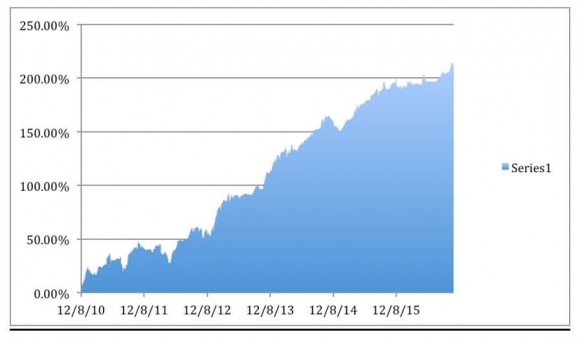
The S&P 500 Real Estate Price Index (see below) is currently running at an annual increase of 5.1%. Net out the many tax breaks that come with ownership, the real annual return is closer to 7%.
That beats cash at 0%, municipal bonds at 1.25%, US Treasury bonds at 1.55%, S&P 500 equities with dividends at 5%, and junk bonds at 5.5%.
Unless you have a new Internet start up percolating in your garage, it is going to be very hard to beat your own home?s return.
5) The Last Leverage Left
A typical down payment on a new home these days is 25%. That gives you leverage of 4:1. So in a market that is rising by 5.1% a year, your increase in home equity is really 20.4% a year.
Pay a higher interest rate, and down payments as low as 10% are possible, bringing your annual increase in home equity to an eye popping 51%.
There are very few traders who can make this kind of return, even during the most spectacular runaway bull market. And to earn this money on your house, all you have to do is sleep in it at night.
6) The Tax Breaks are Great
The mortgage interest on loans up to $1 million are deductible on your Form 1040, Schedule ?A?.
You can duck the capital gains entirely if the profit is less than $500,000, you?re married, and lived in the house for 2 years or more.?
Any gains above that are taxed at only a maximum 20% rate. These are the best tax breaks you can get anywhere without being a member of the 1%.
7) Job Growth is Good and Getting Better
The monthly Non Farm Payroll reports are averaging out at about 200,000 a month. As long as we maintain this level or higher, enough entry level homeowners are entering the market to keep prices rising.
And you know those much-maligned millennials? They are finally starting to have kids, need larger residences, and are turning from renting to buying. 8) There is No Overbuilding Anywhere
Never in the history of the industry have we been so far into an economic recovery, now seven years, without any sign of overbuilding.
You know those forests of cranes that blighted the landscape in 2006? They are nowhere to be seen, except in San Francisco.
The other signs of excess speculation:? liars' loans, artificially high appraisals, and rapid flipping are also nowhere to be seen.
No bubble means no crash. Prices should just continue grinding upwards in a very boring nonvolatile way.
9) Foreign Capital is Pouring In
Here in the San Francisco Bay Area stories abound of Chinese showing up with suitcases of cash and buying million-dollar homes.
The problem has become so endemic that the US Treasury is demanding proof of beneficial ownership on sales over $2 million to get behind shell companies and frustrate money laundering and tax evasion.
And with yields at 4.5%-6.5% in US commercial real estate, foreign institutions are pouring in tens of billions of dollars in capital. Remember, they are fleeing negative rates at home.
US real estate has become the world?s largest high yield asset class.
So the outlook is pretty rosy for individual home ownership for the foreseeable future.
Just don?t forget to sell by 2030.
That's when the next round of trouble begins.
https://www.madhedgefundtrader.com/wp-content/uploads/2016/09/Johns-House.jpg356473DougDhttps://madhedgefundtrader.com/wp-content/uploads/2019/05/cropped-mad-hedge-logo-transparent-192x192_f9578834168ba24df3eb53916a12c882.pngDougD2016-09-30 01:07:172016-09-30 01:07:17Your Best Performing Asset Just Got Better
If you have been living in a cave for the last 75 years and missed the work of management guru, Peter F. Drucker, here is your chance to catch up.
I finished reading The Essential Drucker, a weighty tome of 368 pages which summarized the high points and pearls of wisdom of the author's 38 books published since 1939.
A self-described?social ecologist?, Drucker was a journalist who moved to Germany because job prospects in his native Austria-Hungary were so poor following its defeat in WWI.
He became a close friend of Austrian economist Joseph Schumpeter, who popularized the term ?creative destruction?, and attended lectures by John Maynard Keynes. He fled to the US in 1934 after his writings were burned by the Nazis.
For most of human history, armies were the predominant management model, and most corporations today show the military influence.
Management only emerged as a science during the 1920s, and Drucker was one of the founding fathers. Early adopters, like Coca Cola, Du Pont, IBM, and General Electric, went on to prosper mightily.
He observed that Franklin Delano Roosevelt set up the most productive administration in history. Taking even a single step was so painful for him that he, and all those who worked around him, had to organize the government with the maximum efficiency possible.
This was a key element in America's victory in WWII.
Drucker writes at length on the risks and opportunities of entrepreneurship, and argues that all companies must innovate or die, no matter how pedestrian their product.
He predicted many of the trends that came to dominate the late 20th and early 21st century, such as privatization, decentralization, globalization, and the rise of the knowledge worker.
He had a huge following when I was in Japan during the seventies, and his mark can be seen in today's global presence of the major Japanese keiretsu.
While most define a company in terms of producing products and making a profit, Drucker sees it's mission as?creating a customer?. He presents a rigorous process for decision making.
He lauds nonprofits as the best-run organizations in the country because they have to be. Groups like the Girl Scouts, the Red Cross, and United Way maintain an effective global presence without paying their people any money.
He makes the distinction between efficiency and effectiveness, doing things right, versus doing the right things.
Anyone who manages a business, from a Fortune 500 company to a single individual banging away on a PC at home, will benefit from reading this book.
It forces you to take a look at your own operation with fresh eyes. It even advises on how to manage one's own time, from dispensing with unnecessary meetings to minimizing paperwork and bureaucracy.
Drucker moved to California during the seventies, where he set up one of the early MBA programs for Claremont College.
He died in 2005 at the age of 96. To order this insightful book from Amazon, please click here.
https://www.madhedgefundtrader.com/wp-content/uploads/2013/02/The-Essential-Drucker.jpg513339Mad Hedge Fund Traderhttps://madhedgefundtrader.com/wp-content/uploads/2019/05/cropped-mad-hedge-logo-transparent-192x192_f9578834168ba24df3eb53916a12c882.pngMad Hedge Fund Trader2016-09-30 01:06:102016-09-30 01:06:10Peter F. Drucker on Management
Expectations of a substantial outcome from the Algiers OPEC meeting were zero. Traders loaded up on the short side.
So when word leaked out about a production cap to take place in November, futures went screaming, adding $3, or 6.75% to the price of Texas tea in hours.
OPEC wide production will be limited to 32.5 million barrels a day. Final numbers will be fixed at a November 22nd OPEC meeting in Vienna. Currently, OPEC is producing 33 million barrels a day.
Big oil did as well, with Exxon Mobil (XOM) rocketing 4.67%.
If there was ever a ?buy the rumor, sell the news? event, this is it.
I have monitored OPEC since a decade after it was it was created in Bagdad in 1960, and have traveled in the Middle East for 49 years.
I covered the neighborhood wars for The Economist magazine during the 1970s.
When representing Morgan Stanley in the firm?s dealings with the Saudi royal family in the 1980s, I paused to stick my finger in the crack in the Riyadh city gate left by a spear thrown by King Abdul Aziz al Saud when he captured the city in the 1920s, creating modern Saudi Arabia.
The only mistake I made in my Texas fracking investments is that I sold out too soon in 2005, when natural gas traded from $2 a BTU to $5, and missed the spike to $17.
So let me tell you about the price of oil.
There has never been an OPEC agreement made in person that has stuck. No matter what they promise, they cheat before the ink is dry on any deal.
Saudi Arabia, which has the final say on the price of oil, went into the meeting with production at an all time high of over 11 million barrels a day.
Over the past year alone they have boosted production by an amazing 400,000 barrels a day.
So it will be more than interesting to find out what they do from here.
It is a matter of national survival for the Sunni Kingdom to keep its Shiite enemy across the Persian Gulf, Iran, as economically weak as possible. That means keeping oil prices lower for longer.
It will also be fascinating to see how fast American fracking production will come back on stream.
The Baker Hughes Rig Count has risen for 12 of the past 13 weeks, and there are another 1,000 wells already drilled, but not brought on line.
So what I?m getting to here is that an excellent short selling opportunity its setting up for oil (USO), the Energy Select Sector SPDR Fund (XLE), and individual energy stocks like (XOM).
Just don?t shoot your wad too soon.
Camels Will Fly When OPEC Keeps a Promise
https://www.madhedgefundtrader.com/wp-content/uploads/2016/09/Flying-Camel-e1475113823535.jpg298400DougDhttps://madhedgefundtrader.com/wp-content/uploads/2019/05/cropped-mad-hedge-logo-transparent-192x192_f9578834168ba24df3eb53916a12c882.pngDougD2016-09-29 01:08:222016-09-29 01:08:22Don?t Buy the Oil Rally
Asset allocation is the one question I get every day which I absolutely cannot answer.
The reason is simple: no two investors are alike.
The answer depends on your age, net worth, tax bracket, risk tolerance and whether you're a sophisticated investor or an average Joe. ?
Asset allocation is something you should ask your financial advisor about.
Having said all that, there is one old hard and fast rule, which you should probably dump.
It used to be prudent to own your age in bonds. So if you were 70, you should have had 70% of your assets in fixed income instruments and 30% in equities.
Given the extreme over valuation of all bonds today, and that we are probably on the eve of a 30-year bear market, I would completely ignore this rule and own no bonds whatsoever.
This is especially true of government bonds, which are yielding negative interest rates in Europe and Japan, and only 1.55% in the US.
Instead you should substitute high dividend paying stocks for bonds. You can get 4% a year or more in yields these days, and a great inflation hedge to boot.
You will also own what everyone else in the world is trying to buy right now, high yield US stocks.
You will get this higher return at the expense of higher volatility. So, just turn off the TV on the down days so you won?t get panicked out at the bottom.
That is, until we hit the next recession. Then all bets are off. That, however, may be three years or more off.
I hope this helps.
John Thomas The Mad Hedge Fund Trader
https://www.madhedgefundtrader.com/wp-content/uploads/2015/01/John-Thomas-Art-Museum.jpg377372DougDhttps://madhedgefundtrader.com/wp-content/uploads/2019/05/cropped-mad-hedge-logo-transparent-192x192_f9578834168ba24df3eb53916a12c882.pngDougD2016-09-29 01:07:152016-09-29 01:07:15Some Sage Advice About Asset Allocation
Global Market Comments September 27, 2016 Fiat Lux
Featured Trade: (SEPTEMBER 28TH GLOBAL STRATEGY WEBINAR), (OCTOBER 21ST SAN FRANCISCO, CA GLOBAL STRATEGY LUNCHEON), (WHY CHINA IS GOLD?S BEST FRIEND), (GLD), (GDX), (TLT)
SPDR Gold Shares (GLD) VanEck Vectors Gold Miners ETF (GDX) iShares 20+ Year Treasury Bond (TLT)
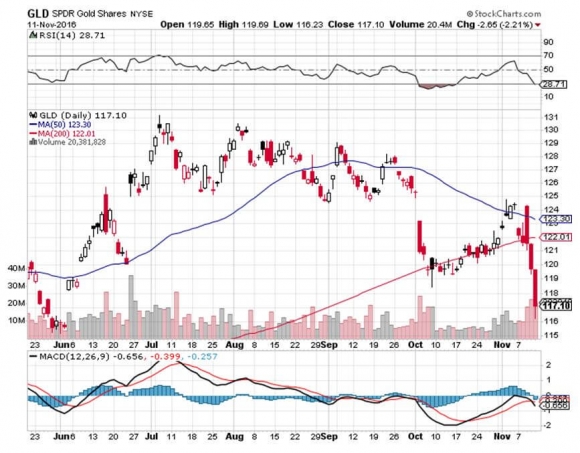
The good news is that you don?t have to be crazy, paranoid, or delusional to own gold (GLD).
However, the ?hundreds of individual investors I know who absolutely love the barbarous relic may not know exactly why.
They originally filled safe deposit boxes with old jewelry, American Eagles, and bullion bars as a hedge against the return of the double-digit INFLATION we endured during the 1970s.
Then gold became a DEFLATION hedge, as yielding nothing outperforms the negative interest rates offered by paper currencies, still -0.35% for the Euro and the Swiss Franc.
They are joined by what I call the tin hat, black helicopter, conspiracy theorists who eternally believe in the collapse of the US dollar and a default of US Treasury debt.
After all, it's always handy to have a few krugerrands in your pocket to bribe the border guards and escape the country (I never understood to where).
Recently, a new crowd of gold buyers has emerged.
Investors are soaking up the yellow metal as a hedge against a Trump presidential win. He has promised a crash of both the debt and equity markets.
Gold should soar.
However, few are aware of the true fundamental reasons for the long-term appreciation of the barbarous relic.
That would be the unrelenting accumulation of gold as a reserve asset by emerging market central banks, especially China.
The Middle Kingdom has long kept any information regarding its gold holdings a state secret.
Individual gold ownership was punishable by death, originally by firing squad, and more recently through organ harvesting.
That changed in June, 2015 when Beijing reported that it owned 1,658 metric tonnes. That is 56.7% higher than the last figure reported in 2009.
Since then, it has added another 165 metric tonnes. Its total holdings are now 1,823 metric tonnes worth $78.6 billion. This compares to the 8,134 metric tonnes, or $350 billion worth of gold owned by the US Treasury.
From these numbers, it is safe to assume that China will continue to add at least another 120 tonnes of gold to its reserve annually for at least another decade.
This should exert upward pressure on prices until we see a serious spike upward in global interest rates.
With ten year Treasury bonds (TLT) yielding 1.61% today, don?t hold your breath for that happening any time soon.
In addition, all of China?s domestic gold production is thought to go into a secret internal account not included in the nation?s central bank reserves.
Apparently, organ harvesting still applies to any release of statistics about THIS gold.
China?s gold buying is only part of an effort to recycle its massive trade surpluses back into the world economy, which last year ran a staggering $593 billion. Of this, $365.6 billion was with the United States.
Run a chart of China?s merchandise trade surpluses against the price of gold and you get an almost perfect match.
China isn?t loading up on gold because of any value or inflationary considerations. It is desperately attempting to diversify away from the US dollar, on which it has become overly reliant due to the massive size of its reserves.
As of July, China?s foreign exchange reserves totaled $3.23 trillion (see table below). America?s only ran to $120 billion, putting it only 14th in the world after the United Kingdom.
China owns $1.4 trillion worth of US Treasury bonds, notes, and bills, making it the largest holder after the Federal Reserve (which still owns $3.4 trillion left over from its quantitative easing programs).
In addition China owns trillions more in dollar cash, banks deposits, and other cash equivalents.
As long as the world remains a gigantic love fest, this is all fine. But what happens if Trump captures the White House?
China isn?t the only country engaging in a gold strategy.
When Iran was subject to trade sanctions and was banned from dollar clearing, it transacted a significant port of its business through gold barter transactions. Russia has lately been very active in the gold market for the same reason.
Other countries running big trade surpluses, like Germany, Russia, South Korea, the Netherlands, Taiwan, and Singapore, are doing the same.
And here is the number that will blow your mind.
For China to raise its gold holdings to the 17.4% of total reserves typical for developed countries, it needs to buy an incredible 10,101 metric tonnes worth $471 billion.
Add in gold purchases by other high surplus nations, and the total amount of net buying to come is truly mind boggling.
It all sounds like a prolonged bull market in gold to me, especially if interest rates stay lower for longer as I expect. This explains why the gold miners (GDX) had such a hyperbolic move early in 2016.
So you really don?t have to be crazy to own gold.
Well ?. maybe it helps a little bit.
China Trade Surplus 2004-2015
China Foreign Exchange Reserves
https://www.madhedgefundtrader.com/wp-content/uploads/2016/05/John-with-Gold-e1478998623625.jpg400400DougDhttps://madhedgefundtrader.com/wp-content/uploads/2019/05/cropped-mad-hedge-logo-transparent-192x192_f9578834168ba24df3eb53916a12c882.pngDougD2016-09-27 01:06:412016-09-27 01:06:41Why China is Gold?s Best Friend
Global Market Comments September 26, 2016 Fiat Lux
Featured Trade: (NOVEMBER 18TH LAS VEGAS, NV GLOBAL STRATEGY LUNCHEON), (MARKET OUTLOOK FOR THE COMING WEEK), (SPY), (VIX), (USO), (BATTERY BREAKTHROUGH PROMISES BIG DIVIDENDS), (TSLA)
SPDR S&P 500 ETF (SPY) VOLATILITY S&P 500 (^VIX) United States Oil (USO) Tesla Motors, Inc. (TSLA)
There is a very high degree of risk involved in trading. Past results are not indicative of future returns. MadHedgeFundTrader.com and all individuals affiliated with this site assume no responsibilities for your trading and investment results. The indicators, strategies, columns, articles and all other features are for educational purposes only and should not be construed as investment advice. Information for futures trading observations are obtained from sources believed to be reliable, but we do not warrant its completeness or accuracy, or warrant any results from the use of the information. Your use of the trading observations is entirely at your own risk and it is your sole responsibility to evaluate the accuracy, completeness and usefulness of the information. You must assess the risk of any trade with your broker and make your own independent decisions regarding any securities mentioned herein. Affiliates of MadHedgeFundTrader.com may have a position or effect transactions in the securities described herein (or options thereon) and/or otherwise employ trading strategies that may be consistent or inconsistent with the provided strategies.