"I mind my own business," she told the Guinness World Records. "And I don't eat junk food," Said Besse Cooper, the world?s oldest person, on her 116th birthday in Monroe, Georgia.


"I mind my own business," she told the Guinness World Records. "And I don't eat junk food," Said Besse Cooper, the world?s oldest person, on her 116th birthday in Monroe, Georgia.
As a potentially profitable opportunity presents itself, John will send you an alert with specific trade information as to what should be bought, when to buy it, and at what price. Read more
Here?s a chart that you don?t see very often, the one for iron ore priced in U.S. dollars. I?m sure that every miner working at BHP?s pits in the Australian outback goes to sleep with a print out of this chart clutched close to his chest. You can?t blame him, as his livelihood depends on it, and it has had a definite southerly tilt for the last two years, losing some 50% from the top.
The reasons are known by all. As Chinese growth downshifts from a torrid 13% annual rate to 7% now and possibly zero next year, the demand for Australia?s largest export has been evaporating like an ice cube in the western deserts. (BHP) has already cancelled one high profile project. There is news of contract defaults with Chinese buyers. Steel plants in the Middle Kingdom are seeing actual shutdowns.
As this is the world?s second largest bilateral trade after America?s oil imports from the Middle East, it offers a valuable window on the health of the global economy. And the patient currently has a bad case of the flu which may develop into a fatal case of pneumonia.
Now contrast this chart with the one for the S&P 500 (SPX), which couldn?t be more different. It has been in an uptrend for the past four years, has doubled off its 2009 low, and is on the verge of drifting up to four-year highs on no volume.
What gives? What we are seeing here is a classic war between the fundamentals and liquidity, and liquidity is winning. You would think that with the rest of the world headed for, or already in, recession, the market would be going to hell in a hand basket. Not so. Ben Bernanke and his central banker friends around the world have orchestrated a crescendo of printing presses that have kept the hopium coming and stock prices rising.
This leads me back to my headline, is ?RISK ON?/?RISK OFF? broken? It would certainly seem so as long as the Federal Reserve is keeping the pedal to the metal. So paper assets, like stocks and bonds, are enjoying their glory days. At the same time, any hard assets, especially those most consumed by China, like copper, iron, ore, sugar, zinc, Caterpillar (CAT) and Freeport McMoRan (FCX), are being beaten like the proverbial red-headed stepchild.
Gold (GLD) is getting a free pass from this punishment, as quantitative easing and the dollar devaluation it assures brings in lots of buyers. Oil (USO) is going up for all the usual geopolitical reasons, including Iran, Syria, Libya, and Hurricane Isaac.
So what?s a trader to do? For a start, it means you have to work harder. Making money is no longer a simple flip of the ?ON?/?OFF? switch. We now have to carefully analyze each asset class, industrial sector, and individual company looking to buy the cheapest ones and sell short the expensive ones against them.
Remember, while people have been bitching about falling volatility and low index returns, Apple (AAPL), my largest position, has soared by 70%. It?s not like this one was hard to find either. If fact, I can see their headquarters from my office window right now, while my iMac, iPad, iPhone 4s, and Airbook are charging.
Of course, there is one way to duck the new, heavy workload, and that is to leave all the heavy lifting to me. Making money in tough conditions like this is something that I thrive on. For the first time, I have sent out more trade alerts than newsletters this month, and the model portfolio has been up almost every day for four months.
Remember, the answer to all questions is to buy my newsletter.



As a potentially profitable opportunity presents itself, John will send you an alert with specific trade information as to what should be bought, when to buy it, and at what price. Read more
As a potentially profitable opportunity presents itself, John will send you an alert with specific trade information as to what should be bought, when to buy it, and at what price. Read more
Buy to Cover the Short position in the (TLT) September $116-$111 put spread at $0.07 or best
Closing Trade
8-28-2012 ? 11:30 AM EST
expiration date: 9-21-2012
Portfolio weighting: 5%on a delta basis
($5,000/100/$0.07) = 25 Contracts
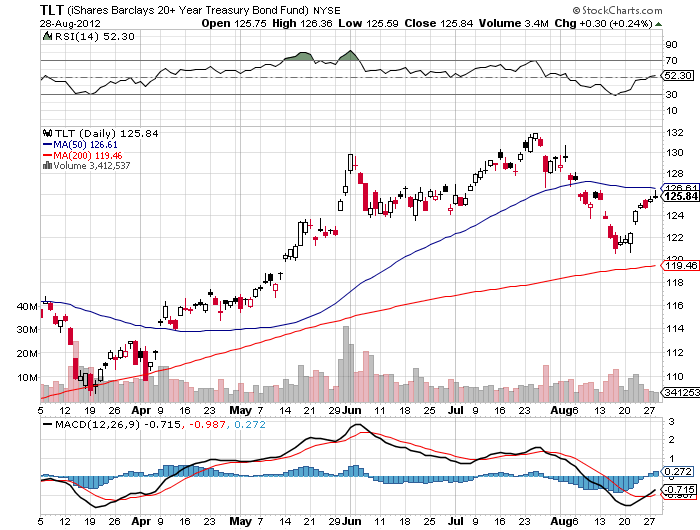
Eight days ago, I was dead-on correct in predicting that a risk reversal in the markets was imminent, and the Treasury bond market was ripe for at least a five point rally. Well, I lied. Instead we got a six points rally which has taken the value of our short position in the (TLT) September $116-$111 put spread from $0.37 to only $0.07, a drop of 81%.
The original 12 point collapse in the (TLT) was caused by comments made by European Central Bank President, Mario Draghi, who in July, said that he would do ?whatever it takes? to save the Euro. It was one of the easiest bets of the year that Mr. Mario would not follow up his words with action, especially during August, when the entire European leadership was taking their annual six week vacation on the Isle of Sylt, the South of France, or at Bognor Regis. Reminder to newbies and beginners: making money is not always this easy.
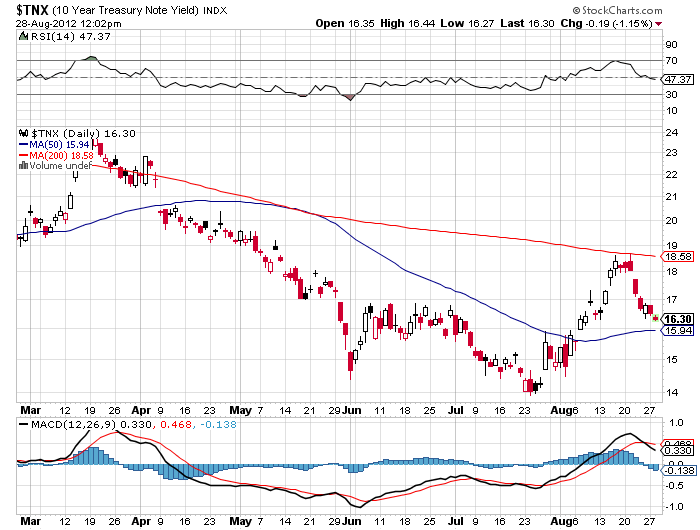
It is a no brainer to take profits here. Yields have plummeted from a high of 1.92% down to 1.63% in a mere eight days. We are now dead in the middle of the three month trading range for the (TLT). We get to come out three days before Ben Bernanke gives his Jackson Hole speech which could rile the financial markets. We also get to duck the coming weekend when Mario Draghi is prone to antics of the quantitative easing variety.
By coming out here, you also free up margin to do more interesting things in gold, silver, the Japanese yen, the Russell 2000, the S&P 500, and Apple. On top of all that, we have squeezed out the bulk of the profit on this position in just eight days. It is not worth it to hang on until September 21 only for 17 more basis points. The world could end by then. The risk/reward ratio is no longer favorable. Remember: hogs get fed, pigs get slaughtered.
The better way to play this move would have been to buy outright calls or call spreads on the (TLT), which would have added a hefty 5% to our year-to-date performance. But the melt up happened so fast, it was hard to pick a good entry point.
The profit on this trade is $0.37 - $0.07 = $0.30
That adds (25 X 100 X $0.30) = $750, or 0.75% to? the notional $100,000 portfolio.
To execute this trade:
Buy to cover the September, 2012 (TLT) $116 puts at..$0.11
Sell the September, 2012 (TLT) $111 puts at????.$0.04
Net Cost to cover:???????.?.??????...$0.07
Enter this trade as a single day limit order for the entire spread, not the individual legs. If you don?t get done, work your limit up a penny at a time. Your options trading platform should allow this. That keeps you from paying a double spread.
I am happy to report that this is the 14th consecutive profitable closing trade alert. If you add the 8 unrealized profitable trades still on the books, this takes my current run to 22 money-making ideas in a row.
Well, it?s back to my workout. I want to wear my Speedo with pride next summer on the Italian Riviera. On to the next one.
If you wish to receive trade alerts like this on a real time, instantaneous basis, please subscribe to my Trade Alert Service by clicking here .

Thank you Mr. Mario


Cheers went up from the real estate industry this morning when the Standard & Poor?s/Case Shiller data was released. It showed the first year-on-year increases in prices since 2006. Calls went out from real estate agents around the country announcing that the bottom was in and that you better buy now before prices shoot up.
Not so fast. Let?s look at the data first. Phoenix delivered a first class dead cat bounce with a +13.9% YOY gain. It was followed by Minneapolis (+5.7%), Miami (+4.4%), Washington DC (+3.9%), and Dallas (+3.7%).
But the recovery was uneven, with some parts of the country still suffering catastrophic declines. Atlanta is still drowning in subprime foreclosures and was off a gut churning -12.1%. New York City was cheaper by -2.1%, where the downsizing of the financial industry prompted by Dodd-Frank was having an impact, while Las Vegas was down by -1.8%. Apparently, all real estate is still local.
It is becoming increasingly clear the national indexes bottomed in the first quarter of this year, and have been picking up steam since. Much of the upturn has been driven by hedge funds which have soaked up homes in major markets for rental and future securitization.
In California, they have accounted for 60% of all buyers. Once they figured out the model and got their management companies in place, they have been a fixture on court house steps statewide, picking up every distressed property as it came up for auction. This is their way to play the current ultra-low level of long-term interest rates, with 30 year money still available at a subterranean 3.6%.
I would not rush to return your broker?s phone call. With the present demographic headwind expected to last another ten years, don?t expect any dramatic appreciation soon. Inventories are still gigantic. Some 80 million downsizing, empty nesting baby boomers are trying to sell homes to 65 million Gen Xer?s who earn half as much. There are 6 million homeowners late on mortgage payments or in foreclosure. There is a shadow inventory of a further 15 million that is available on the first uptick in prices. And who knows what the banks still really own.
If we go into recession next year and the stock market declines 25%, a strong possibility, this year?s recovery could go up in so much smoke. Best case, we keep bouncing along a bottom for five more years. Worst case, we see a secondary banking crisis, lose a few of the largest banks, leading to an additional 25% decline in home prices.
The sushi really hits the fan if we see Fannie Mae and Freddie Mac disappear, which are now in receivership and account for 95% of all conforming home mortgages. And don?t forget that the home mortgage deduction is costing the federal government $250 billion a year in lost tax revenues, and will become target number one in any budget balancing effort.
Rent, don?t buy, unless you intend to keep your new abode for at least a decade.

Is it the Bottom, or Not?

?Central banks can do whatever they want. But there is no monetary policy powerful enough to prevent the U.S. from going into recession in the first six months of next year if the fiscal cliff happens,? said strategist, Dan Greenhaus.

As a potentially profitable opportunity presents itself, John will send you an alert with specific trade information as to what should be bought, when to buy it, and at what price. Read more