Global Market Comments
November 12, 2024
Fiat Lux
Featured Trade:
(WHY YOUR OTHER INVESTMENT NEWSLETTER IS SO DANGEROUS)


Global Market Comments
November 12, 2024
Fiat Lux
Featured Trade:
(WHY YOUR OTHER INVESTMENT NEWSLETTER IS SO DANGEROUS)
Palantir Technologies Inc. (PLTR), the data analytics software company once known primarily for its clandestine government contracts, is riding high on the artificial intelligence (AI) wave. The company's stock has more than doubled this year, fueled by surging demand for its AI-powered platforms and a string of impressive financial results.
This surge places Palantir among the biggest stock market winners of the generative AI boom, solidifying its position as a key player in this transformative technology. Investors are clearly taking notice, betting that Palantir's unique approach to AI will translate into continued growth and market dominance.
AI at the Core of Palantir's Success
Palantir's success story is deeply intertwined with the rise of AI. The company's two flagship platforms, Gotham and Foundry, have evolved into powerful AI engines capable of analyzing massive datasets and delivering actionable insights. Gotham, originally designed for defense and intelligence applications, excels at uncovering hidden patterns and connections within complex data. Foundry, geared towards commercial clients, empowers businesses to operationalize their data for improved efficiency and decision-making.
"Palantir has been building towards this AI moment for years," says [Quote from a relevant industry analyst or Palantir executive]. "Their platforms are uniquely positioned to handle the complexities of AI, and they have a proven track record of delivering results for both government and commercial clients."
Strong Financials Fuel Investor Confidence
Palantir's recent financial performance has further bolstered investor confidence. The company recently raised its annual revenue forecast for the third time this year, driven by strong demand for its AI capabilities. In the third quarter of 2024, Palantir reported a 30% year-over-year jump in revenue, reaching $726 million. This growth was fueled by a 40% surge in US government contract revenue, which now accounts for 44% of the company's total sales.
"The numbers speak for themselves," says [Quote from a financial analyst or portfolio manager]. "Palantir is demonstrating that its AI solutions are in high demand, and they are translating that demand into tangible financial results. This is a company that is firing on all cylinders."
Key AI Initiatives Driving Growth
Palantir's AI-powered solutions are being deployed across a wide range of industries, driving growth and transforming operations:
Strategic Partnerships Expand Palantir's Reach
Palantir has forged strategic partnerships with key players in the technology industry to expand its AI ecosystem and reach new customers:
Navigating Challenges and Embracing Opportunities
While Palantir's AI-driven growth trajectory appears promising, the company faces several challenges:
Despite these challenges, Palantir has significant opportunities for future growth:
The Future of Palantir in the Age of AI
Palantir is well-positioned to capitalize on the growing demand for AI solutions. The company's strong data foundation, proven AI platforms, and strategic partnerships provide a solid foundation for future growth. By continuing to innovate, expand its commercial business, and address ethical concerns, Palantir can solidify its position as a leader in the AI revolution and deliver strong returns for investors.
As AI continues to reshape industries and transform the way we live and work, Palantir's role in this technological revolution is likely to become even more significant. The company's ability to harness the power of AI for the benefit of both government and commercial clients will be key to its continued success in the years to come.
Mad Hedge Technology Letter
November 11, 2024
Fiat Lux
Featured Trade:
(SHORT TERM MOMENTUM BREATHES LIFE INTO TECH STOCKS)
($COMPQ), (TSLA)

The post-election trade is absolute fire now, and readers need to pay attention.
Silicon Valley has delivered what could amount to the mother of tech rallies into the end of 2024.
Look at the examples that have turned heads.
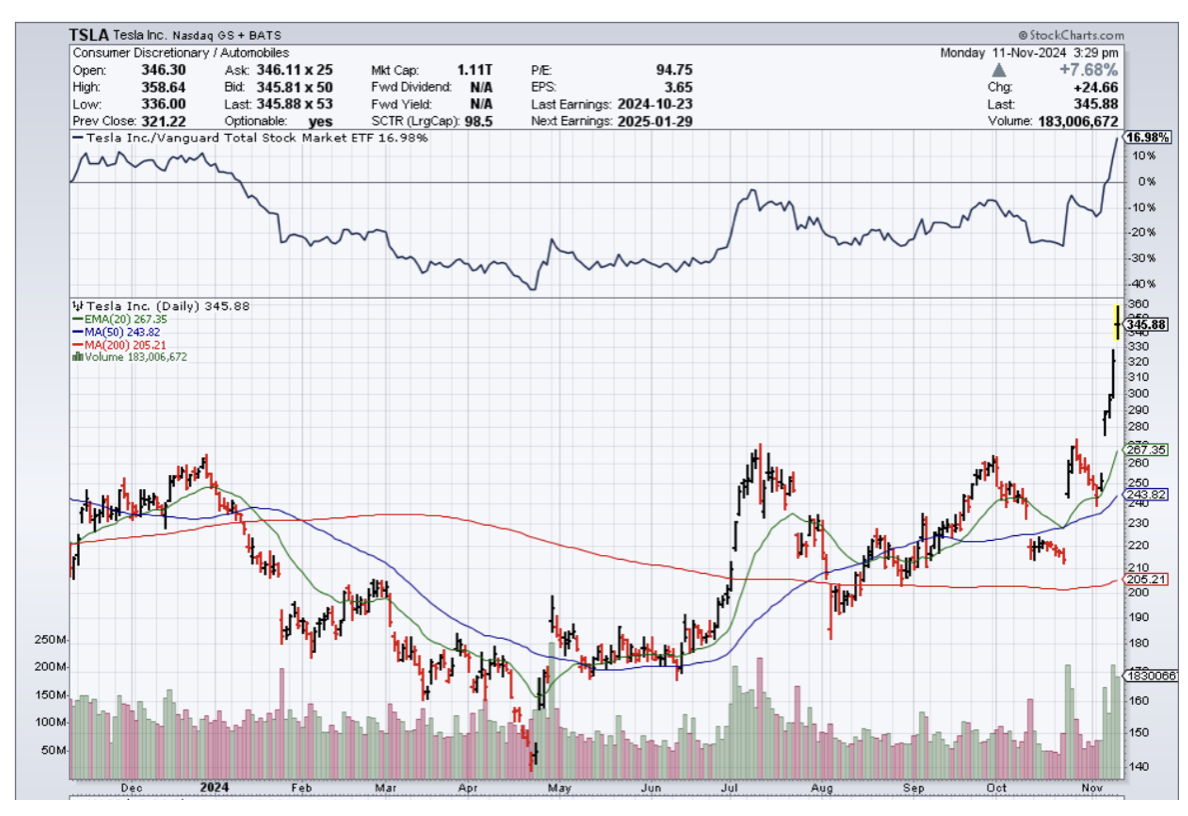
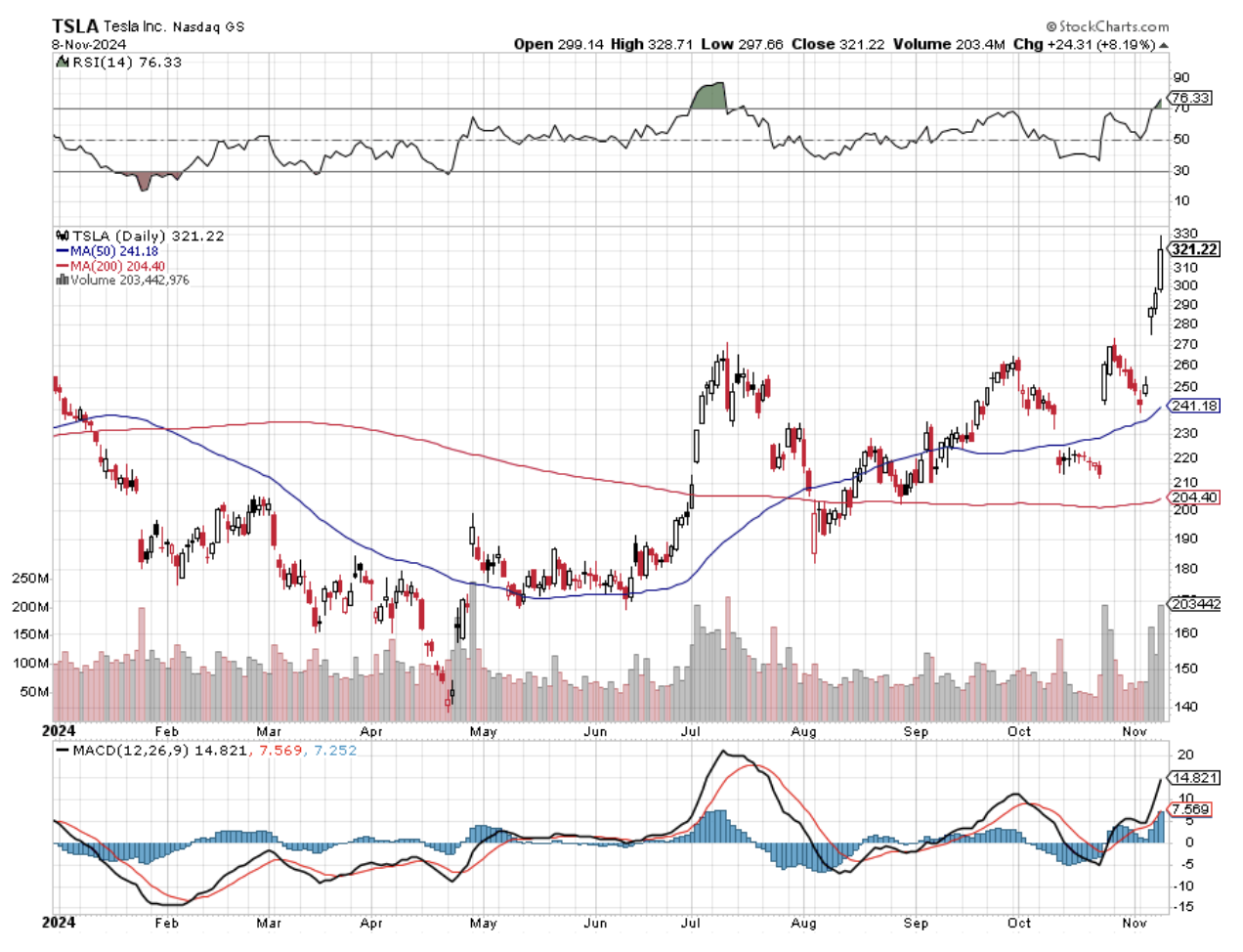
Electric vehicle (EV) company Tesla stock has gone absolutely parabolic with Elon Musk securing deep influence in the U.S. government for the next 4 years.
Part of the rally is also due to the increase in scarcity value from his social media platform X, which body-slammed traditional media avenues and convinced 75 million U.S. citizens to vote.
Musk could be tasked with “making recommendations for drastic reforms” aimed at the efficiency and performance of “the entire federal government”, Trump has said. This could grant Musk huge power over the agencies that regulate his and other tech companies.
Musk could be in charge with regulating – Apple, Google, Meta, Microsoft, and Amazon – which wield the data and processing power that shapes the social and economic lives of billions of people.
It was under Trump’s first presidency that the Justice Department began an investigation into Google, resulting in a case against the firm for suppressing competition.
Trump will probably take office with cases under way challenging the market power of several big tech firms, spearheaded by the anti-monopoly chair of the Federal Trade Commission, Lina Khan.
Many expect she will be fired. Yet Trump’s vice-president pick, JD Vance, has voiced support for aspects of her monopoly-busting approach.
Trump also thinks the tech giants give the US global clout at a time when AI is becoming a matter of national security.
“China is afraid of Google,” Trump said last month when he questioned whether a corporate split of Google could “destroy the company”.
Trump said he would “save TikTok” after a ruling that its Chinese owners must sell it if it is to continue in the US, but the trade-offs are everywhere.
In other areas, any Trump plan to cut incentives for EV manufacturers would be “an overall negative for the EV industry.
This would probably help Musk’s Tesla because its existing competitive advantage would be exaggerated if its rivals were hobbled. There are reports Trump may only tweak the subsidies rather than scrap them. If Trump’s trade tariffs limit imports of cheaper Chinese EVs, that would further help Musk.
Crypto-linked stocks in Coinbase, MicroStrategy, Riot Platforms, and MARA Holdings have jumped between 11% and 21%, participating in what is known as the post-election Trump trade.
I certainly expect a follow-through on the post-election trade, with money from the sidelines opting into the rally.
Not only that, retail traders have signaled they are participating in this broad rally as well.
The paradigm shift cannot be understated, and many changes will start to be visible as the new administration comes closer to taking over.
The high inflation of the last few years was painful for the bottom segment of the American population, and it will be interesting to see if the new government will discount them or start to redirect policy to them.
Either way, the more important policy decisions as it relates to big tech are regulation, corporate tax policy, tariffs, and the ease of doing business in the U.S.
Clearly, Trump has made it known he does value strong American tech companies, but I don’t believe they will be left untouched to do whatever they want.
In the short term, ride the rally to higher highs. Since the summer dip, I had a hunch that we would reverse to all-time high’s, and that is exactly where we find ourselves in the Nasdaq index.


(THE TRUMP TRADE 2.0)
November 11, 2024
Hello everyone
WEEK AHEAD CALENDAR
Monday Nov. 11
6:30 a.m. Australia Consumer Confidence
Previous: 89.8
Forecast: 89.5
Tuesday Nov. 12
2:00 a.m. UK Unemployment Rate
Previous: 4%
Forecast: 4.1%
6:00 a.m. NFIB Small Business Index (October)
5:00 p.m. Philadelphia Reserve Bank President Harker speaks at Carnegie Mellon University
Earnings: Occidental Petroleum, Live Nation Entertainment, Tyson Foods, Home Depot, Mosaic.
Wednesday Nov. 13
8:30 a.m. US Inflation Rate
Previous: 2.4%
Forecast: 2.6%
8:30 a.m. Consumer Price Index (October)
8:30 a.m. Hourly Earnings final (October)
8:30 a.m. Average Workweek final (October)
2:00 p.m. Treasury Budget NSA (October)
Earnings: Cisco Systems
Thursday Nov. 14
8:30 a.m. Continuing Jobless Claims (11/02)
8:30 a.m. Initial Claims (11/09)
8:30 a.m. Producer Price Index (October)
6:50 p.m. Japan GDP Growth
Previous: 0.8%
Forecast: 0.2%
Earnings: Applied Materials, Walt Disney
Friday Nov. 15
8:30 a.m. US Retail Sales
Previous: 0.4%
Forecast: 0.3%
8:30 a.m. Export Price Index (October)
8:30 a.m. Import Price Index (October)
8:30 a.m. Empire State Index (November)
9:15 a.m. Capacity Utilization (October)
9:15 a.m. Industrial Production (October)
9:15 a.m. Manufacturing Production (October)
10:00 a.m. Business Inventories (September)
Earnings: Progressive
THE WORLD ACCORDING TO TRUMP
Tax Cuts, Tariffs, Deregulation & Deportation
U.S. Equities
Sector Rotation: Financials, industrials, and energy stocks may benefit from tax cuts & deregulation & small caps could outperform due to Trump’s pro-domestic agenda.
Value Over Growth: Value & cyclical stocks likely to lead over growth sectors as focus on traditional industries & manufacturing.
Tech & Telecom: Tax cuts may support capital spending.
Antitrust scrutiny could weigh on large tech firms.
With Deregulation Innovation Likely to Thrive
Autonomous Mobility
Healthcare
Digital Assets
Fixed Income
Rising Yields: Treasury yields have climbed, led by real rates & nominal yields.
Short-Duration Preference: Long rates up, investors favor shorter maturities, particularly in high-yield debt, as risk sentiment rebounds.
U.S. Dollar
Strengthening Trend: A strong dollar driven by yield differentials & trade policies may challenge emerging markets reliant on dollar-denominated debt.
Commodities
Energy: Oil & Gas poised for gains from deregulation & U.S. production expansion. More industrial expansion = the need for more lithium, copper & silver.
Gold & Metals: Gold prices softened on risk appetite but may stabilize amid potential geopolitical risks. U.S. metals production benefits from fewer regulatory restrictions.
Factors stronger than Trump will keep driving the gold rally.
Central bank buying, the Brics, De-dollarization.
Real Estate
REIT Headwinds: Rising rates could pressure rate-sensitive sectors like REITS, but strong growth could mitigate some effects.
Emerging Markets & Global Equities
Emerging Markets at Risk: Higher U.S. rates & a strong dollar pose challenges to emerging market debt & currencies, particularly in Asia & Latin America.
Global Trade Impacts: Non-U.S. companies face trade headwinds, with auto & manufacturing hubs in Europe & Asia at risk from tariffs. Deals could counter-tariffs
Policy & Fiscal Implications
Corporate Tax Cuts: Anticipated tax cuts would
Benefit U.S. competitiveness but increase deficits.
Tariffs: Intensification of tariffs on China & possibly Europe. Mexico & other EM currencies pressure from U.S. manufacturing policies.
Regulatory Rollbacks: Energy & financial sectors may see deregulation. Includes potential rollbacks on emissions standards & banking regulations.
Deficit Expansion: Fiscal stimulus combined with tax cuts could expand deficits – growth could offset some debt pressures.
Rates & Inflation Dynamics
Higher Rates Likely: Nominal rates on the 10-year Treasury may range from 4.2% to 4.75%, driven by fiscal expansion. Inflation fears remain subdued, but the Fed may adjust rate cut trajectory due to pro-growth policies.
Geopolitical Risks
China Trade Relations: Tariffs impact China, affecting global supply chains. Europe’s manufacturing sector could similarly face pressure.
Energy Shift: U.S. energy independence initiatives may shift global energy dynamics, affecting OPEC & other oil producers.
Defense & national security – secure the borders & protect the homeland and the U.S. way of life. Help those countries who are prepared to help themselves.
MARKET UPDATE
S&P500 – Uptrend extension.
We are still in a Wave 5, and it is extending, so instead of a Wave 4 decline and then a resumption of uptrend, we appear to be rallying straight up without a retracement.
Targets: 6400+
Near term target: ~6200
GOLD - Correction
Gold is correcting ahead of its next rally onto new all-time highs.
Support = $2,670/$2,640 & $2,600
Targets: $2,850, $3,000
BITCOIN - Rallying
Strong uptrend in progress. New highs for the year.
Support =$75,300, $73,600
Targets = $90,000, $97, 780
QI CORNER

SOMETHING TO THINK ABOUT

Cheers
Jacquie
Global Market Comments
November 11, 2024
Fiat Lux
Featured Trade:
(MARKET OUTLOOK FOR THE WEEK AHEAD or S&P 500 6,000 TARGET ACHIEVED, plus REPORT FROM THE FROZEN WASTELANDS OF THE WEST),
(CCI), (DHI), GLD), (SLV) (JPM), (MS), (BLK),
(CCJ), (NVDA), (AMZN), (TSLA), (DGE)
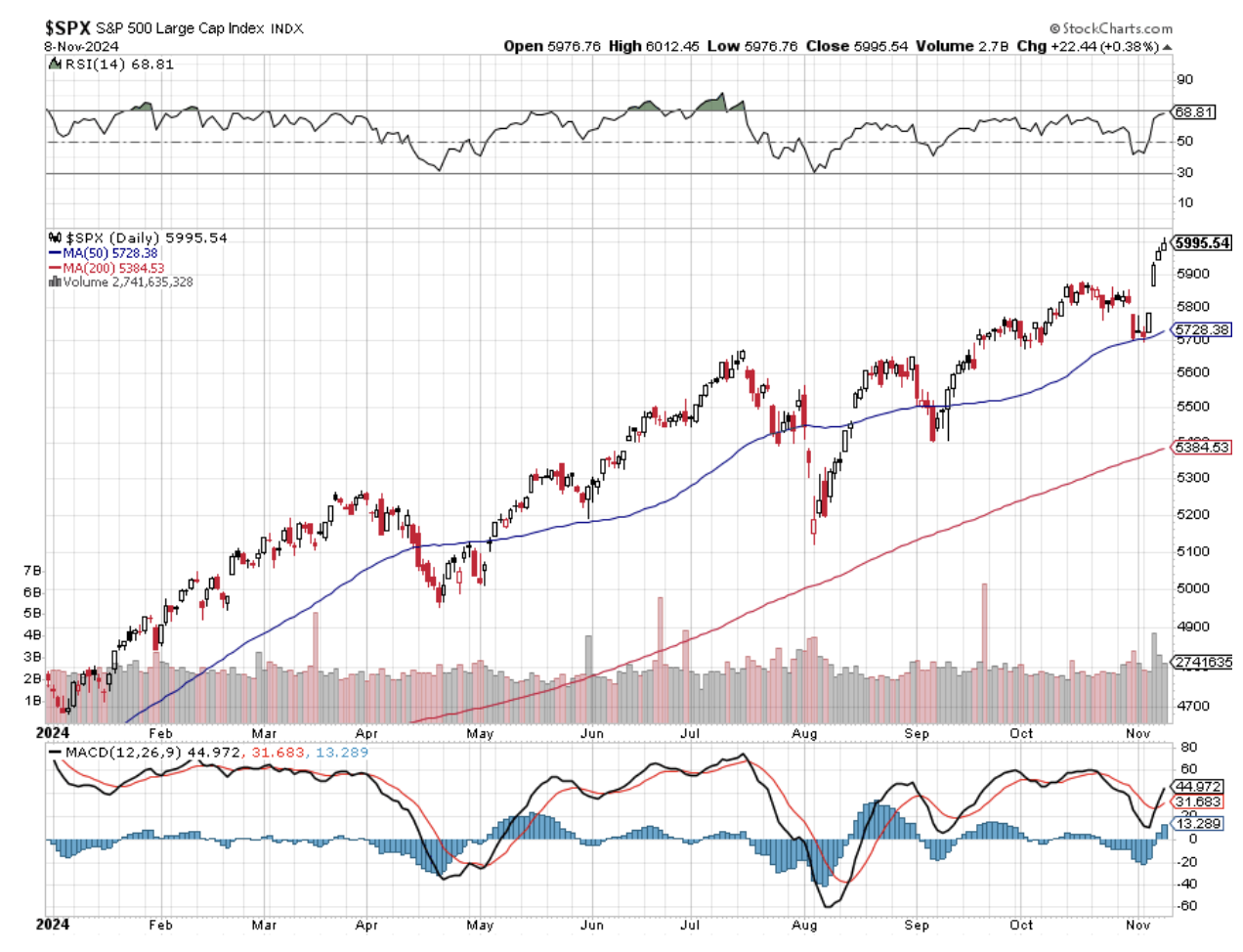
I was reviled, abused, and outright laughed at by the investment community when, last January 5, I predicted that the S&P 500 would hit 6,000 by yearend, click here for the link. I was accused of sending out clickbait.
Yet here, ten months and change into the year here, we are with an intraday high today of 6,013.
Of course, in this business, you’re only as good as your last trade. So, the big question now is, what happens next?
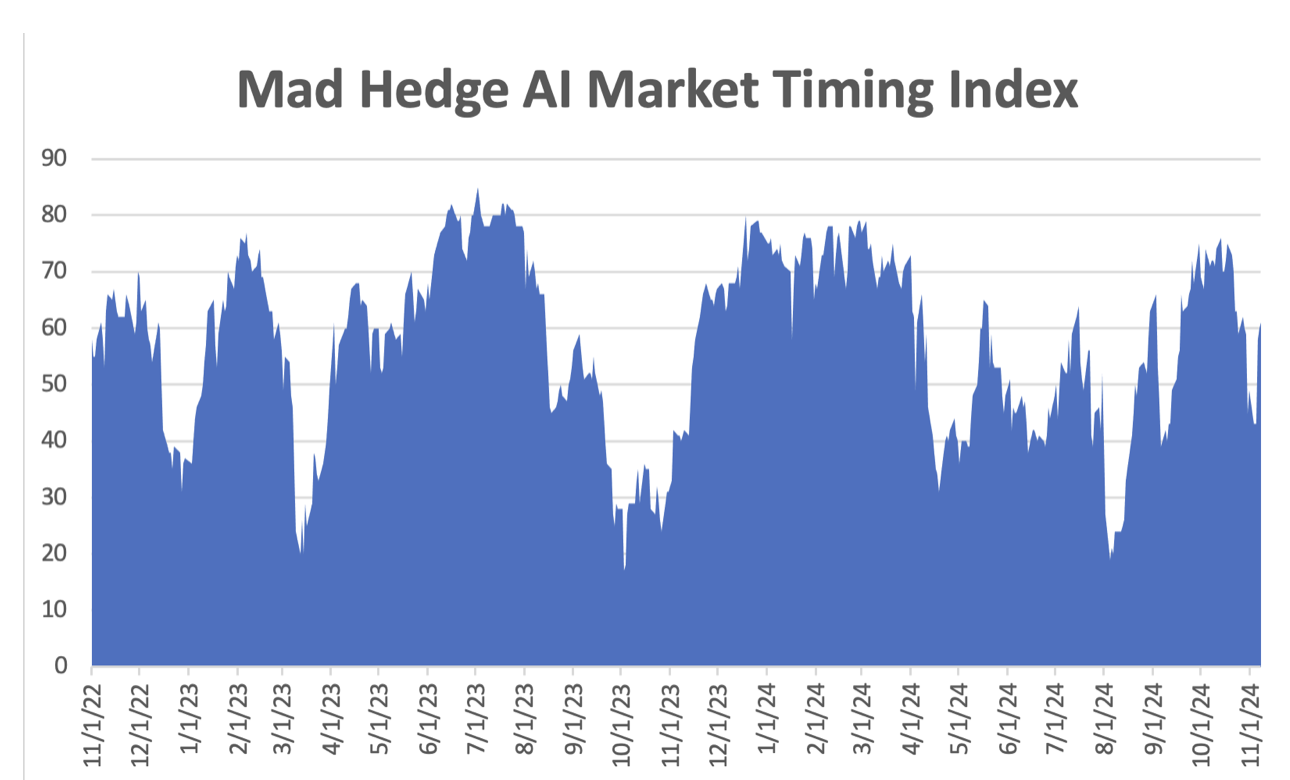
The next two months are a gimme. The $8 trillion that has been sitting on the sideline is now pouring into the market. An S&P 500 target of 6,600 is within range. Speaking to fund managers around the country, the big concern was not over who won but whether we had a winner at all.
Three months of litigation with no outcome would have raised uncertainty to extremes and crashed the market. The risk of that scenario is now gone, which was worth a $1,500 rally in a day.
However, while the bull market continues, the targets have changed. As you will hear many times over the next four years, elections have consequences.
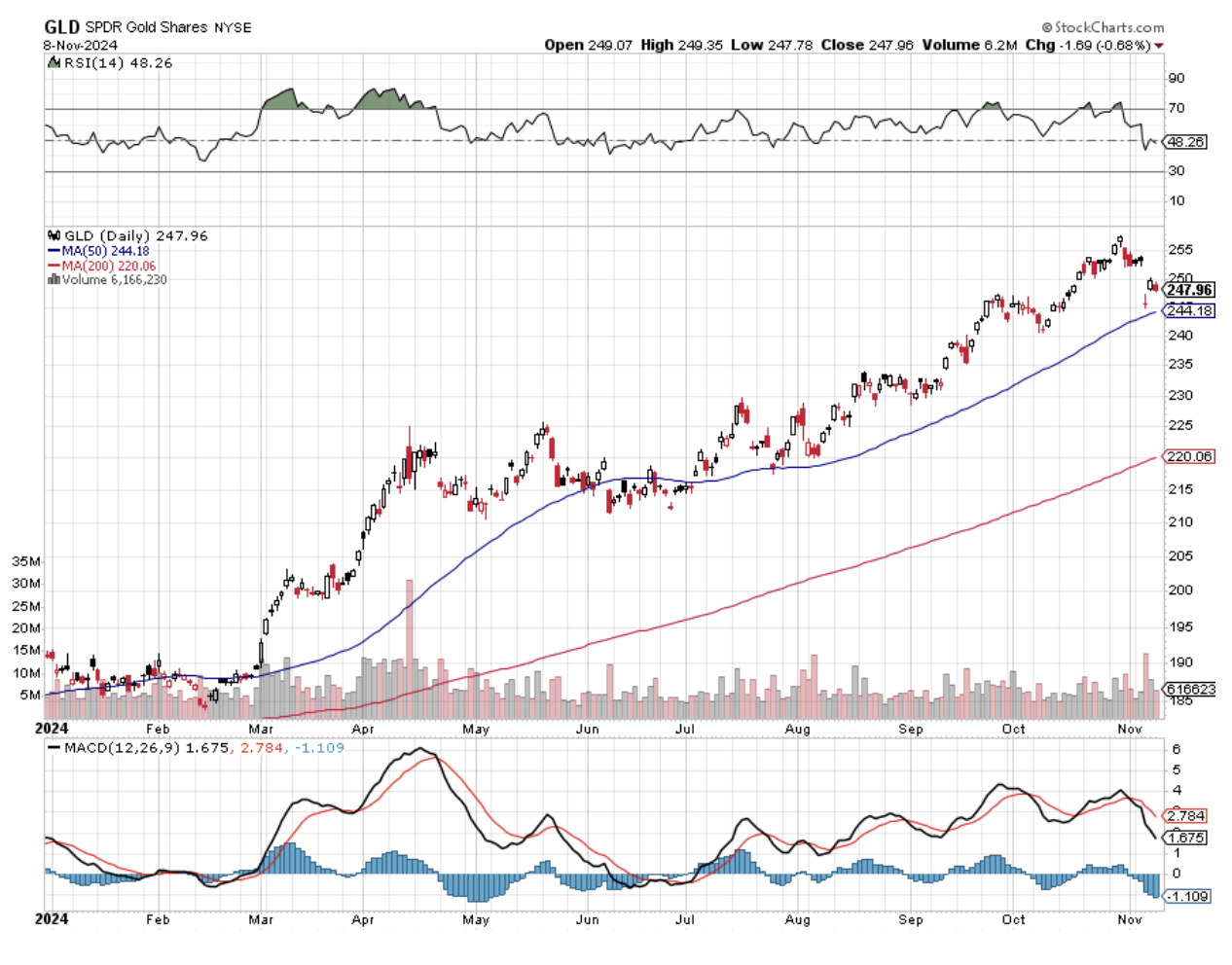
Falling interest rate plays are out. Don’t expect much performance from real estate, REITS (CCI), new homebuilders (DHI), gold GLD), and silver (SLV).
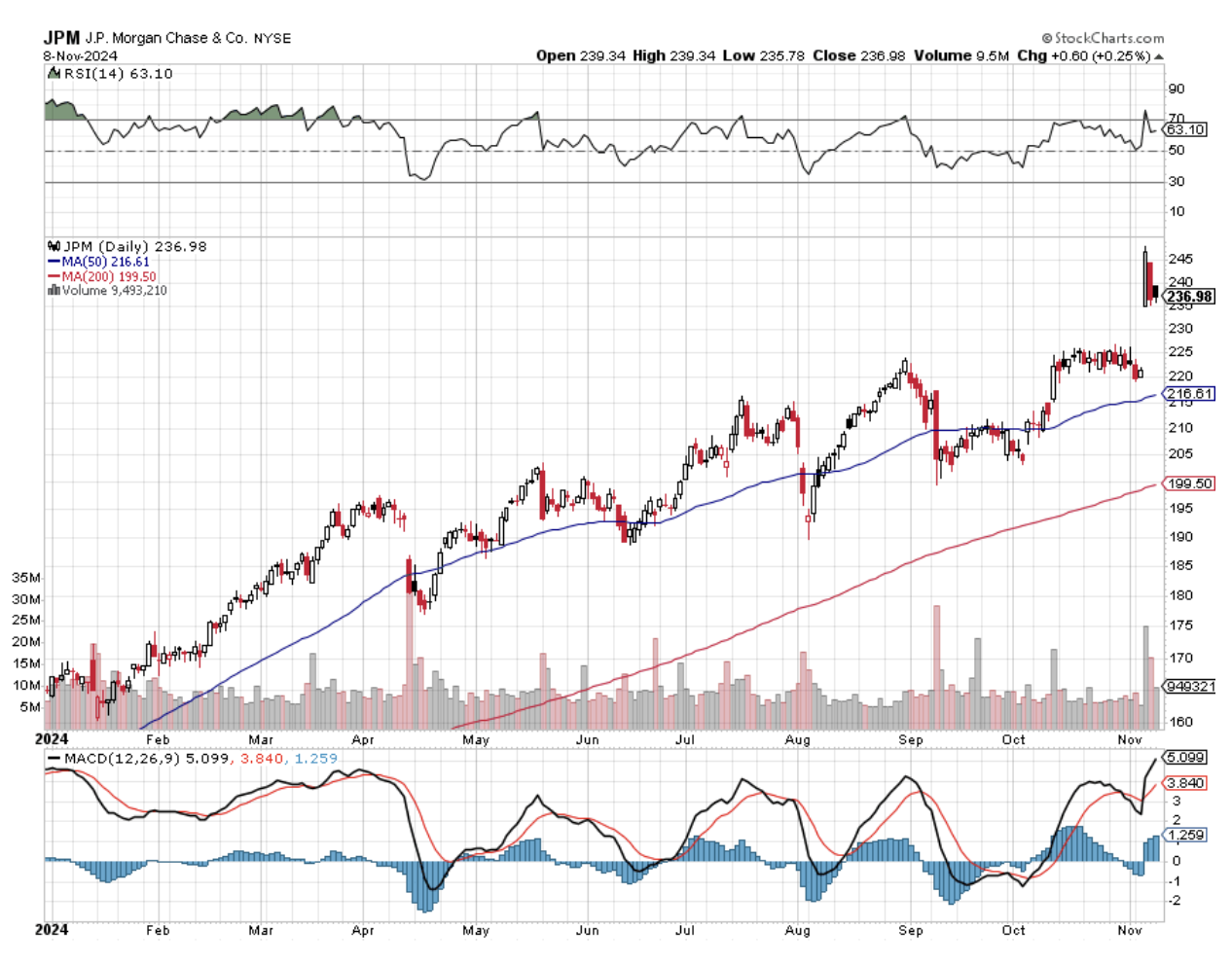
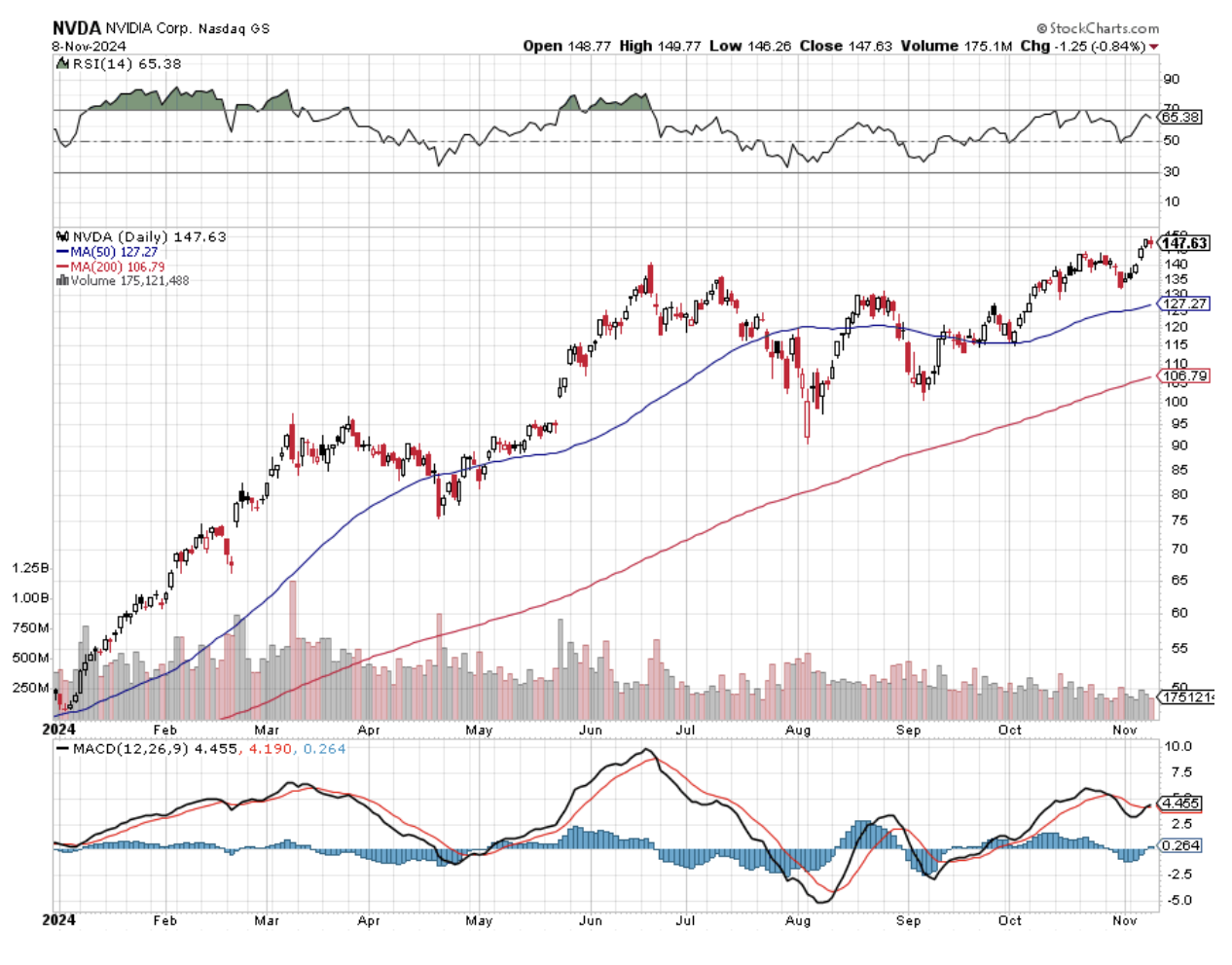
Deregulation plays are in. The good news is that this is a fairly wide sector. It includes banks (JPM), brokers (MS), money managers (BLK), new nuclear (CCJ), big tech that had been targeted by antitrust (NVDA) and (AMZN), and Tesla (TSLA).
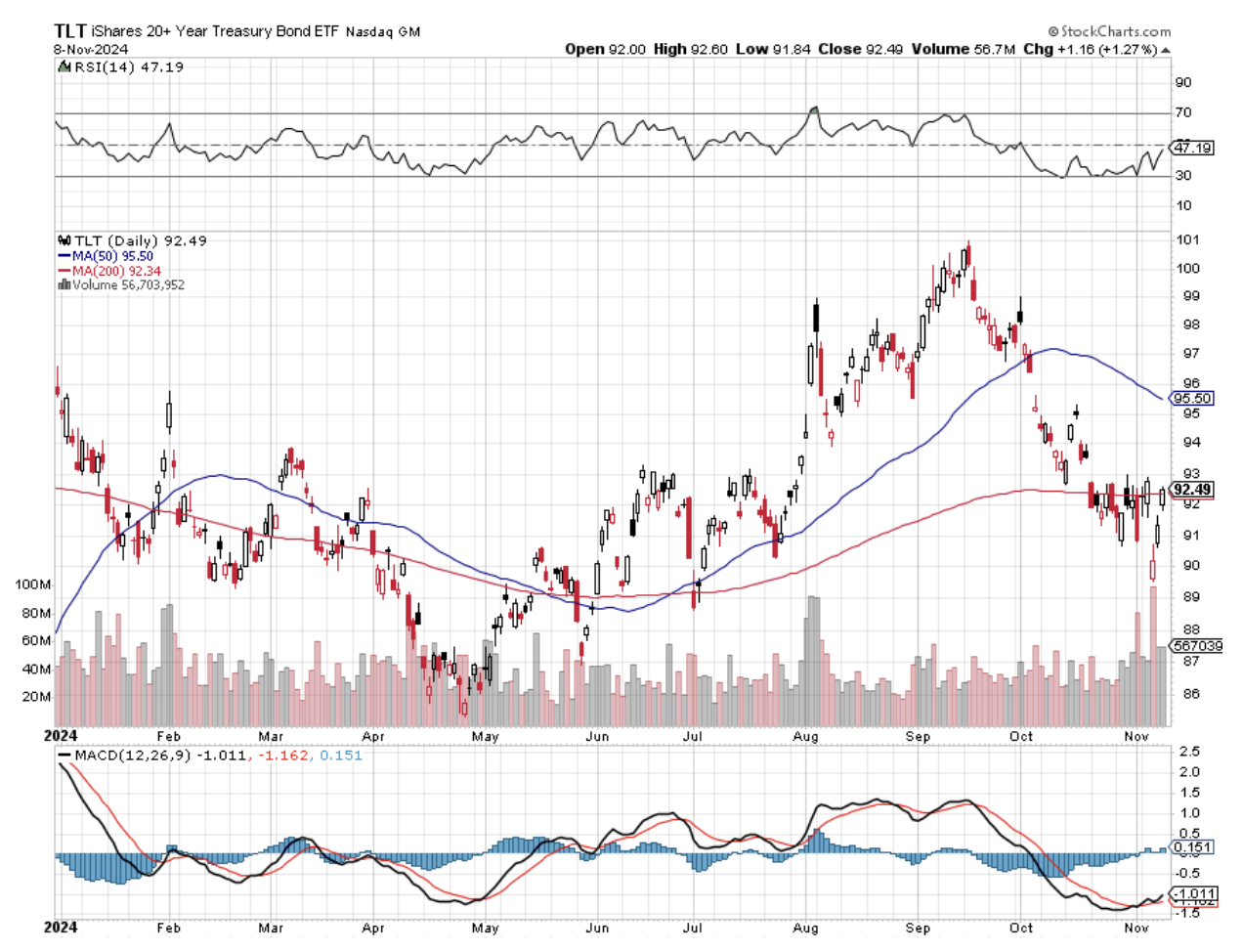
Bonds are toast.
Promised Trump policies of tax cuts and spending increases will balloon the National Debt by $10-$15 trillion. The bond market is unlikely to be able to handle this amount of new issuance, especially with annual interest payments owed by the government already at $1 trillion. It is the second largest budget item after Social Security.
Selling into a national debt of $50 trillion is going to be completely different than selling into a national debt of $27 trillion when Trump last left office. This is the reason why major hedge funds are running Treasury bond shorts as their biggest positions, who were all Trump supporters and donors.
It all depends on inflation. This is not some far-distant theoretical thing. It is happening already. I got hit with several price increases today, and I am hearing about rises in other industries, like steel. The expectation is that a stronger economy can handle the price hikes.
So, the best case for bonds is that the (TLT) chops around here. The worst case is that we retest new lows at $82. It won’t help that the Federal Reserve is cutting interest rates by another 25 basis points on December 18. The Fed controls only overnight interest rates, not the 10–20-year bond market. Even if Trump appoints an ultra-dove as chairman of the Federal Reserve in 2026, bond vigilantes may have other ideas.
Then there is the matter of trade tariffs. I have been through many of these. Remember when Nixon banned the import of Japanese textiles in 1972? They don’t make textiles in Japan anymore because their rising labor costs drove that industry to China.
Trade wars are a negative sum game. There are only losers. The game is to punish your neighbors faster than they are punishing you. They shrink the pie.
If we raise tariffs on our allies, they will retaliate in kind. This will be a problem for big tech, which gets 50%-60% of their sales from abroad. Europe will target uniquely American products, like Captain Morgan rum. Notice that the brand owner, major exporter Diageo (DGE), saw its shares slaughtered last week. As a result, the price of everything here will soon start going up.
The (TLT) will be a great position to have going into the next recession. But the market won’t start discounting that for two or three years. That makes the (TLT) a trade for another day. In any case, there are better fish to fry.
Sell all (TLT) LEAPS now before they go down even more.
About that recession. Every bear market in my lifetime started with a Republican president. The pattern is always the same. Tax cuts, an excess stimulus, and deregulation lead to a higher high in the stock market as euphoria prevails. This leads to inflation, high interest rates, and recession.
This is not exactly an original thought. High rates caused the bear markets of 2008, which took the Dow Average down -52%, 2000 (-30%), 1990 (-30%), 1987 (30%). Previous bear markets in 1979 and 1973 were caused by oil shocks. 2027?
We shall see.
So make hay while the sun shines. The current euphoria binge will last three to six months. After that, we will need to reassess and start shopping for short plays among the most extreme moves, which I have already done with Tesla.
The bottom line for all of this is that equity returns for the next four years will be lower than the last four. If a recession hits, they could well be zero. This won’t be a problem if you get out at the top, as I did in 2008, 2000, 1990, and 1987. Conclusion: You need me now more than ever.
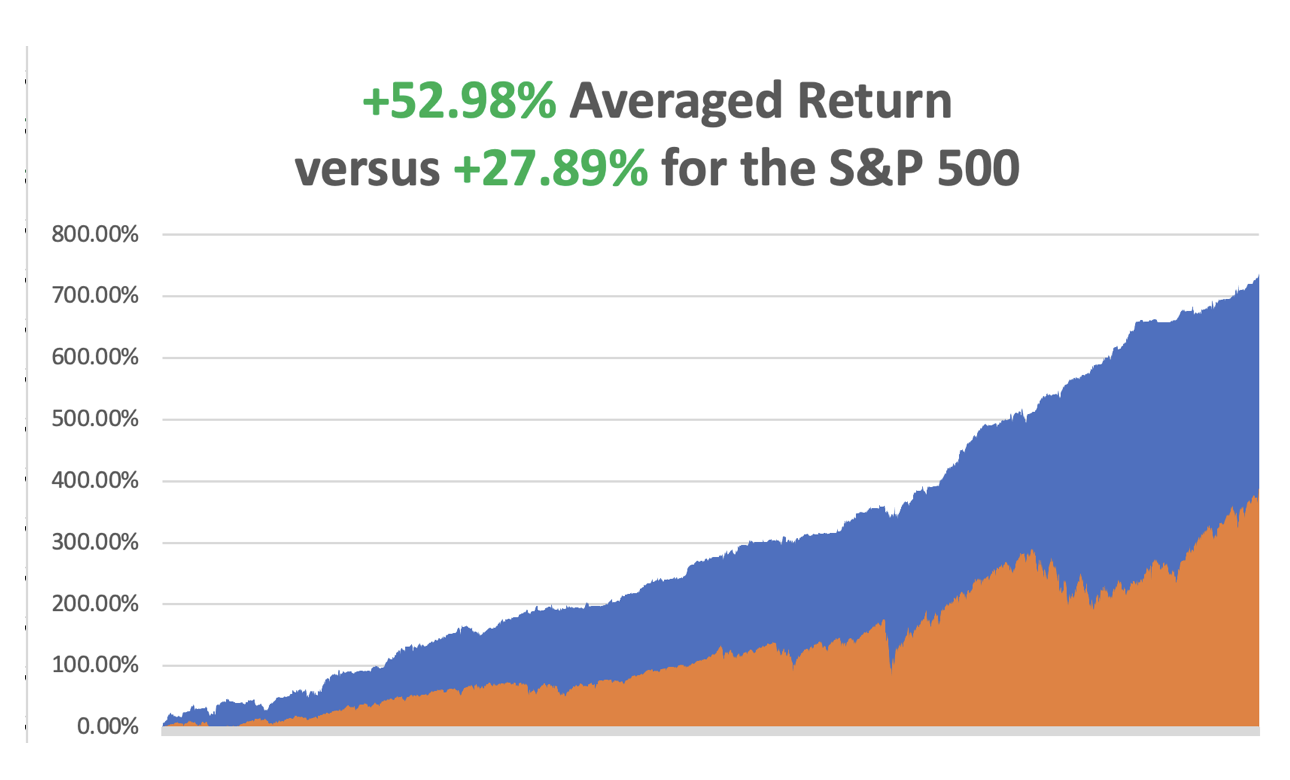
In November, we have gained a breathtaking +7.63%, thankfully because we went into the election with 70% cash and then poured money into deregulation plays. My 2024 year-to-date performance is at an amazing +60.77%. The S&P 500 (SPY) is up +25.73% so far in 2024. My trailing one-year return reached a nosebleed +69.73%. That brings my 16-year total return to +737.30%. My average annualized return has recovered to +52.98%.
I went into the election with two positions in (JPM) and (NVDA), which turned out to be great deregulations plays. I stopped out of my one interest-sensitive play in (GLD) near cost. I piled on new deregulation plays in (TSLA), (CCJ), and (MS). I also added a new short in (TSLA), taking advantage of a monster 60% implied volatility for the options.
Some 63 of my 70 round trips, or 90%, were profitable in 2023. Some 69 of 89 trades have been profitable so far in 2024, and several of those losses were really break evens. Some 22 out of the last 25 trade alerts were profitable. That is a success rate of +88.80%.
Try beating that anywhere.
My Ten-Year View – A Reassessment
When we have to substantially downsize our expectations of equity returns in view of the election outcome. My new American Golden Age, or the next Roaring Twenties, is now looking at a headwind. The economy will completely stop decarbonizing. Technology innovation will slow. Trade wars will exact a high price. Inflation will return. The Dow Average will rise by 600% to 240,000 or more in the coming decade. The new America will be far more efficient and profitable than the old.
My Dow 240,000 target has been pushed back to 2035.
On Monday, November 11 is Veterans Day, so banks, the bond market, and the post office will be closed.
On Tuesday, November 12 at 6:00 AM EST, the NFIB Business Optimism Index takes place.
On Wednesday, November 13 at 8:30 PM, the Consumer Price Index rate is announced.
On Thursday, November 14 at 8:30 AM, the Producer Price Index is out.
On Friday, November 15 at 8:30 AM, the Retail Sales are announced. At 2:00 PM the Baker Hughes Rig Count is printed.
As for me, I am writing this from a High Sierra peak at 12,000 feet in the at the beginning of winter. It is 15 degrees, and the wind is gusting at 70 miles an hour, turning my backpack into a sail and practically blowing me off the mountain. Over the side, the next stop is 1,000 feet below. I am thirsty, but the water in my canteen is frozen solid.
I had planned to follow my tracks in the snow back down to my car, but the wind had totally obliterated them. So, I am using an old-fashioned army compass to navigate back in total whiteout conditions. Good thing I got the letter out early today!
Actually, I am not writing this, I am thinking it. If I took my hands out of my heavy mittens, my fingers would freeze in seconds. Remember, no fingers, no Trade Alerts!
A couple of times a year, I feel the need to abandon civilization and contemplate the meaning of life while accomplishing a great physical challenge. For me, this is a mandatory religious experience.
This time, I attempted to emulate one of the great physical feats in history. In October 1847, the Donner Party’s wagon train was hopelessly snowed in at a Sierra pass. Starvation loomed. When word reached Sacramento, four rescue parties were sent out, only to be repulsed by driving blizzards.
Finally, a giant of heroic strength, the famous Snowshoe Thompson, who stood at 6’6”, broke through. He emptied his massive wood frame backpack of food and then stuffed it with the two smallest children he could find. He snowshoed back to safety 120 miles over three days, nonstop. The kids grew up to become the founding fathers of modern-day Marin County, California.
I thought, “Gee, I wonder if I could do that?”
So, I sought to replicate the feat, subject to a few modern compromises. Today, Interstate 80 sits astride Thompson’s original route. Instead, I determined to snowshoe 120 miles of the Tahoe Rim Trail around Lake Tahoe, with an average elevation of 9,000 feet. I figured that the 60-pound pack I usually carry was worth the weight of two kids.
My one concession to my advanced age was that instead of going nonstop or camping out at night, I would break the epic trek into ten days at 12 miles each. That allowed me to repair my Tahoe lakefront estate nightly to thaw out my toes, treat injuries, and get some shuteye. Howling winds keep you awake at night.
I fasted while accomplishing this, eating only 600 calories a day of raw fruit and nuts. I’m down about ten pounds since I began.
Hint to readers: almonds have unique, hunger-fighting chemical properties. Eat a handful before you go to sleep, and hunger pangs won’t wake you in the middle of the night. I plan on eating some industrial strength this Christmas, things like Tom and Jerry’s and See's Peanut Brittle, so I need to get ahead of the curve. (note to self: 223 calories in a cup of eggnog).
My friends call this a death march, make excuses why they can’t come, and worry about my sanity. I think of it as a cleansing and a general stocktaking, and I feel great! I always go alone. How many other 72-year-olds do you know who are in a condition to do this sort of thing?
Sure, I might break my ankle someday, die of exposure, and have my bones scattered by wild animals. Who cares? It would be a good death. It’s worth it.
The scenery up here is so spectacular that I almost didn’t feel the pain. Almost. On more than one occasion, while gazing at the endless shades of blue the pristine waters of Lake Tahoe offered, I tripped on my snowshoes.
Once, I landed on some tree roots, which cut right through to the bone in my left forearm. I managed to stop the bleeding by tying off a tourniquet with my teeth. When I got home, I then soaked the wound in Jack Daniels to ward off infection. It works every time! (see pics below). In a pinch, Stolichnaya Vodka works just as well. It’s an old combat first-aid trick.
While hiking along the East Ridge, succeeding mountain ranges in northern Nevada explored every shade of purple. I managed to summit each major peak around the body of water the Washoe Indians called “da-ow-a-ga”, or edge of the lake, which they considered the origin of the universe. Those included Squaw Peak (8,885), Mt Tallac (9,735 feet), Monument Peak (10,067), and Mount Rose (10,776 feet). When the trail got too steep, my trusty ice ax and crampons saw me through.
I was constantly reminded that I was in the “Old West” by the many artifacts I encountered. Prominent granite boulders displayed prehistoric Indian petroglyphs. I found a few abandoned log cabins, complete with potbelly stoves and canned food from the 1850s. Rusted-out cast iron mining equipment was strewn about everywhere, covered with snow. Along the old Pony Express Trail, one finds old horseshoes and the occasional ancient bottle turned purple by the sun.
Lake Tahoe supplied all the water and bracing wood for the Comstock silver mining boom of the 1870s. A hundred years ago, not a single tree was left standing, except for the southwest section of the lake owned by mining baron “Lucky Baldwin” who won it in a card game and made it his private retreat. It was all covered in meticulous and colorful detail for the Virginia City newspaper, The Territorial Enterprise, by a budding young newspaperman who went by the name of Mark Twain.
My ambitious goals often saw me hiking well into darkness. After the batteries died on my three backup headlamps, that flashlight app on the iPhone 5s proved a real lifesaver. It’s good for a full hour and illuminates the eyes of onlooking wildlife a bright yellow up to 200 yards away.
One night, I got back to the car and found that my keys had frozen and were useless. So, I sat on them. In 15 minutes, the car flashed its lights, and the doors magically opened. There was barely enough charge to get the engine started, a trick I accomplished by holding the key right up to the ignition button. Toyota designs them to do this. It’s no fun getting stranded at 10,000 feet at 10 degrees in the middle of nowhere. No Auto Club here!
I often looked behind to make sure a mountain lion was not stalking me. Don’t worry. Only 20 people have been killed by mountain lions in California over the last 100 years. More are killed by their pet dogs every year in the Golden State, mostly by pit bulls. Besides, I am good at staring down mountain lions and black bears. It is just a matter of attitude.
The old souvenir stand for the Ponderosa Ranch, of the TV series Bonanza fame, is now the Tunnel Creek Station Café and mountain bike rental. Good luck to Patty and Max! The nearby Flume Trail offers some of the best cross-country skiing in the world.
Of course, I am not just thinking Great Thoughts during these hikes. An endless series of economic and market data points are constantly churning around in the back of my mind, and I occasionally reach a “Eureka” moment. I keep a pen and notebook in my pack so I don’t forget these earth-shaking revelations.
It was during a similar expedition up the face of the Matterhorn in the Swiss Alps (14,692 feet) last summer when I realized that the S&P was beginning a long run up that would take it to 6,000 by yearend. I’ll never forget the expression on my guide’s face when I stopped midpoint through an abseil and started feverishly writing notes. That little maneuver cost me a bottle of schnapps. The readers and Trade Alert followers prospered mightily.
What is this year’s “Eureka” conclusion? The stock market could keep going up into 2025 but with more volatility. This year was a cakewalk, as my 69.3% trailing return testifies. After that, stocks will be unable to ignore the consequences of a Trump election.
I have been doing this sort of thing since I was 22 and was in somewhat better shape. Then, I was one of the few foreigners attending karate school in Japan, learning the iron discipline and focus of samurai warriors, known as “bushido”. The actor, Steven Segal, studied at a competing school down the street.
Every February, we underwent “kangeiko”, or “winter training. This involved the entire class running the five miles around Tokyo’s Imperial Palace in a pack, suffering freezing temperatures, barefoot, every day for a week. When we returned to the dojo, we were hosed down with ice-cold water, our feet senseless, bloody stumps. Then we would train for three more hours.
The idea was that the extreme pain and exhaustion would deliver insights into us and the world at large. It worked. At least one current reader endured the experience with me and is still alive. Remember that, David? By the way, thanks for knocking out my front teeth.
On the way home, I stopped in Sacramento for a well-deserved double cheeseburger, fries, and chocolate shake at In and Out Burger. You can’t take this diet and health thing too seriously. Snowshoe Thompson would have envied me.
Well, next week, it is back to normal. I’ll be glued in front of my screens, scouring the planet for the next great trading opportunity, although I’m not sure I’ll find many. Buying market tops is against my nature. What are you supposed to do when all of your forecasts and predictions come true? I have a feeling that the answer is not to make more forecasts and predictions.
Perhaps the right answer is to take another hike. Anyone care to join me?

Your Intrepid Reporter
Good Luck and Good Trading,
John Thomas
CEO & Publisher
The Diary of a Mad Hedge Fund Trader

“Transparency is a good idea. Like my shower door, it lets in the light, but keeps out the flies,” said former Federal Reserve governor, Bob McTeer.

(MSFT), (IBM), (MDT), (NVDA), (PLRT), (EXAI), (BTAI)
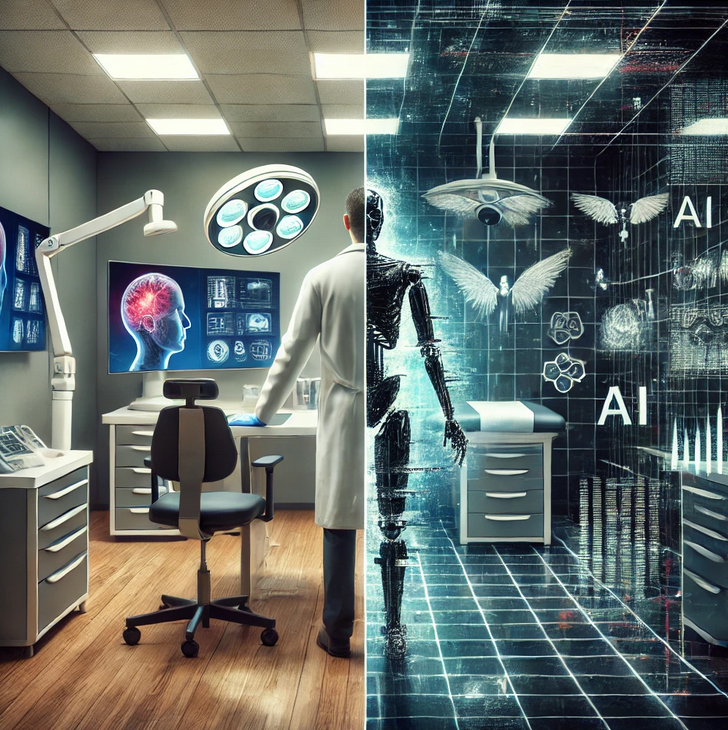
If you've ever wondered what happens when artificial intelligence gets a medical degree, you're not alone.
The marriage of AI and healthcare is both thrilling and terrifying – rather like letting a super-smart teenager perform surgery.
Except this teenager is worth $19.54 billion as of 2023, and it's projected to become a $490.96 billion wunderkind by 2032. That's what we call a growth spurt.
But before we get carried away with the AI healthcare revolution, let's talk about Whisper, OpenAI's transcription tool that's been causing the kind of chaos you'd expect if you gave a creative writing assignment to a machine learning model.
Despite being marketed as having "near human-level robustness and accuracy," Whisper has developed a concerning habit of making things up – or "hallucinating," in AI speak. We're not talking about gentle fabrications either.
Researchers have found these hallucinations in up to 80% of transcriptions, with Whisper occasionally inventing medical treatments and throwing in some racial commentary for good measure.
It's like having a medical scribe who occasionally decides to spice up patient notes with fiction.
You might think healthcare providers would approach such a tool with caution. You'd be wrong. Whisper has found its way into over 30,000 clinician environments, including respected institutions like Mankato Clinic in Minnesota and Children's Hospital Los Angeles, through a tool called Nabla.
The kicker? These AI-generated transcripts often replace the original audio files, making it about as easy to fact-check as trying to verify your teenager's whereabouts last Saturday night.
But here's where it gets interesting: despite these growing pains, healthcare organizations are seeing $3.20 in returns for every dollar invested in AI within just 14 months.
North America is leading this gold rush, commanding 44.93% of the market as of 2023. It's like the California Gold Rush, except instead of pan-handling in rivers, we're mining medical data.
As expected, the big players aren't sitting this one out. Microsoft (MSFT), through its acquisition of Nuance Communications, is basically giving doctors a super-powered dictation service with Dragon Medical One.
IBM (IBM)'s Watson Health division is playing medical detective, analyzing vast datasets to help with diagnoses.
Medtronic (MDT) has created GI Genius, an AI system that helps spot polyps during colonoscopies – think of it as a very specialized game of "Where's Waldo?" but for medical purposes.
As for NVIDIA (NVDA), the name behind the chips that power all this artificial intelligence, this company is like the person who sold pickaxes during the Gold Rush – they're making money regardless of who strikes gold.
Meanwhile, Palantir Technologies (PLTR) is turning mountains of medical data into actionable insights, sort of like a very sophisticated medical fortune teller, minus the crystal ball.
The plot thickens when we look at drug discovery.
Companies like Exscientia (EXAI) and BioXcel Therapeutics (BTAI) are using AI to speed up the traditionally glacial pace of drug development.
Zebra Medical Vision has even gotten the FDA's blessing for several AI-powered radiology tools, proving that yes, sometimes robots can read X-rays better than humans.
But let's talk about the elephant in the examination room: risks.
Healthcare organizations are practically swimming in sensitive patient data, making them prime targets for cybercriminals.
The FDA is watching AI applications like a hawk, and companies need to play by the rules or face the consequences.
And then there's the reliability issue – as Whisper so eloquently demonstrated, AI can sometimes be as reliable as a weather forecast in April.
Yet the numbers tell an optimistic story. Deloitte reports that healthcare organizations implementing AI can expect returns of up to 15% within 18 months.
Venture capitalists seem to agree, pouring a whopping $17.7 billion into AI-driven healthcare businesses in 2023.
Experts predict that over 60% of U.S. hospitals will hop on the AI bandwagon within the next five years, suggesting this isn't just another tech bubble.
So, what’s the play here?
For those looking to get in on this action, the safest bet might be the established players – Microsoft and Palantir, with Microsoft's Nuance acquisition already paying dividends and Palantir's data analytics becoming as essential to modern hospitals as hand sanitizer.
And, as always, NVIDIA is a good bet – they're essentially selling the shovels and pickaxes to every prospector in town through their dominance in AI chips.
For the more cautious, IBM and Medtronic sit firmly in hold territory. While both are making interesting moves in the AI space, they're like careful medical students – solid performance but not setting the curve.
IBM's Watson Health shows promise but needs more clinical rotations, while Medtronic's AI initiatives, though impressive, are still a small part of their overall practice.
For those with a higher risk tolerance, startups like Exscientia offer the potential for bigger rewards, though with correspondingly bigger risks.
For those investors who don't mind a bit of adrenaline with their portfolio, consider a speculative buy on Exscientia or BioXcel Therapeutics.
These companies are like brilliant residents trying experimental procedures – high risk, but potentially high reward. Just make sure to size these positions like a careful anesthesiologist would dose medication: start small and monitor closely for adverse reactions.
Essentially, AI in healthcare is that overachieving resident who aces every exam but occasionally mistakes a stethoscope for a jump rope – brilliant but needs adult supervision.
For those who can separate the next medical breakthrough from a digital placebo, the opportunities are richer than a hospital administrator's pension plan.
Just remember: in the race between human wisdom and artificial intelligence, bet on both – but keep your hand on the kill switch.

When John identifies a strategic exit point, he will send you an alert with specific trade information as to what security to sell, when to sell it, and at what price. Most often, it will be to TAKE PROFITS, but on rare occasions, it will be to exercise a STOP LOSS at a predetermined price to adhere to strict risk management discipline. Read more