“Risk comes from not knowing what you're doing.” – Said American Investor Warren Buffett

“Risk comes from not knowing what you're doing.” – Said American Investor Warren Buffett

(FARMLAND INVESTMENT – A RELATIVELY UNKNOWN OPPORTUNITY)
October 9, 2024
Hello everyone
Spanning many decades in the past, farmland has emerged as a very robust and consistent investment vehicle, outperforming traditional investment options such as the S&P500, real estate, gold, and bonds.
How can that be?
Farmland offers consistent returns
Over the past 30 years or so, farmland has never recorded a negative calendar year.
Let’s delve into some examples here. In the first instance, farmland remained positive during the dot-com bubble, when stocks were down for three consecutive years. Similarly, in 2008, when the S&P500 dropped by 37%, farmland recorded a positive return of 16%. This resilience and consistency make farmland a unique and attractive investment option.
Supply and demand dynamics
The principles of supply and demand go a long way to explain the performance of farmland as an investment. We all know the global population continues to grow on the demand side, leading to an increased need for food. This trend is expected to continue, providing a steady demand for farmland.
On the supply side, as cities expand and populations grow, development often encroaches on farmland, reducing its availability. This phenomenon of urban sprawl has decreased the supply of farmland, further driving up its value.
The combination of increasing demand and decreasing supply creates a healthy investment recipe. It ensures that farmland retains its value and provides consistent returns, making it an attractive investment option.
Farmland - An Underutilized Investment
Despite its impressive performance as an investment, farmland remains relatively unknown in the mainstream financial advisory sector. Many typical advisors have never considered it a viable investment option.
The upfront cost was high, and it was thought that investing required an intimate knowledge of the farming industry. However, that is changing rapidly, with new investment opportunities that greatly reduce these barriers to entry.
Today, all you need to invest in farmland is a bit of extra cash and an investment account. New opportunities are starting to open to the public.
Farmland can be considered as an alternative investment. Farmland produces returns both with rent yields and appreciation in the farmland’s value. So, these investments can work somewhat like dividend stocks or other rental property, with gains from income and capital gains.
Ways to Invest
1/ Owning land directly
If you want to invest in farmland, it’s still possible to own land directly. In this case, you could buy the land outright and rent it to a farmer who would use it for their crops or livestock. So, owning land directly means it would work like an investment property.
The capital needed to buy a farm may be quite significant. For instance, according to the USDA, the average farm size in 2023 was 464 acres. The USDA also reported an average cost of $4,080 per acre in 2023, up from 3,800 the year before. Using these averages, you could expect an average purchase price of $1.89 million for a farm. Naturally, you may be able to get started with less if you can find the right opportunity.
2/ Farmland REITS
Real estate investment trusts (REITS) are not just for office buildings and apartment complexes. REITS can also invest in farmland, and they’re a popular way for investors to enjoy the benefits of real estate investing – that is, enjoying income – without the headaches of management.
Investing in REITS makes diversification easier, and they’re much more liquid, and the minimum investment is often much lower. And REITS enjoy no corporate income tax in exchange for distributing 90% of their taxable income to investors as dividends.
Gladstone Land (LAND) and Farmland Partners (FPI) are two of the most prominent farmland REITS.
3/ Agricultural Stocks
One alternative to investing in farmland directly is investing in agriculture stocks. The idea is simple: instead of buying farmland, you buy shares of stock in companies in the agriculture industry.
These agriculture companies might be involved in things like crop production, agricultural equipment manufacturing, fertilizer production, and distribution. Crop producers, for example, make a return on the investment from producing the land, and they may own the land, too, so they can benefit from the potential rise in land prices.
Widely held agricultural stocks include Archer-Daniels-Midland (ADM), Corteva (CTVA), and Scotts Miracle-Gro (SMG)
4/ Farmland Mutual funds and ETFs.
Some investors prefer mutual funds or ETFs because it is often easier than buying stocks in individual agricultural companies.
Notably, farmland mutual funds don’t always invest exclusively in agriculture and often invest in adjacent sectors.
Buying individual stocks gives you a greater level of certainty over where your funds are being invested. This is not always true when you invest in mutual funds.
The Fidelity Agricultural Productivity Fund (FARMX) aims to invest 80% of its assets in agricultural productivity companies, and its largest holding is Deere (DE), the well-known name behind much agricultural machinery.
It is important to note that these funds can come with high fees – so you always need to check these before investing in any fund.
This is an item of interest Post to show you alternative investments. Overall, it is my preference to buy individual stocks where I can rather than funds.
QI CORNER
SOMETHING TO THINK ABOUT

Cheers
Jacquie
Global Market Comments
October 9, 2024
Fiat Lux
Featured Trade:
(THE MAD HEDGE SEPTEMBER 17-19 SUMMIT REPLAYS ARE UP),
(SCHLUMBERGER LEAPS),
(SLB)
Trade Alert - (SLB) – BUY
BUY the Schlumberger (SLB) January 2026 $47.50-$50 out-of-the-money vertical Bull Call spread LEAPS at $0.90 or best
Opening Trade
10-9-2024
expiration date: January 16, 2026
Number of Contracts = 1 contract
China certainly brought out a big bazooka with its massive stimulus package last week. If this one proves inadequate, they can bring out many more. Government agencies have also promised to invest $1 billion into Chinese stock markets. China is no longer the poor country I knew 50 years ago. For a start, they own $869 billion worth of US Treasury bonds.
And what is the best leverage China plays out there?
Oil.
It just so happens that energy is virtually the only cheap sector in the stock market and the worst stock market performer of 2024.
Oil consumption in China amounted to 16.6 million barrels per day in 2023, up from 15 million barrels daily in the prior year. That is 17.2% of the 96.4 million barrels in global oil production last year. Between 1990 and 2023, figures increased by more than 14 million barrels per day, up from 1 million barrels a day.
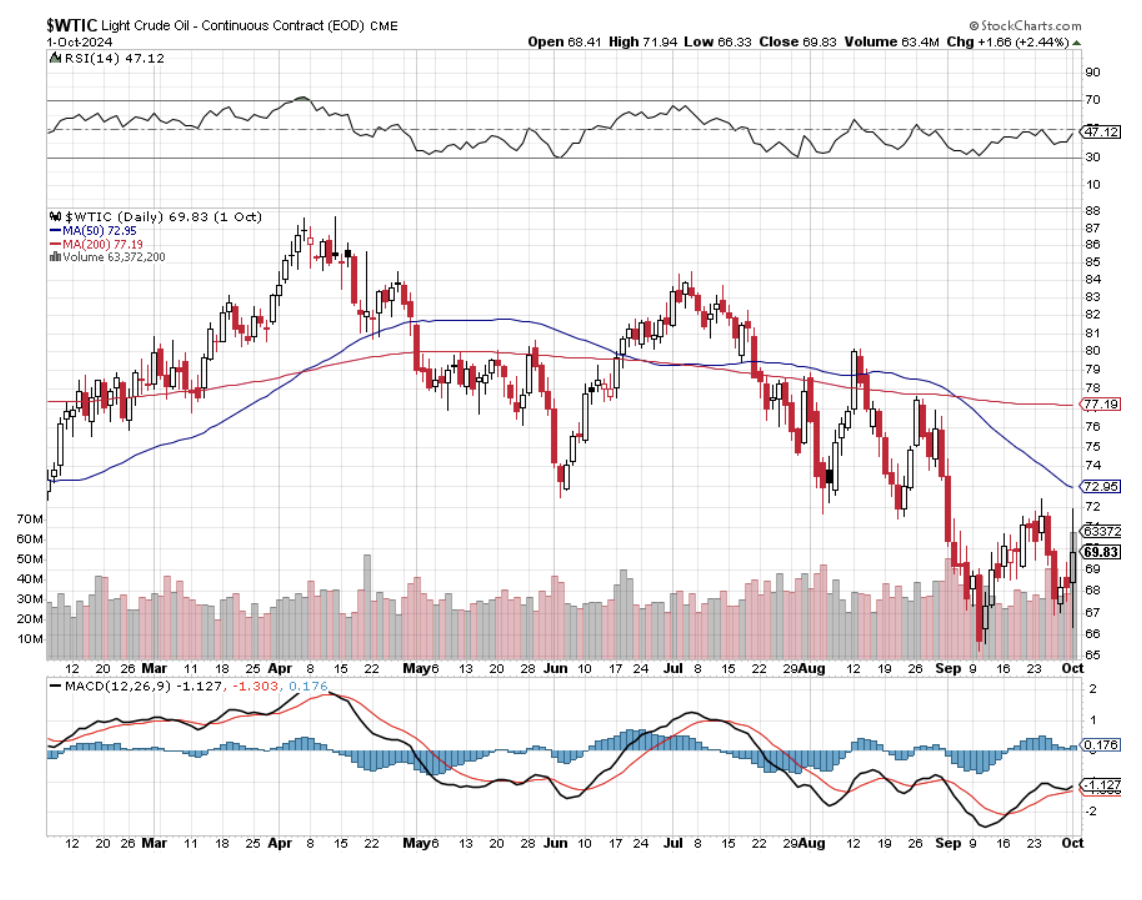
It has been China’s lagging economy that has dragged down the price of West Texas Intermediate Crude by 31%, from $94 a barrel to $65. China has published GDP growth figures this year of 5%, but most who know China well believe the real figure is close to zero. Get China back in business, and we could revisit $94 in no time.
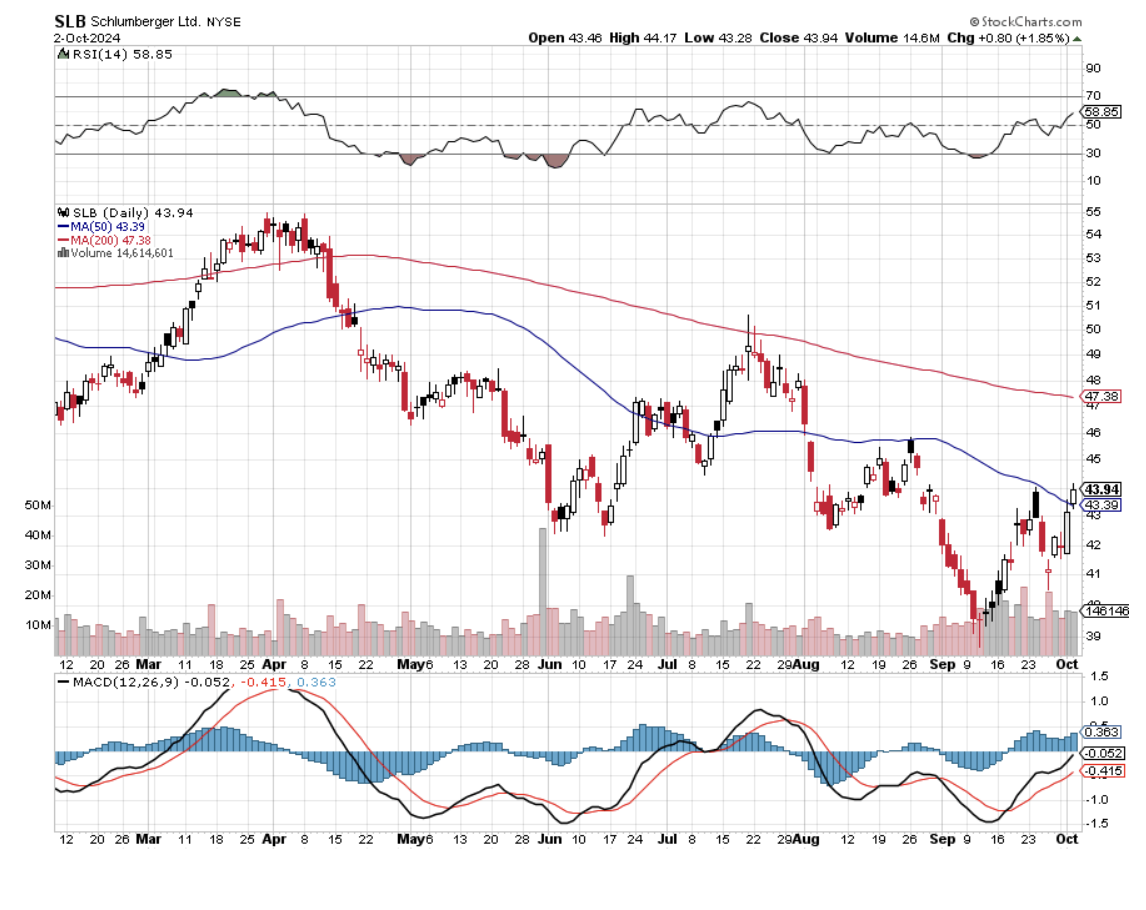
We have just seen a healthy 34% correction in the shares of California-based oil major Schlumberger (SLB), and I am starting to salivate.
If you don’t do options, buy the stock. My target for (SLB) in 2025 is $65, up 20.3%.
I am therefore buying the Schlumberger (SLB) January 2026 $47.50-$50 out-of-the-money vertical Bull Call spread LEAPS at $0.90 or best
DO NOT USE MARKET ORDERS UNDER ANY CIRCUMSTANCES.
Simply enter your limit order, wait five minutes, and if you don’t get done, cancel your order and increase your bid by 10 cents with a second order.
This is a bet that Schlumberger (SLB) will not fall below $50.00 by the January 16, 2026 option expiration in 15 months.
To learn more about the company, please visit their website at https://www.slb.com
Don’t pay more than $1.30 or you’ll be chasing on a risk/reward basis.
Please note that these options are illiquid, and it may take some work to get in or out. Executing these trades is more an art than a science.
Let’s say the Schlumberger (SLB) January 2026 $47.50-$50 out-of-the-money vertical Bull Call spread LEAPS at $0.90 are showing a bid/offer spread of $0.90-$1.50. Enter a good-until-cancelled order for one contract at $0.90, another for $1.00, another for $1.10, another for $1.20, and so on. Eventually, you will enter a price that gets filled immediately. That is the real price. Then, enter an order for your full position at that real price.
Notice that the day-to-day volatility of LEAPS prices is minuscule, less than 10%, since the time value is so great, and you have a long position simultaneously offset by a short one.
This means that the day-to-day moves in your P&L will be small. It also means you can buy your position over the course of a month just entering new orders every day. I know this can be tedious but getting screwed by overpaying for a position is even more tedious.
Look at the math below, and you will see that a 13.79% rise in (SLB) shares over 15 months will generate a 177% profit with this position, such is the wonder of LEAPS. That gives you an implied leverage of 12.84:1 Across the $47.50-$50 space. LEAPS stands for Long Term Equity Anticipation Securities.
(SLB) doesn’t even have to get to a new all-time high to make the max profit. It only has to get back to $50.00, where it traded in July.
Here are the specific trades you need to execute this position:
Buy 1 January 2026 (SLB) $47.50 calls at………….………$5.60
Sell short 1 January 2026 (SLB) $50.00 calls at…………$4.70
Net Cost:………………………….………..………….…..............$0.90
Potential Profit: $2.50 - $0.90 = $1.60
(1 X 100 X $1.60) = $160 or 177% in 15 months.
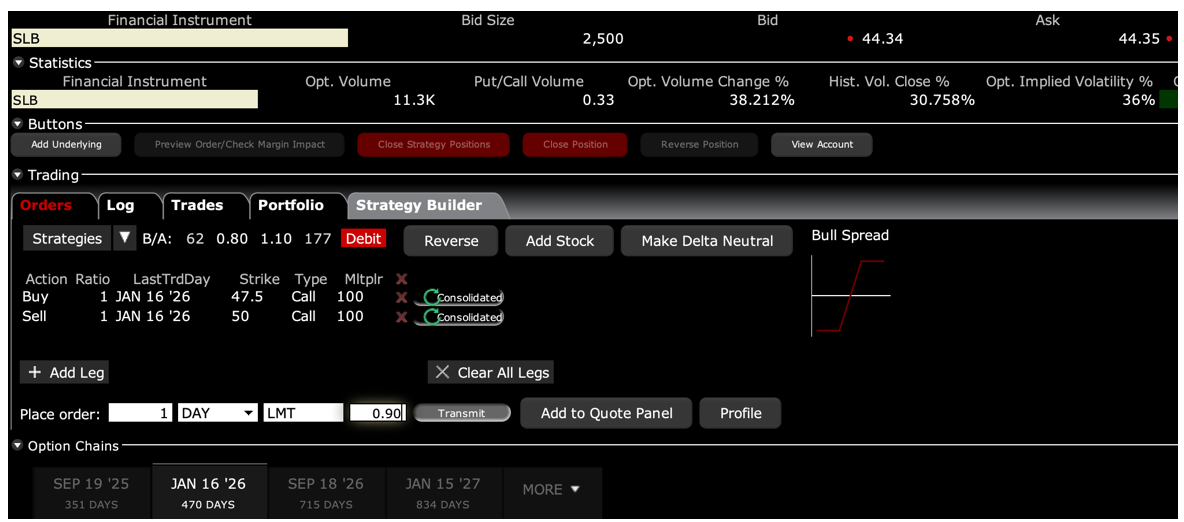
To see how to enter this trade in your online platform, please look at the order ticket below, which I pulled from Interactive Brokers.
If you are uncertain on how to execute an options spread, please watch my training video on “How to Execute a Vertical Bull Call Debit Spread” by clicking here at
https://www.madhedgefundtrader.com/ltt-vbcs/
The best execution can be had by placing your bid for the entire spread in the middle market and waiting for the market to come to you. The difference between the bid and the offer on these deep in-the-money spread trades can be enormous.
Don’t execute the legs individually or you will end up losing much of your profit. Spread pricing can be very volatile on expiration months farther out.
Keep in mind that these are ballpark prices at best. After the alerts go out, prices can be all over the map.
Two scientists walk into a bar. One says, "I've got a funny story about a worm." The other replies, "Hold my Nobel Prize."
This isn't just a setup for a punchline - it's actually a key part of a recent groundbreaking discovery that's just earned Victor Ambros from UMass Chan Medical School and Gary Ruvkun from Harvard Medical School the 2024 Nobel Prize in Physiology or Medicine.
In a nutshell, these two have just been crowned the rock stars of RNA research for 2024 for uncovering the secrets of microRNA. It's like they've found the Rosetta Stone of gene regulation, and boy, is it a game-changer.
Now, you might be thinking, "John, haven't we been down this RNA road before?" And you'd be right. Just last year, the Nobel folks were gushing over mRNA vaccines. But this year's prize? It's a whole different ballgame.
For years, we thought we had gene regulation all figured out. Genes make mRNA, mRNA makes proteins, and proteins run the show. Simple, right? Well, Ambros and Ruvkun just blew that notion out of the water.
Their breakthrough came from an unlikely source - a tiny worm called C. elegans. This little nematode might not look like much, but it's been the workhorse of biology for decades.
Ambros and Ruvkun were puzzling over some mutant worms that couldn't get their growth spurts right. One type was growing too big, the other too small.
After years of head-scratching and late nights in the lab, they stumbled upon something extraordinary. They found that a gene called lin-4 wasn't making a protein at all.
Instead, it was cranking out a small piece of RNA that could stick to another gene's mRNA and shut it down. This was microRNA, and it was about to turn the world of molecular biology on its head.
At first, everyone thought this was just some quirky worm thing. But seven years later, Ruvkun's team found another microRNA that showed up not just in worms but in everything from fruit flies to humans.
Suddenly, microRNA wasn't just a biological oddity - it was a universal regulator of genes.
Fast forward to today, and we now know that humans have over 1,000 different microRNAs. These tiny molecules are pulling the strings on virtually every gene in our bodies. It's like discovering a whole new layer of cellular bureaucracy we never knew existed.
Now, you might be wondering, "That's all well and good, but what's it got to do with making money?" Well, let me tell you, this discovery has set off a gold rush in the biotech world.
Companies are scrambling to turn this basic science into cold, hard cash.
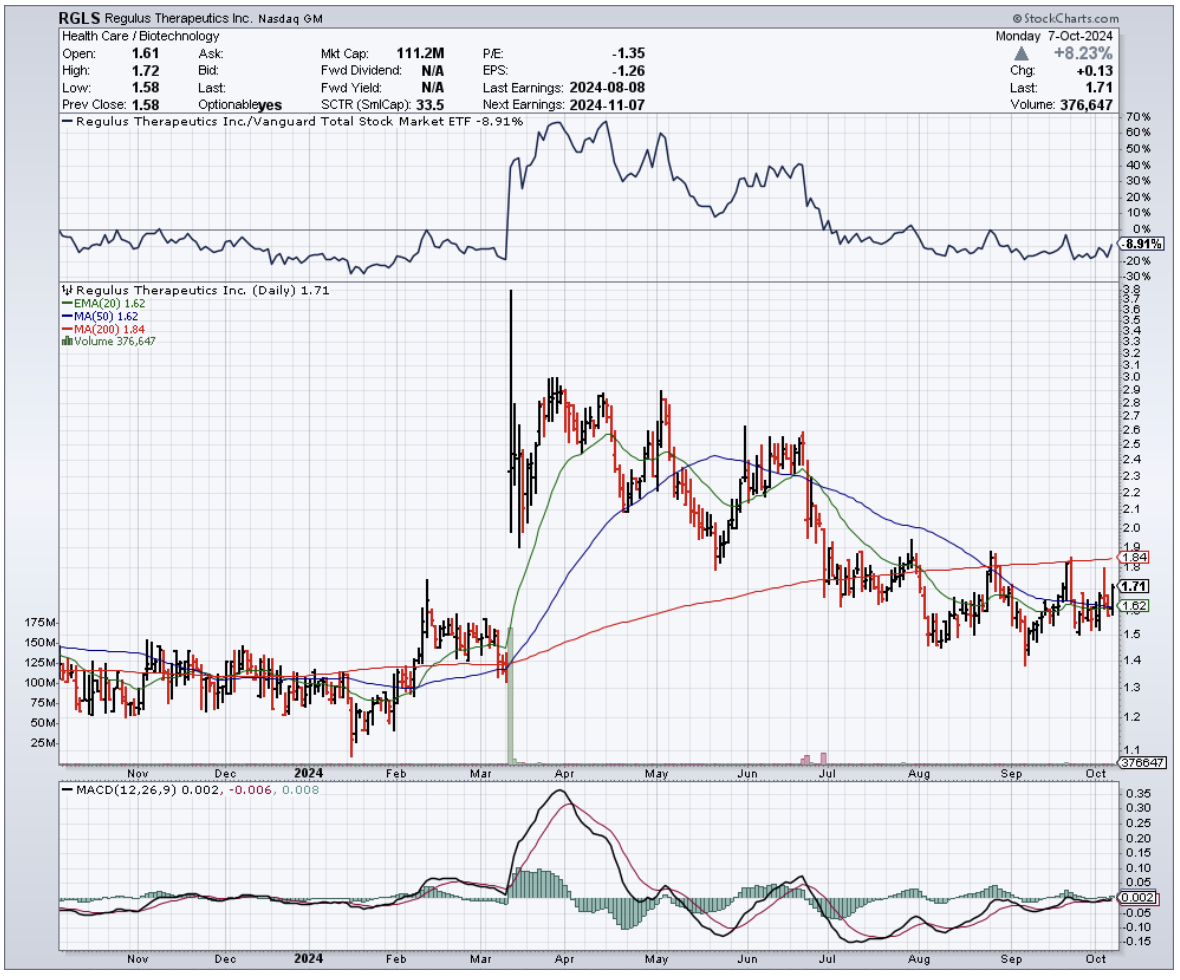
Take Regulus Therapeutics (RGLS), for instance. They're working on a treatment for polycystic kidney disease that targets microRNA-21. It's early days, but the potential is enormous.
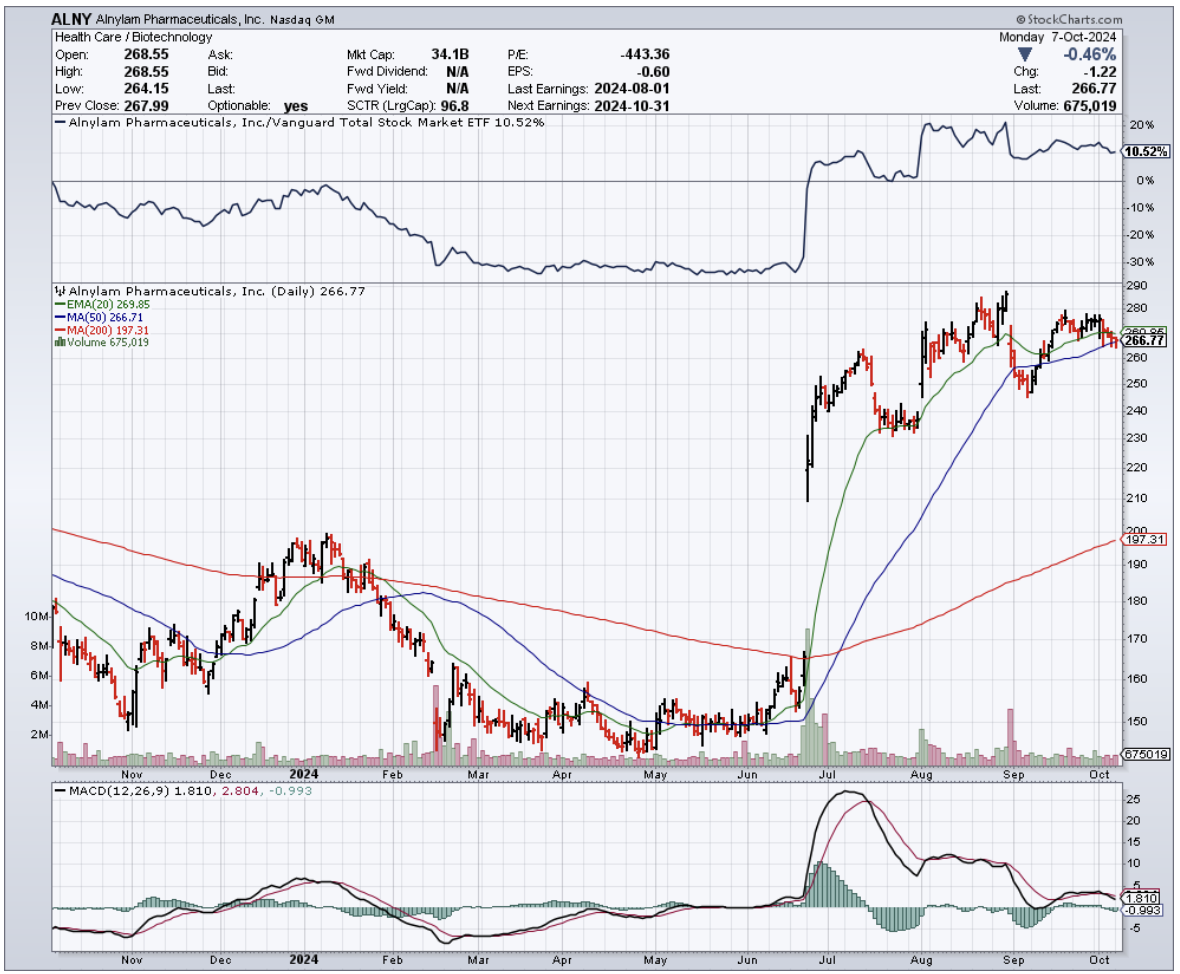
Then there's Alnylam Pharmaceuticals (ALNY). These folks have already brought RNA-based therapies to market.
Their drug, ONPATTRO, is treating a rare disease called hereditary transthyretin-mediated amyloidosis. It's proof that RNA-targeted treatments aren't just pie in the sky - they're real, and they're here.
Big Pharma is getting in on the action, too. Roche (RHHBY) bought up a company called Santaris Pharma back in 2014, snagging some nifty technology for developing microRNA therapies.
Novartis (NVS) and AstraZeneca (AZN) are also dipping their toes in the microRNA waters. And let's not forget about Qiagen (QGEN). They're not developing therapies, but they're selling the picks and shovels for this gold rush - tools for microRNA research and diagnostics.
Now, I'm not saying you should go all-in on microRNA stocks tomorrow. This is cutting-edge science, and the road from the lab bench to the pharmacy shelf is long and treacherous. But for those of you with an appetite for risk and a long-term view, this could be the next big thing in biotech.
So the next time someone corners you at a party with a story about microscopic organisms, maybe don't rush to the bar just yet. Remember, Ambros and Ruvkun weren't trying to create the next blockbuster drug. They were just curious about some weird-looking worms. Who would have thought their discovery could end up revolutionizing medicine?
Mad Hedge Biotech and Healthcare Letter
October 8, 2024
Fiat Lux
Featured Trade:
(THE LITTLE RNA THAT COULD)
(RGLS), (ALNY), (RHHBY), (NVS), (AZN), (QGEN)
Global Market Comments
October 8, 2024
Fiat Lux
Featured Trade:
(OCCIDENTAL PETROLEUM LEAPS),
(OXY)
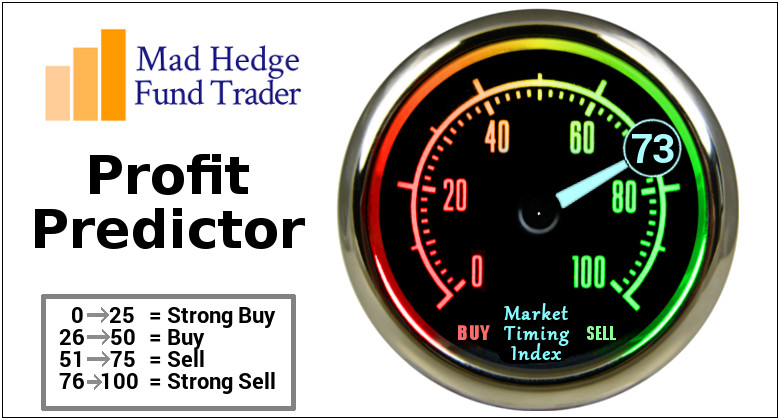
Trade Alert - (OXY) – BUY
BUY the Occidental Petroleum (OXY) January 2026 $60-$62.50 out-of-the-money vertical Bull Call spread LEAPS at $0.80 or best
Opening Trade
10-8-2024
expiration date: January 16, 2026
Number of Contracts = 1 contract
China certainly brought out a big bazooka with its massive stimulus package last week. If this one proves inadequate, they can bring out many more. China is no longer the poor country I knew 50 years ago. For a start, they own $869 billion worth of US Treasury bonds.
And what is the best leverage China plays out there?
Oil.
It just so happens that energy is virtually the only cheap sector in the stock market and the worst stock market performer of 2024.
Oil consumption in China amounted to 16.6 million barrels per day in 2023, up from 15 million barrels daily in the prior year. That is 17.2% of the 96.4 million barrels in global oil production last year. Between 1990 and 2023, figures increased by more than 14 million barrels per day, up from 1 million barrels a day.
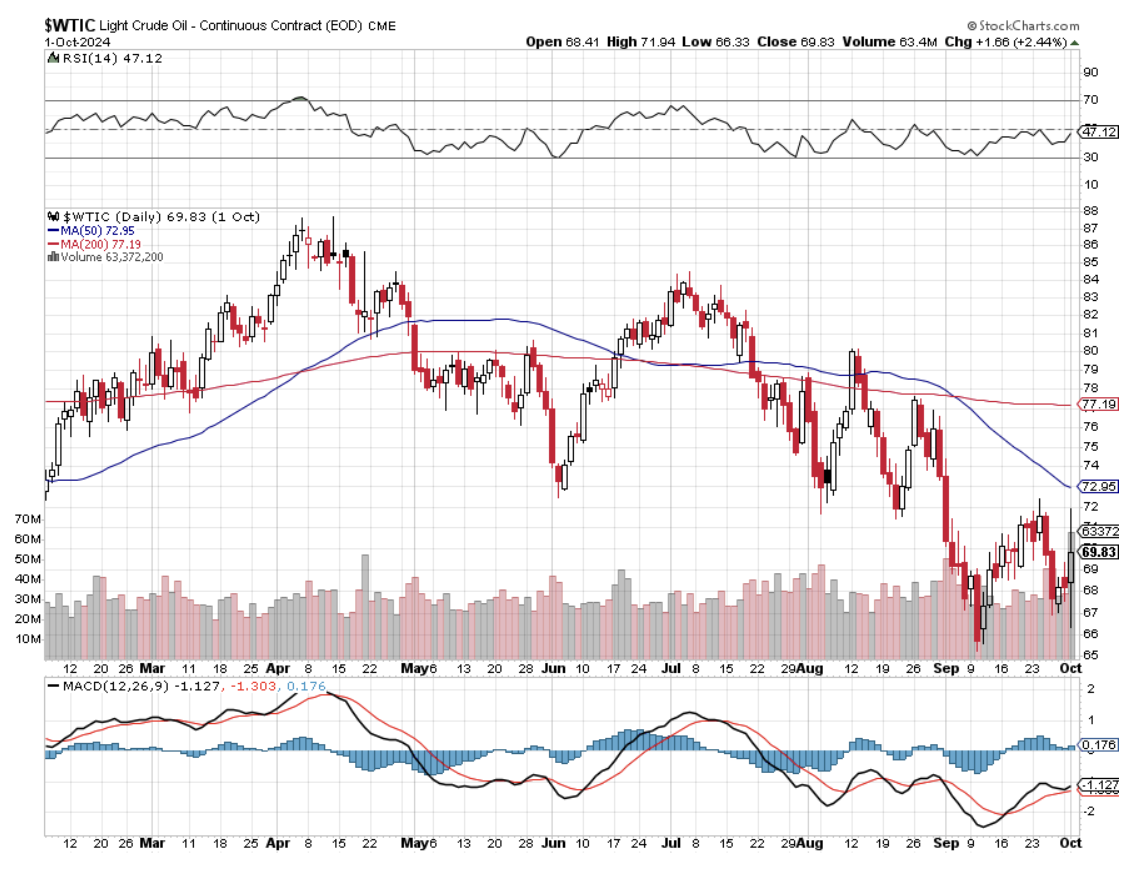
It has been China’s lagging economy that has dragged down the price of West Texas Intermediate Crude by 31%, from $94 a barrel to $65. China has published GDP growth figures this year of 5%, but most who know China well believe the real figure is close to zero. Get China back in business, and we could revisit $94 in no time.
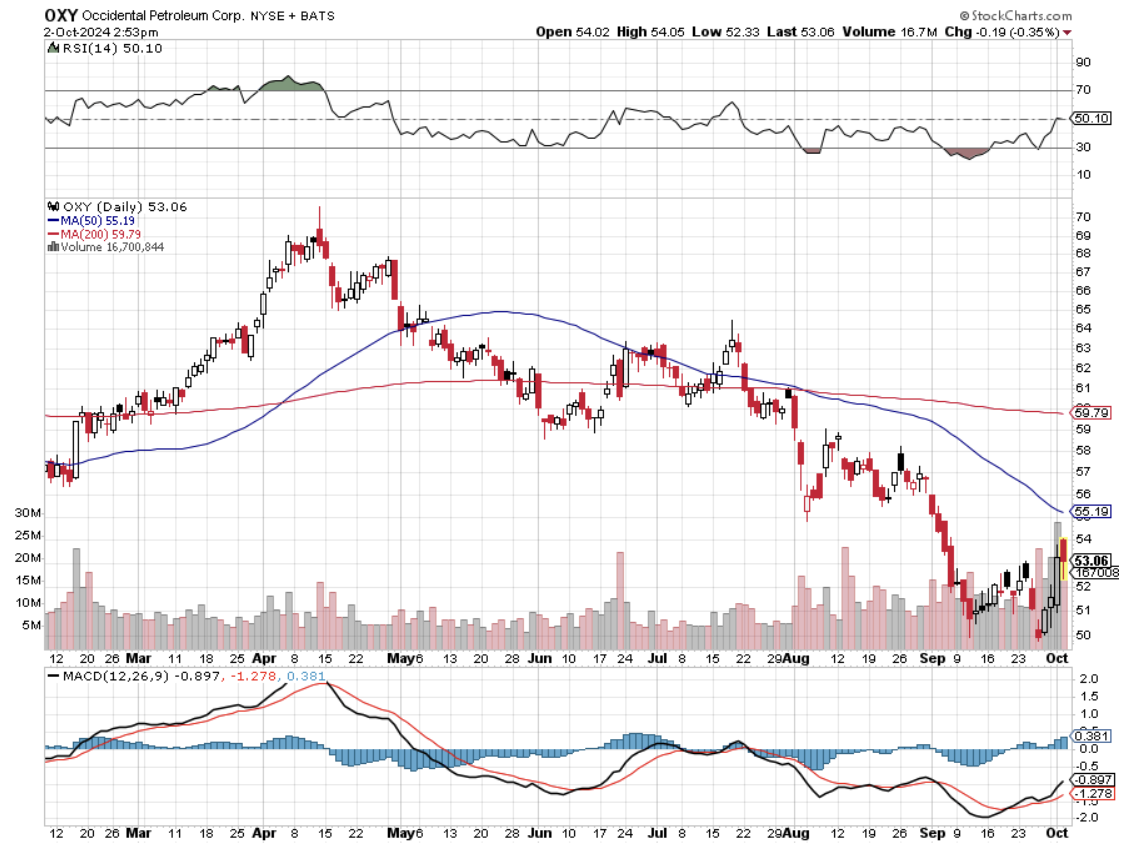
We have just seen a healthy 32% correction in the shares of California-based oil major Occidental Petroleum (OXY), and I am starting to salivate. Finally, I can put to work my 50-year relationship with the company (see research piece below).
If you don’t do options, buy the stock. My target for (OXY) in 2025 is $74, up 37%.
I am therefore buying the Occidental Petroleum (OXY) January 2026 $60-$62.50 out-of-the-money vertical Bull Call spread LEAPS at $0.80 or best.
DO NOT USE MARKET ORDERS UNDER ANY CIRCUMSTANCES.
Simply enter your limit order, wait five minutes, and if you don’t get done, cancel your order and increase your bid by 5 cents with a second order.
This is a bet that Occidental Petroleum (OXY) will not fall below $62.50 by the January 16, 2026, option expiration in 15 months.
To learn more about the company, please visit their website at https://www.oxy.com
Don’t pay more than $1.20 or you’ll be chasing on a risk/reward basis.
Please note that these options are illiquid, and it may take some work to get in or out. Executing these trades is more an art than a science.
Let’s say the Occidental Petroleum (OXY) January 2026 $60-$62.50 out-of-the-money vertical Bull Call spread LEAPS are showing a bid/offer spread of $0.50-$1.50. Enter an order for one contract at $0.50, another for $0.60, another for $0.70 and so on. Eventually, you will enter a price that gets filled immediately. That is the real price. Then, enter an order for your full position at that real price.
Notice that the day-to-day volatility of LEAPS prices is minuscule, less than 10% since the time value is so great and you have a long position simultaneously offset by a short one.
This means that the day-to-day moves in your P&L will be small. It also means you can buy your position over the course of a month, just entering new orders every day. I know this can be tedious but getting screwed by overpaying for a position is even more tedious.
Look at the math below, and you will see that a 15.74% rise in (OXY) shares will generate a 212% profit with this position, such is the wonder of LEAPS. That gives you an implied leverage of 13.46:1. Across the $60-$62.50 space. LEAPS stands for Long-Term Equity Anticipation Securities.
(OXY) doesn’t even have to get to a new all-time high to make the max profit. It only has to get back to $62.50, where it traded in July.
Only use a limit order. DO NOT USE MARKET ORDERS UNDER ANY CIRCUMSTANCES. Just enter a limit order and work it.
Here are the specific trades you need to execute this position:
Buy 1 January 2026 (OXY) $60 calls at………….…....……$5.25
Sell short 1 January 2026 (OXY) $62.50 calls at…………$4.45
Net Cost:………………………….………..………….…...............$0.80
Potential Profit: $2.50 - $0.80 = $1.70
(1 X 100 X $1.70) = $170 or 212% in 15 months.
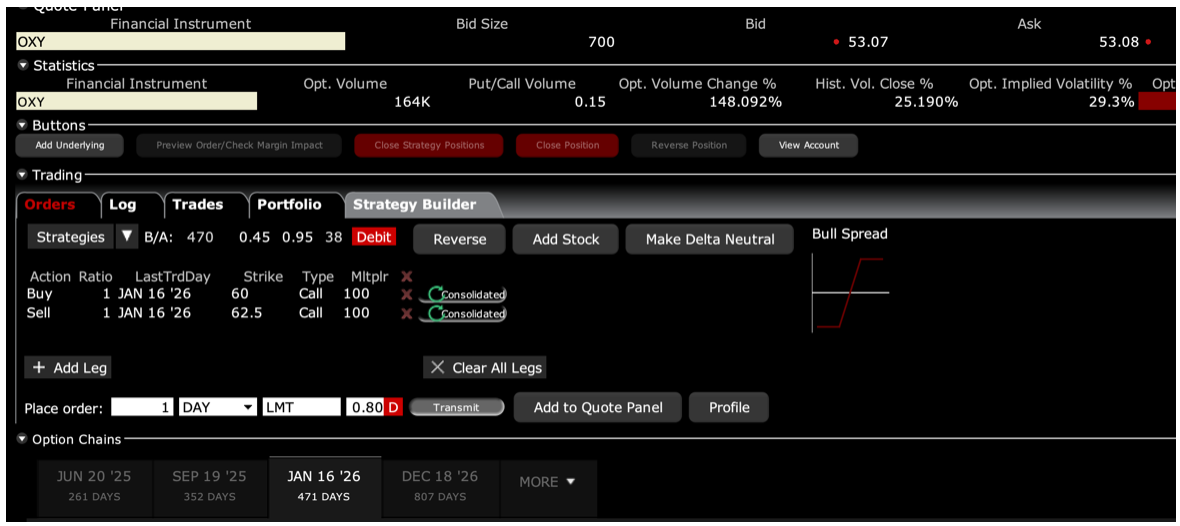
To see how to enter this trade in your online platform, please look at the order ticket below, which I pulled off of Interactive Brokers.
If you are uncertain on how to execute an options spread, please watch my training video on “How to Execute a Vertical Bull Call Debit Spread” by clicking here.
The best execution can be had by placing your bid for the entire spread in the middle market and waiting for the market to come to you. The difference between the bid and the offer on these deep-in-the-money spread trades can be enormous.
Don’t execute the legs individually, or you will end up losing much of your profit. Spread pricing can be very volatile on expiration months farther out.
Keep in mind that these are ballpark prices at best. After the alerts go out, prices can be all over the map.
Take a Look at Occidental Petroleum (OXY)
There are a lot of belles at the ball, but you can’t dance with all of them.
While a student at UCLA in the early seventies, I took a World Politics course, which required me to pick a country, analyze its economy, and make recommendations for its economic development.
I chose Algeria, a country where I had spent the summer of 1968 caravanning among the Bedouins, crawling out of the desert starved, lice-ridden, and half-dead.
I concluded that the North African country should immediately nationalize the oil industry and raise oil prices from $3/barrel to $10. I knew that Los Angeles-based Occidental Petroleum (OXY) was interested in exploring for oil there, so I sent my paper to the company for review.
They called the next day and invited me to their imposing downtown headquarters, then the tallest building in Los Angeles.
I was ushered into the office of Dr. Armand Hammer, one of the great independent oil moguls of the day, a larger-than-life figure who owned a spectacular impressionist art collection and who confidently displayed a priceless Fabergé egg on his desk. He said he was impressed with my paper and then spent two hours grilling me.
Why should oil prices go up? Who did I know there? What did I see? What was the state of their infrastructure? Roads? Bridges? Rail lines? Did I see any oil derricks? Did I see any Russians? I told him everything I knew, including the two weeks in an Algiers jail for taking pictures in the wrong places.
His parting advice was to never take my eye off the oil industry, as it is the driver of everything else. I have followed that advice ever since.
When I went back to UCLA, I told a CIA friend of mine that I had just spent the afternoon with the eminent doctor (Marsha, call me!). She told me that he had been a close advisor of Vladimir Lenin after the Russian Revolution, had been a double agent for the Soviets ever since, that the FBI had known this all along, and was currently funneling illegal campaign donations to President Richard Nixon.
Shocked, I kicked myself for going into an interview so ill-prepared and had missed a golden opportunity to ask some great questions. I never made that mistake again.
Some 50 years later, while trolling the markets for great buying opportunities set up by the recent China bazooka, I stumbled across (OXY) once more (click here for their site at http://www.oxy.com /). (OXY) has a minimal offshore presence, nothing in deep water, and huge operations in the Middle East and South America.
OXY’s horizontal multistage fracturing technology will enable it to dominate California shale. The company offers a respectable dividend of 1.65% and has a submarket earnings multiple of only 13.7 times. Need I say more?
Oh, and I got an A+ on the paper, and the following year, Algeria raised the price of oil to $12.
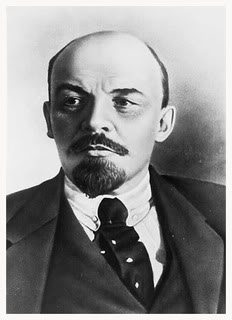

Lenin and Hammer

A Faberge Egg
(GOOGL), (AAPL), (META), (TSLA)
You know, back when I was interviewing Japan's Prime Minister Takeo Fukuda in the late '70s, I never imagined I'd be more excited about artificial intelligence than international politics. Yet here we are.
The world of technology has a funny way of shifting our focus, and AI is the latest game-changer that's got my attention.
As it turns out, the Turing test was just the warm-up. We're now in a whole new ballgame, and some of the biggest players are struggling to keep up.
Remember when Google (GOOGL) was the coolest kid on the block? Well, they've been caught with their pants down. It took them a whopping 30 months after GPT-3 hit the scene to roll out their own AI system.
And Apple (AAPL)? They didn't even mention AI at their 2023 developer conference. Talk about missing the boat.
Over the past months, the big boys have finally started waking up and smelling the coffee. But here's the million-dollar question: Is it too little, too late? Can these tech giants simply slap some AI on their existing products and call it a day? Not so fast, my friends.
Let's break it down and see if AI truly fits the bill of a disruptive technology. Spoiler alert: It does, and then some.
First up, we've got cost declines that would make Moore's Law blush. AI is getting cheaper by the minute. We're talking about costs halving every 4 months. That's 4-6 times faster than the semiconductor space.
In other words, what used to take a decade in traditional tech is now happening in less than 2 years with AI.
Just look at the numbers: Back in 2020, training a GPT-4 sized model would've set you back a cool $6 billion.
But at the rate this tech is evolving, the same AI power that would've cost you billions 4 years ago will be running on your smartphone by 2026.
As expected, this rapid cost decline is giving the big tech companies a serious case of whiplash. Even small delays in getting to market are creating performance gaps wider than the Grand Canyon.
In fact, Google's been playing catch-up, and their customers have been paying the price - literally.
Since early 2023, using Google's top model instead of OpenAI's best offering would've cost you 40%+ more for the same performance. Ouch.
But here's where it gets more interesting. AI isn't content staying in its lane. We're seeing AI pop up everywhere from healthcare to finance, and even in industries you wouldn't expect.
Just look at the earnings calls - everyone and their dog is talking about AI these days.
Now, you might think the tech giants have this in the bag. After all, Google's massive search data gives them an unbeatable advantage. Think again.
Those short, repetitive search queries aren't exactly prime material for training natural language systems.
Meanwhile, social media giants like Meta (META) and even X (formerly Twitter) are sitting on goldmines of rich, conversational data.
And let's not forget about the world beyond keyboards and screens. Companies like Tesla (TSLA) are collecting real-world data at a mind-boggling scale.
We're talking about 80 quadrillion tokens of driving data in the last year alone. By the end of the decade, that could balloon to over 300 quadrillion tokens per year.
That's the kind of data that could make language models look like child's play.
That’s not where it ends though. AI isn't content with disrupting existing industries. If anything, this tech has been spawning entirely new ones. It's like a breeding ground for innovation. Actually, venture capitalists have been throwing money at AI startups like there's no tomorrow.
We're seeing about a third of global venture funding - that's over $90 billion - going to AI companies this year alone.
So, what does all this mean for the tech giants? Well, they're in a bit of a pickle.
They can't afford to incorporate AI disruptively without risking their cash cows. That’s like trying to change the engine of a plane while it's still flying.
As a result, they're likely to water down AI's magic, creating opportunities for nimble startups to swoop in and steal the show.
I'm not saying Google and Apple are doomed just yet—they might still have a trick or two up their sleeve.
But let’s face it, these giants would rather take a more cautious, controlled approach. Unfortunately for them, the AI revolution isn’t waiting around. It’s barreling ahead at full speed, and it’s not slowing down for anybody.

Mad Hedge Technology Letter
October 7, 2024
Fiat Lux
Featured Trade:
(ROBOTAXI HYPE IS HERE)
(TSLA), (ODFL), (CVLG), (ARCB), (ULH), (SNDR), (WERN)