
Favorite headline of the day: "Greece Offers to Pay Back Debt With Giant Horse."

Favorite headline of the day: "Greece Offers to Pay Back Debt With Giant Horse."

WASHINGTON, April 24, 2024 – In a world where financial crimes are becoming increasingly sophisticated, information technology (IT) leaders and AI experts will gather in Washington DC next month for the 2024 AI Training Summit for Financial Investigators. This timely event, to be held at the National Press Club on May 15th and 16th, aims to empower investigators with the latest artificial intelligence (AI) tools and techniques to combat complex financial fraud, money laundering, and other illicit activities.
The Growing Impact of AI on Financial Investigations
Artificial intelligence is rapidly transforming the field of financial investigations. AI-powered algorithms can analyze vast datasets, uncover hidden patterns, and detect anomalies that would be difficult, if not impossible, for humans to identify. This enhanced ability to process information is revolutionizing how investigators approach cases, leading to faster and more accurate identification of fraudulent activities.
Summit Highlights
The 2024 AI Training Summit will bring together thought leaders from government, industry, and academia to share cutting-edge knowledge and strategies for leveraging AI in financial investigations. Key topics include:
Keynote Speakers and Panelists
The summit will feature keynote presentations and panel discussions from leading experts, including:
Transforming the Investigator’s Toolkit
The AI Training Summit for Financial Investigators isn't just about exploring theory. It's designed to provide practical guidance and actionable takeaways. Attendees will participate in hands-on workshops, learning how to:
Visit https://aisummit.link/ to learn more about the upcoming event in May.

Mad Hedge Technology Letter
April 24, 2024
Fiat Lux
Featured Trade:
(RUNNING ON FUMES)
(ARKK), (NVDA), (ROKU), (TSLA)

This is a story of how important it is to accurately time the tech business cycle and to unload winners when they run dry.
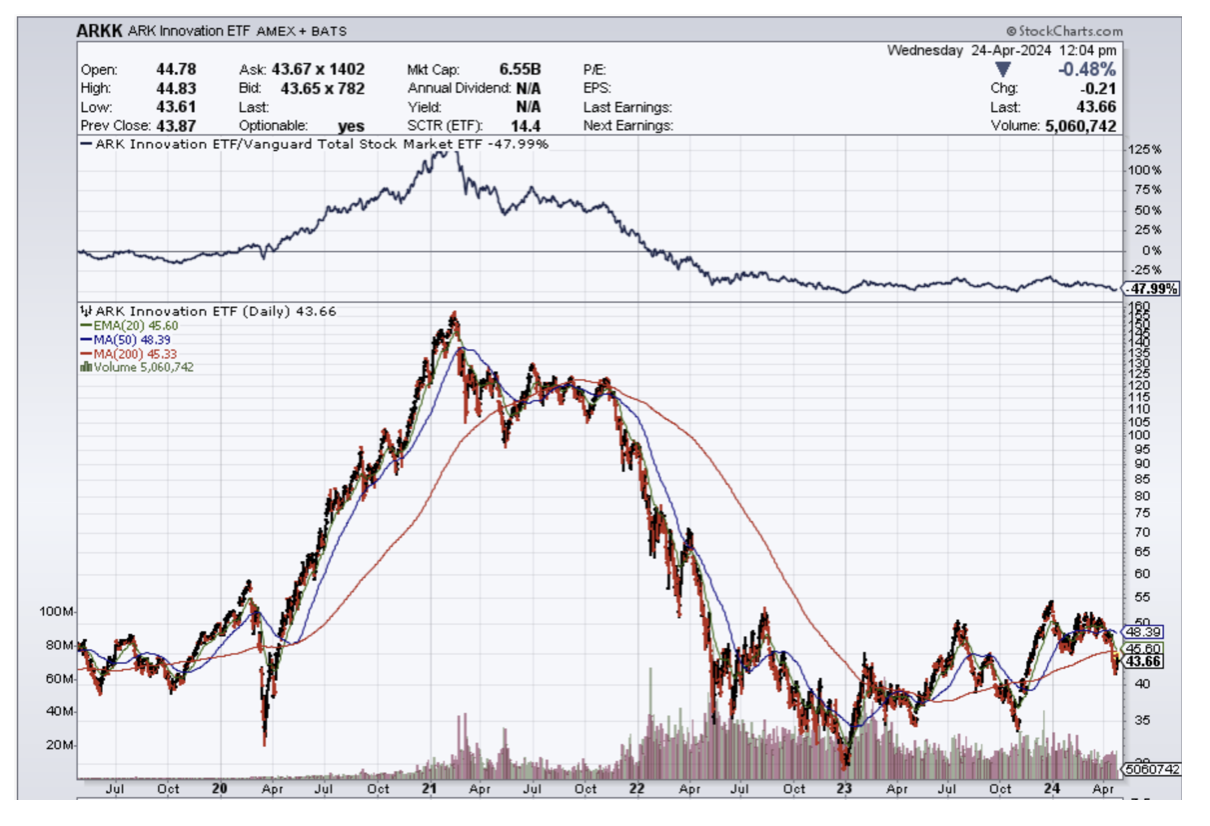
I am talking about Cathy Wood’s ARKK (ARKK) fund and how it has suddenly gone south with no savior in sight.
The beginning of every tech innovation cycle is usually the best time to invest in “innovation” partly because this point in time also coincides with low interest rates.
Rates were historically low for a long time and ARKK did well.
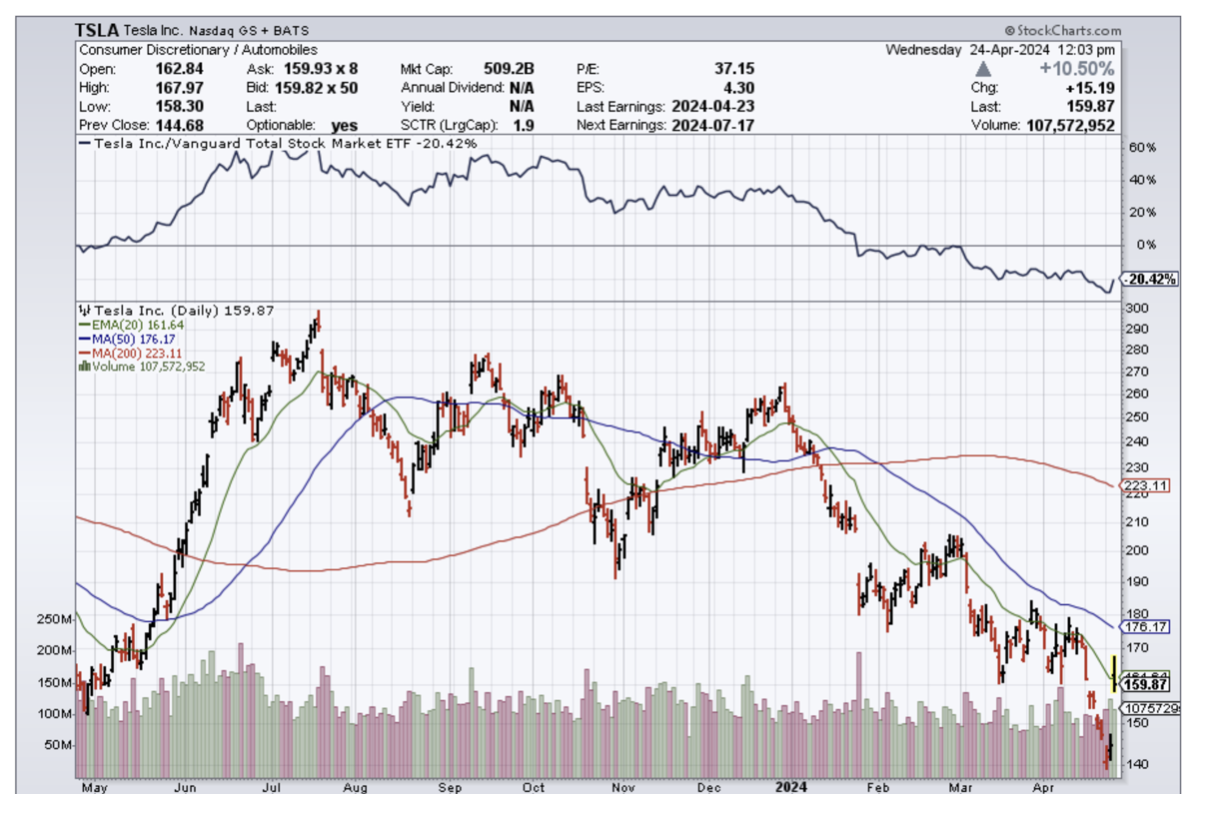
Many of these tailwinds have now gone in complete reverse and Wood’s biggest position Tesla (TSLA) is feeling the brunt of it.
Tesla issued a poor earnings report yesterday, but CEO Elon Musk turned around the price action by chronicling how Tesla is about to roll out cheaper cars.
Cheaper EVs play into the hands of the Chinese who can do it a lot cheaper for better quality.
Fighting the Chinese at its own game is a fool’s errand.
I believe the 12% pop today is largely due to algorithmic buying and when traders see through this empty strategy, it will usher in the next down leg for Tesla and one of its largest positions.
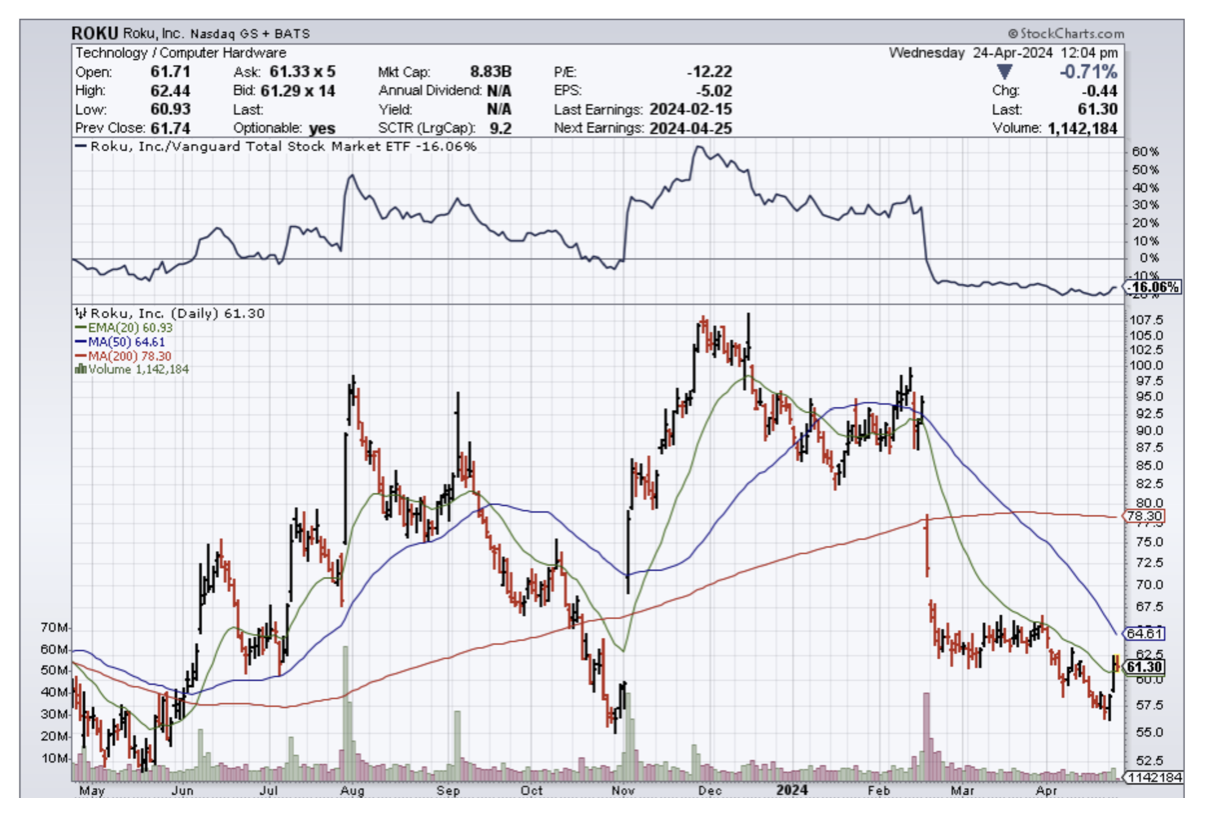
One of ARKK’s other large positions is in ROKU (ROKU) which navigates the streaming sub-sector.
Streaming, aside from Netflix (NFLX), has gone nowhere lately as prices for consumers have skyrocketed but services haven’t improved.
Growth has saturated is the end result.
It’s gone from bad to worse.
It’s a far cry when investors rushed into her funds and it won big during the pandemic when the star fund manager became a social-media sensation by making bold bets on disruptive technology stocks such as Tesla, Zoom Video Communications, and Roku.
Investors have pulled a net $2.2 billion from ARK Investment Management this year, a withdrawal that dwarfs the outflows in all of 2023. Total assets in those funds have dropped 30% in less than four months to $11.1 billion—after peaking at $59 billion in early 2021, when ARK was the world’s largest active ETF manager.
Loyal shareholders have become disillusioned and this should be a better year for the ARK style of investing in growth and disruptive technology, but they are concentrated in companies that have underperformed.
By the end of last year, ARK funds had destroyed more wealth than any other asset manager over the previous decade, losing investors a collective $14.3 billion.
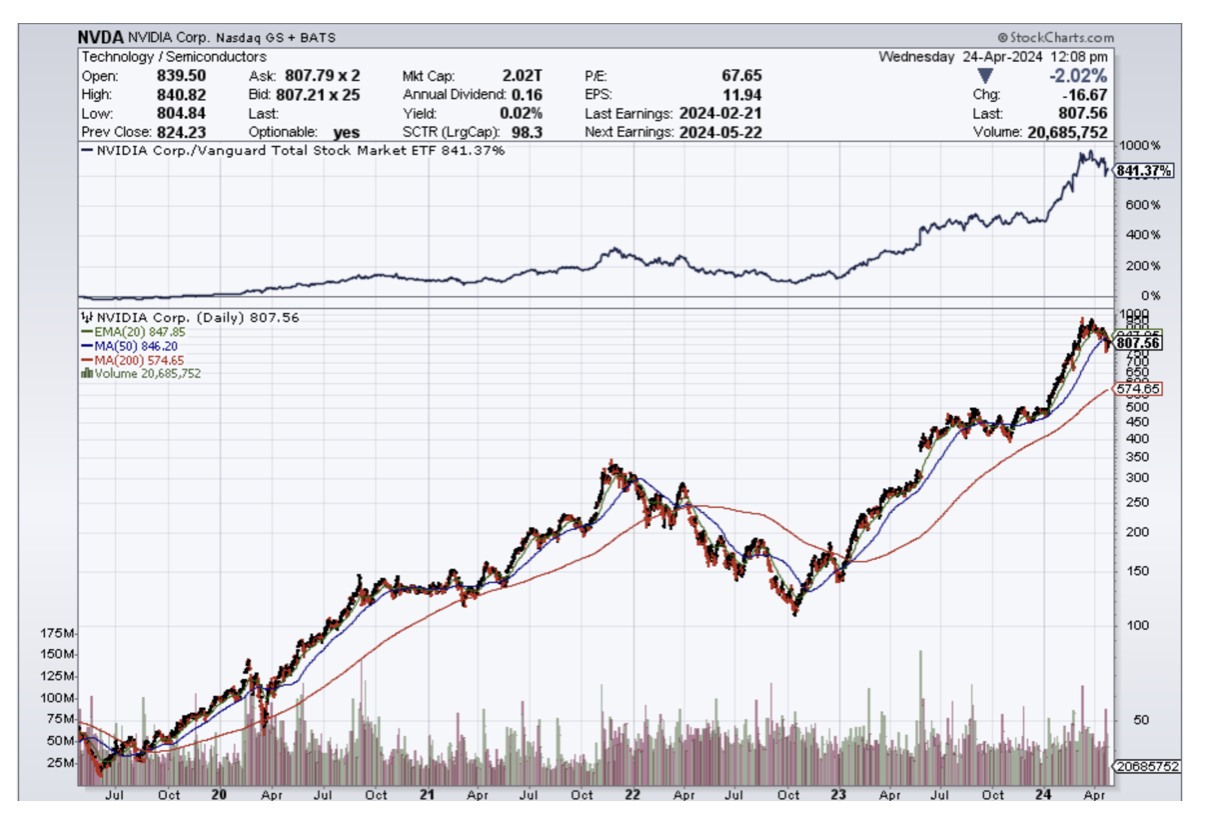
Nvidia’s absence in ARK’s flagship fund has been a particular pain point. The innovation fund sold off its position in January 2023, just before the stock’s monster run began. The graphics chip maker’s shares have roughly quadrupled since.
Wood, a longtime proponent of cryptocurrency, has done better standing by her bet on crypto exchange Coinbase Global, whose shares have quadrupled over the past year. The stock is still down 47% from its peak in 2021.
The ARKK ETF has lost 75% of its value since 2021 which has infuriated investors who thought they could chase innovation to sky-high valuations.
The ETF languishing in the doldrums represents Wood’s inability to innovate her trading philosophy and grapple with the reality that we are in a very late cycle in tech and blowing one’s wad on some pie-in-the-sky dream isn’t going to cut it in 2024.
Still with the robust business models that can weather high interest rates and high inflation.

“If you're trying to create a company, it's like baking a cake. You have to have all the ingredients in the right proportion.” – Said CEO of Tesla Elon Musk


(WALL STREET IS PAYING ATTENTION TO THE METALS SECTOR)
April 24, 2024
Hello everyone,
Arizona Metals Corp.
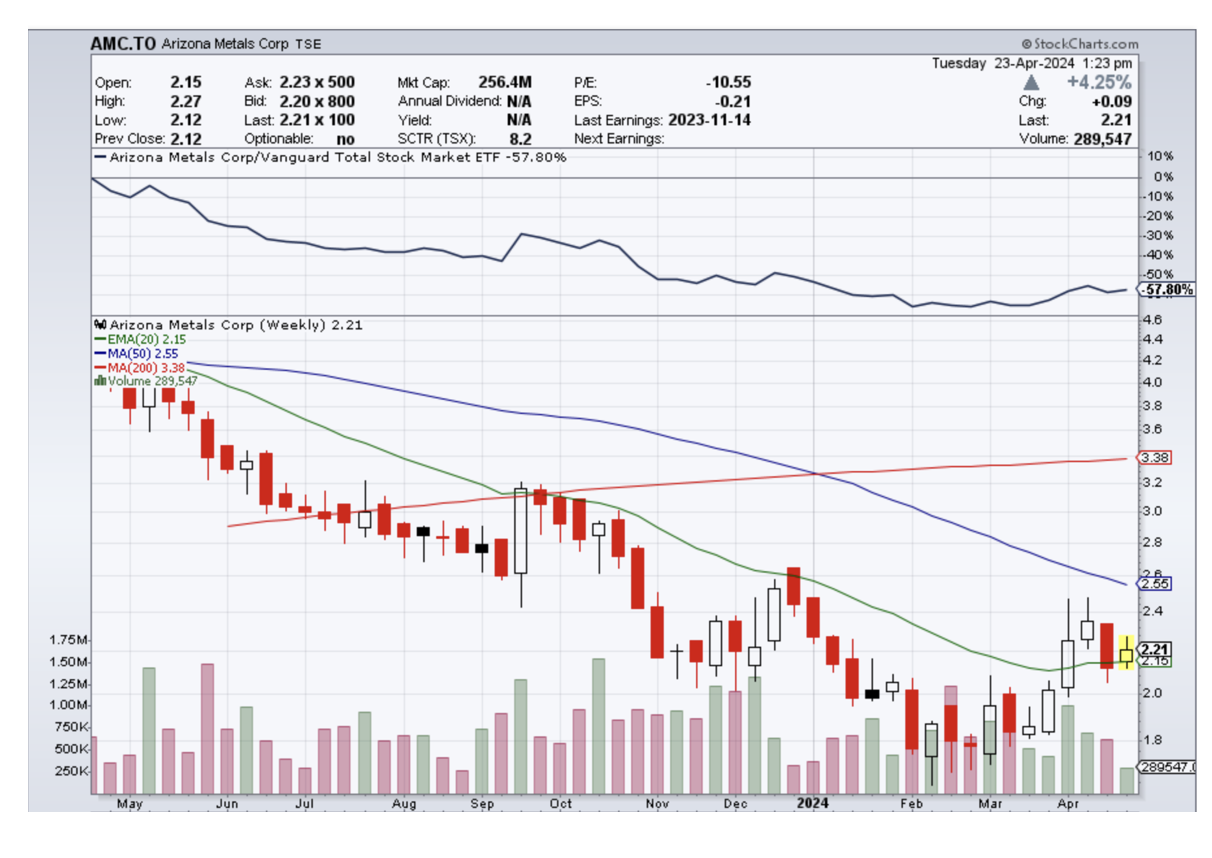
I’m diving into a Canadian gold explorer today that is only priced at $2.21.
New drilling results from its Kay Mine Project, located 45 miles north of Phoenix, Arizona, suggest the presence of high-grade copper and gold mineralization within the drilled areas, which could potentially lead to the discovery of a significant mineral resource.
Analysts at Scotiabank believe the company has completed 106,000 meters of drilling on the Kay property and remains well-funded, with $31 million in cash at the end of last year to complete the remaining 53,000 meters of the drill program.
There is an expectation by analysts at Scotiabank that shares will rise 114% to $4.50 Canadian dollars ($3.27) from current levels.
The Kay Mine, a wholly owned gold-copper-zinc exploration-stage project, is Arizona Metal’s flagship mine. According to the company, minerals have been identified through drilling from 150 metres to at least 900 meters below the surface.
Arizona Metal’s stock has a consensus price target of six Canadian dollars, representing a potential upside of 185%, according to FactSet data.
BMO Capital Markets analyst Rene Cartier has a price target of 6.50 Canadian dollars on the stock, giving it an upside potential of 209%.
Beacon Securities analyst Bereket Berhe, meanwhile, has set a price target of 10.50 Canadian dollars, suggesting a potential upside of 400%. This makes Scotiabank’s price target the most conservative among analysts polled by FactSet.
Investments in mineral exploration companies are often considered to be high-risk, so if you are risk-averse, please skip this investment.
Wall Street is bullish on copper.
Supply risks and rising demand amid the energy transition and the artificial intelligence boom have Wall Street taking note and becoming increasingly bullish on this metal.
Copper is used in data centres for power cables, electrical connectors, power strips, and more.
Global copper demand by data centres will increase from 239 kt (thousand tons) in 2023 to at least 450 kt per annum in 2030.
Jefferies analysts argue that the potential demand growth will exacerbate an underlying copper market deficit, ultimately leading to higher prices.
Data centres house vast amounts of computing power needed for AI workloads, and that need is set to grow as many tech companies are rapidly developing infrastructure for artificial intelligence. Large language models require a lot of data centre capacity.
Recently, Morgan Stanley predicted that the price of the metal will reach $10,500 per ton by the fourth quarter of this year – representing around 12% upside.
Copper is also widely considered an indicator of economic health. The metal has a wide range of applications throughout construction and industry. It’s also a critical component in electric vehicles, used in batteries, wiring, charging points, and more.
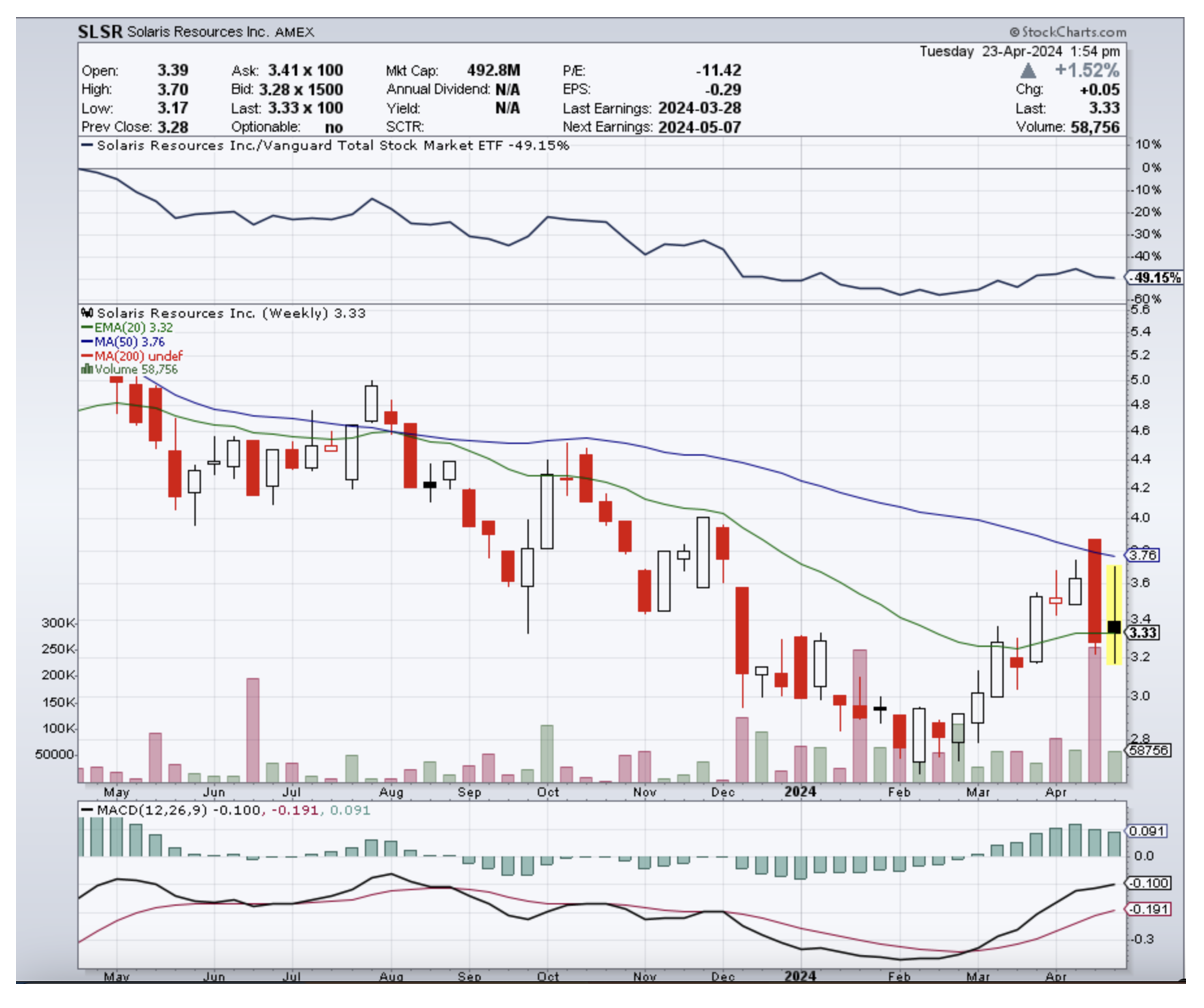
If you want another copper stock besides Freeport McMoRan (FCX) for your investment portfolio, you could consider Solaris Resources (SLSR) Price of $3.33. Analysts have given it a 100% buy rating, with the potential for more than 100% upside.
If you want to consider ETFs you could have a look at Sprott Copper Miners ETF (COPP) and the iShares Copper and Metals Mining ETF (ICOP), as well as the Global X Copper Miners ETF (COPX).

Cheers,
Jacquie
Global Market Comments
April 24, 2024
Fiat Lux
Featured Trade:
(THEY’RE NOT MAKING AMERICANS ANYMORE)
(SPY), (EWJ), (EWL), (EWU), (EWG), (EWY), (FXI), (EIRL), (GREK), (EWP), (IDX), (EPOL), (TUR), (EWZ), (PIN), (EIS)


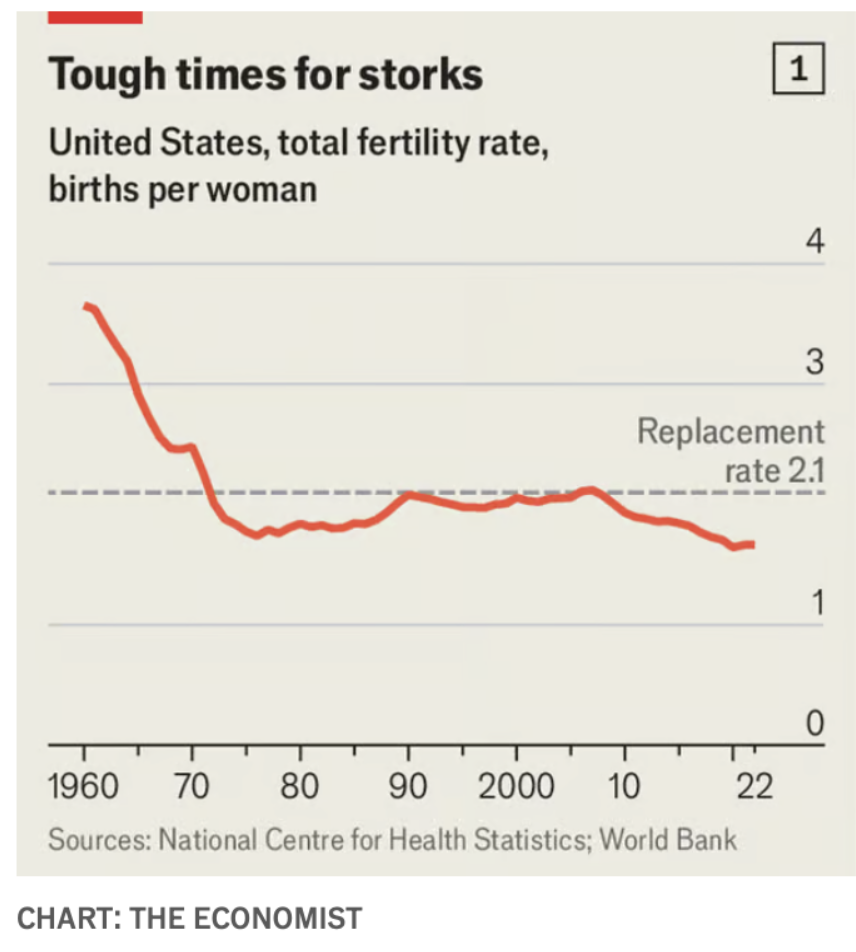
If demographics is destiny, then America’s future looks bleak. You see, they’re not making Americans anymore.
At least that is the sobering conclusion of the latest Economist magazine survey of the global demographic picture.
I have long been a fan of demographic investing, which creates opportunities for traders to execute on what I call “intergenerational arbitrage”. When the numbers of the middle-aged big spenders are falling, risk markets plunge. Front run this data by two decades, and you have a great predictor of stock market tops and bottoms that outperforms most investment industry strategists.
You can distill this even further by calculating the percentage of the population that is in the 45-49 age bracket.
The reasons for this are quite simple. The last five years of child rearing are the most expensive. Think of all that pricey sports equipment, tutoring, braces, SAT coaching, first cars, first car wrecks, and the higher insurance rates that go with it.
Older kids need more running room, which demands larger houses with more amenities. No wonder it seems that dad is writing a check or whipping out a credit card every five seconds. I know, because I have five kids of my own. As long as dad is in spending mode, stock and real estate prices rise handsomely, as do most other asset classes. Dad, you’re basically one generous ATM.
As soon as kids flee the nest, this spending grinds to a juddering halt. Adults entering their fifties cut back spending dramatically and become prolific savers. Empty nesters also start downsizing their housing requirements, unwilling to pay for those empty bedrooms, which in effect, become expensive storage facilities.
This is highly deflationary and causes a substantial slowdown in GDP growth. That is why the stock and real estate markets began their slide in 2007, while it was off to the races for the Treasury bond market.
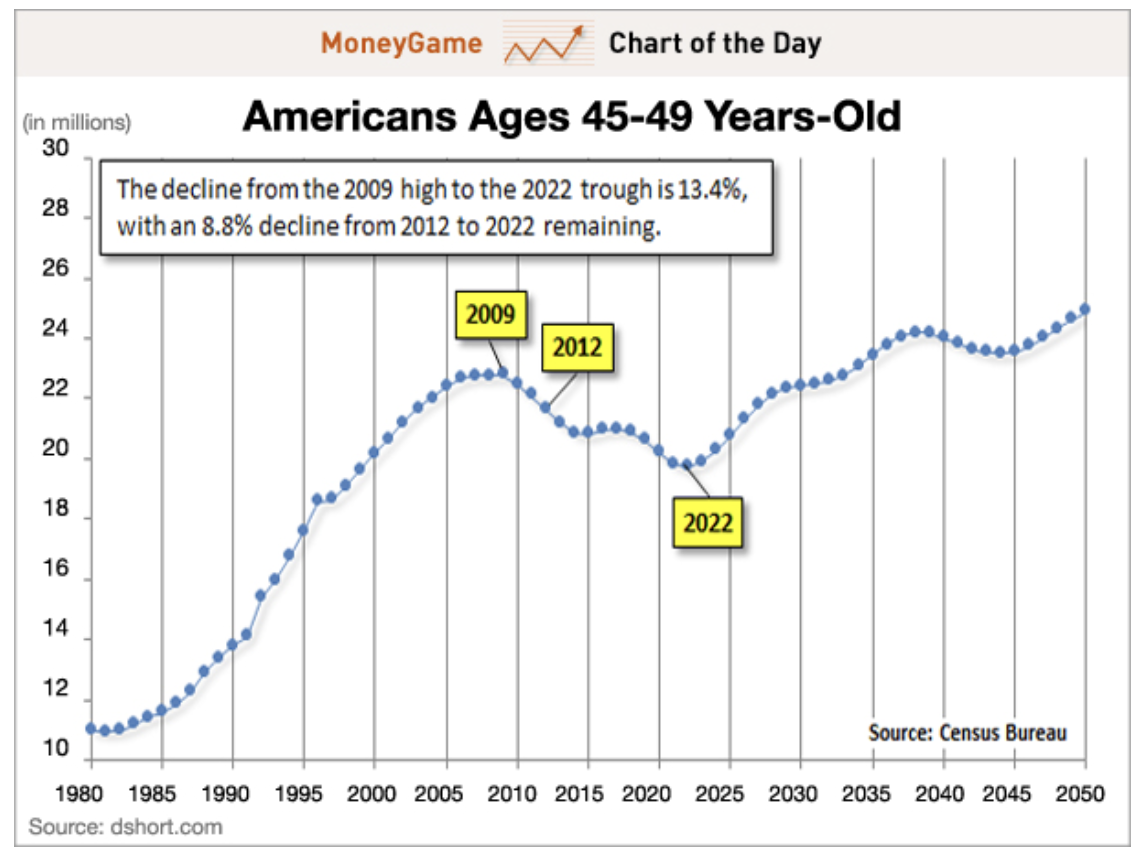
The data for the US is not looking so hot right now. Americans aged 45-49 peaked in 2009 at 23% of the population. According to US census data, this group then began a 13-year decline to only 19% by 2022.
You can take this strategy and apply it globally with terrific results. Not only do these spending patterns apply globally, they also back-test with a high degree of accuracy. Simply determine when the 45-49 age bracket is peaking for every country and you can develop a highly reliable timetable for when and where to invest.
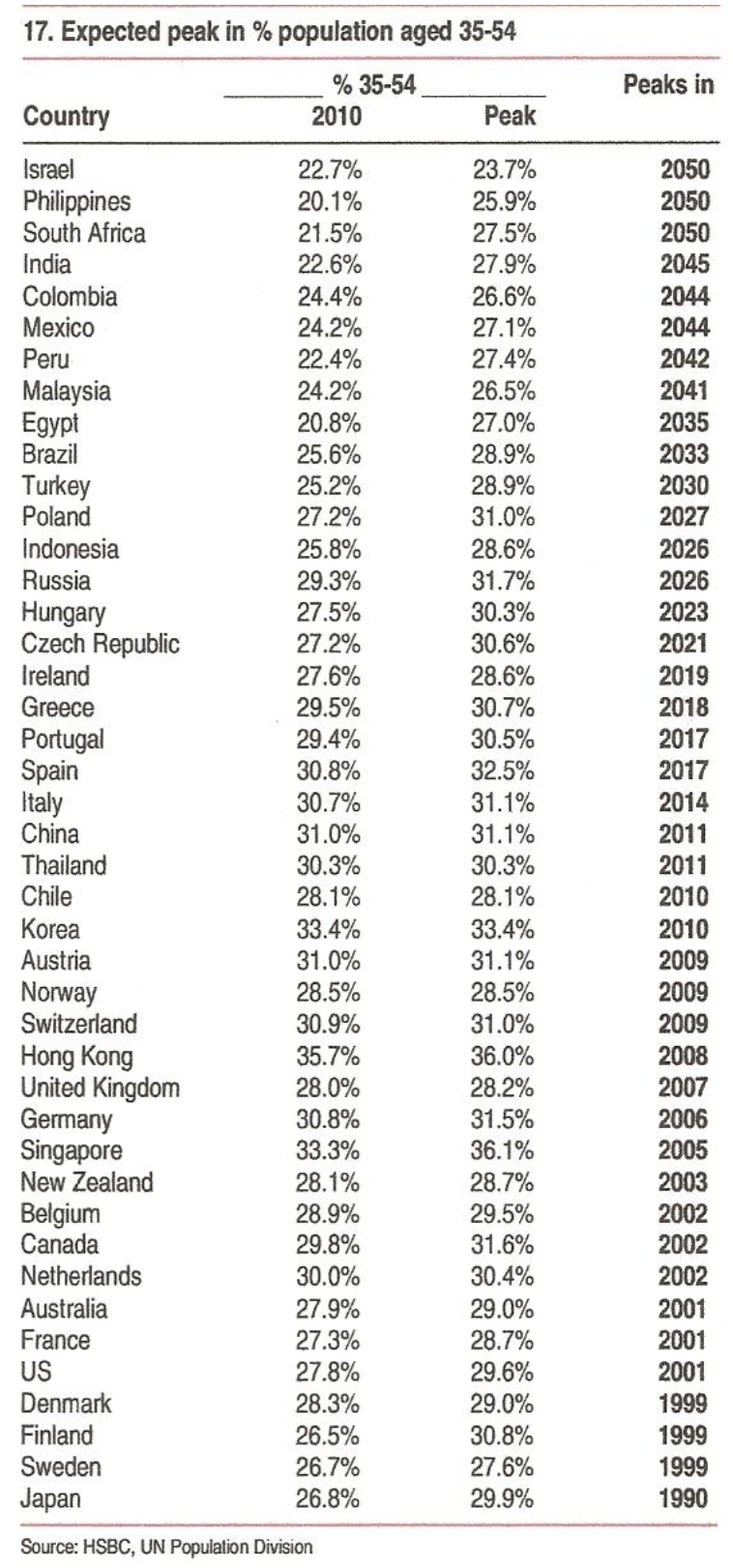
Instead of pouring through gigabytes of government census data to cherry-pick investment opportunities, my friends at HSBC Global Research, strategists Daniel Grosvenor and Gary Evans, have already done the work for you. They have developed a table ranking investable countries based on when the 34-54 age group peaks—a far larger set of parameters that captures generational changes.
The numbers explain a lot of what is going on in the world today. I have reproduced it below. From it, I have drawn the following conclusions:
* The US (SPY) peaked in 2001 when our first “lost decade” began.
*Japan (EWJ) peaked in 1990, heralding 32 years of falling asset prices, giving you a nice backtest.
*Much of developed Europe, including Switzerland (EWL), the UK (EWU), and Germany (EWG), followed in the late 2000s and the current sovereign debt debacle started shortly thereafter.
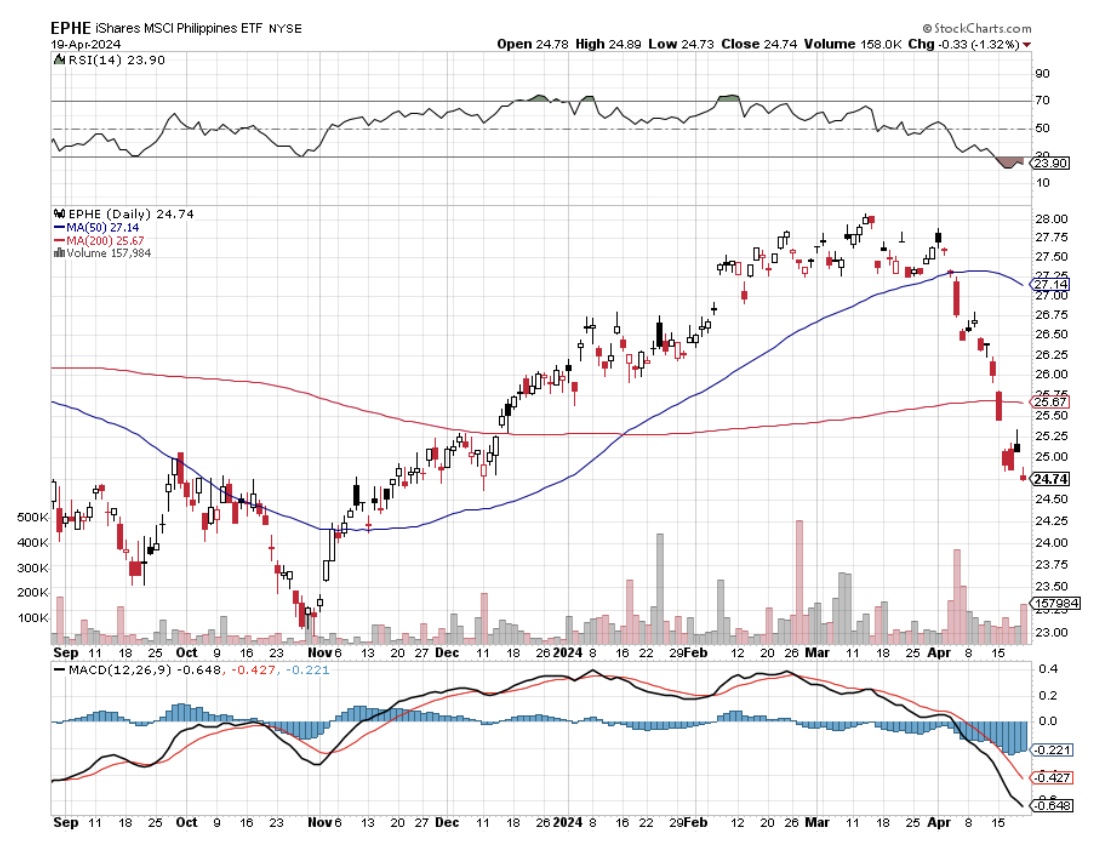
*South Korea (EWY), an important G-20 “emerged” market with the world’s lowest birth rate peaked in 2010.
*China (FXI) topped in 2011, explaining why we have seen three years of dreadful stock market performance despite torrid economic growth. It has been our consumers driving their GDP, not theirs.
*The “PIIGS” countries of Portugal, Ireland (EIRL), Greece (GREK), and Spain (EWP) don’t peak until the end of this decade. That means you could see some ballistic stock market performances if the debt debacle is dealt with in the near future.
*The outlook for other emerging markets, like Indonesia (IDX), Poland (EPOL), Turkey (TUR), Brazil (EWZ), and India (PIN) is quite good, with spending by the middle age not peaking for 15-33 years.
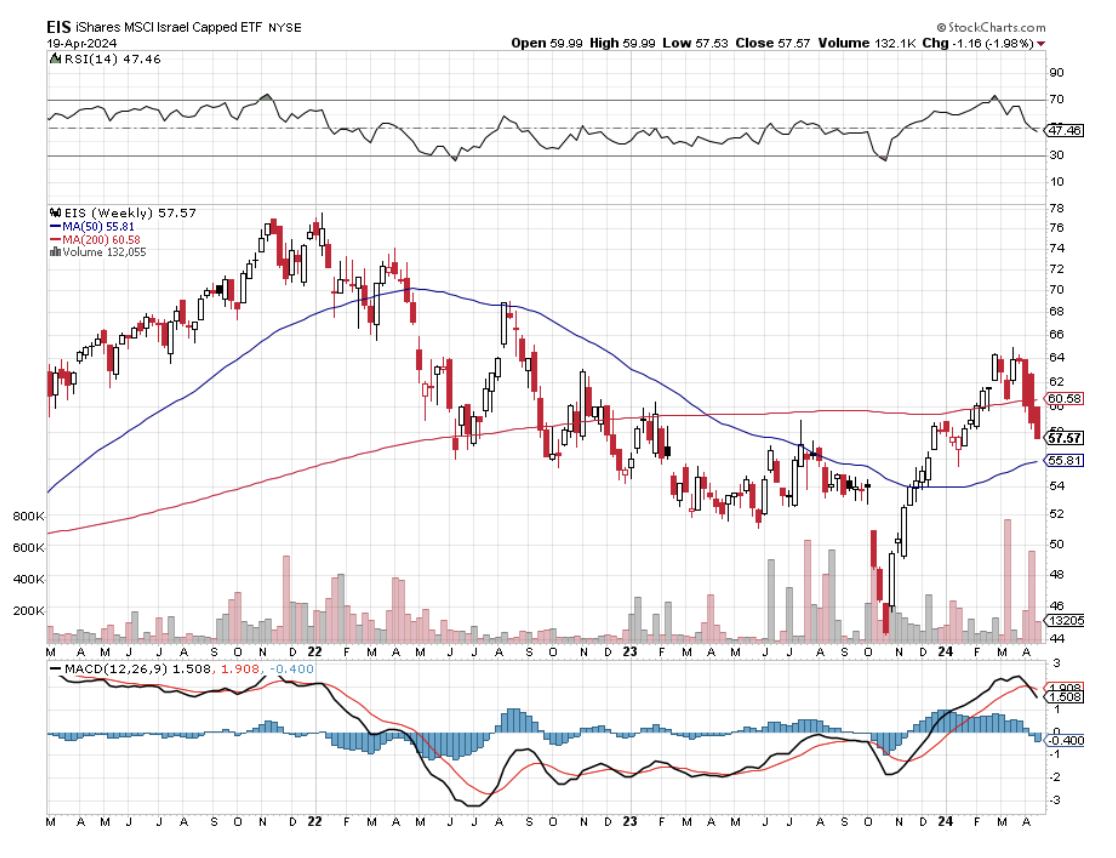
*Which country will have the biggest demographic push for the next 38 years? Israel (EIS), which will not see consumer spending max out until 2050. Better start stocking up on things Israelis buy.
Like all models, this one is not perfect, as its predictions can get derailed by a number of extraneous factors. Rapidly lengthening life spans could redefine “middle age”. Personally, I’m hoping 72 is the new 42.
Emigration could starve some countries of young workers (like Japan) while adding them to others (like Australia). Foreign capital flows in a globalized world can accelerate or slow down demographic trends. The new “RISK ON/RISK OFF” cycle can also have a clouding effect.
So why am I so bullish now? Because demographics is just one tool in the cabinet. Dozens of other economic, social, and political factors drive the financial markets.
What is the most important demographic conclusion right now? That the US demographic headwind veered to a tailwind in 2022, setting the stage for the return of the “Roaring Twenties.” With the (SPY) up 27% since October, it appears the markets heartily agree.
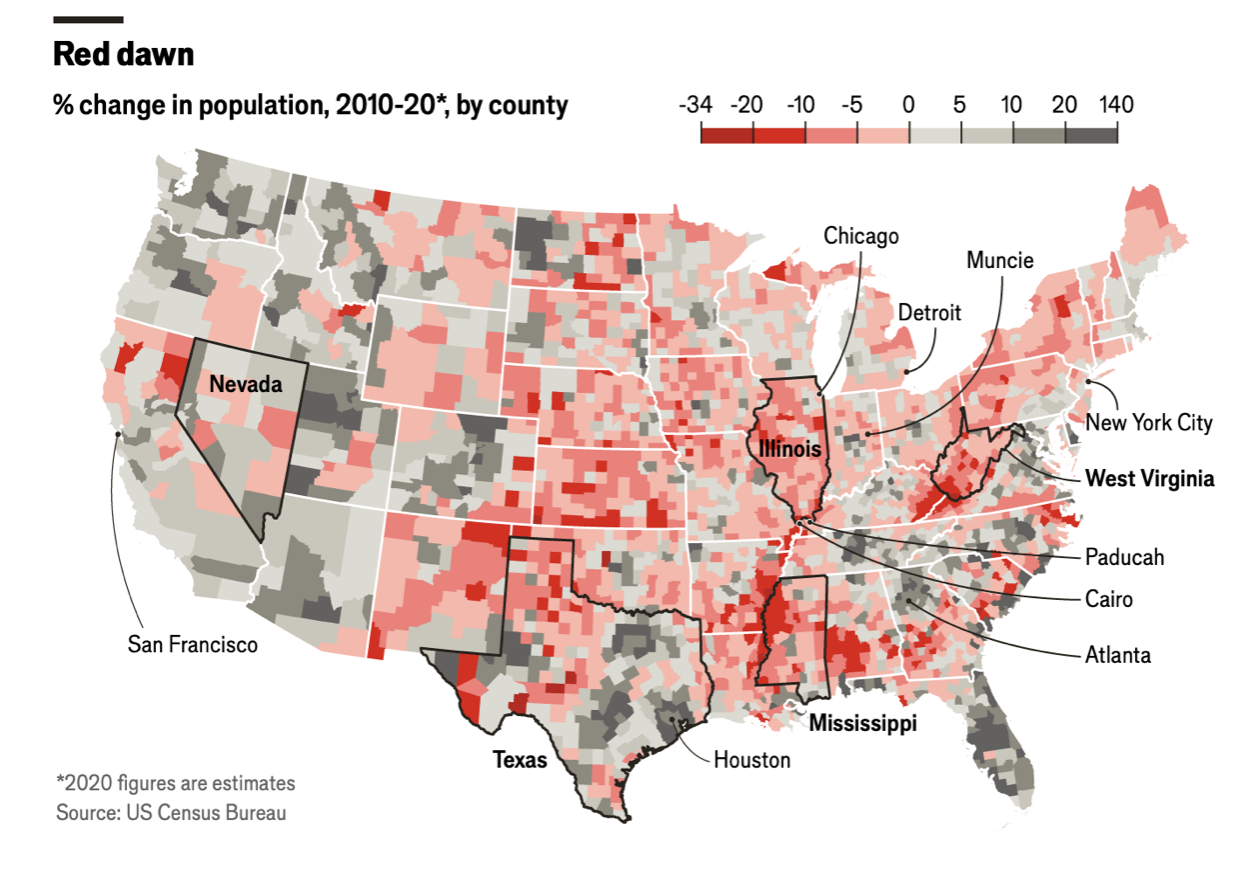
While the growth rate of the American population is dramatically shrinking, the rate of migration is accelerating, with huge economic consequences. The 80-year-old trend of population moving from North to South to save on energy bills picking up speed, the Midwest is getting hollowed out at an astounding rate as its people flee to the coasts, all three of them.
As a result, California, Texas, Florida, Washington, and Oregon are gaining population, while Missouri, Iowa, Nebraska, Kansas, and Wyoming are losing it (see map below). During my lifetime, the population of California has rocketed from 10 million to 40 million. People come in poor and leave as billionaires, as Elon Musk did.
In the meantime, I’m going to be checking out the shares of the matzo manufacturer down the street.


When John identifies a strategic exit point, he will send you an alert with specific trade information as to what security to sell, when to sell it, and at what price. Most often, it will be to TAKE PROFITS, but, on rare occasions, it will be to exercise a STOP LOSS at a predetermined price to adhere to strict risk management discipline. Read more
Mad Hedge Biotech and Healthcare Letter
April 23, 2024
Fiat Lux
Featured Trade:
(A DRUG KINGPIN HIDING IN PLAIN SIGHT)
(ABBV)