
To prove that The Diary of a Mad Hedge Fund Trader only deals with the highest quality, top drawer clientele, I want to share the picture below sent in by a subscriber.


To prove that The Diary of a Mad Hedge Fund Trader only deals with the highest quality, top drawer clientele, I want to share the picture below sent in by a subscriber.

John,
Enjoy your well-deserved vacation and thanks for your guidance.
Thanks for the trade alerts today! I have been trading from the chairlift at Sundance today.
Thanks again for the ongoing education and for teaching me to fish!
Merry Christmas to you and yours!!
Best,
Joe

I have a new training video on how to execute a vertical bear put debit spread. You can watch the full 34:17 video by clicking here.
The last one was made seven years ago.
Since then, we have learned a lot from customer questions. The nature of the options markets has also changed. I recommend watching it on full screen so you can read all the numbers on my options trading platform.
I am normally a pretty positive person.
For me, the glass is always half full, not half empty, and it’s always darkest just before dawn. After all, over the past 100 years, markets rise 80% of the time, and that includes the Great Depression.
However, every now and then, conditions arise where it is prudent to sell short or make a bet that a certain security will fall in price.
This could happen for myriad reasons. The economy could be slowing down. Companies might disappoint in earnings. “Sell in May and go away?" It works….sometimes. Oh, and new pandemic variants can strike at any time.
Other securities have long-term structural challenges, like the US Treasury bond market (TLT). Exploding deficits, as far as the eye can see, assure that government debt of every kind will be a perennial short for years to come.
Once you identify a short candidate, you can be an idiot and just buy put options on the security involved. Chances are that you will overpay and that, accelerated time decay will eat up all your profits even if you are right, and the security in question falls. All you are doing is making some options traders rich at your expense.
For outright put options to work, your stock has to fall IMMEDIATELY, like in a couple of days. If it doesn’t, then the sands of time run against you very quickly. Something like 80% of all options issued expires unexercised.
And then there’s the right way to play the short side, i.e., MY way. You go out and buy a deep-in-the-money vertical bear put debit spread.
This is a matched pair of positions in the options market that will be profitable when the underlying security goes down, sideways, or up small in price over a defined limited period of time. It is called a “debit spread” because you have to pay money to buy the position instead of receiving a cash credit.
It is the perfect position to have on board during bear markets, which we will almost certainly see by late 2019 or 2020. As my friend Louis Pasteur used to say, “Chance favors the prepared.”
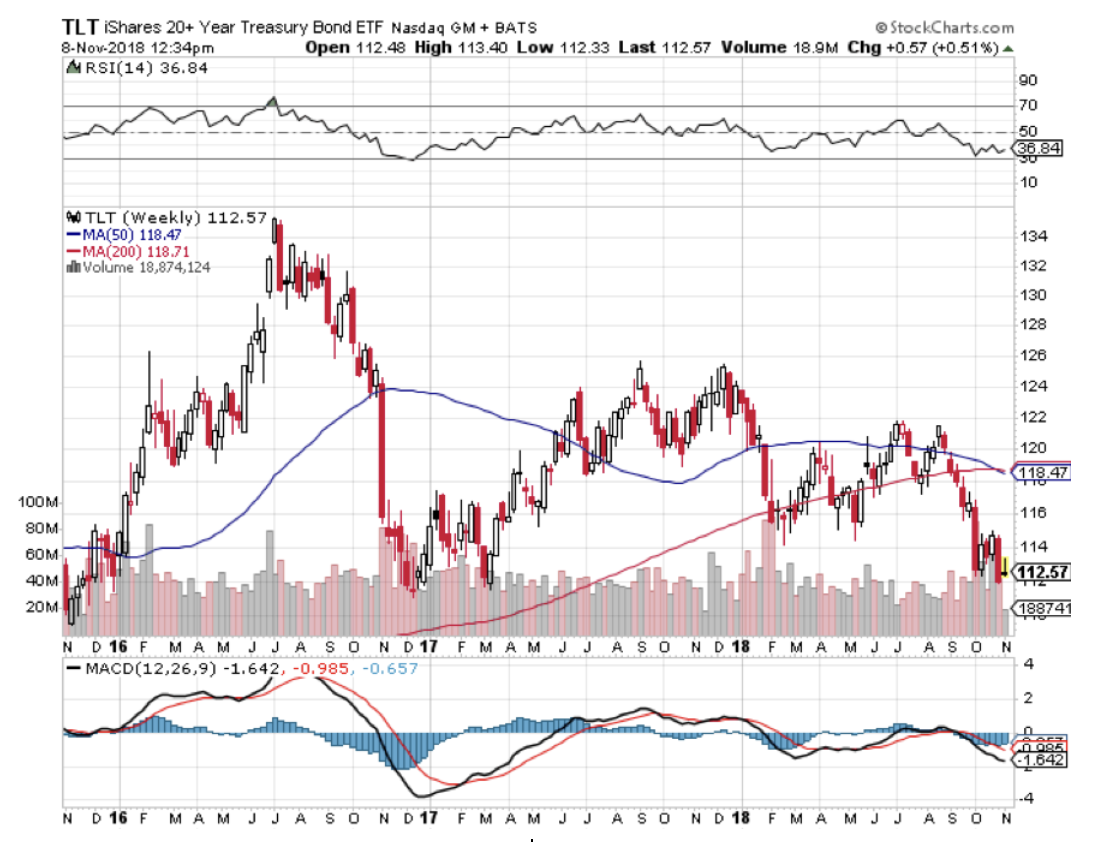
I’ll provide an example of how this works with the United States Treasury Bond Fund (TLT), which we have been selling short nearly twice a month since the bond market peaked in July 2016.
On October 23, 2018, I sent out a Trade Alert that read like this:
Trade Alert - (TLT) - BUY
BUY the iShares Barclays 20+ Year Treasury Bond Fund (TLT) November 2018 $117-$120 in-the-money vertical BEAR PUT spread at $2.60 or best.
At the time, the (TLT) was trading at $114.64. To add the position, you had to execute the following positions:
Buy 37 November 2018 (TLT) $120 puts at…….………$5.70
Sell short 37 November 2018 (TLT) $117 puts at…….$3.10
Net Cost:………………………….………..…………......….....$2.60
Potential Profit: $3.00 - $2.30 = $0.40
(37 X 100 X $0.40) = $1,480 or 15.38% in 18 trading days.
Here’s the screenshot from my personal trading account:
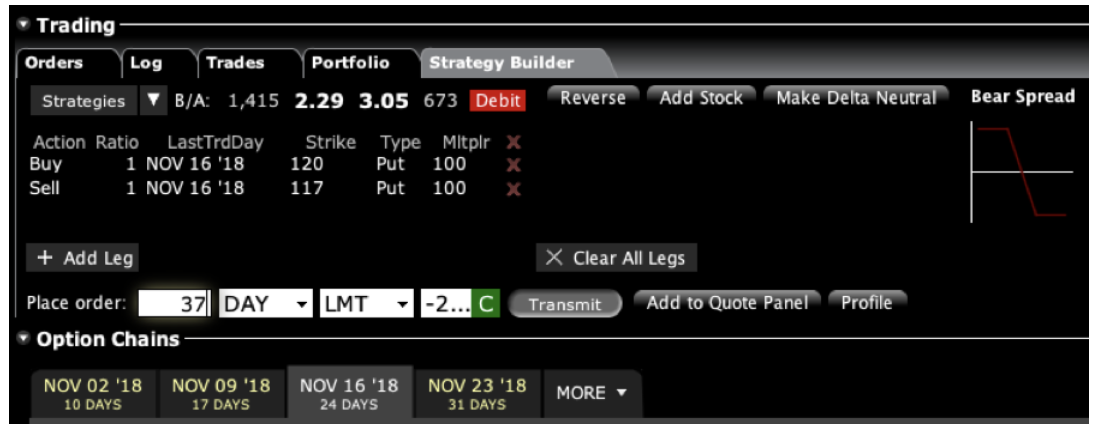
This was a bet that the (TLT) would close at or below $117 by the November 16 options expiration day.
The maximum potential value of this position at expiration can be calculated as follows:
+$120 puts
- $117 puts
+$3.00 profit
This means that if the (TLT) stays below $117 the position you bought for $2.60 will become worth $3.00 by November 16.
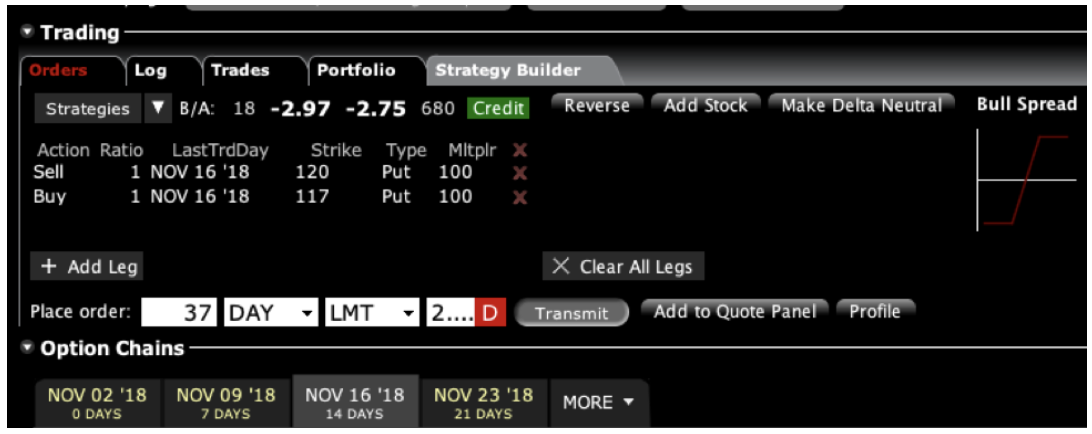
As it turned out, that was a prescient call. By November 2, or only eight trading days later, the (TLT) had plunged to $112.28. The value of the iShares Barclays 20+ Year Treasury Bond Fund (TLT) November 2018 $117-$120 in-the-money vertical BEAR PUT spread had risen from $2.60 to $2.97.
With 92.5% of the maximum potential profit in hand (37 cents divided by 40 cents), the risk/reward was no longer favorable to carry the position for the remaining ten trading days just to make the last three cents.
I, therefore, sent out another Trade Alert that said the following:
Trade Alert - (TLT) – TAKE PROFITS
SELL the iShares Barclays 20+ Year Treasury Bond Fund (TLT)November 2018 $117-$120 in-the-money vertical BEAR PUT spread at $2.97 or best
In order to get out of this position, you had to execute the following trades:
Sell 37 November 2018 (TLT) $120 puts at……………........…$7.80
Buy to cover short 37 November 2018 (TLT) $117 puts at….$4.83
Net Proceeds:………………………….………..………….…..............$2.97
Profit: $2.97 - $2.60 = $0.37
(37 X 100 X $0.37) = $1,369 or 14.23% in 8 trading days.
Of course, the key to making money in vertical bear put spreads is market timing. To get the best and most rapid results, you need to buy these at market tops.
If you’re useless at identifying market tops, don’t worry. That’s my job. I’m right about 90% of the time and I send out a STOP LOSS Trade Alert very quickly when I’m wrong.
With a recession and bear market just ahead of us, understanding the utility of the vertical bear put debit spread is essential. You’ll be the only guy making money in a falling market. The downside is that your friends will expect you to pick up every dinner check.
But only if they know.

Understanding Bear Put Spreads is Crucial in Falling Markets

(IBM), (TRI), (PLTR), (VERI)
In a world where legal dramas often unfold with more twists than a Hollywood thriller, Chief Justice John Roberts Jr. has veered off the beaten path, turning the spotlight on a new protagonist in the courtroom drama: artificial intelligence (AI).
Cutting through Supreme Court melodramas and the 2024 presidential election buzz, Roberts' year-end report spotlights AI as a legal game-changer. It’s not just legalese; it's an investor's guide to the next tech boom.
Imagine AI and legal research going together like peanut butter and jelly, offering everyone from hotshot lawyers to the average Joe unprecedented access to the world of legal mambo jumbo.
But Roberts isn’t just selling a tech utopiaIn fact; he’s quick to flag up the potential issus - think privacy nightmares and a justice system that feels about as personal as a robocall.
Yet, for all the potential AI missteps, like leading lawyers on a wild goose chase with phantom legal cases, Roberts still bets big on the human factor. He’s convinced that when it comes to the really tricky, gray-area stuff, it's going to take more than a machine's cold logic to cut the mustard.
Now, let’s delve into how this technology could revolutionize the legal industry from an investor's perspective. After all, it feels like Roberts’ musings are like a treasure map to a gold mine in the burgeoning legal AI market.
With the global legal services market valued at $950 billion, largely dependent on manual analysis of communications, the potential for AI-driven transformation is massive.
Take a look at IBM (IBM) and Thomson Reuters (TRI), strutting their stuff with AI platforms like IBM’s Watson. These behemoths are not just tweaking the game; they’re the MVPs turning legal research into child's play for the masses.
IBM’s Watson, since 2011, harnesses AI and natural language processing, slashing the time for legal research, sharpening contract analysis, and even predicting case outcomes with a staggering 80% accuracy.
Embedded in law firms and legal departments, Watson has turned the tide in tasks like document review, morphing the once herculean effort into a streamlined process.
This shift in legal services doesn't only save time, but democratizes legal prowess, opening the gates for a wider pool of legal eagles. It's a disruptive force in a traditionally conservative industry, presenting a unique opportunity for forward-thinking investors.
Meanwhile, Thomson Reuters also flexes its AI muscle.
A recent Thomson Reuters Institute survey spotlights a shift in legal minds: 82% of surveyed lawyers see generative AI like ChatGPT fitting snugly into legal work, with 51% championing its deployment.
Surprisingly, only a scant 3% of law firms have actually taken the plunge and started using this AI tech.
Given the growing interest in the technology, it feels like the legal profession’s standing on the edge of a diving board, ready to jump into the pool of an AI revolution.
This mixed bag of eagerness and hesitation, especially when it comes to the nitty-gritty of accuracy and client privacy, paints a picture of cautious optimism in the legal world.
And let me tell you, this is where the savvy investor should perk up their ears. It's a golden ticket of an opportunity in a market that's not just simmering – it's about to boil over.
On top of these, there are companies like Veritone Inc. (VERI) and Nuance Communications, taking the courtroom tech story to the next level with AI-powered transcription and speech recognition.
The legal transcription service sector, which converts recorded legal proceedings into text, represents 30% of all business transcription and is projected to be worth over $3 billion by 2029. This is not just a statistic; it’s a signal to investors about where the industry is heading.
And let’s not forget the dark horse, Palantir Technologies (PLTR). With its eye on the privacy ball, it’s addressing one of Roberts' big red flags head-on.
Putting your bets on Palantir is like backing the player who knows the value of a strong defense, especially when it comes to guarding personal data. This focus on privacy makes Palantir a compelling choice for investors who understand the critical importance of data security in today’s digital landscape.
But that’s not all. The legal AI scene is teeming with sprightly startups and smaller firms, cooking up everything from AI-driven legal crystal balls to high-tech contract analysis. Sure, they might be the wild cards of the investment world, but they’re also where you might find the next big jackpot.
With the global legal services market tipping the scales at $950 billion, largely dependent on manual analysis of communications, AI stands poised to revamp nearly half (44%) of legal tasks in the US and Europe.
This spells out a clear message to investors: the legal tech market is booming, with huge potential for AI integration.
So, there you have it. Roberts’ report is more than just legal eagle talk; it’s a clarion call to investors.
From the tech titans to the plucky upstarts, the legal AI landscape is a buffet of opportunities, each serving up a different flavor of AI’s role in the law. It’s an open invitation to join the fray, balancing the hunger for profits with a dash of ethics and a sprinkle of societal good.
Roberts, known for his “umpires call balls and strikes” analogy, throws us a curveball with a tennis reference this time. Just like tech replaced line judges in tennis, AI is set to revolutionize the legal game. But, he insists, when it comes to the nitty-gritty of legal judgment, nothing beats the good old-fashioned human touch.
For investors and legal buffs, Roberts’ insights are a ticket to understanding AI's role in law. It's a journey through a landscape where technology meets human judgment, a fertile ground for investment in a rapidly changing market.

Mad Hedge Technology Letter
January 5, 2024
Fiat Lux
Featured Trade:
(SILICON VALLEY AND THE US ECONOMY HEATS UP)
($COMPQ)

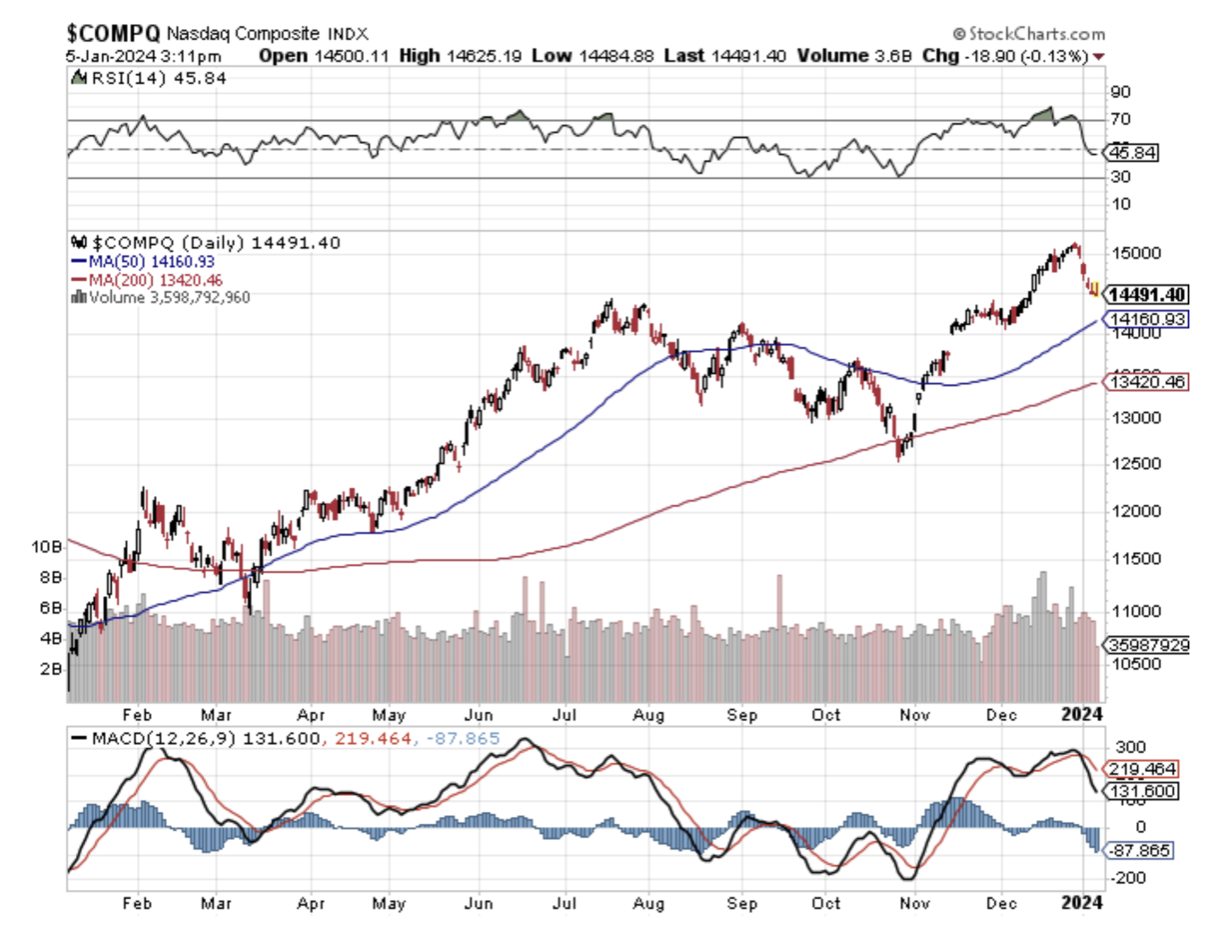
In December, the US economy and the American tech sector ($COMPQ) showed who is boss in the world economy by blasting past employment expectations.
This comes at a time when every professional economist is calling for a gloomy outcome in the short term.
From the tech side of the equation, remote jobs are rebounding at a blistering pace.
Full-time workers plunged by 1.5 million in just one month to the lowest since February 2023.
Part-time workers made gains of 762,000 the highest on record.
Multiple jobholders hit a time-high 8.56 million.
What does this tell us?
Work from home can do more than one job and those are mainly tech jobs. A lot of the time they are IT and software engineering jobs as well.
The other group this could have affected is the group affected by Bidenflation which has crippled the budget of many low-income workers living in the US and this cohort needs two low-paid jobs.
The reality is that these multiple job holders are a mix of each group.
It’s now highly common for remote workers to work 3 or 4 jobs at once because these workers don’t need to be physically present in any office.
They can simply clock in and clock out when they choose to and this has been a boon for tech companies who have taken advantage of this trend and fired many full-time workers who became too pricey.
For the past year, Silicon Valley has taken a machete and chopped off the fat from its business model.
Their leanness was a massive reason for the overperformance of tech stocks last year and even though that same boost won’t happen to the same extent in 2024, it has given the blueprint to management on how to run a tech company.
The largest economy in the world saw the addition of 216,000 new jobs in December 2023, surpassing projections of a decline from the previous month, as per data from the Labour Department.
The joblessness rate remained steady at 3.7 percent, a figure that is notably low historically and counters predictions of a slight increase.
These impressive job market statistics arise amidst the context of rising interest rates. The Federal Reserve has aggressively raised and maintained high rates for the benchmark lending rate to moderate demand and control inflation.
In terms of wages, December witnessed a consistent rise, with a 0.4 percent increase from November 2023, according to the Labor Department. Year-over-year, average hourly earnings went up by 4.1 percent.
Tech jobs are evolving into a different type of existence with agility becoming more important and that is highly positive for tech companies.
Silicon Valley was at the forefront of the firing spree last year, but job numbers were more than compensated by the additions in government, health care, and services.
The strength of the US economy means that it’s painfully obvious that traders are still too early betting that the Fed will drop rates by 1.5% by the end of 2024.
My belief is that we will end up with a drop of .5%-.75% of Fed Funds rate cuts which means we have a little ways to go to reverse from this overshoot.
This idea that the economy is stronger than people think is verified by rising wages and lower unemployment.
I do believe that high inflation and high rates are here to stay and the 0% rate of yore was just a weird anomaly that defied historic data.
Delaying the “recession” yet another year means once we absorb this pullback, tech stocks will be off to the races again.

(TECHNOLOGY SECTOR SET FOR MORE GROWTH IN 2024)
January 5, 2024
Hello everyone,
Happy New Year!
We are all on the lookout for where to put our money in 2024. Will it be technology or another sector or perhaps a variety of sectors that provide good value?
I believe technology will be a growth area in 2024 and beyond. Artificial intelligence will be the catalyst that propels stocks on an upward trajectory for many years to come. There is a tailwind here too, as investors are betting on easing financial policy, including several cuts from the Federal Reserve in 2024. (Are they locked in as a definite? – not yet). In late 2023 the market read the writing on the wall regarding future Fed policy found its legs and brought great profits to many who were disciplined and patient.
So, let’s look at the stocks to start scaling into this year.
Your toolbox should have some of the following:
Google (GOOGL)
Microsoft (MSFT)
Nvidia (NVDA)
Oracle (ORCL)
Amazon (AMZN)
Arista Networks (ANET)
Meta Platforms (META)
Advanced Micro Devices (AMD)
Super Micro Computer (SMCI)
Dell (DELL)
Broadcom (AVGO)
Micron Technology (MU)
Palo Alto Networks (PANW)
Salesforce (CRM)
The technology sector may not mirror the performance of 2023, but many portfolio managers are optimistic about another rosy year for the sector as rates fall, sentiment improves, AI matures and investors hunt for growth. AI may be where all the action is.
Stock giants are funneling money into new businesses and initiatives within the AI sector. Alphabet has rolled out Gemini and Microsoft has launched the Co-pilot tool, which adds AI capabilities to its Office 365 suite. The data networking infrastructure provider, Arista Networks, - one of my recommendations last year - gained 94% in 2023. Average into this stock.
It’s worth remembering that the 2024 election cycle could prove another major boon for mega caps Meta Platforms, Alphabet, and Amazon as candidates and companies increase advertising spending to capture voters.
Consensus targets for the big names imply more upside in 2024. For example, Analysts believe Meta could rally 8% after almost tripling in 2023. Additionally, analysts see Microsoft rallying 11% and Amazon 18% this year after huge moves in 2023.
Do you think Nvidia has run too hard? Don’t ignore it. There is still gas in the tank for this stock. Wall Street targets imply another 35% upside for this stock. The chipmaker is trading at about 25 times earnings over the next 12 months versus about 34 times at the end of December 2022.
Don’t ignore other opportunities out there. Advanced Micro Devices (AMD) and Super Micro Computer (SMCI) rallied 128% and 246%, respectively, in 2023. Dell (DELL) and Hewlett Packard Enterprises (HPE), like the aforementioned, are stocks to scale into this year.
Security will never go out of fashion as there will always be cybercriminals launching cyberattacks on companies. Optus in Australia was just one of the companies that fell victim to a cyber-attack in 2023. MGM Resorts was another that got hit. These crimes will become more sophisticated as AI develops. While it’s a major pain in the neck for companies and consumers, it could prove a major positive for cloud and cybersecurity companies offering tools to repel these attacks.
This puts Palo Alto Networks (PANW) in prime position. Crowdstrike (CRWD) is also another stock that should be in your kit in this area.
AI has become a growth engine for Salesforce (CRM). We are at the beginning of decades of innovation in software. The sector is well positioned in 2024. Improving IT budgets and a general recovery in spending should assist the software space as companies will need to set aside funds to spend on infrastructure to prepare data for harvesting in the AI world.


Our Road Trip
My son, Alex, and I have been on a road trip for the last week. We are driving up the Queensland coast to Mackay. We drove from Brisbane up to Bororen (about a four-hour drive), which is just west of Maryborough, and stayed the night there in a beautiful homestead. On the way, we drove through some very heavy downpours, but after the rain cleared, we enjoyed some very picturesque scenery.



A stunning rainbow to signal the end of the rainstorm.

The rain cleared but the clouds still hugged the mountain tops.

A lone cockatoo atop a dead tree after the downpour.

On the coast at the township of 1770.

The lookout in 1770.

Behind our homestead in Bororen – one hour west of 1770.

Koumala Hotel – 50 minutes south of Mackay in central Queensland.

Cheers,
Jacquie

Global Market Comments
January 5, 2024
Fiat Lux
Featured Trade:
(USING THE “WASH SALE RULE” TO MINIMIZE TAXES ON YOUR OPTIONS TRADING PROFITS)



Come join me for lunch for Jacquie Munro’s Global Strategy Update, which she will be conducting in Melbourne, Australia at 12:00 PM on Wednesday, January 10, 2024. A three-course lunch is included.
She’ll be giving you her up-to-date view on stocks, bonds, currencies commodities, precious metals, and real estate.
And to keep you in suspense, she’ll be throwing a few surprises out there too. Enough charts, tables, graphs, and statistics will be thrown at you to keep your ears ringing for a week. Tickets are available for $198.
She’ll be arriving early and leaving late in case anyone wants to have a one-on-one discussion, or just sit around and chew the fat about the financial markets.
The lunch will be held at an exclusive restaurant in central Melbourne, the details of which will be emailed to you.
Jacquie looks forward to meeting you, and thank you for supporting her research.
To purchase tickets for this luncheon, please click here.


With a lot of new subscribers recently coming on board, it’s time to review the “Wash Sale Rule” one more time.
Options deserve special tax treatment, at least for now, and it’s important that you understand these benefits to take maximum advantage of the specific trading strategies that I propose.
Due to the immense volume of profitable trades in the Mad Hedge Fund Trader Alert Service, I am getting a lot of questions about the dreaded “Wash Sale Rule”.
The wash what?
The problem arises because the Internal Revenue Service believes that taxpayers are on a never-ending quest to avoid paying taxes.
In that belief, the despised government agency is largely right.
So what is the wash sale rule?
Let’s say you purchase 100 shares of XYZ Corp. for $25 per share on February 10. Nine days later, on February 19, XYZ drops to $22 per share and you sell your 100 shares.
You now have a capital loss of $3 per share, or $300, which may be tax-deductible.
However, if, on February 26, you then bought the same security for $22.50 per share, this would be considered a “Wash Sale” because you sold and repurchased shares of the same stock within only a few days.
Without the wash sale rule, the result would be that you could possibly have a tax deduction for your loss, but you would still own the shares, which is why it's called an “artificial loss” by the IRS, and therefore not deductible as a capital loss.
Don’t try hiding your maneuvers by executing one leg of the trade in your personal account, and the second in your wife’s account or your IRA. Both actions still trigger the Wash Sale Rule.
The rule applies whether you are trading stocks, exchange-traded funds, mutual funds, or options on any of the above. In fact, wash sales are quite likely if you have arranged for automatic reinvestment of your dividends back into your mutual funds.
The only requirement is that the two securities be substantially similar in nature, the precise definition of which the IRS has left intentionally and maddeningly vague.
The Wash Sale Rule becomes an issue with the vertical bull call and bear put option spreads the Mad Hedge Fund Trader has been recommending.
Usually, you are long one option and short another in the same company and both legs generate a profit on closing. No problem there. You just pay more in taxes and hope the government doesn’t blow it on some useless program.
But during periods of extreme volatility, such as August and September 2023, it is possible to have a large gain on one leg, and a substantial loss on the other, but to have a profit overall on the combined paired spread.
Enter the Wash Sale Rule.
Since you had gains and losses in nearly identical securities within 30 days, the IRS will hit you with a short-term gain on the profit, but not let you deduct the loss.
Yes, I know this sounds like a rip-off, or a “heads I win, tails you lose” scam perpetrated by a devious IRS.
But it is not the end of the world. NO, I have not designed the most tax-inefficient securities trading strategy imaginable.
While you can’t deduct the loss on the losing leg, you CAN use it to increase the cost basis on your winning leg, thus reducing your overall tax bill.
Also, the holding period of the wash sale securities is added to the holding period of the replacement securities.
Do this enough times, and you will eventually make it to the safety and the lower 20% tax rate for long-term capital gains.
In this manner, the Wash Sale Rule then becomes a convenient tax avoidance scheme, although it was certainly never intended as such.
So the losses ARE deductible at the end of the day. You just have to get your accountant to undergo some mental gymnastics and file the appropriate IRS Form 8949 to claim them indirectly.
He’ll charge you for the extra time. But at the end of the day, it is worth it.
As I am an “active trader” to say the least, in my case, these filings go on for dozens of pages. As a result, my annual tax return looks like the old New York City telephone book.
Actually, I’m told it’s the same length as the corporate return filed by IBM.
Now here are some warnings and provisos for the average taxpayer.
If you use your friendly neighborhood tax preparer, one of the discount firms like H&R Block or Jackson Hewitt, or your fraternity brother from college using TurboTax to file your annual return, they may not know how to handle Wash Sales correctly.
You could well get stuck with the full loss because of their ignorance.
So if you are an active trader yourself, or are dealing in large dollar amounts, I would recommend hiring an accountant who specializes in securities trading.
They will have all of the detailed knowledge readily at hand of the many obscure, arcane tax laws regarding securities trading, know of the recent relevant opinion letters issued by the IRS, and will be well aware of court cases regarding these issues.
Experts such as these can be found in abundance in New York and Chicago. They are easy to find on the Internet.
Go to it.
Having spent 55 years dealing with tax matters, and devoting 10 years to writing a weekly international tax column for the London Financial Times, I can tell you this is not a new problem.
Ignorance of tax problems outside of the plain vanilla questions is rife, even among accountants (yes, Sunday church deductions are tax deductible. Just make them by check so you leave an auditable paper trail).
There is no living person who knows what’s in the entire 100,000 pages of the International Revenue Code, not even the IRS itself.
That’s a scary thought.
During the 1980s, the IRS sent an agent to England every year just to audit me because I was one of the ten highest-earning Americans in the country.
For the last one, they sent a frumpy, bespectacled female agent who had just spent a month auditing roustabouts on drilling platforms offshore from Louisiana, a notorious source of tax avoidance.
She didn’t have a clue about how to interpret my multicurrency convertible home mortgage on my London mansion, so we spent the afternoon at the American embassy planning her entire European vacation to follow.
I think I heard the CIA was torturing someone in the next room.
Similarly, when I went into the oil and gas business in the 1990s, no California accountant could explain the tax benefits there.
I had to go to Houston to learn that, and what I discovered was a real eye-opener.
Why isn’t everyone in the oil and gas business?
To learn about my last run-in with the IRS, read “The Letter From the IRS You Should Dread” by clicking here.
For more background on the IRS, please click here for “Happy Birthday IRS”.
To get the official explanation of the Wash Sale Rule in the IRS’s own turgid, soporific bureaucratese, please click here for IRS Publication 550, “Investment Income and Expenses (Including Capital Gains and Losses)” by clicking here.

Watch Out for the “Wash Sale Rule”